

What do you think?

Future Wars #2
2054
From the acclaimed authors of the runaway New York Times bestseller 2034 comes another explosive work of speculative fiction set twenty years further in the future, at a moment when a radical leap forward in artificial intelligence combines with America’s violent partisan divide to create an existential threat to the country, and the world
It is twenty years after the catastrophic war between the United States and China that brought down the old American political order. A new party has emerged in the US, one that’s held power for over a decade. Efforts to cement its grip have resulted in mounting violent resistance. The American president has control of the media, but he is beginning to lose control of the streets. Many fear he’ll stop at nothing to remain in the White House. Suddenly, he collapses in the middle of an address to the nation. After an initial flurry of misinformation, the administration reluctantly announces his death. A cover-up ensues, conspiracy theories abound, and the country descends into a new type of civil war.
A handful of elite actors from the worlds of computer science, intelligence, and business have a fairly good idea what happened. All signs point to a profound breakthrough in AI, of which the remote assassination of an American president is hardly the most game-changing ramification. The trail leads to an outpost in the Amazon rainforest, the last known whereabouts of the tech visionary who predicted this breakthrough. As some of the world’s great powers, old and new, state and nonstate alike, struggle to outmaneuver one another in this new Great Game of scientific discovery, the outcome becomes entangled with the fate of American democracy.
Combining a deep understanding of AI, biotech, and the possibility of a coming Singularity, along with their signature geopolitical sophistication, Elliot Ackerman and Admiral James Stavridis have once again written a visionary work. 2054 is a novel that reads like a thriller even as it demands that we consider the trajectory of our society and its potentially calamitous destination.
It is twenty years after the catastrophic war between the United States and China that brought down the old American political order. A new party has emerged in the US, one that’s held power for over a decade. Efforts to cement its grip have resulted in mounting violent resistance. The American president has control of the media, but he is beginning to lose control of the streets. Many fear he’ll stop at nothing to remain in the White House. Suddenly, he collapses in the middle of an address to the nation. After an initial flurry of misinformation, the administration reluctantly announces his death. A cover-up ensues, conspiracy theories abound, and the country descends into a new type of civil war.
A handful of elite actors from the worlds of computer science, intelligence, and business have a fairly good idea what happened. All signs point to a profound breakthrough in AI, of which the remote assassination of an American president is hardly the most game-changing ramification. The trail leads to an outpost in the Amazon rainforest, the last known whereabouts of the tech visionary who predicted this breakthrough. As some of the world’s great powers, old and new, state and nonstate alike, struggle to outmaneuver one another in this new Great Game of scientific discovery, the outcome becomes entangled with the fate of American democracy.
Combining a deep understanding of AI, biotech, and the possibility of a coming Singularity, along with their signature geopolitical sophistication, Elliot Ackerman and Admiral James Stavridis have once again written a visionary work. 2054 is a novel that reads like a thriller even as it demands that we consider the trajectory of our society and its potentially calamitous destination.
304 pages, Paperback
First published March 12, 2024
About the author
Elliot Ackerman
18 books788 followersELLIOT ACKERMAN is the New York Times bestselling author of the novels Halcyon, 2034, Red Dress In Black and White, Waiting for Eden, Dark at the Crossing, and Green on Blue, as well as the memoir The Fifth Act: America’s End in Afghanistan, and Places and Names: On War, Revolution and Returning. His books have been nominated for the National Book Award, the Andrew Carnegie Medal in both fiction and nonfiction, and the Dayton Literary Peace Prize among others. He is a contributing writer at The Atlantic and Marine veteran who served five tours of duty in Iraq and Afghanistan, where he received the Silver Star, the Bronze Star for Valor, and the Purple Heart. He divides his time between New York City and Washington, D.C.
Ratings & Reviews
Friends & Following
Create a free account to discover what your friends think of this book!
Community Reviews
Displaying 1 - 30 of 357 reviews

March 15, 2024
Over time, I've developed the habit of setting aside books that fail to captivate me rather than persisting in futile attempts to finish them. However, my anticipation for this particular book surged after devouring "2034", driving me to persist despite my initial reservations. Regrettably, in hindsight, I should have exercised restraint. While I acknowledge the acclaim it has garnered from others, and I empathize with the arduous task of crafting a compelling narrative, courtesy of insights from a close friend who happens to be a published author, I cannot mask my profound disappointment with this novel. Honesty compels me to express my true sentiments about its shortcomings.
April 18, 2024
A couple of years ago, Admiral James Stavridis, a retired naval officer who served as Supreme Allied Commander of NATO and commander of U.S. Southern Command, and Elliot Ackerman, a longtime author and journalist, released 2034: A Novel of the Next World War. As a work of fiction, it wasn't much, but a book co-authored with someone like Admiral Stavridis' credentials depicting how a conflict with China could escalate into a global war and how such a war would be fought made it worth reading. Through the cover of fiction, the authors highlighted China's significant advancements in military technology and challenged the notion of the U.S. military as an unbeatable force. I recommended the book then, and I continue to recommend it now. However, you can skip the sequel.
2054 picks up on the same story twenty years into the future. Sarah Hunt, the Navy captain who served as the main character in the first book, is now dead from an apparent suicide, and Julia Hunt, her stepdaughter and a Marine major, takes her place as the book's protagonist and moral compass. Whereas 2034 was a work of speculative fiction dealing with realistic military technology, 2054 takes a hard turn toward science fiction, delving into a quintessential sci-fi theme: the singularity. The book borrows heavily from the work of the scientist and non-fiction author Ray Kurzweil and makes him a central character in the story. No longer grounded in Admiral Stavridis' insight into the near-term dangers of an emerging Chinese superpower, the book is forced to stand on its own as a work of pure literature, leaving the heavy lifting to Mr. Ackerman. I'm unfamiliar with Mr. Ackerman's other works, and perhaps he's out of his element here, but this is a bad book.
There’s probably no greater literary challenge than creating a world thirty years in the future on the same planet we all currently inhabit, explaining why so much science fiction is set in places far away and the distant future. The authors can’t decide how the world will look and function thirty years from now, mixing references to sub-orbital plane flights and telecommunications conducted through holographic images projected by embedded computer technology with references to laptop computers and landlines. We also discover that people in 2054 are curiously preoccupied with the 2020 coronavirus pandemic, placing more emphasis on it than most people today. And one of the main storylines centers on a power struggle between the major political parties that results in an insurrection in the U.S. Capitol building, which sounds like some alternative version of the January 6, 2021 riots and suggests the authors did little more than extrapolate yesterday’s headlines thirty-three years into the future.
Unfortunately, there's no redemption in the book's plot, character development, or dialogue. The authors tell the story as a futuristic political thriller with predictable characters doing predictable things while dealing with issues that, despite their earth-shattering significance, barely managed to hold this reader's attention. In one scene, a character who feels betrayed by her lover responds to his arrival in her holding cell by slapping his face. In another, a character greets a visitor with the line, "To what do I owe the pleasure of this visit?" Maybe I don't run in the right circles, but I've never known real people who behave or speak this way, and I suspect such behavior and speech are even less likely thirty years from now.
The biggest disappointment here is what could have been. Instead of expanding the previous story by creating storylines in the more challenging-to-predict mid-21st century, the authors could have focused on the near future and addressed issues and concerns more relevant to our time.
Admiral Stavridis's recent Wall Street Journal essay, "Drone Swarms Are About to Change the Balance of Military Power," provides an excellent starting point for such a book. The article describes how low-cost, AI-empowered drone swarms could undermine the supremacy of the American military. While this technology does not yet exist, it is on the horizon and could allow nations like North Korea and Iran to dramatically increase their military capabilities at a fraction of the cost of traditional weapons. I want to read a book, either fiction or nonfiction, examining the potential of this threat, and, based on the insight he provided in the WSJ essay, Admiral Stavridis seems a good candidate to write it.
Perhaps the singularity, the merger of biology and technology, is a more imminent threat than I realize. Maybe we’re on the verge of a world where remote gene editing and other such tools will allow our enemies to kill or control our citizens and soldiers at will. Maybe, but I doubt it. For now, it is the realm of science fiction, and if I want to read about it, I’d rather leave it to those better skilled at telling those tales.
We should appreciate talented people like Admiral Stavridis, who dedicate a significant portion of their lives and careers to serving our nation, and we should listen when they share lessons learned from their military experiences. Rather than trying to compete with skilled science fiction writers, Admiral Stavridis should continue to address the dangers posed by evolving military technologies and emerging superpowers like China, as he did in his first book and the recent Wall Street Journal essay.
2054 picks up on the same story twenty years into the future. Sarah Hunt, the Navy captain who served as the main character in the first book, is now dead from an apparent suicide, and Julia Hunt, her stepdaughter and a Marine major, takes her place as the book's protagonist and moral compass. Whereas 2034 was a work of speculative fiction dealing with realistic military technology, 2054 takes a hard turn toward science fiction, delving into a quintessential sci-fi theme: the singularity. The book borrows heavily from the work of the scientist and non-fiction author Ray Kurzweil and makes him a central character in the story. No longer grounded in Admiral Stavridis' insight into the near-term dangers of an emerging Chinese superpower, the book is forced to stand on its own as a work of pure literature, leaving the heavy lifting to Mr. Ackerman. I'm unfamiliar with Mr. Ackerman's other works, and perhaps he's out of his element here, but this is a bad book.
There’s probably no greater literary challenge than creating a world thirty years in the future on the same planet we all currently inhabit, explaining why so much science fiction is set in places far away and the distant future. The authors can’t decide how the world will look and function thirty years from now, mixing references to sub-orbital plane flights and telecommunications conducted through holographic images projected by embedded computer technology with references to laptop computers and landlines. We also discover that people in 2054 are curiously preoccupied with the 2020 coronavirus pandemic, placing more emphasis on it than most people today. And one of the main storylines centers on a power struggle between the major political parties that results in an insurrection in the U.S. Capitol building, which sounds like some alternative version of the January 6, 2021 riots and suggests the authors did little more than extrapolate yesterday’s headlines thirty-three years into the future.
Unfortunately, there's no redemption in the book's plot, character development, or dialogue. The authors tell the story as a futuristic political thriller with predictable characters doing predictable things while dealing with issues that, despite their earth-shattering significance, barely managed to hold this reader's attention. In one scene, a character who feels betrayed by her lover responds to his arrival in her holding cell by slapping his face. In another, a character greets a visitor with the line, "To what do I owe the pleasure of this visit?" Maybe I don't run in the right circles, but I've never known real people who behave or speak this way, and I suspect such behavior and speech are even less likely thirty years from now.
The biggest disappointment here is what could have been. Instead of expanding the previous story by creating storylines in the more challenging-to-predict mid-21st century, the authors could have focused on the near future and addressed issues and concerns more relevant to our time.
Admiral Stavridis's recent Wall Street Journal essay, "Drone Swarms Are About to Change the Balance of Military Power," provides an excellent starting point for such a book. The article describes how low-cost, AI-empowered drone swarms could undermine the supremacy of the American military. While this technology does not yet exist, it is on the horizon and could allow nations like North Korea and Iran to dramatically increase their military capabilities at a fraction of the cost of traditional weapons. I want to read a book, either fiction or nonfiction, examining the potential of this threat, and, based on the insight he provided in the WSJ essay, Admiral Stavridis seems a good candidate to write it.
Perhaps the singularity, the merger of biology and technology, is a more imminent threat than I realize. Maybe we’re on the verge of a world where remote gene editing and other such tools will allow our enemies to kill or control our citizens and soldiers at will. Maybe, but I doubt it. For now, it is the realm of science fiction, and if I want to read about it, I’d rather leave it to those better skilled at telling those tales.
We should appreciate talented people like Admiral Stavridis, who dedicate a significant portion of their lives and careers to serving our nation, and we should listen when they share lessons learned from their military experiences. Rather than trying to compete with skilled science fiction writers, Admiral Stavridis should continue to address the dangers posed by evolving military technologies and emerging superpowers like China, as he did in his first book and the recent Wall Street Journal essay.

March 16, 2024
2034, the novel preceding 2054, was incredibly written, fast paced, and impossible to put down. I read it in one sitting. Similarly I did the same with 2054, although it may have lacked some of the shock and awe that drove its predecessor. Whereas 2034 dealt with a hypothetical war between China and the United States, one that upends the global hegemony and sees four cities (two in each country) destroyed by atomic bombs, 2054 imagines the United States two decades after that devastating conflict, one on the brink of a second civil war. Many characters, or their descendants return, adding an interesting layer to the events of the novel. Ackerman and Stavridis have crafted a future that seems both plausible and too believable; the country is ruled by a semi-authoritarian political party self identifying as the “American Dream” party, centered around a three-term president, while their opponents, the “Democratic-Republicans” seek to take power through means both legal and illegal(?). While sections of the novel veer deeply into science fiction, the most salient chapters stem from this civil conflict. At the onset of the story, the country is in the grips of an ideological civil war, meaning that there is not yet a direct conflict, but the opposing political parties view each other as enemies rather than fellow countrymen. When two political parties have diverging definitions of the truth, and increasingly demonize one another, what’s bound to happen? It’s an apt metaphor for the current political climate; two political parties increasingly convinced of the others mendacity and corruption, while some elements veer into thinly veiled-authoritarian rhetoric. In some ways, 2054 shows where we could end up if we don’t fix the polarization we’re experiencing today.
Overall, the book may have lacked the shocking twists of 2034, however it remained exciting nevertheless. Admiral Staviridis’s experience as a naval officer and Ackerman’s own military service and writing talents create a fictional universe that is both sparse and full of depth at the same time. Ackerman’s writing with Halcyon, The Fifth Act, 2034, and now 2054 makes for an interesting body of work that seeks to answer or at the very least muse difficult questions about the American character and national consciousness. Here’s to hoping for 2074!
Overall, the book may have lacked the shocking twists of 2034, however it remained exciting nevertheless. Admiral Staviridis’s experience as a naval officer and Ackerman’s own military service and writing talents create a fictional universe that is both sparse and full of depth at the same time. Ackerman’s writing with Halcyon, The Fifth Act, 2034, and now 2054 makes for an interesting body of work that seeks to answer or at the very least muse difficult questions about the American character and national consciousness. Here’s to hoping for 2074!

December 5, 2024
Political/Techno-thriller. Politicians from several countries, billionaires, and scientists court the advent of
The Singularity
. Second book in the author’s futurist series.
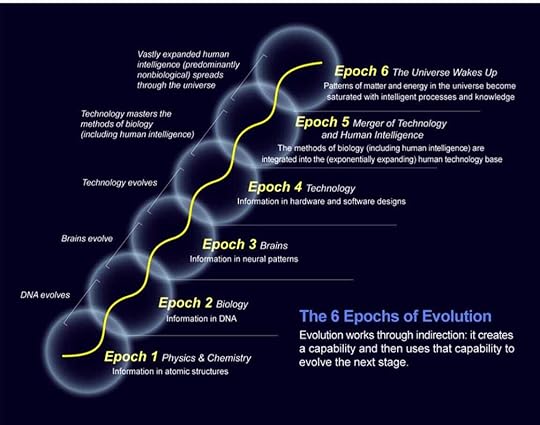
Epoch 5 occurs circa 2054
My audiobook was 9-hours, 20-minutes long. A dead tree copy would be a modest 310-pages. The book had a US 2024 copyright.
This book was co-authored. James Stavridis is a retired United States Navy admiral, currently involved in numerous high-level commercial, academic and media positions. He is the author of about ten (10) non-fiction books on military and political topics. Elliot Ackerman is an American author and former Marine Corps officer. He is the author of five works of fiction. This is the second book I've read by the authors. The first being 2034: A Novel of the Next World War (my review).
The audio book had five (5) narrators: Junior Nyong'o, Brian Nishii, Eunice Wong, Emily Woo Zeller, Vikas Adam voiced the story’s ensemble cast of characters. They did a good job, although I couldn't tell you who voiced which characters.
Firstly, it is not completely necessary to have any previous: technology background to be reading this book. However, it would be helpful to have a Popular Mechanics -level understanding of future tech, along with both PRC and US political organization, and a grasp of international politics.
Secondly, having read 2034: A Novel of the Next World War would also be helpful. The world building of this book leverages the events of that one. Several of the characters in that book are recycled, albeit twenty years later. Frankly, this book should be properly labeled Book #2 in the Twenty-first Century Series.
Finally, having a familiarity with the computer scientist, author, entrepreneur, futurist, and inventor Ray Kurzweil would also be helpful in understanding the transhuman orientation of The Singularity used in the book.
This book was part of the long tradition of modern, tech thrillers which became popular in the 1970’s by books like Michael Crichton and more recently by Daniel H. Wilson . These genre-books include a detailed description of technology gone wild. This book adds politicians and political leaders into the story.
The American Century ended with the limited nuclear exchange with the Chinese in 2034. The world is politically more multipolar, with the US no longer being the lone superpower. In the story, nation states are still competing commercially and technologically. In addition, the US has lapsed into a state dominated by a single, conservative, political party with a supermajority. They have a President, angling for his forth consecutive term. (Note this implies the 22nd Amendment of the US Constitution was repealed.)
Currently, the world’s Great Powers are in a race to be the first to achieve Technological Singularity . The nation state having First Mover advantage with achieving the Singularity is assumed to exclude all competitors from reaching it.
Characters from the previous book have since risen to high political and commercial positions. (They're grayer now.) New, young, "brilliant", characters were introduced for the action scenes. A race, both hampered by the political situation in the nation states and using a neo-modern, form of technological-espionage takes place with separate countries striving to reach the singularity first.
Writing was technically good. Descriptive prose was written in a clear, unaffected manner. A competent, details oriented, ‘writing team’ typically produces a well-groomed narrative. The narrative contains a moderate amount of details in scenes on both sides of the conflict. Dialog, at least that related to action scenes was good too. However, I thought the prose tended to be too melodramatic.
Issues I had with the previous book continued into this one.
The characters continued to be very flat. This was an artifact of the very short, chapters with changing POVs and only a modest number of pages. It did not leave a lot pages for character development, nor did they give me time to become invested in most of them.
There was an enormous amount of exposition. This was an advantage in the cut ‘n dried techo-political plotlines. However, the narrative fell flat when attempting to describe the emotional relationships between the characters. Most male, female relationships were filial. All romantic relationships were heterosexual. All relationships came out as too on the nose.
Finally, this story was "the view from above". The lowest rank contributing a POV was a US Marine Major. Others included: brilliant, young, scientists; US Presidents and Senators, Billionaires and their young, quant minions.
The final chapter, “Coda”, was a terribly awkward attempt at The Summation trope, by the primary POVs. It was the schmaltziest of chapters contributing to the HFN ending, that had verged on schmaltz throughout.
The book contained sex, a small amount of drugs, and a small amount of music references. (That's, sex, drugs, and rock 'n roll.) There was a small amount of violence due to civil unrest. The sex was of the fade to black type and non-graphic. Alcohol was the only drug consumed. That was in moderation. Music references came from references to background music. Violence was: physical, and military small arms. Violence was not gory and only mildly descriptive. As in many thrillers, the POV contributing protagonists had remarkable stamina. Body count was moderate. (There was a Civil War on.)
World building was a disappointment. Except for implanted devices, automated taxis, and advanced cellular therapy, it might have been 2024. There were no 'new' consumer products, the ravages of climate change went unmentioned, and there was no mention of space industries. Where's the futurism?
In addition, three of the protagonists conveniently (for the plot) "lost communications" in rural Brazil, even from the orbital networks. Currently there are seven, with two more US and two offshore orbital constellations under development. Thirty years from now, no handset on Earth will be out-of-reach from a network. Ever.
Like the previous book, this story was a story of disruptive technology. The opportunist adversaries of the U.S. like the Chinese, Nigerians and Japanese were in a low-level, technological confrontation with the United States. Unlike many techno-fests of this genre, the story wasn’t completely there to support The Singularity. The real story was, “The US’s fractious politics were its greatest liability.”.
This book was a hybrid-fiction/non-fiction work. At heart it’s about how unknown unknowns can topple a well-ensconced leader. Putting aside the techno-babble, it was pretty thin soup. Too many POVs starved the characters of development. (Ackerman didn’t learn from his previous book in the series.) There were too few pages for them to be anything but stereotypical. There were numerous plot holes, particularly with technology and how tech-savvy folks approach 'technical' challenges. They went against the 'realistic' grain of the overall book. There was a lot of exposition. I could not avoid thinking the basic themes of the book were pessimistic and too contrived. If you’re a AI geek into modern political pr0n this would be a decent beach read, this may be for you? However, I’m not reading any more stories in this series.
Epoch 5 occurs circa 2054
My audiobook was 9-hours, 20-minutes long. A dead tree copy would be a modest 310-pages. The book had a US 2024 copyright.
This book was co-authored. James Stavridis is a retired United States Navy admiral, currently involved in numerous high-level commercial, academic and media positions. He is the author of about ten (10) non-fiction books on military and political topics. Elliot Ackerman is an American author and former Marine Corps officer. He is the author of five works of fiction. This is the second book I've read by the authors. The first being 2034: A Novel of the Next World War (my review).
The audio book had five (5) narrators: Junior Nyong'o, Brian Nishii, Eunice Wong, Emily Woo Zeller, Vikas Adam voiced the story’s ensemble cast of characters. They did a good job, although I couldn't tell you who voiced which characters.
Firstly, it is not completely necessary to have any previous: technology background to be reading this book. However, it would be helpful to have a Popular Mechanics -level understanding of future tech, along with both PRC and US political organization, and a grasp of international politics.
Secondly, having read 2034: A Novel of the Next World War would also be helpful. The world building of this book leverages the events of that one. Several of the characters in that book are recycled, albeit twenty years later. Frankly, this book should be properly labeled Book #2 in the Twenty-first Century Series.
Finally, having a familiarity with the computer scientist, author, entrepreneur, futurist, and inventor Ray Kurzweil would also be helpful in understanding the transhuman orientation of The Singularity used in the book.
This book was part of the long tradition of modern, tech thrillers which became popular in the 1970’s by books like Michael Crichton and more recently by Daniel H. Wilson . These genre-books include a detailed description of technology gone wild. This book adds politicians and political leaders into the story.
The American Century ended with the limited nuclear exchange with the Chinese in 2034. The world is politically more multipolar, with the US no longer being the lone superpower. In the story, nation states are still competing commercially and technologically. In addition, the US has lapsed into a state dominated by a single, conservative, political party with a supermajority. They have a President, angling for his forth consecutive term. (Note this implies the 22nd Amendment of the US Constitution was repealed.)
Currently, the world’s Great Powers are in a race to be the first to achieve Technological Singularity . The nation state having First Mover advantage with achieving the Singularity is assumed to exclude all competitors from reaching it.
Characters from the previous book have since risen to high political and commercial positions. (They're grayer now.) New, young, "brilliant", characters were introduced for the action scenes. A race, both hampered by the political situation in the nation states and using a neo-modern, form of technological-espionage takes place with separate countries striving to reach the singularity first.
Writing was technically good. Descriptive prose was written in a clear, unaffected manner. A competent, details oriented, ‘writing team’ typically produces a well-groomed narrative. The narrative contains a moderate amount of details in scenes on both sides of the conflict. Dialog, at least that related to action scenes was good too. However, I thought the prose tended to be too melodramatic.
Issues I had with the previous book continued into this one.
The characters continued to be very flat. This was an artifact of the very short, chapters with changing POVs and only a modest number of pages. It did not leave a lot pages for character development, nor did they give me time to become invested in most of them.
There was an enormous amount of exposition. This was an advantage in the cut ‘n dried techo-political plotlines. However, the narrative fell flat when attempting to describe the emotional relationships between the characters. Most male, female relationships were filial. All romantic relationships were heterosexual. All relationships came out as too on the nose.
Finally, this story was "the view from above". The lowest rank contributing a POV was a US Marine Major. Others included: brilliant, young, scientists; US Presidents and Senators, Billionaires and their young, quant minions.
The final chapter, “Coda”, was a terribly awkward attempt at The Summation trope, by the primary POVs. It was the schmaltziest of chapters contributing to the HFN ending, that had verged on schmaltz throughout.
The book contained sex, a small amount of drugs, and a small amount of music references. (That's, sex, drugs, and rock 'n roll.) There was a small amount of violence due to civil unrest. The sex was of the fade to black type and non-graphic. Alcohol was the only drug consumed. That was in moderation. Music references came from references to background music. Violence was: physical, and military small arms. Violence was not gory and only mildly descriptive. As in many thrillers, the POV contributing protagonists had remarkable stamina. Body count was moderate. (There was a Civil War on.)
World building was a disappointment. Except for implanted devices, automated taxis, and advanced cellular therapy, it might have been 2024. There were no 'new' consumer products, the ravages of climate change went unmentioned, and there was no mention of space industries. Where's the futurism?
In addition, three of the protagonists conveniently (for the plot) "lost communications" in rural Brazil, even from the orbital networks. Currently there are seven, with two more US and two offshore orbital constellations under development. Thirty years from now, no handset on Earth will be out-of-reach from a network. Ever.
Like the previous book, this story was a story of disruptive technology. The opportunist adversaries of the U.S. like the Chinese, Nigerians and Japanese were in a low-level, technological confrontation with the United States. Unlike many techno-fests of this genre, the story wasn’t completely there to support The Singularity. The real story was, “The US’s fractious politics were its greatest liability.”.
This book was a hybrid-fiction/non-fiction work. At heart it’s about how unknown unknowns can topple a well-ensconced leader. Putting aside the techno-babble, it was pretty thin soup. Too many POVs starved the characters of development. (Ackerman didn’t learn from his previous book in the series.) There were too few pages for them to be anything but stereotypical. There were numerous plot holes, particularly with technology and how tech-savvy folks approach 'technical' challenges. They went against the 'realistic' grain of the overall book. There was a lot of exposition. I could not avoid thinking the basic themes of the book were pessimistic and too contrived. If you’re a AI geek into modern political pr0n this would be a decent beach read, this may be for you? However, I’m not reading any more stories in this series.
March 29, 2024
I read and loved 20234. I was excited for this one, jumping on the library queue. I couldn't finish it, having given up after 120 pages. The characters are thin, the pacing plodding, and the story confusing. I'm not sure if it's just my memory or the character connections aren't well referenced, but I couldn't track those associated with the prior book either.
It's a rare book that gets added to my "start and stopped" list on Goodreads. Here's hoping the third one is better.
It's a rare book that gets added to my "start and stopped" list on Goodreads. Here's hoping the third one is better.

June 23, 2024
Elliot Ackerman & James Stradivarius – 2054
Depois de ler “2034” dos mesmos autores e ter acabado a “Destinados à Guerra - Poderão a América e a China Escapar à Armadilha de Tucídides?” de Graham Allison, esperava um desenvolvimento do conflito latente entre a potência instalada e a desafiante. E não, este livro não é sobre isso e ainda bem! E digo, ainda bem, porque achei o livro “2034” dececionante. O “2054” é bem melhor. É um livro bem construído, com muitas histórias que evoluem em simultâneo e com múltiplos pontos de intersecção. É eficaz na forma como prende o leitor a uma conclusão que não encontra na história a que respeita, mas está adiante, subtilmente insinuada, no meio de uma outra paralela. O texto é insinuante, eficaz e com algumas “perolas” literárias, como quando diz por exemplo – que no fim somos todos “sangue e solo”, ao referir-se aos conflitos interiores que temos e quando não há mais referencias, acabamos sempre por nos virar para os pontos cardinais que nunca nos abandonaram. E se não é um livro sobre um conflito entre EUA e China, é sobre quê? Bom, não querendo estragar a leitura direi que é um livro sobre a América, sobre o conflito entre duas facções políticas aqui identificadas como Sonhadores e Realistas e um livro sobre Ray Kurzweill. E esta revelação foi para mim a grande surpresa deste livro.
Ray Kurzweill é um investidados da área das tecnologias e da IA, um futurista, um sonhador, alguém que fez inúmeras previsões sobre tecnologia, biologia e IA, e as possibilidades da intersecção entre elas.
Este publicou alguns livros dos quais destaco “The Singularity is Near” e “How to Create a Mind: The Secret of Human Thought Revealed”. Para Ray Kurtweill, a inteligência e a consciência humana são realidades que podem ser replicadas pela IA através dos algoritmos apropriados. Esta visão afasta-se de outros com um entendimento mais biológico e que vêm a consciência não como uma actividade isolada do córtex, mas como uma representação do corpo. Sem corpo não há consciência. Este livro, 2054, é sobre isso, sobre uma visão de um mundo futuro, um mundo onde há uma interface entre biotecnologia genética e engenharia genética, ou sobre a interface cérebro-máquina, sobre terapias genéticas, sobre nanotecnologia, sobre a “Singularidade”, as “singularidades tecnológica”.
Contudo, se quanto ao futuro pouco tenho a criticar ou opinar, cada um sonha de acordo com a suas emoções e sentimentos, já quanto ao presente tenho algumas dúvidas no que concerne aos habituais conceitos, e que este livro reflete, de como se tomar os avanços tecnológicos do presente como um avanço significado para a humanidade. Para muitos deles tenho dúvidas, mas tirando estas, 2054 é uma ficção interessante onde essencialmente se aborda a relação entre política, movimentos sociais e as capacidades que as novas tecnologias têm de os influenciar. Um ficção, um thriller político a ler.
Depois de ler “2034” dos mesmos autores e ter acabado a “Destinados à Guerra - Poderão a América e a China Escapar à Armadilha de Tucídides?” de Graham Allison, esperava um desenvolvimento do conflito latente entre a potência instalada e a desafiante. E não, este livro não é sobre isso e ainda bem! E digo, ainda bem, porque achei o livro “2034” dececionante. O “2054” é bem melhor. É um livro bem construído, com muitas histórias que evoluem em simultâneo e com múltiplos pontos de intersecção. É eficaz na forma como prende o leitor a uma conclusão que não encontra na história a que respeita, mas está adiante, subtilmente insinuada, no meio de uma outra paralela. O texto é insinuante, eficaz e com algumas “perolas” literárias, como quando diz por exemplo – que no fim somos todos “sangue e solo”, ao referir-se aos conflitos interiores que temos e quando não há mais referencias, acabamos sempre por nos virar para os pontos cardinais que nunca nos abandonaram. E se não é um livro sobre um conflito entre EUA e China, é sobre quê? Bom, não querendo estragar a leitura direi que é um livro sobre a América, sobre o conflito entre duas facções políticas aqui identificadas como Sonhadores e Realistas e um livro sobre Ray Kurzweill. E esta revelação foi para mim a grande surpresa deste livro.
Ray Kurzweill é um investidados da área das tecnologias e da IA, um futurista, um sonhador, alguém que fez inúmeras previsões sobre tecnologia, biologia e IA, e as possibilidades da intersecção entre elas.
Este publicou alguns livros dos quais destaco “The Singularity is Near” e “How to Create a Mind: The Secret of Human Thought Revealed”. Para Ray Kurtweill, a inteligência e a consciência humana são realidades que podem ser replicadas pela IA através dos algoritmos apropriados. Esta visão afasta-se de outros com um entendimento mais biológico e que vêm a consciência não como uma actividade isolada do córtex, mas como uma representação do corpo. Sem corpo não há consciência. Este livro, 2054, é sobre isso, sobre uma visão de um mundo futuro, um mundo onde há uma interface entre biotecnologia genética e engenharia genética, ou sobre a interface cérebro-máquina, sobre terapias genéticas, sobre nanotecnologia, sobre a “Singularidade”, as “singularidades tecnológica”.
Contudo, se quanto ao futuro pouco tenho a criticar ou opinar, cada um sonha de acordo com a suas emoções e sentimentos, já quanto ao presente tenho algumas dúvidas no que concerne aos habituais conceitos, e que este livro reflete, de como se tomar os avanços tecnológicos do presente como um avanço significado para a humanidade. Para muitos deles tenho dúvidas, mas tirando estas, 2054 é uma ficção interessante onde essencialmente se aborda a relação entre política, movimentos sociais e as capacidades que as novas tecnologias têm de os influenciar. Um ficção, um thriller político a ler.

April 1, 2024
3.5 ⭐️s.
I preferred 2034 to 2054.
Where it fell short:
- the stakes didn’t feel as high as the previous book.
- Foreign powers didn’t have as much of an impact on the story, and they didn’t do a good job of explaining how/why Nigeria became so important. More importantly, India was totally absent from this story (I don’t count the Chowdhrys as representing India as a country). 2034 set India up to be a global leader in politics and it wasn’t mentioned at all.
- it was evoking Jan 6th vibes at most, I would have liked the Singularity to have been the looming threat.
- it had the opportunity to add more intensity to the romances but it didn’t, which I understand since that’s not the focus of the book.
Where it worked:
- given the route the authors chose, the resolution of the tension made sense, and it is the ideal case scenario we would ever hope to see if the country was on the brink of civil war over a presidency.
- it incorporated the characters from the first book really well.
- I did like that Sarah Hunt lived on as the singularity, was able to bring about peace, and remain connected with her daughter. I wish they had delved more into the sci-fi of how she achieved influencing dreams.
I think a big problem with me for this was that I ad just watched 3 body problem on Netflix before reading this and that show is about an advanced technology influencing what humans are able to achieve through science and even how they perceive the world. So, I wonder if the authors had read Cixin Liu’s Three Body Problem before they wrote this book.
I preferred 2034 to 2054.
Where it fell short:
- the stakes didn’t feel as high as the previous book.
- Foreign powers didn’t have as much of an impact on the story, and they didn’t do a good job of explaining how/why Nigeria became so important. More importantly, India was totally absent from this story (I don’t count the Chowdhrys as representing India as a country). 2034 set India up to be a global leader in politics and it wasn’t mentioned at all.
- it was evoking Jan 6th vibes at most, I would have liked the Singularity to have been the looming threat.
- it had the opportunity to add more intensity to the romances but it didn’t, which I understand since that’s not the focus of the book.
Where it worked:
- given the route the authors chose, the resolution of the tension made sense, and it is the ideal case scenario we would ever hope to see if the country was on the brink of civil war over a presidency.
- it incorporated the characters from the first book really well.
- I did like that Sarah Hunt lived on as the singularity, was able to bring about peace, and remain connected with her daughter. I wish they had delved more into the sci-fi of how she achieved influencing dreams.
I think a big problem with me for this was that I ad just watched 3 body problem on Netflix before reading this and that show is about an advanced technology influencing what humans are able to achieve through science and even how they perceive the world. So, I wonder if the authors had read Cixin Liu’s Three Body Problem before they wrote this book.
This entire review has been hidden because of spoilers.

June 1, 2024
All the nations of the world have achieved the Singularity. Long ago biological and technological evolution merged. Look at the societies in which we live, riven with divisions, embracing technologies we know don't make us better off, that we know hurt us, and that we embrace nonetheless. Who or what is driving that? The technology has already won. It won a long time ago. We humans lost to it, enslaved ourselves to it, this is all ancient history.

April 20, 2024
Very interesting premise although the story falls short in ways that I am unable to articulate.

June 26, 2024
2 to 2.5 stars.
Idk how to feel about this book. Was excited by the premise and thought it would be an engaging speculative fiction. Yet I was left bored and found myself skimming through filler prose that did little for the worldbuilding and characterisation.
This was unbearably slow paced and unexciting. To call this Speculative fiction would do a disservice to the genre as there was nothing speculative about a plot that closely mirrors the American politics of today (read: January 6th)
It was a lot of yapping about political conflict which was tiresome, lengthy, and predictable. So much could have been done to explore the more sci-fi elements of the plot but yet the authors decided to indulge in their unnecessary addiction to political drama and “civil war”.
The complete lack of worldbuilding is exceptionally disappointing since I was keen to find out what the world after nuclear war and 20 years of rebuilding LOOKED like. Yet, there was little to no imagery or descriptions of such a world apart from political changes and technological advances.
It’s amazing how the authors have managed to portray America in 2054 as almost entirely politically to America in 2024. I don’t know much about American society or politics but this book is as messy as American politics today.
Idk how to feel about this book. Was excited by the premise and thought it would be an engaging speculative fiction. Yet I was left bored and found myself skimming through filler prose that did little for the worldbuilding and characterisation.
This was unbearably slow paced and unexciting. To call this Speculative fiction would do a disservice to the genre as there was nothing speculative about a plot that closely mirrors the American politics of today (read: January 6th)
It was a lot of yapping about political conflict which was tiresome, lengthy, and predictable. So much could have been done to explore the more sci-fi elements of the plot but yet the authors decided to indulge in their unnecessary addiction to political drama and “civil war”.
The complete lack of worldbuilding is exceptionally disappointing since I was keen to find out what the world after nuclear war and 20 years of rebuilding LOOKED like. Yet, there was little to no imagery or descriptions of such a world apart from political changes and technological advances.
It’s amazing how the authors have managed to portray America in 2054 as almost entirely politically to America in 2024. I don’t know much about American society or politics but this book is as messy as American politics today.

March 24, 2024
Set 20 years after 2034, when a catastrophic war between the United States and China takes place, 2054 promises an equally terrifying prospect — the next threats to humankind will come from AI, biotech, and Singularity (where technology and humanity become one). Except they don't.
Whereas Elliot Ackerman and Admiral James Stavidis deliver a near five-star story with their first outing, 2054 doesn't have the same gusto. It misses much of the tension the authors captured in 2034 as if the topics themselves should scare the heck out of us. They should have, could have, would have, but ultimately don't as the plot becomes more of a Rorschach ink splotch than a storyline.
The crisis kicks off when a physically fit President Ángel Castro collapses while giving a speech — the victim of remote gene editing. This sets the stage for America falling into a Civil War, which would have made a thrilling story. But in this case, the prospect of a Civil War is secondary to clandestine progress being made in creating a Singularity.
Thus, with the action largely passive, 2054 never becomes the thriller it could have been and, instead, simply gives a shakedown that remote gene editing, AI, and uploading minds into a Singularity are all bad things for humankind. (They are.) But the novel itself won't convince you of this, especially when the biggest potential for loss might be what one character wagers in Las Vegas.
Even the political intrigue in the book feels watered down. While the authors' geopolitical prowess is plain, they don't do enough with it. In terms of creating a government crisis, it ultimately feels lightweight in the face of things many of us have experienced in the last 50 years. And that's a shame because they want us to consider society's trajectory but don't do enough to warn us away from it. So, ultimately, it's well-written but bleh.
Whereas Elliot Ackerman and Admiral James Stavidis deliver a near five-star story with their first outing, 2054 doesn't have the same gusto. It misses much of the tension the authors captured in 2034 as if the topics themselves should scare the heck out of us. They should have, could have, would have, but ultimately don't as the plot becomes more of a Rorschach ink splotch than a storyline.
The crisis kicks off when a physically fit President Ángel Castro collapses while giving a speech — the victim of remote gene editing. This sets the stage for America falling into a Civil War, which would have made a thrilling story. But in this case, the prospect of a Civil War is secondary to clandestine progress being made in creating a Singularity.
Thus, with the action largely passive, 2054 never becomes the thriller it could have been and, instead, simply gives a shakedown that remote gene editing, AI, and uploading minds into a Singularity are all bad things for humankind. (They are.) But the novel itself won't convince you of this, especially when the biggest potential for loss might be what one character wagers in Las Vegas.
Even the political intrigue in the book feels watered down. While the authors' geopolitical prowess is plain, they don't do enough with it. In terms of creating a government crisis, it ultimately feels lightweight in the face of things many of us have experienced in the last 50 years. And that's a shame because they want us to consider society's trajectory but don't do enough to warn us away from it. So, ultimately, it's well-written but bleh.

March 13, 2024
It's a perfectly serviceable sequel, though it doesn't quite have the juice of 2034. The concepts were interesting, and the storytelling was alright, but the late book tonal shift from speculative political fiction to almost science fantasy was not executed particularly gracefully and left much to be desired. 2034's storytelling during its climactic sequence was thrilling, full of dread excitement, as the reader watched permanent, devastating consequences relentlessly crash over their beloved characters like a tsunami. 2054 had so much build up only for the store to fizzle out; it had big, fascinating ideas centered on the intersection of technology, politics, and free will, but never explores them to their full potential. Truthfully, at times it seemed like the authors didn't quite know how to get their arms around what they had started; the predictable plot twist in the third act only seemed to highlight that fact.
TL;DR- It's a perfectly ok, entertaining quick read. But it could've been more.
TL;DR- It's a perfectly ok, entertaining quick read. But it could've been more.
This entire review has been hidden because of spoilers.
May 5, 2024
This is a mostly American political drama, combined with the possible risks of artificial intelligence, set in the near future. The points of view of several characters are followed, and I had to go back several times to keep them straight in my mind. I found it a fairly good read. This is apparently a sequel to 2034, which I may yet tackle.
February 11, 2026
100 pages in and DNF. It’s a sequel to a book I haven’t read, which can’t help, but it just lacked any kind of pull to really keep me interested. There’s a lot of speculative ideas that don’t work given where we already are as a society in 2026. Maybe it’s unfair of me to rate it at all but I’m determined to keep a record of everything I’ve read.

June 20, 2026
Good book overall. Definitely a different vibe to the original, sometimes a little hard to follow. I think some of that may have been how long it took me to finish it, with progress to about half then a big break before a dash to the finish. I enjoyed it though. An imaginative and cautionary tale of how easy an "advanced" society can collapse in on itself.

March 16, 2024
Definitely recommend 2034 prior to follow characters and storyline. Building on that previous novel, a look into the future that hits way too close to home.
April 16, 2024
What a mess.
The previous book in the series, 2034, was a so-so military thriller with so-so prose. It seemed likely that Admiral Stavridis came up with the storyline and Elliot Ackerman handled the writing.
Did they reverse roles on this one? The writing is amateurish, and the plot is a slow-moving political scenario combined with some speculative science that that has little to do with the political storyline. A military novel based 30 years into the future, co-authored by an actual solider is an intriguing idea, but that's not this book.
The dialog is stilted and frequently jingoistic, most of the characters are paper-thin and forgettable, and the ties to the earlier book are tenuous. I kept expecting some plot twist that would salvage the read, but the storyline just peters out.
Why in the world did Wired magazine think this was worth devoting an issue to? And why would Ray Kurzweil agree to be dragged into it?
At least it was short.
The previous book in the series, 2034, was a so-so military thriller with so-so prose. It seemed likely that Admiral Stavridis came up with the storyline and Elliot Ackerman handled the writing.
Did they reverse roles on this one? The writing is amateurish, and the plot is a slow-moving political scenario combined with some speculative science that that has little to do with the political storyline. A military novel based 30 years into the future, co-authored by an actual solider is an intriguing idea, but that's not this book.
The dialog is stilted and frequently jingoistic, most of the characters are paper-thin and forgettable, and the ties to the earlier book are tenuous. I kept expecting some plot twist that would salvage the read, but the storyline just peters out.
Why in the world did Wired magazine think this was worth devoting an issue to? And why would Ray Kurzweil agree to be dragged into it?
At least it was short.

April 9, 2024
After reading "2034," I was excited to delve into "2054." However, I must express my profound disappointment with the book. At times, it proved difficult to engage with, leaving me unable to immerse myself fully. One of the primary disappointments stemmed from the fact that the depiction of the year 2054 felt akin to that of 2030. The anticipated advancements one would expect in a narrative set thirty years in the future seemed conspicuously absent. Moreover, the storyline appeared rather flat to me.

February 12, 2024
I received an advance copy from Penguin.
When I first started reading this book I wasn't sure I would like it as Dystopian fiction is one of my least favorite genres. However, I did enjoy the story. I did wonder several times if I had read the previous book, 2034, would I understand and know the characters better?
This story takes place after WWIII. The USA is in political disarray with a President who's in his 3rd term. He has full control of the media but the American people are divided. He is giving a speech in San Diego when he collapses and dies. Was it natural causes or was it assassination?
It was a thought-provoking read. I would like to read 2034 and then possibly read this book again.
When I first started reading this book I wasn't sure I would like it as Dystopian fiction is one of my least favorite genres. However, I did enjoy the story. I did wonder several times if I had read the previous book, 2034, would I understand and know the characters better?
This story takes place after WWIII. The USA is in political disarray with a President who's in his 3rd term. He has full control of the media but the American people are divided. He is giving a speech in San Diego when he collapses and dies. Was it natural causes or was it assassination?
It was a thought-provoking read. I would like to read 2034 and then possibly read this book again.

January 20, 2024
Provocative and engaging view into the future with characters and their offspring from 2034. A must read for readers seeking a strong story with intellectual content and a glimpse into possible pathways of tomorrow.

April 10, 2024
A little less boring than '2034' but not much. Couldn't finish it.

April 17, 2024
Speculative fiction by two upper-echelon US military officers, that looks at the potential consequences of technological trends, from disinformation to further-reaching implications of AI, here transformed into the Singularity) and political, in which a third-party, multi-term populist President is assassinated, sparking the risk of a totalitarian government.
In their first book, 2034, we saw the speed with which war can escalate from the point of view of characters in the middle of a precarious situation, resulting in a nuclear war. The book worked extremely well, with a fast-moving, believable plot and a fairly small number of well-drawn characters with different, (multi-national, points of view at the centre of events.
Here, there are two separate ‘prongs’ and more characters involved. The two storylines, political and AI, are intertwined but there’s almost too much going on in the space provided.
The book never feels complicated, and it’s not ‘preachy,’ with characters explaining philosophies or alternating points of view, but it did feel like we were skimming the surface, never going deep enough to care about the characters, and rushing from one scene to another (this from a guy who likes tightly plotted books that move at breakneck speed).
The book might have been better serviced as two books, where the political situation leads to events related directly to the Singularity. The two plots working in tandem were too much for the space provided, even though the plot lines are connected. Individual characters are interesting, but there were also too many characters for me to develop a relationship with any of them.
I respect the author's military knowledge but I wonder what someone like Neal Stephenson or William Gibson would have done with the plot line.
In their first book, 2034, we saw the speed with which war can escalate from the point of view of characters in the middle of a precarious situation, resulting in a nuclear war. The book worked extremely well, with a fast-moving, believable plot and a fairly small number of well-drawn characters with different, (multi-national, points of view at the centre of events.
Here, there are two separate ‘prongs’ and more characters involved. The two storylines, political and AI, are intertwined but there’s almost too much going on in the space provided.
The book never feels complicated, and it’s not ‘preachy,’ with characters explaining philosophies or alternating points of view, but it did feel like we were skimming the surface, never going deep enough to care about the characters, and rushing from one scene to another (this from a guy who likes tightly plotted books that move at breakneck speed).
The book might have been better serviced as two books, where the political situation leads to events related directly to the Singularity. The two plots working in tandem were too much for the space provided, even though the plot lines are connected. Individual characters are interesting, but there were also too many characters for me to develop a relationship with any of them.
I respect the author's military knowledge but I wonder what someone like Neal Stephenson or William Gibson would have done with the plot line.

January 14, 2025
Rating: 3 stars
I picked 2054 to read after listening to an interview with Admiral James Stavridis (USN). I didn't read the previous book by the Admiral and Elliot Ackerman (2034), but I don't think that it was necessary to follow this plot.
SUMMARY: It is twenty years after the catastrophic war between the United States and China that brought down the old American political order. A new party has emerged in the US, one that’s held power for over a decade. Efforts to cement its grip have resulted in mounting violent resistance. The American president has control of the media, but he is beginning to lose control of the streets. Many fear he’ll stop at nothing to remain in the White House. Suddenly, he collapses in the middle of an address to the nation. After an initial flurry of misinformation, the administration reluctantly announces his death. A cover-up ensues, conspiracy theories abound, and the country descends into a new type of civil war.
A handful of elite actors from the worlds of computer science, intelligence, and business have a fairly good idea what happened. All signs point to a profound breakthrough in AI, of which the remote assassination of an American president is hardly the most game-changing ramification. The trail leads to an outpost in the Amazon rainforest, the last known whereabouts of the tech visionary who predicted this breakthrough. As some of the world’s great powers, old and new, state and nonstate alike, struggle to outmaneuver one another in this new Great Game of scientific discovery, the outcome becomes entangled with the fate of American democracy.
I picked 2054 to read after listening to an interview with Admiral James Stavridis (USN). I didn't read the previous book by the Admiral and Elliot Ackerman (2034), but I don't think that it was necessary to follow this plot.
SUMMARY: It is twenty years after the catastrophic war between the United States and China that brought down the old American political order. A new party has emerged in the US, one that’s held power for over a decade. Efforts to cement its grip have resulted in mounting violent resistance. The American president has control of the media, but he is beginning to lose control of the streets. Many fear he’ll stop at nothing to remain in the White House. Suddenly, he collapses in the middle of an address to the nation. After an initial flurry of misinformation, the administration reluctantly announces his death. A cover-up ensues, conspiracy theories abound, and the country descends into a new type of civil war.
A handful of elite actors from the worlds of computer science, intelligence, and business have a fairly good idea what happened. All signs point to a profound breakthrough in AI, of which the remote assassination of an American president is hardly the most game-changing ramification. The trail leads to an outpost in the Amazon rainforest, the last known whereabouts of the tech visionary who predicted this breakthrough. As some of the world’s great powers, old and new, state and nonstate alike, struggle to outmaneuver one another in this new Great Game of scientific discovery, the outcome becomes entangled with the fate of American democracy.

July 6, 2024
A sequel (of sorts) to 2034, but covering subjects perhaps less in the wheelhouse of the authors.
It begins with the (suspected) remote assassination of a US President who is seeking to extend his term (for the good of the country of course). The means of said killing (remote gene-editing) comes straight out of the misunderstanding of the nuttosphere about mRNA vaccines and nanotechnology. But never mind, this piece of handwavium brings us an interesting speculation on the impending 'Singularity', seen depressingly as an opportunity for one power group to gain a march on everyone else, with the effect that they would overlord the rest of us forever.
Anyhow, the race is on, and the heroes it seems are those in a secret conspiracy to put sand into the gears of progress. And, via a speculation on how an actual coup d'etat might be performed in the US by an attack on the Capitol, it goes in rather unexpected directions, though the sense of disbelief gets a thourough working over!.
It is a very easy read, quick, clear and uncomplicated.
It begins with the (suspected) remote assassination of a US President who is seeking to extend his term (for the good of the country of course). The means of said killing (remote gene-editing) comes straight out of the misunderstanding of the nuttosphere about mRNA vaccines and nanotechnology. But never mind, this piece of handwavium brings us an interesting speculation on the impending 'Singularity', seen depressingly as an opportunity for one power group to gain a march on everyone else, with the effect that they would overlord the rest of us forever.
Anyhow, the race is on, and the heroes it seems are those in a secret conspiracy to put sand into the gears of progress. And, via a speculation on how an actual coup d'etat might be performed in the US by an attack on the Capitol, it goes in rather unexpected directions, though the sense of disbelief gets a thourough working over!.
It is a very easy read, quick, clear and uncomplicated.
April 8, 2024
Ugh.
I loved 2034, by this same pair of writers, which imagined a world war where a heretofore "third world country" rises from the ashes of the United States and China. Tight, suspenseful, and creative speculative fiction - but not completely outlandish.
Now twenty years later, we are back again on the earth of the future, this time exploring the potential merger of biology and AI - the good, the bad, and the ugly. Characters from 2034 make appearances - sometimes preposterously - to connect the two books. There is much wading through vaguely connected story arcs that are too quickly and conveniently woven together in the last pages of the book. By then I hardly cared. It was only the "two river" metaphor used in tying together these disparate pieces that saved it for me.
I loved 2034, by this same pair of writers, which imagined a world war where a heretofore "third world country" rises from the ashes of the United States and China. Tight, suspenseful, and creative speculative fiction - but not completely outlandish.
Now twenty years later, we are back again on the earth of the future, this time exploring the potential merger of biology and AI - the good, the bad, and the ugly. Characters from 2034 make appearances - sometimes preposterously - to connect the two books. There is much wading through vaguely connected story arcs that are too quickly and conveniently woven together in the last pages of the book. By then I hardly cared. It was only the "two river" metaphor used in tying together these disparate pieces that saved it for me.
August 14, 2025
2/5- Den ersten Teil dieser Reihe mochte ich lediglich aufgrund des Hintergrunds und der mMn realistischen Darstellung eines Anfanges des 3. WK, das ist vielleicht nicht die sinnvollste Basis um dann auch noch den 2. Teil zu lesen. Gemacht hab ich’s trotzdem und naja, das war‘s irgendwie nicht.
Die Charaktere fand ich sehr langweilig und ich habe bei niemandem mitgefiebert. Auch die Story und das Konzept der Story, auch wenn es einige interessante Ideen hatte, waren eher uninteressant und deutlich unrealistischer als im ersten Teil.
Es war irgendwie trotzdem einigermaßen spannend, weil schnell und viele Cliffhanger, und ließ sich daher gut und schnell lesen, daher immerhin noch 2 Sterne.
Die Charaktere fand ich sehr langweilig und ich habe bei niemandem mitgefiebert. Auch die Story und das Konzept der Story, auch wenn es einige interessante Ideen hatte, waren eher uninteressant und deutlich unrealistischer als im ersten Teil.
Es war irgendwie trotzdem einigermaßen spannend, weil schnell und viele Cliffhanger, und ließ sich daher gut und schnell lesen, daher immerhin noch 2 Sterne.
June 21, 2024
The book starts slow, but picks up. It's an interesting read on Singularity, with technology out of control. Add the political angles, the presidential assassination component, and this book gained in interest.
The future will be an interesting place. I prompted ChatGPT...here's my tech enabled review
In Diane Ackerman's novel 2054, there is a palpable sense of anticipation for a deep dive into a future shaped by climate crisis and technological advancement. Ackerman's prose shines with vivid descriptions of a world transformed, yet the narrative seems to falter in delivering on its promise of profound insight. While the world-building is meticulous and imaginative, the characters, though intriguing, often feel overshadowed by the grandeur of the setting. The novel's exploration of ethical dilemmas and societal shifts is thought-provoking, yet it occasionally loses focus, leaving the reader wanting more depth and emotional resonance. 2054 is a commendable effort with moments of brilliance, but ultimately falls short of fully capitalizing on its ambitious premise.
The future will be an interesting place. I prompted ChatGPT...here's my tech enabled review
In Diane Ackerman's novel 2054, there is a palpable sense of anticipation for a deep dive into a future shaped by climate crisis and technological advancement. Ackerman's prose shines with vivid descriptions of a world transformed, yet the narrative seems to falter in delivering on its promise of profound insight. While the world-building is meticulous and imaginative, the characters, though intriguing, often feel overshadowed by the grandeur of the setting. The novel's exploration of ethical dilemmas and societal shifts is thought-provoking, yet it occasionally loses focus, leaving the reader wanting more depth and emotional resonance. 2054 is a commendable effort with moments of brilliance, but ultimately falls short of fully capitalizing on its ambitious premise.
March 22, 2024
unexpected
My expectation was immediately taken hostage by this strange yet captivating novel of our future. While expecting the exciting military novel of future combat, the resulting narrative was overtaken by exceptionally researched technology and “in your face” ethics that resulted in introspective soul searching of what it means to be human and how we relate to those we think as enemies or allies. I’ve come to admire Admiral Stavridis and his co-author Ackerman in delivering a thought provoking novel of our future and hope for mankind. Bravo gentlemen!
My expectation was immediately taken hostage by this strange yet captivating novel of our future. While expecting the exciting military novel of future combat, the resulting narrative was overtaken by exceptionally researched technology and “in your face” ethics that resulted in introspective soul searching of what it means to be human and how we relate to those we think as enemies or allies. I’ve come to admire Admiral Stavridis and his co-author Ackerman in delivering a thought provoking novel of our future and hope for mankind. Bravo gentlemen!

September 4, 2024
2034 was by no means a smart book, but at least it felt grounded somewhat. This book was so dumb! I cannot bring myself to care about AI and so reading about the Singularity every other paragraph made for a dull read.
May 8, 2026
Book was alright, not as good as the first one. Felt like the characters and plot was kinda cheesy and predictable and wasn't too gripping. Also feel like they could have elaborated more on the technological/biological threat that was central to the book. Felt too Sci fi and abstract
Displaying 1 - 30 of 357 reviews