Jump to ratings and reviews
Rate this book

Persons Non Grata #2

Ein Lied für die Stille

Rate this book
Eine Novelle aus der Welt von Hämmer auf Knochen, das für den British Fantasy Award und den Locus Award nominiert war und von Kameron Hurley als »ein weiter Sprung in das Blutige, das Seltsame und das Fantastische« bezeichnet wurde.


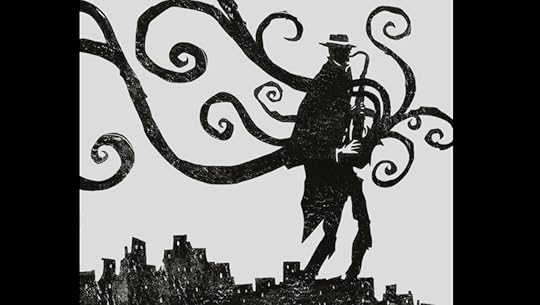
Deacon James ist ein Bluesmusiker aus Georgia, ein schwarzer Mann mit Problemen, denen er nicht entkommen kann, und einer Musik, die ihn nicht loslässt.

Seine Welt gerät aus den Fugen, als er auf einer Zugfahrt nach Arkham albtraumhafte Visionen von klaffenden Mäulern und gierigen Tentakeln hat. Er begegnet einem Verrückten namens John Persons, der behauptet, Deacon trage einen Samen in seinem Kopf, der die Welt zerstören könnte, sobald er keimt.

Persons' irres Geschwätz verfolgt Deacon bis zum nächsten Gig, wo sein Saxophonspiel nicht nur das Publikum von den Stühlen reißt, sondern auch Monstrositäten aus anderen Dimensionen heraufbeschwört. Auf der Flucht trifft er auf ein Mädchen, das ebenfalls gefährliche Kräfte in sich birgt. 
Gemeinsam versuchen sie, Arkham zu entkommen, doch der Song in Deacons Kopf wird immer mächtiger, und bald wird er ihm nicht mehr entrinnen können.

Publishers Weekly, starred
»Khaw beweist Meisterschaft im Horror.«

Victor
»Eine bewegende Geschichte über Musik, Monster und Trauer.«

Alle fünf Bände der 24er-Ausgabe von Cemetery Dance Germany SELECT sind von Vincent Chong illustriert, haben illustrierte Vor- und Nachsatzpapiere sowie 3 Innenillustrationen.

HINWEIS Gesamtausgabe &
Die fünf Bände von Cemetery Dance Germany SELECT '24 - LOVECRAFTIAN VIBES sind ebenfalls als Gesamtausgabe im Sammlerschuber erhältlich.
Die Hardcover der ersten Auflage der Gesamtausgabe werden einen digitalen Farbschnitt erhalten.
Ein bestehendes CDG-SELECT-Abo (direkt beim Verlag) zählt ebenfalls in Bezug auf die erste Auflage der Gesamtausgabe mit Farbschnitt.

103 pages, Kindle Edition

First published August 29, 2017

97 people are currently reading
2121 people want to read

About the author

Cassandra Khaw

126 books2,930 followers
Cassandra Khaw is an award-winning game writer.
Their recent novella Nothing but Blackened Teeth was a British
Fantasy, World Fantasy, Shirley Jackson, and Bram Stoker
Award finalist. Their debut collection Breakable Things is now
out.

Ratings & Reviews

What do you think?
Rate this book

Friends & Following

Create a free account to discover what your friends think of this book!

Community Reviews

5 stars
335 (23%)
4 stars
545 (38%)
3 stars
405 (28%)
2 stars
115 (8%)
1 star
20 (1%)
Displaying 1 - 30 of 228 reviews
Profile Image for carol. .
1,752 reviews9,980 followers
October 13, 2021
After a buddy read of Khaw’s Lovecraftian-themed Hammers on Bone, we decided to try the subsequent novella. I was hopeful that a new protagonist–a bluesman–would provide a change from the odd vernacular and breathe some new notes into the relentless picture of decay. Unfortunately, though there are bits and pieces of stellar writing, there’s also a lot of self-indulgent and purple prose that becomes just so much scat when Khaw tries to take it into the metaphysical. Add to it a protagonist that is only reactive instead of active with a wandering plot, and it devolves into a mess.

“What Deacon wishes for, more than anything else, is someone to tell him what to do in this period between hurting and healing, neither here nor there, the ache growing septic.”
The time and place aren’t clear as we listen to bluesman Deacon plucking out a tune while on a train, but it’s clear when visions of hungry mouths chase him into a different carriage that segregation is ongoing. He heads to a diner, keeping the planned performance he and his father had booked up in Arkham, and finds he can’t escape the music.

There are intriguing ideas here, particularly the idea of music as a medium for cracking the Lovecraftian gate open. But it isn’t very well executed. The story is third-person limited, so we’re in on Deacon’s thoughts. But then Khaw interrupts herself for self-indulgent description:

“This is what Deacon sees in the windows as he weaves between the carriages:

One: The landscape, blurred into protean shapes. Jagged peaks thickening to walls, valleys fracturing into ravines, black pines melting into blasted plains. In the sky, the stars swarm, an infection of white, a thousand cataracted eyes. There is nothing human here, no vestige of man’s influence. Only night, only blackness.

Two: His face, reflected in the cold glass. Deacon looks thinner than he remembers, grief gnawed, cheekbones picked clean of softness. His eyes are old from putting his pa into the soil and holding on to his mother as she cried bargains into his shoulder…

Three: Mouths, toothless, tongueless, opening in the windows, lesions on a leper’s back.”

Except for the part about his mother, we really get nothing from this, as a reader. Sure, all vivid sentences. But what’s the point? It’s an interlude, only it’s visual, not aural. There’s a couple more, one much shorter, so it’s not narrative device. It’s indulgent set-dressing.

The rest of the story is in the same vein. The plot is even less cohesive than the last; it’s sort of a typical supernatural episode or Lovecraftian short story. The characters are in service to the plot, so we actually learn very little; their motivation is in response to story needs. We need a world-breaker for a final confrontation? Sure, we’ll bring in one, and we’ll make them irresistible to Deacon, although I’m not sure why. John Persons (haha) is brought back from the first story, mostly to scare Deacon. As a story, I don’t think it holds up to any scrutiny at all, and is best read for the language and quickly passed on.

Many thanks to David and Nataliya for the buddy read, and I'm sure we'll have better luck on the next.
Profile Image for Nataliya.
985 reviews16.1k followers
October 16, 2021
“You can’t murder that which is eternal, that which will lie until death itself passes. But you can slow it, cripple it, hobble it. You can hurt your nightmares; it’s a two-way street.”
This story is set in the same universe as the first novella in the series, Hammers on Bone, but a few decades earlier, and the protagonist of that one, John Persons, is a secondary character here — but it’s really a standalone. This is a Lovecraftian world full of horrors that lurk just beneath the thin skin of the world (eyes, mouths, tentacles, Elder Gods, all that jazz) — and this one is set in Arkham, that my buddy read partner David thankfully pointed out to be a Lovecraft-created haunted town.

The first story was Lovecraftian noir; this one lacks the detective part and instead has a blues musician at its center, dealing not only with racism and violence but also with sinister music that took residence in his head — music that is a harbinger of something very sinister to come.
“The blues, you see, is the music of the ache and the grind, the letter from the front saying your brother is dead, the smile that reminds you of that girl you lost when you were too young to know better.”

But the notes of this one fell flat for me. Some of it was very purple prose for which I only have intermittent tolerance (Cat Valente works for me for some reason, and last year’s Hugo winner This Is How You Lose the Time War managed to hit the right spot, for instance). Some of it was my general indifference to all things Lovecraftian unless there’s something else to hold my attention. Some of it was that John Persons despite all my irritations with him still was a better, more interesting character than Deacon James, and relegating Persons to the sidelines did not help holding my attention.

Yes, I must admit that a lot of purple prose elaborate passages were strikingly beautiful and created quite visceral imagery (yes, at times literally - it’s Lovecraftian vibes we are talking about here!), but despite me appreciatively nodding when these parts came along they failed to combine into the atmosphere that was immersive rather than just striking. It was pretty, but remained more abstract than anything, and flowery prose would often actually dissipate that building tension.
“What do you do when the funeral is over but your heart is still broken. When all the condolences have been spoken and the mourners have gone shuffling home, and you’re left to stare at the wall, so raw and empty that you don’t know if you’ll ever be whole again.”

And it’s quite fast. Despite not that much actually happening, somehow it reads almost frantic, jumping from scene to scene with quite an urgency, with little room left to catch your breath and think about what’s happening and why you would care.

And therefore despite it being so short, I had to force myself to finish it.

2.5 stars.

—————

My review of the first book in this kinda-series, Hammers on Bone, is here: https://www.goodreads.com/review/show...

—————
Buddy read with Carol and David.
Profile Image for Dan.
3,204 reviews10.8k followers
November 10, 2017
Shortly after the death of his father, bluesman Deacon James rolls into Arkham with an otherworldly song in his head and a sinister detective, John Persons, on his trail...

I follow Cassandra Khaw on twitter and she mentioned needing reviews for this. Since I liked her first John Persons novella, Hammers on Bone, I was all over it like a ghoul on an unsuspecting citizen of Arkham.

Noir mixed with cosmic horror is the best combo since chocolate and peanut butter and A Song for Quiet is a prime example. Much like in Lovecraft Country, the horrors of the cosmos mesh with the mundane horrors of racism and ignorance. Deacon James is much more worried about white folks putting the screws to him, partially in the form of the strange detective on his trail, than horrors from beyond the stars.

Melding music with Lovecraftiana isn't a totally new concept but Khaw does a great job with it here. The truth behind the song was in keeping with Lovecraftian tradition while still being fresh. Actually, the only gripe I have about the tale is I wish I'd read this one before Hammers on Bone so I wouldn't have an inkling what John Persons was up to.

Khaw's prose reminds me of Laird Barron's, a great blend of pulp and poetry. Where's my full length John Persons novel, Khaw? Where?

Silliness aside, this was one hell of a read. Four out of five squamous, suckered stars.
Profile Image for Bradley.
Author 9 books4,866 followers
May 19, 2018
My gods, I loved this! Deep DEEP Jazz meets gibbering horrors and the connections between memory, selflessness, and total sacrifice WITHIN the music.

The prose was jazz in its most intensely lyrical and dense and evocative!

Like... total purple prose, man. But here, it was absolutely gorgeous. Syncopated tune with counterbeats to a Cthuhlu horror eating memories even as the most delicious riff, harmony, and melody bridged two souls together on the stage.

Deep, emotional, utterly horrific. I imagined this as a riff on The Ballad of Black Tom, taken short, sharp, and as heartbreaking as the best set ever played, known to man or monster, used as a way to abort a gibbering horror JUST about to be born into this universe. :)

This is something of almost pure poetry. :)

HOLD NO PUNCHES!
Profile Image for Zain.
1,884 reviews286 followers
May 21, 2022
What?

I just want to say that I don’t know what I just read. I don’t know if it’s fiction or a fantasy or a musical. Whatever it is I am confused. I definitely don’t know if I enjoyed it.

I don’t remember the beginning, don’t understand the middle and don’t like the ending.

What I can tell you is that the story is based in Arkham, Massachusetts, a place that exists in Lovecraft lore. But I don’t remember any mythos of the world of Lovecraft.

Deacon, the protagonist of the story, is battling a person named Person and a female that wants to destroy the world. I think that I got this right.

How it is done is confusing and convoluted, but I believe it happens.

Okay, thanks, for reading this review and I hope you didn’t find it as befuddled as I have this story.
Profile Image for Andrew .
117 reviews14 followers
October 19, 2025
3 1/2 stars rounded up to 4.
Another waking nightmare of infinite proportions from Cassandra Khaw. A Lovecraftian, fantastical cosmic horror that rends your soul. The atmosphere is lyrical, haunting, immersive and lined with sweat. There is an unparalleled voice here. The words resonate; they suck you in. Our main character, Deacon James, is a man that can pull notes from the outer tendrils with his saxophone. He fuses together pieces of sound from the dark night of a cold river, flowing. Khaw, like Lovecraft and so many others, sings an imperfect song that we weren’t meant to hear yet. She writes words of putrescence, of decay, the separation of muscle and bone, the tearing of the soul of Deacon’s dead father. This is one of Ms. Khaw’s more lucid excursions, though I rather enjoy her existential tightrope walks. This novella may be more accessible, as Khaw has directed her prose toward the vernacular. A solid story, well worth your time exploring.
Profile Image for Elle Maruska.
232 reviews109 followers
February 8, 2017
Just so you know, Cassandra Khaw's work is my aesthetic.

I mean this 100%.

This book makes me hurt with how viscerally, disgustingly, triumphantly good it is. It's Lovecraft elevated to human art instead of just dry cosmic musings; the characters in this book are so real you ache for them, you feel your own bile rise as they confront nameless horror. There is a such a strong thread of call-and-answer in this story, questions characters ask being asked of the reader as well, sacrifices the characters make turned into sacrifices the reader chooses too. It's a way of writing that I don't find often--the directness, the questions hidden in the void, the pulp and gore a reminder of what existence costs.

I say it so often I feel like I'm a broken record but Lovecraft without the actual Lovecraft is my favorite genre. Especially Lovecraft written by women, by people of color, by voices Lovecraft himself would have shouted silent in his sniveling way. This story is evidence of how powerful cosmic horror can be when the human isn't neglected, when the human is elevated, when humanity is given power too--nonsensical, horrifying, destructive power, sure, but power all the same--a place within the cosmic scale.

I recommend Cassandra Khaw's work 100% and I can't wait to read more.
Profile Image for Lindsay.
1,405 reviews266 followers
Read
May 22, 2018
A bluesman from Georgia comes to Arkham, but is beset by horrific visions and a strange man by the name of John Persons.

I didn't love this quite as much as the first book, but it's still a compelling story with the customary beautiful writing from Cassandra.
Profile Image for Dannii Elle.
2,331 reviews1,830 followers
December 29, 2022
This is the second instalment in the Persons Non Grata series.

This might not have been entirely the book for me, but it featured some of the gorgeously, swoon-worthy prose that ensured this author one I return to. For example:

"Funny how the worst thing about grief turned out to be someone else's sympathies, the way they cut through the stitching, drag out the hurt. But you take kindness when its offered"

This author knows how to make her readers FEEL!

I also loved the unique premise and the intermingling of fantastical and horrifying inclusions in a realistic world. I would always be interested in anything this author penned for how unsettling the creations and how vastly different this series has felt to most other books that I have read. The distinct voice is what will see me return, even if the elements here were not entirely suited for me, personally.
Profile Image for Craig.
6,330 reviews178 followers
January 28, 2025
This is a very well written novella with a lush vocabulary that's put together in a challenging and intriguing way, but I never really got a handle on what it's all about. Deacon James is a saxophone player going by train from his father's funeral to an engagement in Arkham. He encounters racial harassment and meets with strange people and situations once he arrives, but I never felt sure what was real and what might have been imagined, nor when, exactly, the story was taking place. The train made me think of the early part of the 20th century, but there was a mention of television that made me unsure. It's connected to another book called Hammers on Bone, and perhaps I needed to read that one in order to fully get this one. I enjoyed the language and rhythm, but was left confused... However, there are many other people who've posted comments saying they loved it, so the fault may just lie with me.
Profile Image for K.J. Charles.
Author 65 books12.1k followers
Read
August 31, 2017
A lyrical, deeply weird horror novella about a bluesman with a song in his head that will end the world (and since he's black in 1950s USA, you can see the temptation). As with the best horror, humanity comes across as pretty much as awful as the Old Ones with tentacles, although those are also spectacularly grim.

Khaw's writing is incredibly rich, with the saturation turned up to 100 all the time to dizzying effect, and her knack for vividly revolting images has not deserted her (insert cannibalism 'dessert' gag here, or just read the hilariously horrific Rupert Wong, Cannibal Chef) but what makes her horror really special for me is the sense of deep kindness and, for lack of a better word, humanity in the worst possible circumstances that underpins it. She suggests we are, just about, better than this, and it gives a vital grounding to the baroque events and blood-splatter.
Profile Image for David.
Author 5 books38 followers
October 11, 2021
This story really could've been something. The blues mixed with Lovecraft. Definite potential.

We meet Deacon James while he's riding a train to Arkham, famed fictional city of Lovecraft's. Between his recent past and this quote, I connected with him right off the bat.
Deacon looks up as civilization robs the night of its endlessness, finger painting globs of light and farmhouses across the countryside.

I was thinking that this might've been an update to Lovecraft's "The Music of Erich Zahn."
Raw, unevenly syncopated, the music's a clatter of droning notes, looping into themselves, like a man mumbling a prayer.
...
No trace of the blues, no ghost of folk music, not even the wine-drunk laughter of big-city jazz or the thunder of gospel. Only a hard lump of yearning that snags like fishbones in his throat as he plays, plays, plays, improvisation, frantically straining to wrench the bassline into familiar waters.

But then the story ran into problems. First off, Deacon himself. He struggled to carry the story. He got off to a great start, but then spent the rest of the story running in fear. I didn't need an action hero, but I wanted him to either confront his emotional burden or make a feint towards dealing with the social injustices he regularly encountered. His actions at the climax of the story might've been perceived that way, but it could also be perceived as surrender. I can't say anything more without spoiling it.

And the way Khaw handled him when he first encountered Ana seemed abrupt. There was no parley, no interpersonal recon. He instantly bonded with her as if she were a long lost daughter (That isn't hyperbole).

I was disappointed that Khaw didn't make use of Arkham besides name dropping. There's nothing in the story that really made use of it. This could be set in Anytown, USA, circa 1950.

I really liked Persons in the first book, but here he's pushed into a supporting role. While his narration in the first book could be a bit much at times, it always lent itself to the story. Maybe this book should've been published first with Persons' minor role serving as an introduction to the character, piquing the reader's interest to learn more.

In Hammers on Bone, Khaw used noir and metaphors to set the scene and help build the story towards its climax. But here the noir was replaced by a wall of purple prose. It was wonderful at times ("cutlery scraping over crockery"), as the above quotes hint at, but then it became repetitive. Later, it meandered like so much jazz improvisation that I lost all sense of what was going on. I had to re-read parts a couple of times, scrutinize sentences, to piece together what was actually happening, find some semblance of structure. It was there though, buried beneath a lovely purple blur.

The resolution proved unsatisfying, so all I was left with was a bunch of lovely prose. So, 2.5 stars rounded down because I needed more.

Buddy read with Nataliya and Carol.
Profile Image for Benjamin - Les Mots Magiques.
403 reviews109 followers
November 10, 2025
Situé dans le même univers que Briser les os, ce court récit inclut à nouveau John Persons, l’enquêteur un peu mystique rencontré dans le premier tome. Pourtant, il n’est pas le personnage principal ici puisqu’on est dans la tête de Deacon James, un bluesman afro-américain en deuil depuis le décès de son père, et qui est depuis hanté par une musique qui résonne sans cesse dans sa tête.

J’ai vu que les avis étaient globalement plus enthousiastes pour ce tome que pour le premier mais pour ma part, j’ai été moins emballé, sans pouvoir tellement m’expliquer pourquoi.

Dans la narration, c’était plus intéressant dans l’absolu mais je crois que j’ai été déçu par la manière dont la thématique centrale (le racisme) a été abordée ici. Je pense que je m’attendais à quelque chose d’un peu plus « frontal » peut-être ? J’ai aussi eu l’impression de ne pas comprendre grand chose, mais c’était déjà un peu vrai dans le premier tome.

Quoi qu’il en soit, la lecture n’a pas été désagréable et il y a des choses intéressantes dans cette novella mais ce ne sera pas une lecture bien marquante pour moi.
Profile Image for RG.
3,084 reviews
October 22, 2017
Lyrical prose and interesting enough story about a bluesman on a train with something going on in his head, and creatures doing anything to retrieve it. Never read the 1st so not sure if any different but just didnt work as a novella for me.
Profile Image for DeAnna Knippling.
Author 173 books282 followers
April 26, 2020
An uncanny song that leads a bluesman on a road he would rather not walk.

If you liked the first book in the series, you'll probably like this one, too; it's inventive historical horror and a fun read. The only thing that dragged it down a little was that the reader wasn't quite brought on board smoothly. The story seemed to assume that I had read this right after the first one and would remember things like, oh, what the main character from the first story was like, what year it was, where the location was... But those are minor hitches; I picked up on a few hints here and there and followed along reasonably well. The tale just wasn't at the point of being quite a masterpiece. Still a good read.

Recommended if you like uncanny fiction written with a bit of poetry (or, in this case, music).
Profile Image for Melanie.
264 reviews59 followers
December 7, 2018
I totally forgot to review this, so here's a quick one.

Awesome story, connected to the first book, it can definitely be read on its own but you really need a least a little understanding of Lovecraft's Cthulhu mythos or you're going to be really confused.

The writing's pretty heavy, you have to concentrate and I admit to hitting the dictionary a couple of times, but the imagery is superb.
Profile Image for Alasdair Stuart.
Author 41 books69 followers
September 22, 2017
Deacon James is a blues man. Not the stereotypical figure of a blues man either. There's no deals done at crossroads, no careful deployment of artfully vague music as magic. Deacon is good at what he does, famous enough to be a little noticed, and folded in half with grief.

Deacon is also in the wrong place at the right time, his grief and anger combining with something truly monstrous and propelling him into the centre of a situation so vast he can only perceive some of it. A situation that John Persons is very interested in...

Cassandra Khaw is fearless and that gives this book a spine it hangs extraordinary things off. Persons, front and centre in Hammers On Bone, is a supporting character here, a man rendered into something booth less and more than the hat he wears. This is Persons not as a man suit containing a God but a God trying on a man suit. It's also Persons as the ultimate embodiment of his stereotype; the weary, bitter PI of Bone replaced by a younger, more enthusiastic piece of biological cosplay. You can almost hear his accent shift from Bogey to Cagney, almost see his facial features morph from Marlowe to Hammer. Because this is a prequel, and because the focus is not on Persons that gives him more freedom. Unbound, like his author, he's an enigmatic, sinister figure whose agenda is only partially apparent until the very end. Even then, there's a sense of this being Persons in transition, on his way to who we meet in Bone but taking the long way round.

This gleeful subversion of the core character is just the start of the chances A Song For Quiet takes. Here, Khaw repositions the Cthulhu mythos as a theological iceberg. It becomes something comparable to the vast creatures in Stephen King's The Mist, its consequences vast and all consuming but still just the signs of its passing. The simple fact that Deacon is unlucky (or perhaps, his luck is...pushed) speaks to that. As does the calm, careful incision that peels back just where the story is taking place and everything that implies.

But where the novella really strikes home is with Deacon and everything he isn't. It's incredibly simple to write a standard off the peg supernatural blues story. You focus on Robert Johnson's career, you set every second sequence at a crossroads and you make sure the devil is immaculately dressed, urbane and ruthless. Supernatural got at least a season out of that sort of approach and its fun.

But it's also reductive of an entire genre and the culture behind it. That's not even a criticism, it's just a fact. The Blues is intimately tied to a vast area of history in terms of geography and time. To talk about all of it in a fictional context is all but impossible so, for the most part, people focus in on Johnson, the crossroads and the devil.

Khaw takes a different approach. Here, again, the Blues is used as a tidal force whose effects are felt more than its seen. Deacon is famous enough for the harassment he suffers to be mitigated. He's not famous enough to not have to worry about it and he's painfully aware of the width of the corridor he's chipping through life. Deacon is surviving, but he's not doing very much more than that.

It would be easy to make the 'voice' he's infected with Faustian but its so much more interesting than that. Deacon acquires power, the ability to dominate an audience and the reality around it and it absolutely terrifies him. It also proves intensely personally destructive and that folds the book into its most interesting shape.

Deacon's background, his choices and his craft wrap a discussion of institutionalised racism around a detailed examination of the creative mindset and the endless march of Doing The Work. The creative rails Deacon travels are the same ones that carnies, professional wrestlers, journeyman fighters and mid list authors know so well. Do the work. Keep healthy. Do the work again. Repeat.

Success, visibility for Deacon here is acquainted with destruction. Not the destruction of an overdose in a Paris bathroom but the destruction of being ripped apart by the work you do and the attention it garners. For a performer of any sort that's an extraordinarily powerful motif. For a performer of colour like Deacon, that's a career choice he can't escape from. Be mediocre forever. Be brilliant once.

Deacon makes the right choice. Persons, that's a different story. And thats just what he wants.


A Song For Quiet is fearless. It's a fearless examination of the price we pay for creativity, the cost of success and the unique perils of being a black man with a public image. The fact it's also a blisteringly smart horror story and a re-purposing of an often intensely racist mythos makes it all the more impressive. Fierce, horrific, humane and a welcome return for John Persons and his world.
Profile Image for Kdawg91.
258 reviews14 followers
August 29, 2017
I am reviewing both books in the Persons Non Grata series at the same time (this one and Hammers on Bone). I have spent the year trying to read things I don't usually, horror and novellas, and honestly, I am kind of glad I did.

I recently told a friend of mine, (Hey Dan) I thought that some writers did Lovecraft better than Lovecraft did himself (weird sentence there..) Ms. Khaw happens to be one of them. As a reader who enjoys the Chulthu mythos more than the actual Lovecraft works, I love the fact that while her characters maintain a deep level of humanity, the beings encountered in the world have a more visceral punch than the dry, cosmic horror usually brought out. The things they face are not remotely like us, for the most part we are beneath them and they will do whatever they want. To me, that's where the horror lies. The things that lie under the surface of our perfect little world will destroy you, eat you up and never stop just because you scream. That's the kind of punch that makes Ms. Khaw's stories a strong read. I spent 2 hours and read them both, and can't wait for more.

If you like your horror on the more weird alien side, these are for you.
Profile Image for Remostyler.
116 reviews4 followers
December 5, 2020
This was a huuuuge downgrade from the first book.

First of all, why would you limit John Persons this much? He was such a great character. He was, in my opinion, was the best thing about the first book. He was the sole reason I started reading this one. And replace him with a character like Deacon? I don’t know. Deacon started great, just like the novella itself, and gradually became worse as the book progressed.

Second, I think this story is the living proof that sacrificing coherence, plot, emotion this much for the sake of ‘artsy prose’ is not usually a good thing. I don’t know, you may like it but definitely wasn’t my cup of tea. To me, the prose was just a bunch of abstract word that failed evoke any emotion l. Failed to create any semblance of an atmosphere and ambiance. Way too stream of consciousness.

I’m really disappointed with this one. The first one is much much better.
Profile Image for Acqua.
536 reviews235 followers
March 2, 2018
This was even better than the first one.

What. A. Book.
I've never read anything similar to this novella series. Not only because Lovecraftian Noir and Lovecraftian Southern Gothic aren't everyone's favorite genres, but also because I never found horror written this well before.

A Song for Quiet is the second book in the Persons Non Grata series, but it's set long before Hammers on Bone. Its main character is a black bluesman, Deacon James, whose music just won't let him go - it's slowly taking control of him.
In this novella we also meet John Persons, the protagonist of Hammers on Bone. I have to say that I missed his narration, but as someone whose first language is not English, A Song for Quiet was easier to follow - even if it took me a bit more to get into it. The writing is beautiful, as always, and this time the side characters were better developed.

The tone is different from the first book. In some ways, A Song for Quiet is darker - it's a story about grief and loss and is it still worth it? But no matter what, we can't let the world end like this.

You can’t murder that which is eternal, that which will lie until death itself passes. But you can slow it, cripple it, hobble it.

You can hurt your nightmares; it’s a two-way street.
Profile Image for Jared Millet.
Author 20 books66 followers
October 9, 2021
So I guess "Lovecraftian Novella" is a genre all its own now, this being the third one I've read in the last twelve months. I can't say that I enjoyed this one as much as The Dream-Quest of Vellitt Boe or The Ballad of Black Tom . A Song for Quiet treads some of the same ground as Black Tom, but it's more overtly horror than either of the others I've read. Cassandra Khaw has a knack for drumming up tension, but she's also got a love of florid language that sometimes goes over the top.

The story boils down to a simple, tense chase sequence - bluesman Deacon James has something evil growing in his head that expresses itself as unearthly music, and there are scary, nefarious characters who want to get it out of him for their own purposes. The ending is more redemptive than I expected for a story like this, but I think it's also designed to hook you into a longer series, whereas Vellitt Boe and Black Tom both stood firmly on their own.
Profile Image for Jim.
3,092 reviews155 followers
January 22, 2018
Khaw has a brilliant and awesome grasp of language usage... and i love how she uses music and its terminology throughout this tale... Cthulhu-inspired works take a tough road, as some authors have near-mastered the worlds of The Old Ones and make dipping ones tentacles there to be fraught with failure and/or overwrought writing... Khaw succeeds admirably, fantastically, viscerally... her descriptives flow, nay ooze, with menace and awfulness... a grand adventure, touching and raw and dreary and dark...
Profile Image for Mikhail.
Author 1 book45 followers
February 24, 2020
Not quite as interesting as the first, since it lacks the sort of puzzlebox element of figuring out who exactly is what.

I will say that I am amused at how Mythos fiction is gradually turning into a PoC-focused genre, as multiple authors react against Lovecraft's racism with an eye towards centering PoC as the main characters. It rather helps that, interestingly, cosmic horror is actually a really good metaphor for widespread and institutionalized racism.
Profile Image for Michelle.
513 reviews16 followers
September 6, 2017
Cassandra Khaw is a really, really good writer. And this story is fascinating. But.... it's too complete to be a short story and too incomplete to be a novella. The reader isn't allowed far enough into the world to appreciate the greater arc at play.
Profile Image for Runalong.
1,379 reviews75 followers
November 4, 2017
A grieving blue singer starts to feel an urge to sing a song that could destroy the world. Beautifully written tale of grief and hope and the language Khaw uses go paint this picture is gorgeous - her ability to paint music into words is really unique to read. Strongly recommended!
Profile Image for Joy.
813 reviews2 followers
August 9, 2022
I loved the beginning of the book. I love the combo of cosmic horror and noir crime novella.

But...Purple prose has limits and I hit the wall around the 75% mark. I slogged on. A formerly interesting character changed into a wild, vindictive Mary Sue! The plot fell apart into tiny, shining shards of black beetles scuttling about my little device. As the beetles fell to the floor, the book lay in villa covered ruins, covered in brown viscera, my hands limply falling to my side unable to wipe away the tears streaming down my sweaty face. The street grew quiet. My eyes still followed the nonsensical words spilling from the crazily powered electronic device, but it was only the words I saw, not meaning, as I contemplated what book I would read next.

I have no idea what happened at the end of the book except words. Ten pages of words. I think it had to do with the "power of lurve" or something. Can you even “Cthulhu fhtagn”?
Profile Image for Alex Sarll.
7,053 reviews365 followers
Read
May 5, 2019
A bluesman rides the train to Arkham, with new music in his head that's raw and powerful and somehow deeply wrong (if proof were needed, it's music which, in its first eruption, demands to be played out loud on public transport). Out of the corner of his eye, or just before passing out, he keeps catching glimpses of terrible things, and Khaw's prose is beautifully measured at making us feel the same way he does, not quite sure we saw what we think we did, but unsettled all the same. There are a fair few writers currently engaged in the project of seeing what can be done with the Cthulhu mythos once you try disentangling it from Lovecraft's own ghastly prejudices, but I've never been satisfied with the way someone like Ruthanna Emrys does this; her moderate Cthulhu worshippers, Deep Ones who just want to get along with the neighbours like any other good immigrant, defang the concept to the point of pointlessness. Khaw, though, finds a far more fruitful angle of approach. After all, the classic Lovecraftian protagonist skates across the surface of a world whose shadows hide horrors and, having once stumbled through that veneer of sanity and safety, is then pursued by antagonists against which he has no effective recourse, which operate according to their own baffling rules and which, if so minded, can destroy him on a whim. And who better to inhabit that predicament than a black man in mid-twentieth century America? Less successful, for me, was the corresponding notion that the cultists plotting to destroy the world also make more sense the less this world has ever given them. On the one hand, yes; but it's not as if humanity has ever needed the incentive of structural oppression to get into poisonous, life-denying cults - just look at Mike Pence.
Profile Image for Bridget Mckinney.
251 reviews49 followers
November 4, 2017
I want to say I loved this little book, the second in Cassandraw Khaw’s Persons Non Grata series, but the truth is that I am just Lovecraft-homaged-out these days, which made it a tough read for me. That said, A Song for Quiet is a definite improvement upon Khaw’s previous Lovecraftian novella, Hammers on Bone. It’s better paced, with a more interesting main character in Deacon James, and it does a much better job of capturing the sense of truly cosmic horror that Lovecraft was known for. There’s less of Persons in this one, with Deacon as the main point of view character and the one whose actions are of the most consequence in the narrative. Khaw’s prose is lovely as always, and the book tries to answer a worthy question: What fate does an unjust world deserve? I’m just ready for this new-Lovecraftian trend to have a rest for a few years. In the meantime, Khaw also has a delightful urban fantasy romance out from the Book Smugglers earlier this year. Bearly a Lady is nearly perfect.
Profile Image for Owen Townend.
Author 9 books14 followers
March 13, 2020
I came across this book while browsing the Waterstones tent at last year's Bradford Literature Festival. Blues Horror certainly isn't a genre I've read before.

A Song for Quiet is a short but compelling cat-and-mouse narrative with some glorious layered description blending musical terminology with uncanny nightmare. Deacon James is a likeable protagonist, a grieving Bluesman who also must navigate a society hostile to the colour of his skin. He puts up with a lot but he certainly isn't expecting the mysterious Mr Persons.

I'm afraid it didn't occur to me till posting on Goodreads that this is the second in a series but even so I would say this book stands alone well. Mr Persons is very much a secondary character in the narrative, allowing Deacon to take the lead.

If there was one thing I didn't care for in this book it was the third act: this simply moved too fast for me, featuring more detail than I could comfortably process. Nevertheless I am willing to put this down to the limitations of the novella format.

I recommend A Song for Quiet and Hammers on Bone before it, to those looking for noir mystery horror that is rich in imagery and light on pages.
Displaying 1 - 30 of 228 reviews

Can't find what you're looking for?

Get help and learn more about the design.