What do you think?
Rate this book


822 pages, Kindle Edition
First published January 1, 1949


“Si la quiere, ¿que importan unos golpes? Si un hombre te dice que eres suya... ¿qué más dan unas cuantas bofetadas?”Pero, por encima de todo ello, la novela de Algren es un canto en favor de los desafortunados en el reparto de cartas de la vida, un relato a la vez áspero y compasivo con la lucha impotente por no perder la dignidad. Impotente, sí, porque esta es la gran tesis del libro: no hay escapatoria a la mala suerte en la lotería de dones y, sobre todo, de circunstancias.
“Vivían en la cárcel de una manera muy parecida a como vivían fuera de ella, vagamente satisfechos la mayor parte del tiempo, sin esperanza ni desesperación, sin desear otra cosa que un sitio donde dormir y una bandeja de hojalata con algo que comer, tanto daba qué, un par de veces al día. Ni les desvelaba el futuro ni se arrepentían del pasado ni les preocupaba el presente.”... con mucha crítica social...
“Nunca les habían dado una buena razón para aplicar sus fuerzas a algo útil. Así que acababan renegando de ellas mediante todo tipo de autoengaños.”... y con el sabor amargo de aquel EEUU que se estaba formando a todo galope a caballo de las mafias y en el que convivían la opulencia más inmoral con la indigencia más miserable a la que eran arrojados sin solución miles de americanos.
“En los barrios bajos ni siquiera los nativos tenían la sensación de haber nacido en América. Les daba la impresión de que simplemente habían emergido del lado equivocado de las vallas publicitarias.”Y a pesar de todo el drama que encierra, también hay hueco para el humor, aunque sea un humor de la desesperación. Como el caso de esa prostituta a la que le gustaban las historias de sexo intelectual...
“ella va con un tío, esa es la parte del sexo. Luego se casan, y esa es la parte intelectual”... o aquella historia sobre la fabricación de ataúdes estándar incapaces de albergar los cuerpos de esos desgraciados que no consiguen sobrevivir a la cárcel y cuyas dimensiones corporales exceden a la media y que Nelson sentencia con una gran frase:
“Ya no eran tiempos de gigantes”
were the other side of the billboard which gave each American his commandments, which they had failed all down the line. They could not afford the liquor or tobacco that gave them distinction & their lives had long gone stale. They had emerged from the wrong side of the billboards, gave off a certain jailhouse odor & even if native-born, no longer felt a part of America.Most prominent among the outcasts is Francis Majcinek, cast as "Frankie Machine" & it is said that the hustler's god watched over him. He is hooked on morphine & married to Sophie, someone who courses about a 2nd floor apartment over a saloon in a wheelchair, relegated to an invalid state via a drunken crash with Frankie behind the wheel.
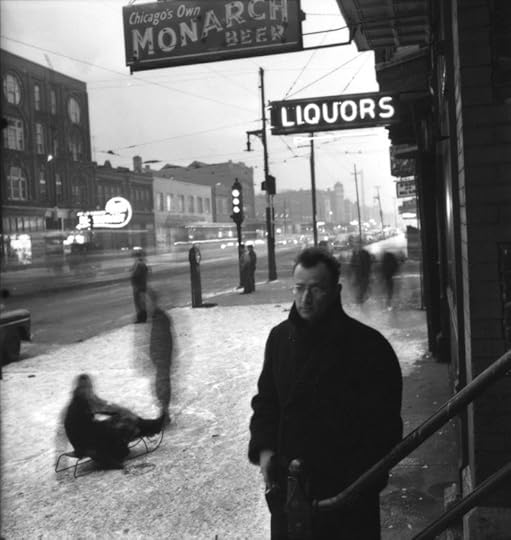
Long lonesome shadows of the December were cast on the tenements that fled the neon carnival below while the air hung wearily. This was the shadow-gatherers hour: the hour for those all over the earth who had rest neither in sleep nor waking. Some gathered their shadows like memories; but Sophie gathered hers like unborn children to her pale & secret eyes.Algren's novel involves ample Christian imagery, countered by the passing elevated trains that bind the night together, occasionally illuminated by flashing signal towers in "a world gone wrong."
She knew when the shadows waited to come by the way the luminous crucifix glowed a bit. They move toward her then for warmth, they had been feeling unwanted all day. Like for everyone else for whom things had gone wrong. She alone knew how lost all the shadows felt: it made them the dearer to her own unwanted heart, a heart weighed down by its own uselessness.
As the moon of her girlhood had woven all night: great copper strands through clouds of cloth upon the darkness's measureless loom. Moonlight that once revealed so many stars now showed her how the city was bound, from southeast to the unknown west, steel upon steel upon steel: how all the rails held the city too tightly to the thousand-girdered El.