From the international bestselling author Anthony Ryan comes the spectacular second novel in a new epic fantasy trilogy inspired by Norse mythology.
The Sister Queens have fallen and Ascarlia lies naked before the storm. A Nihlvarian plan, years in the making, has seen Ascarlia’s enemy seize the capital Skar Magnol. Now the invaders look to the wealthy port city of Olversahl to complete their conquest.
But there is hope.
Elvine is trapped at the heart of the conspiracy, yet her role in the new government offers the chance to plan resistance from within. She must tread a fine line between loyalty and secret disobedience, knowing the smallest mistake will mean her death.
Meanwhile, Thera has secured the Outer Islands, but her loyalist forces alone cannot liberate Skar Magnol. She must seek allies to have any chance of defeating the Nihlvarian threat. But her greater challenge will be to overcome her own doubts and become the leader she needs to be.
If she fails, Ascarlia will fall.
And far away across the ocean, Felnir embarks on a bloody path towards kingship whilst to the north, Ruhlin seeks escape from the tyrannical realm of Nihlvar where the mysterious Vortigurn holds sway.
Continuing the epic tale begun in A Tide of Black Steel, Born of an Iron Storm is a compelling saga of bloody retribution, deadly intrigue, and desperate courage.
"A gripping epic." – Publishers Weekly on A Tide of Black Steel
For more from Anthony Ryan, check
The Age of Wrath A Tide of Black Steel Born of an Iron Storm
Covenant of Steel The Pariah The Martyr The Traitor
Anthony Ryan was born in Scotland in 1970 but spent much of his adult life living and working in London. After a long career in the British Civil Service he took up writing full time after the success of his first novel Blood Song, Book One of the Raven’s Shadow trilogy. He has a degree in history, and his interests include art, science and the unending quest for the perfect pint of real ale.
I loved the first book and the second one is just as solid. This is an epic tale, full of action, conspiracies and fascinating characters. Can't wait for book three.
On a personal note, I love that Anthony Ryan includes summaries of the previous books at the beginning of a new instalment, it's really helpful.
Born of an Iron Storm by Anthony Ryan Age of Wrath #2 Fantasy NetGalley eARC Pub Date: Aug 26, 2025 Orbit Books Ages: 17+
Elvine is held prisoner, but not in a cell; instead, her mother's life is threatened, and now Elvine is at the beck and call of the only living Sister Queen.
Thera and others are gathering forces to fight the Nihlvarian before they take all the lands and kill or enslave the people.
This book/series has so many characters that it is hard to keep track of who is who and what they are doing. Sure, they each have their own chapters, and after a few pages, I knew who it was about and what they were doing, but there was also the fact that many months go by, and that also got confusing because when the next chapter started, they had to catch up with the previous chapter. I still don't know if it has only been months or years that have passed since the end of the first book.
Worse is the lack of depth in the characters, which is something hard to develop when there are so many. Also, most of the story is told, not shown. But it's hard to show when the story has to be hurried along, and telling makes time go by faster.
Yes, the plot and the characters are interesting, and some of them I do like and wonder what will happen in the next book, but at the same time, this one dragged on and on as the characters traipsed around the world, talked to this person and that one, made swords, a battle here and there, etc, to the point that I had to force myself to read it. I couldn't skim because of the number of characters and the extended time frame that all this happens in, so it was a tedious read that got boring.
As to the next book, I do want to find out what happens (this one was a cliffhanger), but it's not high on my want-to-read list, plus I can already guess, so I hope that's good enough.
This is violent, so it's not suitable for readers under 17.
“Born of an Iron Storm” continues the saga of the Ascarlians, the Nihlvarians, the Morvek and more. The story continues from a few different viewpoints, and we slowly learn how each person is connected. Main characters of the first book continue to grow in stature and status, not the least of which is the scholar Elvine Jurest. I have to say, I enjoyed her arc the most—she is very, very intelligent. It’s fun to realize key points along with her.
Some of these main characters have the items found in the vaults of the Altvar, and they gradually find out what said items are capable of (the spear is my favorite).
As you might have surmised from the abrupt ending of book one, this sequel contains a veritable boatload of battles. If you shy away from graphic descriptions of extreme violence, I suggest finding a different series.
Also, if you think book one ended with a cliffhanger, Anthony Ryan said, “Hold my beer” when he wrote the ending of this book. Haha, I love it, though! I’m stoked to read the final book, hopefully in less than a year.
Thank you so much to NetGalley and Orbit Books for the chance to read an advance copy! All opinions are my own.
This entire review has been hidden because of spoilers.
This took a while to get into, but I eventually found my footing.
What stood out to me was the lack of Ryan’s usual beautiful prose. This had moments, but most of the book felt like getting from point A to B. The characters didn’t develop and the plot was bloated with repetitive battles. This is definitely signs of a middle book - filler syndrome.
There are four main characters and it can take a while to settle into their POVs following their individual ambitions as they all felt similar.
I usually wax on about Ryan’s incredible political intrigue and character work, however this felt rudimentary.
”History, you see, is a weapon. But one that must be used with expert care if it is to be effective.
I did enjoy the first few battle scenes - brilliant and vicious and immersive enough you can hear the flashing of shields. But then it happens again and again…. As you can tell, I am not an action-focused reader.
I enjoy the Easter Eggs nods to his previous series (which I do recommend reading first), but I wish he leaned further into now that it seems apparent this plays a larger role.
I am hoping the finale will bring everything together as there were some parts I really enjoyed and felt gripped by. I can’t wait for the siblings to meet.
This reminded me of The Hunger of the Gods by John Gwynne.
Book Stats: 📖: 400 pages Genre: Fantasy Publisher: Orbit Format: eARC from NetGalley Series: 2/3 The Age of Wrath Trilogy
Themes: 💫: Corruption of power
Representation: 🩸: Norse Mythology
🥵: Spice: 🚫 Potential Triggers: **check authors page/socials for full list.
General Thoughts: This was a solid follow up to the first book in the age of wrath series. We continue with our main characters who we've already come to know, and love and their trials and tribulations, reaching their goals.
Ryan's ability to interweave different storylines and characters really shines in the novel. He has a way of making things cohesive and organic as he writes without hitting boredom. I really enjoyed the battle scenes that were within the novel. I feel like it was more battle heavy than the first book which I appreciated.
There were a few parts where I felt the pacing slowed down a bit, but the storylines and intrigue between the characters really kept me engaged and going forward. Slower periods don't always mean less quality. They just mean the high action was not present. But the battle scenes were so epic that I quickly forgot any of the slow parts as soon as I hit a good run.
I'm really inspired to see where the third where the third book takes us. Ryan is one of my faves so I'm sure it'll be a good time.
Disclaimer: I read this book as a eARC from the publisher and NetGalley . All opinions are my own. This is my honest and voluntary review.
This is a very solid second book in the Age of Wrath series.
The story continues where it left off (after a helpful recap) and we again follow four main character POVs. I really enjoyed this aspect of the book as it keeps the story moving forward at a good pace,, whilst avoiding tedium. There are plenty of battles and the character development is again well handled. The fantasy elements in particular are really well executed, with plenty of mystery around certain elements which adds to the intrigue and the overall journey the characters embark on.
Overall, this was a really enjoyable book and a great continuation of the series. I love the characters, world-building and fantasy aspects and am very excited to see the POVs converge even more, especially given the ending. A great read, though it didn't quite pack the punch of the first book for me.
An easy 4 stars. Roll on book three and thank you NetGalley and Orbit for the ARC!
’If war must be fought, let it be fought unto the most bitter end’
Born of an Iron Storm is the second instalment in Anthony Ryan’s gripping, Norse-inspired fantasy trilogy, Age of Wrath. We follow our cast of characters across their known-world; Thera and Elvine trapped in the now overthrown Ascarlia, eager to find a way to end Sister Lore’s tyranny, Felnir to the northern continent of Vorunvahl, desperately vying for kingship, and Ruhlin seeking escape from the dreaded Nihlvar Empire.
Born of an Iron Storm picks up where A Tide of Black Steel ended, and keeps up a breakneck pace for the majority of the book. Bloody battles are aplenty, and the political intrigue deepens as more of Ascarlia’s forgotten past is revealed. The narrative is mostly compelling, and while nothing in this story could be described as overly unique or defining for the genre, I still found myself entertained throughout. I found myself enjoying this book more than the first, largely due to its many conflicts and focus on developing the story rather than ‘setting the stage’, i.e. introducing the characters and world.
As main four pov characters do not have interlocking events / interactions this time around, I want to discuss their individual stories more in-depth.
Thera, Queen of the Isles I’m pleased to say that Thera remains my favourite character in the series, and once again has the best storyline, in my opinion. I loved the many sea-centred battles throughout her chapters, and the overall warfare-centric nature of her story. She is an engaging character, whose strong personality shines through the rest of the books weaker ones. I thought her rise to Queendom was well-deserved, and I would very much like to see her have a happy ending come the final book!
Felnir, the Sea King Unlike his sister, I did not care for Felnir’s storyline this time around, nor his overall character. Felnir went from a character I found mediocre in the first instalment, to one I found quite grating and dislikable this time around. His overly inflated ego, which is only egged on by the simpering side-characters he travels with, grew and grew and GREW throughout this book, to the point I couldn’t get much enjoyment out of his chapters. While the battles were a fun read, they culminated in what was an incredibly lacklustre final chapter. I have an idea of the role Felnir will play in the coming book, but the execution of us getting there and his overall huge disconnect from the rest of the story made for some aggravating reading at times.
Ruhlin, the Promised One Much like Felnir, I didn’t care much at all for Ruhlin’s storyline. However, unlike Felnir, I did care for his character! I enjoyed seeing him grow in confidence and develop into his leadership role, but I took next to no enjoyment out of his plot. While the other storylines are action-packed or at least filled with things happening, Ruhlin’s tended to sort of plod along, with entire chapters dedicated to rather empty nothingness - this largely being travelling or base-building. It didn’t make for engaging reading, and this was worsened by my personal lack of interest in the Morvek. I’m sorry, but if I have to choose between the events in Nihlvar or Ascarlia, I’m going to choose Ascarlia every time. That world and its plight is just more compelling than the Morvek’s, and it made Ruhlin’s plot all the more boring. Oh and the ‘twist’ reveal that concluded Ruhlin’s plot (and the overall book)? Utterly predictable.
Elvine, the Spear Maiden Elvine’s storyline was a breath of fresh air this time around, and far more engaging than her previous one. The political intrigue, while basic, was plentiful enough to capture my interest, and I very much enjoyed seeing her interactions with Sister Lore. While her plot was simple, it was still effective, and I enjoyed her development from a quite meek and naive girl, to a much more brave and headstrong woman.
Overall, Born of an Iron Storm gets 4/5 stars. While I wouldn’t say this series has done anything spectacularly special for Norse-themed fantasy, nor does it standout in my mind from other series in the genre, it remains an interesting albeit conventional story.
thank you to Netgalley and the publisher for an e-arc in exchange for an honest review! <3
Thank you Netgalley for an eARC of this book! I was so excited to receive the second book to Age of Wrath series. I absolutely love Anthony Ryan’s stories, and Covenant of Steel is my top favorite series. Tide of Black Steel was a great first book into a follow up series from Covenant of Steel. And Born of Iron Storm picks up right where Tide of Black Steel ends. Luckily there was a recap at the beginning, so I was able to refresh my memory which was super appreciated.
Again, we are following 4 main point of views throughout the story. Felnir is working to achieve his kingship, Ruhlin is trying to get to safety/freedom from his captures but it seems he will never truly escape or find safety. He has a bigger role to play than he wants. Thera is fighting against the invasion of the Nahlvarians and has received the loyalty of the Outer Isles. Elvine is stuck with the traitor queen and is trying to find a way to escape.
I enjoyed each character’s story, but overall each character’s story was not as exciting in this book as they were in the previous book. This is definitely a book 2, buildup book. The ending has me excited for the next installment, but Born of an Iron Storm definitely was slower and felt more like it was moving the characters into place for book 3.
There were times I had trouble motivating myself to read. I believe the reason I had such a hard time is because of the multiple point of views. Unfortunately, right when I would get pulled into the story, the chapter would end and so would that character’s story for the 3 chapters… I constantly felt like I was getting pulled away from the a story and thrown into a new one that I had to get re-interested in. I think this is why the Covenant of Steel series and Blood Song (only book 1) were my favorites, were because they were just one point of view. The stories of the various characters are great, I just wish there weren’t so many breaks.
I was also disappointed Colvyn was hardly in this book, and he didn’t even have an appearance until about 60% of the way through. I did enjoy this book, and I am ready for book 3, but Covenant of Steel is still my favorite.
There is a scene in this book where Colvyn carries old man Magnus Gruinskard and says:"I hope he is worth the trouble." The answer he gets: "Without him, the boat doesn't sail." In a way, this sentence actually represents perfectly the strongest sentiment I have about this novel: without the old man this ship doesn't sail, or at least, doesn't sail as smoothly.
The story continues right where we left off. The realization of war coming to Ascarlia has finally dawned on everyone with the Nihlvarians pulling their decapitation strike off in Skar Magnol. It's left to our heroes to gather what's left of it and fight the enemy.
Freed from the clutches of slavery, berserker Ruhlin and his small crew of friends are trying to get away from the wretched Nihlvarian land, but the only way to do it is the same way they get there, which is by the ship. That's a hard thing to get when you are a fugitive so Ruhlin decides they need numbers. And where else to look then to fellow enslaved Morovek people? They are divided into various clans and scattered around, but the monster in him may unite them behind his cause. Thera's simple task from Sister Iron grew into full onto battle for Outer Isles she managed to win, but the war is not over. Ever dutiful, she sails to call on all Veilvalds to join her fleet against Nihlvarian ships but it's her prowess for fighting and keen strategic mind that earns her a loyal following of people willing to fight for her. Felnir turns his course to Vorunvahl, the long forgotten kingdom beyond the Fire Isles that ancient Wothin says it's his to claim it because he has the legendary Sword of Altvar. But, of course, he knows that you don't just get to become king because you have a sword. Kingship is a thing you build through acts of extraordinary courage worthy of a legend and swift strategic alliances in right places at the right time. Appointed to a service to the new High Queen of Ascarlia, Elvine Jurest doesn't have a lot of options. The capital is filling with black ships with red sails and it's her duty to sell Volkrath propaganda to the people. Her only chance is to throw it in with the one single person she doesn't want to, Magnus Gruinskard.
When it comes to plot, it's dense and it's scattered through different places with so many new characters introduced, but I didn't mind. Essentially, it's all about laying the bricks for the showdown that's bound to happen in the final book of this trilogy and I trust Ryan to make all these story-lines converge into epic ending. So, my focus was more on characters. All five of our pov characters in this novel are, in a sense, on their own path to greatness, writing their own saga: they have a skill or a gift or a mythical weapon, but they earn the loyalty of others the only way Ascarlians know and respect: by throwing themselves right into danger, by risking their lives for others, with a sword and blood. It all sounds very heroic and Viking-like, but I have a penchant for more complex characters. That's why Thera's chapters were the one I struggled the most with. She is a perfect Ascarlian and it's like everything works out for her. On the other hand Felnir's chapters were some of my favorites because he knows he has to work for everything and he is ambitious, but he posses more heroic traits than he himself realizes. Other pov characters are in between and sometimes their chapters work because side characters are shining. I got really hooked into the story when the old man Magnus was pushing our unwilling characters to do his biding. He was not as present in this novel, but when he was he was he electrified every scene. He reminds me a bit of a Luthen Rael from Andor with his ruthlessness and willingness to do anything. Another one worth mentioning is Synghild Vyrnvest, Veilwald of the Speldmeara Geld who was so intriguing and continues the streak of Ryan writing great female side characters. Colvyn? Still amazing and not enough present in the novel.
So, all in all, this reads like a prelude that prepares us for the main event to come. Considering how much Ryan put effort into it, I can't wait to read how will all go down. But most of all, I can't wait to read the inevitable family reunion scene. :) p.s. Surely, I can't the only one wondering just who did Alwyin hire to teach Colvyn how to fight?
I would like to thank Netgalley, Little, Brown Book Group UK / Orbit and Anthony Ryan for an advanced copy of Born of an Iron Storm. All opinions are my own.
Anthony Ryan delivers another masterclass in epic fantasy with Born of an Iron Storm, the second installment of the Age of Wrath trilogy. Picking up after the devastating fall of the Sister Queens, Ryan throws readers into a world teetering on the brink, where betrayal and courage collide at every turn.
The stakes are monumental: Ascarlia’s capital has fallen to the Nihlvarian invaders, and hope seems all but lost. Yet Ryan crafts a tale where resilience shines through darkness. Elvine’s desperate dance within enemy ranks—balancing loyalty, deception, and the ever-present threat of death—is riveting. Thera’s struggle to unite fractured forces and overcome her own doubts is both inspiring and heartbreakingly real.
Ryan’s world-building is as immersive as ever, weaving Norse-inspired myth with political intrigue and bloody retribution. The pacing is relentless, the action sequences pulse with intensity, and the characters’ internal battles are as gripping as the external ones. Every chapter brims with tension, sacrifice, and moral complexity.
Born of an Iron Storm cements Anthony Ryan’s status as a master storyteller. This is epic fantasy at its finest—unpredictable, emotionally charged, and utterly unforgettable. Highly recommended for anyone who craves a saga that lingers long after the final page
This entire review has been hidden because of spoilers.
A brilliant continuation of the series. There are many great moments, then others when you cry out, "Noooooooo!" Born of an Iron Storm is a thrilling read from start to finish.
Thank you to NetGalley, the author and publishers for access to this ARC 📚.
Genre/Themes: ⚔️⚓️📜🏹🌋🌊🐈🔮💪🏽 Tropes: Epic Quest, Grand Battles and Sieges, Legendary Artifacts, Legends and Mythology, Prophecies, Reluctant Hero, Sacrifice, Unlikely Alliance, War Between Kingdoms, Corruption and Redemption, Cursed Positives: well written action and conflict scenes, intriguing world building aspects Room for Improvement 🔎 : weak characterisation, slow pacing, less engaging prose Rating: 🌕🌕🌖
✍🏻 Full Review - RISK OF SPOILERS 🛑
I really didn’t get on with the first book in this series so went in with low expectations for the sequel. Those expectations were correct, it turns out. Every Anthony Ryan book I have read has put me in a huge reading slump. Every time I tried to power through a good portion of this one, I would suddenly wake up to the sound of my iPad falling on the floor.
🧍♀️Characterisation:🧍♂️ The characterisation was somehow even weaker in this instalment, and to add insult to injury an absolute myriad of supporting characters were thrown in there for no valuable reason. The POVs were still those of Thera, Elvine, Felnir and Ruhlin, but there were pairs of characters with names beginning with T, D, C and V that I genuinely got confused over every time. I truly believe that Thera’s POV was completely unnecessary in this series. Her becoming Queen of the Isles in this sequel might have been interesting for her character, in the sense that she had learned to utilise her leadership rather than use it to be subordinate to the Sister Queens, but that aspect didn’t do anything to carry the story forward. The only interesting aspects of her POV were nothing to do with her, really. It was Lynnea and her mysterious powers, and her great-grandfather with his dream-walking ability. Her great-grandfather is more prominent in Elvine’s POV and Lynnea could easily have been slotted into a different POV, so overall Thera just wasn’t an interesting enough character and I always skim read her chapters. The attempts to create the will-they-won’t-they between Thera and Lynnea fell extremely flat, especially considering the first novel saw them as nothing more than friends and then suddenly they’re in bed cuddling from the start of this one. THEN Thera… rejects her? Even though they’d basically been acting like a couple all along? No real development whatsoever. Elvine was far more interesting, becoming Sister Lore’s greatest enemy and having to protect her homeland with the Spear of the Gods. Watching her use her skill in rhetoric for herself rather than the Sister Queen, learning to wield the spear and become battle-hardened, was great. But absolutely all of her relationships were half-written, despite being some of the most interesting in the novel. Her new found brother, her mother, Sister Lore, Lore’s brother, even Thera and Felnir’s Great-Grandfather could all have been deeply explored, but weren’t. When it was randomly slipped in that Lore was in love with Elvine I genuinely did a double take. Absolutely nowhere did that feel developed. I thought a matronly love, sure. But IN LOVE? Enough to seek vengeance on her for her betrayal and breaking Lore’s heart? Nonsense. Lore’s brother at least flirted with Elvine, but even then his interest was apparently so significant it had been foretold and made him hesitate killing her, yet at no point did his feelings come across as serious or genuine. Not justified by the writing at all. Felnir felt like such a huge afterthought in this book. He was destined to be a King, and going around trying to convince everyone he should be one. But his character felt like it had gone nowhere. He was my favourite in book one and in book two I couldn’t really tell you what his arc is. Ruhlin changed in the sense he had gone from a coward in book one (which never seems to be mentioned, by the by) to a leader, a servant of the Gods reborn having to make sacrifices for his family. But like Elvine, his relationships with others were such missed opportunities. His relationship with Aleida was already rubbish in book one, and it didn’t change in book two. In fact it was good that people kept mentioning their relationship because I honest to God would have forgotten. There are no truly loving interactions between them at all. Then they ADOPT A CHILD! A child that Ruhlin conveniently forgets all the time! Never interacts with! A truly pointless addition. All the characters in his POV from the Morvek were indistinguishable from each other and his friends from book one were barely mentioned until one of his final chapters, so when they died I felt nothing. I’d basically forgotten about them anyway. The biggest issue was his friendship with Guthnyr. I was told they were friends rather than shown, which was a crying shame because Guthnyr could have easily been one of the most interesting characters in the series. But, as usual, he was an underdeveloped and largely forgotten supporting character.
🗺️World-Building:🗺️ I admire Anthony Ryan’s ability to conjure realistic politics and wars, I truly do, but there were so many aspects of magic in this book that were so much more interesting and yet overlooked completely. The weapons of the Altvar, the dream-walkers, Ruhlin’s beast, Aleida’s magic with metal, her aunt’s existence in a literal bear, Ruhlin’s confrontation with a dark magical beast from a different world, Lynnea’s powers including telling truth from lie, Wohtin and other characters living for hundreds of years… where were all of these aspects truly going? Why did nobody seem to be questioning any of it? Is any of this going to be explored at all in book three, where these powers come from? How they are wielded? Why certain individuals are chosen to possess these powers? With such a heavy emphasis on the sieges and gathering of allies the magical elements of the story feel impossible to expand on properly and so don’t feel immersive. The other big issue in the world building that still exists from book one is the religions and cultures. I am still so unclear on what the difference is between the state religion of the Sister Queens and the Ascarlians, the Nihlvarians and the Volkrath, the covenant that Elvine came from, the world Felnir is in (I don’t even remember the name of this empire) and the Morvek. I think I was able to discern that the Volkrath were a cult that worshipped a sole individual called the Vortigern, not the Altvar? The Morvek had their own culture, again not clearly explored which was completely criminal because it turned out they had their own government, religion and history. I had no idea which gods they followed. It didn’t help that Morvek and Nihlvarian was sometimes written as if it was interchangeable and I don’t think that was intentional. Unless they both counted as Nihlvarian because of living in the Fire Isles? As usual, very unclear. I don’t even remember any of the names for anything involving Felnir’s POV. It honestly felt too vast a world, history and culture to fit well in this series alongside the Volkrath Empire. Who were their Gods? Where were their powers coming from? How did their culture differ from the others in the series? I couldn’t tell you. And that whole Covenant thing involving Elvine came up at only one point in the novel, and I still don’t get what it is.
📝Prose/Plot:📝 Pacing was the biggest issue in this novel. Each chapter in each POV was painfully long, yet didn’t move the plot forward fast enough. Each switch left me trying to remember where the characters were up to, and usually it wasn’t much further than last time so completely forgettable. In fact, it generally felt like the plot hadn’t moved forward much further than book one by the time I’d finished. Elvine had only just started to get involved towards the end, Thera becoming Queen of the Isles had yet to make much difference yet and both Ruhlin and Felnir spent the whole novel wandering around more than actually achieving much. There was still a criminal lack of dialogue in this book in proportion to text, and then the dialogue that was there was a big exposition dump. It meant the characters had no chance to be likeable or interesting, or have meaningful relationships with one another. I also wasn’t sure if it was just because this was an ARC, but scene changes weren’t made clear. A character would say something and then suddenly be in a different place or conversation in the next sentence because it turned out there’d been a time skip. I would hope the scene breaks would have been laid out more clearly in the published edition. To add, the plot summary of book one at the beginning was helpful, but far too long. There was mention of things not truly important at all and just felt like it was the original chapter written out again. While siege and battle scenes were written well, they got repetitive, especially in Thera’s POV. More scenes with the magic elements could have broken this up, or scenes of characters actually spending quality time together to develop them as individuals. I will admit - I didn’t see the ending coming for Ruhlin and the reveal of the Vortigurn. It was so frustrating because it proved that Ryan can create tension, intrigue and misdirection. It just kills me that he gets so caught up in the less interesting aspects of his stories. Overall, reading these two books left me feeling like I was an idiot. Like I am just dense or not intelligent enough to follow such complex politics and cultures. But the more I analyse it, the more I realise I am not the problem as a reader. It is the authors job to give clarity and immersion. Even a complex book can be made enjoyable and digestible. This series is too lacking in characterisation or fantasy world-building for me to enjoy, but if you like reading about naval battles or land sieges then this could be for you.
Review: I have a hard time getting into novels that prelude almost a quarter of the novel with a narrative back story. Not only was the preview lengthy but entirely confusing with all the story line shifts and name dropping with no definitive breaks between. One moment your in a jail cell and the next someone is killing some Queens.
The writing is good and deserves attention. Perhaps I got here late to the party.
Really enjoyed this and got through it pretty quick too It's Anthony Ryan so not surprising at all but built on everything in the first one and then some.
The world building is excellent and really jumps off the page. It's vivid and takes us to a lot of different places and locations but they are all so clearly described. It fits really well with the stories and the locations and characters and just adds to the appeal. There's also a clear historical bent too with some mediaeval themes especially Norse and European. I always find it intriguing to try and match who the nationalities in the book might match with in reality. It's not always super clear but I like trying.
The characters are excellent as they were in the first but really developed their characterisations in this one. Thera was excellent as she was in the first and you could see her excel at what she does best but also changes as the weight of expectation starts to affect her. But she is clever, loyal and quite a good judge of character. Especially as she has the excellent lynnea by her side and she also gets a little bit more time in this one which was great.
Ruhlin also is a great character. Unsure of his role and place in the world and lacking the confidence of Thera or Felnir he really starts to settle into things and does his best to be the steadfast, loyal and forthright leader he needs to be. Felnir is also great in this one as he knows who he is unlike Ruhlin but can't make anyone else see it. He has always been underrated and dismissed but those days are over.
For me though in the first one and then more so in this one Elvine is my favourite and the star. Smart and a brilliant scholar she really learns so much about herself and her true nature and calling as her journey unfolds. She is strong and unflinching in her resolve and while she can't see it for most of the book by the time it gets towards the end we certainly can. There's an especially good description of her near the end that really highlights this. And while he's not in it much I hope her brother Colvyn gets a bit more airtime soon as he's got a lot of potential.
The plot is fairly simple but there are a lot of threads being weaved together. It's quite intricate and while there is a lot going on it's never overly complicated. The pacing is good and there are some brilliantly written battle scenes especially the naval ones. Oh also quite the suspenseful revealing style of Cliffhanger ending. And I do love a Cliffhanger ending.
There are a lot of political intrigues and machinations and also themes of trust, family, honour, loyalty and loss. They are well written and fit really well with the characterisations and plot and world building.
Overall it's a fantastic second book that takes so much from the first and then builds and expands on it. Great locations and historical elements with some fantastic characterisations. Highly recommended for those that love fantasy with a magical and historical element.
Anthony Ryan is rapidly becoming a favorite author of mine. He is brilliant at writing engaging stories, and dragging you into the world he is spinning.
Born of an Iron Storm starts up right where the first one left of. And hallelujah for that because that cliffhanger was intense!
The for POVs we have, Fjelnir, Thera, Ruhlin, and Elvine, are still distinct and their lives have all taken a hard turn from book one as a consequence of the fall of the Ascarlian Queens at the machinations of the Nihlvar Empire.
It's really interesting to read about sea battles, because I haven't read any before. I find it really engaging since it seem like there's a lot more to it than warfare on a battlefield. Or at least that is how Ryan writes it.
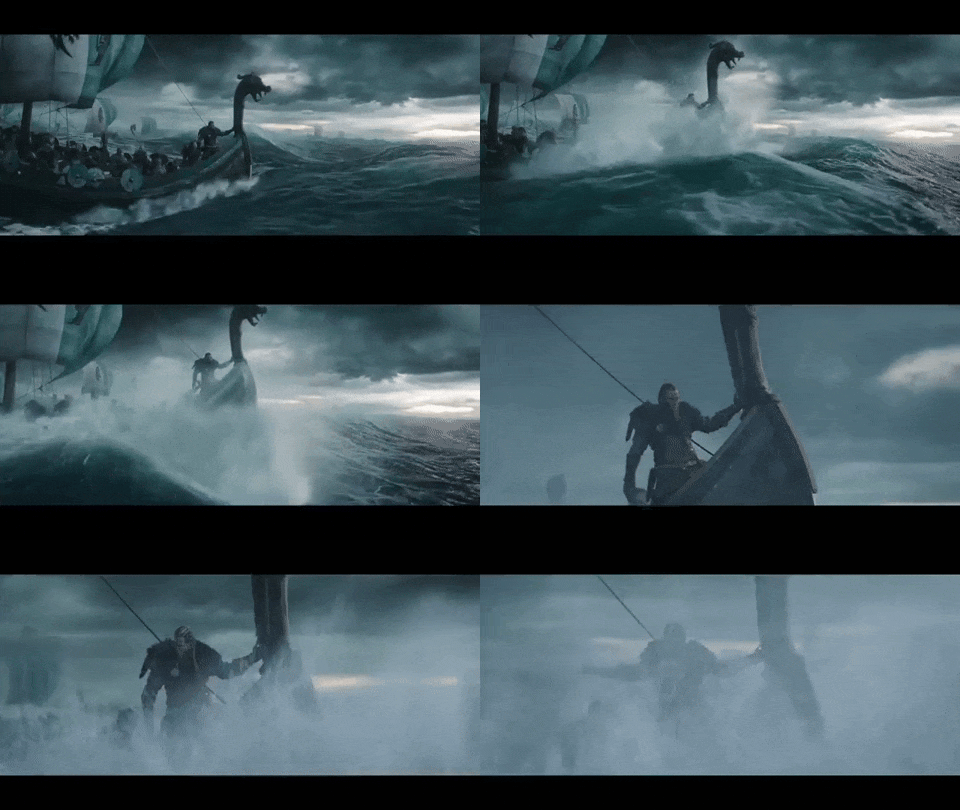
I've played AC Valhalla for way too many hours, so I'm basically imagining Thera and Fjelnir as Eivor - IYKYK.
Also, the plot twists? I did NOT see them coming.
It's also great how events in Covenant of Steel series is rippling into Age of Wrath. Yay for worldbuilding across series!
That cliffhanger I mentioned above from A Tide of Black Steel? Well, Anthony Ryan is not holding back on them! I'm chomping at the bit to find out what happens next. It will likely be an explosive ending!
3.75 stars
i>Thank you to NetGalley and the publisher for the eArc in exchange for an honest review. It's highly appreciated!
I'm loving this series! Like the first book, I found all the POVs to be equally compelling and am SO excited to watch them intersect further. In the first book, I found Felnir's POV to be the weakest (while still super entertaining) and am really pleased to report he was actually one of my favorite POVs in this book. My all time favorite remains Elvine--she is such an interesting character.
I am really impressed by Ryan's worldbuilding. You can tell a lot of thought was put into creating the world and it feels very real and lived in. I love fantasy, but can admit that not many books really succeed in this regard.
There were some parts where the pacing was slow and it sort of suffered from "second book syndrome", but ultimately I think those slower parts were necessary to build up the massive battle scenes in these books. Seriously, the last like 20% had me in a chokehold I am so incredibly excited for the third book!
I received this book in the goodreads giveaway, and while it took me some time to get into it, I’m glad I did. I really enjoyed the progression of the characters as time went on and how the majority of them displayed more than simple surface emotions and motivations. And as a major plus, the plot wasn’t driven by characters making stupid and impulsive decisions that result in them having to find a means to deal with the consequences as seems to happen in fiction so often lately.
Book two in The Age Of Wrath Series. It's been a while since I read the first book, so the recap at the start was helpful. The story continues where it left off in book one and is once again told by the 4 main characters - each has their own POV chapter. Like the first book, it's full of conspiracy, corruption, power, and plenty of blood and gore. Jeezo, that ending, though. I need book three now!
Better than 3 stars but very frustrating. 400 plus pages, dozens of characters. But absolutely no resolution at the end. Now you have to wait 2-3 years for book 3. Ridiculous. Plus, with the “talking spear” I kept thinking of Beauty and the Beast. Very distracting.
In many ways, my review of A Tide of Black Steel fits its sequel, Born of an Iron Storm. The dark, Viking-inspired fantasy has the same visceral action, clever treachery, and inspiring bravery that made the first installment so engrossing. Unfortunately, not all the strengths carry forward and, even more than before, it feels like a prelude to the main event.
Just like its predecessor, reading Born of an Iron Storm feels like stepping into another world. Inspired by Vikings, the world-building is familiar yet also fully its own thanks to rich historical and cultural detail that goes beyond being simply aesthetic to one where the characters behave in ways foreign to our own world. This time, the attention to detail is even more impressive, both in terms of the logistics of battle and the introduction of new cultures. An isolated Ascarlian (Viking) society provides an interesting example of how societies diverge with isolation and the Morvek people (who believe in nature spirits, not gods) are more thoroughly and thoughtfully explored in an interesting clash with Ascarlian beliefs. The large and varied cast of characters (with four POVs) continue to be engaging and easy to root for (though the sheer number of characters does sometimes become unwieldy). The plotting is quick and unpredictable, without quite managing to be as twisty as A Tide of Black Steel.
The biggest loss is that the four POV’s lack the range they exhibited in the first book. The political intrigue is largely confined to Elvine’s POV, and the treasure hunting aspect of the first novel is entirely gone. Battle consumes nearly everything. And, while the battles are often quite inventive, taken together they can start to feel repetitive.
Even more than A Tide of Black Steel, this story feels like a lead-in to what’s next. Many of the scenes are not important in of themselves, but a vehicle to more important scenes. Too many have a predetermined outcome before they begin, making character’s decisions feel inconsequential. They aren’t forced to overcome their weaknesses like the most engaging epics. The story was never boring, but it also wasn’t hard to put down.
Even though Born of an Iron Storm didn’t quite live up to my expectations, I’m still very excited for the next installment. As the conclusion to the trilogy, I expect the stage has been set and the ground laid for a thoroughly satisfying conclusion.
Thank you to Orbit Books and NetGalley for the ARC.
This is the second book in the series, and it wastes no time picking up right where the first one ended. Right away, I appreciated the detailed recap at the beginning for both the plot and the characters. With such a large cast and so much going on, that refresher was extremely helpful.
The author balances the four POVs (Felnir, Thera, Ruhlin, and Elvine) fairly evenly throughout. That’s both a strength and a weakness. On the one hand, it feels fair and structured, but on the other, it means you’re stuck spending equal time with characters you may enjoy less. Personally, I found Felnir and Thera’s arcs a bit too similar, repetitive even, and reminiscent of tropes I’ve already seen in Norse inspired fantasy. Because of that, I didn’t feel very connected to them. On the flip side, Ruhlin and especially Elvine’s POVs stood out for me, with Elvine’s storyline adding something fresh to the mix.
This book is very action-heavy, filled with battles from start to finish. While that keeps the pace moving, I sometimes found the constant fighting overshadowed deeper character moments. Another struggle for me was the naming conventions. So many side characters, places, and titles started with T, V, or C that I often had to pause and use context clues to remind myself who was who. This could just be a me thing, but it did trip me up.
Overall, Born of an Iron Storm is a decent continuation of the series. It didn’t really bring anything new to the genre for me, but it did succeed in building tension and setting the stage for what should be a big, action-packed finale. I’m definitely curious to see how the author ties it all together in the final book.
I received an ARC of this book from NetGalley and Orbit in exchange for an honest review.
I like it, but for whatever reason, this was a lot more tedious to get through. The downside of these epic sagas is that you feel like you’re doing homework when trying to remember the storylines from the previous book.
I enjoyed this second installment of Anthony Ryan’s Norse mythology series, but it fell a little short for me. With so many names and characters it was hard to keep track of who everyone is and I didn’t quite enjoy the plot as much as the first novel. However, this was still an impressive piece of high fantasy & I recommend to anyone who has enjoyed other Ryan works.
Thank you to Orbit Books for providing this book for review consideration via NetGalley.
The second installment of this series was a satisfying read. Not a masterpiece by any means, but an enjoyable read. The author has created a traditional epic fantasy, which seem to become fewer each year a traditional fantasy epic full of bone-crunching, bloody epic fantasy full of naval and land battles with a large group of characters.
It was appreciated that there was a recap at the beginning of the novel to help readers to familiarize themselves again with where the story left off. To avoid spoilers, I will not go into many plot details but provide only general impressions after completing the second novel in the series. If you haven’t read the first novel of the series, I would strongly recommend that you do so. It is a great novel that will help you to understand the characters better.
The novel is set in a fantastical Norse inspired world. My impression is GOT without the dragons, but with Vikings. There are multiple POVs of reluctant heroes who are scattered across the islands on their own individual quests to bring harmony back to the different warring factions of this kingdom. A few of the heroes have magical weapons that could change the landscape of this kingdom forever. Multiple chess pieces are being moved around the gameboard through these individual POV storylines that will eventually lead to something monumental as characters come together in the next installment, which is common in epic fantasy when it comes to the second novel of a series.
The strength of the novel of being a traditional epic fantasy is also its weakness. Epic fantasy told on a large scale usually uses the device of having multiple POVs. In this case, at times there was frustration when a chapter ended with one POV and then switched to a different POV. First, I wanted to know what happened next with the main character and the group of minor characters in this part of the story, without changing to a different POV and set of characters. This changing of POV each chapter does benefit pacing and with keeping this impression of a story of individual adventures with a large overall scope, but moving from POV to POV each chapter, can cause the reader frustration with time spent trying to get themselves familiar again with plotlines and characters in the next POV chapter before they have to start the process again when the POV changes again. All the POVs were entertaining, but with epic fantasy on a large scale, there can be reader frustration with having to get familiarized again with characters over and over again with each new chapter. Secondly, with it being a second novel of a series, while the last chapters had me waiting with anticipation of what is to come next, this novel doesn’t have a satisfying ending, but the reader is left with some frustration by asking, “Is that it?”
The novel could have also been enhanced with a POV from an antagonist to give the novel more texture to help develop some of the villains more and their motivations. I would have liked to have had a POV with Sister Lore, for those that have read the first novel, for example.
The action sequences are exciting and bloody. Throughout the novel, there are scenes of strong male and female characters battling on land and on sea. Larger scale battle sequences near the end of the novel could be a little confusing where it is difficult to picture the actual setting where the battles took place, but overall, the action sequences were enjoyable. Also, the author does an excellent job of showing that while warfare can be glorious, horrific and at times necessary, there is tragedy for many that are directly and indirectly involved when violence is the answer.
I look forward to the next novel in the series. Also, I can see myself checking out other novels by this author as there is talent here, and what I have read so far by this author has been enjoyable. I want to fully thank the publisher Orbit and NetGalley for this ARC in exchange for my honest review. I look forward to reading more from this author in the future.
Since this is an ARC, the review aims to be as Spoiler-free as possible.
The grimdark Norse-inspired (Norsedark, yes, I am making it a thing!) trilogy Age of Wrath continues with its bloody sequel, Born of an Iron Storm.
Famous for his Covenant of Steel series, Anthony Ryan chose to set his next trilogy in the same universe. The Age of Wrath trilogy focuses on the Viking-analog Ascarlians as they navigate their own bloody and violent intrigue. The second entry in the series, Born of an Iron Storm, continues the perilous journey of our five protagonists.
I reviewed the first entry in the Age of Wrath series, A Tide of Black Steel, calling it one of the standout grimdark novels I read that year. I praised Ryan’s ability to tell a tight narrative with plenty of darkness, breakneck action, compelling characters, and a plot that keeps you on your toes.
Born of an Iron Storm continues to follow the five POV characters, similar to A Tide of Black Steel, as their journey continues. The siblings Thera Blackspear and Felnir Redtooth continue to diverge in their paths, possibly toward an exciting conflict in the finale. Thera attempts to reconcile with her new place in the world after the drastic concluding events of the first entry. Felnir, in contrast, is determined to forge his path to greatness by any means necessary. The berserker Ruhlin struggles in his new role as unlikely hero, and the scholar Elvine realizes that perhaps she has more in common with her lineage than she had imagined.
The central core of Born of an Iron Storm is the pursuit of destiny. Our five protagonists continually wrestle with their destinies through the events in this sequel. Some have their destiny thrust upon them and grudgingly rise to the challenge, while others try their best to shrug off the identity and destiny placed upon their shoulders, knowing the burden it would entail. Some will believe any destiny shown to them if it leads them to power and fame, and are willing to pay the price in blood.
One of the major complaints in my review of A Tide of Black Steel was the lack of a clear overarching plot to the book. It came off as a summation of individual character quests, feeling rather disjointed for most of the book. Being the middle book in the series, Born of an Iron Storm does a better job of cementing the overarching plot of this series — the struggle of the Ascarlian people against the mysterious Nihilvarian people under the dread leadership of the evil warlord dubbed the Vortigurn.
However, Born of an Iron Storm does suffer from middle-book syndrome more than I would have liked from an Anthony Ryan novel. This book reads more as a way to set up the board, pushing the individual characters and plotlines into place for the showdown in the third novel. With plenty of action setpieces throughout the novel, every character is pushed to the bloodiest limits of their physicality and morality. Ryan continues to prove to us that he is among the best at writing battle sequences that are adrenaline-fueled without losing focus on individual events.
He also excels at character work, giving even side and minor characters enough depth to make the world come alive. However, I wish there was more significant growth in at least two of the main protagonists as they battle with their enemies and destinies. In addition, I prefer my grimdark with as little magic as possible, relying on grounded grit. Like the second half of the Covenant of Steel series, Ryan is slowly amping up the role of magic in the Age of Wrath trilogy, and I am not completely sold.
Born of an Iron Storm is filled to the brim with violence, betrayal, blood, gore, and steel — all the goodies we love in our Norsedark novels. I have quickly become a must-read fan of Anthony Ryan, and I am waiting, axe in hand, for the bloody conclusion to the Age of Wrath.
Advanced Review Copy provided in exchange for an honest review. Thank you to Orbit Books and NetGalley.