В городке Ривер-Мидоуз находятся крупнейшие в мире залежи загадочного минерала под названием «призрак»: его стоимость в двадцать восемь раз превосходит стоимость золота. Новый источник энергии вызывает немало споров среди ученых, которые связывают его с аномальными временными волнами, возникающими в процессе добычи и обогащения руды, а также с рядом странных симптомов у местного населения. В результате ужасной катастрофы несколько сотен гектаров возле месторождения, включая большую часть Ривер-Мидоуз, эвакуируют и огораживают. Запретную теперь для людей территорию саркастично называют «Заповедником», хотя, что на самом деле находится по ту сторону забора, никому не известно...
I live near Edmonton, Alberta, Canada and write for grown-ups and children. My newest novel, The Book of Rain, will be published by Random House Canada in 2023.
Did I mention that I want to support Canadian authors?
Did I also mention that I am not a fan of science fiction or fantasy?
Toward the end, you definitely felt like you were in the Twilight Zone
Or in a Dr. Who Time Warp...
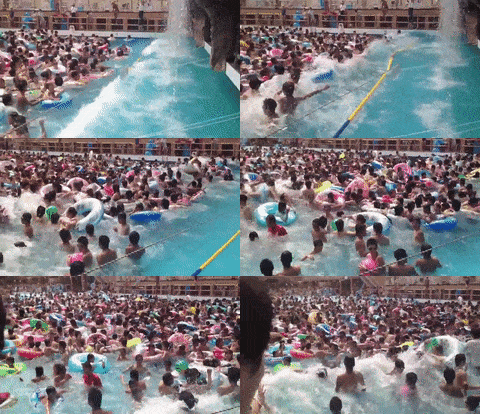
I knew I was in trouble when the author described - at length - Claire's adventures in a wave pool.... This type of unconnected filler messes with the tone and mood of a story. I get it that this character, who illegally poaches animals for a living, was trying to blend in with the rest of the tourists in the hotel, but I could have done without this odd distraction.
The story became downright fantastical toward the end. (Not my cup of tea at all!)
The moral of this story?
As usual: we stupid humans always mess everything up for all the other sentient (and not so sentient!) beings on this planet.
I'm rating this a 3.4 out of 5. My thanks to the author, publisher and NetGalley for an ARC of this novel in exchange for an honest review.
I received this e-arc from NetGalley in exchange for a fair review.
Blending genres, timelines, and characters, The Book of Rain is an eco-fiction that shows how our connection to the nature around us is both strong and tenuous.
It’s part sci-fi, part environmentalist message, part character-driven stream-of-consciousness meandering. I tend to enjoy all three of these aspects, so I found this book entertaining, enlightening, thoughtful, and interesting, though I wouldn’t go too far as to say it’s fascinating or too emotional.
While there are some minor characters who have a point of view (Michio’s part was my favourite), the two main characters are Alex and Claire. Alex wasn’t entirely exciting as a person - he feels like a vessel at times (perhaps because he’s rather dead inside) and Claire is a trickster because she starts out interesting but grows supremely unlikeable once you are involved in her story (though I think we are meant to feel this way about her! Her selfishness towards the environment is, I think, intentionally distasteful, more so because we can see the excuses she makes about her environmentally unfriendly choices reflected in average people being lazy or uncaring about their carbon footprint, how wasteful they are, the excess at which they live without heed to the environment). Both characters have arcs about finding things they’ve lost, and while they are fully fleshed-out characters, they aren’t loveable. Such is literary fiction, though.
What’s riveting about the novel is the style. If you enjoy literary fiction, you know what I mean - the blending of thoughts and concepts into and around one another, the lack of exposition or even true explanation of the events or concepts, and the flowery language.
The message behind the novel - that our fracking and destruction will not only kill the environment but lead to our destruction - I was totally on board with as an environmentalist myself.
The language in the novel is straightforward and clear (despite the stream-of-consciousness drifting), so that I was never confused. It’s peppered with metaphors and similes that tie back to the environment in a way that’s very clever.
The novel also exists in a sort of parallel dimension where everything is the same except Atlanis (presupposing it existed) never sank into the sea, and there is a mysterious mineral that, when mined in abundance, creates these space-time continuum decoherence waves that warp reality for a few minutes, either in showing other realities or other times. It’s fascinating in that it’s just an accepted part of the world so the story, while the decoherence is important to it, isn’t about “stopping it” or something. There is a part of Alberta called the Reclamation Area where decoherences run wild. It had a kind of Dhalgren or Annihilation feel to it at times. The sections of the novel that take place there, while brief, are engrossing.
The last section of the book is an epic poem that reminded me a lot of Hollow Kingdom without the comedy because it features an animal perspective. I’m not opposed to poetry in fiction, but it felt to me like it was done to save space. If you’ve read Seveneaves, you’ll understand what I mean, I think.
Along with finding the poem “alright,” I also found the novel dipped into telling and not showing a lot, which was less engaging, and there are often long stretches of dialogue that could have used some action beats to break them up. I also found Claire and Alex’s stories didn’t really tie together, so they felt like two different books at times.
Yet, overall, I really enjoyed the novel and loved the message behind it.
Special thanks to NetGalley and the publisher for a free, electronic ARC of this novel received in exchange for an honest review.
Expected publication date: March 14, 2023
Thomas Wharton is a Canadian author whose newest work, “The Book of Rain” is an emotional, thought-provoking and beautifully written examination of the world as it could be, and the connections that are made, and lost, with the world around us.
Alex Hewitt and his sister, Amery, move to River Meadows with their parents when their father finds a job working in the mining fields. River Meadows is one of the few places in the world that mine a new and mysterious form of material called “ghost ore”, known to generate energy at alarming rates, and with alarming consequences. River Meadows’ inhabitants begin to experience lapses of time and space, eventually making the town uninhabitable. When it is evacuated, its remnants are cordoned off, and the world continues at its edges. Amery returns to River Meadows, now known as “The Park”, as an adult, in a desperate attempt to try and salvage the remaining animals and ecosystems, but then she disappears, leaving Alex behind to search for her.
“Rain” is a very unique story, deemed ‘environmental suspense’, and unlike anything I’ve read before. Narrated by Alex and Claire (a character also from River Meadows, who traffics exotic animals and endangered wildlife), both sides of a very gruesome environmental battle are portrayed, both before the town is evacuated, and after. “Rain” speaks of a world on the brink- and every page of it is terrifyingly realistic.
Although the chapters are long, each section is clearly marked so it is evident whose story we are hearing. Both Claire and Alex (and their associated relations) are depicted honestly and emotionally, which builds instant rapport. The character development is on point in “Rain”, and the plot is disturbing and eye opening, with smooth flow and a powerful message.
Although Wharton is a new author for me, and a Canadian one at that, he is not a new novelist and “Rain” has piqued my curiousity. I am beyond intrigued to read his other works and see if it creates the same emotional reaction that “Rain” did. I can definitely see this unique novel being turned into a movie (or a Netflix series, as things seem to go these days) and with the right casting, it will be something memorable. “Rain” is an absolute must-read for those looking for something more in a novel, and it will be talked about for a long time to come.
4.5 stars. Thomas Wharton's "The Book of Rain" is thought provoking. Focusing on three characters, and seeding the world with some fantastic elements (e.g., Atlantis exists in this world, people mine a material that causes strange perturbations in time, etc.) to talk about species extinction, capitalism, climate disasters, and family.
Alex and his sister Amery move to River Meadows with their parents. Their father has a job working for the mining company extracting a material called "ghost ore", which causes a variety of physical and perceptual problems but is prized for its energy uses. After an accident at the mine, the town is evacuated and River Meadows is cordoned off. Amery continues to return to "The Park" (as the town is now called) for years after the disaster, and eventually fails to return after one of her visits.
Alex goes looking for her in The Park with the help of one of Amery's friends, a mathematician working on a project to create clouds that can be controlled. The two men have a profoundly disturbing experience while in The Park.
Meanwhile, Claire, a former resident of River Meadows, works for a trafficker in endangered wildlife. On assignment, while waiting to hand over her latest acquisition, she is deeply affected after she encounters an endangered bird.
Then, Wharton moves us to a period long past the lives of these three, and tells us the story of a bird looking for long lost humans, and what it finds.
The characters are wonderfully rendered, and no matter their faults, are compelling and oddly sympathetic. The world Wharton describes is in a mess, with species disappearing, climates in crisis, and some people working to repair environments, and others always ready to profit, regardless of the ethics or the outcomes.
The writing is emotional and insightful, and there are no easy resolutions for the three human characters we followed. I particularly loved the last part of the book, where we see the world through birds' eyes.
The book is stark, imaginative, and poetic.
Thank you to Netgalley and to Penguin Random House Canada for this ARC in exchange for my review.
With The Book of Rain, Thomas Wharton has penned an original, incredibly detailed apocalyptic novel. I was drawn in by the synopsis, which promised a book set in Canada, with a unique and intriguing premise that is unlike other books of the genre. However, by the time I was 30 percent into the book, I was seriously considering giving up on it, but continued on in hopes that the book would deliver on the promise of its synopsis. As I continued reading I found to be book to be disjointed, obscure, and a chore to read. I pressed on to the end, which I found to be quite unsatisfying. The writing is technically proficient, but it never grabbed me and made me want to continue. I received an advance copy of the book courtesy of #NetGalley.
I was drawn in to this book as it was an interesting concept and had all the themes of a gripping story: a missing sister, an abandoned ghost town, environmental activism, and illegal trafficking of animals in a disturbing not-so-far-off future wasteland. Sounds pretty wicked.
Although the writing was beautiful, I continuously hoped for the plot to gain suspense and further spark my interest. This was a very slow read for me. I found the story jumped around to so many different POVs and timeframes that I often felt lost and not grasping what the point is for most of it. The ending was so abstract I almost DNF 95% in.
I felt that the author created an intricate universe that he understood but unfortunately, I did not get the correct invitation to enter it. I had high hopes and now I feel a disappointed reading slump and I would not recommend.
There’s an undefinable danger twisting time and space inside the Park. What it is, exactly, is never fully explained but the results of encountering any of its many manifestations... Well, it’s a game of Russian roulette for everyone who enters the restricted area. Which anomaly will you find? Or will it find you? Will you die? Lose your mind? Just your memories? End up trapped in a pocket of space until you starve to death? The suspense, or perhaps more accurately anticipatory dread of the Book of Rain is palpable. And the assortment of ways that the Park can hurt, main, or kill the living is an unpredictable horror.
Alex and Amery Hewitt moved to River Meadows as children. It formed who they would become while it was still being formed itself by a mining operation harvesting newly discovered ghost ore. There is fear and dread even in those early days when the dangers were still... developing. As an adult, Amery continued sneaking in to save any animals trapped or harmed by these mysterious anomalies, until she doesn’t return. Then Alex does and convinces Michio to guide him safely in and out of the zone in search of her.
Claire is interesting in that her story is almost completely independent. She left River Meadows years ago and now traffics in endangered species. That is, she picks up and delivers the illegal goods. On her newest job she’s losing her nerve and messing up, but she also has an opportunity to cash in on the most valuable animal she’s ever come across. Interestingly, her story drops off before she decides what she’ll do with the creature. The reader does learn the consequences of her decision in a general sense but that’s all. Her story becomes part of the many unanswered questions in The Book of Rain.
We have a bit more resolution with Alex. While his story is much more unsettling than Claire’s (his foray back into Meadow Rivers and the anticipation of things going horribly wrong, which they may or may not, read to find out), his journey into the Park nudges him towards a sense of acceptance. He’s not necessarily happy but he seems settled with what he discovers and on how he decides to move forward with his own life.
We leave Claire, then Alex for good, and enter the distant future where the story changes direction entirely. The final 80 pages have an equally curious yet hopeful note to them in the form of a transcribed legend – a poem – about birds and humans joining together to try and save the world humans have all but destroyed. A little strange and disjointed from the rest of The Book of Rain, but it ties all the pieces together nicely.
The Book of Rain requires attention to see where Wharton is leading you, as there are ideas planted throughout that become meaningful later; seemingly random chapters about how animals communicate, Alex’s boss explaining his virtual Ark, and more.
This is a strange, fascinating and brilliantly written mixture of suspense and legend with a dash of crime. You are constantly on edge wondering what, exactly, was released into the Hewitts’ world.
Highly recommend.
Thanks to Netgalley for a copy of this book in exchange for an honest review.
The Book of Rain by Thomas Wharton is a dystopian novel based on an environmental disaster.
Let me thank NetGalley, the publisher Penguin Random House Canada, and of course the author, for providing me with a copy of this book in exchange for an honest review. All opinions are my own. So sorry for the long delay - it slipped into the gorge that is my TBR pile.
This was a hard read for me. An environmental thriller is one thing....this was long, and boring, and I simply struggled from the start. This is the first time that I started a NetGalley book, and set it aside time and time again.
I enjoy dystopian, I enjoy science fiction and I love promoting Canadian authors, especially when there are so many familiar place names.
I did not enjoy this book. It was wordy, and I often skimmed. The writing wandered all over the place, very disjointed. I didn't like any of the characters. I didn't care what happened to them. The book did not even make me care what happened to humanity. It did, however, make me care more about the animals.
The addition of Michio, enhanced the story. Unfortunately, that was roughly 75% in, and it didn't last. Even the ending didn't help.
Anyway, this is hard to rate. I have given maybe half a dozen 1 star ratings in the last 10 years. But I can't find enough good in this book to rate it higher. I feel bad, but this book simply dragged me down. Although GoodReads gives it an overall 3.25 rating, I cannot. I guess it just wasn't for me.
Anyway, until next time....
For a more thorough review of this book and others (including the reason I chose to read/review this book, my own synopsis of the book, and its author information), please visit my blog: http://katlovesbooksblog.wordpress.com/
I didn’t enjoyed the story. I think it was okay. I picked that story only because it was a free ARC from NetGalley, and I thought it has a very interesting promise, mix of my favourite genres - sci-fi, fantasy, and post-ap. However, I cannot go along with the characters, especially Claire. The writing style is good. Kind of was interesting that the last part was written in the poetry style, from the perspective of birds. Took me some time to finish the book, which actually less than 490 pages. I just was not pulled into the story not by the plot, not by the characters.
231203: read in one day. powerful, prescient, poignant. this is exactly what is needed to unravel the madness of anthropogenic climate/habitat disaster. this is gently different world presented, which allows the reader to concentrate on what is of most metaphorical importance (Atlantis as precursor to collapse of proud human culture, 'ghost ore' that generates disturbances in time as we studiously ignore real world)...
this is also written in gently Pomo way. with letters, diaries, stream of conscious, poetry... this is work which engages the reader in putting it together, not linear, not simple, with characters truly rounded and complex and seen from various perspectives in time and space, with ineradicable contingency, with frustrated 'coherence' in all plot lines. I am of the opinion the openness, the gaps, the unsaid, is what always makes work...
poetry is music: infinitely analysable but finally only 'understood' as heard. this is poetry...
What do you get when you cross Tomorrow and Tomorrow and Tomorrow, The Overstory, and Cloud Atlas? The Book of Rain.
Yes, those are three of my top favourite books, ever. And The Book of Rain will be joining them on that list.
With elements of speculative fiction looking into our future on this planet (Cloud Atlas), environmentalism (The Overstory), and video game design (Tomorrow x3), The Book of Rain is a profound and heart-tugging examination of the interrelationships between humans and the other species on this earth that is all it’s own.
I have been a long-time fan of Thomas Wharton, ever since I read Salamander as a high-schooler and the long wait for this new work was absolutely worth it. Put it on your to be read list.
I was drawn to the premise but wondered if I’d be too confused by the “slippages in time or space” aspect to properly enjoy the story. It got a bit much for me for only a few pages. It demanded careful reading for some parts to fit together but it was by no means a slog because of it. I found it an imaginative and brilliant exploration, in story and poetic form, of the implications of what we’re doing to our planet.
I wanted to love this book - comparisons to Station Eleven and The Overstory had me excited, but I learned a long time ago to take that stuff with a grain of salt - but in the end I have to go with liking it, with a lot of disappointment at the missed potential. The author created a very intriguing apocalyptic world that he was clearly excited to explore, but he never really figured out how to invite anyone else into it to share his excitement. It was always RIGHT THERE but I just couldn't get in. And I have no idea what the logic was with ending it the way he did. Anticlimactic doesn't even begin to cover it. Just a long fable/fairy tale/allegory that causes the book to end on a completely flat note. It's like if the Beatles were playing Let It Be and halfway through the overture at the end they just dropped their instruments and walked off-stage.
There is a lot of potential in the story and I really wanted to like it but it wasn’t captivating enough in the first 110 pages so I did not finish.
I was attracted to The Book of Rain because it is set in the Canadian province where I live. I liked the idea of an alternate history with an ore and of ripples in time. This being a climate change fiction also piqued my interest. I found the writing beautiful and the notes on bird and animal patterns as well as the fictional history of River Meadows informative but not enough to create an emotional connection. I was intrigued by the characters and setting but not immersed enough to be completely invested to know more. I found the narrative to be challenging because the two characters are in separate locations and both are built through flashback style storytelling. There is a lot of jumping around in time and it didn’t build a cohesive plot of where the book was going.
Many thanks to the publisher for a review copy of the book for an honest review.
This was an interesting one to read. I had to really force myself to pay attention to the different characters and the jumps through time, Some parts seemed very important while you were reading them only to find that they weren't in the grand scheme.
Set in a not-so-distant future, a new "ghost ore" is mined and has serious environmental repercussions. The open ending was slightly disappointing, I kept trying to flip to the next page thinking my kindle was frozen so I was left a little confused and underwhelmed.
Thank you to NetGalley and Penguin Random House Canada for an advanced reader copy.
“The northern mining town of River Meadows is one of three hotspots in the world producing ghost ore, a new source of energy worth twenty-eight times its weight in gold. It's also linked with slippages of time and space that gradually render the area uninhabitable. After the town is evacuated, the whole region is cordoned off, the new no-go zone wryly nicknamed "the Park."
Three intertwined stories flow from the disaster of River Meadows. Alex Hewitt and his sister, Amery, were among the first to be shipped out of the contaminated town. Now an accomplished game designer, Alex has moved on, but his sister has not, making increasingly dangerous break-ins to save animals trapped in the toxic wasteland. When at last she fails to return from a trip inside the fence, Alex flies to River Meadows to search for her, enlisting her friend, Michio Amano, a mathematician who needs to transcend the known laws of physics if he and Alex are to succeed.”
If the Book of Rain was a short story, it would fit very well with How High We Go in the Dark – speculative fiction, post-apocalyptic, “easy” fantasy, hint of mystery. This also has a sprinkle of Hollow Kingdom (minus the zombies and a funny crow) with its talking birds.
I’m glad Thomas Wharton discussed Alberta’s oil sands in the book through the “ghost ore” and I enjoyed the Canadian references and “decoherences” aka next-level déjà vu. But oh man was this ambitious! I found it hard to follow with multiple POVs, flashbacks, diary entries, and the random drift to stream-of-consciousness writing, and because of these, I highly recommend picking up a physical copy rather than audio. As some reviewers have said, this story really picks up around the 60% mark… which is a little too late in the book lol. Since I did not quite enjoy this, I’m going to feature a few articles about the “ghost ore” aka Alberta’s oil sands in this post. 1. This is the world's most destructive oil operation—and it's growing by Stephen Leahy (April 2019) 2. Canada’s Tar Sands: Destruction So Vast and Deep It Challenges the Existence of Land and People by Nicholas Kusnetz (November 2021) 3. World of Change: Athabasca Oil Sands (Earth Observatory – NASA)
This is my first book by Thomas Wharton. He has a great writing style, and this novel gripped me right away. There are several stories happening at the same time. Alex is returning home to look for his sister, Amery, who has gone missing. In a flashback, we learn that when their family moved to River Meadows they encountered a strange phenomenon that the locals refer to as “decoherences”. Nearby, they are mining a substance known as ghost ore, causing these “wobbles” in reality. The occurrence caused Alex to have a vision of the future and Amery to fall into a sort of short-lived coma. Claire was also in the restaurant where this time wobble occurred, and in her present storyline she is travelling across the globe trafficking exotic animals. Throughout the book, there is also a thread of the animal ecosystems and how humans are affecting them. There are also rogue clouds, made up of nanobots I think, affecting the weather.
All of the pieces of the story keep you guessing, wondering how all of the characters will be connected in the end. I couldn’t put this down, I read it in a day. It started out with a fascinating and suspenseful sci fi premise. I could have done without all the comic book and superhero references, but I was fully invested in the outcome.
Let me just say, the outcome was so anticlimactic. I don’t mind endings that are open to interpretation, but this ending was not satisfying at all. The style went from speculative science fiction to spiritual-fantasy at the end, and only one of the story threads was followed through to a resolution. It really left me hanging.
I received a digital review copy of this book from NetGalley.
I have several thoughts and unfortunately I cannot write them in a neat little paragraph because I'm just confused atp:
1. I wish the different povs connected in a more meaningful way.
2. I feel like there was SO MUCH information in here and most of it wasn't even really necessary
3. So many unanswered questions 😩
4. I felt like I was sitting in front someone being told a story rather than experiencing the story with with characters. I feel no connection to any of them except maybe Michio.
5. Who is Reyna??¿???
6. Alot of skipping around with time that was easy to follow in the beginning but became increasingly confusing near the end. Also, there were details littered throughout that I know meant something and should be connected someway somehow, but it was just a lot of information and too confusing
[SPOILER BUT NOT REALLY BECAUSE I'LL KEEP IT VAGUE]
7. What do you mean grandson????? Who's the mom????? Where have you been??? Where are you now ????? Hello?? I'm confused 🧍🏿♀️
This entire review has been hidden because of spoilers.
A unique eco-dystopian story with flawed execution.
This book has all the things I look for, it's written by a Canadian, it's sci-fi, eco-horror/dystopia and recommendations that liken the book to Station Eleven. My expectations were set, however the book I was hoping to read doesn't start until the 60% mark.
We're following a young brother and sister who pass through a small Alberta mining town with their parents. Mysterious wobbles, or decoherences give people glimpses of alternative realities, and sends the young sister to a hospital. The family decides to call the town home and never leaves. We meet the brother as an adult when he can't get ahold of his sister and goes back to their hometown to find her. Now the decoherence has taken up a widening space around the town, forcing residents to leave, a fence to be built and people to be kept out. We find out his sister has been returning to document the mysterious events happening within it's borders, and is likely lost somewhere inside.
It's not until the 60% mark that we even get a glimpse of what is inside the decoherence boundary, which is when the books pace starts picking up.
The idea behind this story is unique, dark and has lots of potential. Unfortunately the pacing is slow and our characters aren't compelling.
Thank you to NetGalley and Penguin Random House Canada for an advanced reader copy.
The Book of Rain is only the second environmental suspense that I have read. It is an interesting read that kept me wondering how things would turn out for Alex, Amery, and the planet as a whole. This was a tricky one to get into as it's really info heavy and alternates between multiple POV's at the beginning. Once the ground work is laid though I really got into it, and couldn't put it down. I love how it tackles the theme of the massive environmental toll the Alberta tar sands are taking on our planet, bleeding it dry, through a comparable resource named ghost ore.
I greatly enjoyed this book, despite it having some flaws. There were a lot of interesting ideas that were well written and I was very invested in the plot. I thought that every person's story was memorable and kept me wanting more. However, I felt like the characters felt flat, and the timeline made it necessary for me to flip back often to remember who was who. I also wanted the author to stick with some of the ideas for longer to keep fleshing them out instead of jumping to a new idea or concept. This book will definitely stick with me and I'll be on the lookout for other things they have written.
I received an advance reading copy of this book from NetGalley in exchange for a review.
Ambitious without being pretentious. Left a lot of things unsaid or unexplained which I think might turn a lot of people off, but I found it effective. Probably wouldn't recommend this to most people but I liked it a lot.
I liked the beginning of the book a lot, but not the ending. I felt the story had a potential to develop much further and deeper. It felt like the writer just cut it short to finish the book fast. Could have been also the editors choice to shorten the book to fit certain word count. So beginning was more like 5 stars, ending 3 stars.. giving it 4 as an average.
I love CanLit. I love environmental fiction. I love a good cover. I really wanted to like this book but I think there were too many POVs but not enough emotional depth and then a lot of fatalism without much hope.
I really wanted to love this book and get lost in the world and feel that connection to my home country and beyond but I'm not going to lie this book felt like a chore to finish.
It was technically proficient and clearly written with meaning, but I often found myself bored during passages and wondering when the story would pick up more. The chapters were way too long for my attention span and the book was riddled with flashbacks that didn't necessarily add to the story and often left me more confused as to where I was in the plotline. The mix of chapters, headings, diary entries, and other writing forms muddled the storyline and the random added points of view confused me even more.
There's a possibility that because I was bored and confused the whole time that the ending passed right over my head. It just didn't feel complete and I didn't get to know what happened to certain characters. My brain just hurts.