

What do you think?

Fallen City Duology #1
Fallen City
In the great walled city of Isara, political turmoil ignites a rebellion one hundred years in the making. But when a legionnaire falls in love with a Magistrate's daughter, their love will threaten the fate of the city and the will of the gods.
Luca Matius has one purpose—to carry on the family name, maintaining its presence in the Forum once his powerful and cruel uncle dies. But his noviceship with the city's Philosopher places him in the middle of a catastrophe that will alter the destiny of his people.
Maris Casperia was raised amidst the strategic maneuvers of the Citadel's inner workings, and she knows what her future holds—a lifetime of service to a corrupt city. But her years of serving as a novice to the last Priestess who possesses the stolen magic of the Old War has made her envision a different kind of future for the city. When she meets Luca, a fated chain of events is set into motion that will divinely entangle their lives.
As a secret comes to light and throws the city into chaos, Luca and Maris hatch a plot to create a calculated alliance that could tip the scales of power. But when an execution forces Luca to become the symbol of rebellion, he and Maris are thrown onto opposite sides of a holy war. As their fates diverge, they learn they are at the center of a story the gods are writing. And even if they can find their way back to each other, there may be nothing left.
Luca Matius has one purpose—to carry on the family name, maintaining its presence in the Forum once his powerful and cruel uncle dies. But his noviceship with the city's Philosopher places him in the middle of a catastrophe that will alter the destiny of his people.
Maris Casperia was raised amidst the strategic maneuvers of the Citadel's inner workings, and she knows what her future holds—a lifetime of service to a corrupt city. But her years of serving as a novice to the last Priestess who possesses the stolen magic of the Old War has made her envision a different kind of future for the city. When she meets Luca, a fated chain of events is set into motion that will divinely entangle their lives.
As a secret comes to light and throws the city into chaos, Luca and Maris hatch a plot to create a calculated alliance that could tip the scales of power. But when an execution forces Luca to become the symbol of rebellion, he and Maris are thrown onto opposite sides of a holy war. As their fates diverge, they learn they are at the center of a story the gods are writing. And even if they can find their way back to each other, there may be nothing left.
403 pages, Kindle Edition
First published November 4, 2025
About the author
Adrienne Young
32 books18.9k followersAdrienne Young is the New York Times and international bestselling author of the Sky and Sea duology, the Fable series, and Spells for Forgetting. When she’s not writing, you can find Adrienne on her yoga mat, on a walk in the woods, or planning her next travel adventure. She lives and writes in the Blue Ridge Mountains of North Carolina.
For information on release, appearances, ARCs, giveaways, and exclusive content, sign up for the newsletter at https://adrienneyoungbooks.com/
Instagram: @adrienneyoungbooks
For information on release, appearances, ARCs, giveaways, and exclusive content, sign up for the newsletter at https://adrienneyoungbooks.com/
Instagram: @adrienneyoungbooks
Ratings & Reviews
Friends & Following
Create a free account to discover what your friends think of this book!
Community Reviews
Displaying 1 - 30 of 3,401 reviews

November 9, 2025
POV: When you’re just trying to fall in love but the Greco-Roman empire is collapsing and you've just accidentally become a divinely-touched symbol of rebellion.
Fallen City humbled me. The evocative writing, the politics, the commentary on nepotism and nepo babies, war, power, class, corruption and control was exquisite. As too was the story, the characters, the Romeo & Juliet vibes, the Greco-Roman aesthetics, the chitons. If I were judging each element on its own, this has five-star potential for sure.
What held me back though was the non-linear execution. I was confused in the earlier chapters and the flow of the story lost momentum in other parts [a subjective experience, obviously]. I believe this is one of those polarising books readers will either fall deeply in love with or lose patience with, and where you land will depend on what you want reading to feel like.
In that opening stretch, I would compare it to something like watching Monet paint in real time, thinking, bro, what on earth are these textures and why should I care? You’re meant to wander, to relinquish your need for immediate clarity and understand that meaning will crystallise later. And it does.
But not everyone wants to watch Monet paint. Like me, for instance. For a good while, Fallen City gave me admiration and frustration sometimes simultaneously. I’m an impatient reader with ADHD, so trusting the process isn’t my strong suit. If you want the perspective of someone with way more chill and astuteness, check out Ivana’s review, she adored it from chapter one.
For me, it was somewhere after the 30% mark that I felt myself mentally stepping back from the Monet painting and seeing the whole composition rather than isolated strokes and started caring more about Maris, Luca, Vale and Theo. Once that happened, I could finally appreciate the full extent of the political complexity, the intricately layered plot threads and the satisfying reveals and twists.
By the end, I was glad I stayed the course. I think this book is challenging but I did end up appreciating it. I recommend it to readers who are comfy with non linear narratives that you have to piece together like a puzzle. The risk of this approach is that it could be alienating readers who want to feel invested immediately. Also, be aware that the politics are high key in this one. But if that excites you, you should definitely read this.
I was lucky enough to do an immersion read with both e-arc and audio, and a shout out to the dual narrators, Leela Bassuk and Dylan Reilly Fitzpatrick whose expressive tonal range for different characters were fabulous and elevated the experience.
3.5 stars, rounding up. I strongly suspect that if I ever re-read this knowing what it’s doing from the outset, it could very easily become a five-star experience, so I’ll be sure to re-read this before its sequel comes out and report back (if anyone actually cares, lol).
A big thanks to Titan for the ARC and Bolinda Audio for providing the ALC of Fallen City via NetGalley.
Fallen City humbled me. The evocative writing, the politics, the commentary on nepotism and nepo babies, war, power, class, corruption and control was exquisite. As too was the story, the characters, the Romeo & Juliet vibes, the Greco-Roman aesthetics, the chitons. If I were judging each element on its own, this has five-star potential for sure.
What held me back though was the non-linear execution. I was confused in the earlier chapters and the flow of the story lost momentum in other parts [a subjective experience, obviously]. I believe this is one of those polarising books readers will either fall deeply in love with or lose patience with, and where you land will depend on what you want reading to feel like.
In that opening stretch, I would compare it to something like watching Monet paint in real time, thinking, bro, what on earth are these textures and why should I care? You’re meant to wander, to relinquish your need for immediate clarity and understand that meaning will crystallise later. And it does.
But not everyone wants to watch Monet paint. Like me, for instance. For a good while, Fallen City gave me admiration and frustration sometimes simultaneously. I’m an impatient reader with ADHD, so trusting the process isn’t my strong suit. If you want the perspective of someone with way more chill and astuteness, check out Ivana’s review, she adored it from chapter one.
For me, it was somewhere after the 30% mark that I felt myself mentally stepping back from the Monet painting and seeing the whole composition rather than isolated strokes and started caring more about Maris, Luca, Vale and Theo. Once that happened, I could finally appreciate the full extent of the political complexity, the intricately layered plot threads and the satisfying reveals and twists.
By the end, I was glad I stayed the course. I think this book is challenging but I did end up appreciating it. I recommend it to readers who are comfy with non linear narratives that you have to piece together like a puzzle. The risk of this approach is that it could be alienating readers who want to feel invested immediately. Also, be aware that the politics are high key in this one. But if that excites you, you should definitely read this.
I was lucky enough to do an immersion read with both e-arc and audio, and a shout out to the dual narrators, Leela Bassuk and Dylan Reilly Fitzpatrick whose expressive tonal range for different characters were fabulous and elevated the experience.
3.5 stars, rounding up. I strongly suspect that if I ever re-read this knowing what it’s doing from the outset, it could very easily become a five-star experience, so I’ll be sure to re-read this before its sequel comes out and report back (if anyone actually cares, lol).
A big thanks to Titan for the ARC and Bolinda Audio for providing the ALC of Fallen City via NetGalley.

November 26, 2025
4⭐️
All I needed to know before picking this up was that it’s a Greco-Roman inspired fantasy and written by one of my favorite authors. If I’m being honest, it started out a little slow for my taste, which had me worried at first. But I really should know better than to underestimate Adrienne Young’s storytelling. For the first 30%, I was a bit confused with the timeline and wasn’t sure where things were headed, but once the pieces started falling into place and the bigger picture came into focus, I couldn’t put it down.
Told in two timelines, before and after the rebellion, this book offers a little of everything: political intrigue, action, divided loyalties, romance, and gods who grant gifts even as they manipulate humans like pieces on a board. And unfortunately, the gods aren’t the only ones playing games.
I’ve always loved her writing style and the way she pulls me into a story, but she’s also remarkable at giving her characters real depth. She moves between genres and mixes things up with such ease, and I always end up enjoying whatever she creates. And now, after that ending, I’m doing my best to wait patiently for the second half of this duology.
Available now. Many thanks to St. Martin’s Press via NetGalley for my eARC.
All I needed to know before picking this up was that it’s a Greco-Roman inspired fantasy and written by one of my favorite authors. If I’m being honest, it started out a little slow for my taste, which had me worried at first. But I really should know better than to underestimate Adrienne Young’s storytelling. For the first 30%, I was a bit confused with the timeline and wasn’t sure where things were headed, but once the pieces started falling into place and the bigger picture came into focus, I couldn’t put it down.
Told in two timelines, before and after the rebellion, this book offers a little of everything: political intrigue, action, divided loyalties, romance, and gods who grant gifts even as they manipulate humans like pieces on a board. And unfortunately, the gods aren’t the only ones playing games.
I’ve always loved her writing style and the way she pulls me into a story, but she’s also remarkable at giving her characters real depth. She moves between genres and mixes things up with such ease, and I always end up enjoying whatever she creates. And now, after that ending, I’m doing my best to wait patiently for the second half of this duology.
Available now. Many thanks to St. Martin’s Press via NetGalley for my eARC.

May 29, 2025
The Fallen City by Adrienne Young is one of those rare books that doesn’t just tell a story—it consumes you.
From the opening line to the final, gut-wrenching page, I was completely swept away. Set in the shadow of a crumbling empire, this romantasy masterpiece unfolds like a whispered prophecy—intimate, mythical, and achingly beautiful. It’s not just about love or rebellion—it’s about the cost of hope, the weight of legacy, and the fragile thread between fate and free will.
Told in a dual timeline, we witness the beginning of Luca and Maris’s forbidden love—soft, slow, and full of longing—and its devastating aftermath, shaped by war, betrayal, and impossible choices. Every chapter deepens the emotional tension, and I was helpless against the slow tightening around my heart. Their chemistry is subtle but searing, filled with unspoken words and sacrifices that left me aching.
The worldbuilding is rich and immersive, with divine forces simmering just beneath the surface and revolution brewing in every shadow. Isara isn’t just a city—it’s a living, breathing character filled with history, secrets, and pain. And Adrienne Young brings it all to life with prose that is cinematic and soul-stirring—every sentence feels crafted with care, every emotional beat lands with quiet power.
The pacing builds like a crescendo, and by the final act, I couldn’t turn the pages fast enough. That ending? It shattered me in the best way.
The Fallen City is more than a fantasy novel—it’s an emotional journey about love, loss, and what it means to fight for something bigger than yourself. Adrienne Young has once again proven why she’s one of my all-time favorite authors.
Huge thanks to NetGalley and St. Martin’s Press | Saturday Books for the digital ARC. I’m still reeling—and already counting down the days to the next book in the duology.
Follow me on medium.com to read my articles about books, movies, streaming series, astrology:
medium blog
instagram
facebook
twitter
From the opening line to the final, gut-wrenching page, I was completely swept away. Set in the shadow of a crumbling empire, this romantasy masterpiece unfolds like a whispered prophecy—intimate, mythical, and achingly beautiful. It’s not just about love or rebellion—it’s about the cost of hope, the weight of legacy, and the fragile thread between fate and free will.
Told in a dual timeline, we witness the beginning of Luca and Maris’s forbidden love—soft, slow, and full of longing—and its devastating aftermath, shaped by war, betrayal, and impossible choices. Every chapter deepens the emotional tension, and I was helpless against the slow tightening around my heart. Their chemistry is subtle but searing, filled with unspoken words and sacrifices that left me aching.
The worldbuilding is rich and immersive, with divine forces simmering just beneath the surface and revolution brewing in every shadow. Isara isn’t just a city—it’s a living, breathing character filled with history, secrets, and pain. And Adrienne Young brings it all to life with prose that is cinematic and soul-stirring—every sentence feels crafted with care, every emotional beat lands with quiet power.
The pacing builds like a crescendo, and by the final act, I couldn’t turn the pages fast enough. That ending? It shattered me in the best way.
The Fallen City is more than a fantasy novel—it’s an emotional journey about love, loss, and what it means to fight for something bigger than yourself. Adrienne Young has once again proven why she’s one of my all-time favorite authors.
Huge thanks to NetGalley and St. Martin’s Press | Saturday Books for the digital ARC. I’m still reeling—and already counting down the days to the next book in the duology.
Follow me on medium.com to read my articles about books, movies, streaming series, astrology:
medium blog

May 8, 2025
Another new release from Adrienne Young? Gasp! I can’t freaking wait! 😍😍
Thank you SMP for blessing be again 😊🤸🏻♀️💖
Expected Release Date 11/4/25 🤸🏻♀️🤸🏻♀️🤸🏻♀️
Thank you SMP for blessing be again 😊🤸🏻♀️💖
Expected Release Date 11/4/25 🤸🏻♀️🤸🏻♀️🤸🏻♀️

January 16, 2026
Very political, i liked the characters but i really liked that the story was more focused on the plot. The love story was important, but the storyline itself was more important. I really enjoyed this and am excited to see where the next book takes us!
January 7, 2026
Blog | Instagram
Rating: 3 stars
Despite its captivating prose and political dynamics, 'Fallen City' fell short in certain areas and failed to meet my high expectations.
Cover: 🌟🌟🌟
Writing: 🌟🌟🌟🌟
Storyline: 🌟🌟🌟
Main character(s): 🌟🌟🌟
Secondary characters: 🌟🌟🌟
Romance: 🌟🌟🌟
Narration & Audio:🌟🌟🌟🌟🌟
I was quickly drawn in by the vivid writing and the fractured political landscape, which nicely explores themes of corruption, oppression, and rebellion. The Greco-Roman–inspired setting that emerged felt rich and impressive, even though the magic system could have used a bit more depth. That said, initial information dumps, combined with the split timelines and dual perspectives, made the opening chapters feel quite dense.
"Even one’s enemy can be useful at the right moment."
As the story progressed, the nonlinear structure and repeated reveals only slowed its momentum. My interest also dipped as the development of the main characters felt shallow, relying more on telling than showing. This left me feeling disconnected from their journeys and romance angst. The secondary character didn't stand out much either, as their motivations and personalities were underdeveloped.
"Nothing tests loyalty like desperation."
The story does manage a few strong twists that, paired with all the political intrigue, kept me reading. I also really enjoyed the audiobook as narrators Leela Bassuk and Dylan Reilly Fitzpatrick gave immersive performances that made the listening experience engaging.
See my other review for Adrienne Young:
Fable
You can also find more of my thoughts and discussion questions on my blog! - I'd love to hear your thoughts!
Rating: 3 stars
Despite its captivating prose and political dynamics, 'Fallen City' fell short in certain areas and failed to meet my high expectations.
Cover: 🌟🌟🌟
Writing: 🌟🌟🌟🌟
Storyline: 🌟🌟🌟
Main character(s): 🌟🌟🌟
Secondary characters: 🌟🌟🌟
Romance: 🌟🌟🌟
Narration & Audio:🌟🌟🌟🌟🌟
I was quickly drawn in by the vivid writing and the fractured political landscape, which nicely explores themes of corruption, oppression, and rebellion. The Greco-Roman–inspired setting that emerged felt rich and impressive, even though the magic system could have used a bit more depth. That said, initial information dumps, combined with the split timelines and dual perspectives, made the opening chapters feel quite dense.
"Even one’s enemy can be useful at the right moment."
As the story progressed, the nonlinear structure and repeated reveals only slowed its momentum. My interest also dipped as the development of the main characters felt shallow, relying more on telling than showing. This left me feeling disconnected from their journeys and romance angst. The secondary character didn't stand out much either, as their motivations and personalities were underdeveloped.
"Nothing tests loyalty like desperation."
The story does manage a few strong twists that, paired with all the political intrigue, kept me reading. I also really enjoyed the audiobook as narrators Leela Bassuk and Dylan Reilly Fitzpatrick gave immersive performances that made the listening experience engaging.
See my other review for Adrienne Young:
Fable
You can also find more of my thoughts and discussion questions on my blog! - I'd love to hear your thoughts!

May 19, 2025
જ⁀➴ 3.75 stars (rounded up to 4 stars)
Thank you to NetGalley, Adrienne Young, and St. Martin's Press/Saturday Books for providing this eARC in exchange for an honest review. Fallen City is out now!
🏛️🇲🇪⚔️🕊️🏛️🇲🇪⚔️🕊️🏛️🇲🇪⚔️🕊️🏛️🇲🇪⚔️🕊️🏛️🇲🇪⚔️🕊️🏛️🇲🇪⚔️🕊️🏛️🇲🇪⚔️🕊️🏛️🇲🇪⚔️🕊️
This was my first Adrienne Young book, and the only thing I can say is I NEED MORE. I needed the second book like, yesterday. This book literally lived rent-free in my head whenever I was doing literally anything else. Like, I wanted to read this book and was thinking about wanting to read this book whenever I was running errands, when I was at work...seriously, Maris and Luca have taken over my life for the last week and I JUST WANT THEM TO BE HAPPY, OKAY?
Maris Casperia is the daughter of one of the most powerful Magistrates in the Forum, AKA her mother. Her mother, known to be conniving and willing to do anything to get people to join her faction, is nothing like what Maris wants for the future of her city when she eventually will one day take her mother's place. Enter Luca Matius, the nephew of Maris's mother's rival and opponent in the Forum. They're not supposed to fall in love. They're not supposed to want anything to do with each other. When fate pushes them together in the wake of catastrophe, they form an unexpected alliance to tip the scales not only in their favor, but to help them build a better future for themselves and their fellow citizens. But what happens when Luca and Maris are once again pitted against each other? Will their relationship survive, or will fate push them apart?
I think something of note is that THIS IS NOT A YA FANTASY. Despite what Goodreads has it labeled as under the genres of this book, I repeat, this is NOT YA FANTASY. The themes in Fallen City are much darker than what a YA book would allow.
(Not to mention that there is some spice in the story, albeit not overly explicit, but enough for it not to be classified as a YA book.)
This book is about war, rebellion, corruption, and how far people are willing to go to secure political alliances and prove they're on the right side of history. It's almost eerie how some of these themes reflect the current political situation in the US today, but that's another discussion for another time. If you love political intrigue in your books, Fallen City has a ton of that! I enjoyed seeing how the Magistrates held court and the alliances and factions worked. It's been a while since I read a book with lots of political intrigue and court politics, and this didn't disappoint. I love the Greco-Roman inspiration and influences throughout the story; as someone who's a huge fan of Greek mythology/Roman mythology and their retellings, I love that you can easily tell that the world is heavily influenced by those themes.
I know some people say that the romance could've been developed a bit better, and I also agree on that. Part of this is because the story is split into a dual timeline; Maris and Luca have POVs in both the present and the past, which takes place about one year or so (give or take one or two months) prior to the events leading up to their present-day POVs. I personally felt the time jumps made the story a bit difficult to get into at first.
I got used to it eventually, but I also didn't fully understand how or why the dual timeline was necessary when the story could've just been told in chronological order and then have the second book of the duology continue where the first book left off and finish, especially since the flashbacks aren't from like, years or decades ago, it was literally from a year prior. The flashbacks would occur at random throughout the story, with no rhyme or reason, and I felt like that also disrupted the flow of events that took place in the present day.
Going into Luca and Maris themselves, I definitely felt the chemistry between the two. Maybe it's just because this book made me discover that I like a good forbidden romance here and there, but despite the flashbacks, I could still tell that they were attracted to each other and that they loved each other. Both of them simply want one thing: to create a better future for themselves and their fellow citizens. There was one line in the story where Maris is like, "I love how he thinks and how his brain works" (not actually the words, it's just along those lines), and I was like, "YES, WE LOVE SMART MEN WHO CAN THINK FOR THEMSELVES!" Maris and Luca balanced each other out, and they saw each other as equals rather than Luca wanting to take control over Maris and what she did and what she thinks, which is something that was common back in the day in Greco-Roman times. They very much gave Romeo and Juliet vibes with how they met and their forbidden romance, and the romance lover in me very much ate that up despite the romance not being a huge aspect of the plot.
Another thing I wish we got in the story was a map. I would've loved to have been able to see for myself where the upper and lower cities were and how much the rebellion had taken over and how much ground they covered. I also would've loved to see the religion/religious aspects play a larger part in the story. Maybe it gets more involved in the second book, but with the synopsis stating that the war that takes place is a "holy war," I didn't really get much of that throughout the story, aside from the monthly feast celebrations that are dedicated to a different god/goddess every month. I think I was sort of expecting some sort of Divine Rivals-style holy war with the gods and goddesses playing a part in how the war turns out, but I think that's on me for expecting something that probably isn't going to play out that way in the second book.
Overall, for my first Adrienne Young book, this didn't disappoint! This was her adult fantasy debut, and I can see the hype around her writing and storytelling. I can't wait for the second book to come out to see what happens next, and I'll definitely be reading her backlist at some point to keep me occupied until the second book comes out! Now if you'll excuse me, I'll be staring at my OwlCrate edition of Fallen City and hoping that the second book somehow magically comes out in like, 3 months vs. a year out from now haha.
(I have a theory that the title of the second book is going to be called Risen Empire or at the very least, Risen _____ or Ruined ____. This is just my theory and it's not confirmed what the title of the second book is going to be yet LOL
🏛️🇲🇪⚔️🕊️🏛️🇲🇪⚔️🕊️🏛️🇲🇪⚔️🕊️🏛️🇲🇪⚔️🕊️🏛️🇲🇪⚔️🕊️🏛️🇲🇪⚔️🕊️🏛️🇲🇪⚔️🕊️🏛️🇲🇪⚔️🕊️
⋆˙⟡ 𝒫𝓇𝑒-𝓇𝑒𝒶𝒹 (11/6/2025): It's 2 AM where I am right now, and I'm burning the (well, now past) midnight oil trying to get an ARC review up and posted, and I completely forgot to update this to say I'm currently reading this! I actually started it a few days ago, and I'm liking it so far!✨ I'm hoping to finish it by this weekend if I don't finish it on my day off from work today, so here's to hoping it's a four or five-star read because heaven knows I haven't had a ton of those this year🤞🏼🍀
⋆˙⟡ 𝒫𝓇𝑒-𝓇𝑒𝒶𝒹 (5/19/2025): I GOT THE ARC!✨Just wanted to leave a PSA here for anyone who has an American NetGalley account: this is available to Read Now for the first 1,000 people who request it! It's STILL available to Read Now as of 8 AM EST so go go go!
I'm super excited to read this closer to the publishing date! Update: As of 4:15 PM EST, it’s no longer available to Read Now on NetGalley.
Thank you to NetGalley, Adrienne Young, and St. Martin's Press/Saturday Books for providing this eARC in exchange for an honest review. Fallen City is out now!
The way he looked at me then was like he was looking into the past. "You're the only god I believe in."
🏛️🇲🇪⚔️🕊️🏛️🇲🇪⚔️🕊️🏛️🇲🇪⚔️🕊️🏛️🇲🇪⚔️🕊️🏛️🇲🇪⚔️🕊️🏛️🇲🇪⚔️🕊️🏛️🇲🇪⚔️🕊️🏛️🇲🇪⚔️🕊️
This was my first Adrienne Young book, and the only thing I can say is I NEED MORE. I needed the second book like, yesterday. This book literally lived rent-free in my head whenever I was doing literally anything else. Like, I wanted to read this book and was thinking about wanting to read this book whenever I was running errands, when I was at work...seriously, Maris and Luca have taken over my life for the last week and I JUST WANT THEM TO BE HAPPY, OKAY?
Maris Casperia is the daughter of one of the most powerful Magistrates in the Forum, AKA her mother. Her mother, known to be conniving and willing to do anything to get people to join her faction, is nothing like what Maris wants for the future of her city when she eventually will one day take her mother's place. Enter Luca Matius, the nephew of Maris's mother's rival and opponent in the Forum. They're not supposed to fall in love. They're not supposed to want anything to do with each other. When fate pushes them together in the wake of catastrophe, they form an unexpected alliance to tip the scales not only in their favor, but to help them build a better future for themselves and their fellow citizens. But what happens when Luca and Maris are once again pitted against each other? Will their relationship survive, or will fate push them apart?
I think something of note is that THIS IS NOT A YA FANTASY. Despite what Goodreads has it labeled as under the genres of this book, I repeat, this is NOT YA FANTASY. The themes in Fallen City are much darker than what a YA book would allow.
(Not to mention that there is some spice in the story, albeit not overly explicit, but enough for it not to be classified as a YA book.)
This book is about war, rebellion, corruption, and how far people are willing to go to secure political alliances and prove they're on the right side of history. It's almost eerie how some of these themes reflect the current political situation in the US today, but that's another discussion for another time. If you love political intrigue in your books, Fallen City has a ton of that! I enjoyed seeing how the Magistrates held court and the alliances and factions worked. It's been a while since I read a book with lots of political intrigue and court politics, and this didn't disappoint. I love the Greco-Roman inspiration and influences throughout the story; as someone who's a huge fan of Greek mythology/Roman mythology and their retellings, I love that you can easily tell that the world is heavily influenced by those themes.
I know some people say that the romance could've been developed a bit better, and I also agree on that. Part of this is because the story is split into a dual timeline; Maris and Luca have POVs in both the present and the past, which takes place about one year or so (give or take one or two months) prior to the events leading up to their present-day POVs. I personally felt the time jumps made the story a bit difficult to get into at first.
I got used to it eventually, but I also didn't fully understand how or why the dual timeline was necessary when the story could've just been told in chronological order and then have the second book of the duology continue where the first book left off and finish, especially since the flashbacks aren't from like, years or decades ago, it was literally from a year prior. The flashbacks would occur at random throughout the story, with no rhyme or reason, and I felt like that also disrupted the flow of events that took place in the present day.
Going into Luca and Maris themselves, I definitely felt the chemistry between the two. Maybe it's just because this book made me discover that I like a good forbidden romance here and there, but despite the flashbacks, I could still tell that they were attracted to each other and that they loved each other. Both of them simply want one thing: to create a better future for themselves and their fellow citizens. There was one line in the story where Maris is like, "I love how he thinks and how his brain works" (not actually the words, it's just along those lines), and I was like, "YES, WE LOVE SMART MEN WHO CAN THINK FOR THEMSELVES!" Maris and Luca balanced each other out, and they saw each other as equals rather than Luca wanting to take control over Maris and what she did and what she thinks, which is something that was common back in the day in Greco-Roman times. They very much gave Romeo and Juliet vibes with how they met and their forbidden romance, and the romance lover in me very much ate that up despite the romance not being a huge aspect of the plot.
Another thing I wish we got in the story was a map. I would've loved to have been able to see for myself where the upper and lower cities were and how much the rebellion had taken over and how much ground they covered. I also would've loved to see the religion/religious aspects play a larger part in the story. Maybe it gets more involved in the second book, but with the synopsis stating that the war that takes place is a "holy war," I didn't really get much of that throughout the story, aside from the monthly feast celebrations that are dedicated to a different god/goddess every month. I think I was sort of expecting some sort of Divine Rivals-style holy war with the gods and goddesses playing a part in how the war turns out, but I think that's on me for expecting something that probably isn't going to play out that way in the second book.
Overall, for my first Adrienne Young book, this didn't disappoint! This was her adult fantasy debut, and I can see the hype around her writing and storytelling. I can't wait for the second book to come out to see what happens next, and I'll definitely be reading her backlist at some point to keep me occupied until the second book comes out! Now if you'll excuse me, I'll be staring at my OwlCrate edition of Fallen City and hoping that the second book somehow magically comes out in like, 3 months vs. a year out from now haha.
(I have a theory that the title of the second book is going to be called Risen Empire or at the very least, Risen _____ or Ruined ____. This is just my theory and it's not confirmed what the title of the second book is going to be yet LOL
🏛️🇲🇪⚔️🕊️🏛️🇲🇪⚔️🕊️🏛️🇲🇪⚔️🕊️🏛️🇲🇪⚔️🕊️🏛️🇲🇪⚔️🕊️🏛️🇲🇪⚔️🕊️🏛️🇲🇪⚔️🕊️🏛️🇲🇪⚔️🕊️
⋆˙⟡ 𝒫𝓇𝑒-𝓇𝑒𝒶𝒹 (11/6/2025): It's 2 AM where I am right now, and I'm burning the (well, now past) midnight oil trying to get an ARC review up and posted, and I completely forgot to update this to say I'm currently reading this! I actually started it a few days ago, and I'm liking it so far!✨ I'm hoping to finish it by this weekend if I don't finish it on my day off from work today, so here's to hoping it's a four or five-star read because heaven knows I haven't had a ton of those this year🤞🏼🍀
⋆˙⟡ 𝒫𝓇𝑒-𝓇𝑒𝒶𝒹 (5/19/2025): I GOT THE ARC!✨

July 29, 2025
⭐️ 4.25 ⭐️ H.L.Mencken once said that love is like war—easy to begin but very hard to stop. There is love and then there is duty. Love gives duty its meaning but duty gives love its strength. But there is also a time when our heart is in two place and our duty is tethered to both. What then would you do for love amidst war?
In Fallen City, the city of Isra is on a brink of a rebellion. The story follows a forbidden romance between a legionnaire, Luca, who is the face of rebellion (the Lower City) and Marius, the daughter of a high ranking Magistrate within the Citadel. Blessed by the gods and enamored with their favor, the city’s magic lays solely in the blood of the higher Priestesses. But now the magic is limited as the gods are angry with the people, and as the rich (the Citadel) grow more power hungry, the lower classes are suffering. Luca is determined to take over the Citadel and clean up the city from inside out, but that doesn’t come without a cost. The cost is her, Marius. Their love threatens the city, the will of the gods and his duty. Being on opposite ends of the war, what will it take for both of them to find their way back to each other?
Set in a Greco-Roman city, the vibes of the ancient, classical antiquity were immaculate. From temples, beliefs in the power of the Gods and higher beings to textural descriptions of fabrics (drapery or clothing of both elites and peasants) and the lush architecture, the richness of that world was felt through every line and page. Cultural perceptions, ideas and sensitivities were so well portrayed that I was surprised at how easily I was transported into a Macedonian/Roman empire.
From the very beginning, we are thrown into full actions of war. Not knowing who is who, or what is happening, I admit I felt unsure if this book was for me. The first quarter made no sense to me as war talks, politics and court schemes never worked well for me (I get bored with them easily, unless of course it’s the Tudors we are talking about then I’m all ears). Somewhere by 40% I was fully invested due to how flawlessly Adrienne Young fused mythology, fantasy and romance into the historical context. Never have I thought I would be interested in war politics and power play, but in the Fallen City the intrigue was sooo high and double play was never a snooze fest!
Told from dual perspective and timelines (now and then), the slow burn romance was weaved into political conflict in a way that was emotionally impactful. Having met at Citadel before the uprising, Maris & Lucas relationship was full of longing, tender moments. They were both very similar in character, opinions and drive. Their love was rooted in deep understanding, hope and optimism. With a rebellion on the rise, they end up on different sides of the conflict, always longing but never reaching. This is where duty and love tested their loyalties not just to each other but also to others. While the romance was not a major component of the book, its subtlety was the backbone to the entire story. The slow pacing of their own story is what completely drew me in because it made me think about the choices I would make for love amidst war. It one of the best “yearning” stories I’ve read in a while.
So why is this not a 5 star read for me? Well, I thought the beginning could have been written better. Most new readers to historical war conflicts or political intrigue would find the beginning very hard to get into. The fact that the book started in the middle of battle may drawn in male readers more than females. The narrative may appear boring, unclear and confuse the reader. I personally struggled the first few chapters because I was trying very hard to grasp what is happening. This might result in people DNFing the book earlier—but I promise if you keep going, it will all be worth it.
Incorporation of gods and powers was also not very fleshed out, more surface level but at the same time it made the fantasy world seem more complex than it should have been. There is a page at the start of the story that lists all the gods and their significance but only two have been mentioned through out the book. I also didn’t fully comprehend what role they played or how they supplied the city with magic and powers. The people of Citadel are believers but when everyone kept saying that “this war is a result because the Gods were angry” but angry with what and whom? What made them angry was not really explored and I hope before this gets published, some of the plot holes will be brushed up.
Hope this will be to your liking! Can’t wait to read part two!!
Thank you NetGalley, St. Martin’s Press and the author, Adrienne Young for this eARC!
Publication date: November 4, 2025
In Fallen City, the city of Isra is on a brink of a rebellion. The story follows a forbidden romance between a legionnaire, Luca, who is the face of rebellion (the Lower City) and Marius, the daughter of a high ranking Magistrate within the Citadel. Blessed by the gods and enamored with their favor, the city’s magic lays solely in the blood of the higher Priestesses. But now the magic is limited as the gods are angry with the people, and as the rich (the Citadel) grow more power hungry, the lower classes are suffering. Luca is determined to take over the Citadel and clean up the city from inside out, but that doesn’t come without a cost. The cost is her, Marius. Their love threatens the city, the will of the gods and his duty. Being on opposite ends of the war, what will it take for both of them to find their way back to each other?
Set in a Greco-Roman city, the vibes of the ancient, classical antiquity were immaculate. From temples, beliefs in the power of the Gods and higher beings to textural descriptions of fabrics (drapery or clothing of both elites and peasants) and the lush architecture, the richness of that world was felt through every line and page. Cultural perceptions, ideas and sensitivities were so well portrayed that I was surprised at how easily I was transported into a Macedonian/Roman empire.
From the very beginning, we are thrown into full actions of war. Not knowing who is who, or what is happening, I admit I felt unsure if this book was for me. The first quarter made no sense to me as war talks, politics and court schemes never worked well for me (I get bored with them easily, unless of course it’s the Tudors we are talking about then I’m all ears). Somewhere by 40% I was fully invested due to how flawlessly Adrienne Young fused mythology, fantasy and romance into the historical context. Never have I thought I would be interested in war politics and power play, but in the Fallen City the intrigue was sooo high and double play was never a snooze fest!
Told from dual perspective and timelines (now and then), the slow burn romance was weaved into political conflict in a way that was emotionally impactful. Having met at Citadel before the uprising, Maris & Lucas relationship was full of longing, tender moments. They were both very similar in character, opinions and drive. Their love was rooted in deep understanding, hope and optimism. With a rebellion on the rise, they end up on different sides of the conflict, always longing but never reaching. This is where duty and love tested their loyalties not just to each other but also to others. While the romance was not a major component of the book, its subtlety was the backbone to the entire story. The slow pacing of their own story is what completely drew me in because it made me think about the choices I would make for love amidst war. It one of the best “yearning” stories I’ve read in a while.
So why is this not a 5 star read for me? Well, I thought the beginning could have been written better. Most new readers to historical war conflicts or political intrigue would find the beginning very hard to get into. The fact that the book started in the middle of battle may drawn in male readers more than females. The narrative may appear boring, unclear and confuse the reader. I personally struggled the first few chapters because I was trying very hard to grasp what is happening. This might result in people DNFing the book earlier—but I promise if you keep going, it will all be worth it.
Incorporation of gods and powers was also not very fleshed out, more surface level but at the same time it made the fantasy world seem more complex than it should have been. There is a page at the start of the story that lists all the gods and their significance but only two have been mentioned through out the book. I also didn’t fully comprehend what role they played or how they supplied the city with magic and powers. The people of Citadel are believers but when everyone kept saying that “this war is a result because the Gods were angry” but angry with what and whom? What made them angry was not really explored and I hope before this gets published, some of the plot holes will be brushed up.
Hope this will be to your liking! Can’t wait to read part two!!
Thank you NetGalley, St. Martin’s Press and the author, Adrienne Young for this eARC!
Publication date: November 4, 2025

Want to Read
August 21, 2020*there is no cover, no full synopsis, no publication date yet*
Me: great! Let's add one more book to my "short" tbr!!
Me: great! Let's add one more book to my "short" tbr!!

November 12, 2025
RATING BREAKDOWN
Characters: 4⭐️
Setting: 4⭐️
Plot: 4⭐️
Themes: 4⭐️
Emotional Impact: 3⭐️
Personal Enjoyment: 4⭐️
Total Rounded Average: 4⭐️
What helps this story stand out among other romantic fantasies of the moment is its dual timeline structure. Because in the present, Maris and Luca are separated by war, it's clear to the reader from the beginning that the two are in love. So, when the plot flashes back to before the war, and the story shows them falling for each other, it's not relying on tropes or gimmicks. There's a trust between author and reader. This ages the book well for its adult audience. While there is on-page sex, it's not the focal point or written overly explicitly to garner adult audience attention. Fallen City is as much court politics and religious intrigue as it is romance. The characters act like adults and show the range expected.
In contrast to Adrienne Young's magical realism standalone novels, Fallen City departs in that much more time is spent on world-building. Without a thriller hook or any kind of twist to move towards, the book's pacing relies more on working the two timelines towards each other, from past to present. The device works well. It leaves so many questions at the end, which sets up an earned book two. Again, I have more experience with Young's standalone novels, so it will be fun to see how she fills out her duology.
I felt like this was a very solid book one. It does not conclude by any means, so I'm eager for a book two release so I can evaluate the completed story. So far, so good!
Characters: 4⭐️
Setting: 4⭐️
Plot: 4⭐️
Themes: 4⭐️
Emotional Impact: 3⭐️
Personal Enjoyment: 4⭐️
Total Rounded Average: 4⭐️
What helps this story stand out among other romantic fantasies of the moment is its dual timeline structure. Because in the present, Maris and Luca are separated by war, it's clear to the reader from the beginning that the two are in love. So, when the plot flashes back to before the war, and the story shows them falling for each other, it's not relying on tropes or gimmicks. There's a trust between author and reader. This ages the book well for its adult audience. While there is on-page sex, it's not the focal point or written overly explicitly to garner adult audience attention. Fallen City is as much court politics and religious intrigue as it is romance. The characters act like adults and show the range expected.
In contrast to Adrienne Young's magical realism standalone novels, Fallen City departs in that much more time is spent on world-building. Without a thriller hook or any kind of twist to move towards, the book's pacing relies more on working the two timelines towards each other, from past to present. The device works well. It leaves so many questions at the end, which sets up an earned book two. Again, I have more experience with Young's standalone novels, so it will be fun to see how she fills out her duology.
I felt like this was a very solid book one. It does not conclude by any means, so I'm eager for a book two release so I can evaluate the completed story. So far, so good!

October 28, 2025
2.5 ⭐
Welcome back to another episode of "My Brain Refuses To Do Brain Things and Makes My Life Harder Than It Needs To Be!" I'm your host, Confused-About-What-The-Heck-I-Just-Read Carol!
I’m not even going to try to write a summary of what this book is about. I still don’t really know what happened. 😅
I think I’m too dumb for fantasy books like this. This took me FOREVER to finish! 😭 From page one, I was so confused about what was going on, wondering who was whom and what was what. I’ve read The Hobbit, or There and Back Again, and that took me a minute to understand what I was reading, but I eventually got it and have loved that book. But this? Yeah, no. I’m dumb. I’m just too dumb for this. I was trying to use movies like Gladiator and 2004’s King Arthur to help me picture the world I was trying to make sense of, but even that didn’t help me. I guess the limit of my imagination is unicorns and dwarves. 😂
I mean, granted. Towards the end, I was starting to get a grasp of what was going on, understanding why there was a rebellion, why this happened, and why this person did this. I was surprised when I needed to be surprised (I hope), and I was rooting for some of the characters, hoping they wouldn’t die. Because that’s always my main concern in books. And, for the most part, I enjoyed some parts of the book. Not most of it, but some. This is a well-thought-out story, and it’s amazing how people can think of worlds like this. I could never because–let’s say it together–I’M DUMB! 😂
I don’t understand why Luca and Maris fell in love. They reminded me of Romeo and Juliet, and their “love” didn’t do them any favors or end up well for either of them. Was it lust? Insta-love? Fate? Free will? That is the real question. I couldn’t root for their romance because there was no foundation for their affections, which explains why it was so wobbly as time went on, not including their own surface-level personalities that made it hard for me to care for them.
But I will say, the story made me think about the argument of fate vs. free will. How much of our lives are our doing? Is there someone or something calling the shots, and we are mere instruments to execute their plans and schemes for their own purposes? Do we fall in love because we want to or because the “gods” wanted it to be so? Did we do this certain thing because it’s what our heart told us to do or because fate orchestrated our every move? It really gets you thinking, and I was taken back to the 11th grade when we were studying Macbeth. ☺
Will I read the second book in this duology? I don’t know. I might, if I feel like putting myself through boredom and confusion again for the sake of finding out what the heck is going to happen to the city and the characters. But just because I didn’t really like this book, it doesn’t mean that you won’t! You are SO MUCH smarter than I am and will understand the book better than I ever will. 😂
Thank you to St. Martin’s Press and NetGalley for providing the arc in exchange for an honest review! All opinions and statements are my own.
❗Content Warnings❗
Murder, death, blood, violence, & mentions suicide.
Swearing: Yes
Spice: Yes, but not very explicit. (🌶🌶.75/5)
Welcome back to another episode of "My Brain Refuses To Do Brain Things and Makes My Life Harder Than It Needs To Be!" I'm your host, Confused-About-What-The-Heck-I-Just-Read Carol!
I’m not even going to try to write a summary of what this book is about. I still don’t really know what happened. 😅
I think I’m too dumb for fantasy books like this. This took me FOREVER to finish! 😭 From page one, I was so confused about what was going on, wondering who was whom and what was what. I’ve read The Hobbit, or There and Back Again, and that took me a minute to understand what I was reading, but I eventually got it and have loved that book. But this? Yeah, no. I’m dumb. I’m just too dumb for this. I was trying to use movies like Gladiator and 2004’s King Arthur to help me picture the world I was trying to make sense of, but even that didn’t help me. I guess the limit of my imagination is unicorns and dwarves. 😂
I mean, granted. Towards the end, I was starting to get a grasp of what was going on, understanding why there was a rebellion, why this happened, and why this person did this. I was surprised when I needed to be surprised (I hope), and I was rooting for some of the characters, hoping they wouldn’t die. Because that’s always my main concern in books. And, for the most part, I enjoyed some parts of the book. Not most of it, but some. This is a well-thought-out story, and it’s amazing how people can think of worlds like this. I could never because–let’s say it together–I’M DUMB! 😂
I don’t understand why Luca and Maris fell in love. They reminded me of Romeo and Juliet, and their “love” didn’t do them any favors or end up well for either of them. Was it lust? Insta-love? Fate? Free will? That is the real question. I couldn’t root for their romance because there was no foundation for their affections, which explains why it was so wobbly as time went on, not including their own surface-level personalities that made it hard for me to care for them.
But I will say, the story made me think about the argument of fate vs. free will. How much of our lives are our doing? Is there someone or something calling the shots, and we are mere instruments to execute their plans and schemes for their own purposes? Do we fall in love because we want to or because the “gods” wanted it to be so? Did we do this certain thing because it’s what our heart told us to do or because fate orchestrated our every move? It really gets you thinking, and I was taken back to the 11th grade when we were studying Macbeth. ☺
Will I read the second book in this duology? I don’t know. I might, if I feel like putting myself through boredom and confusion again for the sake of finding out what the heck is going to happen to the city and the characters. But just because I didn’t really like this book, it doesn’t mean that you won’t! You are SO MUCH smarter than I am and will understand the book better than I ever will. 😂
Thank you to St. Martin’s Press and NetGalley for providing the arc in exchange for an honest review! All opinions and statements are my own.
❗Content Warnings❗
Murder, death, blood, violence, & mentions suicide.
Swearing: Yes
Spice: Yes, but not very explicit. (🌶🌶.75/5)

May 18, 2025
- post read -
5 stars. going to sit and stare at the wall until book 2 comes out. rtc
- preread -
this one looks SO good!
>> thank you to netgalley and the publisher for an arc! <3
5 stars. going to sit and stare at the wall until book 2 comes out. rtc
- preread -
this one looks SO good!
>> thank you to netgalley and the publisher for an arc! <3

October 9, 2025
Fallen City
by Adrienne Young has a great premise, and with a walled city, political turmoil, a rebellion, and a love story, I expected this to be a home run, but it didn’t quite reach that level.
Luca Matius is supposed to carry on the family name in the Forum when his powerful uncle dies. However, his noviceship with the city’s Philosopher puts him in the middle of a conflict that changes the destiny of his people. Maris Casperia was raised amidst the wealthy and strategic maneuvers of the Citadel’s inner workings. She knows her future will likely be serving a corrupt city. However, her years as a novice to the last Priestess who possesses the stolen magic of the Old War has made her believe there can be a different king of future for the city. When she meets Luca, their lives become entangled. A secret that affects everyone in the city becomes known and throws it into chaos. As Luca’s and Maris’s plans disintegrate, they find themselves on opposite sides of a war.
I wanted to thoroughly enjoy this story, but there were a few things that didn’t work well for me. First, the story goes back and forwards in time continually and switches points of view between Maris and Luca in each timeline. This disrupted the flow. While there wasn’t enough information about the magic system, the author did a great job of describing the city and giving the readers an understanding of the political intrigue. Additionally, I wanted more character depth and romance. Despite this, I enjoyed the overall story.
Overall, this fantasy kept me interested in the outcome and was entertaining, but I didn’t fully engage with the characters. However, the author did a great job of helping readers understand the upper and lower classes and the political maneuvering. Unfortunately, the ending is unfinished with a lot left in the air for the second and final book in the duology. I wanted more closure in this one.
St. Martin’s Press and Saturday Books provided a complimentary digital ARC of this novel via NetGalley. All thoughts and opinions expressed in this review are my own. The publication date is currently set for November 04, 2025.
----------------------------
My 3 star review is coming soon.
Luca Matius is supposed to carry on the family name in the Forum when his powerful uncle dies. However, his noviceship with the city’s Philosopher puts him in the middle of a conflict that changes the destiny of his people. Maris Casperia was raised amidst the wealthy and strategic maneuvers of the Citadel’s inner workings. She knows her future will likely be serving a corrupt city. However, her years as a novice to the last Priestess who possesses the stolen magic of the Old War has made her believe there can be a different king of future for the city. When she meets Luca, their lives become entangled. A secret that affects everyone in the city becomes known and throws it into chaos. As Luca’s and Maris’s plans disintegrate, they find themselves on opposite sides of a war.
I wanted to thoroughly enjoy this story, but there were a few things that didn’t work well for me. First, the story goes back and forwards in time continually and switches points of view between Maris and Luca in each timeline. This disrupted the flow. While there wasn’t enough information about the magic system, the author did a great job of describing the city and giving the readers an understanding of the political intrigue. Additionally, I wanted more character depth and romance. Despite this, I enjoyed the overall story.
Overall, this fantasy kept me interested in the outcome and was entertaining, but I didn’t fully engage with the characters. However, the author did a great job of helping readers understand the upper and lower classes and the political maneuvering. Unfortunately, the ending is unfinished with a lot left in the air for the second and final book in the duology. I wanted more closure in this one.
St. Martin’s Press and Saturday Books provided a complimentary digital ARC of this novel via NetGalley. All thoughts and opinions expressed in this review are my own. The publication date is currently set for November 04, 2025.
----------------------------
My 3 star review is coming soon.

January 17, 2025
THANK YOU SO MUCH, St. Martin's Press | Saturday Books, for sending me this ARC. 😭😭😭 I adore Andrienne Young. I finished it just in time for Publication Day!
There’s so much to love about this book. From the detailed world-building and well-developed characters (both main and supporting), to the engaging plot, the dual timeline, and the dual POV. The list goes on.
I wasn't surprised because I’ve always been drawn to Adrienne Young's writing. Her magical realism is always top-notch, and I also really enjoy her YA fantasy stories. Her writing and storytelling skills are unparalleled. However, with that said, the question is - why not five stars?
Honestly, I wish I could pinpoint exactly why, because on paper and as I type, this story truly has everything. Personally, I just wanted a little more - perhaps more romance, tension, or even more mystery. The dual timeline and POV filled in many gaps, yet I still found myself craving more from the MMC and FMC. I also just didn't feel as hooked while reading.
But in short, this is a solid story, and I’m really excited to see what happens next in the second book. And I must note that Théo was a STAR in this one. I love it when a side character becomes just as great as the main characters. I hope his character stays true come book two.
Pub Date Nov 04, 2025. Go snag yourself a copy. Blessed to receive this ARC, and my personalized & signed copy has just arrived. 💕
As always, all thoughts are my own. 🖤✨
There’s so much to love about this book. From the detailed world-building and well-developed characters (both main and supporting), to the engaging plot, the dual timeline, and the dual POV. The list goes on.
I wasn't surprised because I’ve always been drawn to Adrienne Young's writing. Her magical realism is always top-notch, and I also really enjoy her YA fantasy stories. Her writing and storytelling skills are unparalleled. However, with that said, the question is - why not five stars?
Honestly, I wish I could pinpoint exactly why, because on paper and as I type, this story truly has everything. Personally, I just wanted a little more - perhaps more romance, tension, or even more mystery. The dual timeline and POV filled in many gaps, yet I still found myself craving more from the MMC and FMC. I also just didn't feel as hooked while reading.
But in short, this is a solid story, and I’m really excited to see what happens next in the second book. And I must note that Théo was a STAR in this one. I love it when a side character becomes just as great as the main characters. I hope his character stays true come book two.
Pub Date Nov 04, 2025. Go snag yourself a copy. Blessed to receive this ARC, and my personalized & signed copy has just arrived. 💕
As always, all thoughts are my own. 🖤✨

June 1, 2025
❥ My Thoughts & Rating ❥
This novel really took me on a dark emotional journey! I was not expecting this book to be so powerful! It is a truly a masterpiece! This book comes with romance, fantasy, rebellion, a forbidden love, war, political intrigue and so much more! This book was such a fun read and is definitely one of my top favorites so far this year. This story has dual points of views and a dual timeline. It is immersive, deep, engaging, entertaining and I really did not want this book to end! This was very thought provoking and comes with an immersive world building. This is very well written and an engaging read! This has themes of legacy, hope and fate, political turmoil and a very emotional story! Overall, I rate this a high 5 out of 5 stars!
❥ Who I think would enjoy this book & Content Warnings ❥
I highly recommend reading this book, especially if you love a great fantasy romance! Content warnings include death, blood, murder, suicide and war.
❥ Thank You ❥
Thank you to NetGalley, author Adrienne Young and St. Martin's Press | Saturday Books for this electronic ARC of this book in exchange for my honest review. All thoughts and opinions expressed are my own.
❥ Release Date ❥
This book is expected to be published on November 4, 2025!
This novel really took me on a dark emotional journey! I was not expecting this book to be so powerful! It is a truly a masterpiece! This book comes with romance, fantasy, rebellion, a forbidden love, war, political intrigue and so much more! This book was such a fun read and is definitely one of my top favorites so far this year. This story has dual points of views and a dual timeline. It is immersive, deep, engaging, entertaining and I really did not want this book to end! This was very thought provoking and comes with an immersive world building. This is very well written and an engaging read! This has themes of legacy, hope and fate, political turmoil and a very emotional story! Overall, I rate this a high 5 out of 5 stars!
❥ Who I think would enjoy this book & Content Warnings ❥
I highly recommend reading this book, especially if you love a great fantasy romance! Content warnings include death, blood, murder, suicide and war.
❥ Thank You ❥
Thank you to NetGalley, author Adrienne Young and St. Martin's Press | Saturday Books for this electronic ARC of this book in exchange for my honest review. All thoughts and opinions expressed are my own.
❥ Release Date ❥
This book is expected to be published on November 4, 2025!

Want to Read
July 31, 2025₊˚⊹ ᰔ 𝐩𝐫𝐞-𝐫𝐞𝐥𝐞𝐚𝐬𝐞:
I GOT THE ARC!!! ✨🫠
this will be my first adrienne young so i’m so excited to see how this one turns out!! will be reading this one soon!
I GOT THE ARC!!! ✨🫠
this will be my first adrienne young so i’m so excited to see how this one turns out!! will be reading this one soon!

July 29, 2025
I received a copy of this book via NetGalley (thank you, St Martin's Press). All thoughts and opinions are my own.
✅ 2 POVs
✅ Greco-Roman setting
✅ Quick read
✅ Pace
✅ Plot
✅(🆗) Dual timeline
✅(🆗) Characters
✅(🆗) Romance
❗️❗️Trigger warnings: hangings, mentions of suicide, death of family members
🔥 Spice level : 🌶️🌶️ / 5
Maris and Luca are children of magistrates leading opposite factions in Isara’s government. They were never meant to be together, seeing as their parents were sworn enemies, but they found their way to each other, meeting in secret and falling in love, only to find themselves separated again, as they stood on opposite sides of the civil war destroying the city.
Fallen City has a Greco-Roman setting that shows in the clothing and the way the city works, but the mythology and Gods are new. They are listed at the beginning of the book, but it is not necessary to memorize them at all to understand and appreciate the story. This book is a good mix of politics, idealism, and romance, but it could have used more depth and backstory.
The magic of the Gods and their role in the conflict was not well explained. We understand early on that the priestesses have Godblood, which can be used to create powerful artefacts, enhance crops, etc. But why do the Gods gift some people? Is it because they are predestined for something great? Is it because the Gods are involved in the conflict and are manipulating those people? Is it simply to make them stronger/more influential? There were hints of answers, and some of it was explained, but I am left with more questions than answers when it comes to the Gods.
The pace and tension build as the story progresses. The author managed to depict the idealism of the rebel that slowly got crushed under the bleak reality and the cost of a revolution. Overall, I did enjoy the book, and the short chapters made it easy to read quickly, but despite the political aspect, there were no surprises or unexpected twists.
It is a dual POVs, which I always enjoy, but also a dual timeline, which I am more wary of. The story moves between past and present, and each chapter happening “before” gives us another piece of the puzzle to understand Maris and Luca’s story, and how the city got to where it is. I enjoyed that part and how it created tension, but sadly, on the other hand, the dual timeline made it harder to get invested in the romance, and it gave the feeling that the story was dragging at times. I was also less engaged in the “before” timeline, since I already knew how it would go, with the clues we got in the “present” chapters. In general, though, I am not the biggest fan of flashbacks in books, so it didn’t help either that I am picky about flashbacks and dual timelines.
I would have loved more backstory to help me connect with the characters. We got to see the beginning of Maris and Luca’s romance, and how their forbidden love only grew more intense in the middle of the revolution, but we never really saw them fall in love. We saw the insta-attraction, the beginning of feelings developing in the “before” chapters, and in the “present” chapters, we are told how they would die and kill for each other, but I didn’t feel this intensity. I was told it was there, but the stakes didn’t feel as high as if I had had more time to see them fall in love and get to where they are.
The characters are nice, but I struggled to truly get attached to them. As I previously said, I would have loved more backstory and depth. I cared about them and didn’t want them to die, but I was not that invested in their romance or quest. I wanted to know why Maris was so against her mother’s schemes and way of doing things, why she decided to risk it all to be with Luca. I also wanted to know what transpired between them at the beginning of the revolution, and we got there eventually, but it was a little too late. By the time we got there, I already thought the romance lacked substance.
Overall, I still really enjoyed this book, despite the weaker romance. The ending is promising, and I am curious to read the sequel, but not in a hurry to do so.
Follow me on Instagram 🙂
✅ 2 POVs
✅ Greco-Roman setting
✅ Quick read
✅ Pace
✅ Plot
✅(🆗) Dual timeline
✅(🆗) Characters
✅(🆗) Romance
❗️❗️Trigger warnings: hangings, mentions of suicide, death of family members
🔥 Spice level : 🌶️🌶️ / 5
Maris and Luca are children of magistrates leading opposite factions in Isara’s government. They were never meant to be together, seeing as their parents were sworn enemies, but they found their way to each other, meeting in secret and falling in love, only to find themselves separated again, as they stood on opposite sides of the civil war destroying the city.
Fallen City has a Greco-Roman setting that shows in the clothing and the way the city works, but the mythology and Gods are new. They are listed at the beginning of the book, but it is not necessary to memorize them at all to understand and appreciate the story. This book is a good mix of politics, idealism, and romance, but it could have used more depth and backstory.
The magic of the Gods and their role in the conflict was not well explained. We understand early on that the priestesses have Godblood, which can be used to create powerful artefacts, enhance crops, etc. But why do the Gods gift some people? Is it because they are predestined for something great? Is it because the Gods are involved in the conflict and are manipulating those people? Is it simply to make them stronger/more influential? There were hints of answers, and some of it was explained, but I am left with more questions than answers when it comes to the Gods.
” What did you think was going to happen?” He was shouting now. “You want revolution, but you don’t want to pay the cost. You don’t want to sacrifice.”
The pace and tension build as the story progresses. The author managed to depict the idealism of the rebel that slowly got crushed under the bleak reality and the cost of a revolution. Overall, I did enjoy the book, and the short chapters made it easy to read quickly, but despite the political aspect, there were no surprises or unexpected twists.
It is a dual POVs, which I always enjoy, but also a dual timeline, which I am more wary of. The story moves between past and present, and each chapter happening “before” gives us another piece of the puzzle to understand Maris and Luca’s story, and how the city got to where it is. I enjoyed that part and how it created tension, but sadly, on the other hand, the dual timeline made it harder to get invested in the romance, and it gave the feeling that the story was dragging at times. I was also less engaged in the “before” timeline, since I already knew how it would go, with the clues we got in the “present” chapters. In general, though, I am not the biggest fan of flashbacks in books, so it didn’t help either that I am picky about flashbacks and dual timelines.
I would have loved more backstory to help me connect with the characters. We got to see the beginning of Maris and Luca’s romance, and how their forbidden love only grew more intense in the middle of the revolution, but we never really saw them fall in love. We saw the insta-attraction, the beginning of feelings developing in the “before” chapters, and in the “present” chapters, we are told how they would die and kill for each other, but I didn’t feel this intensity. I was told it was there, but the stakes didn’t feel as high as if I had had more time to see them fall in love and get to where they are.
The characters are nice, but I struggled to truly get attached to them. As I previously said, I would have loved more backstory and depth. I cared about them and didn’t want them to die, but I was not that invested in their romance or quest. I wanted to know why Maris was so against her mother’s schemes and way of doing things, why she decided to risk it all to be with Luca. I also wanted to know what transpired between them at the beginning of the revolution, and we got there eventually, but it was a little too late. By the time we got there, I already thought the romance lacked substance.
Overall, I still really enjoyed this book, despite the weaker romance. The ending is promising, and I am curious to read the sequel, but not in a hurry to do so.
Follow me on Instagram 🙂

October 26, 2025
The political messiness of this book put me off. I was really intrigued by Luca and Maris’s characters and how we eventually get their backstories later in the book. But it didn’t really grip me, I felt it was boring at times and quite slow. Unfortunately, this one wasn’t my cup of tea. Thank you to NetGalley and the publisher for the opportunity to review this ARC.

November 4, 2025
This story just drops you straight into the action and never really explains anything in a satisfying way. You just have to figure it out yourself. I didn’t manage to do that, and I didn’t enjoy that feeling very much.
I was mostly lost while reading this, and the dual timeline + dual POV situation did not help at all, it majorly contributed to my overall confusion.
The characters were okay, but I never felt anything besides indifference for them because the way the book is written made it very difficult to connect to anyone. The premise sounded interesting, and I’ve enjoyed other books by this author before, but this one didn’t work for me.
I don’t really know how to rate it, either. Like it’s not bad, I think? If you get it, which I didn’t.
Try it for yourself I guess because what didn’t work for me might work for you? Good luck 🤷♀️
Thank you to NetGalley and the publishers for the arc in exchange for an honest review.
___
This comes out today so I better start this arc now 🏃♀️➡️
I was mostly lost while reading this, and the dual timeline + dual POV situation did not help at all, it majorly contributed to my overall confusion.
The characters were okay, but I never felt anything besides indifference for them because the way the book is written made it very difficult to connect to anyone. The premise sounded interesting, and I’ve enjoyed other books by this author before, but this one didn’t work for me.
I don’t really know how to rate it, either. Like it’s not bad, I think? If you get it, which I didn’t.
Try it for yourself I guess because what didn’t work for me might work for you? Good luck 🤷♀️
Thank you to NetGalley and the publishers for the arc in exchange for an honest review.
___
This comes out today so I better start this arc now 🏃♀️➡️

October 26, 2025
“I think they want what they’ve never been able to get— vengeance. And I think they will have it.”
when it comes down to it.. i really just believe that this book was not for me at all. the way the book is structured with the alternating timelines between past and present was done so sloppily. i could not tell you what was even going on in the story, i was confused and remained that way until the last page. the religious undertones were so uninteresting to me and that’s a huge problem because the whole plot and rebellion is based on that specific aspect. the characters were so bland, their motivations lacking any real urgency and the romance was missing believability. i think the fact that things switched so quickly between the two timelines, there was a lot of telling rather than showing and the romance suffered the most because of that. it was good in theory but the execution failed for me.
↝ many thanks to NetGalley, the author and St. Martin’s Press for the arc, all opinions are my own.
when it comes down to it.. i really just believe that this book was not for me at all. the way the book is structured with the alternating timelines between past and present was done so sloppily. i could not tell you what was even going on in the story, i was confused and remained that way until the last page. the religious undertones were so uninteresting to me and that’s a huge problem because the whole plot and rebellion is based on that specific aspect. the characters were so bland, their motivations lacking any real urgency and the romance was missing believability. i think the fact that things switched so quickly between the two timelines, there was a lot of telling rather than showing and the romance suffered the most because of that. it was good in theory but the execution failed for me.
↝ many thanks to NetGalley, the author and St. Martin’s Press for the arc, all opinions are my own.

November 24, 2025
⋆˚ “You're the only god I believe in.” ˚⋆
꒰ ⚔️🌿📜⌛✨🏹💘🏛️🏺🕊️ ꒱
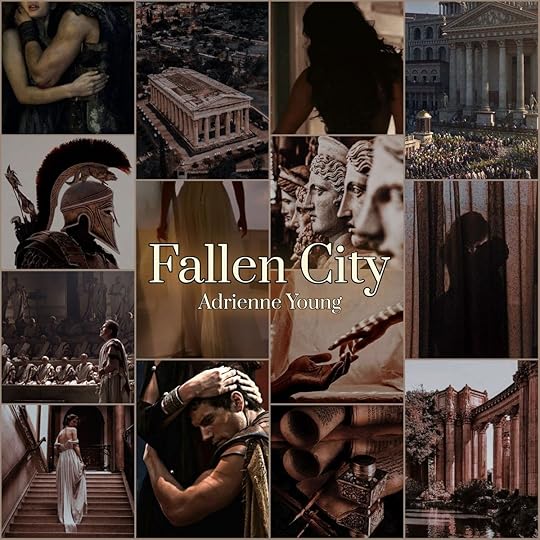
📖┆Fallen City
╰┈➤ ✰┆ ˗ˏˋ 𝟜.𝟟𝟝 𝕤𝕥𝕒𝕣𝕤 ˊˎ˗
╰⪼ ⋆౨ৎ˚┆ 𝓟𝓻𝓮 𝓻𝓮𝓪𝓭: Adrienne Young, you never fail me. A Roman-inspired story with star-crossed lovers on opposite sides of a rebellion?? 😍
📆┆˚₊· ͟͟͞͞➳❥ Dates read: 11/17/25 - 11/23/25
𓂃🖊┆𝓣𝓻𝓸𝓹𝓮𝓼:
➳ found family ➳ political intrigue ➳ forbidden romance ➳ star-crossed lovers ➳ fate/magic ➳ meddling gods ➳ rebellion
🏷️┆𝓐𝓽 𝓪 𝓰𝓵𝓪𝓷𝓬𝓮:
🏛️ greco-roman inspired historical fantasy
🌿 first book in an uncompleted duology
⚔️ rebellion between the wealthy and lower classes
✨ political turmoil with a divine plot orchestrated by the gods
💘 forbidden romance between a legionnaire and a magistrate's daughter
🕊️ yearning and tension-filled (spice🌶️🌶️ = open door, non-descriptive)
🏺 complex political intrigue, rich world-building
⌛ dual timeline with dual POV creating mounting tension
📜 atmospheric and lyrical writing
📋┆𝓢𝔂𝓷𝓸𝓹𝓼𝓲𝓼:
「Luca Matius has one purpose—to carry on the family name, maintaining its presence in the Forum once his powerful and cruel uncle dies. But his noviceship with the city's Philosopher places him in the middle of a catastrophe that will alter the destiny of his people.
Maris Casperia was raised amidst the strategic maneuvers of the Citadel's inner workings, and she knows what her future holds—a lifetime of service to a corrupt city. But her years of serving as a novice to the last Priestess who possesses the stolen magic of the Old War has made her envision a different kind of future for the city. When she meets Luca, a fated chain of events is set into motion that will divinely entangle their lives.
As a secret comes to light and throws the city into chaos, Luca and Maris hatch a plot to create a calculated alliance that could tip the scales of power. But when an execution forces Luca to become the symbol of rebellion, he and Maris are thrown onto opposite sides of a holy war. As their fates diverge, they learn they are at the center of a story the gods are writing. And even if they can find their way back to each other, there may be nothing left.」
🎵 ┆𝓝𝓸𝔀 𝓹𝓵𝓪𝔂𝓲𝓷𝓰: ♫ I'll Wait For You by Harry Gregson-Williams
♪ ↻ ◁ 𝕀𝕀 ▷ ↺ Volume: ■■■■■□□□
1:52 ────|────── 5:50
─────── ⋆.˚ ✩ ⋆˙⟡ ───────
💭┆𝓡𝓮𝓿𝓲𝓮𝔀:
╰┈➤ 📌┆Initial Thoughts:
➛ yes 👏 yes👏 yes👏 YES! Adrienne Young, you have done it again. This was everything I wanted and could've asked for. The politics, the tension, the YEARNING? 🤌 Impeccable. This is what I desperately needed after being in a slump.
╰┈➤ 📝┆Plot and Pacing: 4 stars ✰✰✰✰
➛ Immediately, I was hooked on this premise. Star-crossed lovers on opposite sides of a rebellion? Give me 20 more of these right now! Add the Greek/Roman elements and political intrigue, and you sold me. While some people found the dual POV and dual timeline disjointed, I thought this was the most interesting part of the book. The unique writing structure is what distinguishes this book from others in this genre. It creates mounting tension, making it all the more addictive. With each new chapter, another puzzle piece is added to complete the picture. It was suspenseful, leaving me with a sense of forbidding, which culminated in a breaking point at the end of the book. The ending broke my heart, and I cannot wait to see how this story ends in the sequel.
╰┈➤ 👫┆Characters: 4 stars ✰✰✰✰
ˏˋ°•*⁀➷ 🕊️┆Maris Casperia
➛ Maris was raised as a politician’s daughter, getting used to the strategy of politics in the citadel, and anticipates that her future holds a lifetime of service to a corrupt city. She dedicates her days to avoiding her mother and her political games in an attempt to create a better future for her city. Meeting Luca reinforces her objective, and together they create a plan to stop the corruption from poisoning the city. I loved her determination and her religious faith in the gods. I just wish we knew the reason behind her strong beliefs. Her character did not feel fully developed because we don't know her motivations for her actions. Why did she feel pulled toward the lower class and sympathize with them to begin with? Was there a particular experience that shaped this belief? It would've made her character stronger if this had been fully explored.
ˏˋ°•*⁀➷ ⚔️┆Luca Matius
➛ A man raised on the wrong side of the tracks is suddenly pulled into high society and political maneuvering unlike anything he has experienced. He studies under a famous philosopher who serves as a mother figure to him. He never wanted this life, but he was thrust into it regardless. Falling in love with Maris irrevocably changed him. The tension between his love for Maris and his duty to his friend/the lower class, proves challenging. Feeling responsible for the rebellion, he makes an impossible choice that leaves Maris in shambles. His love for Maris was above everything, and his unwavering faith in her was breathtaking.
ˏˋ°•*⁀➷ Romance/Spice
➛ Although the plot is heavily influenced by the central romance between the main characters, it did not feel romance-heavy. In fact, at times, I wish there were more romance. The characters spend most of the book apart, yet their love for each other is palpable in everything they do. The tension and yearning made this book what it is. The how and why these characters fell in love was not explicitly explored, which is definitely a weak aspect of the story. We knew right from the beginning that these characters love each other, but the subsequent flashbacks showed glimpses into their relationship. I wished it delved into this a little more. While there is on-page sex, it's not the focal point or written overly explicitly to garner adult audience attention, which I think was a smart decision.
ˏˋ°•*⁀➷ Minor Characters
➛ Vale - I wanted to know so much about his backstory, his relationship with his father, and how he became best friends with Luca! I think he was an incredible leader despite the circumstances. He decided to step up when Luca refused, and Luca is indebted to him for it. Their friendship was reciprocal, and each made sacrifices for the other.
➛ Théo - My absolute favorite character, hands down. He's fierce protection, loyalty, and dedication to Luca... damn. I need to know everything about him, and I hope we explore that in the sequel. And his decision at the end... it broke me. I love his character so much, and he'd better get a happy ending!
╰┈➤ ✎┆Setting and Writing: 5 stars ✰✰✰✰✰
➛ Adrienne Young's writing is incredible, especially her more recent adult novels. She is an auto-buy author for me. This book differs from her recent magical realism books, which heavily relied on mystery and thriller premises. Fallen City had to spend more time on the world-building. The book's pacing relies more on bringing the two timelines together, from past to present. It worked so well for me. It left so many questions at the end, which beautifully sets up an earned book two.
The world is set in a Greco-Roman city, with an immaculate atmospheric depiction of ancient classical antiquity. I was transported to another time with her vivid imagery. From descriptions of temples, fabrics, art, lush architecture, and a religion that believed in gods and magic, the richness of the world was felt in every line. Cultural perceptions, ideas, and sensitivities were also well portrayed. It was so easy to be immersed in this world. However, the incorporation of the gods and magical gifts was not fully fleshed out. I felt it merely skimmed the surface. A glossary of all the gods was included at the beginning of the book, but it was not used, as only a few gods were mentioned more than once. It was almost too ambiguous and vague. I am hopeful that we will see more involvement with the gods in the next book, though.
╰┈➤ ☁️┆Themes: 5 stars ✰✰✰✰✰
➛ Fallen City explores the tensions between tradition and modernity, love and marriage in a time of crisis, and the search for identity amidst social and political upheaval. It used the backdrop of a decaying city to explore complex human relationships and the individual's struggle to find stability and meaning as their world falls apart. We witness themes of class injustice, nepotism, and the corruption that arises when a society prizes aristocracy over merit.
╰┈➤ 💕┆Emotional Impact: 5 stars ✰✰✰✰✰
➛ Any book that makes me cry gets five stars, and this was no exception.
╰┈➤ ✨┆Enjoyment: 5 stars ✰✰✰✰✰
➛ The premise, forbidden romance (emphasis on yearning), political intrigue, with a backdrop of an atmospheric ancient Roman city under rebellion, made this thoroughly addictive. Reading this while listening to the Gladiator II soundtrack made it such an immersive experience. Cannot recommend this book enough.
─────── ⋆.˚ ✩ ⋆˙⟡ ───────
╰┈➤ 🚨┆𝓑𝓸𝓽𝓽𝓸𝓶-𝓵𝓲𝓷𝓮:
ˏˋ°•*⁀➷ Fallen City is an evocative story with complex political intrigue, rich world-building, and a forbidden romance that leaves you breathless. Adrienne Young's writing is exquisite with vivid imagery and compelling themes. I wanted to cherish this story and never let it end. One of my favorite historical romantic fantasies this year!
➛ ✔ 𝓦𝓸𝓾𝓵𝓭 𝓘 𝓡𝓮𝓬𝓸𝓶𝓶𝓮𝓷𝓭? Absolutely yes!!
➛ 📚┆𝓢𝓲𝓶𝓲𝓵𝓪𝓻 𝓑𝓸𝓸𝓴 𝓡𝓮𝓬𝓸𝓶𝓶𝓮𝓷𝓭𝓪𝓽𝓲𝓸𝓷𝓼:
➷ The Everlasting by Alix E. Harrow
➷ Wild Reverence by Rebecca Ross
➷ The Second Death of Locke by V.L. Bovalino
➷ I, Medusa by Ayana Gray
➷ The Sacred Space Between by Kalie Reid
꒰ ⚔️🌿📜⌛✨🏹💘🏛️🏺🕊️ ꒱
📖┆Fallen City
╰┈➤ ✰┆ ˗ˏˋ 𝟜.𝟟𝟝 𝕤𝕥𝕒𝕣𝕤 ˊˎ˗
╰⪼ ⋆౨ৎ˚┆ 𝓟𝓻𝓮 𝓻𝓮𝓪𝓭: Adrienne Young, you never fail me. A Roman-inspired story with star-crossed lovers on opposite sides of a rebellion?? 😍
📆┆˚₊· ͟͟͞͞➳❥ Dates read: 11/17/25 - 11/23/25
𓂃🖊┆𝓣𝓻𝓸𝓹𝓮𝓼:
➳ found family ➳ political intrigue ➳ forbidden romance ➳ star-crossed lovers ➳ fate/magic ➳ meddling gods ➳ rebellion
🏷️┆𝓐𝓽 𝓪 𝓰𝓵𝓪𝓷𝓬𝓮:
🏛️ greco-roman inspired historical fantasy
🌿 first book in an uncompleted duology
⚔️ rebellion between the wealthy and lower classes
✨ political turmoil with a divine plot orchestrated by the gods
💘 forbidden romance between a legionnaire and a magistrate's daughter
🕊️ yearning and tension-filled (spice🌶️🌶️ = open door, non-descriptive)
🏺 complex political intrigue, rich world-building
⌛ dual timeline with dual POV creating mounting tension
📜 atmospheric and lyrical writing
📋┆𝓢𝔂𝓷𝓸𝓹𝓼𝓲𝓼:
「Luca Matius has one purpose—to carry on the family name, maintaining its presence in the Forum once his powerful and cruel uncle dies. But his noviceship with the city's Philosopher places him in the middle of a catastrophe that will alter the destiny of his people.
Maris Casperia was raised amidst the strategic maneuvers of the Citadel's inner workings, and she knows what her future holds—a lifetime of service to a corrupt city. But her years of serving as a novice to the last Priestess who possesses the stolen magic of the Old War has made her envision a different kind of future for the city. When she meets Luca, a fated chain of events is set into motion that will divinely entangle their lives.
As a secret comes to light and throws the city into chaos, Luca and Maris hatch a plot to create a calculated alliance that could tip the scales of power. But when an execution forces Luca to become the symbol of rebellion, he and Maris are thrown onto opposite sides of a holy war. As their fates diverge, they learn they are at the center of a story the gods are writing. And even if they can find their way back to each other, there may be nothing left.」
"I end," I breathed, "with her."
🎵 ┆𝓝𝓸𝔀 𝓹𝓵𝓪𝔂𝓲𝓷𝓰: ♫ I'll Wait For You by Harry Gregson-Williams
♪ ↻ ◁ 𝕀𝕀 ▷ ↺ Volume: ■■■■■□□□
1:52 ────|────── 5:50
─────── ⋆.˚ ✩ ⋆˙⟡ ───────
💭┆𝓡𝓮𝓿𝓲𝓮𝔀:
╰┈➤ 📌┆Initial Thoughts:
➛ yes 👏 yes👏 yes👏 YES! Adrienne Young, you have done it again. This was everything I wanted and could've asked for. The politics, the tension, the YEARNING? 🤌 Impeccable. This is what I desperately needed after being in a slump.
╰┈➤ 📝┆Plot and Pacing: 4 stars ✰✰✰✰
➛ Immediately, I was hooked on this premise. Star-crossed lovers on opposite sides of a rebellion? Give me 20 more of these right now! Add the Greek/Roman elements and political intrigue, and you sold me. While some people found the dual POV and dual timeline disjointed, I thought this was the most interesting part of the book. The unique writing structure is what distinguishes this book from others in this genre. It creates mounting tension, making it all the more addictive. With each new chapter, another puzzle piece is added to complete the picture. It was suspenseful, leaving me with a sense of forbidding, which culminated in a breaking point at the end of the book. The ending broke my heart, and I cannot wait to see how this story ends in the sequel.
╰┈➤ 👫┆Characters: 4 stars ✰✰✰✰
ˏˋ°•*⁀➷ 🕊️┆Maris Casperia
➛ Maris was raised as a politician’s daughter, getting used to the strategy of politics in the citadel, and anticipates that her future holds a lifetime of service to a corrupt city. She dedicates her days to avoiding her mother and her political games in an attempt to create a better future for her city. Meeting Luca reinforces her objective, and together they create a plan to stop the corruption from poisoning the city. I loved her determination and her religious faith in the gods. I just wish we knew the reason behind her strong beliefs. Her character did not feel fully developed because we don't know her motivations for her actions. Why did she feel pulled toward the lower class and sympathize with them to begin with? Was there a particular experience that shaped this belief? It would've made her character stronger if this had been fully explored.
ˏˋ°•*⁀➷ ⚔️┆Luca Matius
➛ A man raised on the wrong side of the tracks is suddenly pulled into high society and political maneuvering unlike anything he has experienced. He studies under a famous philosopher who serves as a mother figure to him. He never wanted this life, but he was thrust into it regardless. Falling in love with Maris irrevocably changed him. The tension between his love for Maris and his duty to his friend/the lower class, proves challenging. Feeling responsible for the rebellion, he makes an impossible choice that leaves Maris in shambles. His love for Maris was above everything, and his unwavering faith in her was breathtaking.
ˏˋ°•*⁀➷ Romance/Spice
➛ Although the plot is heavily influenced by the central romance between the main characters, it did not feel romance-heavy. In fact, at times, I wish there were more romance. The characters spend most of the book apart, yet their love for each other is palpable in everything they do. The tension and yearning made this book what it is. The how and why these characters fell in love was not explicitly explored, which is definitely a weak aspect of the story. We knew right from the beginning that these characters love each other, but the subsequent flashbacks showed glimpses into their relationship. I wished it delved into this a little more. While there is on-page sex, it's not the focal point or written overly explicitly to garner adult audience attention, which I think was a smart decision.
ˏˋ°•*⁀➷ Minor Characters
➛ Vale - I wanted to know so much about his backstory, his relationship with his father, and how he became best friends with Luca! I think he was an incredible leader despite the circumstances. He decided to step up when Luca refused, and Luca is indebted to him for it. Their friendship was reciprocal, and each made sacrifices for the other.
➛ Théo - My absolute favorite character, hands down. He's fierce protection, loyalty, and dedication to Luca... damn. I need to know everything about him, and I hope we explore that in the sequel. And his decision at the end... it broke me. I love his character so much, and he'd better get a happy ending!
╰┈➤ ✎┆Setting and Writing: 5 stars ✰✰✰✰✰
➛ Adrienne Young's writing is incredible, especially her more recent adult novels. She is an auto-buy author for me. This book differs from her recent magical realism books, which heavily relied on mystery and thriller premises. Fallen City had to spend more time on the world-building. The book's pacing relies more on bringing the two timelines together, from past to present. It worked so well for me. It left so many questions at the end, which beautifully sets up an earned book two.
The world is set in a Greco-Roman city, with an immaculate atmospheric depiction of ancient classical antiquity. I was transported to another time with her vivid imagery. From descriptions of temples, fabrics, art, lush architecture, and a religion that believed in gods and magic, the richness of the world was felt in every line. Cultural perceptions, ideas, and sensitivities were also well portrayed. It was so easy to be immersed in this world. However, the incorporation of the gods and magical gifts was not fully fleshed out. I felt it merely skimmed the surface. A glossary of all the gods was included at the beginning of the book, but it was not used, as only a few gods were mentioned more than once. It was almost too ambiguous and vague. I am hopeful that we will see more involvement with the gods in the next book, though.
╰┈➤ ☁️┆Themes: 5 stars ✰✰✰✰✰
➛ Fallen City explores the tensions between tradition and modernity, love and marriage in a time of crisis, and the search for identity amidst social and political upheaval. It used the backdrop of a decaying city to explore complex human relationships and the individual's struggle to find stability and meaning as their world falls apart. We witness themes of class injustice, nepotism, and the corruption that arises when a society prizes aristocracy over merit.
╰┈➤ 💕┆Emotional Impact: 5 stars ✰✰✰✰✰
➛ Any book that makes me cry gets five stars, and this was no exception.
╰┈➤ ✨┆Enjoyment: 5 stars ✰✰✰✰✰
➛ The premise, forbidden romance (emphasis on yearning), political intrigue, with a backdrop of an atmospheric ancient Roman city under rebellion, made this thoroughly addictive. Reading this while listening to the Gladiator II soundtrack made it such an immersive experience. Cannot recommend this book enough.
─────── ⋆.˚ ✩ ⋆˙⟡ ───────
╰┈➤ 🚨┆𝓑𝓸𝓽𝓽𝓸𝓶-𝓵𝓲𝓷𝓮:
ˏˋ°•*⁀➷ Fallen City is an evocative story with complex political intrigue, rich world-building, and a forbidden romance that leaves you breathless. Adrienne Young's writing is exquisite with vivid imagery and compelling themes. I wanted to cherish this story and never let it end. One of my favorite historical romantic fantasies this year!
➛ ✔ 𝓦𝓸𝓾𝓵𝓭 𝓘 𝓡𝓮𝓬𝓸𝓶𝓶𝓮𝓷𝓭? Absolutely yes!!
➛ 📚┆𝓢𝓲𝓶𝓲𝓵𝓪𝓻 𝓑𝓸𝓸𝓴 𝓡𝓮𝓬𝓸𝓶𝓶𝓮𝓷𝓭𝓪𝓽𝓲𝓸𝓷𝓼:
➷ The Everlasting by Alix E. Harrow
➷ Wild Reverence by Rebecca Ross
➷ The Second Death of Locke by V.L. Bovalino
➷ I, Medusa by Ayana Gray
➷ The Sacred Space Between by Kalie Reid

October 29, 2025
2.5 stars
Whaaaaaaaaaaaaaat???
I am so disappointed in this book. I love Adrienne Young and was excited that she was coming back to writing fantasy. But there was basically nothing about this book I liked. The only reason I finished it is because I love AY and I wanted to finish it for her. Otherwise, this would have been a DNF a long time ago.
90% of this book is unending paragraphs of descriptions, whether it's giving historical information or just internal thoughts that blending back into more descriptions. None of the characters were all that likeable, honestly they were all flat, no emotions, no developments. The best character was Theo and he was a smaller side character and seemed to be the only one that had an actual personality and did something that actually made me have an actual emotional reaction.
And this was a dual timeline with pretty short chapters. So you're jumping back forth a lot and none of the actual scenes we get between characters are long enough to hold any significance or provide any depth to the story or characters.
Just an overall no from me and a major disappointment 😭
Thank you NetGalley and St Martins Press for this arc in exchange for an honest review!
Whaaaaaaaaaaaaaat???
I am so disappointed in this book. I love Adrienne Young and was excited that she was coming back to writing fantasy. But there was basically nothing about this book I liked. The only reason I finished it is because I love AY and I wanted to finish it for her. Otherwise, this would have been a DNF a long time ago.
90% of this book is unending paragraphs of descriptions, whether it's giving historical information or just internal thoughts that blending back into more descriptions. None of the characters were all that likeable, honestly they were all flat, no emotions, no developments. The best character was Theo and he was a smaller side character and seemed to be the only one that had an actual personality and did something that actually made me have an actual emotional reaction.
And this was a dual timeline with pretty short chapters. So you're jumping back forth a lot and none of the actual scenes we get between characters are long enough to hold any significance or provide any depth to the story or characters.
Just an overall no from me and a major disappointment 😭
Thank you NetGalley and St Martins Press for this arc in exchange for an honest review!

April 22, 2021
It's amazing. Prepare yourself. (biased opinion, not even sorry.)

July 30, 2025
I cannot believe I got this ARC!!! I screamed and my bf was like are you okay😂
Thank you so much to NetGalley & St. Martin’s Press I’m so GRATEFUL😭❤️🔥
« It was easy to have faith when you wanted for nothing. »
Adrienne Young has done it again.
This is how you write a rebellion. A rebellion that seeps into your soul and you find yourself thinking about it, and just reflecting on what can be applied to so many things in the real world.
The world building was truly mesmerizing. Well described, well done - I could vividly imagine everything. The politics were at the top of the story - with philosophy woven into it.
I couldn’t stop reading it, Adrienne Young’s writing is so addictive and unputdownable. This was almost a 5 stars read for me - there’s just something that confused me about a decision that was taken in the middle of the story and the ending spiked my confusion even more. I couldn’t fully grasp the MMC’s motives behind the actions decided upon. He was a bit hard to follow and sometimes fickle. Which could be attributed to all the trauma.
I truly grew attached to Théo, a secondary character. He was the star of this story for me.
It ends on a cliffhanger, and I’m really excited to see where the sequel takes us! Will come back to post my favourite quote (literally gave me chills!).
Thank you so much to NetGalley & St. Martin’s Press I’m so GRATEFUL😭❤️🔥
« It was easy to have faith when you wanted for nothing. »
Adrienne Young has done it again.
This is how you write a rebellion. A rebellion that seeps into your soul and you find yourself thinking about it, and just reflecting on what can be applied to so many things in the real world.
The world building was truly mesmerizing. Well described, well done - I could vividly imagine everything. The politics were at the top of the story - with philosophy woven into it.
I couldn’t stop reading it, Adrienne Young’s writing is so addictive and unputdownable. This was almost a 5 stars read for me - there’s just something that confused me about a decision that was taken in the middle of the story and the ending spiked my confusion even more. I couldn’t fully grasp the MMC’s motives behind the actions decided upon. He was a bit hard to follow and sometimes fickle. Which could be attributed to all the trauma.
I truly grew attached to Théo, a secondary character. He was the star of this story for me.
It ends on a cliffhanger, and I’m really excited to see where the sequel takes us! Will come back to post my favourite quote (literally gave me chills!).
September 6, 2025
4.25 ⭐️
This is my first Adrienne Young book and it did not disappoint. Her ability to write such a rich and picturesque world is incredible; I was immediately captivated by the setting and immersed in the world-building.
Fallen City follows two star-crossed lovers, Maris and Luca, who find themselves torn apart by a war between the ruling class in the Citadel and the lower class across the river that divides the city. Told through a dual-POV that jumps between past and present, we follow the events leading up to the war and how they culminate in the present, only days away from victory. While Maris and Luca’s love story is a subplot, it’s still tragically romantic and the driving factor behind their decisions as they navigate this war.
I thoroughly enjoyed the history of the city of Isara, the gods, and the political landscape of this book. The political machinations had me questioning the motives of several characters and who could be trusted, in a way that felt a bit reminiscent of Game of Thrones. The vague influence of the gods is incredibly intriguing. Are the gods pulling all the strings? Is the outcome of the war predestined and our characters just pawns in their larger game? I hope to see these questions more thoroughly explored in book two.
I can’t wait to get a copy of this book for my shelf once it releases, and I’ll be impatiently waiting for the second book to conclude this epic story.
Thank you NetGalley and Saturday Books for the e-arc in exchange for my honest review.
This is my first Adrienne Young book and it did not disappoint. Her ability to write such a rich and picturesque world is incredible; I was immediately captivated by the setting and immersed in the world-building.
Fallen City follows two star-crossed lovers, Maris and Luca, who find themselves torn apart by a war between the ruling class in the Citadel and the lower class across the river that divides the city. Told through a dual-POV that jumps between past and present, we follow the events leading up to the war and how they culminate in the present, only days away from victory. While Maris and Luca’s love story is a subplot, it’s still tragically romantic and the driving factor behind their decisions as they navigate this war.
I thoroughly enjoyed the history of the city of Isara, the gods, and the political landscape of this book. The political machinations had me questioning the motives of several characters and who could be trusted, in a way that felt a bit reminiscent of Game of Thrones. The vague influence of the gods is incredibly intriguing. Are the gods pulling all the strings? Is the outcome of the war predestined and our characters just pawns in their larger game? I hope to see these questions more thoroughly explored in book two.
I can’t wait to get a copy of this book for my shelf once it releases, and I’ll be impatiently waiting for the second book to conclude this epic story.
Thank you NetGalley and Saturday Books for the e-arc in exchange for my honest review.

November 2, 2025
3.75 / 5 Stars
I came for the forbidden romance. I stayed for the political power plays and beautiful writing. Look, the romance was a tad lacking but there were still some really great things about this book. In “Fallen City,” Luca and Maris were never meant for each other. He is the nephew of her mother’s political rival. And yet, they are drawn to each other. Fated even. Set in Isara, an ancient Greco-Roman type city, Luca and Maris try to navigate the political brawling of their families until a match lights a flame and Luca becomes the face of the rebellion. Representing the uprising while Maris represents the powers that be, Luca and Maris try to find their way back to each other. But will they have anything left when they do?
You will probably like this book if you like:
🏛️ Romance set in a Greco-Roman-esque city with a magic system based on power derived from the blood of gods
⚔️ Political power plays mixed with rebellion and war
🏛️ Dual timeline
⚔️ Forbidden romance of the star crossed lovers variety
🏛️ Queer normative world
When a dual timeline is done well, it is a work of art. I really enjoyed that aspect in the beginning of the book. In other books, it will sometimes feel like one character says something like “and that was because of our fight” and then the next chapter jumps directly to the fight. That is fine though not particularly creative. Here, the beginning dropped with plot twists in the “now” sections which made it exciting to get to see them later in the “before.” It felt like acquiring puzzle pieces that you knew would be important later on. That meant that it took a little time to get the full picture but I liked that. It kept the story engaging. After the halfway mark though, when all of the plot twists had been revealed, the time jumps started to feel random and unconnected in even the most tangential way, which made me wish that the book had kept some of the ingenuity of the dual timeline from the first half.
The dual timeline also cut some of the relationship building short. We spend time with Maris and Luca as they fall in love in the past and as they are trying to navigate their separation in the present. That meant that there was literally less space to develop their relationships which made their love feel a little insta-love like. There would be phrases like “we spent countless hours with each other” but we don’t see that, we are just told that, so it didn’t feel earned. Or we would hear someone say, “their love is fated,” but that felt like a slightly cheap way to make their relationship feel worthwhile. The dual timeline aspect also made it very hard to tell time. Because we only get “now” and “before” with no time indicators, I kept wondering how many months had passed (I think a few?) before they fell in love. Their relationship was giving Greek West Side Story (minus the singing and dancing) so I guess some insta-love is to be expected but alas, it is not my favorite trope.
While the love part was a tad iffy, the forbidden part was oh so very forbidden and juicy. Not only are they related to political rivals but then he becomes the face of the rebellion while she is the face of the Magistrates in power. I truly felt my heart in my stomach for a good part of the book and wondered how they were going to survive any of it. And beyond Maris and Luca, there were other examples of quieter love that I really liked (I’m looking at you, tribunes).
I wish the magic system was a tad bit more developed. There was magic in the blood of the gods but beyond that, some of the other aspects, like how someone became blessed by the gods, were a little unclear. And if you are looking for a book with a lot of fantasy, this is not it. Fantastic things happen, but not very often, so if you are looking for a light fantasy read, this will be your cup of tea.
I also really enjoyed that there were three older, morally ambiguous women in power. Maris’ mom, Luca’s mentor who is the Philosopher, and Maris’ mentor who is the Priestess. All three women had totally different motives and felt really fully inhabited. Boo to all the men in power but I’m rooting for all of these morally questionable queens.
The prose was also really beautiful. The imagery was really lush and vivid but not overwhelming. The epilogue set up the next book really well and I am excited to read it when it comes out.
Thank you St. Martin's Press | Saturday Books and NetGalley for providing this eARC! All opinions are my own.
Publication Date: November 4, 2025
__________________________________
Pre-Read Thoughts: I am foaming at the mouth for a forbidden romance. And this one is so forbidden that it makes the gods mad?👩🍳💋x1000
I came for the forbidden romance. I stayed for the political power plays and beautiful writing. Look, the romance was a tad lacking but there were still some really great things about this book. In “Fallen City,” Luca and Maris were never meant for each other. He is the nephew of her mother’s political rival. And yet, they are drawn to each other. Fated even. Set in Isara, an ancient Greco-Roman type city, Luca and Maris try to navigate the political brawling of their families until a match lights a flame and Luca becomes the face of the rebellion. Representing the uprising while Maris represents the powers that be, Luca and Maris try to find their way back to each other. But will they have anything left when they do?
You will probably like this book if you like:
🏛️ Romance set in a Greco-Roman-esque city with a magic system based on power derived from the blood of gods
⚔️ Political power plays mixed with rebellion and war
🏛️ Dual timeline
⚔️ Forbidden romance of the star crossed lovers variety
🏛️ Queer normative world
When a dual timeline is done well, it is a work of art. I really enjoyed that aspect in the beginning of the book. In other books, it will sometimes feel like one character says something like “and that was because of our fight” and then the next chapter jumps directly to the fight. That is fine though not particularly creative. Here, the beginning dropped with plot twists in the “now” sections which made it exciting to get to see them later in the “before.” It felt like acquiring puzzle pieces that you knew would be important later on. That meant that it took a little time to get the full picture but I liked that. It kept the story engaging. After the halfway mark though, when all of the plot twists had been revealed, the time jumps started to feel random and unconnected in even the most tangential way, which made me wish that the book had kept some of the ingenuity of the dual timeline from the first half.
The dual timeline also cut some of the relationship building short. We spend time with Maris and Luca as they fall in love in the past and as they are trying to navigate their separation in the present. That meant that there was literally less space to develop their relationships which made their love feel a little insta-love like. There would be phrases like “we spent countless hours with each other” but we don’t see that, we are just told that, so it didn’t feel earned. Or we would hear someone say, “their love is fated,” but that felt like a slightly cheap way to make their relationship feel worthwhile. The dual timeline aspect also made it very hard to tell time. Because we only get “now” and “before” with no time indicators, I kept wondering how many months had passed (I think a few?) before they fell in love. Their relationship was giving Greek West Side Story (minus the singing and dancing) so I guess some insta-love is to be expected but alas, it is not my favorite trope.
While the love part was a tad iffy, the forbidden part was oh so very forbidden and juicy. Not only are they related to political rivals but then he becomes the face of the rebellion while she is the face of the Magistrates in power. I truly felt my heart in my stomach for a good part of the book and wondered how they were going to survive any of it. And beyond Maris and Luca, there were other examples of quieter love that I really liked (I’m looking at you, tribunes).
I wish the magic system was a tad bit more developed. There was magic in the blood of the gods but beyond that, some of the other aspects, like how someone became blessed by the gods, were a little unclear. And if you are looking for a book with a lot of fantasy, this is not it. Fantastic things happen, but not very often, so if you are looking for a light fantasy read, this will be your cup of tea.
I also really enjoyed that there were three older, morally ambiguous women in power. Maris’ mom, Luca’s mentor who is the Philosopher, and Maris’ mentor who is the Priestess. All three women had totally different motives and felt really fully inhabited. Boo to all the men in power but I’m rooting for all of these morally questionable queens.
The prose was also really beautiful. The imagery was really lush and vivid but not overwhelming. The epilogue set up the next book really well and I am excited to read it when it comes out.
Thank you St. Martin's Press | Saturday Books and NetGalley for providing this eARC! All opinions are my own.
Publication Date: November 4, 2025
__________________________________
Pre-Read Thoughts: I am foaming at the mouth for a forbidden romance. And this one is so forbidden that it makes the gods mad?👩🍳💋x1000

October 15, 2025
3.75 ★— Can you be more in love with the idea of a book than its actual execution? Because I fear that’s how Fallen City landed for me.
As someone who actually learned Latin and has an obsession with anything related to Greco-Roman mythology, this book hit the bullseye for my interests. For the first quarter of the story, I was waiting for it to truly grip me, to see what led to the fall of Isara, the fallen city that gives the book its name, and how Luca Matius and Maris Casperia, heirs of rival political families, came to love each other.
The book is told in dual POVs and across dual timelines, slowly unraveling the stories of Maris and Luca as they each prepare to take over their parents’ seats as magistrates. The setup for both the romance and the political drama is so strong(!), which is why I was surprised that the plot itself never hooked me.
Isara as a city, and its history, are fascinating. It’s clearly inspired by Ancient Rome and Greece, both in mythology and politics, but with an egalitarian twist. Women here can engage in the political process, become philosophers, and wield significant power. The many side characters are also interesting and layered, each with their own motivations and self-interests. This is why it’s such a shame that the two main characters, who start out so promising, end up feeling flat, and their romance even more so.
I think a lot of that comes down to the dual timelines. They make it hard to truly connect with or feel the progression of Luca and Maris’ relationship. I never really understood why they fell in love or how that depth of feeling developed. For a book set around a rebellion where romance plays a key role in the political turmoil, the emotional weight of a forbidden romance should hit. I should understand why these two are willing to risk everything for each other, especially when they start on opposing sides and are practically raised to see each other as enemies, but it never fully comes through. We get a meeting scene, a few brief conversations, and then suddenly we’re told they’re in love, without ever feeling that gradual progression into real romantic love. I kept waiting for those scenes in the flashback but never got them, and I think that ultimately the dual timeline structure limits their relationship and keeps it from reaching its potential.
The overall plot and setting, though, I really enjoyed. The magistrates, the political maneuvering, the philosophical debates, the rebellious female thinker who defies expectations... I loved all of that. The war scenes were intriguing as well and fun to read, even if the eventual reveal of the cause of the war felt a bit anticlimactic.
So, Fallen City definitely has its merits. Readers with a passion for the classical ancient world will probably get a kick out of it. If it’s grand, amazingly complex, and gut-wrenching romance you want, that might be a bit lacking here.
🎧 Audiobook Note
🎙️ Narration Style: Dual
This was a dual POV story, as I mentioned in my review, with a female and male narrator for Luca’s and Maris’ perspectives. I enjoyed the male narrator a lot more than the female narrator. Her tone didn’t quite match what I pictured for Maris, sounding a little immature for my taste, but she was otherwise solid. The dual narration style added to the immersion of the story and really increased my enjoyment!
__________________
Thank you to NetGalley and St. Martin's Press for the ARC and to Macmillan Audio for the ALC.
As someone who actually learned Latin and has an obsession with anything related to Greco-Roman mythology, this book hit the bullseye for my interests. For the first quarter of the story, I was waiting for it to truly grip me, to see what led to the fall of Isara, the fallen city that gives the book its name, and how Luca Matius and Maris Casperia, heirs of rival political families, came to love each other.
The book is told in dual POVs and across dual timelines, slowly unraveling the stories of Maris and Luca as they each prepare to take over their parents’ seats as magistrates. The setup for both the romance and the political drama is so strong(!), which is why I was surprised that the plot itself never hooked me.
Isara as a city, and its history, are fascinating. It’s clearly inspired by Ancient Rome and Greece, both in mythology and politics, but with an egalitarian twist. Women here can engage in the political process, become philosophers, and wield significant power. The many side characters are also interesting and layered, each with their own motivations and self-interests. This is why it’s such a shame that the two main characters, who start out so promising, end up feeling flat, and their romance even more so.
I think a lot of that comes down to the dual timelines. They make it hard to truly connect with or feel the progression of Luca and Maris’ relationship. I never really understood why they fell in love or how that depth of feeling developed. For a book set around a rebellion where romance plays a key role in the political turmoil, the emotional weight of a forbidden romance should hit. I should understand why these two are willing to risk everything for each other, especially when they start on opposing sides and are practically raised to see each other as enemies, but it never fully comes through. We get a meeting scene, a few brief conversations, and then suddenly we’re told they’re in love, without ever feeling that gradual progression into real romantic love. I kept waiting for those scenes in the flashback but never got them, and I think that ultimately the dual timeline structure limits their relationship and keeps it from reaching its potential.
The overall plot and setting, though, I really enjoyed. The magistrates, the political maneuvering, the philosophical debates, the rebellious female thinker who defies expectations... I loved all of that. The war scenes were intriguing as well and fun to read, even if the eventual reveal of the cause of the war felt a bit anticlimactic.
So, Fallen City definitely has its merits. Readers with a passion for the classical ancient world will probably get a kick out of it. If it’s grand, amazingly complex, and gut-wrenching romance you want, that might be a bit lacking here.
🎧 Audiobook Note
🎙️ Narration Style: Dual
This was a dual POV story, as I mentioned in my review, with a female and male narrator for Luca’s and Maris’ perspectives. I enjoyed the male narrator a lot more than the female narrator. Her tone didn’t quite match what I pictured for Maris, sounding a little immature for my taste, but she was otherwise solid. The dual narration style added to the immersion of the story and really increased my enjoyment!
__________________
Thank you to NetGalley and St. Martin's Press for the ARC and to Macmillan Audio for the ALC.

Want to Read
August 16, 2023I have been seeing this book since the past two years and I WANT IT SO BAD 😭
like?? The premise is short but so intriguing and I get so excited whenever Adrienne teases us with new books because I always think it's going to be this but it ends being soemthing else 😭
Please give me this by next year ☄️☄️
like?? The premise is short but so intriguing and I get so excited whenever Adrienne teases us with new books because I always think it's going to be this but it ends being soemthing else 😭
Please give me this by next year ☄️☄️

June 10, 2026
2.5 stars 🌟
I received a free copy of this book from NetGalley Read Now Section (post-publication). All opinions are my own. Thank you to NetGalley for the ARC.
Unfortunately, Fallen City was not for me. I thought to give the author another chance after reading Fable (https://www.goodreads.com/review/show...) and when I saw this was on Read Now I decided to pick it up. The premise is interesting enough and should have worked in theory, but the execution was lackluster. The writing wasn't impressive either, and the dual povs with flashbacks did not work. I really don't understand why this book wasn't in chronological order because anything remotely interesting is "revealed" in the current timeline.
The characters were also both dry, with almost interchangeable names, and even the side-characters had names with the same letters, making it more confusing. Both the MCs were so bland and did not hold my attention at all, and even calling them 'one-dimentional' would be giving them too much grace.
The main romance itself is not only insta-love and insta-lust, but so poorly written that I shipped the MMC Luca with his friend Vale more than Maris. But alas my ship did not sail (trust me would have made the book 10x better). Perhaps white hetro forbidden love is not for me. If these characters are supposed to be "enemies" then how were they loitering around being seen by other people with no concequence. Never mind that, what they even like in each other is beyond me. Maybe they deserve each other because who else could stand to be around such boring characters!
And ultimately, the biggest crime of this book is that is is SO BORING! Because I am willing to excuse bad writing, uninteresting characters and a non-existent plotline if there is something worth reading, but if the book bores me, then really nothing can redeem it.
So why 2.5 stars you might ask? Well even I have no answer to that. I suppose the world was mildly intriguing and some quotes here and there were pretty good. But really, the moment I finish a book I Rate With My Gut (somewhat in alignment with my system) and the star-gods said 2.5 so 2.5 it is! I will maybe read the sequel it it goes up on NetGalley. I do wish this story gets better, because there is so much to explore here.
Until then, hoping my next read is much better.
BR with ash ❤️
#Book 97 of 2026.
Review written on 17th June, 2026.
DISCLAIMER-All opinions on books I’ve read and reviewed are my own, and are with no intention to offend anyone. If you feel offended by my reviews, let me know how I can fix it.
How I Rate-
1 star- Hardly liked anything/ was disappointed
2 star- Had potential but did not deliver/ was disappointed
3 stars- Was ok but could have been better/ was average / Enjoyed a lot but something was missing
4 stars- Loved a lot but something was missing
5 stars- Loved it/ new favourite
.............
17/6/26: finished, 2.5 stars. rtc.
.............
10/6/26: this is on NetGalley Read Now! BR with Ash <33
I received a free copy of this book from NetGalley Read Now Section (post-publication). All opinions are my own. Thank you to NetGalley for the ARC.
Unfortunately, Fallen City was not for me. I thought to give the author another chance after reading Fable (https://www.goodreads.com/review/show...) and when I saw this was on Read Now I decided to pick it up. The premise is interesting enough and should have worked in theory, but the execution was lackluster. The writing wasn't impressive either, and the dual povs with flashbacks did not work. I really don't understand why this book wasn't in chronological order because anything remotely interesting is "revealed" in the current timeline.
The characters were also both dry, with almost interchangeable names, and even the side-characters had names with the same letters, making it more confusing. Both the MCs were so bland and did not hold my attention at all, and even calling them 'one-dimentional' would be giving them too much grace.
The main romance itself is not only insta-love and insta-lust, but so poorly written that I shipped the MMC Luca with his friend Vale more than Maris. But alas my ship did not sail (trust me would have made the book 10x better). Perhaps white hetro forbidden love is not for me. If these characters are supposed to be "enemies" then how were they loitering around being seen by other people with no concequence. Never mind that, what they even like in each other is beyond me. Maybe they deserve each other because who else could stand to be around such boring characters!
And ultimately, the biggest crime of this book is that is is SO BORING! Because I am willing to excuse bad writing, uninteresting characters and a non-existent plotline if there is something worth reading, but if the book bores me, then really nothing can redeem it.
So why 2.5 stars you might ask? Well even I have no answer to that. I suppose the world was mildly intriguing and some quotes here and there were pretty good. But really, the moment I finish a book I Rate With My Gut (somewhat in alignment with my system) and the star-gods said 2.5 so 2.5 it is! I will maybe read the sequel it it goes up on NetGalley. I do wish this story gets better, because there is so much to explore here.
Until then, hoping my next read is much better.
BR with ash ❤️
#Book 97 of 2026.
Review written on 17th June, 2026.
DISCLAIMER-All opinions on books I’ve read and reviewed are my own, and are with no intention to offend anyone. If you feel offended by my reviews, let me know how I can fix it.
How I Rate-
1 star- Hardly liked anything/ was disappointed
2 star- Had potential but did not deliver/ was disappointed
3 stars- Was ok but could have been better/ was average / Enjoyed a lot but something was missing
4 stars- Loved a lot but something was missing
5 stars- Loved it/ new favourite
.............
17/6/26: finished, 2.5 stars. rtc.
.............
10/6/26: this is on NetGalley Read Now! BR with Ash <33

July 30, 2025
🚪 “Some stories begin at the end. This one does—of that, I’m sure.” (Prologue)
Well, this story should’ve never begun. And if it absolutely had to, it should’ve ended right here in book one.
Because, my friends, 416 pages of absolutely nothing is more than enough nothing for a lifetime.
🏗️ Worldbuilding? Whose world? What building?
Welcome to a realm where words exist, but logic has packed up and left.
You hear the same vague worldbuilding lines repeated through different POVs, different timelines, yet nothing — nothing — is ever defined or expanded. It’s all “figure it out if you can,” which… I couldn’t. And I TRIED!
Oh, and there’s a rebellion.
Why? Against whom? For what? You’ll start maybe piecing it together at 50%, but won’t fully know until 80%. By then, I was too emotionally evicted to care 😮💨.
🩸 Magic system or magical chaos?
We’re told it’s powered by “godsblood.”
Sounds cool, right? Yeah… until you realise it’s got more loopholes than a politician’s apology tour. (which you incidentally never get in this story)
Godsblood needs to be directly from the source to work. Yet, it’s conveniently bottled up and kept for who knows how long. How does that still… work?
Do you need a drop? A spoonful? A ritual dance under moonlight? Nobody knows.
The system isn’t just shaky; it’s basically “don’t touch or it’ll break.”
This is all made even worse by "the touch of gods" also not being explained. We don't know how or why or what it means to be touched by gods, other than you have a glowing thing on you...
💔 Romance? More like rumour
Blurb says romance. Book says “psych!”
It’s all flashbacks and “trust me, they’re in love” energy. You’re told, never shown. There’s zero chemistry, zero connection, zero spark.
The dual timeline structure? A grave mistake.
Had this been chronological, we might’ve felt something, we might have gotten a deeper story, deeper characters, a more threaded plot, and actual twists. Instead, we got emotional whiplash and a PowerPoint presentation of their feelings and what was happening.
😩 Maris & Luca, the definition of disappointment
Maris — my weak, confused little dove. Behaves like a hormone-fuelled teen, not a trained novice of a priestess or political figure. All blind faith, no brains.
Luca — my self-pitying puddle of sorrow. Introduced as a symbol of rebellion but… rebellion where? What did he actually do? You find out at 83%, and it’s as underwhelming you feel blah! Like you held out to not even deliver anything I couldn’t guess myself; couldn’t even add a grain of salt. Guess the drought is inside the book and in the plot as well.
AND, he’s not a reluctant leader. He’s just reluctant, period.
☕ Final regrets
To be completely honest, the only reason I didn’t DNF this book (though I should’ve at 9% when I fell asleep three nights in a row) was pure sunk-cost pride.
I invested too much time in this literary mirage not to count it toward my yearly reading total.
The story is not bad, it's just told horribly. It could have had some promising potential, but it was lost in a sea of bland pages.
Thank you, Netgalley and St. Martin's Press, for the ARC. I am sorry we’re all disappointed: me by this book, you by this review.
--
Pre-read:
I'm a bit nervous tbh but I think it's time I start this.
--
Got the eARC!
Can't wait to dive in this soon, the premise is sooooo interesting!
Well, this story should’ve never begun. And if it absolutely had to, it should’ve ended right here in book one.
Because, my friends, 416 pages of absolutely nothing is more than enough nothing for a lifetime.
🏗️ Worldbuilding? Whose world? What building?
Welcome to a realm where words exist, but logic has packed up and left.
You hear the same vague worldbuilding lines repeated through different POVs, different timelines, yet nothing — nothing — is ever defined or expanded. It’s all “figure it out if you can,” which… I couldn’t. And I TRIED!
Oh, and there’s a rebellion.
Why? Against whom? For what? You’ll start maybe piecing it together at 50%, but won’t fully know until 80%. By then, I was too emotionally evicted to care 😮💨.
🩸 Magic system or magical chaos?
We’re told it’s powered by “godsblood.”
Sounds cool, right? Yeah… until you realise it’s got more loopholes than a politician’s apology tour. (which you incidentally never get in this story)
Godsblood needs to be directly from the source to work. Yet, it’s conveniently bottled up and kept for who knows how long. How does that still… work?
Do you need a drop? A spoonful? A ritual dance under moonlight? Nobody knows.
The system isn’t just shaky; it’s basically “don’t touch or it’ll break.”
This is all made even worse by "the touch of gods" also not being explained. We don't know how or why or what it means to be touched by gods, other than you have a glowing thing on you...
💔 Romance? More like rumour
Blurb says romance. Book says “psych!”
It’s all flashbacks and “trust me, they’re in love” energy. You’re told, never shown. There’s zero chemistry, zero connection, zero spark.
The dual timeline structure? A grave mistake.
Had this been chronological, we might’ve felt something, we might have gotten a deeper story, deeper characters, a more threaded plot, and actual twists. Instead, we got emotional whiplash and a PowerPoint presentation of their feelings and what was happening.
😩 Maris & Luca, the definition of disappointment
Maris — my weak, confused little dove. Behaves like a hormone-fuelled teen, not a trained novice of a priestess or political figure. All blind faith, no brains.
Luca — my self-pitying puddle of sorrow. Introduced as a symbol of rebellion but… rebellion where? What did he actually do? You find out at 83%, and it’s as underwhelming you feel blah! Like you held out to not even deliver anything I couldn’t guess myself; couldn’t even add a grain of salt. Guess the drought is inside the book and in the plot as well.
AND, he’s not a reluctant leader. He’s just reluctant, period.
☕ Final regrets
To be completely honest, the only reason I didn’t DNF this book (though I should’ve at 9% when I fell asleep three nights in a row) was pure sunk-cost pride.
I invested too much time in this literary mirage not to count it toward my yearly reading total.
The story is not bad, it's just told horribly. It could have had some promising potential, but it was lost in a sea of bland pages.
Thank you, Netgalley and St. Martin's Press, for the ARC. I am sorry we’re all disappointed: me by this book, you by this review.
--
Pre-read:
I'm a bit nervous tbh but I think it's time I start this.
--
Got the eARC!
Can't wait to dive in this soon, the premise is sooooo interesting!
Displaying 1 - 30 of 3,401 reviews