Jump to ratings and reviews
Rate this book

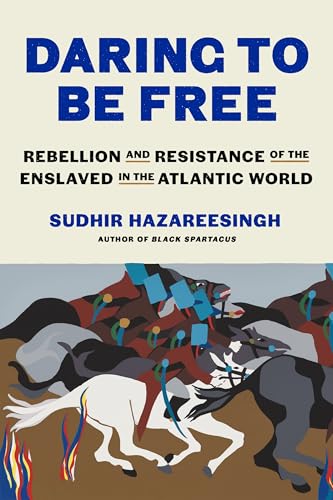
Daring to Be Free: Rebellion and Resistance of the Enslaved in the Atlantic World

Rate this book
A revelatory history of enslaved people's resistance and self-emancipation, across the Atlantic world and beyond.

The ending of the slave trade and the abolition of slavery by European powers during the nineteenth century is generally told as the work of enlightened liberals. Sudhir Hazareesingh turns this narrative on its head, showing the extraordinary degree to which the enslaved resisted their oppressors and emancipated themselves.

Daring to Be Free portrays the struggle for liberation from the perspective of the enslaved and, wherever possible, in their own words. It shines a light on the lives of revolutionaries like Toussaint Louverture, Nat Turner, and the pregnant mutineer Solitude; freed writers of narrative accounts like Frederick Douglass; and the countless rebels, insurgents, and conspirators. Hazareesingh gives particular emphasis to the role of powerful women as campaigners, warriors, and disrupters.

Drawing on both written archives and oral history, the book traces the networks of cooperation that connected runaway settlements and rebellions from Haiti, Jamaica, Brazil, and Cuba to Mauritius and the United States. It shows how the struggle for freedom was shaped less by Western Enlightenment ideals than by spiritual, martial, and religious influences from the lives of the enslaved in Africa before the Middle Passage. Daring to Be Free reshapes our understanding of Atlantic slavery by portraying how enslaved lives were defined not by their dehumanization at the hands of colonialists and slavers but by their own resilience, rebellion, and commitment to emancipation.

464 pages, Hardcover

Published December 2, 2025

9 people are currently reading
415 people want to read

About the author

Sudhir Hazareesingh

27 books34 followers
Sudhir Hazareesingh FBA is a British-Mauritian historian. He has been a fellow and Tutor in Politics at Balliol College, Oxford since 1990. Most of his work relates to modern political history from 1850; including the history of contemporary France as well as Napoleon, the Republic and Charles de Gaulle.

Ratings & Reviews

What do you think?
Rate this book

Friends & Following

Create a free account to discover what your friends think of this book!

Community Reviews

5 stars
9 (45%)
4 stars
9 (45%)
3 stars
1 (5%)
2 stars
1 (5%)
1 star
0 (0%)
Displaying 1 - 8 of 8 reviews
Profile Image for Bex.
28 reviews
September 6, 2025
Daring to be Free is essential reading for anyone who wants to understand how people resisted enslavement throughout the Atlantic. Every chapter is thoroughly researched and written to focus on historical evidence documenting inspiring individuals and communities that resisted the brutality and degradation of enslavement. Their knowledge of war, deep spirituality, and resourcefulness allowed enslaved people to resist in many ways: from acts of noncompliance, running away, forming secret communities, or rising up. As someone raised in the U.S., this book taught me more about the Atlantic slave trade than any history class. We are taught abolition in a way that centers prominent white people without focusing on how emancipation could not have happened without the ceaseless resistance of enslaved men and women. I honestly think that this should be required reading in schools. I will be picking up a physical copy when this book comes out!

Thank you Net Galley, Farrar Straus and Giroux (publisher), and Sudhir Hazareesingh (author) for the ARC!)
Profile Image for Lois .
2,407 reviews624 followers
January 7, 2026
This is an excellent nonfiction history on the rebellions that occurred during chattel slavery during the Trans Atlantic Slave Trade. I’ve read similar books that focused on isolated incidents like the Jamaica Maroon Wars or the Haitian Revolution but this ties all of this together. Looking at this as a whole helps to understand how slavery functioned and changed by focusing entirely on how the oppressed population responded. This allows the enslaved a dignity and agency that is often missing in how we look at study and chattel slavery.

Most importantly, we’re at a period in history when everyday citizens need to be reminded that governments are supposed to be afraid of their people and not the other way around. This is an excellent reminder that even the most disenfranchised amongst us have the power to cause ‘good trouble’ and we must do so. It has a very long as history has shown. This audiobook is narrated by Ben Arogundade and the author, Sudhir Hazareesingh.

Thank you to Sudhir Hazareesingh, Macmillan Audio, and NetGalley for the opportunity to listen to and review this audiobook. All opinions and viewpoints expressed in this review are my own.
Profile Image for Fanchen Bao.
142 reviews10 followers
January 19, 2026
A very important and well researched book to remind us that slavery took place all over North, Central, and South America, not just the Southern states in the U.S., that most White abolitionists never treated the Black people as equals and considered emancipation a benevolent gift from the enlightened Europeans to the uncivilized Africans, and that it was the enslaved people themselves, through unyielding rebellions as early as the 1500s and the shining beacon of the independence of Haiti in 1804, who had driven and landed their self emancipation.

In the day and age when the Far Right talking points are encouraging everyone to be a coward by hiding or twisting the history, this book injects a strong dose of reason to calm the cacophony and reveals to our face the cruelty of slavery and the courageous fight against it. Some of the contents might make some people feel uneasy, but good medicine tastes bitter; the feeling of uneasiness is the right response as your body is cleansing itself of the cowardliness beloved by the Far Right. Ultimately, we all aspire to be a people of reason and responsibility, and this book is a new addition to its many predecessors that can help us achieve that goal.

Don't be a coward and read the book, regardless of the color of your skin or orientation of your political compass.

That being said, the writing might feel dry and academic, which is part of the reason why it had taken me longer than expected to finish.

Interesting Quotes


For example, it is no longer possible to write credibly about the French and American Revolutions without engaging with their complex relationships around slavery and race, or by confining the analysis to conversations and interactions among white citizens only – many of whom owned enslaved people.

--p18.


Even those who wrote sympathetically about the plight of the enslaved before the nineteenth-century abolitions, such as radical Enlightenment pamphleteers and local Christian missionaries, typically approached the issue from a position of intellectual and moral superiority. ... As pointed out by one commentator, ‘[Diderot’s] black person is unable to move beyond a literary existence.’... Indeed, these writings tended to be contemptuous of the spirituality of the captives, which they dismissed as ‘superstitions’.

--p25.


It should be self-evident but let us make the point anyway: the enslaved did not begin to think about their emancipation only when European philosophers happened to start expressing unease about the morality of human bondage in the salons of the Enlightenment.

--p26.


Slavery existed in Africa, however, long before the advent of the transatlantic trade and European colonialism.

--p29.


Catholic ecclesiastical hierarchies became actively complicit in Atlantic slavery, from its theological justifications as a form of divine redemption and persecutions of African religions to the forced baptisms of captives, the presence of churches in coastal slave forts (in some instances, as at Elmina, directly above the dungeons where prisoners were held), and the naming of slave ships after Christian saints. For example, there were British slave vessels called Saint George, Saint Michael, Saint Paul, Saint Thomas, and Saint David.

--p38. God can be perfect but the humans interpreting God can sin just as easily as any of us. God can preach that water is wet, yet the God-interpreters can perform whatever mental gymnastics necessary to claim otherwise, if being contradictory to God suits their need (e.g., make them rich).


...Islam did not offer a blanket opposition to slavery, and many of the major Islamic caliphates were heavily engaged in the Atlantic slave trade, even though they did not sell members of their own faith. But Islamic teachings could inspire and justify individual oppositions to slavery by dissenting figures...

--p38. The problem with the fluidity of religious teaching is not restricted to Christianity. Islam suffers from it as well. Men sin, no matter what holy text they pretend to read.


The determination to resist enslavement at all costs forced the slavers to remain on their guard, and to redesign the ships so as to make rebellions and suicides less likely, by creating a fortified ‘barricado’ within the deck area and increasing the number of crew members; these measures, in turn, led to an increase in the costs of slave-shipping. Marine insurance lawyers were forced to debate and take into account the humanity of the enslaved, and recognize their desire for freedom. Most importantly, this resistance is thought to have significantly reduced the number of captives transported across the Atlantic.

--p47. Individual resistance might appear powerless, but each rebellion made the slave trade a little bit less profitable, which in turn made it more likely for fewer people to be subject to slavery.


It is sometimes claimed that before the Age of Revolutions in the late eighteenth century the enslaved had no real understanding of the concept of freedom, except in personal, self-interested, or ‘ethnic’ terms, and that their opposition to enslavement was thus at best conditional. The cumulative evidence from this chapter demonstrates that this view is incorrect.

--p66


In this sense, Islam shared several other similarities with Obeah. It was both a source of refuge as well as potential rebellion and remained true to its African origins

--p81


This union included the colony’s white settlers, and was perhaps the boldest component of Louverture’s dream. It envisioned a state of affairs no previous Atlantic enslaved insurgency had aspired to or even imagined: the forging of a constructive relationship between the emancipated and their former enslavers, on the basis of civil equality, forgiveness, and mutual respect.

--p93. Louverture was too ahead of his time. Even today we cannot fully achieve the equality and mutual respect he had envisioned more than two hundred years ago. Sadly, we might never achieve it on our own.


Haiti’s post-independence isolation was arguably a vindication of Toussaint’s caution. But this approach blunted Toussaint’s sensitivity to the immediate and human effects of his harsh labour regime, and the way it reminded many labourers of the servitude they had experienced before 1791.

--p99. Right idea at the wrong time or implemented in the wrong way is still a bad idea. This is true even for the greats like Louverture.


More significant for our purposes is what Bolívar’s exchanges with Pétion in 1816 reveal about Haitian black internationalism at this juncture. When Pétion agreed to provide Haitian military assistance to Bolívar, the Haitian president was in a position of relative strength, and asked the Liberator for two commitments in return. The first, which is widely known and commented on, was the abolition of slavery, which Bolívar agreed to (but he backtracked quickly, and the 1819 Angostura Congress that appointed him president made no mention of abolition). The second pledge was that any Africans taken from slave-trading vessels by insurgent republican privateers would be turned over to the Haitian government; Bolívar made a commitment to do so.

--p107. Today I learned that Bolívar's revolution had an abolition angle to it.


To make the same point in ‘Haitian’ terms, the Dominican maroons were Makandalist, but not Dessalinist. They cherished their autonomy but wanted to be free and self-sufficient, and they had no interest in holding power in a centralized state.

--p111. The Dominicans just wanted to be left alone, yet just like it never works when you tell a bully to leave you alone, the only way to make others respect your wish is to be militarily strong enough to force the hand.


All the rebellions had Haitian-style general emancipation as their primary goal, although how this liberty was to be achieved could vary considerably, depending on circumstances as well as local preferences: the options included self-emancipation (Dominica), coercing colonial authorities into granting freedom (Demerara), capturing sovereign power (Louisiana), breaking free from colonial rule and creating a state on the Haitian model (Barbados), and taking flight to the Haitian land of liberty (Virginia).

--p116.


Compensation was handed out to some 46,000 British slavers, highlighting the pivotal nature of slavery in the national economy....In other words, slavers were compensated through general taxation by generations of ordinary British men and women, including many people of Afro-Caribbean descent.

--p120. The ridiculousness of asking the enslaved to pay compensation to the enslavers. That was what a lot of the White abolitionists were campaigning for.


The Church of England too endorsed British slavery, producing slave bibles which were heavily edited to remove all references that could be interpreted as opposing human bondage or encouraging emancipation.

--p122.


Fourteen years before British emancipation, the idea of compensating slavers for their losses was already fully endorsed by Britain’s chief abolitionists, even as they condemned the immorality of the slave trade, and were denouncing slavers for treating their captives as chattel.

--p127.


These three black narratives made powerful interventions in the British abolitionist debate in the later eighteenth century. Gronniosaw, Equiano, and Cugoano challenged widespread views – held by both slavers and abolitionists – about the barbarity of Africans, and robustly asserted their full and unqualified membership of the human race.

--p130.


Also in alignment with British abolitionists, the organization’s position on emancipation remained strictly gradualist. As de Broglie put it in a speech to the French parliament in 1822: ‘slavery is an ill for which freedom is not the immediate cure’. This was exactly what Wilberforce and Clarkson were saying at the time in London.

--p150. The organization referred to was "Société des Amis des Noirs". They were never friends to the Black for sure.


Initiating an interpretation among progressives that proved enduring (and remains common in France to this day), the Haitian revolution was presented not as an autonomous struggle of enslaved captives, but as a by-product of the 1789 Revolution.

--p151. The intentional erasure of the Black people's self emancipation.


Some French gradualist pamphleteers, such as Charles Coquerel, argued that it would be appropriate for captives to contribute to their own liberation by working three days a week for their masters. This form of indentured emancipation demonstrated that, like their British counterparts, French metropolitan abolitionists had no moral qualms about making the enslaved pay for their freedom.

--p151. This is essentially what the French liberals were saying: you Black people are no longer slaves, but you need to work for your previous owner for free three days a week to compensate for their financial losses as a consequence of setting you free.


As Aimé Césaire later observed, black populations were driven by the active democratic sentiment that ‘freedom does not fall from the sky, and it is never completely granted, but taken and conquered’.

--p153. This applies to everything in life.


Lincoln declared in 1860 that he did not believe in racial equality, and many abolitionists were critical of his prudent constitutionalism. In the characteristically blunt evaluation of Frederick Douglass, Lincoln was ‘pre-eminently the white man’s president’ at the time of his entry into the White House, and he was ‘ready and willing at any time during the first years of his administration to deny, postpone and sacrifice the rights of humanity in the coloured people to promote the welfare of the white people’.

--p187. Lincoln issued The Emancipation Proclamation not out of voluntary will but political necessity. He was an abolitionist by coincidence, albeit one of the most important abolitionists regardless.


It was blurred (to the advantage of the enslavers) by the 1850 Fugitive Slave Act, by the widespread incidence of racial discrimination and prejudice in the North, and by the 1857 Dred Scott Supreme Court ruling entrenching the idea that African Americans, whether free or enslaved, had ‘no rights which the white man was bound to respect’ and could therefore never become full citizens of the United States.

--p191. The blur referred to the difference between the Free Northern States and the Slavery Southern States.


The American collective memory of the Civil War pivoted to an emphasis on national reconciliation between Northern and Southern whites, reinterpreting the conflict as a struggle to preserve the Union. Against this backdrop, the abolitionist narrative that viewed the Civil War as a conflict about slavery was gradually marginalized, and the contributions of African Americans to the emancipation process were erased.

--p199. I have heard of this one before. To not mention slavery, the conservative textbook refers to the reason of the Civil War as some disagreement between the North and the South but never spelled out the disagreement was on slavery.


Moreover, the prominence given to individual insurgent leaders somewhat obscured the collective dimensions of resistance, and the key fact which has been illustrated throughout this book, namely that all rebellions were grounded in acts of co-operation and solidarity among the enslaved; even an individual act of flight was underpinned by networks of community support.

--p206.


The cumulative evidence demonstrates, I hope, that at all times the enslaved made major contributions to their freedom, and that emancipation cannot be understood without appreciating their critical agency in all these domains.

--p211.


Haiti was an admired exemplar for black Atlantic communities but not a model. Its force resided in its role as a symbol of black martial valour and capacity for self-government, rather than a template for complete emulation.

--p213. Haiti was the beacon of hope, yet from my own upbringing, Haiti had always been depicted in a negative tone with highlights on its under-development, poverty, and corruption. Maybe both are true but the fact that this book is the first place where I have learned of the positive side of Haiti indicates that, either I have always been ignorant and absentminded during history class or the positivity of Haiti had been intentionally omitted.


After 1804, Haiti provided a refuge for all those (both enslaved and free) seeking to escape to a place where black sovereignty was recognized as a constitutional right. In other words, Haiti represented the ideal that united the different strands of resistance: the principle of autonomy.

--p213.


In the United States the tendency likewise is to hone in on key individuals (Frederick Douglass, Harriet Tubman), whereas the more active forms of black resistance are avoided. This phenomenon is accentuated by the highly decentralized education system and the resurgence of a conservative white nationalism that seeks systematically to downplay the significance of slavery. In many widely used American textbooks, especially in private schools in the South, the Civil War is portrayed as a conflict about states’ rights, and enslaved people have even been described as ‘immigrants’. Moreover, plantation museums in the South generally continue to present the antebellum period in rosy terms.

--p215


However, even though Toussaint Louverture has become a national hero in France, the history of the Haitian revolution is not taught in secondary schools in the métropole; only students in overseas departments and territories are given the option of learning about it. The story of abolition remains focused around 1848, and classically framed as a vindication of triumphant French republicanism.


--p215.
Profile Image for Jeni Enjaian.
3,688 reviews55 followers
January 11, 2026
While I firmly believe that many people need to learn about the history chronicled in this book, I believe that this narrative is too dry to have wide appeal. Hazaresingh tells the story of person after person, group after group who refused to cease their struggle against unjust enslavement. This struggle spans continents, ethnic groups and centuries. I recommend this book with the caveat that the narrative leans more academic in tone.
220 reviews1 follower
December 7, 2025
A much needed corrective to the popular imagining of history. With evidence based research and moral clarity, Hazareesingh connects the reader through the rich traditions of Africans resisting their own enslavement. From beehives through off hills to stop slave raiders to mixing of poison and magic. From the rural island plantations to the halls of power. At every turn, it was the enslaved themselves, not the waffling, contradictory abolitionists of textbooks and statues, who led the charge. The revolution and founding of Haiti became the rallying cry, showcasing the interconnectedness of the enslaved, who are often depicted as meek and weak. It was an international history, and a human story, blurred and hidden for too long.

[Special Thanks to Macmillain audio and Libro.fm for providing me with a free audiobook copy].
Profile Image for Chelsea Knowles.
2,675 reviews
October 13, 2025
*Thanks to NetGalley and the publisher for an advance reader copy of this book in exchange for an honest review.*

Daring to be Free reveals how enslaved people fought against slavery and how some became revolutionaries. This book gives a voice to the enslaved and discusses famous people who fought against enslavement such as Toussaint Louverture, Nat Turner, Dessalines and Frederick Douglass. The role of women is discussed too and the importance of slave narratives which proved hugely important in detailing what slavery was really like. This book isn’t just focused on the North American context like many books about slavery are as it considers Haiti, Cuba, Brazi and other countries as well as the United States. This book also discusses the culture and religions of enslaved people in their different contexts particularly spiritual influences from Africa.

I found this book to be very interesting and an important read considering most of the books I’ve read on slavery tend to focus on the horrors enslaved people experienced. Whereas, Daring to be Free gave agency to enslaved people and showed how they fought for their freedom and had their own ideas on how society should be run with free black communities. This book is well written and it gave me many things to think about. I enjoyed reading this and I think this is an important addition to the books about enslavement and I would recommend this.

Favourite Quote - But as the enslaved resisters have shown us throughout this book, and as pertinently summarized by Frederick Douglass: ‘power concedes nothing without a demand’.
Displaying 1 - 8 of 8 reviews

Can't find what you're looking for?

Get help and learn more about the design.