Jump to ratings and reviews
Rate this book

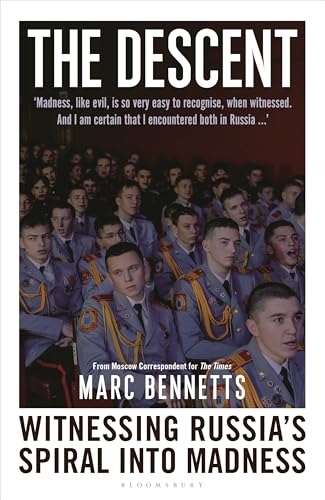
The Descent: Witnessing Russia's Spiral into Madness Under Putin

Rate this book
An extraordinary first-hand account of Russia's descent into totalitarianism, paranoia and madness.

Marc Bennetts, foreign correspondent for The Times and The Sunday Times, moved to Russia in the chaotic final years of President Yeltsin's rule. Twenty-five years later, The Times pulled him out of Russia over concerns for his security following his arrest in Moscow at a protest against the war in Ukraine.

From the “wild” 1990s in Moscow to narrowly escaping death under fire in Ukraine, The Descent is a unique and personal diary of how Russia spiraled into violent insanity. Bennetts witnessed the often-terrifying events in Russia up close, observing how the Kremlin's ubiquitous propaganda warped minds and fomented hatred of Putin's foes, at home and abroad, even among people close to him. After leaving Russia, he travelled in war-torn Ukraine, where he came face-to-face with the appalling consequences of this madness.

Bennetts meets a vast array of characters, from pro-war Russian politicians, influential Russian Orthodox Church officials and aggressive Kremlin activists to opposition figures and a Siberian shaman who tried to “exorcise” Putin, as well as Russians who took up arms to fight Moscow's invading forces. In this extraordinary panorama, Marc Bennetts shows in frightening detail how a society can lose its mind, and how easily a power-hungry leader can reshape an entire country in his own malevolent image.

272 pages, Hardcover

Published May 26, 2026

Loading...
Loading...

About the author

Marc Bennetts

13 books12 followers
Marc Bennetts is a British journalist based in Moscow, where he has lived for the past fifteen years. He has reported from Russia, Iran, and North Korea for the Guardian, The Times, the Observer and the New York Times, among other publications. He spent eighteen months as a reporter for Russia’s RIA Novosti news agency. His first book, Football Dynamo, examined Russian culture through the country’s national sport.

Ratings & Reviews

What do you think?
Rate this book

Friends & Following

Create a free account to discover what your friends think of this book!

Community Reviews

5 stars
65 (34%)
4 stars
81 (43%)
3 stars
30 (16%)
2 stars
7 (3%)
1 star
3 (1%)
Displaying 1 - 19 of 19 reviews
Profile Image for Laura Hutchinson.
125 reviews2 followers
July 15, 2026
I can see lots of reviewers of this book have said that it’s got nothing new to say about what’s happened in Russia - but I still think it’s worth reminding ourselves. It’s desperately sad to read.
Profile Image for Dmitry.
1,406 reviews118 followers
September 18, 2026
(The English review is placed beneath the Russian one)

Подобный жанр политической литературы можно обозначить как персональные заметки журналиста или любого другого иностранца долго прожившего в той или иной стране. Подобных книг, которые написаны не только о путинской России, было издано довольно много и как бы подразумевается, что такие книги заслуживают больше доверия чем академические исследования, ведь авторы таких книг видели своими глазами то, что они описывают. В этой книге автор описывает путинский режим, государственные репрессии и, в конце концов, войну. Кажется, что такой автор должен быть более объективным, чем академические исследования людей, которые не прожили в России столько лет, сколько прожил автор. В реальности же, такие авторы как автор этой книги, вовсе не обязательно объективны, нейтральны или даже поняли тот предмет, на который они пишут книгу.

Я буду утверждать что, несмотря на то, что автор много лет прожил в России, женился на гражданке России, а так же воспитывает на половину русских детей, автор не понял Россию или, что более вероятно, не захотел понять. Главная проблема этой книги в том, что автор кроме Путина ничего не видит. У автора всегда только Путин, Путин, Путин и Путин. Это как утверждать, что СССР – это только Сталин или только Ленин или только Брежнев. Проблема в том, что дело не столько в Путине, сколько в СИСТЕМЕ, которую начал строить Ельцин, а достроил Путин. Другими словами, ту диктатуру, которую мы сегодня видим в России, построил не Путин, а Ельцин. Диктатура или мягкий авторитаризм появился при Ельцине, а не при Путине. Система, которая обеспечивает Путина возможностью полностью игнорировать любые российские законы, будь то Конституция или Уголовный кодекс РФ, была выстроена именно Ельциным, и именно при Ельцине народ был выдрессирован ничего не спрашивать и не требовать у власти. Вспомним, что Ельцина ненавидела чуть ли не вся страна, что именно при нём Россия впервые начала несправедливую войну в которой власти не жалели ни молодых военных ни гражданских. Какую бы политику бы по обнищанию и обворовыванию бы Ельцин и его правительство не проводило, а он всегда побеждал на выборах президента. И кто знает, что бы было бы, если бы его здоровье было бы более крепким, и если бы он сам добровольно бы не отказался бы от власти. Не народ отказал Ельцину в доверии, тем самым сняв его с поста президента, а это он САМ это сделал. Так о какой политической силе и влиянии российского народа можно говорить, если у этого народа её никогда и не было?

Что касается Путина, которому и посвящена вся книга, то он делал лишь то, что позволяла политическая система, выстроенная при Ельцине, самим Ельциным. Да, Путин диктатор без чести и совести и диктатор очень жестокий, пусть и не уровня Сталина и Ленина. Но вот автор этой книги должен был понять, что проблема не в Путине, а в системе, ибо если убрать сегодня Путина без разрушения этой системы, то очень скоро придёт новый Путин, второй Путин, ибо СИСТЕМА.

Вот это главная проблема этой книги, но второй проблемой является фрагментарное повествование. В книге нет одной темы, а есть как бы зарисовки, короткие истории из жизни автора, его наблюдения которые были сделаны пока он жил и работал в России, но по ним невозможно построить цельную картину. Все те репрессии гражданских активистов, которые автор описывает в книге, описаны поверхностно, да и о них и так каждый знает, кто читал хоть какие-то книги о России или смотрел международные новостные интернет-каналы в YouTube как то CNN, DW или FoxNews. Да, порой автор описывал менее известные случаи как то высказывания российских священников, которые абсолютно мракобесные или описывает свои разговоры с русскими, так называемыми радикальными националистами. Почему «так называемыми»? Потому что настоящих националистов в России нет, ибо по отношению к настоящим российским националистам, точно так же как по отношению к настоящим идейным левым российские власти применяют репрессии разной силы, поэтому и тут автор ошибся, думая, что беседует с настоящими националистами.

Третья проблема, это чёрно-белый взгляд, когда в книге мы встречаем либо людей, которые слепо поддерживаю Путина либо кто является ярыми критиками его правления. На самом деле в России полно людей (большинство населения), которым по большому счёту всё равно, т.е. кто далёк от политики или кто аполитичен. К сожалению, политика 90-ых очень сильно отбила российским гражданам интересоваться и участвовать в политике, ибо всё равно будет так, как хочет того верховная власть и в этом смысле преступления Ельцина даже большее, чем Путина. Путин, по крайне мере, не создал эту политическую систему, но он лишь использовал то, что ему дали. А кто дал? Кто преврати Путина из никому неизвестного Санкт-Петербуржского чиновника сначала в директора ФСБ, потом в премьер-министра и вскоре - в президента с диктаторскими возможностями? Уж не те ли так называемые либералы и демократы, а так же технократы, кто на протяжении всех 90-ых поддерживали или, в крайнем случаи, не сильно критиковали Ельцина?

Четвёртая проблема в том, что автор смотрит в рот российскому народу ожидая услышать от него осуждения Путина, но проблема в том, что от российского народа никогда не зависело движение российской политики. Поэтому это совершенно не важно, поддерживает ли российский народ Путина в его борьбе с Украиной или нет, ибо всё решает элита, о которой автор написал…НИ-ЧЕ-ГО.


This genre of political literature can be described as the personal observations of a journalist or any other foreigner who has lived in a particular country for a long time. Quite a few such books—which are not limited to Putin’s Russia—have been published, and it is sort of implied that such books deserve more credibility than academic studies, since the authors have seen with their own eyes what they describe. In this book, the author describes the Putin regime, state repression, and, ultimately, the war. It seems that an author like this should be more objective than academic studies by people who haven’t lived in Russia as long as the author has. In reality, however, authors like the one who wrote this book are by no means necessarily objective, neutral, or even knowledgeable about the subject they are writing about.

I would argue that, despite the fact that the author has lived in Russia for many years, married a Russian citizen, and is raising children who are half Russian, he has failed to understand Russia—or, more likely, has refused to understand it. The main problem with this book is that the author sees nothing but Putin. For the author, it’s always just Putin, Putin, Putin, and Putin. It’s like claiming that the USSR was nothing but Stalin, or nothing but Lenin, or nothing but Brezhnev. The problem is that it’s not so much about Putin as it is about the SYSTEM that Yeltsin began to build and Putin completed. In other words, the dictatorship we see in Russia today was built not by Putin, but by Yeltsin. Dictatorship—or soft authoritarianism—emerged under Yeltsin, not under Putin. The system that allows Putin to completely ignore any Russian laws—whether the Constitution or the Criminal Code of the Russian Federation—was built by Yeltsin, and it was under Yeltsin that the people were conditioned not to ask questions or make demands of the authorities. Let us recall that Yeltsin was hated by virtually the entire country, and that it was under his rule that Russia first launched an unjust war in which the authorities spared neither young soldiers nor civilians. No matter what policies Yeltsin and his government pursued that impoverished and robbed the people, he always won the presidential elections. And who knows what would have happened if his health had been stronger, and if he hadn’t voluntarily stepped down from power. It wasn’t the people who withdrew their trust in Yeltsin, thereby removing him from the presidency—he did it HIMSELF. So what political power and influence of the Russian people can we even talk about if that people have never had any?

As for Putin, to whom the entire book is dedicated, he did only what the political system—established under Yeltsin and by Yeltsin himself—allowed him to do. Yes, Putin is a dictator without honor or conscience, and a very cruel one at that, even if not on the level of Stalin and Lenin. But the author of this book should have realized that the problem lies not with Putin, but with the system; for if Putin were removed today without dismantling this system, a new Putin—a second Putin—would very soon emerge, because of THE SYSTEM.

That is the main problem with this book, but the second problem is its fragmented narrative. The book lacks a single overarching theme; instead, it consists of sketches—short stories from the author’s life and his observations made while he was living and working in Russia—but it is impossible to piece them together into a coherent picture. All the repressions against civil society activists that the author describes in the book are covered only superficially—and besides, anyone who has read even a few books about Russia or watched international news channels on YouTube, such as CNN, DW, or Fox News, is already familiar with them. Yes, at times the author described lesser-known instances, such as statements by Russian priests that were utterly obscurantist, or recounted his conversations with Russians—so-called radical nationalists. Why “so-called”? Because there are no real nationalists in Russia; the Russian authorities use repression of varying intensity against genuine Russian nationalists, just as they do against genuine ideological leftists. That is why the author was mistaken here as well, thinking he was speaking with genuine nationalists.

The third problem is the black-and-white perspective, where the book portrays people as either blindly supporting Putin or as fierce critics of his rule. In reality, Russia is full of people (the majority of the population) who, by and large, don’t really care—that is, those who are distant from politics or apolitical. Unfortunately, the politics of the 1990s severely discouraged Russian citizens from taking an interest in and participating in politics, because things would turn out the way the supreme authority wanted them to anyway; and in this sense, Yeltsin’s crimes are even greater than Putin’s. Putin, at least, did not create this political system; he merely took advantage of what was handed to him. And who gave it to him? Who transformed Putin from an obscure St. Petersburg bureaucrat first into the director of the FSB, then into the prime minister, and soon after into a president with dictatorial powers? Aren't these the so-called liberals and democrats—as well as the technocrats—who, throughout the 1990s, supported Yeltsin or, at the very least, didn't criticize him too harshly?

The fourth problem is that the author is waiting for the Russian people to speak out against Putin, but the problem is that the direction of Russian politics has never depended on the Russian people. Therefore, it is completely irrelevant whether the Russian people support Putin in his conflict with Ukraine or not, because everything is decided by the elite—about whom the author has written…NOTHING.
Profile Image for Mark Peacock.
187 reviews6 followers
June 29, 2026
When I read this in the preface -
When I began this book, one of my biggest challenges was to control my hatred: without doing so, I would have likely produced 80,000 words of unreadable bile. I hope I have avoided that trap but I make no apologies for any anger that has spilled over onto these pages.
I knew I was in for a ride. And note to future readers -- he doesn't avoid the trap.
Bennetts' anger at what Putin has done to Russia seems to overwhelm every conversation he recounts. The people he meets either agree with him or the conversation decays into name calling and arguments. Bennett is very manichean about today's Russia; if people aren't completely aligned with his views, they're morally corrupt.

This is not to defend what Putin has done in Russia. It's that I rarely find that people are so starkly black and white. He kinda lost me when he cut off his mother-in-law; must be tough for his wife and daughter.

Between Bennetts' self-assigned position as moral arbiter and the non-linear/up-and-back narrative (again, another thing about which he warned readers in the preface), it is difficult to extract facts from Bennetts' tirades. For me, this book was a slog and difficult not to DNF.
Profile Image for Bernhard.
85 reviews
July 22, 2026
This is not a history book. But it contains heaps of valuable first-hand information from a qualified journalist, collected over a 25-year period in Russia and Ukraine in interviews, personal encounters and day-to-day life. This is information that you would find difficult to obtain otherwise.

The book does not try to give a complete picture of the events since Putin rose to power, their causes, the detailed behind-the-scenes political developments, the Ukraine war, and how could it? Most of the time, the information is also not presented in chronological order. Bennetts makes a half-hearted attempt to categorise the phenomena that emerge from his experiences with Russians and Ukrainians by giving the book a chapter structure. Only rarely, however, do the chapter titles point to what the leitmotif of the chapter is meant to be. In spite of these limitations, Bennett`s book is extremely interesting to read.
Profile Image for Nitay.
111 reviews3 followers
June 21, 2026
Bennetts rarely if ever seems to connect with or understand the people who are at the center of the book he wrote. Most interactions with them rarely last more than a few interchanges before being derailed by arguments, name calling, and general hostility. Those that dont rarely lead to second or third meeting, as Bennetts just seems to disgusted or morally superior to connect to them on any deep level, so he doesn’t actually have much of depth to say. Often, a person who could have been a fascinating source of information is squandered so he could throw some antagonizing accusation at them, instead of trying to get some trust or showing some basic tact.

It’s okay to not want to develop connections with radicals and racists - but not if you want to write a book about them with anything new or deep to say.

If you already know that Russian nationalistic populism is schizophrenic, racist, self contradictory, and will lead to nothing more than the enrichment of oligarchs at the expense of the rest - which you probably already do - you basically got the gist of his insights that come from this own supposed witnessing. The historical recap was good enough.
Profile Image for Michael Greene.
131 reviews
June 22, 2026
I really wanted to like The Descent more than I did.

I recently finished From Russia with Blood by Heidi Blake, and I suspect that influenced my expectations going into this book. I was hoping for something similar stylistically, which is probably unfair to Marc Bennetts because he is trying to tell a different story in a different way.

For me, the biggest issue was that the narrative felt somewhat disjointed. There were certainly interesting and important stories throughout the book, but I never felt fully pulled into a single narrative thread.

That said, Bennetts has an important story to tell. His observations about Russia under Putin are valuable, and there were plenty of moments that were enlightening and thought provoking.

I am curious what I would have thought of this book had I not read From Russia with Blood immediately beforehand. Perhaps I would have been more receptive to its style. Then again, I suspect I still would have landed at roughly the same rating.

Overall, an informative and worthwhile read, but one that never fully came together for me. Three stars.
Profile Image for Taylor.
59 reviews1 follower
August 29, 2026
The key word in this title is "witnessing," as the book reads mostly as a collection of journalistic and personal encounters. I personally found the organization to be disorienting and disappointing; the anecdotes jump back and forth in time and only sometimes did the chapters cohere around a theme and evidence/argumentation. In terms of content, the beginning does not offer much for those familiar with Russian politics since the fall of the Soviet Union (1990s as traumatic period of economic chaos, criminality, and humiliation, seeding the field for a strong man ruler; rise in living standards in major cities during Putin's first terms because of global oil price rise; historic themes of political apathy / learned helplessness). Mostly I was disappointed that there was not greater evidence or argument around the "spiral into madness", rather just documentation of its existence. For instance, Bennetts presents the Kremlin's multiple and conflicting narratives and justifications as evidence of muddled thinking or even Putin's declining rationality, when this is a hallmark strategy of misinformation--a feature not a bug.

Critiques aside, many of the anecdotes and cultural references are genuinely striking or surprising, including passages on the lagging standards of living in the regions and Russian spirtualism and shamanism. There are also frightening parallels to the last 15 years of US polarization. He bookends the story movingly and effectively with the ideas of slain opposition leader Galina Starovoitova, who in the 1990s advocated for accountability for Soviet crimes and barring former Soviet officials from government, which may well have led to a more enduring attempt at democracy.

Some quotes....

Regime change and democracy:

Galina Starovoitova: "We can see too many parallels between Russia’s current situation [in the 1990s] and that of Germany after the Treaty of Versailles. A great nation is humiliated and many of its nationals live outside the country’s borders. The disintegration of an empire has taken place at a time when many people still have an imperialistic mentality."

Son of Starovoitova: "The desire for freedom and democracy that appeared after the collapse of the Soviet Union was squandered. It will take decades, at least, to restore the drive for the kind of conscious social change that took place in Eastern Europe after the fall of the Berlin Wall, or in Germany, after Nazism. We failed as a society."

Vladimir Kara-Murza, opposition politician in exile: "We need to be preparing for the day after Putin now… There will need to be justice. There will need to be accountability. There will need to be a genuine reflection, a genuine moral cleansing."

Propaganda , misinformation, and education:

“The impact of this constant stream of crude but effective Kremlin propaganda on regular viewers was as predictable as it was disturbing. Inflammatory broadcasts helped to whip up unprecedented levels of hatred… I could barely have a five-minute conversation with my mother-in-law before she steered the conversation towards Ukrainian ‘Nazis’ and the ‘evil’ West. …Not long after Russia’s annexation of Crimea, we stopped speaking entirely and, as she consumed state media’s foulness like a drug, I [a British man] grew in her mind into a grotesque, almost demonic figure.”

“Why was Putin able to get away with portraying Ukraine as a Nazi regime? In part, it’s because for many of his citizens, the words ‘Nazi’ or ‘fascist’ often signify little more than anti-Soviet or anti-Russian. School history books focus on Hitler’s horrendous crimes against the Soviet people, with the slaughter of millions of Jews in concentration camps reduced to almost a footnote.”

Chechen teenagers Bennetts interacts with insist that "Putin saved Chechnya" rather than launching a brutal war against it.

The evolution of political figures spouting misinformation:

“I wasn’t so sure that Zhirinovsky was simply playing a part. Even if this was true at the dawn of his bizarre political career, the irrationality that he deployed as a vote-winning strategy later appears to have consumed him entirely, like an aging actor whose personality has merged so much with his on-screen persona that it is impossible to say where one begins and the other ends.”

Pavlovsky, a ‘political technologist’ involved in Putin’s coronation in the presidency, did focus groups that found Russians thought an ideal leader would like a fictional Soviet-era secret agent. ‘We enacted a whole story about a spy who had ensconced himself among the authorities and then suddenly emerged and went over to the side of the people… It was like a theatrical production, and Putin quickly learnt his role.’ ... The myth that Putin decides everything, that there is no alternative to Putin, we worked on constantly through his first two terms. …For the majority of Russian’s today, Russia is Putin’s state.’ This team also discouraged him from engaging in debates or attending scenes of tragedies, patterns he maintains to this day.
Profile Image for Olga.
124 reviews
September 16, 2026
I was so glad to read this. The feeling of disgust and anger from the author is exactly what many Ukrainians felt. Betrayal and anger. When it comes from a rational actor like Marc Bennetts, it's even clearer: the black-and-white nature of the swamp that russia has become, its drain of decent people, and also the thirst for Ukrainian blood from the majority of the population. I was sad to hear this in his tone, in his trying to "keep things balanced." I appreciate the venom. I appreciate the truth. Even about his mother-in-law (which some reviewers here are shocked that Marc disavowed).

I would recommend this book to all my friends in the West because the author is an outsider to russian society, but someone who has been embedded for long enough to truly understand the rotting core. This is why I would trust his words and his message if I were you. His disappointment in the society comes from heartbreak as well. He didn't want to leave. He was forced by the rot that has spread.

I feel for him, and I feel more for the many, many people that russians have hurt in the past 4.5 years of the full-scale invasion of Ukraine.

Thanks for writing the truth about your experience and for doing it bravely and as composed as you could. I, as a Ukrainian, appreciate and respect you for it. 💙💛💪🏼
Profile Image for Lissa00.
1,388 reviews32 followers
June 4, 2026
Marc Bennetts went to Russia as a young journalist and ended up marrying and spending over two decades in the country with his family. What he witnessed was the country devolve from the possibility of democracy to the reign of an increasingly maniacal despot. This was a fascinating and terrifying glimpse from the inside of the country. It is very hard not to draw some parallels to happenings inside our own which whether meant or not created a scary cautionary tale. This book does jump around quite a bit in time (especially 2014 and 2022) and I wasn't always sure which time period was being discussed. This probably didn't matter in the long run but was a bit frustrating. Overall, if you want an overview of the situation in Russia leading up to the invasion of Ukraine, this is a good book to start. I received a digital copy of this book from the publisher via NetGalley.
Profile Image for Tania.
84 reviews25 followers
Review of advance copy
April 21, 2026
What stood out most to me was how personal the book feels. The author’s conflicting emotions toward Russia add a layer of authenticity, making the narrative feel deeply human rather than purely historical or analytical.

Even as someone who has read extensively on this subject, I found a surprising amount of new and thought-provoking material. This is where the book distinguishes itself—rather than simply retelling familiar events, it offers a more nuanced and original perspective.
Profile Image for Toni.
3 reviews
August 25, 2026
A harrowing and insightful report into russia's spiral into putin's ever more psychopathic system and the people cynically or gleefully helping him along.

And yet, a work full of humanity and the struggle of many, including the author, to make sense of the brainwashing of relatives, the regime's breathtaking, beastly crimes - and what to make of the hatred that so naturally must in response come to those who dont close their eyes.

5/5
55 reviews
Review of advance copy
May 21, 2026
I felt when reading it was unsettling. How can a civilised country descend into what Russia has become? I can’t answer that and I doubt anyone can. But I feel ashamed to be a human being after reading about the atrocities inflicted. Some say Russia is a brutal conspiracy but but you be the judge. Read the book and decide
Profile Image for Matt Brown.
260 reviews1 follower
September 8, 2026
A surprisingly easy to read book (embarrassingly, I get easily confused by all the Russian names) that sheds a lot of light on the horrible ways that Russia has been transformed since the arrival of Vladimir Putin. This kind of current history is so fascinating, and the author’s personal ties to Russia add even more perspective and fury to this engaging account.
Profile Image for Ana-Maria Bujor.
1,528 reviews82 followers
September 21, 2026
Depressing and fascinating at the same time. Quite interesting to get the story from the inside, to witness the slow descent to insanity, be it through politicians or regular people. If you are versed when it comes to recent Russian history, not much is new, but it's definitely worth reading for the reporting and smaller and very human stories.
Profile Image for Ilia Markov.
359 reviews23 followers
June 24, 2026
Love how the book is written – although there's nothing really new in it.

It's a chronicle of how Russia went mad in 20-25 years.

Not much of an explanation/theory (from the author) on what caused it.
354 reviews
July 3, 2026
Good primer to the topic weakened by the author's dogmatism in interviews. Overall a very good overview of Putin's Russia and the drivers behind the war.
Profile Image for Gergely.
89 reviews4 followers
April 6, 2026
As someone who lived in Moscow for 10 years, I have long been awaiting an account based equally on the every day and the symbiotic relationship of that with federal level politics. They are indivisible. If you want to know what it was like to live in Russia as a foreigner, and also understand the wider world as it changed on a sixpence around us, this is the book. For this reader, utterly readable and cathartic in equal measure.
Displaying 1 - 19 of 19 reviews