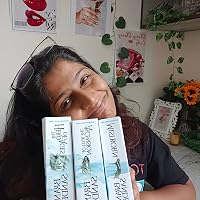
The Empyrean Series 3 Books Collection Set Fourth 9781649374042 Iron 9781649374172 Onyx 9781649374189
Publisher A #1 New York Times bestseller - TV series in development at MGM Amazon Studios with Michael B. Jordan's Outlier Society - Amazon Best Books of the Year, #4 - Apple Best Books of the Year 2023 - Barnes & Noble Best Fantasy Book of 2023 - NPR "Books We Love" 2023 - Audible Best Books of 2023 - Hudson Book of the Year - Google Play Best Books of 2023 - Indigo Best Books of 2023 - Waterstones Book of the Year finalist - Goodreads Choice Award Winner - Newsweek Staffers' Favorite Books of 2023 - Paste Magazine's Best Books of 2023 "Suspenseful, sexy, and with incredibly entertaining storytelling, the first in Yarros' Empyrean series will delight fans of romantic, adventure-filled fantasy." -- Booklist , starred review "Fourth Wing will have your heart pounding from beginning to end... A fantasy like you've never read before." ―#1 New York Times bestselling author Jennifer L. Armentrout Enter the brutal and elite world of a war college for dragon riders from #1 New York Times bestselling author Rebecca Yarros Twenty-year-old Violet Sorrengail was supposed to enter the Scribe Quadrant, living a quiet life among books and history. Now, the commanding general--also known as her tough-as-talons mother--has ordered Violet to join the hundreds of candidates striving to become the elite of dragon riders. But when you're smaller than everyone else and your body is brittle, death is only a heartbeat away...because dragons don't bond to "fragile" humans. They incinerate them. With fewer dragons willing to bond than cadets, most would kill Violet to better their own chances of success. The rest would kill her just for being her mother's daughter--like Xaden Riorson, the most powerful and ruthless wingleader in the Riders Quadrant. She'll need every edge her wits can give her just to see the next sunrise. Yet, with every day that passes, the war outside grows more deadly, the kingdom's protective wards are failing, and the death toll continues to rise. Even worse, Violet begins to suspect leadership is hiding a terrible secret. Friends, enemies, lovers. Everyone at Basgiath War College has an agenda--because once you enter, there are only two ways graduate or die. The Empyrean series is best enjoyed in order.
Discover the instant #1 New York Times bestseller! TV series now in development at MGM Amazon Studios with Michael B. Jordan's Outlier Society. Accolades for Fourth Wing Amazon Best Books of the Year, #4 - Apple Best Books of the Year 2023 - Barnes & Noble Best Fantasy Book of 2023 (Fourth Wing and Iron Flame) - NPR "Books We Love" 2023 - Audible Best Books of 2023 - Hudson Book of the Year - Google Play Best Books of 2023 - Indigo Best Books of 2023 - Waterstones Book of the Year finalist - Goodreads Choice Award, semi-finalist - Newsweek Staffers' Favorite Books of 2023 - Paste Magazine's Best Books of 2023 "The first year is when some of us lose our lives. The second year is when the rest of us lose our humanity." --Xaden Riorson Everyone expected Violet Sorrengail to die during her first year at Basgiath War College--Violet included. But Threshing was only the first impossible test meant to weed out the weak-willed, the unworthy, and the unlucky. Now the real training begins, and Violet's already wondering how she'll get through. It's not just that it's grueling and maliciously brutal, or even that it's designed to stretch the riders' capacity for pain beyond endurance. It's the new vice commandant, who's made it his personal mission to teach Violet exactly how powerless she is-unless she betrays the man she loves. Although Violet's body might be weaker and frailer than everyone else's, she still has her wits--and a will of iron. And leadership is forgetting the most important lesson Basgiath has taught Dragon riders make their own rules. But a determination to survive won't be enough this year. Because Violet knows the real secret hidden for centuries at Basgiath War College--and nothing, not even dragon fire, may be enough to save them in the end. The Empyrean series is best enjoyed in order.
Preorder now and receive the stunning DELUXE LIMITED EDITION while supplies last―featuring gorgeous sprayed edges with stenciled artwork, as well as exclusive special design features. This incredible collectible is only available for a limited time, a must-have for any book lover while supplies last in the US and Canada only. After nearly eighteen months at Basgiath War College, Violet Sorrengail knows there's no more time for lessons. No more time for uncertainty. Because the battle has truly begun, and with enemies closing in from outside their walls and within their ranks, it's impossible to know who to trust. Now Violet must journey beyond the failing Aretian wards to ...
Rebecca Yarros is a hopeless romantic and coffee addict. She is the New York Times bestselling author of over twenty novels, including Fourth Wing, The Last Letter and The Things We Leave Unfinished. She’s also the recipient of the Colorado Romance Writer’s Award of Excellence for Eyes Turned Skyward. Rebecca loves military heroes and has been blissfully married to hers for over twenty years. A mother of six, she is currently surviving the teenage years with all four of her hockey-playing sons.
Want to know about Rebecca’s next release? Check her out online at www.rebeccayarros.com.
I've wrestled a lot whether to provide a review for these books and finally decided to raise my voice. In compiling my review I want to be very careful not to create an ad hominem attack on the author, who writes well and is inventive--but not, to my mind, well enough or with sufficient invention.
My disappointment in the series stems from three points that will not trouble other readers. First is the requirement to suspend disbelief in a positively ridiculous, unsustainable social setting. There is no society which can strengthen its ranks by killing off its potential members--particularly a society or force which claims to be engaged in a conflict with an implacable, growing enemy. It sound dramatically romantic, but killing off everyone works only in an imaginary world. To a social historian (my day job), that premise is simply not even marginally realistic. Like any conflict between corrupt warlords, this sort of competition favors not the brave or the strong, but rather those who won't take risks or will undercut the competition, exactly the opposite of the characters the author wants us to believe. In the process the author fails to note that attrition, while inevitable, occurs chiefly from accident and happenstance, which is not the same as being unsuitable. Even she realizes this point; note the change as the griffon selection is introduced into the story. Especially in Fourth Wing I found my eyes rolling so much they got tired.
Second, the constant use of coarse vulgarity sustained neither the story nor the characters at all. I don't care how common it may be on subways or among casual conversation in some groups. In my world (and my classroom) profanity is discouraged as I encourage people to think and react genuinely and effectively. Doing so prevents no one from communicating nor expressing their thoughts, but they do learn to think and shape arguments before they talk. Characters in this book evidently do not. Profanity is so common through the pages as to be wearying. The constant, gratuitous, and useless insertion of coarse language reminds me of something I learned as a young writer: "vulgarity is the sign of a weak writer trying to find forceful expression." I lost respect for the books as technical examples of storytelling while plodding through the profanity, and never really regained it.
Third, I found the choice of ceaseless promiscuity and verbal pornography to be useless distractions. It offered the reader no help toward understanding characters, served no useful or even practical plot exposition. Worst, as a literary device the descriptions of passionate abandon are utterly unlike any real-life sexual experience that is not wholly faked. Young readers looking for a thrill will find it, but those hoping for a mirror for real relationships will be sadly deceived. "If a thing can go without saying, let it," my grandfather said repeatedly. That should have been the guiding principle in these three books. In lived experience, promiscuity does not ever foster the sort of stable, committed interpersonal relationships that is supposed to be created by the central characters. Quite the opposite. Readers who want a love story won't find it tucked into the hormonal adolescent passion written here. I'm not advocating prudishness, just better narrative ability than resorting to this type of gratuitous distraction.
As one with previous professional experience in commercial publishing (albeit, a quarter century ago), it occurs to me that these flaws are not merely the faults of the writer but also reflect poor advice from both agent and editor. Doubtless both are competent, committed professionals. They should know better. For me, the stories' interesting and well-crafted qualities are offset fatally by these choices. Each of the books could have been written without these elements. They would have lost nothing as works of literature, and would have been both better storytelling and have given the works wider appeal. Other readers will think differently, asserting that they are fantasy or provide a touch of realism, but I see nothing either realistic or encouraging in this, however popular the books might be. I wish the author would have chosen differently and been a bit more careful employing the writing skill that she obviously has. Like a bowl of ice cream with only a few cockroaches mixed in with the nuts and caramel, these narrative choices provide the reasons I will not recommend the books to anyone.
this was... an interesting read. i liked how the events of the first book played out. the romance wasn't forced and there was chemistry between the characters. i liked violet too, she was a very strong fmc and i liked how she would think outside of the box to keep herself alive. i liked xaden too, but he seemed a little stereotypical and he so easily fit into the cookie cutter enemies to lover love interest. but he soon became more interesting as a character, and i ended up really liking him. however, in the second and third books, i felt like the story was not properly explored and the chapters were rather confusing. it wasn't as smooth a read as the first book and the characters started feeling more like words on paper than real people. one thing rebecca did well though, was incite anger towards catriona in the reader. i was gritting my teeth through some scenes, i could not stand this girl. the story could have ended as a trilogy, however. rebecca, you are trying way too hard to milk these books. take your money and go.
Overall, I’d give this series 3.75 out of 5, as of book three. Book one was fantastic and book two was great but felt like the author was thinking “guess I’ll make it a series.” Book three was a disappointment, the kind of quality you get from a fat cash cow. Excited to read book four and five, as they’ve been announced, but limiting my excitement due to the drag book three was.
Minor, but still; SPOILERS BEYOND THIS POINT. YOU HAVE BEEN WARNED. Trespassers shot? I don’t know.
Book 1 review:
4.5/5 stars. I never rate above a 4.
I don't usually like the enemies to lovers trope, honestly I hate it, but this? This was peak. This was a slow burn I enjoyed. Fantastic book, the only negative thing I have to say has nothing to do with the writing and solely my own taste, so I won't bother to mention it. Only reason I don't give it 5 stars is because I am very picky with giving 5 stars. I would reread this, but I'm not gonna be thinking about this book every day.
Book 2, 4/5 stars
Book 3 review:
If this was stand alone I'd give it 3 stars. Boring in comparison to the other 2 books in this series
The Empyrean series is an absolute rollercoaster that hooks you from the very first page of Fourth Wing. The first book sets the bar incredibly high with its brutal dragon-rider college setting, fast pacing, and a heartbreaking twist ending that leaves you in tears and desperate for the sequel. While Iron Flame keeps that high-stakes energy alive with massive world-building and terrifying new threats, the series hits a noticeable speed bump at the start of Onyx Storm. The third book definitely suffers from a slow, political start that lacks the immediate "run-for-your-life" thrill of the earlier books. However, even when the plot bogs down, the intense bond between Violet and Xaden keeps you turning the pages. It is an incredibly addictive fantasy romance where the first two books completely steal your heart, and the sheer love for Xaden is enough to carry you through the slower chapters of the third.
I inhaled this series. I’m not kidding. It has absolutely everything I love. Strong female lead, characters with complexity and depth, action, love, adventure, fantasy. For a few months there I had a true obsession with all things Dragons and felt myself on a parallel Universe - halfway between this world and the other half on planet Earth whenever I took those headphones off.
It is full of tragedy and triumph, it was well written and expansive. There’s a reason this series was so well talked about. I actually started watching review videos for the first time ever once the last one ended. That’s how much I enjoyed it.
Bravo Yaros, I cannot WAIT to see the magic you’re cooking up now 🐉✨
A fun gallop through an alternate universe with dragons and griffins and a war college of randy cadets. Some pretty graphic sex scenes that felt contrived-- thrown in, like a stiff structured formula, rather than naturally allowing the story to drive the romance within the evolution of each character. Also, she might remember a naked lady squatting down on 5th Avenue, her lady parts agape is far LESS sexy than just a hint of cleavage and a suggestion of curves beneath fluttering, diaphanous cloth. Yarrow should leave more to the reader's imagination so we can be as graphic or as sophisticated as we choose. Fun story line with the dragons holding some of the strongest values, best loved and most feared. Looking forward to book 4.
While not aspiring to literary greatness, this series delivers thoroughly enjoyable escapism. The worldbuilding creates a vivid, immersive setting complete with dragons and a well-developed magic system. The romantic storyline features genuine tension and chemistry, with intimate scenes that are both passionate and thoughtfully crafted to center the female experience. The protagonist stands out as both intellectually sharp and emotionally resilient, offering a refreshing departure from weaker fantasy heroines. The monogamous romance develops naturally amid thrilling dragon-riding adventures.
Rebecca what the heck was this the cliffhanger the lack of basic plot the whole book was concerning. with trying to find a cure for xaden and finding andarnas kind and why did she get her fathers books just to use them once. She should have just stopped at the first book. As it is the best, also how can you milk two more books from this series it’s not possible with out it being absolutely butt just wrap it up.
This entire review has been hidden because of spoilers.
Very well written and draws you in right away. Wonderful character building and story building. Liam destroyed me. I loved him 😢 Xaden is 🔥 and just love their love story he better not break my heart. Happy there's more books to come but not happy that they aren't out already 😁. Violet and Xaden were a little whiny in the second book but there was so much other stuff going on that it was easy to get over that annoyance. Highly, highly recommend.
I’m just so gutted I loved the other two books this book took me agesssss to get into. When I got about half way through it picked up again. But just nothing really happened. And then the ending I mean I will read the next book but I just feel like I didn’t buzz off it like the first two. Just took ages for anything to happen and me really enjoy it. I just felt like what happened in the whole book could have been in two chapters.
Action. Mystery. Intrigue. Deception. Dragons. Love. Betrayal. Loss. What more could you ask for in a book? Beautifully written, keeping you on the edge of your seat. I wasn’t reading about Basgiath, I was there! I was there feeling every passion, every betrayal, every victory, every heartache, every step of the way.
Make sure you have a neck brace and first aid kit on standby when reading this book because the plot twists will give you whiplash and the heartache will scar you forever.
Rebecca instantly grabs your attention and holds it as tightly as Tairn does Vi. She knows how to rip your heart out, then finds a way to put it back and make it beat again. I love her writing. I'm not a personal fan of on the page spice, but that's just me. Other than that, this is one of the best series I've read in awhile.
She has once again left us in a state of awe. The story is amazing. The journey we travel is beyond words. I don't want to leave spoilers here. To say this as everyone knows she leaves us on a very unsatisfied ending. I think about this series alot. All I can say is sign me up for 4 and 5 never thought I'd be so wanting.
.....how dare Rebecca Yarros leave us on THAT cliffhanger. I loved the character development and emotional trauma that this book put me through. That is all I can say. I feel like if I give ANY amount of details, I might spoil something for potential readers. If you enjoyed the first 2 books, you will enjoy this one, too!!
Fourth wing had me hooked from the start I couldn’t put it down, I like how Violet wasn’t a strong character to begin with. The character development through the series is captivating. Iron flame took me a while to read, it dragged on a while but I pushed through.. onyx Storm held a grip on me especially with that ending I NEED MORE
These books pulled me in so much that I read each of these in the matter of a couple days. The first book is 800 something pages and read it in a couple days. I am known to take breaks and forget to read but not with these. There were always things happening that made you want to keep going. Definitely recommend to others often.
This book was a masterpiece by Rebecca Yarros. The way she invokes such real feelings and attachments to her characters is astounding. I am shattered by the ending and those we lost along the way! I cannot wait for the next one when she gets around to it
Cool book, good carry on after the first two. Don’t recall it being too groundbreaking but I do enjoy the graphic audio and the world building. Perhaps too many cringe spicy scenes. Just chill. Not everyone is 🥵🔥🥵🔥 24/7.
These books are magic! I love every single one and I am looking forward to reading the next ones. The power is everything and the fights are amazing, so much potencial🩷🩷🩷🩷 I hope to like the fourth and fifth books!
I LOVED IT. Got me out of my 4 month reading slump. my poor liam. Violet and Xaden are forever my favorite couple. I’m anxiously waiting for book 3.5-5! Onyx storm had my heart broken, stepped on, and blended in a food processor but i’m so excited!
This entire review has been hidden because of spoilers.