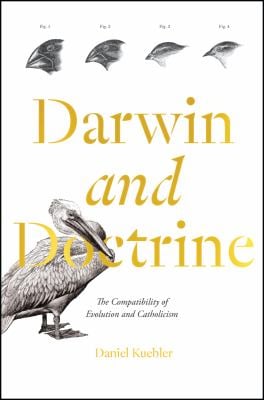
In Darwin’s Dangerous Idea, the philosopher Daniel Dennett referred to evolution as a “universal acid,” an idea that necessarily alters our way of thinking about everything—largely by eating away at our belief in a loving, providential Creator. And since the publication of On the Origin of Species in 1859, countless believers have sensed an apparent conflict between evolution and the Christian faith, abandoning the latter in light of the robust evidence for the former.
But does the science of evolution necessarily lead to atheism or override the doctrines of Christianity? If not, how exactly can they fit together in a single search for truth?
In Darwin and Doctrine, molecular and cell biologist Daniel Kuebler investigates the evolution-creation question from within the framework of the Catholic tradition. After a brief history of the Church’s engagement with evolutionary theory, Kuebler systematically yet swiftly answers the big questions that can move the dialogue What exactly does the scientific data demonstrate about evolution? What does the Catholic understanding of creation, and the creation of man, entail? And how can we integrate the truths from both science and theology into a cohesive whole?
Thoughtful, accessible, and inspiring, Darwin and Doctrine surveys the whole lay of the land—past, present, and future—of the Catholic approach to evolution. And it offers all readers—Catholic, non-Catholic Christian, and non-Christian alike—a fascinating exploration of the compatibility and mutual flourishing of science and religion.
This work beautifully and masterfully links together scientific, philosophical, and theological tools to explore what the beginnings of humanity may have looked like. It is a thought-provoking and humble approach that presents questions regarding evolution and our beginnings not as problems for faith, but as opportunities to pursue truth with faith and reason. What we learn about man through the book of faith and the book of nature only draws us to further knowledge and love of the Creator.
Kuebler could have written a much more compelling book had he taken aim at atheistic materialism rather than trying to justify the doctrine of original sin and the basic tenets of Catholicism.
The supposed conflict between science and religion is the basis for a lot of arguments from people at the far end of both camps. Rather than meet in the middle by finding out about each other's positions, they hunker down in their trenches and lob truth bombs at each other. After several hundred years of conflict, you'd think they'd adopt a different tactic. For such people, the "I'm right, you're wrong" victory is more important than reconciling differences by finding the complicated, integrated truth together.
Daniel Kuebler seeks just such a reconciliation. Operating from the Catholic assumption that there is no genuine conflict between faith and reason, a concept that dates back at least as far as Saint Augustine, he looks at historic understandings of the issues. On the Catholic side, he details the growing understanding of the first chapters of Genesis and how a literal historical interpretation is both unnecessary and unlikely. The origin of the universe is described from a theological perspective at a time when the best science was a nascent science. Sure, a fundamentalist mentality can be found throughout Christian history. But wiser heads can also be found who have taken science seriously and made strides to reconcile the claims of science and the claims of Christianity. On the science side, Kuebler delves into the understanding of evolution as found in Darwin's writings which is quite different from what is asserted by many of Darwin's followers. Evolution is more complicated and incorporates more influences than natural selection. Other natural processes are involved. Digging into the details of current scientific thinking about evolution yields a more complicated and nuanced understanding of how species like homo sapiens came into existence and developed into prominence.
One issue in the debate is a matter of demarcation. Science is great at discovering and explaining processes in the natural world, including the relationships between living organisms (and those that used to live but have been relegated to the fossil record). Theology is great at discovering and explaining relationships between the divine and the human and how that impacts the lives of rational beings. Science and theology look at relationships of things but in different ways and with different ends in mind. They do not have two separate fields of truth, they have two related fields that can inform one another.
This book is fascinating reading. It is written for a general audience, eschewing highly technical details in science and in theology. But the explanations get into enough detail to make their points. Also, the book is as up-to-date as can be, using the most current advances in both fields to establish how they can be reconciled with each other and provide mutual support and insight.
Highly recommended.
SAMPLE QUOTE: "Much of the perceived conflict between evolution and Catholicism stems from a failure to distinguish what can legitimately be read from the Book of Nature and what can legitimately be read from the Book of Scripture. While scientific discovery--the 'reading' of the Book of Nature--can uncover how the planets move or how species are related, it cannot fully explain the purpose of man or answer why a universe that is order to support life exists in the first place." [p. 248]
Bridging difficult arguments on Evolution and Creationism is difficult.
One needs the prescient attitude of accepting that there is something more than the physical world. From there we can always find the evidence as make the assessment of what makes humans more than a biological mechanical system. By looking at the theological human as the basis for that “more”. Mr. Kuebler is able with some difficulty for the case for God who is the ultimate author of Creation. Sometimes, the arguments were hard to follow and his supporting documentation is based on limited sources, his scientific training kept him focused on his hypothesis. It was a good read.
Good read. The chapter regarding Original Sin was the hardest to reconcile, but was still thought-provoking and understandable. Faith and Reason. Not mutually exclusive but brothers that keep each other in-line.