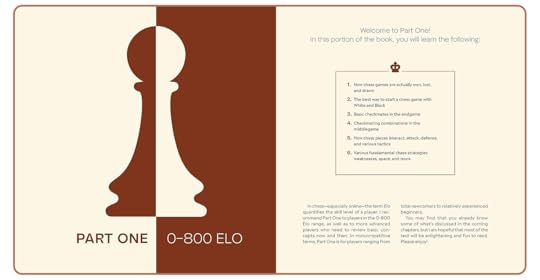
This is the most popular chess book of 2023-2024, written by the most popular chess-tuber. It's an online-first general-purpose beginner's book.
The material is (nominally) split into two separate skill ranges: "0-800 Elo" ("beginner") and "800-1200 Elo" ("intermediate"). You're left to infer that he means your chess.com rapid (or maybe chess.com blitz, or maybe USCF, but definitely not Lichess) rating. Yes, you need to guess the Elo.
The book is written in a jokey, kid-friendly style. The clickbait king has a soft-spoken teacher side and a toxic gamer side, and this is the former.
Part 1 has everything you need to know to play a game just above the level of "knowing how the pieces move", and a couple things you don't. The book doesn't assume any prior knowledge at all, and that's a good thing. It's probably appropriate as a first book for a genuine beginner. The emphasis on openings is probably excessive (especially the "drills" in the online supplement), but it can't hurt to be exposed to a larger variety.
I don't know if there's really a clean distinction between the material of part 1 and 2. Some of the endgame stuff in part 2 is definitely more advanced.
This seems like it would do an alright job as a first chess book at most ages.
Other/final thoughts:
- Most of the exercises are not included directly in the book, but as an online supplement through the author's course/training website (I guess this makes the book a bit of a sales funnel, but it's not much different from a book advertising other books from the same author/publisher on the back flap). This means there's a bit of friction going from the hardcover to the end-of-chapter exercises (links, QR codes), but I think many readers will appreciate the interactive element.
- The online supplement includes a few annotated full games, which was nice to see.
- There are only a few demonstrative puzzles on the website, which is fine considering you can do millions for free on Lichess. Their difficulty is not too hard relative to the material.
- The book is extremely openings-heavy, which goes against the conventional wisdom that openings don't matter much for beginners ("your opponent won't know the main line" etc.) Openings make up about 1/3rd of the page count.
- Although the book touches on a lot of openings, the rook guy does recommend switching your brain off and playing the same specific "system"-style openings (the London as white and a King's Indian-style setup as black) every game.
- I like that the author actually explains the rationale behind the "checks, captures, attacks" (elsewhere sometimes "checks, captures, threats") mantra: evaluate the most immediately promising and forcing lines first, because a human can't comb through 30^plies variations every move.