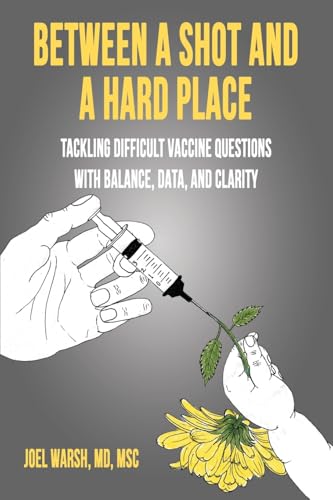
Vaccines are amongst the most heated topics of debate and discourse around vaccines is often subject to censorship. This is why openly discussing them has never been more critical. In Between a Shot and Hard Place, Dr. Joel "Gator" Warsh, an integrative pediatrician and trusted voice in holistic health, navigates the complex and controversial landscape of childhood vaccination with clarity, compassion, and evidence-based insight.
This book is not about taking sides—it's about empowering parents with the knowledge they need to make informed decisions for their families. Drawing on decades of medical expertise, the latest research, and real-world experience in his practice, Dr. Gator presents a balanced, nuanced perspective that bridges the gap between mainstream medicine and holistic health.
In Between a Shot and Hard Place, you’ll
• A historical perspective on vaccines • How do vaccines work, and why are they so heavily debated? • What are the risks and benefits of specific vaccines, and how do they compare? • What the research actually shows on vaccines, autism, SIDS, and chronic disease • How to make decisions that are right for your family
Dr. Gator shares case studies, practical advice, and tips for communicating effectively with healthcare providers. Whether you're a parent starting to explore vaccination options, someone following an alternative schedule, or simply looking for a deeper understanding of this complex topic, this book is your trusted companion.
With honesty, humility, and a commitment to the health and well-being of all children, Between a Shot and Hard Place challenges the polarizing rhetoric and offers a path forward—one that respects individual choices while fostering informed, thoughtful dialogue.
Dr. Joel “Gator” Warsh is a board-certified pediatrician who specializes in parenting, wellness, and integrative medicine. He grew up in Toronto. He completed his Pediatric Medicine training at Children’s Hospital of Los Angeles and currently runs Integrative Pediatrics and Medicine Studio City. He is also the founder of the parenting Masterclass series Raising Amazing.
Not anti vax , Not pro vax. Just straight up facts and humble dialogue. Overarching point Dr. Joel drives home is that parents need to be able to voice their questions and concerns without being labeled as anti vax or a conspiracy theorist. Good parents care about their children and just because they have questions and concerns about vaccines (or any medical intervention for that matter), does not mean they are anti that thing. Perhaps they actually care about science so much that they want to see it improve and grow. This book doesn’t tell you what to do, but instead gives you facts and empowers you to make decisions for your children that you are most comfortable with. It encourages you as a parent to not be afraid to ask questions, pump the breaks if you need to and seek respectful and humble people to engage with on this important topic.
Read from front to back. Wish I would’ve had a book like this when my babies were younger. I love how he gives the facts, the history, the good & bad without being picking a side. Ultimately it’s up to parents to decide but having the facts on what they are injecting into our children and what could happen if we do or we don’t vaccinate is so important.
For me somebody who is on the side of Natural health and trusting in the human body. this book provided exactly what I needed, albeit fell short of providing a personal opinion. but it is understandable why he doesn't do that as many would choose to hinge their decision making on him and therefore heap blame. this book provides one of the most balanced views attempting to look at the pros and the cons attempting to swing left swing right and to understand and review the literature and available studies from the most neutral perspective possible. of course it is not possible to apply zero bias to anything that is as emotionally loaded as this topic. however, I believe Joel does as good a job as any at balancing and approaching from a non-bias perspective. my level of knowledge regarding vaccines and vaccine science has improved significantly. although I believe I still won't confidently be able to make the decision that my gut believes is right, I will feel more confident making a decision as a whole compared to before reading this book.
This may be one of the most terrifying books I’ve ever read.
As a parent making medical decisions for a tiny human, this was genuinely eye-opening for me. This book answered so many questions I’ve had along the way of parenthood thus far and really made me feel empowered to dig deeper and make the most educated decision possible.
What I appreciated most is that it didn’t feel like I was reading something written to blindly convince me of one side or the other. It is incredibly well-researched, fact-led, and, to me, presented a perspective that made me feel like I was finally looking at the bigger picture rather than simply being told what I should think.
We should be willing to question science. We should be willing to question guidelines. We should be willing to ask where recommendations come from, what evidence supports them, how that evidence was gathered, and what we may still not know.
History has shown us that things once considered completely safe can later be understood very differently. Cigarettes were once promoted by doctors. Lead was widely used before we fully understood its dangers. The lesson isn’t that science is useless. It’s that science evolves because we learn more.
We don’t know what we don’t know.
And when the decisions involve your child, I personally don’t think asking questions makes you ignorant, difficult, or anti-science. I think it makes you a parent doing your job.
This book challenged me. It scared me. It made me dig deeper. And most importantly, it made me feel more confident that I’m making informed decisions rather than simply following a guideline because someone told me to.
If you are a parent, especially one who has ever found yourself wondering “But why?” when it comes to vaccines, I genuinely think this book is worth picking up.
You may disagree with parts of it. You may walk away with more questions than answers. But read it. Question it. Research it. Think for yourself.
The book “Between a Shot and a Hard Place” is a book written by integrative pediatrician Joel Warsh that purports to be the definitive text that thoughtfully integrates the views of antivaccine activists, vaccine hesitant families, and staunchly pro-vaccine advocates. While it is commendable to take the stance that his clinic is open for whatever questions come up, the vast number of logical mistakes and outright factual errors in his book make his publication severely fall short in the eyes of a fellow pediatric subspecialist.
One of the biggest problems in this book is the assertion that both sides of a scientific argument are equally valid. For example, the assertion that heart artery narrowings are the eventual cause of heart attacks, should never take the same level of credibility as someone who sincerely believes that cholesterol doesn’t matter. In other parts of the book, Joel implores people like myself to take the views of vaccine hesitant families and antivaccine families more seriously and to stop making fun of them. The issue is that scientific debates have an admissions price – it is required to agree on the same basic scientific premises before embarking on a debate (which Dr Warsh curiously also agrees with elsewhere). I will never, as a board-certified pediatrician, agree with the assertion that all vaccines are poison. Most antivaccine advocates are not here for a thoughtful discussion – they are here to cook up maximum fear of vaccines and sell their supplements as the solution. Occasionally, they engage in actual violence against provaccine activists. This is a dishonest fundamental premise, and I think no other profession would accept a debate with a hesitant listener who can’t even agree on the basic premises of the subject.
A small handful views in the book are objectively correct and credit is shared where credit is due.
Warsh frequently returns to the theme of censorship – he would do well to realize that antivaccine content on social media has vastly more reach and volume than conventional fact-based public health content on vaccines. Even attempts to censor antivaccine media are routinely squashed by multiple techniques (and in 2025, are squashed by the US Federal Government). Normal straightforward vaccine content is just there, while sensational antivaccine activists regularly go viral with millions of views that generate vaccine hesitancy because their content feeds the algorithm better. The number of verified antivaccine activists that truly endured follower count, legal or financial consequences serious enough to censor their work is miniscule. Some conventional public health professionals like Katelyn Jetelina, to my relief, have very large followings, but the number of us who have massive followings on social media is a tiny slice of the total number of health professionals.
Finally, Warsh indirectly shares with us that vaccine mandates “must be justified, rooted in solid science, and meet transparent and clearly delineated criteria to ensure they are reserved exclusively for extraordinary circumstances where public safety unequivocally outweighs personal autonomy.” His analysis of the available vaccine data shows that he simply does not believe existing vaccine data. He thinks it does not rise to his level of personal preference of what would be enough to enforce a mandate. The issue with refusing vaccines for your child comes with consequences for other families – while an individual person may not see the neighbor with immune compromise, enough measles outbreaks caused by enough families that decline measles vaccination will eventually hurt families with immunocompromise as a whole.
Throughout this book, Warsh exhorts the reader to think of the only true placebo as saline. He also goes into a fair amount of detail about the ethical problems associated with comparing a new vaccine with nothing which is commendable. He does at one point advocate for a three-arm trial, which compares a new vaccine to its adjuvant and to placebo. The biggest error in handing the greatest credibility to a “true placebo” is that even saline injections are documented as having a real negative effect; some people get prolonged arm pain, shoulder injuries, and any of a variety of allergic reactions even though the item injected was just salt water or plain water. The mere expectation of badness primed the person to feel side effects. In addition, the inactive ingredients in vaccines have all previously been tested in various forms as to what their side effects are; for example, we know exactly what injectable sucrose and sodium phosphate do: they are normal parts of the human diet in other forms. One of the arguments about the true placebo is that we don’t know how ingredients in vaccines interact with each other when mixed in various permutations. First off, it is not necessary to individually test every possible permutation because all the ingredients in vaccines have known lengths of time in which they normally degrade in the body. It is not necessary to figure out if the ingredients in the 2-month-old Pentacel vaccine interact with the 2-year-old measles vaccine because the 2-month-old vaccine will have disappeared loooooong before then. Next up, Warsh is apparently not aware that pharma is already required to prove that vaccine inactive ingredients work normally with each other in preclinical studies. We can’t have a situation where the inactive ingredients in a vaccine mess around with the active ingredients. We already know which vaccines can/cannot be given with other vaccines because this was tested. Lastly, a small handful of vaccines can do specific types of interference and this has already been well documented and accounted for.
The book is comprehensively debunked, argument by argument, on frankhan dot online.
Great read/listen. He brings both sides together and you realize how the vaccine debate really isn't so black and white. It's way more nuanced and he points out huge flaws in vaccine research.
I had heard this doctor on a podcast and liked his style and approach to the childhood vaccine subject, so I was interested to read his book. It did not disappoint! The book was so readable I was (surprisingly) able to read it straight through on a long flight, and I deeply appreciated his thoughtful, caring, open way of sharing from his research on the topic and addressing concerns many parents have. To my personal disappointment and great credit to him, he does not leave you with any recommendation on what to do, but rather presents the distilled facts as he understands them and encourages you to make your own decision in consultation with your pediatrician. I finished the book feeling so much more informed on vaccines and the research behind them, even if the final conclusion to many questions seems to be "we simply don't know."
The author does a good job laying out both sides of the debate—but he never actually says anything. It’s just pages and pages of ultra-specific detail with no real summary, no big-picture takeaways, and definitely no help drawing a conclusion. If you’re trying to make informed choices for your kids, be ready to work for it.
Also, this book could be half as long if the author didn’t feel the need to shout “I’m not telling you what to do!” every other page. We get it. You love open debate. You think we should hear both sides. Cool. So do your readers—or they wouldn’t have made it past chapter one. No need to keep preaching to the choir.
I feel like it’s hard to rate a book of this nature. It took me months to get through cause there is A LOT of information.
This book broke down each and every vaccine on the childhood schedule. It addressed every question parents had but left you with more questions than answers. I don’t feel as if this book leans one way or the other in regard to whether you should or should not vaccinate your child. He truly is just giving you all the facts on ingredients and studies done on each vaccine. Again this book was A LOT. But in the end it was informative and did leave you with a lot to think about.
This is a fair assessment of the current state of the vaccine protocol. As one who stood in the middle of the development of the plethora of vaccines, I have questions. I’m old enough to have perspective on many of these mild illnesses, that a vaccine has now been developed to prevent. But does it?? Other strains not in current vaccines become more prevalent, invasive, making certain vaccine obsolete, or at least offering only partial coverage. The ‘science’ has been corrupted by money, ongoing for decades, but exposed by Covid. It’s time to ask the questions with real science. Easily understood by lay person….5 stars despite the embarrassing mispronunciations.
This was an excellent look at vaccines and the studies that have been done. The author is not at all anti-vax (or pro). I have read several books on vaccines just searching for clear answers, but all have been disappointingly one sided with clearly cherry picked data, making blanket statements one way or the other. In this book he is honest and humble and gives the facts without asserting his opinions as facts. I learned a lot and if anything, this helped me feel better about the vaccines i have allowed my kids to get. But i also learned that we need more studies on vaccines!
Although this book is primarily written in the US context, there's helpful information in here for anyone who wants to have a better understanding of vaccines, how they work, what's in them, how they have been studied as safe and effective, and how they were created.
As a soon to be parent, this has helped me to be more informed in making decisions around this issue in relation to my child. Definitely worth the read.
Not anti, not pro, just the facts. If you’re going to read one book about vaccines- make it this one.
Finally a non-biased book that lays out the advantages of vaccination, as well as the unknowns. It focuses on providing the information to make an informed decision when it comes to vaccines.
I recommend this book to all parents, all future parents, pediatricians, and honestly anyone who wants to learn more about vaccines concerning the childhood vaccination schedule.
Finally a voice on vaccines that is not anti-vax or blindly pro all vaccines. Dr. Joel Gator truly just gives an objective view without bias or political agenda. He believes in the efficacy of many vaccines and also acknowledges the risks and adverse side effects that have occurred. He just believes there should be more transparency for parents as we are ALL trying to make the best choices for our children.
this is one of the most neutral-minded books on vaccines that i’ve read so far. very fact based, for ever “anti” thought there’s a “pro” thought within a page. he breaks it all down in a very easily digestible way. great book all around.
This was an extremely balanced deep dive into the vaccine debate. Very thorough (almost too much info at times) presentation of the history of vaccine development and testing. Unfortunately, I came away with more questions than answers.
A really good neutral book on vaccines. Not anti- vac or pro- vac but more looking at the research and how the research is done. Dr. Joel really encourages parents to ask questions, and do research. A great book for parents to read.
I read this last year using the audio book, but opted to re-read hoping I missed something. Unfortunately, it is still a very disappointing read on a pivotal issue which offers no insight and reinforces anti-vaccine sentiment under the guise of objectivity while offering none. In a word, disappointing.
A clear, compassionate, and well-researched guide that cuts through the noise on childhood vaccines. With balanced insights, practical explanations, and respect for parental choice, it empowers families to make informed decisions. A must-read for anyone seeking clarity on this important topic.
Mediator between the fringe and the standard thought on vaccines. Just presents the research, what we do and don’t know, and makes it a point to not make recommendations.
Dr Warsh’s only detectable bias is in support of informed consent. A genuinely helpful book for parents who have unanswered questions about vaccinating their children.
As someone who grew up around mostly antivax groups this book was a tough read. Extremely challenging questions for both sides and a great look into both.
Was a good book. Very mindful of presenting data in an unbiased way as much as possible. This was good book to receive education on vaccines and review data relavent to the current CDC vaccine schedule, ingredients used in them, and review of research and data concerning prevalent questions concerning them. I highly recommend this book for new parents and anyone looking to begin a deeper education into the topic of vaccines.