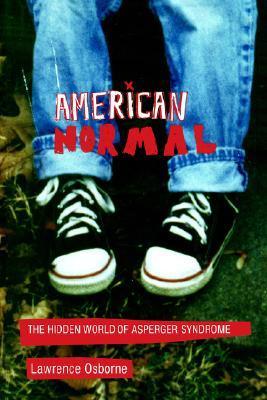
Asperger's Syndrome, often characterized as a form of "high-functioning autism," is a poorly defined and little-understood neurological disorder. The people who suffer from the condition are usually highly intelligent, and as often as not capable of extraordinary feats of memory, calculation, and musicianship. In this wide-ranging report on Asperger's, Lawrence Osborne introduces us to those who suffer from the syndrome and to those who care for them as patients and as family. And, more importantly, he speculates on how, with our need to medicate and categorize every conceivable mental state, we are perhaps adding to their isolation, their sense of alienation from the "normal." -This is a book about the condition, and the culture surrounding Asperger's Syndrome as opposed to a guide about how to care for your child with Aspergers. -Examines American culture and the positive and negative perspectives on the condition. Some parents hope their child will be the next Glenn Gould or Bill Gates, others worry that their child is abnormal and overreact.
Lawrence Osborne is the author of seven critically acclaimed novels, including The Forgiven (now a major motion picture starring Ralph Fiennes and Jessica Chastain), and Only to Sleep: A Philip Marlowe Novel, a New York Times Notable Book and nominated for an Edgar Award, as well as six books of nonfiction, including Bangkok Days. He has led a nomadic life, living in Paris, New York, Mexico, and Istanbul, and he currently resides in Bangkok.
I think Osborne made a strategic error in the way he wrote this book. I believe his intent was to identify and empathize with those who suffer from Asperger's Syndrome. To this end he showed us how he, a "neurotypical," does things that might be considered Aspergerish, such as giving in to an obsessive need to circle lamp posts or to watch every episode of the Japanese TV show "Iron Chef" or to only feel comfortable at Red Roof Inns, etc. In his interviews with Aspies he took a sometimes playful tone, and in his retrospective of people who may (or may not) have had AS, he emphasized the eccentric nature of their lives, not their suffering. The effect of this approach on Aspies themselves was to make them feel that he was trivializing AS. Some even felt he was making fun of them.
Furthermore, in his effort to suggest that AS can be seen as an alternative approach to life (or at least an attempt at one) he ran into those who want to make it clear that Asperger's is a neurological disease and that most (if not all) who suffer from it are not curious "little professors." They and their friends and relatives (and the therapeutic community administering to them) do not want to read anything that in any way might mislead the general public into thinking that Aspies are just weird eccentrics.
In other words, he missed the psychology of the larger AS community. People who are distinct minorities in a larger community, as Aspies are, and who feel discriminated against because they are different (and the larger society surely does discriminate against them)--such people are not likely to welcome a satirical or playful approach to their situation. They tend to be serious and understandably intolerant of anything that might threaten their dignity. And they are right in feeling this way because throughout human history it is only one step from making fun of people to ostracizing them.
Also one gets the sense that more than anything Osborne was satisfying his curiosity. He became the journalist who travels around interviewing AS people to find out what they are like. He reported what he saw and heard. For readers who know little or nothing about AS, this approach has its merit. For those who have AS or are friends or relatives of people with AS, this approach is not only not interesting, it is of little value.
The AS people also feel that such an approach does not best serve the general public. What they want are books that inform the larger community about AS in a factual manner complete with an understanding of the problems that Aspies have to deal with vis-a-vis governmental bureaucracies, school administrators, daily life, etc. They are not going to be pleased with a book about AS that is largely an entertainment. Osborne missed all of this. I am sure he was absolutely shocked and dismayed at the reception his book received from the AS community. On a more positive note, like me say that Osborne is a very good writer. He worked hard to make his book accessible to the reader, and, yes, entertaining and very readable. He balanced the interviews with Aspies with information about historical figures like famed pianist Glenn Gould and our second president Thomas Jefferson and others who might have suffered from AS. He did this in an attempt to give as broad a picture as possible. He even compares AS to other neurological diseases such as latah and koro in an attempt to show how such disorders are affected by cultural norms in different countries.
What I think Osborne was trying to do is follow the ideas of Dr. Mel Levine, Professor of Pediatrics at the University of North Carolina at Chapel Hill, whom he quotes as saying that "American psychiatry embodies a deeply pessimistic, gloomily simplistic view of the world" and is "Unable to conceive of a healthy eccentricity..." And so it resorts to "reductionist labeling." In particular, the Diagnostic Manual of Mental Disorders is replete with "dubious disorders" which "children are shoehorned into." (pp. xiv-xv)
He further observes (still relying on Levine) that "the codes [from DSM-IV] are quick and convenient, especially for the purposes of filling out insurance forms and getting reimbursed, but they bear little relation to the complexity of people's lives." In other words, the whole idea of syndromes as defined by the DSM-IV is a convenience for the administrating and "therapeutic" community, and not for the patients or those with neurological differences.
In the long run I think we are going to find that Osborne is on the side of the angels, and that his approach which emphasizes the similarities between those with AS and those they label "neurotypical" is better than an approach that stigmatizes people whose behavior is different.
Don't misunderstand me, please. I have seen people with autism and other mental disorders and they are very real and in some cases terribly disabling. However, I think whenever possible we ought to tolerate individual differences and not put depreciating labels on them.
Finally Osborne asks the telling question, "What would it mean to 'cure' a personality disorder?" "We might ask whether a personality disorder should be cured at all...Do we even really know what a personality is in the first place, and by what impertinence do we affect to lay down its laws?" (p. 185) The truth is in most cases we don't understand either the etiology of these so-called disorders or have any idea of what we can or should do about them. In some cases we might ask should we "fix" the individual or the society?
I think Osborne has made some important points here, and that an open-minded reading of his book would reveal the author as a person who has thought long and hard on the subject of AS and one who appreciates individual differences.
--Dennis Littrell, author of “The World Is Not as We Think It Is”
This was an odd book...not sure exactly what to make of it...there is a voyeurish quality about it...with the visits to one unusual person after another. I am interested in Asberger's syndrome and came away with a confirmation of something I have always believed...that each person deserves to be accepted for who he/she is. I was interested in the distinction between "neurotypicals" and "others" and the idea that any differences are culturally molded, even ones that seem to be hardwired.
I enjoyed this quirky account of the lives of a bunch of people with Asperger's syndrome, written by a person who probably has it himself. He seems to suggest that we might be better off viewing people as interesting and eccentric rather than diagnosing them with a mental disorder.
I feel like shouting, "I made it!" Mr. Osborne can write, however, this account of interviews and popular historical figures mixed with psychatric data and personal opinion, I found exhausting. I wanted to like it more, but I must nap now.