

What do you think?
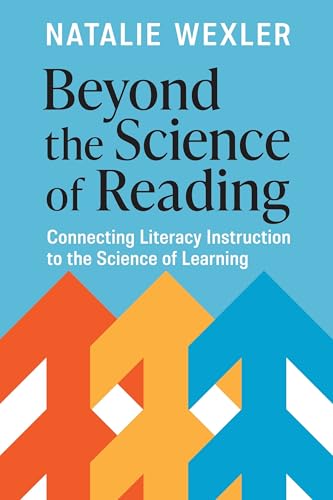
Beyond the Science of Reading: Connecting Literacy Instruction to the Science of Learning
- GenresEducationNonfiction
240 pages, Paperback
Published January 30, 2025
About the author
Natalie Wexler
13 books63 followersNatalie Wexler is an education writer focusing on cognitive science, literacy, and fairness. She is the author of "Beyond the Science of Reading: Connecting Literacy Instruction to the Science of Learning" and "The Knowledge Gap: The Hidden Cause of America's Broken Education System--and How to Fix It." She is also the co-author of "The Writing Revolution 2.0: Advancing Thinking Through Writing in All Subjects and Grades," a step-by-step guide to using the instructional method developed by Dr. Judith C. Hochman. She blogs at her free Substack, Minding the Gap, and was the host of Season 1 and a co-host of Season 3 of the Knowledge Matters Podcast.
Ratings & Reviews
Friends & Following
Create a free account to discover what your friends think of this book!
Community Reviews
Displaying 1 - 29 of 29 reviews

Read
March 5, 2026DNF. Not my cup of tea. You need to know stuff to learn stuff. Okay.

March 16, 2025
Helpful, clear, less ground-breaking than an excellent compendium of research and thinking on reading. Very helpful for high school teachers as it emphasizes the role of content knowledge in creating fluent, literate students. Alongside Reading Reconsidered, must-reads for English teachers and administrators who care about literacy.

March 7, 2026
Work teacher book club pick for 2026. So good!!! Got me back into using TWR and also thinking about how to expand the knowledge building curriculum I’m using w 7th grade and my ENL students
May 15, 2025
I just finished Beyond the Science of Reading by Natalie Wexler, and it really gave me a lot to think about. It goes deeper than the usual phonics conversation and focuses on what really helps students become strong readers: building knowledge. One of the key takeaways for me was that kids can’t understand what they don’t know, so we have to give them access to content-rich learning across subjects, not just isolated reading skills.
Wexler also makes a strong case for the importance of writing, not just as a way to improve literacy but as a powerful tool for thinking and learning. She brings in insights from cognitive science in a way that’s easy to understand and really practical—things like how memory works, why background knowledge matters, and how we can actually help students retain and apply what they learn.
If you’re an educator looking to go beyond the basics and dig into what really supports long-term literacy, this book is definitely worth the read.
Wexler also makes a strong case for the importance of writing, not just as a way to improve literacy but as a powerful tool for thinking and learning. She brings in insights from cognitive science in a way that’s easy to understand and really practical—things like how memory works, why background knowledge matters, and how we can actually help students retain and apply what they learn.
If you’re an educator looking to go beyond the basics and dig into what really supports long-term literacy, this book is definitely worth the read.
June 27, 2025
This book gave me a lot to consider as an educator weeding through what I was taught and what research tells us about learning. As I am navigating the SoR movement and the implications on my instruction, O was pleased to come across a text that went beyond foundational reading skills. I have many launch points to continue my research and improve my instruction. Great resource for those recognizing the need for something different in their classrooms or schools, and looking for somewhere to begin. A nice summation of research findings and perspectives with actionable suggestions to improve practice.

October 12, 2025
This is pretty much a very long infomercial, and I continued reading it anyway. I appreciate her invitations to question our assumptions as teachers & the reminders of the value of research (in this case, on the effectiveness of schooling). The author speaks strongly about the value of equity, the frequent overtasking of classroom teachers, & accounting for the realities of students’ working memory. The author acknowledges that a lot of evidence is anecdotal, & has perspectives why this is so. Nothing here is radical, something is definitely for sale.

August 2, 2025
Really liked this one! It reinforced how important it is to teach knowledge-rich content—not just skills—and gave me a better understanding of how kids actually learn through writing and background knowledge. A little repetitive if you’ve read The Knowledge Gap, but still worth it. Now I want to read The Writing Revolution and Make It Stick next!
July 28, 2025
While this book does not necessarily cover a ton of new ground, it succinctly and clearly points to concerns and issues in education, curriculum, and pedagogy. It would be an excellent overview for someone new to the topics.

May 18, 2026
Read over a few months alongside a group of colleagues as part of a PLC, Natalie Wexler's book presents a detailed account of the "science of learning" critique of the "balanced literacy" approach championed by Lucy Calkins at Teachers College, Columbia. Despite the promise to move "beyond" what some have termed the "Reading Wars," Wexler at times still reads very much as a partisan of those battles. In partial fairness, she is frustrated that the weight of the evidence has not yet translated into wholesale changes in educational practice. She makes the case that balanced literacy endeared itself to educators through its alignment with constructivism and intrinsic motivation but was never supported by research, and later helped drive declining literacy as measured by standardized testing. In its place, she favors phonics, direct instruction, and an overall commitment to well-structured literacy instruction.
A fair amount of this critique lands, and I found Wexler at her best when arguing that students—especially those from less privileged backgrounds—are disadvantaged when content knowledge is assumed rather than taught. Reading this book, I came to see that it is far more respectful of our students' intelligence to simply deliver certain contextual facts than to dress up "guess what's in the teacher's head" and call it "discussion." Still, it was a lost opportunity not to take Calkins and balanced literacy advocates seriously, or even to attempt to understand what, aside from naked ideology, might be motivating them. This absence is doubly puzzling since Wexler concedes at various points that inquiry, compelling stories, and student agency are all important and part of a well-rounded (dare I say balanced?) approach to literacy.
A fair amount of this critique lands, and I found Wexler at her best when arguing that students—especially those from less privileged backgrounds—are disadvantaged when content knowledge is assumed rather than taught. Reading this book, I came to see that it is far more respectful of our students' intelligence to simply deliver certain contextual facts than to dress up "guess what's in the teacher's head" and call it "discussion." Still, it was a lost opportunity not to take Calkins and balanced literacy advocates seriously, or even to attempt to understand what, aside from naked ideology, might be motivating them. This absence is doubly puzzling since Wexler concedes at various points that inquiry, compelling stories, and student agency are all important and part of a well-rounded (dare I say balanced?) approach to literacy.

October 27, 2025
I posted this in my state’s Science of Reading Facebook group:
I just read this book, which I had gotten for free at the SD Literacy conference. It was pretty rough, honestly. It seemed so repetitive to me, even within itself--though I have also read her other books, as well as all of E.D. Hirsch's books about knowledge-building: https://www.youtube.com/watch?v=p0GK3.... She wants us to consider the science of learning. She mentions some things, but mainly focuses again and again on knowledge-building and writing and keeps promoting the organizations with which she's involved (Core Knowledge and The Writing Revolution). I think these are great organizations, actually, but I'm not sure I needed to read another book about them. Am I being too harsh?
I also think it's interesting how she and The Reading League seem to be at odds. As I was finishing this book at home, I was reading the Sept/Oct Reading League Journal at school. They really criticize Wexler's viewpoint a lot (pages 27-31). THEN, I finished Wexler's book at home and found out that she criticizes The Reading League's Navigation tool in the last chapter of her book. Interesting.
I know that a lot of you read the book. What are your thoughts on the book, the debate about knowledge-building vs. comprehension strategies instruction, etc.?
Meanwhile, regarding the Science of Learning, I'm thinking we should go with Make it Stick and also Why Don't Students Like School, two books Wexler does mention in this book.

May 17, 2026
I appreciate Natalie Wexler’s attention to the matter of curriculum reform and the many challenges it faces.
I think many parents and educators were captivated by Emily Hanford’s reporting in Sold A Story. But having a reading curriculum that does not pay attention to the science of reading is just like having a writing or science or history curriculum that does not pay attention to cognitive science. Natalie continues to draw attention to this problem in education. I appreciate that she does so with both eyes open acknowledging the many challenges that education reform faces, including teacher preparation programs that do not teach reading science or cognitive science (the largest flaw in my own personal opinion).
I would recommend this book to educators, parents, and department of education and teacher preparation programs.
I think many parents and educators were captivated by Emily Hanford’s reporting in Sold A Story. But having a reading curriculum that does not pay attention to the science of reading is just like having a writing or science or history curriculum that does not pay attention to cognitive science. Natalie continues to draw attention to this problem in education. I appreciate that she does so with both eyes open acknowledging the many challenges that education reform faces, including teacher preparation programs that do not teach reading science or cognitive science (the largest flaw in my own personal opinion).
I would recommend this book to educators, parents, and department of education and teacher preparation programs.
April 18, 2025
I was captivated by the title of this work but I was left feeling quite disappointed.
The thrust of it is that "knowledge" subjects such as science, social studies, history etc. should be used as comprehension texts, which has been all over social media for a couple of years.
There was one study in there that I was not familiar with, but the rest was wash, rinse, repeat, as far as I am concerned.
Might be ok if you are new to education or reading studies but I don't really think that it adds anything to the literature or the field that hasn't been stated much more succinctly elsewhere.
The thrust of it is that "knowledge" subjects such as science, social studies, history etc. should be used as comprehension texts, which has been all over social media for a couple of years.
There was one study in there that I was not familiar with, but the rest was wash, rinse, repeat, as far as I am concerned.
Might be ok if you are new to education or reading studies but I don't really think that it adds anything to the literature or the field that hasn't been stated much more succinctly elsewhere.
September 2, 2026
Another GREAT book by Natalie Wexler! If you haven’t read "The Knowledge Gap", add that to your list, too! Cognitive science—the “science of learning”—should be at the heart of teacher preparation and ongoing professional development. The human brain is complex, and if we want learning to be meaningful and long-lasting, we need to understand how learning actually happens and use that knowledge to inform our teaching. We owe it to our students to focus not just on what we teach, but on how the brain learns best.

October 9, 2025
I had to. For work. And it was painful.
Also, there's such a disconnect between the classroom, the university, and the government, and we all know -- the twain shall never meet. This is your realism for the day.
Also, there's such a disconnect between the classroom, the university, and the government, and we all know -- the twain shall never meet. This is your realism for the day.

March 4, 2026
This book was part of our professional book club. The author spoke to us online and made a presentation.Her book gets us to focus on the science of learning, not just the science of reading. She backs her assertions with research.

April 5, 2025
Any educator who cares about student learning needs to read this book.
June 24, 2025
Chapters 4 and 5 are important reads
July 12, 2025
Bit of a retread of her previous works. I didn’t find much new material here, but it could be a good overview for someone new to the topic.
July 29, 2025
I was so excited to read this, and it spent 9 chapters talking educators into buying one of her previous books or the curriculum she endorses. Disappointing

August 4, 2025
2.5 ⭐️ More of a subtle diatribe against current literacy theories rather than a handbook or guidebook, with specific steps and concepts woven throughout, for integrating literacy instruction

August 22, 2025
I mean I was already on board with knowledge building curriculums alongside phonics instruction but it’s still good stuff!!

December 23, 2025
Recommended to every teacher I know.

June 2, 2026
Great practices but often difficult to
Follow, in my opinion.
Follow, in my opinion.
June 29, 2026
All teachers should read this book as it is truly enlightening.
July 26, 2026
An excellent book if you are interested in the science of reading and what makes it successful
September 1, 2026
Had some good information but read like a textbook in that it was hard to stay interested and focused on the topic

September 22, 2026
I really enjoyed this book. I wish there were videos on how this is implemented in the classroom either real students.

April 14, 2026
This is definitely going to be a professional reread at some point soon. It turns a lot of contemporary thinking about standards and curriculum inside out, but Wexler's theory and her explanation are sensible. She expresses a lot of things that I've felt but couldn't put into words. If you're a teacher, this is probably one of the most important books you could read to understand the current shift in literacy instruction.
June 23, 2026
2.5
Not sure who the intended audience is.
Needed a good editor.
Not sure who the intended audience is.
Needed a good editor.
Displaying 1 - 29 of 29 reviews