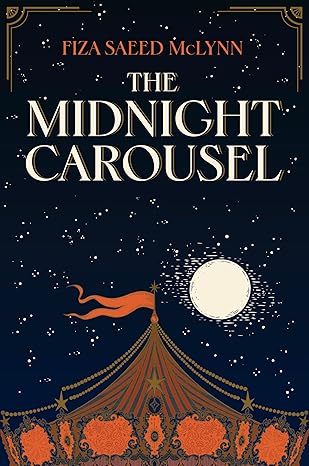
Thank you to Fiza Saeed McLynn, HarperCollins Publishing, and NetGalley for the e-ARC of this book (which releases very shortly, so if you would like to preorder a copy, please do it soon!).
2.5 stars
The first ten percent of this book had me hooked. The air of mysticism, the hopping timelines, the presence of a fantastical carousel -- all of it made me think of The Night Circus by Erin Morgenstern. Needless to say, I was intrigued and excited to see if it would take off in the same direction. Alas, it did not. Those first fifty pages or so were undoubtedly the best of the entire novel, in prose and objective. Beyond them, the plot turned to mush.
The carousel that is featured in the title is introduced shortly into the book. The process of its creation is something marked by tragedy, with the inventor's wife and son passing when he is in the middle of the project, leaving him almost manic with grief. Still, he is able to finish the project, honoring his son by casting his name into the head of one of the horses.
Maisie, our main character, has no recollection of her parents and has lived the entirety of her life in a neglectful group home/orphanage set up on the coast of England. After several years of enduring horrendous conditions at the hands of two cruel caregivers, her lovely Aunt Mabel arrives and whisks her away to better living. While Mabel works as a governess for the niece of a rich and kindly man, Sir Malcolm, Maisie makes the best memories of her life. Shortly, she adjusts to the lavish lifestyle and, although maintaining a spirit of humility due to her humble upbringing, she blossoms with happiness. One of her most magical memories are of her going to her first-ever funfair with Mabel, Sir Malcolm, and his charge, a sweet and kind girl named Charlotte. There, the pivotal carousel makes its first appearance, but not its last.
Not long after, Mabel and Charlotte fall victim to the dreaded scarlet fever aggressively striking the country. After this tragedy, Maisie and Malcolm are both cast into a haze of grief that eventually sends them to Chicago in pursuit of a new life, untainted by negative memories. This is where they once again come across the very same carousel that left such a positive impression on them at the funfair years ago. Malcolm, normally a canny man, makes an impulsive decision and purchases the carousel.
After it is erected at their new home, Maisie invites the neighborhood children to come and enjoy it, and that's when the first mysterious disappearance happens, that of young Billy, a tailor's boy, whisked right off the ride. His disappearance is never solved, so with a sober mind, it is closed down.
Years later, after Malcolm has become a recluse and drank much of his money away, never truly overcoming the grief that chased them to America in the first place, Maisie -- fresh with the optimism of reaching new-adulthood -- decides to reopen the carousel, with a few additions. An amusement park, something that will put the carousel, which has been lying idle all this time, to use, and which will also bring in revenue that will sustain the household.
Only, it quickly becomes evident that Billy isn't the first individual to mysteriously disappear from the carousel, and he may not be the last.
Over a decade earlier, when the carousel had been running in France, young and promising Detective Laurent of the French Constabulary had investigated a series of disappearances very similar to that of Billy. A man was accused and found to be the cause of the disappearances, and subsequently beheaded, but the bodies of his victims were never found. Assuming the case was closed, Laurent received a promotion and the families were able to find some sort of closure, even if the pieces never fully fit. An ally to the murderer was assumed to exist, but was never uncovered.
People went on with their lives.
But when Laurent hears of the amusement park, and then the case of Billy, he gets a hunch that maybe the trouble isn't over.
In fact, maybe it's just beginning.
From there comes a confusing slew of events that don't make a lot of sense, from my perspective. The hairpin turns that the plot makes are nearly as harsh as my summary of the plot (which I am sorry for, but not enough so to rewrite that whole synopsis. You'll just have to deal with the bewildering mess.). Timelines make little sense and are inserted as if they were allowed a mind of their own; characters fall flat in every way, and only inspired pity in the best of cases; the story unravels and becomes dubiously interwoven, so as to rouse a feeling of cleverness that never comes to fruition. I noticed a couple of blatant plot holes, and based on other reviews, I am not the first to pick up on them. A few times, some action sequences were so unbelievable I flinched.
Maisie is seen across the span of a lifetime and undergoes many trials and misfortunes, yet her character only suffered from them. Upon meeting her as a twelve year-old girl in an orphanage, bereft and without any idea of where her parents are or who they could have been, one begins to feel pity for her. Alas, that pity is heightened as more tragedy strikes.
However, this snowballs into a crude conglomeration of disasters. After a while, it fails to inspire any sort of sympathy, and becomes rather annoying. Her whole character is what she has suffered through, without the benefit of her seeming to overcome any of these experiences. She doesn't make any effort to change herself or her situation; every event is merely "something that happens to her". She's like a leaf, floating along, battered by the wind, helpless. With an unknown parentage and skin that doesn't meet society's preferences, she is scorned. This is an awful thing that many during this period experienced, unfortunately. But she never proves herself. She lets herself get walked on and does a vast disservice to the real heroes who overcame adversity and racial discrimination in similar circumstances. Her character never developed, its growth prematurely stunted.
Her decision-making abilities are poor and her virtues don't compare to her vices. By the final chapter of the book, my feelings towards her had morphed from pity into mild, stale disgust.
Woefully, she was arguably the best character in the book, because none of the others left any impression on me whatsoever. Laurent had an interesting family structure and plenty of harsh memories that could have been cause for a unique, emotional storyline, but were instead only provided as a brief sideshow, quickly swept under the rug.
The forward-momentum of the book did the characters a disservice. Like an immature man in a relationship who refuses to commit, the author bounced between so many genres, it was a headache trying to sort them out. Thriller, mystery, romance, historical fiction, even fantasy were all literary classifications that were dabbled with, but never confidently dedicated to. This is a common theme found in debut works, and so I usually try to be more forgiving, but the severity found here cannot be overlooked. The romance wasn't focused on enough for chemistry to evolve, cheated by the rising stakes of the mystery aspect that also proved dull, as the thriller angle rudely interrupted its clue-finding cleverness by attempting to raise the intensity at awkward times. The consequence was an ending lacking in emotional depth or satisfaction.
At the end of the day, it was just too much at once. The author has talent, for sure; those first fifty pages were really beautiful, enough so that I upped the rating by half a star. I don't know what changed after them, but it was enough to bring a potentially masterful work to its knees.
I hope others find this book to be more enjoyable than I.
Happy reading!