“Every word is an accusation…and every whisper kills.” This staggering graphic novel explores the infamous Salem witch trials and the long shadows they cast more than 300 years later. 1692 is a year of terror. In Salem, Massachusetts, Giles and Martha Corey are forced to confront their troubled past when accusations of witchcraft plunge their community into a violent moral panic. Based upon true events, and set in three centuries, More Weight is a unique inquiry into the Salem witchcraft tragedy and the misunderstood city now synonymous with it.
There is a worthwhile history of the Salem witch trials buried in these 534 pages, but the effort required to dig it out is simply too great. This is obviously a passion project, but it is one in need of a draconian editor.
I got bogged down 150 pages into the story, lost in the giant cast of poorly introduced characters. And not only are we dealing with the events of 1690, but there are alternating fantasy chapters set in the 1860s that imagine a long, miserable, and convoluted conversation between Nathaniel Hawthorne and Henry Wadsworth Longfellow as they take a walking tour of Salem. Were I editor, these tedious intrusions would never have seen the light of day.
After setting the work aside for several weeks, I dived back in one lazy weekend afternoon and forced myself over the course of way too many hours to trudge through another 300 pages. I almost found myself intrigued at times as the story of Giles Corey finally took on a form I could decipher, but the author kept fighting me with a barrage of words and fantasy sequences.
And once I made it to the end of the narrative, there were still two challenges. The “Outro” — the author’s diatribe against the exploitative consumerism of modern-day Salem, a veritable “Witch City” amusement park — while interesting at times, is overburdened with purple prose and an ever-growing deluge of words that increasingly cause the captions to bulge further and further into the space meant for the illustrations. It was disheartening to turn the page and realize that my eyestrain was only going to get worse and Wickey’s tone more strident. And then there are the more than fifty pages of Author’s Notes, which of course are footnoted because how else can it be made more ridiculous?!?!?! I tried wading into this sea of text, but gave up after a page or three of sources, quotes, rationalizations, and asides.
The influence of Alan Moore’s From Hell seems to be all over this work — starting with his blurb on the front cover to the in-depth annotation. Moore’s study of Jack the Ripper has never broken into my mental top ten of his best works, often for similar reasons outlined above for this book, but he has a gift for putting together words and scenes that Wickey is still a long way from achieving but is at least moving toward — perhaps more quickly with some editorial assistance.
Disclosure: I received access to a copy of this book from the publisher through NetGalley.com.
"There are consequences to the fictions that we tell."
This was a sometimes fascinating look at the Salem Witch Trials of 1692, a dark time in America's past when government and religious leaders chose to believe the hysterical screechings of some "distracted" teenage girls rather than the solemn vows of innocence by respected townsfolk, most of them women.
The book is exhaustively researched, and exhaustively told. It probably could have been edited down to under 300 pages (I would not have missed the Hawthorne/Longfellow ramblings), but this massive tome is one man's vision, and I respect the publisher's choice to bring it to fruition.
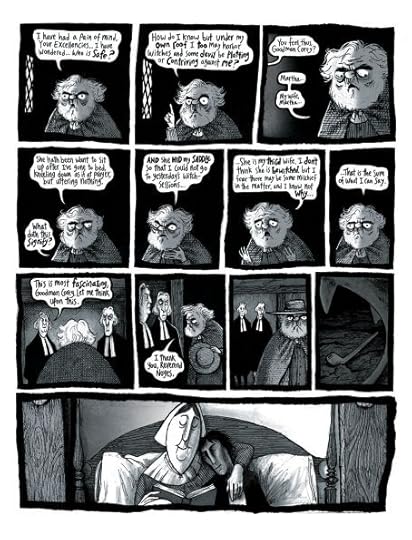
The artwork is superb.
More Weight seems a well-timed reminder to seek out truth, and do whatever it takes to make sure our country remains a democracy, not a theocracy.
Thanks to Top Shelf and NetGalley for the ARC, though my review is of the published paperback.
I received a free copy of, More Weight: A Salem Story, by Ben Wickey, from the publisher and Netgalley in exchange for an honest review. This is a long graphic novel on a dark part of American history, the Salem Witch trials. I thought this was a good read, but it was way too long of a read.
A friend posted this book and when I saw it, I knew I had to read it. More Weight is a big doorstopper of a graphic novel about the Salem Witch Trials. I've always been fascinated with this period in history and have read quite a few books on the subject. This book is extremely well-researched, and all the details with regard to the people and places involved are meticulously laid out in precise order. It's an absolute feat given that everything is accompanied by amazing illustrations. I am in awe. It took the author/illustrator 10 years to finish this phenomenal book. It is also the most comprehensive book I've ever read on the subject. Mindblowing. Very highly recommended for history buffs, and those who love education with their graphic novels.
I was so excited to get to read this book, I've always been fascinated by Salem and the brutality of the Witch Trials. Unfortunately, the art was about the only thing I enjoyed about this book... This is a chuncky book, sitting at over 500 pages. There are plenty of big books out there that make every page worth it, but this book just felt bloated and was a chore to read in some places. I was reading it on an iPad and there were still times when I had to zoom waaaaaaaay in just to be able to read a single frame of text. The layout really suffered from how much the artist tried to cram onto each page. And there were times when the text wasn't legible at all. I'm not sure if this was an artistic decision, but I did see that at the end of the book there is about 30 pages of text which I surmise to be the typed out illegible handwriting found throughout the book. That would have upset me if I had been reading a print version of this graphic novel let alone if someone were trying to read the digital version. There are parts of the novel where it is just walls of words, which defeats the idea of a graphic novel to me. A graphic novel should rely on the pictures to do most of the exposition of the story. It seems like this should have just been a novel, not a graphic novel. Most of the story is set in 1692, during the witch trials. But sometimes we would jump forward to 1800, and I really could have done without this storyline. It did not add anything but more pages to read. Thank you to NetGalley, IDW Publishing, and Top Shelf Publishing for giving me the chance to read this book. I wish I had postive things to say about it.
There are at least four interwoven stories here. Seeing the Salem horrors through the lens of Giles Corey’s tragic persecution lends new life to the familiar horrors of the Salem witch hysteria. Corey was an unpleasant neighbor but no match for the vile, self-serving piety of his persecutors. The second story is a dialog between Longfellow and Hawthorne (or his ghost) about the meaning of the witch trials and the way art both magnifies and distorts history. The third story is Salem itself and the commercialization of atrocity. The fourth is about the ineradicable blot on the soul of the country, the symptoms of so much later misery arising from the greed and cruelty of our self-righteous fellow citizens. That’s a lot of weight for a graphic novel to bear, but Wickey manages it adeptly.
Absolutely gorgeous art, but that can't save a convoluted, plodding, boring story. Suffers from way too much text and way too many characters. Besides, the (hi)story just makes me sad and angry. Not in the least because bigoted, retarded zealots are still ruling The US.
Meticulously researched. You'll need a second bookmark for the end notes. Despite its fantastic sections and rambling "outro", I've shelved this as nonfiction; even the made-up conversations and opinion section have been scrupulously documented and carefully explained. All of which rightly implies that it's way too long, bogged down in every single detail, and can be hard to follow. The art is amazing and so very detailed. I learned a lot about the trials for sure, too, but a lot of folks are going to DNF this one for sheer density.
This graphic novel is a natural pick for the Halloween season, but be prepared for a very dense read.
The illustrations are a solid 5 stars, but I agree with the others who said it could use some judicious editing. The time shifts, the ghostly interludes, and the author's thoughts on the modern-day commercialization of Salem, Mass., not to mention the sheer wordiness of the text, may become tedious and confusing for readers.
This is a remarkably ambitious graphic novel, weighing in at over five hundred pages. More than fifty of those pages are notes on the main text, and given that author Ben Wickey spent ten years creating it, the book almost reads like an academic work, which is both a strength and a weakness.
More Weight dives deeply into the history of Salem, Massachusetts, focusing both on the infamous witch trials of the late seventeenth century, and on the writers Nathaniel Hawthorne and Henry Wadsworth Longfellow, both of whom created works based on those notorious events. Wickey's visualization of the witch trials and their victims is dark and powerful, and really conveys the feeling of a fractured community turning on itself. This part of the story eventually focuses on Giles Corey's death by peine forte et dure, wherein more and more weight was placed on his chest until he was crushed to death. The rendering of Corey's defiance of his accusers is heartbreaking and thrilling at the same time.
The chapters focused on Hawthorne and Longfellow are not quite as successful, and occasionally feel like distractions from the main narrative. While the ruminations of these two authors provide commentary on the story of the witch trials, they don't really expand much on that part of the text. Wickey was born and raised in the Salem area, and his overall goal with More Weight is to plea for that city to reconsider its relationship with a black chapter of its history. Having never been to Salem myself, much of that part of this work is simply too specific to be of interest, and I suspect a lot of other readers will have the same reaction.
This was a beast of a graphic novel. Over 500 pages and a very extensive look at the witch trials in Salem. And i mean thoroughly. As a kid i lived in Limburg, close to Roermond, a city were 60 witches were killed, as a kid it was very interesting to hear witch stories and such, but as a adult its really crazy to read about it. These were woman who were just different, or just normal. If someone had it in for you he could sat your a witch, panic and mobs did the rest. More Weight is such a story. A brilliant looking graphic novel, with very cool artwork but a harrowing story. A real passion project that took Ben Wickey over a decade to finish. Everyone that gas something to do with the Salem Trials gets mentioned, and its admirable, but over halfway the book it gets to be to much, and nearing the end you get so much info its hard to stay invested. This was a cool read, but in the end i got lost, it could have used some trimming. If your interested in the subject, this is a yes. But beware, this book takes some time to finish.
I found this graphic novel to be a dense read. The illustrations are beautiful, and the book was visually enjoyable, but overall, it felt like the narrative was trying to accomplish too many things at once, which made the story feel blotchy and unfocused. I also found the repetition a bit excessive. While I understand that repetition can shape how a story is perceived, here it ended up dragging the pacing and gradually pulled me out of it. Sadly, by the end, I was more disinterested than anything.
That being said, if you're interested in a historically grouded tale, this graphic novel could very much be worth picking up !
Real rating: 4.5 stars. This is a heavy read (no pun intended lol). Wickey covers everything Salem- from the 1692 Witch Trials, Nathaniel Hawthorne, and how it became the “witch city” tourist spot. It’s loaded with information, including a large Author’s Notes section that backs up each detail with facts and sources. It’s a reminder that Salem is literally buried in history- it’s not just a place for a photo shoot. Many lose sight of this in the over-commercialization of Halloween and paganism- sure, it’s cool to see where Hocus Pocus was filmed, but also remember that innocent people were killed for no reason, and to be respectful. I mean, the last accused victim was only exonerated in 2022!
Yes, I am guilty of indulging in the spooky ambiance Salem gives- it’s what makes it my happy place. However, in my visits to Salem, I never lose sight of the victims of the Witch Hysteria. Taking my mom to Salem, I made sure to show her ALL of historical Salem- in between shopping down Essex Street, I scheduled a walking tour of Danvers (formerly Salem Village) and a visit to Rebecca Nurse’s homestead. After having lunch at Rockafella’s, we made a stop at Proctor’s Ledge and toured the House of the Seven Gables property. I needed to show her the cultural significance of the town, and I needed to show her what makes Salem special.
Enjoy Salem by all means, but also don’t be oblivious to what has happened there in the past. To paraphrase Wickey- “more people believe the Earth is flat today than anyone in 1692.”
This graphic novel may have been dense at points, but incredibly worth it. Ben does a fantastic job balancing detailed artwork with just as detailed descriptions of Salem’s diverse history. Interwoven in this narrative is everything from the rich literary history to the witch trials and contemporary adaptations of what it meant to be considered “a witch” during that time period. All glaringly relevant. He sets out to prove that Salem is so much more than just the witch trials and yet we keep going back to this main event (that lasted about a year) as the core of modern Salem. If you are a true scholar or lover of history and literature or even if you are neither, it’s worth the read. It’s dense, but so is history if you’re willing to uncover the truth…
Wow what a powerful book! The attention to detail was incredible! The work he put into this, the research, the different writings, the different drawings to depict the time, weaving the lore, the truth and pop culture, phenomenal. So, the next time you walk down the streets of Salem, don't glorify it. Call it what it is.
Thank you Netgalley, Top shelf and Ben Wickey for this advance copy. What an absolute treat! My opinions are my own.
Special thanks to the publisher and Netgalley for providing an advanced digital copy in exchange for an honest review
It's clear there was a lot of love and research that went into making this story. The art is wonderful, and while the style was similar for each person, I had no trouble telling one character apart from another. When we think of Salem today, we often get caught up in the Hocus Pocus of it all and just think "Fall! Spooky Season! Witches!" that we often forget this was a truly dark time that had truly innocent victims. Stories like this give those victims a voice, and serve as a reminder that there were real people behind the stories that we know.
When it comes to the Salem Witch Trials, I am very familiar with names like Sarah Goode, Tituba, and Abigail Williams. And while I recognize the Coreys' name as people who were accused, I really didn't now much about Giles and and Martha (outside of what the Crucible showed me), and I don't even really know why. Retellings that I have found just don't focus on them for some reason. I found this story to be educational, riveting, and heartbreaking all at the same time.
This was beautifully illustrated and so well researched. It was long, I found myself picking it up and putting it down a few times before finishing because it was lengthy and the language was to the times. I loved the ending, focusing on how Salem moved into where it is today with all its tiny missteps and little victories to preserve the history. The appendix with the detailed research was phenomenal.
An almost academic level of density, including endnotes. Interesting use of stylization (and colour) to indicate the progression of time. Overall, more proof that comics have immense potential for scholarship and are possibly the superior medium for historical fiction, nonfiction etc.
This is the first graphic novel I’ve ever read! I was skeptical at whether I’d be able to do it but I very much could and enjoyed it. This story was so compelling and there were so many ties between the 1670s and present day in how humans behave.
Like any good work, More Weight’s title bears many meanings, direct reference to the events surrounding the death of the book’s major figure, Giles Corey, the weight of suspicion and mistrust that tore Salem apart, and the weight of history as the events of the 1692 witch trials echo across American history. The weight is heavy on Nathaniel Hawthorne and Henry Wadsworth Longfellow, two of the foundational titans of American literature, the former of which had direct familial ties to Salem, and the latter who bore the weight of personal tragedy and saw his own story reflected in Corey’s tragedy.
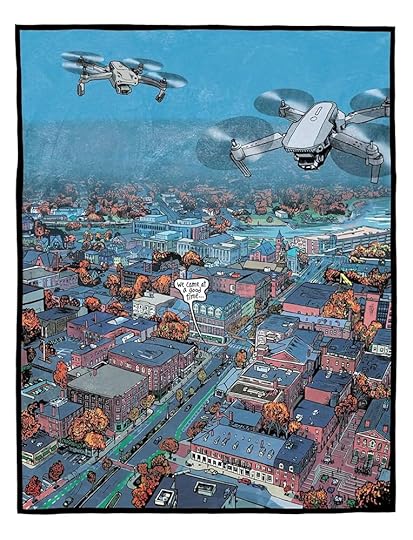
Ben Wickey makes the case, first naturally through the flow of the story and then perhaps too overtly in painstaking detail and narration in the book’s final 40 pages or so, that Salem’s witch Trials were among America’s foundational sins, the ripple of which is cast through history. In many ways we still suffer from the kind of paranoia and mass hysteria that turns neighbor against neighbor. In 2025, it is harrowing to revisit a tale that has become myth, repackaged into pop culture and commercial kitsch, in such stark and human detail. Wickey’s cross century struggle is particularly effective here, as we break from the black and white cartooning throughout the events of the Salem trials to the sepia tone haunting of Longfellow and Hawthorne revisiting the ghosts of Salem in their day. It is this second era where the book’s climax feels most evocative and personal, with a slight twist that is both shocking and deeply heartbreaking. The book suffers for going on beyond that as Wickey then spends dozens of pages outlining and criticizing centuries of obfuscation, capitalization, and commodification of Salem’s dark past.
The meat of the book, though, is the exploration of the events, pulled together and dramatized through a mix of deeply researched contemporary accounts as well as previous dramatizations (chiefly Longfellow’s New England Tragedies).
Too much weight. There are truly stunning moments and powerful storytelling in this expansive non-fiction book, but they are overwhelmed by the author's extreme logorrhoea. The uneven cartooning is at times gorgeous (the expressive black-white-and-grey retelling of the Salem Witch Trials at the heart of the story, with wonderful and expressive characters) and at others it is actively ugly (the photo-referenced and overly-filtered scenes that frame the tale). There might be a remarkable book at the core of this sprawling, boring, and occasionally illuminating work, but it is lost in the midst of hundreds of pages of deeply unnecessary material. There is no doubt that the author is an interesting talent, but ultimately this is a powerful example of the importance of editing and control.
So I live literally across a bridge from Salem, MA, and it's legacy affects me and everyone in the area every September-November. I loved this for many reasons-- the varying art styles and colors to express which time period we were in, the storyline that preserved faith, grit, and panic, and the clear heroism of ordinary people in the face of literal insanity. Wickey presents the Witch Trials as a tragedy to be remembered, not an event to be commercialized. It moved me and repulsed me all at once. This was just so good.
Amazingly drawn and wonderfully researched graphic novel about the Salem witch trials. This is an interesting and respectful book that reminds us that the victims of the trials were real people suffering horrible fates. The notes at the back of the book are so good. I also enjoyed the Hawthorne and Longfellow storyline that ran throughout and the look at modern day Salem- and what it all means for us today.
There is lots to love about this graphic novel about the Salem witch trials. The illustrations are stunning, and it was interesting following the story of Giles and Martha Corey, who I had never heard of before. The book is in three timelines, beginning with modern day and moving into the 1692 trials, with parts of the book set in the 1800s. The 1692 sections were incredible. The way that the text and images worked together evoked a reaction in me that at times was emotional. I am very familiar with the Scottish and Lancashire witch trials, and have a basic understanding of the events in Salem, but this went deeper, which was great. For me, I could have done without the 1800s story, though. I’m not familiar with American history or literature in any way, and I kept having to look things up. And as we concluded the 1692 story, I was surprised that I still had a third of the book to go. What followed started as a summing up of what happened to the people we had come across already, and quickly became a history of everything that has happened in Salem since, most of it irrelevant to the witch trials, and then an intense rant about how modern Salem is a Disneyland of witch tourism. At times this got incredibly sneery. He describes tourists as rude, and that Salem is reduced to a selfie backdrop. He attacks the films and tv shows that are based in Salem, as well as the business owners. He calls it a ‘consumerist quagmire’. And then what follows that is 56 pages of author notes, which could have been a book in itself. But a typed book, because the handwritten text is incredibly hard to read when there is that volume of information. Ben Wickey clearly doesn’t like tourists, and wants us to know that. Which is fine, except that by the end I had a headache and wanted it to stop. He states in his author’s note that he wants his readers to think, but doesn’t trust us or give us space to do so. It’s his manifesto and we are there to listen. There is a point towards the end of the book where we see the graves of Giles and Martha Corey, and this was a wonderful moment of pause. That image alone made me stop and think. It made me want to visit Salem, not for the Halloween festivities, but to take a moment to show my respects for the people who were persecuted. And in that way, the aims of the book have been achieved. But I wish we had done without the additional information that clouded the waters of what is, in part, a stunning and emotional retelling of the awful events of Salem in 1692.
(I received an ARC in return for an honest review)
Each October, thousands flock to the infamous "Witch City" of Salem, Massachusetts. Among the shops and monuments to beloved pop culture witchery, spookiness, quasi-satanism, and debauchery, there lies the blood-soaked earth of centuries past, and the events that have birthed and rebirthed the city of Salem as it is today. It started with a whisper, and ended in death for twenty-five innocents and a shadow over a foundling colony that paved a path in mistrust and pain for years to come.
Spanning three centuries of history, readers are brought to heel in the stories of three different generations of Salem: of Giles and Martha Corey, who are forced to come to terms with their dark pasts in the first and finals days of the trials as accusations of witchcraft plunged their small community into moral panic; of a descendant of the trials as he traces the ghost of the past, present, and future in understanding the plight of the city more than a hundred years later; and that of the author, writing in the present as he brings the many faces of Salem to look at themselves in a mirror - which is the truth, how did we get here, and how do we move forward in knowledge and power?
I had to sit with this book for several days after I finished it - I quite enjoyed it, but it also forced me to confront a lot of my own thoughts about "witchcraft" and the aesthetic of a culture loosely built on historical events - which is hard, uncomfortable, and frankly why I feel like this book isn't very highly rated online, which raised an eyebrow when I was adding it to my own reading lists. The triptych-esque telling of this story is winding, interweaved, and thorough - part fictional reenactment of the trials and the major players, part historical lesson and backwards lens view from the fictional overview of a real-life famous descendant, and part musings and editorial from the author themselves - a descendant of one of the original "witches", this graphic novel is densely packed with historical fact (with references), dramatic and colorful storytelling, and both retrospective and introspective opinions on the history of Salem for those who feel drawn to the "strange and unusual" of this now famously aesthetic fall destination.
The overall purpose of this book as I understand it, in addition to presenting a fictionalized first-person account of The Salem Witch Trials, supported by evidence and with heavy emphasis on the socioeconomic and cultural factors that allowed this dark event in American history to come to pass, is to challenge readers on what makes Salem and the Witch Trials so pliable in the hands of time - in the sense that, unlike other dark tragedies of American and world history that have resulted in injustice, loss of life, and religious/other oppression, Salem is now primarily celebrated as a pop culture destination and hub for "witches", with the legend of the Witch Trials serving as almost a cultural ancestry for slogans/movements/sentiments such as "we are the daughter of the witches you couldn't burn" (with the author reminding us that no witches were burned in Salem). The author asks us for introspection - why is Salem open to reinterpretation and cultural adoption in a way which would been seen as inappropriate, vile, or blasphemous such as the horrors of Auschwitz? Why does Salem not receive the solemn respect and remembrance of a human tragedy purported in the name of religion and moral panic?
I have a hard time really answering this question myself and I've really had to think about it, which I think is the best thing this book does, as it also draws this argument out past the stone walls of Witch City into the greater world with more extrapolated questions. If it's okay to rewrite the mythos of Salem into a consumer-friendly tourist destination, relegating the human horrors of its origins to the dusty back corners of spell and tarot shops, then where else is it okay for the demands of capitalism to cannibalize and rewrite the history of other events? On the one hand I think the author makes incredibly valid points, and on the other - as they also acknowledge - there can be identity in making a history and a place for oneself, in celebrating the freedom to celebrate choice and progress in a place where it as violently stripped in a dark and distant past. I think part of being human and being present in a living history - especially in the viral and fast-moving word of the internet - is accepting that things may take on a life of their own before you can think of the consequences. For example, folk tales spring to life from creepypastas and found footage, becoming their own culture and legend in a way that narrative tales of old could only dream of - with their own flesh-and-blood consequences.
But to the author's point, one of the greatest conundrums of a capitalism-forward "Witch City" is that there were no witches in Salem at the times of the trials - men, women, and children living their lives were accused and hanged for something they never claimed and never celebrated in the name of God, of country, of moral righteousness. Rewriting Salem as a haven of witchcraft in that lens almost feels like a slap in the face to those who died in the wake of this panic - and the same to those across the world today who still suffer life and limb in the face of witchcraft accusations. In thinking through these confounding ideas, as someone who very admittedly loves the aesthetic of witchcraft and its interplay with feminism, religious freedom, and expression - is really discordant, and is one of the reasons why I recommend others pick up this book. I don't have an answer to the author's challenge in this book, but I can say with confidence I came out learning more and thinking more critically than I did before, and I hope others will give this beautiful book (the illustrations and detail that went into telling this story are incredible) a chance as we close out October.
I saw this in the comic shop and was probably drawn to it because it had a striking cover with an Alan Moore endorsement. At first glance, it looked a lot like From Hell (one of my favourite books), with similar word-balloon lettering and a big annotation section, though this was about the Salem Witch Trials which I didn’t know much about. I wasn’t immediately taken with the art, but I was underwhelmed by Eddie Campbell initially too. After borrowing it from the library and having a closer inspection, I confirm that it does owe a big debt to From Hell and is incredibly impressive.
There is a lot to describe. The intro explains a bit about the relationship between the people of Salem Town and Salem Village and the events leading up to the accusations of witchcraft. Then we get an almost day-by-day account of events - from the accusations, through the trials (often taking dialogue directly from court records, and expanded in the annotations), other political intrigue that was going on, and ending the main narrative ending with the last of the executions. The story periodically returns to the characters of Giles and Martha Corey, who were among the accused. It’s such a large cast of characters and relationships that it’s hard to keep track of everyone, but the Coreys are distinctive and help to anchor the story. Giles is interesting in his own right - he’s very unlikeable and sketchy (perhaps even murderous, as we learn more about his backstory), but he’s also strongwilled in the face of all the chaos happening and you can’t help but root for him by the end. It was very sad that there really wasn’t much that the accused could do to help their causes in the face of such illogical accusations and questioning. Some attempted to escape execution by naming other conspirators.
Mixed in with this is a story set in the 1860s with poet Henry Wadsworth Longfellow and novelist Nathaniel Hawthorne (a descendant of one of the Witch Trial judges) walking through Salem with reference to some of their literary works. (The endnotes mention Hawthorne’s “House of Seven Gables” as a metaphor for the history of Salem and the city's ups and downs). This section is reminiscent of the chapter in From Hell about Nicholas Hawksmoor and architecture of London. (When Hawthorne was introduced in More Weight, I thought it may have been the architect but I’d gotten the names mixed up). The Salem of the 1860s is depicted in a different (and personally preferable) art style than the Salem of the 1690s - with some nice colours, and the characters a little less stylised. But the 1860s story is just as dense as the witchcraft sections, and I’m still not entirely sure whether Hawthorne dies partway through their series of conversations and Longfellow is speaking with a ghost. The outro of the book gives a history of Salem from after the trials (including the fates of all the characters) to the present day, and the city’s relationship to “witches” as a unique lure for tourists. The author probably goes on a bit too long in his criticisms of this, but the points are valid and interesting. One point is that many self-proclaimed witches adopted Salem as their home in the 20th Century and aligned themselves with the victims of the witch trials but, as Wickey points out, the victims were not witches, and indeed no self-identified witches existed anywhere in 1692.
Following the comic is a large section of endnotes. Anything that is briefly alluded to in the story is given proper attention here, with extended quotes, references, and some opinions and personal reflections from the author. I read the annotations at the end of every chapter and it definitely slowed things down, and I ended up skim reading much of it towards the end, but it’s a very worthwhile and fascinating inclusion to have such a wide range of sources included here and quoted in length.
All in all, this is very impressive. Even if ‘From Hell’ may have been used as an existing mould, Wickey amply fills that out as an excellent writer, researcher and illustrator. It’s a dense work that will likely require re-reads but it manages to be very informative while conveying some of the tragedy and the lasting impact of these events.
My thanks to NetGalley and IDW Publishing Top Shelf Productions for an advance copy of a graphic novel that serves as both a history and a rumination on the Salem Witch trials, why they happened, why they were allowed to go on, and what in this day of fake news and trial by public opinion it tells us about ourselves.
Growing up it every Halloween like clockwork we always spent a week on the Salem Witch Trails. Didn't matter the grade, for two weeks we read books, made crafts, dressed as witches or I guess warlocks. My school wasn't that free yet. This was a school in Connecticut, so maybe it was a history thing. I can't see this happening in Alabama or Oklahoma. As we got older we learned more about it, read books of fiction, nonfiction, a few poems and of course Arthur Miller's The Crucible. However we never really got to the heart of it. Religion run amuck. Power of the crowd against the weak. Though the image of what the witch trials were has changed in the public eye. Even now one can hear both innocent men and guilty presidents scream about witch trials, being railroaded, beset on all sides. I have read a few books on witches in New England but I learned and even more importantly felt quite a bit at the end of this graphic novel. Sadness, rage and an understanding that history repeats itself in so many different ways. More Weight: A Salem Story is written and illustrated by Ben Wickey and tells of witches, ghosts, outsiders redemption, fear, mistakes, love, and of course the power of others over our lives.
The book begins with a look at modern Salem around Halloween, with people in costumes walking around following tours of witches, ghosts and hauntings, while taking selfies with statues. Wickey sets the scene for what happened in the past at Salem, the different sides that were feuding and how little things could be used to consolidate power, get back at enemies, and get out of control quickly. The story is told by different characters and times. Our main during the Salem trials is the Coreys, Giles and Martha. Giles is a man who regrets his past, his coldness, his indifference, his acts of violence. Martha hides a secret, but one that has not let her get jaded, though one day a spat with her husband leads them both down the path of ruin, and terrible death. During the 1860's Henry Wadsworth Longfellow, poet and writer is doing research on the Witch trials for a play, and is joined by his friend Nathaniel Hawthorne. Both roam the area, seeing ghost, are haunted by the past, and in Hawthorne's case hiding a secret. All while in the background people are being accused of witchery and being sentenced to horrible deaths.
A big book that I think could only be told in a sequential art story. There is just so much, and yet the book reads so well that one learns much while not even noticing. The story is good, jumping in points of view, into different eras, and one never gets lost, the art working with the words to keep the narrative smooth and engaging. The art is excellent, different in each story, and really fit the tale being told. One can tell this is a real labor of love. I can't imagine the time and research needed to get this right, but Wickey does an incredible job doing so. One of my favorite graphic novels of the year so far, and one I don't think will be beat.
History fans will enjoy this, artists will love the art and the way the story works so well with the pictures and vice versa. I learned a lot, and as I said earlier felt a lot. One gets a real understanding of America today from this book. I just hope we don't repeat many of these mistakes.
More Weight: A Salem Story (2025) by Ben Wickey is in this year yet another brick of a book, more than 550 pages including lots of notes and references, ala Alan Moore's From Hell, the story of another bad moment in history, about Jack the Ripper. Moore also blurbs the book. If you have read or taught The Crucible by Arthur Miller as I have you may recall one of the murdered residents, Giles Corey, who as he is being coerced to confess by having huge stones placed on his 80 year old chest, only replies, "More weight." The first person crushed by the state of Massachusetts. I hope the only one. All these folks were eventually, some of them centuries later, exonerated. This is the key and powerful story of the book and it is clear and has several impacts (I'll explain), but it is weighed down by Wickey's wanting to tell everything but the kitchen sink that may relate to it.
This hefty book piles it on--more weight!--often ambitiously and impressively--it is already on many best of 2025 lists of graphic novels--such as in not wanting Salem to be offended by his characterization of it as the place of the trials, only later to criticize Salem for commercializing the tragedy. It also does not leave its references only in the appendix, but moves quotes and analysis into the text, which I often appreciated and learned from. And there are critiques of said texts, including The Crucible, which Wickey feels misdirects us to infidelity (of John Proctor) as one basis for the witchcraft trials. Okay, point taken, but that's not the only thing that book is about. Wickey emphasizes infighting in the community, greed, capitalism, and so on. A political mess of allowing our differences to divide us to the point of violence (see almost anything as reference right now).
Wickey looks at a lot of fiction that references the trials and intolerance such as from Longfellow and Hawthorne. Sociological analysis abounds through nonfiction and fiction in American lit, and Wickey gives us a lot of it. He takes us--as Miller does--up to the McCarthy trials as an example of how the Puritanism of the past goes on and on, as well as to the present day infighting that leads to the abuse of those we disagree with. So it's at times impressive, but it is so much; it tries to do everything, so it is way more than it has to or should be. Less is sometimes more is usefyl advice. The artwork is often amazing. The story is itself also heavy--more weight!--so to keep some of the stones off our chests and hearts, he uses bright color to brighten things up from time to time, and somewhat cartoony characterizations of principal participants. But the overall effect is overwhelming and uneven.
I knew the basic story of the Salem Witchcraft Trials from my teaching of The Crucible and looking into secondary sources myself years ago, so the basic narrative and trial excerpts were familiar to me, but I still appreciated all the refs, and the focus on Corey, as opposed to Proctor, and I liked that in the process Wickey discovered that one of his own relatives, Mary Easty, was part of the trial! Weird!? And sort of cool, helping him dig into the story on a personal level. If you are interested in this period, you have to look at this book, it will help make it more real and (usefully) terrible for you, and give you sources for digging into it deeper.
I’m cheating a little because I’m still working through the footnotes, but they’re so extensive and in such small print that it’s going to take me a few more days to really be “done with this book.” I haven’t done the best job of tracking creative non-fiction/actual non-fiction entries among graphic novels I’ve read in the last few years, but this one made me realize that it, alongside Beaton’s Ducks and Pond’s Do Admit, has earned a spot on one of the bookshelves (maybe the new office bookshelf on campus).
In middle/high school and throughout two English degrees, I know I read a bit of early 17th to late 18th century writing by American and pre-American authors, but I feel like little of it pertained to the Salem Witch Trials. I dodged The Crucible and skimmed The Scarlet Letter in high school, so other than Hocus Pocus, I think my inroads to this historical moment were cartoonishly absent from my education. Wickey not only catches me up to speed, but has presented this as a new rabbit hole for me to explore for the next several weeks, months, and years. I was jumping between wikis and Google Maps (taking a tour of the House of Seven Gables and wandering around parts of Salem and Danvers to see various museums and memorials at a digital remove), and it was stunning to see how much of that appears in this GN with expanded details and references — it’s incredibly clear that Wickey used an abundance of the past decade really exploring every accessible nook and cranny of the historical record to contextualize this piece.
He clearly has an opinion about how history has conveyed these events, as well as how they have been transported and remembered in the past several decades of recent history in and around Salem, but it feels like his personal familial connection to Mary Easty combined with the scope of his research warrants all of this. Wickey is also incredibly transparent in moments about injecting himself into interpreting and conveying ideas, and that seems fine to me.
I’ll admit I found the art style a bit off-putting initially and while it doesn’t jive with the limited historical record of painting and sketches of some of the folks populating this novel, it’s hard not to feel like the aesthetic actually take pretty big pains to still humanize all these historical figures. It’s a bit dense and maybe it fits perfectly with my own brand of ADHD, but I feel like I “get” who everyone was by the end and now has a great starting place for further exploration of the panic in 1692.
I should have learned more about this sooner. I’m so glad AVClub put this on my radar.