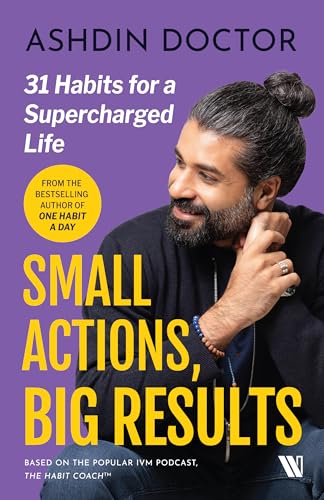
About the Book Practical and easily-actionable advice from everyone’s favourite Habit CoachTM Ashdin Doctor. Life is rough in this modern age. Everyone seems to be chasing a deadline or, worse, staring a burnout in the face. If only there was a way to manage the high stress of our work and life better, and also up our productivity at the same time! But how? There are only twenty-four hours in a day, and surely we need to rest and recover too? What is the trick to getting stuff done while keeping anxiety at bay? Habit CoachTMAshdin Doctor has some no-nonsense coping strategies. His simple, fuss-free habits are easy to integrate into our daily lives. Each habit that he proposes—be it mindfulness, or tricks to improve time management—can be seamlessly added to our routines, providing a road map for transforming our attitude to work and productivity. Each chapter has, at its heart, exercises that put those ideas into practice. If you’ve been wondering how to unlock your productivity and stride confidently towards success, Small Actions, Big Results offers you easy strategies to achieve your goal.
About the Author Ashdin Doctor is The Habit CoachTM. He firmly believes that an awesome life starts with awesome habits. He hosts The Habit CoachTM podcast on IVM, which is a daily podcast that has over a thousand episodes. It is ranked among the top self-development podcasts in India. It covers a wide variety of topics, all designed to help the listener evolve through their daily habits.
They begin much earlier—in the life you are already living.
Small Actions, Big Results: 31 Habits for a Supercharged Life began for me somewhere between an early-morning routine I try hard not to skip, a basketball court that still teaches me discipline at forty-plus, a reading habit that once turned into a world record, and the quiet inheritance of values my father left behind—without ever calling them habits.
I rarely pick up self-help books. Many feel loud, bossy, or oddly disappointed in the reader. This one wasn’t. Written by Ashdin Doctor, it felt less like a manual and more like a conversation with someone who understands fatigue—not the kind that sleep fixes, but the kind that comes from constant mental noise.
My life, for years now, has been shaped by repetition. Reading every day. Writing even when no one is watching. Showing up on the court when the body protests but the spirit doesn’t. None of these began as grand plans. They began as small promises kept daily. Which is why this book didn’t feel new to me—it felt familiar. Almost affirming.
Ashdin’s central idea—that attention is our real currency—hit close to home. I have spent years protecting my attention fiercely, sometimes instinctively, sometimes clumsily. When you commit to reading 365 books in 365 days, you learn very quickly what drains you and what nourishes you. Distraction isn’t harmless. It’s expensive. This book finally gave language to something I had been living without naming.
What surprised me was how interactive the book felt. At the end of each chapter, there are exercises—simple, almost deceptively so. I found myself writing in the margins. Pausing. Reflecting. I don’t usually do that. But these weren’t exercises asking me to change. They asked me to notice. And noticing, I’ve learned, is where real transformation begins.
One section where Ashdin asks readers to categorise themselves—worrier, fanatic, overthinker—made me smile. I recognised parts of myself in more than one box. Life has made me disciplined, yes. But also introspective. Sometimes too much. His suggestion to “be like water”—persistent, adaptive, choosing the path of least resistance—felt deeply personal. As a sportsman, as a writer, as a son of a serviceman, I’ve learned that rigidity breaks. Flow survives.
The structure of the book respects the reader’s life. Short chapters. Clear ideas. A rhythm that allows you to read one habit a day without feeling rushed or overwhelmed. That mattered to me. Because habits, like reading or training or writing, don’t grow in bursts. They grow in patience.
Emotionally, this book didn’t shake me. It steadied me. It reminded me why the small things I’ve been doing quietly, consistently, actually matter. It reassured me that intensity isn’t the same as effectiveness. That productivity doesn’t have to come at the cost of peace.
Its strengths lie in its practicality and humility. It doesn’t pretend to reinvent wisdom. It refines it. If I were to offer a soft critique, it would be this: readers who crave dramatic storytelling may find the tone restrained. But perhaps restraint is the lesson.
Would I recommend it? Absolutely. Especially to those who already live disciplined lives but feel mentally stretched. To people who do a lot yet wonder where their attention disappears. To anyone standing at the edge of another year, promising themselves change, knowing deep down that change only survives when it is small enough to repeat.
This book didn’t ask me to become someone else.
It simply nudged me to honour the journey I am already on — one habit, one day, one conscious act of attention at a time.
And sometimes, that’s the most powerful reminder of all.
I seldom read self-help books. Some I feel are condescending. Some are too sensational. Some repeat stuff that's already been told. Why did I read this one then? Because I found it really useful. Period.
This is my first book by Ashdin Doctor, popularly known as 'The Habit Coach'. So what's new here that's not available elsewhere? The author's first book was based on habits. This one is based on attention. He asks you to adopt 31 habits that will supercharge your life. At the end of every chapter is a kind of self-appraisal noting system and I found myself scribbling there: a thing I have never done. So yes, this book did speak to me.
He writes: 'Think of attention as money. If you wake up and have attention worth a thousand dollars, where do you end up spending it throughout the day? Is it spent on distractions like porn and TV? Is it spent on cunning? Is it spent on your loved ones, worrying and obsessing about them?'
Ashdin gives many practical lessons. In the beginning, he asks the reader to divide themselves into categories (worrier, fanatic etc). You can be a combo of any. Then he advises you to be like water: persistent but trying to find a path of least resistance.
I really enjoyed this book—it stands out because it is genuinely easy and simple to use. What I appreciated most was that the examples are drawn from an Indian context, which made the advice feel immediately relatable to my daily life. It’s been a great companion during my commutes. The strategies are handy enough that I can listen to a specific section on the go and immediately put it into practice or use it for planning. Honestly, reading this felt like listening to a friend distill the best lessons from all the books they’ve read into practical advice. Really a good one. Well done to the author.