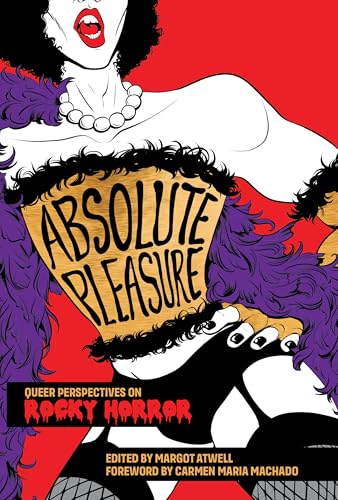
Since its earliest midnight showings at the Waverly Theater in New York City, The Rocky Horror Picture Show has been an underground sensation. For five decades, people around the world have dressed up and gathered in dark theaters to dance, yell, mime obscene acts, and forge connections with other queer people and weirdos.
The film shattered expectations and social norms at the time of its release. But how does its presentation of queerness—not to mention its portrayals of murder, manipulation, consent violation, and cannibalism—hold up today? The essays in Absolute Pleasure—by queer writers including Sarah Gailey, Grace Lavery, and Magdalene Visaggio—explore the film's complicated legacy, along with queer and trans joy, sexuality, family, generational understandings of queerness, and what we do with our problematic faves.
Margot Atwell is a writer, editor, publisher, and creative community builder, once called “Book Biz Cassandra” by Publishers Weekly. Her books are Absolute Pleasure: Queer Perspectives on Rocky Horror (Feminist Press, 2025) Derby Life: A Crash Course in the Incredible Sport of Roller Derby (Gutpunch Press, 2015) and The Insider’s Guide to Book Publishing Success (Beaufort Books, 2013). She writes On the Books, a newsletter about writing, publishing, and money.
She was the Executive Director and Publisher of Feminist Press, and Head of Publishing and Director of the creative outreach team at Kickstarter. She played roller derby under the name Em Dash for over a decade, skating with the world champion Gotham Roller Derby, and co-founding Derbylife.com. She was a Publishers Weekly Star Watch Honoree and received the Digital Book World Outstanding Achievement Award for her work creating The Next Page conference. She lives in Brooklyn, New York and you can find her online @MargotAtwell and www.margotatwell.com.
The description of this book is plain wrong: While it's advertised as an investigation into the complex legacy of Rocky Horror, it's in fact mainly a collection of personal essays in which queer people explain how the live show and /or the movie have helped them come into their own - such a compendium is certainly a worthwhile endeavor, but I was promised an in-depth media, narrative, and performance analysis, so I was left very unsatisfied, which is not what our favorite transsexual Transylvanian Dr. Frank-N-Furter stands for. I was promised to receive analysis, in abundance, but my antici...........pation just led me to an anti-climax. I got lost in time, and lost in space and meaning, and not in a good way. Okay, I'll stop now.
Sure, there are some texts and some textual elements that ponder the legacy of the show: Janet and Brad transforming from square WASPS into a sexually liberated woman and a man who starts to openly question his sexuality, Frank as an anti-hero, sex god and scorned lover who ultimately gets punished for his hedonism, Rocky as a sex object, etc pp. The elements of musical parody, SciFi, horror, exploitation, camp, social criticism, and literary references (especially Frankenstein, sure). And of course the iconic sentences of self-empowerment for all those who do not fit the Brad-and-Janet expectations of society: "There's a light / Over at the Frankenstein place", "Don't dream it, be it".
Some of these observations are critical: Do Janet and Brad consent when a initially disguised Frank seduces them? Are some of the classic audience chants outdated and sexist (for those who don't know: In Rocky Horror shows and movie showings, the audience is expected to participate in various ways)? Should author Richard O'Brien be criticized for his statements about trans women? These are certainly valid discussions, although I'm (once more) siding with Carmen Maria Machado who stresses the progressive power of the musical. Much worse though, all these questions and critical examinations take a back seat to personal stories that use Rocky Horror as a backdrop, and that's not what I came for.
So all in all, this was a rather disappointing, but mainly because it's not marketed correctly.
My first encounter with The Rocky Horror Picture Show was a very private thing—I was sixteen-ish, and watched a pirated file on my laptop, alone in my bed, almost furtively, even though I knew virtually nothing about it. I was into horror movies, and was making my way through the classics; I’d been hearing about this one for years, and I think I expected a slasher. It went on to deliver murder, dismemberment, and cannibalism, but nothing could’ve prepared me for a musical involving aliens, orgies, and Tim Curry in fishnets. It blew my mind wide open.
Since that day, I have rewatched the movie countless times, seen the stage show close to twenty, suffered through terrible remakes and reboots, and attended a midnight showing with a shadow cast on the other side of the world. I’ve always felt safe in the knowledge that the people around me at Rocky Horror were either queer, or at the very least my preferred kind of queer-friendly weirdos, and I’m hard-pressed to think of any other piece of pop-cultural media that can make me giddy with joy, yet unspeakably sad at the same time—every time I experience it, in whatever form, I glean something new from it. I shivered in anticipation when I learned of this project, and jumped at the opportunity to review this collection of essays ahead of publication.
The blurb led me to believe that the writers would celebrate Rocky Horror as the trailblazing queer classic that it is, while also acknowledging the ways in which it hasn’t aged well in its fifty year history. While many of the contributing writers did reckon with its complicated legacy by offering nuanced critiques of its problematic elements, overall, this collection wasn’t quite what I had expected. The vast majority of essays were predominantly about the authors’ relationship with the show and how it shaped their understanding and acceptance of their gender identity and/or sexuality—very personal and often admirably vulnerable contributions, but not quite the scholarly look at Rocky Horror‘s influence on queer media that I would’ve liked.
Of the twenty-six essays included, there were three I disliked to the point that I think the finalized book would be improved by cutting them entirely, but I’d much rather highlight the three stand-out pieces: Sweet Transgression by Sarah Gailey, a manifesto against hiding queerness; Time Slip: Rewinding Rocky Horror by Mel King, about the author’s transgender awakening and the role Rocky Horror played in bonding with their father; and far and away my favorite, To Find the Truth I’ve Even Lied: Self-Deception and Liberation in The Rocky Horror Picture Show by Magdalene Visaggio. As is often the case with anthologies of this kind, the result is quite uneven, but despite some forgettable pieces, this collection only reaffirmed my deep love for this subversive musical horror satire that taught generations of young queers not to hide their authentic selves. Today, Richard O’Brien’s core message is still the same guiding light in the darkness that it was over fifty years ago: Don’t dream it, be it.
3.5 stars.
—————
Note: I received an ARC of this book in exchange for an honest review. It did not include the foreword by Carmen Maria Machado.
Absolute Pleasure was an interesting read but not quite what I had expected. From the blurb, I had envisaged essays really breaking down the problematic elements of the film and considering its place as an artwork and part of queer storytelling history. While there were a couple of pieces that touched on those themes, in actual fact the majority of the essays were stories of peoples' interactions with the show and how it affected their understanding of their sexuality, helped them to accept themselves etc. These were interesting to peruse but I think the blurb could have been better phrased to highlight this focus, as I had picked it up expecting it to be far more 'scholarly' than it actually was. In the end, I am giving this one 3.5 stars. It is a fun read for fans of the show who are keen to hear others' experiences with it and views on it.
I received this book as a free eBook ARC via Edelweiss in exchange for an honest review.
I watched Rocky Horror for the first time as a freshman in high school. I had been out as pansexual and genderqueer for a little over a year. You can imagine the wildly sexy and equally insane Dr. Frank-N-Furter gave me lots to think about — good and bad.
Was this how people saw me? Did I want that? Is Frank dangerous or misunderstood? Is he (and by extension, queer people like him) the hero or the villain? Is this a cautionary tale about the dangers of consorting with gender traitors or a fantasy about sexual awakening and liberation?
As we approach the 50th anniversary of Rocky Horror, it’s important we think critically about the role this landmark piece of cinema has played in queer history, representation, community, and personal development. And this book absolutely rose to the occasion.
What an incredibly well-balanced collection of perspectives and styles. Couldn’t have asked for a better set of takes on one of queer history’s most iconic and infamous movies.
Thanks, as always to Feminist Press for an advanced reading copy! 💕
"Absolute Pleasure" is a collection of essays and works discussing queer perspectives on the pivotal film: "The Rocky Horror Picture Show," which is based on the stage show, "The Rocky Horror Show."
It seems everyone remembers where they were the first time they watched "RHPS." Many people went to one of the iconic shadow-cast film screenings where they perhaps had a "V" for "virgin" marked on their forehead, threw toast into the air, or attempted to keep up with shouting one of the many "callouts" that occur throughout the film. However, for me, I remember hearing about "RHPS" through "Glee," I hid under the covers to watch the episode on my iPod Touch. I was shocked, fascinated, and... awakened?! Later, I nervously asked my Mom if I could rent it, she immediately said, "No," as it was rated R. Nothing more clear-cut then telling a ten-year-old "no" to seeing an R-rated film.
I asked my way more media-laxed Dad, who also without hesitation said, "No." However, my Mom's "no," came from an unknowing, unwilling to find out place. My Dad's "no" was spoken with a seemingly confident recognition. Despite him showing be "The Hangover" at 9-years-old, he did not want me to watch the heavily queer and sexual film, he described it to me as being pornographic. So, what was a curious kid to do? I had to find out for myself why this film was so terrible even my Dad told me I couldn't watch it. I used one of my Apple Store gift cards from Christmas to purchase the film and, just like I did with "Glee", hid to watch it under the covers. Shout-out to Apple for having absolutely no way to verify age in 2010, I bought and watched so many R-rated movies because of you and my unrestricted internet access! Needless to say, my queer-ass was permanently altered by the horned-up, campy experience that is "RHPS."
Despite "RHPS" being influential for many queer folk (several people contributing it to awakenings of gender-identity and expression and sexual orientation), we can also acknowledge the 50-year-old film had some problematic qualities. "Absolute Pleasure" set out to discuss those very topics. I will say, discussions of problematic scenes, tropes, and ideas were not discussed as in-depth or consistently as I thought they would be, however I did appreciate whenever they were. Even though it is a film that I consider very beloved, I was ready to push myself to explore the problem areas I might've overlooked (or was very blatantly aware of, I'm looking at you questionable-consent in the sihloutted bedroom scenes). But, I wasn't pushed into that as much as I was expecting. Truthfully, the book (similar to my review), seemed to be a channel for people to discuss the impact "RHPS" had on their lives and identities. Which I, of course, didn't mind reading as someone who just loves reading stories and getting into various heads. It was heartwarming and intriguing to see how much the film had played a role in people's lives, it just wasn't exactly what I was expecting.
Due to the essays largely discussing people's experiences with "RHPS", the writing and stories did feel a little redundant at times. Many essays offered similar background knowledge as to what "RHPS" and "shadow-casts" are. This isn't too much of an issue, just something to be aware of going in, you'll get quite a bit of repeating information from various writers.
I think where this book really shines is the discussion of problematic scenes in the film, people's personal connections to the film, and dissecting various motifs and tropes within the film (as a film theory nerd, that was probably my favorite part). This book was a super fun deep-dive and overall just a great reminder to the power of community and culture.
This wouldn't be complete without me saying something very important as a reminder... "Don't dream it, be it."
Thank you so much to Margot Atwell for sending me a free copy in exchange for a fair and honest review!
It is more a collection of personal experiences with the show than an in-depth exploration of it, and some of the essays do feel only tangentially related to Rocky Horror. There are a few essays that dive into textual analysis and critiques of the culture, but I would have liked more. Still, I really did enjoy reading this. Rocky Horror is so much bigger than a film or a musical, and it's fascinating to see what others take away from it.
Some of the overarching themes that stood out to me:
- The role of the community, particularly shadow casts, in creating a sense of family for people whose birth families are not in the picture.
- The sense of connection to a queer past the movie and live experiences continue to bring to people, as it is that rare artifact that continues to resonate.
- The significance of representation - even flawed representation.
- The polarity of some of the callbacks as well as the lack of consent in the Brad/Frank and Janet/Frank scene.
- We all love Meat Loaf as Eddie.
I didn't keep track as I went, but these are some of the essays I found most interesting based on what I highlighted in them:
- "One From the Vaults" - really interesting analysis of Riff Raff in light of Richard O'Brien's own comments on trans identity
- "The Town is Neutered" - discussion of how annual Rocky Horror performances function as a silence breaker around queerness in a small, remote town
- "To Find the Truth I've Even Lied: Self-Deception and Liberation in The Rocky Horror Picture Show" - super interesting, partially-textual-analysis based reading of Brad as trans based heavily on the Floor Show
- "Becoming a Regular Frankie Fan" - critique of an unwillingness to address problematic content in favor of poking fun at low-production values
- "A Cinnamon Roll" - personal story of intense shadow-cast involvement that shows a darker side to the community
- "Brief Encounters with Dr. Frank-N-Furter" - critiques of some of the callbacks and the culture surrounding them
- "Midnight Picture Show" - fascinating look into the role of midnight in the film as well as in the community built around it
- "Asexulity in Transylvania" - one that feels less connected to the show but was welcome as an asexual
- "There’s a Light" - discussion about how Rocky depicts a queer community and helps to create spaces for queer communities to form (or has)
An anthology about my special interest?? Sign me up!!
It fell short of what I was hoping for, though. I recognize that Rocky is personal to people... but I think many of these essays focused strictly on the personal, without much recognition of the cultural. It got repetitive: most people saw Rocky for the first time when they were probably too young, they experienced a "found family" with the other attendees, and concluded that Rocky is important because of the rise of anti-trans bills recently. I personally think no one should've written a plot summary of the movie. Like girl, I know. Rocky is high shock-factor movie (it leaves very few stones unturned) and therefore people's personal experiences were not very impactful to me.
There were a few scholarly essays I found notable: essays about the midnight premiere + queer nightlife, words from generations beyond mine, "cross dressing" in a time before the internet and more. I think that's more of what I was expecting based on the description. The personal anecdotes were nice, but just about anybody who's seen Rocky a handful of times could write an essay about how it feels freeing to dress slutty and scream curse words.
In both the forward and the intro (both are excellent), the book purports to examine the accusation (presumably by mostly younger audiences) that Rocky Horror is "queerbaiting." I find the idea that Rocky horror could in any way be "queerbaiting" frankly kind of absurd, but I am willing and interested to hear that argument made, or explained anyway.
I think it goes without saying that Rocky Horror is problematic in plenty of other ways, but if Rocky Horror is anything, it is queer-batting, a term I just made up to express how hard it hits you over the head with its total, abject-in-the-best-way queerness.
I had thought it would more academic (perhaps I mean more "critical" but not in an angry way). It is, so far however, sufficiently and satisfactorily historical. I have learned a lot in that regard, and it feels 'correct.'
So far (I am only 1/4 through), it has a lot of personal anecdotes, more than I wanted, but it turns out they're nice, and easily breezed through. What critical passages exist, however, are fantastic -- their main points (so far) being about what Rocky Horror was/is/means to the people who do it. And, I do mean "do," not "watch/love."
Still, I long for a bit more anthropology, but perhaps it is forthcoming ("antici-"). It does make sense to front-load the book with lighter fare.
I’ve always been more of a casual Rocky Horror enjoyer, but the act of reading this book has left with with a deepened affection and connection to the musical and my community experiences with it. Nostalgia runs deep in this collection, almost bringing me to tears at times. There are many thoughtful, engaging essays in the books, but some redundancy as so many focus on the same themes of how their personal Rocky experiences shaped their coming out, sense of identity, etc. I was hoping for more scholarly critique and analysis. The essays that even dabble in that territory were generally my favorite, partially because they provided a change of pace. It succeeds as a celebration and in-group wink of shared community experiences and I have been recommending it to others. A really nice gift book for super fans, and enjoyable to make your way through during Rocky Horror season.
As a college Rocky Horror convert myself, this book felt like coming home, hearing from others who have experienced Rocky and seen themselves in it, and the maybe-but-not-quite-understanding-why they loved it so much. There are so many reasons to love Rocky (flaws and all), but the community it creates is top of the list. Shout out to my college friends who probably have similar vignettes to the ones in this book. Everyone looks good in fishnets, and we all deserve to feel free
going into this i expected a more rocky horror focused essay collection but still really enjoyed reading this! seeing how rocky horror has influenced different queer experiences (from both past and current generations) was so eye opening! especially as a lifelong rocky horror fan who also felt my eyes bulge out of my head the first time i saw frank n furter come down that elevator, i can never pass up an opportunity to see how it's inspired other people!
staff rec blurb, march 26: Dear creatures of the night, the book you've been antici...pating is here! Time warp back to '75 and go on a strange journey with 26 LGBTQ writers reflecting on Rocky's impact in their lives and culture at large. Equal parts chilling, thrilling, and fulfilling, Absolute Pleasure is a sweet transgression in these horrifying times. There's a light in the darkness and it's this book, dammit! Don't dream it, be it!
very interested in this one. i've always had complicated feelings about rhps (the transmisogyny + the creator defending jkr is a truly crazy combo for something widely considered to be a "queer classic") but it's also obviously important from a historical perspective & many trans women have found it impactful. particularly excited to read the transfem perspectives here
I really enjoyed this! Only criticism is that some of the essays felt a bit predictable/repetitive after a while ("Rocky Horror made me queer and gave me a community and is also kind of problematic!"). I kept reading for the essays that explored the writers' relationships to more non-obvious characters, like Brad, Eddie, Magenta, and Columbia. 3.5 stars rounded up.
A beautiful and thoughtful collection of essays featuring a broad array of perspectives on the film and its performance culture. I really admired the inclusion of a range of reactions from different generations and communities.
There were a few killer essays in this one, but a bunch that felt more biographical than analytical. Since the subject is a single work, the autobio ones got repetitive and blurred together in my memory.
Loved reading all these first person essays about how rocky horror affected their lives. I remember hitchhiking to go see it at the Cherry Hill mall back when I was a teenager (my parents of course had no idea)