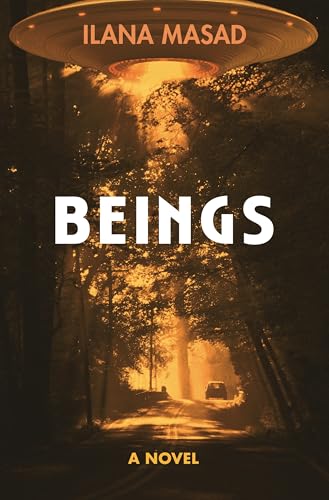
“The alien abduction meets lesbian yearning novel that will restore your faith in the universe. Ilana Masad excavates the juiciness of historical archives and the otherworldly mysteries of the everyday in her most brilliant work yet.” –Ruth Madievsky, author of All-Night Pharmacy
Named a "Most Anticipated Book" by the LA Times, Washington Post, Autostraddle, Town and Country, Boston Globe, Chicago Tribune, Lit Hub, and The Millions
In 1961, an interracial couple drove through the dark mountains of New Hampshire when a mysterious light began to follow them. Years later, through hypnosis, they recalled an unbelievable brush with extraterrestrial life. Unintentionally, a genre was born: the alien abduction narrative.
In Ilana Masad’s Beings, the couple’s experience serves as one part of a trio of intertwined threads: Known only by their roles as husband and wife, Masad explores the pair’s trauma and its aftermath and questions what it means to accept the impossible. In the second thread, letters penned by a budding science-fiction writer, Phyllis, to her beloved, Rosa, expose the raw ache of queer yearning, loneliness, and alienation in the repressive 1960s—as well as the joy of finding community. In the present day, a reclusive and chronically ill Archivist attempts to understand a strange forgotten childhood encounter while descending into obsession over both Phyllis’s letters and the testimony of the first alien abductees.
Over the course of a decade, Phyllis wrestles with her desires and ambitions as a lesbian writer, while the abducted couple grapple with how to maintain control of their narrative. All the while, the archive shatters and reforms, redefining fact and fiction via the stories left behind by the abductees, Phyllis, and the Archivist themself. Masad makes human what is alien and makes tangible what is hidden – sometimes by chance and sometimes intentionally – in the archive.
Ilana Masad is a writer of fiction, nonfiction, and criticism. Her work has appeared in The New Yorker, New York Times, LA Times, Washington Post, NPR, The Atlantic, StoryQuartlerly, Catapult, Buzzfeed, Joyland, The Account, and many more. She is the author of the novels All My Mother’s Lovers and Beings and is co-editor of the anthology Here for All the Reasons: Why We Watch The Bachelor
Masad holds a PhD in English from the University of Nebraska-Lincoln, has taught a wide variety of creative writing and literature courses, and also provides editorial services to authors.
This was good but not quite what I was expecting. Alien abduction meets queer literary fiction with multiple timelines and characters who seem to have nothing to do with each other until the end. I think I was expecting something more directly about aliens with a sci-fi vibe, but this is a very human novel about people and impact of being othered.
An interracial couple in 1961 experiences an alien abduction and spends decades processing that experience. A lesbian science fiction writer during the same time period faces rejection and roadblocks to love. In the future an archivist examines records from what happened. It's a slow, quiet book filled with yearning and examining prejudice and oppression, including from seemingly well meaning people. And are there aliens? Well..maybe. But that's kind of left up to the reader. I received a copy of this book for review, all opinions are my own.
So often, I think of writing as an act of control: you write someone into being, authoring their existence, deciding who they are and what happens to them. It’s almost aggressive. But here, in this novel about Betty and Barney Hill—the couple who in 1961 were the first to experience an alien abduction—writing is an act of care.
There are three different narratives in this novel: the story of the couple, told in beautiful stream-of-consciousness prose that made me think of Virginia Woolf (and specifically To the Lighthouse), recounting their possible alien abduction alongside their very “normal” lives; the letters and journals of Phyllis, a lesbian science-fiction writer from the 60s and a simply amazing character with such a distinctive, fun voice—it was a thrill to read about her; and finally, the story of The Archivist, an unnamed non-binary person who becomes obsessed with both the couple and with Phyllis, taking care of all these memories while also confronting their own (of lack thereof).
So it’s not really a novel about the couple; it’s about writing this couple, about writing in general, about reaching back across time and space to write and read about other people. As a writer, you pay attention, care about your subjects, bring them into existence or their existence into light. You can also take care of your subjects in a more direct sense: sure, you can imagine them into horrors, can write them as terrible idiots, but you can also imagine them as having a nice night, a good life, and as being good people, charmingly regular, complicated, real. There’s something so gentle and beautiful about this novel choosing to do that, quite consciously, carefully. It doesn’t shy away from the bad and the ugly of reality, but it also tries to imagine otherwise.
I should note that other than the couple—who, as mentioned, are fictional renditions of the real Barney and Betty Hill—the other characters are totally fictional. But this intermingling of non-fiction and fiction, of what is real and what is imagined, runs through the entire novel and speaks to its meditation on memory and writing. I really loved going down this rabbit hole of history. It felt so universal, but it’s also a very specific American history: the civil rights, the gay liberation, and the anti-war movements are all present throughout, though mostly in the background. These are always a large part of characters’ lives, alongside their personal experiences, small and ordinary—or big and strange, like going on a drive one night and ending up (maybe?) taken by alien beings.
Let's call it what it is: I am making things up. With a purpose, though. Which is to convey the truth. Well. A truth.
...I am fully aware that in trying to tell you about them I'm further muddling the line between fact and fiction, between objective and subjective truth. The space between these, though, strikes me as narrower than I ever imagined. That frightens me, but at the same time, I can't help but love this shimmering border where uncertainty dwells, because it is here that we can live alongside the endless realm we call mystery.
The three interwoven threads of this novel speak to one another through history. The reimagined couple reeling from their alien abduction, the young queer writer trying to find her bearings in a new place, and the unnamed archivist coping with chronic illness in real time.
In many ways, the characters all grapple with reality and unreality. The couple tell their story and they are met with both credence and incredulity. Phyllis, the writer, encounters a world that denies the validity of her existence, and one that welcomes it. The archivist delves into these histories, the traces of lives gone by that give meaning to what may have happened and how, as well as the questions and varying perceptions of their own memories and family. The characters are caught between the world as it is to them and as they want it to be, as they know themselves and as others see them, the lives they live and the histories that are told and retold - or forgotten, except for one person’s careful attention to the ephemera of their lives so many years later.
I was thoroughly engrossed in the lives of the characters, in the beautifully crafted inner worlds and the lovely, visceral quality of the writing. When I paused to reflect I was also struck by the bigger ideas shaped by the narrative, the nature of reality as it is molded by our own perceptions and those of others, the question of what it actually is to be real, for an experience to be true, for us to believe ourselves and others. The best books pull you in and then make you think, and this novel does both masterfully. I loved it.
I struggle with reviewing this one, because it is so exceedingly well intentioned and who doesn’t want to love a book about (in part) a lesbian sci-fi writer that also takes on queerness, race, archival history, neurodivergence, and oh yeah, alien abduction? But the shifting narration feels disjointed, the pacing is miscalibrated, and nothing quite coheres. It feels more researched than written. That said, some readers will adore this and I hope it finds its audience.
“To be looked at, to be seen, however fleetingly, is to exist.”
A fantastic mix of genres and writing styles. It’s a historical fiction sci-fi with some focus on societal issues and civil rights, and I highly recommend.
There are three distinct stories here that are connected by threads, but they work together seamlessly. One: an account of a real life couple who experienced a possible brush with extraterrestrial life in 1961; Two: a sci-fi writer’s penned letters to her lost love, Rosa; Three: a queer archivist researching both of these, plus recovering their own hidden childhood memories.
It feels very respectful and non-sensationalized considering a third of the story is about real people’s lives. I especially loved getting to know Phyllis through her penned letters.
Thank you so much to Bloomsbury Publishing for the ARC of this book!! I really enjoyed it! Pub date 9/23
An ok book, but I put it down at the halfway point. I was interested in the UFO and alien abduction storyline, and I liked the structure of the storytelling. But seriously, where have all the editors gone? The writing was repetitive and unnecessarily drawn out. I just got bored.
As someone who’s spent my fair share of time parasocially fixating on dead people’s things in archival settings, this. is. exactly. what. it. feels. like. The grip each person’s collection had on my thoughts and emotions touched everything I did for weeks on end. And it was… frightening? Like lovingly laying a complete stranger’s remains to rest yet still likely knowing them unlike any one person might have done when they were living. It’s so incredible to see someone DO something with that eerie, tender feeling.
Not to mention the ALIENS and sci-fi WEIRD and LESBIANS. GOD.
What does it mean to be “alien?” Beyond our perceived borders of race, nationality, class, religion, gender, sexuality — even beyond time or life and death — might there be something out there that we would all agree is truly “other?” And what might such a discovery make us?
There’s so much here. Easily a top 5 read for this year.
There’s 3 different stories in here. 1. biracial married couple who are the first reported alien abduction case - loved them, HATED the archivist’s input. It was condescending and annoying. The way they keep posing questions and then saying “I don’t know” or “we’ll never know” or “who knows” like what’s the goddamn point of that 2. The epistolary lesbian awakening of a sci-fi writer - loved it. Although it Felt almost out of place but i get the point that each of these characters feels alien in their own way. Still felt a bit out of place and jarring to jump from abduction to yearning so randomly. 3. The goddamn archivist. Oh how i loathe you. I just hate the impersonal writing style. It’s incredibly dry and I just didn’t relate AT ALL. Didn’t enjoy it either. This book was meant for someone else i think. I can see others just absolutely obsessing over this book. But it is NOT for me.
This was a great queer story but I came for aliens and all the alien sightings could’ve been taken out of the story and it would’ve been the same. I was promised lesbians and aliens, where are my aliens???
This novel has three interwoven stories that overlap--two are historical stories from the mid-20th century and one is of the modern archivist who studies them. One is a story of a couple that experiences an alien abduction, one of the earliest stories to go public. One is a coming of age story told through letters of a young woman discovering her queer identity and struggling to become a science-fiction writer. And the archivist themself reads and considers these stories, while being hounded by documentarians trying to get an interview from them about an alleged alien sighting from their childhood that they've blocked out. The stories interweave elements of the supernatural, of queerness, of what it means to be alien.
It can be tricky to write a book with 3 different stories. The risk is that the reader enjoys one much more or much less than the others. But I felt these were all really well balanced. There are different styles of narration, different periods of time, and the slowly recurring themes that appear and reappear and these all help to keep it feel like a well-braided whole. Though if I had to pick one, I most enjoyed Phyllis in Boston discovering the lesbian underground culture, that was a real joy.
This is one of those books that doesn't have a whole lot of forward movement, it's not building towards some big climax. And yet I always felt satisfied and happy to come back to it. It's an interesting novel and it's hard to make something with this structure and subject matter interesting, but Masad really pulls it off. I'll be looking for her work in the future.
I did this on audio, which worked relatively well, made effective use of multiple narrators.
Sometimes I finish a book and immediately know that there is no way for me to capture its quiet nuance in a simple review. It’s the type of book that softly pulls you into an atmosphere all its own, creating a feeling that just cannot be explained until experienced.
Beings by Ilana Masad is one of these types of books, and I knew it from the very first chapter. There is a gentleness to the writing, and that gentleness manifests differently in the three unique perspectives the book covers. At the most simple explanation, this is a book about alien encounters. But that is really just the surface, and underneath there is so much exploration of heart and humanity. This is a really special book, and I haven’t stopped thinking about it since I finished it. Masad blends genres, spans decades, and raises questions of what makes something truly “alien” in a world where alienation happens to so many groups of people who don’t follow some archaic “norm”.
It is a lovely, thoughtful book and I cannot recommend it highly enough.
I raced through the audiobook in three days. One of my absolute favorites of the year. While this book involves alien abduction, that is absolutely not what it is About. For me at least, this was a book about relationships, memory, trauma, and truth. I am bereft that I no longer get to spend time with these characters.
This was strange as a whole, although interesting in parts. There are three interrelated stories: a novel in the novel about a couple (irl) who had an alien encounter in NH in the 60s. Then a young lesbian kicked out of her home who goes to Boston, also in the 60s, and then a present day archivist (who made me think of Ian McEwan’s archivists). The alien abduction story was a little boring. The contemporary archivist a little obscure.
Beings is a novel that follows three intertwined storylines. The first storyline is about a couple living in the 60s who get abducted by aliens. Also set in the 60s, the second storyline follows Phyllis, a lesbian science fiction writer dealing with being alienated from her family and her best friend. The last storyline follows a nonbinary archivist in the current day who becomes obsessed with Phyllis and who may have also encountered aliens as a child.
This novel has a very interesting structure as each of the storylines relate to one another to some extent, but really each storyline stands on its own. If you read this novel for the aliens in particular, this story may leave you disappointed as it's really about the characters and their lives. I would definitely say this falls into the literary fiction or historical fiction genre more than science fiction. This may have been the reason why I enjoyed this novel as much as it did. As enthralling as an alien story might be, I liked that this novel had a hint of the extraordinary, but it was really about how alienated and othered humans themselves can be. The unique experiences people may have or the identities that may define them set people apart and change how people relate to each other or how they treat one another. I liked how the author explored these ideas through relationships while also having aliens be a larger theme in the novel. While to some extent every character in this book is an outsider in some way, their main conflicts relate more to their closest familial and romantic relationships and not with aliens themselves. Usually when I am reading a story from multiple perspectives I have a favorite one I can’t wait to get back to, but with Beings I found myself not minding whose perspective I was reading from because all of them were so well done.
Beings is a fantastic historical fiction novel about people, relationships, and the things that keep us moving forward. If you go into this novel knowing that aliens are just a small part of the story, you will find so much to enjoy here. Each of these characters and their stories are explored so deeply. The writing in this novel is stunning! I am so glad to have finally read something by Masad.
*e-ARC provided by the publisher through NetGalley in exchange for an honest review.*
Having somehow accidentally consumed tons of media about alien abductions, I was really excited for this book and wish I had thought of its premise. I thought the aliens would end up being more explicitly a metaphor for alienation or something - bodily alienation, dysphoria, something along those lines. Instead, they seem more a metaphor for or symbol of what is unknowable. It's a lofty topic, and although I enjoyed reading this I'm not sure it fulfilled its potential.
The three storylines - historical fiction about Barney and Betty Hill, who claimed they were abducted by aliens + a contemporary of theirs, a lesbian science fiction writer + modern-day nonbinary archivist who may or may not also have seen aliens in their youth - are somewhat ill-fitting, tied together mostly by the much overdone overlay of archival research. Possession and People of the Book did it so well. I haven't read The Historian or The Weight of Ink, but I would imagine that the modern research component in those novels, too, plays in integral part of the overall plot. Here, it feels a lot like a mere device to explore the two unconnected past narratives.
I had some other quibbles, but I won't go on because it is a good and interesting book that I do recommend.
“I also want to leave a message in a bottle for someone like me in 10 or 50 or 1200 years: keep asking questions. Keep seeking answers. Do it carefully, but keep trying to understand the nature of our species, the spaces where our experiences overlap, the venn diagrams, the circles, the archetypes of stories, of what moves us.”
Thank you to Carla at Lavender PR for the gifted eARC and finished copy! This book was published in the US on September 23, 2025 by Bloomsbury Publishing.
Ilana Masad’s Beings is one of those rare novels that reaches into your chest, rearranges something quiet and unspoken, and then leaves you gentler for it. Told through three intertwining perspectives—a 1960s interracial couple who may have been abducted by aliens, a queer sci-fi writer piecing together her identity through letters, and a nonbinary archivist uncovering their stories decades later—Masad builds an intricate constellation of narrative, memory, and meaning. This is a story about what it means to believe: in yourself, in others, in the stories that shape our survival.
Masad’s prose is lyrical and deeply philosophical, pulsing with curiosity. Every sentence feels like an excavation of both history and interiority—what we inherit, what we imagine, what we choose to remember. There’s a rhythm to the writing that mimics the looping nature of memory itself: “I am making things up…to convey the truth,” one voice admits, encapsulating the novel’s heart. Beings dwells in ambiguity, inviting readers to live at that shimmering border where reason and wonder overlap. It’s a book that trusts its readers to sit with uncertainty, to honor the parts of humanity that can’t be archived or explained away.
What’s most striking is how Masad uses the speculative to illuminate the painfully real. The UFO encounters and hypnosis sessions become metaphors for how marginalized people are disbelieved—how queerness, Blackness, and other forms of difference are made to seem alien. For Phyllis, the queer writer at the book’s center, storytelling becomes both rebellion and refuge: a way to rewrite the world when the world refuses her. For the Archivist, queerness and chronic illness intersect with questions of legacy—what it means to preserve the self without being consumed by it. And for the couple, love across racial boundaries becomes its own kind of abduction, one that transforms and isolates all at once.
Beings isn’t just literary sci-fi—it’s a radical act of empathy. It asks us to listen more closely, to believe each other’s impossible truths. When I finished my ARC, I immediately bought the audiobook and listened again, unwilling to let go of Masad’s voice or her vision. I’ve been frustrated by the hollow promises of “literary sci-fi” lately, but this novel renewed my faith entirely. It’s haunting, tender, and breathtakingly humane—a new all-time favorite that reminds me why I read in the first place.
📖 Read this if you love: introspective speculative fiction that blurs the line between truth and myth; queer and trans archives; or stories about memory, belief, and the longing to be understood.
🔑 Key Themes: Storytelling as Survival, Queerness and Self-Definition, Memory and Mythmaking, Alienation and Belief, The Ethics of Archiving and Bearing Witness.
Content / Trigger Warnings: Medical Content (minor), Medical Trauma (minor), Transphobia (minor), Animal Death (minor), War (minor), Racism (minor), Death of a Parent (minor), Child Abuse (minor), Homophobia (minor).
I was quite taken aback when, upon describing one of the main storylines of Ilana Masad's new novel to my husband, he responded, "Oh, my grandma knew those people."
The first narrative strand introduced in BEINGS is based on the real-life story of Betty and Barney Hill, civil rights activists and (like my husband's grandma) residents of Portsmouth, New Hampshire. After a honeymoon trip to Montreal in the fall of 1961, they reported being followed by a mysterious glowing vessel, and then being abducted by aliens and kept aboard their ship for hours in the White Mountains. As Masad outlines in her book (where the couple is identified just as "the husband" and "the wife"), much of their testimony --- most of it collected while they were under hypnosis --- has shaped countless other alien encounter stories and works of science fiction.
In another of the novel's three main narratives, readers meet one of those science fiction authors, Phyllis, who --- also in the early 1960s --- writes letters to her best friend (and former lover), Rosa, recounting her mix of fear and excitement as she relates the experience of living alone in Boston and starting to explore the city's deeply hidden but still vibrant queer community. Phyllis' letters go unanswered, and her sense of heartbreak is palpable in these sections, which are balanced by her growing dedication to publishing (under a pen name) her science fiction stories and novels. In addition to hiding behind a male pseudonym, Phyllis has to decide how much to disguise the queer plots and themes she is desperate to write about, in a pre-Stonewall society where being gay is still against the law.
The third and final interwoven narrative is set in the present day, where a nonbinary researcher known only as the Archivist is cataloging Phyllis' papers while also struggling against their own loneliness and the pain of their mother's paranoia and conspiracy theories. But the Archivist finds themself at the center of one of those theories when they are contacted by a documentary filmmaker, who says that the Archivist was one of a group of schoolchildren who claimed to have experienced their own alien encounter.
The extraterrestrials who tie together these disparate narratives are not the only unifying strands. Throughout, Masad is playing with the idea of alienness, of outsider status. For the Archivist and Phyllis, it's their gender identity and their sexuality. For the husband and wife, it's the fact that they're an interracial couple at a time when such relationships were vanishingly rare. All three narratives --- which have some overlapping elements but ultimately stand alone --- explore experiences of feeling unseen, mistrusted or alone, and seek to understand what it means to find belonging, especially under circumstances where that belonging can feel elusive at best and impossible at worst.
Like many novels that employ multiple independent narratives, it's perhaps inevitable that each reader will connect with one storyline over the others. But through voice, technique and format, Masad manages to make each one distinct, memorable and more than worthy of readers' attention.
This is a weird book, but overall I really liked it. We follow 3 stories: an account of a couple who were allegedly abducted by aliens in the early 1960s, a little-known 1960s lesbian sci-fi author writing letters to her first love, and the archivist in modern day who is writing the account & reading the letters.
Usually when I read a book like that, the stories eventually intertwine in some way. But Beings doesn't do that, so if you go into hoping for a reveal that these three stories are somehow connected, you're going to be disappointed. They're all loosely connected by the fact that the archivist is involved in them all, but despite the fact that the couple & author were alive at the same time, those two stories are never connected.
Instead, I think this book is really just about the archivist. They are unnamed, had a childhood encounter with aliens that they don't remember but their mother (who was not there) does, and they're estranged from their family. They work in an LGBTQ+ archive, which is where they learn about the sci-fi author after a request from an external academic. She gets caught up in the story of the abducted couple (loosely based on a real life account), likely due to the similarities between their encounter and the couple's. By sifting through these histories, the archivist finds a little bit of themselves.
I think the sci-fi author's letters are actually the strongest part of this book. I was excited every time the archivist read more of them. From first childhood crush to early adulthood, we get a really good glimpse of her life and how she became the relatively obscure (but beloved) author the archivist knows her as. I enjoyed her exploration of her gender & gender expression, and the ups and downs of her first few lesbian relationships. I appreciate that we do get a pretty satisfying "ending" to her story, unlike the other two story threads.
I think what stops this book from being 5 stars for me is that you're really left at the end going "so?" I'm unsure what the overall message is or if the author even intended one. Other than the archivist being fascinated by them, it was unclear to me what the couple's story was even for. It was just a narrative biography, as far as I can tell, and a discussion of what a nonfiction author's relationship to truth & facts is. I didn't dislike reading about them by any means - I even like the archivist's notes in between passages - but there was a definite feeling of "so what?" by the end of the book.
So yeah, this is a weird one. I really enjoyed reading it. I would recommend it. But I think I went into it with some expectations that just weren't met. That could be a me problem. Still a good time!
“There was nothing, really, that could stop life from continuing on, except for its opposite, and even then, it went on for everyone else.”
Beings was a book that took me by complete surprise and ended up stealing the nr. 10 spot on my Favourites-list of 2025. It might just be one of the most underrated book on that list, but it also requires a little personal background, in order for me to explain why this made such an impact on me.
At the start of this year I started writing a novel of my own, which I unfortunately had to abandon temporarily when Black-Dog reared its head. The story is (in very oversimplified terms) about two characters, who must learn to navigate their lives after witnessing an event that’s so unexplainable and incomparable to anything else, that they don’t have the words to talk about it, or process it properly. It’s about the isolation of trauma, healing from pain you cannot voice and friendship that doesn’t require words to offer comfort. Because of that project, these themes were on my mind a lot this year, and Beings probably clicked with me so much because it engages with some of these same themes.
Beings Apart from the themes of how to cope with something you cannot voice, the novel addresses alienation and othering of queerness in many forms. All three of our central characters are “queer” in their own way. The couple’s interracial relationship is scrutinized almost as much as their alien-encounter in the press-attention that follows it, in a time where this was still a huge taboo. Phyllis struggles with the expression of her queerness and feelings for another woman, specifically in a male-dominated field. Then there’s the Archivist, who’s non-binary and disabled, and therefore othered in their own way. I really loved the way the author explored these topics organically through their stories. It also engages with questions of storytelling and mythmaking. Specifically about who gets to tell a story, and how this changes the actors within it. The author does a fantastic job of packing a lot of meaning and depth into only 300 pages. The same goes for the characters; despite literally not even knowing some of their names (!), I came to care deeply for Phyllis, the couple and the Archivist through the intimate glimpse into their lives Masad offered us.
I obviously highly recommend this novel, but don’t let the cover fool you into expecting an adventure-packed sci-fi-romp. It’s a character-study and a portrait of a time in our history where being queer often truly meant being alien.