

What do you think?
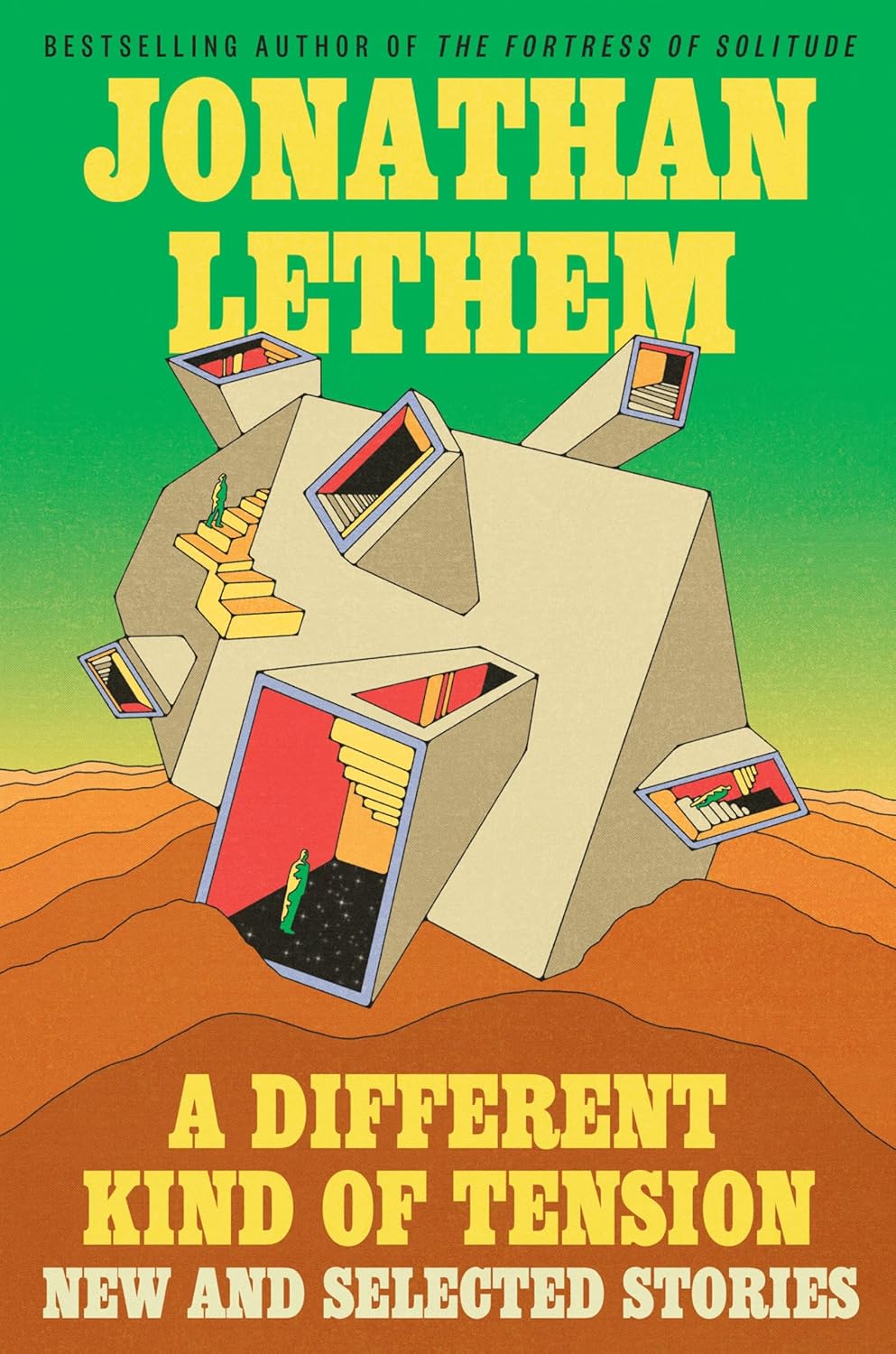
A Different Kind of Tension: New and Selected Stories
A definitive collection of new and selected stories by a master of the form. “Comparisons might be drawn to writers ranging from Jorge Luis Borges and Haruki Murakami to Margaret Atwood and J. D. Salinger. All of Lethem’s stories are enlivened by his wit and provocative wordplay” (Chicago Tribune).
This dazzling, genre-defying collection from Jonathan Lethem features seven major stories published since his last collection, along with his best work spanning more than three decades. A major new story, “The Red Sun School of Thoughts,” never published elsewhere, follows a teenaged boy coming to terms with figures of authority and power—those both in his own biological family and in the family he creates for himself.
Elsewhere we meet “Super Goat Man,” a down-at-heels bohemian superhero; “The Porn Critic,” whose accidental expertise wrecks his own romantic aspirations; and “Sleepy People,” who pose interpersonal conundrums without ever rousing from their slumber. Fluidly moving between realism and the surreal, the absurd and the mundane, A Different Kind of Tension is a container bursting with life and death, couples in trouble, talking animals, technologies on the fritz. Through it all are people longing to be seen and to connect; to thrive, love, and be forgiven. “This is the joy of reading Jonathan you never know what you’re going to get” (Financial Times).
This dazzling, genre-defying collection from Jonathan Lethem features seven major stories published since his last collection, along with his best work spanning more than three decades. A major new story, “The Red Sun School of Thoughts,” never published elsewhere, follows a teenaged boy coming to terms with figures of authority and power—those both in his own biological family and in the family he creates for himself.
Elsewhere we meet “Super Goat Man,” a down-at-heels bohemian superhero; “The Porn Critic,” whose accidental expertise wrecks his own romantic aspirations; and “Sleepy People,” who pose interpersonal conundrums without ever rousing from their slumber. Fluidly moving between realism and the surreal, the absurd and the mundane, A Different Kind of Tension is a container bursting with life and death, couples in trouble, talking animals, technologies on the fritz. Through it all are people longing to be seen and to connect; to thrive, love, and be forgiven. “This is the joy of reading Jonathan you never know what you’re going to get” (Financial Times).
400 pages, Hardcover
Published September 23, 2025
About the author
Jonathan Lethem
237 books2,709 followersJonathan Allen Lethem (born February 19, 1964) is an American novelist, essayist and short story writer.
His first novel, Gun, with Occasional Music, a genre work that mixed elements of science fiction and detective fiction, was published in 1994. It was followed by three more science fiction novels. In 1999, Lethem published Motherless Brooklyn, a National Book Critics Circle Award-winning novel that achieved mainstream success. In 2003, he published The Fortress of Solitude, which became a New York Times Best Seller.
In 2005, he received a MacArthur Fellowship
His first novel, Gun, with Occasional Music, a genre work that mixed elements of science fiction and detective fiction, was published in 1994. It was followed by three more science fiction novels. In 1999, Lethem published Motherless Brooklyn, a National Book Critics Circle Award-winning novel that achieved mainstream success. In 2003, he published The Fortress of Solitude, which became a New York Times Best Seller.
In 2005, he received a MacArthur Fellowship
Ratings & Reviews
Friends & Following
Create a free account to discover what your friends think of this book!
Community Reviews
Displaying 1 - 30 of 42 reviews

June 12, 2025
Rec. by: A Goodreads giveaway, sure, but more than that by previous work, fellow readers Ryan and Dan... and a remarkably ambivalent NYT review entitled "Sort-Of Science Fiction" (10/26/2025)
Rec. for: Holding the eyedropper over your tongue and watching the drop grow and grow before it falls...
A Different Kind of Tension is a chronology of Jonathan Lethem's short fiction, from 1990 through 2004... and while, frankly, I prefer my Lethem doses (heh) at novel length, these concentrated and surreal stories provide a strobe-lit series of fascinating glimpses into Lethem's evolution as a writer.
I am, as I often do, including brief comments about each entry in this collection, although some of 'em won't make much sense until after you've read the tale itself:
"Walking the Moons" (1990)
This brief and not especially auspicious beginning nevertheless contains hints, even this early, pointing to what Lethem would become. What we would become...
"Program's Progress" (1990)
Or maybe call this one "The Revolution Will Be Motorized" (heh). It's the same age-old hierarchy: car over pedestrian over stationary. And Gifford, demoted to the least of the three, feels the urge to better himself...
These early stories are often gimmicky, to be sure—and from Lethem's title, with its echoes of Pilgrim's Progress, to Gifford's problems, this is one of those.
"The Speckless Cathedral" (1992)
Who the hell needs a drug to fall out of love?
"Forever, Said the Duck" (1993)
These are some unreal party animals...
"How We Got In Town and Out Again" (1996)
This is the first story in A Different Kind of Tension that I can remember encountering before.
"Five Fucks" (1996)
Sex that's so good it steals time (but then, that might be worth it); eternal rivalry and recurrence; a pup's kiss... what the fuck did I just reread?
"Sleepy People" (1996)
Danny-boy ain't the only one.
"The Spray" (1998)
The cops had a spray that could make lost things visible. What could possibly go wrong?
"Access Fantasy" (1998)
A cautionary tale from the other side of the endless traffic jam, somewhere down around 1215th Street.
"Children with Hangovers" (2002)
Eh, ya get old enough, they all start looking like kids, after awhile—but whaddayagonnado? Just keep trying to be a good neighbor, that's all, I guess...
"The Dystopianist, Thinking of His Rival, Is Interrupted by a Knock on the Door" (2002)
His rival's "utopias wrote reality itself" (p.136).
"Super Goat Man" (2004)
A long-retired, nth-tier superhero put out to pasture (heh) at a small college... and one of the most trenchant final scenes in A Different Kind of Tension (at least, so far).
"Vivian Relf" (2004)
Another re-read. Vivian and Doran and deja-don't.
"Interview with the Crab" (2005)
It's gonna take a lot to coax this guy out of his shell...
My throat started aching after reading some of the Crab's choice bits to myself out loud... but I couldn't help myself. His voice is just that distinctive.
"Lucky Alan" (2007)
Something about the name... sure, I read this one before, but I didn't remember the details.
I do remember similar movie palaces back in my home town, though, those "decaying venues" with "big rooms chopped into asymmetric halves or quartered through the balcony" (p.190).
"Zelig-like" (p.191) and Lethem's reference to Durrell's Alexandria Quartet (also p.191) resonated with me as well.
However lucky he may have been, Alan isn't even really the focus of this story. We only see him twice removed, filtered through the colorful theater director Sigismund Blondy and then through our narrator. But nevertheless I thought "Lucky Alan" remains one of the more thought-provoking stories in this collection.
"The King of Sentences" (2007)
When I recently reencountered "The King of Sentences" in The Best American Short Stories 2008, I called it "a creepy tale about the lengths to which people will go, both as fans and as the recipients of such adulation"—but I didn't quote this line then, and I should have:
"Proximity People" (2009)
This one's peevish, and tongue-in-cheek—I hope, anyway, for I am in proximity to some of these people myself...
"The Dreaming Jaw, the Salivating Ear" (2009)
One blogger, alone—two followers, one already dead (brutally disemvowelled, in point of fact), and one fled. And the scent of the dead sea. Sounds about right... this one's a Coney Island of the Mind, all right.
"Procedure in Plain Air" (2009)
Kafkaesque—but it's true: if you carry a clipboard around (or a jackhammer) and look sufficiently bored, you can get away with almost anything in a city like this one.
"The Empty Room" (2011)
Keep your family dynamic with this one weird trick!
"The Porn Critic" (2012)
Kromer "looked more villainous than he felt" (p.252). Just... don't get too excited.
"Guy Bleeding All Over Skype" (2013)
Camera off, please. Apart from the obsolete name "Skype," this particular office horrorshow could have happened yesterday.
"Pending Vegan" (2014)
For a guy who's gone off his meds (on purpose) and who is considering going vegan, maybe Sea World wasn't the best choice of vacation spot...
"Elevator Pitches" (2017)
What it says on the tin...
"The Afterlife" (2020)
Eh, it's as plausible as any other explanation, but...
"The Crooked House" (2021)
Is it—could it be—an homage to Robert A. Heinlein's "And He Built a Crooked House"? Why, yes... from the title onward. But Heinlein's crooked house had held but a couple of occupants, its architect and one curious visitor, whereas Lethem's contains multitudes...
"Narrowing Valley" (2022)
An extraordinarily metafictional fiction, from its title nod to R.A. Lafferty onward, "Narrowing Valley" is also self-consciously decolonialist (and doesn't that undermine the entire project? Lethem does acknowledge this).
"To Visit the City of the Dead" (2022)
Every proper city has one of these...
"In Mugwump Four" (2023)
Immersion in irreality is irrational... but I clicked Like on this one (again; it's another reread), am Sharing it now, and was already Subscribed.
"The Red Sun School of Thoughts" (2024)
This seems like a memoir, could be a memoir, with no hint of the fantastic other than that conferred by the psychedelic magic of San Francisco.
To begin with, anyway...
Like much of Lethem's work, this story deals ambiguously with borders, genres... lines. In sum, "The Red Sun School of Thoughts" is a devilishly ambiguous way to end a book...
(This time, I've adapted the Table of Contents with thanks from the entry at the Northwest Regional Library, which is in the northwestern corner of the not-at-all Northwestern state of... Minnesota.)
Rec. for: Holding the eyedropper over your tongue and watching the drop grow and grow before it falls...
A Different Kind of Tension is a chronology of Jonathan Lethem's short fiction, from 1990 through 2004... and while, frankly, I prefer my Lethem doses (heh) at novel length, these concentrated and surreal stories provide a strobe-lit series of fascinating glimpses into Lethem's evolution as a writer.
I am, as I often do, including brief comments about each entry in this collection, although some of 'em won't make much sense until after you've read the tale itself:
"Walking the Moons" (1990)
This brief and not especially auspicious beginning nevertheless contains hints, even this early, pointing to what Lethem would become. What we would become...
"Program's Progress" (1990)
Or maybe call this one "The Revolution Will Be Motorized" (heh). It's the same age-old hierarchy: car over pedestrian over stationary. And Gifford, demoted to the least of the three, feels the urge to better himself...
These early stories are often gimmicky, to be sure—and from Lethem's title, with its echoes of Pilgrim's Progress, to Gifford's problems, this is one of those.
"The Speckless Cathedral" (1992)
Who the hell needs a drug to fall out of love?
"Forever, Said the Duck" (1993)
These are some unreal party animals...
"How We Got In Town and Out Again" (1996)
This is the first story in A Different Kind of Tension that I can remember encountering before.
The people watching probably didn't know why they wanted to, except it made them forget their screwed-up life for a while to watch the only suckers bigger than themselves—us.
—p.56
"Five Fucks" (1996)
Sex that's so good it steals time (but then, that might be worth it); eternal rivalry and recurrence; a pup's kiss... what the fuck did I just reread?
"Sleepy People" (1996)
Danny-boy ain't the only one.
"The Spray" (1998)
The cops had a spray that could make lost things visible. What could possibly go wrong?
"Access Fantasy" (1998)
A cautionary tale from the other side of the endless traffic jam, somewhere down around 1215th Street.
"Children with Hangovers" (2002)
Eh, ya get old enough, they all start looking like kids, after awhile—but whaddayagonnado? Just keep trying to be a good neighbor, that's all, I guess...
"The Dystopianist, Thinking of His Rival, Is Interrupted by a Knock on the Door" (2002)
His rival's "utopias wrote reality itself" (p.136).
"They laughed when I sat down at the Dystopiano! But when I began to play—"
—p.141
"Super Goat Man" (2004)
A long-retired, nth-tier superhero put out to pasture (heh) at a small college... and one of the most trenchant final scenes in A Different Kind of Tension (at least, so far).
"Vivian Relf" (2004)
Another re-read. Vivian and Doran and deja-don't.
"Interview with the Crab" (2005)
It's gonna take a lot to coax this guy out of his shell...
My throat started aching after reading some of the Crab's choice bits to myself out loud... but I couldn't help myself. His voice is just that distinctive.
"Lucky Alan" (2007)
Something about the name... sure, I read this one before, but I didn't remember the details.
I do remember similar movie palaces back in my home town, though, those "decaying venues" with "big rooms chopped into asymmetric halves or quartered through the balcony" (p.190).
"Zelig-like" (p.191) and Lethem's reference to Durrell's Alexandria Quartet (also p.191) resonated with me as well.
"Want a job, Blondy? You should write an opera about Donald Trump. He's what passes for a hero these days."
—p.198
However lucky he may have been, Alan isn't even really the focus of this story. We only see him twice removed, filtered through the colorful theater director Sigismund Blondy and then through our narrator. But nevertheless I thought "Lucky Alan" remains one of the more thought-provoking stories in this collection.
"The King of Sentences" (2007)
When I recently reencountered "The King of Sentences" in The Best American Short Stories 2008, I called it "a creepy tale about the lengths to which people will go, both as fans and as the recipients of such adulation"—but I didn't quote this line then, and I should have:
Punctuation! We knew it was holy.
—p.206
"Proximity People" (2009)
This one's peevish, and tongue-in-cheek—I hope, anyway, for I am in proximity to some of these people myself...
"The Dreaming Jaw, the Salivating Ear" (2009)
One blogger, alone—two followers, one already dead (brutally disemvowelled, in point of fact), and one fled. And the scent of the dead sea. Sounds about right... this one's a Coney Island of the Mind, all right.
"Procedure in Plain Air" (2009)
Kafkaesque—but it's true: if you carry a clipboard around (or a jackhammer) and look sufficiently bored, you can get away with almost anything in a city like this one.
"The Empty Room" (2011)
Keep your family dynamic with this one weird trick!
"The Porn Critic" (2012)
Kromer "looked more villainous than he felt" (p.252). Just... don't get too excited.
"Guy Bleeding All Over Skype" (2013)
Camera off, please. Apart from the obsolete name "Skype," this particular office horrorshow could have happened yesterday.
"Pending Vegan" (2014)
For a guy who's gone off his meds (on purpose) and who is considering going vegan, maybe Sea World wasn't the best choice of vacation spot...
"Elevator Pitches" (2017)
What it says on the tin...
Just because you're crazy doesn't mean you're not also stupid, and neither precludes the possibility that you've got your boot on the neck of someone even worse off.
—p.283
"The Afterlife" (2020)
Eh, it's as plausible as any other explanation, but...
"I said to her, if the future of sex is bald men with ponytails, I want no part of it."
—p.290
"The Crooked House" (2021)
Is it—could it be—an homage to Robert A. Heinlein's "And He Built a Crooked House"? Why, yes... from the title onward. But Heinlein's crooked house had held but a couple of occupants, its architect and one curious visitor, whereas Lethem's contains multitudes...
"Narrowing Valley" (2022)
An extraordinarily metafictional fiction, from its title nod to R.A. Lafferty onward, "Narrowing Valley" is also self-consciously decolonialist (and doesn't that undermine the entire project? Lethem does acknowledge this).
Game over. Thanks for playing.
—p.320
"To Visit the City of the Dead" (2022)
Every proper city has one of these...
"In Mugwump Four" (2023)
Immersion in irreality is irrational... but I clicked Like on this one (again; it's another reread), am Sharing it now, and was already Subscribed.
"The Red Sun School of Thoughts" (2024)
This seems like a memoir, could be a memoir, with no hint of the fantastic other than that conferred by the psychedelic magic of San Francisco.
To begin with, anyway...
Like much of Lethem's work, this story deals ambiguously with borders, genres... lines. In sum, "The Red Sun School of Thoughts" is a devilishly ambiguous way to end a book...
(This time, I've adapted the Table of Contents with thanks from the entry at the Northwest Regional Library, which is in the northwestern corner of the not-at-all Northwestern state of... Minnesota.)
March 3, 2025
Thirty-one stories, dozens of themes and countless innovations, A Different Kind of Tension will engage the imaginations of all readers.
It’s fascinating to see how creative minds viewed what the future might look like from the past. Lethem's visions are more expansive than jet packs and flying cars. My favorite stories in this collection move from the retro to high-tech seamlessly. It is impossible to tell if these short tales were composed 1980’s or 2020’s. Bob Dylan, mind-altering substances, Star Wars, Brooklyn, punk-rock, our characters embody cool corners of space familiar to Baby-Boomers and Generation X.
Standout scenes include a swinger party in which any drugs or alcohol consumed is transferred between characters by kissing, gridlock traffic jams so long that drivers fantasize about being elsewhere by watching palatial real estate demonstrations on screens in their car, carny-types who set up low-rent virtual reality stations to allow audience members the chance to watch what the players do in a second-life type environment. It is great fun to jump from analog to cyberpunk, from literary to experimental.
Other highlights include the man engaged in a sales presentation on Skype who bleeds more profusely with each passing minute, the boy who discovers truths about himself and his father while living in a commune filled with compelling mini-stories in every room, and the apartment burgled but when the police arrive with a special spray, people are outlined with the missing objects.
Every dart thrown by Lethem hits the board and some strike the center of the bullseye.
Thank you to Ecco Books and Netgalley for a review copy.
It’s fascinating to see how creative minds viewed what the future might look like from the past. Lethem's visions are more expansive than jet packs and flying cars. My favorite stories in this collection move from the retro to high-tech seamlessly. It is impossible to tell if these short tales were composed 1980’s or 2020’s. Bob Dylan, mind-altering substances, Star Wars, Brooklyn, punk-rock, our characters embody cool corners of space familiar to Baby-Boomers and Generation X.
Standout scenes include a swinger party in which any drugs or alcohol consumed is transferred between characters by kissing, gridlock traffic jams so long that drivers fantasize about being elsewhere by watching palatial real estate demonstrations on screens in their car, carny-types who set up low-rent virtual reality stations to allow audience members the chance to watch what the players do in a second-life type environment. It is great fun to jump from analog to cyberpunk, from literary to experimental.
Other highlights include the man engaged in a sales presentation on Skype who bleeds more profusely with each passing minute, the boy who discovers truths about himself and his father while living in a commune filled with compelling mini-stories in every room, and the apartment burgled but when the police arrive with a special spray, people are outlined with the missing objects.
Every dart thrown by Lethem hits the board and some strike the center of the bullseye.
Thank you to Ecco Books and Netgalley for a review copy.

April 15, 2025
Jonathan Lethem has been entertaining me for over 25 years with his wit and imagination. This collection is a bit uneven, and I admit having to struggle with otherworldly subjects. His longer books, featuring life in New York, are preferable, but I did enjoy a chance to become acquainted with his shorter works.
December 5, 2025
Jonathan Lethem's stories are a remarkable combination of speculative fantasy and social realism. The premise for each story is always outlandish: in "Program's Progress", consciousness has been digitized, people are promoted and demoted between the ranks of "stationary", "walker" and "car" and one person wants to foment a revolution to upend the class system (the story is a kind of techno-Marxist dystopian); in "Sleepy People", an unconscious serviceman is dropped off on a house doormat and the woman inside must take care of this new ward (a kind of modern Rip Van Winkle story); in "Super Goat Man", a lame comic-book hero moves into the neighborhood, none of the boys are impressed with his small-town rescues, but he eventually becomes a professor of literature and, while his superpowers are never awe-inspiring, he continues to exercise power over one boy's imagination; in "Interview With The Crab", a lecherous bad-boy crab who was the producer of a successful sitcom grills his interviewer and then later reveals his plan to dominate the world with his clones; in "King of Sentences", two booksellers track down the author they consider to be the best writer in the country but, when they find him, he is clearly a tortured artist and desperado who makes them undress, tears up their clothes and then leaves them behind—to their delight.
The stories are weird, often set in the future, often in virtual worlds, but they still preserve a semblance of realistic plausibility. Lethem generally opens with a captivating hook that makes its inner world seem both strange and quotidian. "Pending Vegan" starts with the intriguing sentence, "Paul Espeseth, who was no longer taking the antidepressant called Celexa, braced himself for a cataclysm at SeaWorld." It's a hilarious entry into the story of a man at Sea World experiencing the psychotropic effects of a withdrawal—his doctor advises him that he will start to notice "bums and pickpockets". Already it seems so relatable (family vacation) but epic (a cataclysm). A similarly enticing story is "The Crooked House" which opens with the sentence, "The week he met the man who claimed to have exited the house by falling downward into a desert valley, Mull decided to give up coffee." It's a confounding sentence: what is the house? Who is the man? How does one fall into a desert valley? It's an enigmatic start to what will be a moral about dystopian architecture but the first sentence terminates with the most banal clause: "Mull decided to give up coffee." Lethem makes the surreal seem humdrum: the Dystopianist starts with the line "The Dystopianist destroyed the world again that morning, before making any phones or checking his mail"—a mysterious sentence that turns world-destruction into a mundane morning routine; "Super Goat Man" begins, "When Super Goat Man moved into the commune on our street, I was ten years old"—a bizarro sentence that invites the reader to wonder not just who Super Goat Man is but why this ten-year-old is living in a commune.
It's an eclectic range of stories. There is a porn critic, a person living inside a blog, a man who bleeds more profusely minute by minute on a video conference, a writer trying to write his way out of a virtual world. It's a kooky collection but the execution is uneven and it often felt like the stories never went anywhere and ended abruptly, as if the writer was relishing the novelty of the premise rather than building a story.
The stories are weird, often set in the future, often in virtual worlds, but they still preserve a semblance of realistic plausibility. Lethem generally opens with a captivating hook that makes its inner world seem both strange and quotidian. "Pending Vegan" starts with the intriguing sentence, "Paul Espeseth, who was no longer taking the antidepressant called Celexa, braced himself for a cataclysm at SeaWorld." It's a hilarious entry into the story of a man at Sea World experiencing the psychotropic effects of a withdrawal—his doctor advises him that he will start to notice "bums and pickpockets". Already it seems so relatable (family vacation) but epic (a cataclysm). A similarly enticing story is "The Crooked House" which opens with the sentence, "The week he met the man who claimed to have exited the house by falling downward into a desert valley, Mull decided to give up coffee." It's a confounding sentence: what is the house? Who is the man? How does one fall into a desert valley? It's an enigmatic start to what will be a moral about dystopian architecture but the first sentence terminates with the most banal clause: "Mull decided to give up coffee." Lethem makes the surreal seem humdrum: the Dystopianist starts with the line "The Dystopianist destroyed the world again that morning, before making any phones or checking his mail"—a mysterious sentence that turns world-destruction into a mundane morning routine; "Super Goat Man" begins, "When Super Goat Man moved into the commune on our street, I was ten years old"—a bizarro sentence that invites the reader to wonder not just who Super Goat Man is but why this ten-year-old is living in a commune.
It's an eclectic range of stories. There is a porn critic, a person living inside a blog, a man who bleeds more profusely minute by minute on a video conference, a writer trying to write his way out of a virtual world. It's a kooky collection but the execution is uneven and it often felt like the stories never went anywhere and ended abruptly, as if the writer was relishing the novelty of the premise rather than building a story.

November 6, 2025
Walking the Moons - the earliest of his published stories herein collected, a comic vignette about virtual reality, digital planet mapping, celebrity journalism
Program's Progress - Autobot (or Transformers) fanfiction: sentient microchips that through behavior can either ascend into walking robots and, ultimately, automobiles or descend into some sort of data processing brick embedded into the sidewalk. Introduces the idea of karma debits and credits we would later see in Gun with Occasional Music
Speckless Cathedral - experimental drug NtroP concocted to break prisoners of war of their allegiance is repurposed as a means for couples in troubled relationships to finally break up and move on
How We Got in Town and Out Again - a sort of cyberpunk They Shoot Horses Don’t They wherein hapless poor and hungry contestants submit to the degradations of a traveling virtual reality show
Five Fucks - the total incompatibility of a pair of lovers is enough to twist time, warp space and rearrange reality: a very interesting story
Sleepy People - reads like a section from an abandoned novel: roving gangs straight out ofClockwork Orange terrorize while a haphazard militia drunkenly play out their war fantasies; yet humdrum life continues apace as the protagonist dutifully puts in hours at a call center and contends with the narcoleptic phenomenon known as the sleepy people
The Spray - a curious chemical reveals the ghosts of past lovers in this light sci-fi domestic vignette
Access Fantasy - our hero is dependent on watching video of apartments on tape to escape the tedious life in a terminal traffic jam - but in an echo of Rear Window thinks he sees a murder and takes steps outside his bubble to investigate (another example of a story that reads like an excerpt from an abandoned novel)
Children with Hangovers - a Brautiganian vignette, a surreal survey of life in the city
Red Sun School of Thoughts- Lethem revisits his personal picnic, lightning (Star Wars, Mother dying) with a startling eye for the fantastic
...these and many more tales await to gift the attentive reader!
Note: Kafka Americana is not represented in this collection
Program's Progress - Autobot (or Transformers) fanfiction: sentient microchips that through behavior can either ascend into walking robots and, ultimately, automobiles or descend into some sort of data processing brick embedded into the sidewalk. Introduces the idea of karma debits and credits we would later see in Gun with Occasional Music
Speckless Cathedral - experimental drug NtroP concocted to break prisoners of war of their allegiance is repurposed as a means for couples in troubled relationships to finally break up and move on
How We Got in Town and Out Again - a sort of cyberpunk They Shoot Horses Don’t They wherein hapless poor and hungry contestants submit to the degradations of a traveling virtual reality show
Five Fucks - the total incompatibility of a pair of lovers is enough to twist time, warp space and rearrange reality: a very interesting story
Sleepy People - reads like a section from an abandoned novel: roving gangs straight out ofClockwork Orange terrorize while a haphazard militia drunkenly play out their war fantasies; yet humdrum life continues apace as the protagonist dutifully puts in hours at a call center and contends with the narcoleptic phenomenon known as the sleepy people
The Spray - a curious chemical reveals the ghosts of past lovers in this light sci-fi domestic vignette
Access Fantasy - our hero is dependent on watching video of apartments on tape to escape the tedious life in a terminal traffic jam - but in an echo of Rear Window thinks he sees a murder and takes steps outside his bubble to investigate (another example of a story that reads like an excerpt from an abandoned novel)
Children with Hangovers - a Brautiganian vignette, a surreal survey of life in the city
Red Sun School of Thoughts- Lethem revisits his personal picnic, lightning (Star Wars, Mother dying) with a startling eye for the fantastic
...these and many more tales await to gift the attentive reader!
Note: Kafka Americana is not represented in this collection
October 21, 2025
Good ol' Johnny Lethem. I've read some of these stories three times now. I got his short story collection Men & Cartoons as a birthday present as a teenager, and even after I forgot the book existed, there were certain stories that always rose up in my mind, made me ask things like "What was that book I read where ads were living people?" Then one day I found a copy of Men & Cartoons at a friend's house. I was excited and said "I used to have this book." Then I opened the book and saw my name printed inside it along with a birthday dedication. It WAS my book. He insisted I let him take it and simply forgot, but just because I have a bad memory doesn't mean I'll let someone hustle me, so we obviously never spoke again (actually he just moved). Either way, I read the book again and rediscovered all those forgotten stories. I then immediately misplaced my copy again (maybe someone else stole it this time, because I refuse to believe I lend things out). And now I've read some of them once again in this volume. Which is a long winded way of saying that sometimes the best stories are the ones you barely remember and can't put your finger on, it makes it that much more exciting when you rediscover them down the line.

April 13, 2026
some 7s, lotta 2s

October 25, 2025
This is somewhat of a career retrospective of Lethem's short fiction, comprising 30 stories dating back to 1990 and as recently as last year, presented in chronological order. Lethem fans will realize what he admits in the credits section: 18 of these stories have appeared in previous collections and most of the rest in various periodicals. Only one story, the longest and last in the book, is original to this collection. In that sense, the subtitle is misleading.
Lethem famously uses fantasy or science fiction tropes in many of his stories. To this long-time SF reader, those stories remind me of much earlier SF stories that were 'idea' stories - a single twisty idea drove the action. In Lethem's case, most of those stories are set in or result in some form of dystopia. Lethem recognizes this and makes fun of it in an autobiographical story called 'The Dystopianist, Thinking of His Rival, Is Interrupted by a Knock on the Door'. (Don't worry, that's the longest story title in the book.) There are other 'autofiction' or metafictional stories that include a writer. His story 'Narrow Valley' comments on early SF stories, especially R.A. Lafferty's story of the same name. 'Crooked House' is a clear homage to Robert Heinlein's story 'And He Built a Crooked House'. This book's cover is a likely reference to that story.
It's curious. While I am a fan of SF, most of the stories that worked best for me were the ones that didn't include SF or fantasy elements. When he doesn't have a gimmicky idea to lean on, Lethem tends to lean on character development a little more. I was disappointed in the last story, the original one, which was an intriguing teenage coming-of-age story in a 1970s commune in San Francisco, until at the very end it lurches into an SF concept that tantalizes more than it satisfies.
Anyhow, none of this will be a real surprise to veteran Lethem readers. For those who want to sample 35 years of Lethem's short work, this is the book for you.
Lethem famously uses fantasy or science fiction tropes in many of his stories. To this long-time SF reader, those stories remind me of much earlier SF stories that were 'idea' stories - a single twisty idea drove the action. In Lethem's case, most of those stories are set in or result in some form of dystopia. Lethem recognizes this and makes fun of it in an autobiographical story called 'The Dystopianist, Thinking of His Rival, Is Interrupted by a Knock on the Door'. (Don't worry, that's the longest story title in the book.) There are other 'autofiction' or metafictional stories that include a writer. His story 'Narrow Valley' comments on early SF stories, especially R.A. Lafferty's story of the same name. 'Crooked House' is a clear homage to Robert Heinlein's story 'And He Built a Crooked House'. This book's cover is a likely reference to that story.
It's curious. While I am a fan of SF, most of the stories that worked best for me were the ones that didn't include SF or fantasy elements. When he doesn't have a gimmicky idea to lean on, Lethem tends to lean on character development a little more. I was disappointed in the last story, the original one, which was an intriguing teenage coming-of-age story in a 1970s commune in San Francisco, until at the very end it lurches into an SF concept that tantalizes more than it satisfies.
Anyhow, none of this will be a real surprise to veteran Lethem readers. For those who want to sample 35 years of Lethem's short work, this is the book for you.
February 2, 2026
Some very creative but weird short stories in this collection- some old, some new. Wouldn’t call this science fiction but these stories are OUT THERE! Great writer though.
His three page list of annoying types - “ Proximity People” hits the mark. Thank you Jonathan Lethem. You are great.
His three page list of annoying types - “ Proximity People” hits the mark. Thank you Jonathan Lethem. You are great.

December 26, 2025
good but uneven.
spanning decades and genres it was somewhat disorienting but I expected that. His darker to techno near future stories I appreciated but the coming of age stories felt a little dry and some of his weird for the sake of weird stories were middling.
his stories kinda strike like his novels, some I await their release and some you couldn't pay me to read.
spanning decades and genres it was somewhat disorienting but I expected that. His darker to techno near future stories I appreciated but the coming of age stories felt a little dry and some of his weird for the sake of weird stories were middling.
his stories kinda strike like his novels, some I await their release and some you couldn't pay me to read.

June 10, 2025
I am very grateful to receive this ARC from NetGalley--I love Jonathan Lethem. I find his stories intriguing,. thought-provoking and often disturbing. I'll admit my favorite story in this collection, The Red Sun School of Thoughts, is the most realistic of the stories (with a sudden veering off toward the end of the story into science fiction which was a surprise and although a little jarring worth its strangeness because of its humor but also tantalizing hints of differing perspectives, shifts into other kinds of thinking, and possibilities of future worlds to come). Most of the story concerns an adolescent boy whose mother is dying and whose father is, mostly absent and so self-absorbed that even when he is physically present he is not fully present. The boy is struggling (as Lethem's boys--and adolescents)--often are) with figuring out who he is and how he fits into the world. iespecially loved all the musical references and what they mean to the boy. It takes place in San Francisco amongst a diverse group of people living together in a kind of commune.
Another story I particularly like is "Pending Vegan," about a man (husband and father) struggling with increasing awareness of what is wrong in his world, his society. As is generally true in these stories, and Lethem generally, there is a lot of humor in this story, as well as sadness and anxiety.
The stories are generally science fiction explorations of worlds, future dystopias for the most part. And although they are meaningful and self-contained, they also felt to me like fragments of a larger consciousness, a fuller narrative that is coherent and unsettling. And, of course, beautifully written.
Many of these stories have been published elsewhere, although also included are four new ones.
A Different Kind of Tension lives up to its title. The stories surprise, disturb, intrigue and glisten with beautiful sentences and a coherent vision.
I want to thank Ecco Press, NetGalley, and the author for providing me with an early reviewer copy of this book and I strongly recommend it for anyone who loves good writing and new perspectives on humanity.
Another story I particularly like is "Pending Vegan," about a man (husband and father) struggling with increasing awareness of what is wrong in his world, his society. As is generally true in these stories, and Lethem generally, there is a lot of humor in this story, as well as sadness and anxiety.
The stories are generally science fiction explorations of worlds, future dystopias for the most part. And although they are meaningful and self-contained, they also felt to me like fragments of a larger consciousness, a fuller narrative that is coherent and unsettling. And, of course, beautifully written.
Many of these stories have been published elsewhere, although also included are four new ones.
A Different Kind of Tension lives up to its title. The stories surprise, disturb, intrigue and glisten with beautiful sentences and a coherent vision.
I want to thank Ecco Press, NetGalley, and the author for providing me with an early reviewer copy of this book and I strongly recommend it for anyone who loves good writing and new perspectives on humanity.

December 18, 2025
Strong, dense, & strange collection of tales. A few surprises but definitely a book lovers grace moved through these tales.
“A Different Kind of Tension” by Jonathan Lethem
From “The Speckless
Cathedral”
“Now I understand my fate. Only if I could learn to love her again can I be fully human. Only by working through my indifference and hate, back to that center where I bathed in her glow. Only then will I be strong enough to leave her. Which I’ll do, I swear, if it’s the last thing I do. It obviously will be.” P.26
From “Five Fucks”
“Human lives exist to be experienced, or possibly endured, but not solved. They resemble any other novel more than they do mysteries. Westerns, even. It’s that lie the mystery tells that I detest.” P.78
From “The Spray”:
“What else?” the oldest policeman said. We didn’t know what else. That’s when they brought it out, a small unmarked canister, and began spraying around the house. First they put a mask over the mouth and nose of the dog. None of them wore a mask. They didn’t offer us any protection. Just the dog. “Stand back,” they said. They sprayed in a circle toward the edges of the room. We stood clustered with the policeman. “What’s that” we said. “Spray,” said the oldest policeman. “Makes lost things visible.” P.107
From “Vivian Relief”
“Oh yeah.” she seemed to grow immensely sad.
They stood together contemplating the privileges of their special relationship, its utter and proven vacancy.
“It’s like when you start a book and then you realize you read it before,” he said. “You can’t really remember anything ahead, only you know each line as it comes to you.” P.168-169
“She only smiled. Her husband intruded from the end of the table, his voice commanding. “What is it with you too?” Improbably, Polymus’s Pauline impatience seemed to call it all into mind as one thing, a life’s story. All those years since Doran’s and Vivian’s first meeting, the otherwise forgettable party. Doran wondered if anyone else on the planet had reason to recall that vanished archipelago of fume, conversation, and disco, tonight or ever. The ancient party was like a radio signal adopting off through outer space, it seemed to him now.” P.173
From “Interview with the Crab”
“I came to it the same way maybe your precious Keaton or Vigoda came by their own – pure suffering, forged into something of value to others, like crushing a coal in a diamond, at great cost of effort and personal sacrifice, a process you wouldn’t know too much about since everything to you is just a big pile of slippery postmodern illusions in references with no soul to speak of, not even any notion that it might be missing one, that there might be something to more in the loss of – a soul, I mean.”
I knew that it was not my place to defend myself, here. Not to point out that it was precisely that essence of existential suffering, or soul, if he preferred that term, which had drawn me to his work, made me seek for a description for how such an uncanny and timeless thing had broken out in the vacuous, tinselly environs of network situation comedy. Even in berating me he was inviting me inside, I felt. My task was to selflessly except that invitation.” P.180
From “The Kings of Sentences”
“We worked in bookstores, the only thing to do. Nobody who didn’t Dash and that included every one of our customers – knew what any of the volumes throbbing along those shelves was worth, not remotely. Nor did the bookstore’s owners. Cleo and I were custodians of a treasury of sentence as much bigger on the inside than on the outside. Though we mostly handled the books only by their covers (or paged briefly through to ascertain that no dents had stripped the pages yellow or pink with a Hi-Liter), we communities deeply with them, felt certain that only we deserved to abide with them. Any minute we’d read them all covered to cover, it was surely about to happen. Meanwhile, every customer robbed us a little. At the cash registers we spoke sentences tailored to convey our distain, in terms so subtle it was barely detectable. If our customers blinked a little at the insults we embedded in our thank-yous, we believed they just might be worthy of the marvels they’re grubby dollars entitled them to bear away.” P.205-206
From “Pending Vegan”
“Civilizing children was pretty much all about inducing cognitive dissonance. His daughters’ balancing their desire both to cuddle onto a devour mammals was their ticket for entry to the human pageant.” P.272
“Meanwhile, on the other side of the twins, a mystery: Pending Vegan’s wife. She with whom he’d once practically merged. Then, as if he bumped into her and knocked off two pieces, the twins had appeared. In the past year, she’d become opaque, as though deliberately to spare him. Her human outline now contained what Pending Vegan had named, in conversation with Renker, “the Cloud of Unknowing.” P.276-277
From “The Afterlife”
“He supposed he’d become a kind of veteran of this place, and what felt like a little more than an hour. (Time was a ridiculous concept.) Hey, you kids, get off my lawn! he almost joked, but it was hardly funny. He felt both sorry for them and irritated that they could have no idea how easy it had once been to circulate.
At this thought, R. faintly recalled someone, long ago, trying to explain this place to him, the system that prevailed. Of course he paid no attention. You don’t care about that kind of stuff until you’re forced to, mostly. And why should he have cared to listen then? It wouldn’t have done any good. No, be where you are. Be there when you get there. And now he was.” P.294
From “Narrowing Valley”
“In this, the writer is too typical of himself. That he feels that the past lives in him, and that it stirs him, doesn’t mean that the past actually exists in him. The past, two, is a narrow valley, one refusing occupation. Or no. That’s wrong. The past is huge, and real, but you are small. To re-enter the valley of the past is, properly, to grow tiny, and to vanish.” P.318-319
“A Different Kind of Tension” by Jonathan Lethem
From “The Speckless
Cathedral”
“Now I understand my fate. Only if I could learn to love her again can I be fully human. Only by working through my indifference and hate, back to that center where I bathed in her glow. Only then will I be strong enough to leave her. Which I’ll do, I swear, if it’s the last thing I do. It obviously will be.” P.26
From “Five Fucks”
“Human lives exist to be experienced, or possibly endured, but not solved. They resemble any other novel more than they do mysteries. Westerns, even. It’s that lie the mystery tells that I detest.” P.78
From “The Spray”:
“What else?” the oldest policeman said. We didn’t know what else. That’s when they brought it out, a small unmarked canister, and began spraying around the house. First they put a mask over the mouth and nose of the dog. None of them wore a mask. They didn’t offer us any protection. Just the dog. “Stand back,” they said. They sprayed in a circle toward the edges of the room. We stood clustered with the policeman. “What’s that” we said. “Spray,” said the oldest policeman. “Makes lost things visible.” P.107
From “Vivian Relief”
“Oh yeah.” she seemed to grow immensely sad.
They stood together contemplating the privileges of their special relationship, its utter and proven vacancy.
“It’s like when you start a book and then you realize you read it before,” he said. “You can’t really remember anything ahead, only you know each line as it comes to you.” P.168-169
“She only smiled. Her husband intruded from the end of the table, his voice commanding. “What is it with you too?” Improbably, Polymus’s Pauline impatience seemed to call it all into mind as one thing, a life’s story. All those years since Doran’s and Vivian’s first meeting, the otherwise forgettable party. Doran wondered if anyone else on the planet had reason to recall that vanished archipelago of fume, conversation, and disco, tonight or ever. The ancient party was like a radio signal adopting off through outer space, it seemed to him now.” P.173
From “Interview with the Crab”
“I came to it the same way maybe your precious Keaton or Vigoda came by their own – pure suffering, forged into something of value to others, like crushing a coal in a diamond, at great cost of effort and personal sacrifice, a process you wouldn’t know too much about since everything to you is just a big pile of slippery postmodern illusions in references with no soul to speak of, not even any notion that it might be missing one, that there might be something to more in the loss of – a soul, I mean.”
I knew that it was not my place to defend myself, here. Not to point out that it was precisely that essence of existential suffering, or soul, if he preferred that term, which had drawn me to his work, made me seek for a description for how such an uncanny and timeless thing had broken out in the vacuous, tinselly environs of network situation comedy. Even in berating me he was inviting me inside, I felt. My task was to selflessly except that invitation.” P.180
From “The Kings of Sentences”
“We worked in bookstores, the only thing to do. Nobody who didn’t Dash and that included every one of our customers – knew what any of the volumes throbbing along those shelves was worth, not remotely. Nor did the bookstore’s owners. Cleo and I were custodians of a treasury of sentence as much bigger on the inside than on the outside. Though we mostly handled the books only by their covers (or paged briefly through to ascertain that no dents had stripped the pages yellow or pink with a Hi-Liter), we communities deeply with them, felt certain that only we deserved to abide with them. Any minute we’d read them all covered to cover, it was surely about to happen. Meanwhile, every customer robbed us a little. At the cash registers we spoke sentences tailored to convey our distain, in terms so subtle it was barely detectable. If our customers blinked a little at the insults we embedded in our thank-yous, we believed they just might be worthy of the marvels they’re grubby dollars entitled them to bear away.” P.205-206
From “Pending Vegan”
“Civilizing children was pretty much all about inducing cognitive dissonance. His daughters’ balancing their desire both to cuddle onto a devour mammals was their ticket for entry to the human pageant.” P.272
“Meanwhile, on the other side of the twins, a mystery: Pending Vegan’s wife. She with whom he’d once practically merged. Then, as if he bumped into her and knocked off two pieces, the twins had appeared. In the past year, she’d become opaque, as though deliberately to spare him. Her human outline now contained what Pending Vegan had named, in conversation with Renker, “the Cloud of Unknowing.” P.276-277
From “The Afterlife”
“He supposed he’d become a kind of veteran of this place, and what felt like a little more than an hour. (Time was a ridiculous concept.) Hey, you kids, get off my lawn! he almost joked, but it was hardly funny. He felt both sorry for them and irritated that they could have no idea how easy it had once been to circulate.
At this thought, R. faintly recalled someone, long ago, trying to explain this place to him, the system that prevailed. Of course he paid no attention. You don’t care about that kind of stuff until you’re forced to, mostly. And why should he have cared to listen then? It wouldn’t have done any good. No, be where you are. Be there when you get there. And now he was.” P.294
From “Narrowing Valley”
“In this, the writer is too typical of himself. That he feels that the past lives in him, and that it stirs him, doesn’t mean that the past actually exists in him. The past, two, is a narrow valley, one refusing occupation. Or no. That’s wrong. The past is huge, and real, but you are small. To re-enter the valley of the past is, properly, to grow tiny, and to vanish.” P.318-319

October 15, 2025
I received a copy of this book for free in a Goodreads giveaway.
This is an interesting and eclectic collection of short stories, but it felt a bit sprawling and unfocused. I found myself wanting some of these to be more fleshed out and others to be just puzzling, which I suppose is true of most short story collections, but this one felt a bit long, like there were too many stories and too many ideas crammed into one collection. And yet, after I finished reading it, I looked back and appreciated the many journeys it took me on.
Particularly in the more speculative fiction-type stories, I often felt like they should be fleshed out more. There's a certain amount of world building that's usually helpful in these types of stories, so there's only so much you can do in a short story, and I often had the feeling that the world felt underdeveloped, and if only it were a much longer piece of fiction, the author could have done the proper world building and had an interesting plot in that world.
The more realistic stories are more effective, focusing on character and not having to deal with setting up a different world with different rules or technologies. I don't know if it's just because I read it last that it stayed in my mind, but I enjoyed the last story in this book. It's the longest one and is realistic until a sudden science fiction-y element thrown in near the end, but it's a personal story about a teenage boy figuring out life and relationships with other people, including his parents and the family he finds at the commune he lives in.
It's hard to read this straight through, and even though I took over a week doing so, I still felt a lot of whiplash, with so many different worlds and ideas crammed into this short story collection. I think it could have done with some trimming down, just to make the reading experience not nearly as exhausting, but at the end of it, I could not help but admire the variety and breadth of ideas in this book.
This is an interesting and eclectic collection of short stories, but it felt a bit sprawling and unfocused. I found myself wanting some of these to be more fleshed out and others to be just puzzling, which I suppose is true of most short story collections, but this one felt a bit long, like there were too many stories and too many ideas crammed into one collection. And yet, after I finished reading it, I looked back and appreciated the many journeys it took me on.
Particularly in the more speculative fiction-type stories, I often felt like they should be fleshed out more. There's a certain amount of world building that's usually helpful in these types of stories, so there's only so much you can do in a short story, and I often had the feeling that the world felt underdeveloped, and if only it were a much longer piece of fiction, the author could have done the proper world building and had an interesting plot in that world.
The more realistic stories are more effective, focusing on character and not having to deal with setting up a different world with different rules or technologies. I don't know if it's just because I read it last that it stayed in my mind, but I enjoyed the last story in this book. It's the longest one and is realistic until a sudden science fiction-y element thrown in near the end, but it's a personal story about a teenage boy figuring out life and relationships with other people, including his parents and the family he finds at the commune he lives in.
It's hard to read this straight through, and even though I took over a week doing so, I still felt a lot of whiplash, with so many different worlds and ideas crammed into this short story collection. I think it could have done with some trimming down, just to make the reading experience not nearly as exhausting, but at the end of it, I could not help but admire the variety and breadth of ideas in this book.

October 28, 2025
A Different Kind of Tension is a hugely varied collection of short stories. Each new story was its own peak in this self-contained mountain range. From the science-fictive, the vaguely autobiographical, to the straight-up nonsensical, Lethem’s packed it all in. I’ve never read Lethem’s work before, but have been eyeballing The Ecstasy of Influence for some time.
Like any short story collection, there were hits and misses. My rating of three stars is about equal to how the stories averaged out for me.
My favorites included:
- Program’s Progress, about an existence lived as a chip to be placed in progressively ranging body from stationary to mobile dependent on class status.
- How We Got in Town and Out Again, about two down and out people who wind up competing in a game show.
- Access Fantasy, about a man drawn from a permanent traffic jam to investigate what he thinks is a murder caught on tape, on the other side of the One-Way Permeable Barrier.
- Super Goat Man, about a washed-up superhero who continually makes appearances in the narrator’s life, to his continued chagrin. (I think the college setting in this story is a thinly-disguised Bennington)
- Proximity People, about the worst (?) kinds of people.
- The Red Sun School of Thoughts, the final (and longest) story, which I suspect is autobiographical about the instability of the author’s living arrangements with his father during his mother’s terminal illness. If not autobiographical, then I would guess it’s heavily inspired by his real life.
Thank you to NetGalley and Ecco for the ARC.
Like any short story collection, there were hits and misses. My rating of three stars is about equal to how the stories averaged out for me.
My favorites included:
- Program’s Progress, about an existence lived as a chip to be placed in progressively ranging body from stationary to mobile dependent on class status.
- How We Got in Town and Out Again, about two down and out people who wind up competing in a game show.
- Access Fantasy, about a man drawn from a permanent traffic jam to investigate what he thinks is a murder caught on tape, on the other side of the One-Way Permeable Barrier.
- Super Goat Man, about a washed-up superhero who continually makes appearances in the narrator’s life, to his continued chagrin. (I think the college setting in this story is a thinly-disguised Bennington)
- Proximity People, about the worst (?) kinds of people.
- The Red Sun School of Thoughts, the final (and longest) story, which I suspect is autobiographical about the instability of the author’s living arrangements with his father during his mother’s terminal illness. If not autobiographical, then I would guess it’s heavily inspired by his real life.
Thank you to NetGalley and Ecco for the ARC.

February 12, 2026
Someone saw me with this book and started quizzing me on my taste in Lethem, which reminded me that I probably had not read a book by him in over 20 years. The last Lethem book I read seems to have been Men and Cartoons, which was a bit unsettling to figure out, since the vast majority of it is reproduced here but the only story that I had any recall of was “Super Goat Man” (which remains a minor masterpiece).
One conclusion I’ve come to is that I need to stop reading the “collected” works of authors and move to the “selected” works and this is a perfect example of why. This career spanning collection is substantial without being overwhelming, shows the breadth of Lethem’s skill as a fiction writer and the variety of things he can do with the form. While I think a Lethem story is generally pretty recognizable from his themes, tone, and humor, the stories here do vary widely in subject, form, and attack in a way that keeps you from feeling bogged down- none of these offerings remotely feels like a repeat of another. While most can be described as “speculative,” there’s a wide array of areas explored here and distance between our everyday concerns and the great beyond of untethered imagination. You also get so many examples of fantastic Lethem character names. The most recent works at the end that comprise most of the “previously uncollected” works are all strong, especially “The Red Sun School of Thoughts” which closes the collection and really feels like Lethem giving you everything he does best in one forty page package.
One conclusion I’ve come to is that I need to stop reading the “collected” works of authors and move to the “selected” works and this is a perfect example of why. This career spanning collection is substantial without being overwhelming, shows the breadth of Lethem’s skill as a fiction writer and the variety of things he can do with the form. While I think a Lethem story is generally pretty recognizable from his themes, tone, and humor, the stories here do vary widely in subject, form, and attack in a way that keeps you from feeling bogged down- none of these offerings remotely feels like a repeat of another. While most can be described as “speculative,” there’s a wide array of areas explored here and distance between our everyday concerns and the great beyond of untethered imagination. You also get so many examples of fantastic Lethem character names. The most recent works at the end that comprise most of the “previously uncollected” works are all strong, especially “The Red Sun School of Thoughts” which closes the collection and really feels like Lethem giving you everything he does best in one forty page package.
January 24, 2026
I like Lethem's writing and his cultural frameworks are similar to mine -- the references to arthouse films throughout this definitely made me feel seen in terms of clocking someone whose brain works similarly -- but most of the stories in this collection have some sort of a caveat. I didn't realize how many of them were going to be sci-fi, which generally isn't my genre, but I was impressed with how he clocked a lot of future sociopolitical trends in the early 1990s with unusual accuracy. The best stories for me were The Dystopianist, Thinking of His Rival, Is Interrupted by a Knock at the Door because it was extremely funny, and the brand new contribution, The Red Sun School of Thoughts, partly autobiographical and very moving as such -- I kept thinking about Agnes Varda's Uncle Yanco as he described the ragtag community in San Francisco in which he suddenly found himself as a teenager -- but the ending of that one seemed like it created an unnecessary formal distance. And lots of the other stories, like the one in which a terminally detached man takes his family to Sea World, started beautifully but took turns toward convention that I found less interesting. Still, I mostly had fun reading these pieces, I just think Lethem is one of those authors who's better longer, even though Brooklyn Crime Novel, which is what turned me on to him, was comprised basically of vignettes.
October 10, 2025
thank you to the Author and Publister for my ARC.
This is an honest review. please read.
I had to step away from this book many times and separate my personal preferences from their review.
If I were to rate and review this book on the same scale as the novels I routinely read it would be very unfair. my personal preference would have me rating 2 stars.
To me this book is not meant to be read streight through like a novel. it is a collection of short stories and should be read as such.
My frustration, as well as the reason I walked a way from it multiple times, is the fact that reading the stories back to back in one sitting is difficult. the stories are so vastly different and unique I found it hard to transition from one vivid story to the next.
once I spread out my readings and looked at the collection for what bit is I came to the conclusion to rate 4 stars.
the author does a wonderful job creating a vibrant world in such a small span of pages. the works are out side the box yet keep the reader at attention.
I recommend the book for the individual 30 stories to be read as they should.
This is an honest review. please read.
I had to step away from this book many times and separate my personal preferences from their review.
If I were to rate and review this book on the same scale as the novels I routinely read it would be very unfair. my personal preference would have me rating 2 stars.
To me this book is not meant to be read streight through like a novel. it is a collection of short stories and should be read as such.
My frustration, as well as the reason I walked a way from it multiple times, is the fact that reading the stories back to back in one sitting is difficult. the stories are so vastly different and unique I found it hard to transition from one vivid story to the next.
once I spread out my readings and looked at the collection for what bit is I came to the conclusion to rate 4 stars.
the author does a wonderful job creating a vibrant world in such a small span of pages. the works are out side the box yet keep the reader at attention.
I recommend the book for the individual 30 stories to be read as they should.
July 19, 2026
A bunch of good ideas spoiled. Left undone, uncooked, unworked. Or unwoven into something that wears time well.
Just a bunch of riffs on other authors' ideas. Even the language seems stolen.
Modern literature - prime example, this book - seems mostly like books based on wordplay, the main thing. Trying so hard to be original but not only has it been done before but (like with Hollywood and music these days) it's just sequels upon sequels, all the way down. I get the feeling I'm reading a book picked at random from a series I dimly seem to remember having read.
Most new books (like most new movies) seem to be half-wrought affairs. A good idea spoiled.
There's the big "what if" and then riffing on it, formula jazz without the music. No new characters, just glimpsed personalities. Just shadows and shades of character. I have to stop myself from skimming ahead to see if anything grabs me and pulls me in.
No, just an echoey chamber on wheels.
Is this all it takes anymore to grab the attention of publishers nowadays? Gone the way of Hollywood. I fear for the young in a culture that will never know better, never be more than titillated, never inspired.
Just a bunch of riffs on other authors' ideas. Even the language seems stolen.
Modern literature - prime example, this book - seems mostly like books based on wordplay, the main thing. Trying so hard to be original but not only has it been done before but (like with Hollywood and music these days) it's just sequels upon sequels, all the way down. I get the feeling I'm reading a book picked at random from a series I dimly seem to remember having read.
Most new books (like most new movies) seem to be half-wrought affairs. A good idea spoiled.
There's the big "what if" and then riffing on it, formula jazz without the music. No new characters, just glimpsed personalities. Just shadows and shades of character. I have to stop myself from skimming ahead to see if anything grabs me and pulls me in.
No, just an echoey chamber on wheels.
Is this all it takes anymore to grab the attention of publishers nowadays? Gone the way of Hollywood. I fear for the young in a culture that will never know better, never be more than titillated, never inspired.

June 9, 2026
Short stories in chronological order, starting with post-PKD '90s & becoming increasingly literary fiction-like over time, & including one new one. The cover says 'Bestselling author of Fortress of Solitude', his 2003 novel, so I guess that's become his classic, which I agree with. Lethem's best fiction, like Fortress & the excellent new short story 'The Red Sun School of Thoughts' is what you might call magical fiction fictionalized autobiography -- a 60-ish person's depiction of late-20th century cultural change. Also excellent: his non-fiction, like the making-of of Talking Heads' 'Fear of Music', called Fear of Music, one of those 33 1/3 books, & the collection Ecstasy of Influence.

March 2, 2026
A few of the stories didn't quite hit me, but most were really good. At first I though they were grouped sort of according to "subject" - the first half of the book had very "dystopian/surreal" kind of stories, while the last third or so were a little more conventional "coming of age" type stories. After finishing, I saw that these were pretty much presented chronologically according to date of publication/completion. So I guess this is a pretty good record of Lethem's writing interests as he aged.
October 2, 2025
This is a fantastic collection. By turns, futuristic, surreal, hilarious, deep. His choices for characters are visceral and eye opening. With reflection his stories become modern fables.
His latest published short story, "The Red Sun School of Thoughts" is ingeniously placed within Lethem's universe. Its allusion to one of Superman's weaknesses is a deep cut. At first autobiographical, then surreal, it transcended the destination I imagined it would reach.
His latest published short story, "The Red Sun School of Thoughts" is ingeniously placed within Lethem's universe. Its allusion to one of Superman's weaknesses is a deep cut. At first autobiographical, then surreal, it transcended the destination I imagined it would reach.

January 5, 2026
As a Lethem addict I pre-ordered this book, NATURALLY I DID!
Especially fascinating how JL writes about VR in the 90s.
I can't think of another author who tackled the subject in a more satisfying stylistic way.
Chronological ordering in the book? Great choice!
As folks know I am a fan of the MAXIMALIST form but with Mr. Lethem I am appreciating the short story just as much :)
Onward Jonathan: I AM WAITING FOR THE NEXT BIG ONE ALL CAPS !!!!!
Especially fascinating how JL writes about VR in the 90s.
I can't think of another author who tackled the subject in a more satisfying stylistic way.
Chronological ordering in the book? Great choice!
As folks know I am a fan of the MAXIMALIST form but with Mr. Lethem I am appreciating the short story just as much :)
Onward Jonathan: I AM WAITING FOR THE NEXT BIG ONE ALL CAPS !!!!!

October 6, 2025
"Whether life can thrive inside the aura of death, as I needed so badly to feel it could" (Lethem 381).
This is vintage, marvelous Jonathan Lethem.
"A Different Kind of Tension" is truly a treasure trove of how wonderful Mr. Lethem is as a writer, a wordsmith, and a writer who always has his heart out on his sleeve.
Every story brims with humor and the candor I am used to from his masterpieces "The Fortress of Solitude", "Motherless Brooklyn", "The Wall of the Eye, The Wall of the Sky" and "Brooklyn Crime Novel".
Some stories in this collection I have definitely read, and have always laughed out loud because they are at once witty and devastatingly sad.
The first stories in this work are dystopian in tone. They are riffs on the stories of Ursula K. LeGuin, Philip K. Dick, and Samuel R. Delany. They are set in worlds where humans find it difficult to connect with one another, and technology usually becomes a temporary solution for loneliness, until it becomes a toxic crutch.
Standouts include:
"Sleepy People"- a darkly perverse story of a lonely woman named Judith who finds a sleeping man on the curb. She does sleep with him as he is fast asleep (or is he?!) and the boundaries of consent are crossed. It's a disturbing tale that shows the lengths she will go to in order to have some kind of possible connection. Then unsavory characters appear...
"Super Goat Man" was my favorite story from his collection "Men and Cartoons" about a young man named Everett who grew up with a washed up superhero named Super Goat Man in Brooklyn during the 1970s. Super Goat Man becomes a legend in Everett's eyes growing up, "Super Goat Man was only another of the strange men who sat on stoops in sleeveless undershirts on hot summer days watching the slow progress of life on the block" (Lethem 143).
Later as Everett has become a college professor, he learns that Super Goat Man crossed a line with his future partner Angela. Everett's childhood hero at once becomes a human foil, and all at once human for him. Everett knows that like his dad, Super Goat Man, aka. Ralph Gersten, instilled a love of jazz in him, "my preference was not so much Ornette Coleman and Rahsaan Roland Kirk as Duke Ellington and Fletcher Henderson" (161). It's a story of love- both lost and regained for a father figure and hero worship that ends in a satisfying, bittersweet end.
"Access Fantasy" is a disturbing story of how people have developed human relationships towards their cars, gridlocked on the highway during a not too distant future. The rich live in subterranean dwellings below.
My favorite stories are two that I'd regard as the masterpieces of the collection.
"How We Got in Town and Out Again" is a riff on the immortal and harrowing novel and film "They Shoot Horses Don't They?" by Horace McCoy, directed by Sydney Pollack and starring Jane Fonda and Gig Young in what is some of the most indelible acting I have ever seen in film.
It's about 16 year old Lewis and 20 year old Gloria (named after McCoy's heroine) also living in a bleak not too distant future. To eat, they must put on virtual reality outfits in harrowing situations that put their lives at risk. Like the source material's bleak dance till you drop premise- here situations like sexathons are horrifying to stomach.
Then there are the unsavory characters Mr. Sneeze, Fearing, and Kromer who predatorily prey on Gloria and Lewis. Lewis falls for a young girl named Lane who is weak willed and innocent. Lewis and Gloria's friendship are put to the test by some of these challenges, in which they narrowly escape, "pretty funny that Fearing would take out his frustration on us, but that just shows you how good Fearing had that whole town wrapped around his finger" (66).
Unlike the brokenhearted ending of "They Shoot Horses Don't They?" Gloria lives, "Gloria didn't laugh, but I knew she would later".
"The Red Sun School of Thoughts" is my other favorite. It is a coming of age story set in the 1970s Bay Area where our narrator is thinking about the meaning of life. He lives in a commune and wants The Founder to answer questions for him. An Octopus also appears.
The beating heart of this story is the narrator's grief over his mother being ill, dying with cancer. He writes, "only later did I understand that this plan was devised to keep me out of my mother's hair as she began her treatments which consisted of both conventional Western medicine and its alternatives, all fruitless. She couldn't deal with a thirteen year old who'd been suspended from school" (Lethem 352).
It is a story of self discovery, of developing a love for music, for movies such as "Star Wars" and classics such as "Beat the Devil" and "A Thousand Clowns".
"The Red Sun School of Thoughts" and "Super Goat Man" are the two stories that allude to "The Fortress of Solitude" for me- and share the common themes of loss, anxiety, and ultimately an acceptance to keep going.
I have written time and time again that in all of Professor Lethem's fiction that I have read, each story and novel always comes from a bruised, battered heart that has seen and experienced loss. Even in the dystopic stories- they all brim with sadness because the author's storied career and writing in some way, in an autobiographical lens make these works all the more poignant.
This is vintage, marvelous Jonathan Lethem.
"A Different Kind of Tension" is truly a treasure trove of how wonderful Mr. Lethem is as a writer, a wordsmith, and a writer who always has his heart out on his sleeve.
Every story brims with humor and the candor I am used to from his masterpieces "The Fortress of Solitude", "Motherless Brooklyn", "The Wall of the Eye, The Wall of the Sky" and "Brooklyn Crime Novel".
Some stories in this collection I have definitely read, and have always laughed out loud because they are at once witty and devastatingly sad.
The first stories in this work are dystopian in tone. They are riffs on the stories of Ursula K. LeGuin, Philip K. Dick, and Samuel R. Delany. They are set in worlds where humans find it difficult to connect with one another, and technology usually becomes a temporary solution for loneliness, until it becomes a toxic crutch.
Standouts include:
"Sleepy People"- a darkly perverse story of a lonely woman named Judith who finds a sleeping man on the curb. She does sleep with him as he is fast asleep (or is he?!) and the boundaries of consent are crossed. It's a disturbing tale that shows the lengths she will go to in order to have some kind of possible connection. Then unsavory characters appear...
"Super Goat Man" was my favorite story from his collection "Men and Cartoons" about a young man named Everett who grew up with a washed up superhero named Super Goat Man in Brooklyn during the 1970s. Super Goat Man becomes a legend in Everett's eyes growing up, "Super Goat Man was only another of the strange men who sat on stoops in sleeveless undershirts on hot summer days watching the slow progress of life on the block" (Lethem 143).
Later as Everett has become a college professor, he learns that Super Goat Man crossed a line with his future partner Angela. Everett's childhood hero at once becomes a human foil, and all at once human for him. Everett knows that like his dad, Super Goat Man, aka. Ralph Gersten, instilled a love of jazz in him, "my preference was not so much Ornette Coleman and Rahsaan Roland Kirk as Duke Ellington and Fletcher Henderson" (161). It's a story of love- both lost and regained for a father figure and hero worship that ends in a satisfying, bittersweet end.
"Access Fantasy" is a disturbing story of how people have developed human relationships towards their cars, gridlocked on the highway during a not too distant future. The rich live in subterranean dwellings below.
My favorite stories are two that I'd regard as the masterpieces of the collection.
"How We Got in Town and Out Again" is a riff on the immortal and harrowing novel and film "They Shoot Horses Don't They?" by Horace McCoy, directed by Sydney Pollack and starring Jane Fonda and Gig Young in what is some of the most indelible acting I have ever seen in film.
It's about 16 year old Lewis and 20 year old Gloria (named after McCoy's heroine) also living in a bleak not too distant future. To eat, they must put on virtual reality outfits in harrowing situations that put their lives at risk. Like the source material's bleak dance till you drop premise- here situations like sexathons are horrifying to stomach.
Then there are the unsavory characters Mr. Sneeze, Fearing, and Kromer who predatorily prey on Gloria and Lewis. Lewis falls for a young girl named Lane who is weak willed and innocent. Lewis and Gloria's friendship are put to the test by some of these challenges, in which they narrowly escape, "pretty funny that Fearing would take out his frustration on us, but that just shows you how good Fearing had that whole town wrapped around his finger" (66).
Unlike the brokenhearted ending of "They Shoot Horses Don't They?" Gloria lives, "Gloria didn't laugh, but I knew she would later".
"The Red Sun School of Thoughts" is my other favorite. It is a coming of age story set in the 1970s Bay Area where our narrator is thinking about the meaning of life. He lives in a commune and wants The Founder to answer questions for him. An Octopus also appears.
The beating heart of this story is the narrator's grief over his mother being ill, dying with cancer. He writes, "only later did I understand that this plan was devised to keep me out of my mother's hair as she began her treatments which consisted of both conventional Western medicine and its alternatives, all fruitless. She couldn't deal with a thirteen year old who'd been suspended from school" (Lethem 352).
It is a story of self discovery, of developing a love for music, for movies such as "Star Wars" and classics such as "Beat the Devil" and "A Thousand Clowns".
"The Red Sun School of Thoughts" and "Super Goat Man" are the two stories that allude to "The Fortress of Solitude" for me- and share the common themes of loss, anxiety, and ultimately an acceptance to keep going.
I have written time and time again that in all of Professor Lethem's fiction that I have read, each story and novel always comes from a bruised, battered heart that has seen and experienced loss. Even in the dystopic stories- they all brim with sadness because the author's storied career and writing in some way, in an autobiographical lens make these works all the more poignant.

October 2, 2026
Lethem's certainly a genius. What a life he's led and both his novels and short stories are excellent. I only dinged this a star because the early stories are just too fanciful for my taste. I much prefer the latter half of the book where his tales are more grounded. But he's funny AF, which is a rare skill.
August 20, 2025
A Different Kind of Tension is a bold, genre-bending collection that showcases Jonathan Lethem’s versatility and enduring curiosity. It’s a rich exploration of the odd, emotional, and surreal—all delivered with his characteristic wit and intellectual daring.

Did Not Finish
June 30, 2026My first official DNF: not a bad collection of stories, but I only made it about 10% of the way through. I primarily read novels, especially historical/sci-fi/fantasy, and too many WTR greats await on my shelf of library books with time limits on them.

July 26, 2026
This was my first Jonathan Lethem, and I'm glad I read it. A really mixed bag for me though. I loved some of the stories here, disliked some others, was pleasantly surprised by others, couldn't get on board with others. Oscillated wildly but all in all this was an interesting read.
July 18, 2025
Kept me reading
July 25, 2025
A Different Kind of Tension contains some interesting fictional short stories.

September 13, 2025
a lot of fun and interesting stories in here. none stood out to me, because all were wonderful and well-done. 5 stars. tysm for the arc.
Displaying 1 - 30 of 42 reviews