I was born in 1963 in Princeton, New Jersey, which back then was a quiet college town, surrounded by old farmland slowly giving way to housing developments. I spent a lot of time building dams and forts in the woods across the street with my best friend, inventing things, and writing and drawing with my older sister. At various times during my childhood, we had newts, gerbils and rabbits as pets. When I was in fifth grade, an author and illustrator visited my school, and I was amazed that one could have a job writing and drawing. I wished it could be my job! But I didn’t think I was good enough at either writing or drawing to even try.
I had always liked to draw, though, and kept doing it just for fun. During high school, I also painted with oil paints and made stained glass windows. I actually sold some, too—my first taste of self-employment. I went to Brown University after high school, where I studied Psychology and British and American Literature. I began to think about what I really wanted to do for a career, and what I really wanted was something that involved art. So after graduation from college in 1985, I moved to Boston to study drawing and painting at the Boston Museum School (also known as the School of the Museum of Fine Arts, Boston).
At the Museum School, I started getting paintings in exhibitions and won a few prizes, and then was able to get political illustrations published in the Christian Science Monitor and the Boston Globe.
Suddenly I had a career as an editorial and political illustrator, working with a lot of magazines and newspapers. In 1989, I illustrated my first book, Flatfoot Fox and the Case of the Missing Eye, with Houghton Mifflin Company in Boston.
Since then, I've illustrated some twenty books, including my newest one, Bats at the Library, which I also wrote. My other three written-and-illustrated books to date are the New York Times bestseller, Bats at the Beach, Hamlet and the Enormous Chinese Dragon Kite, and Hamlet and the Magnificent Sandcastle.
I also get lots of work published in Cricket, Spider, Ladybug and Babybug magazines, and I enjoy visiting schools to work with students on writing and illustrating stories.
I live in a seaside town in Massachusetts with my wife, my daughter, two cats and a hamster. My hobbies are bicycling, woodworking, and tending a big vegetable garden behind the house. I’m very interested in old-fashioned food preparation, too, and sometimes make my own cheese, kimchi and other things (including a drink called switchel, which I kind of liked but which everybody else in my family thought was nasty).
I also read a lot, which I think is important—it keeps my imagination going, and leaves me feeling much more relaxed than television does!
I don’t usually add picture books to goodreads but I’ll make an exception because, from the bottom of my heart, if this is not a Caldecott book I don’t know what the award is for. Simple and lovely literal cat and mouse chase through the art pieces at the Met, where every page is an illustration of the chase AS PARTS OF THE ART, where EACH PIECE IS ADAPTED IN ITS ORIGINAL MATERIALS AND STYLES, from ink paintings to a medieval saint’s portrait to illuminated manuscript to Egyptian tablets to ancient pottery. It’s such an exuberant experiment and celebration of art while also being a fun little story that should work well for kids. I haven’t felt really blown away by a picture book in a minute but it’s sweet and fun and jaw droppingly gorgeous. the energy and skill and playfulness of this book is outstanding, and I want EVERYONE TO KNOW.
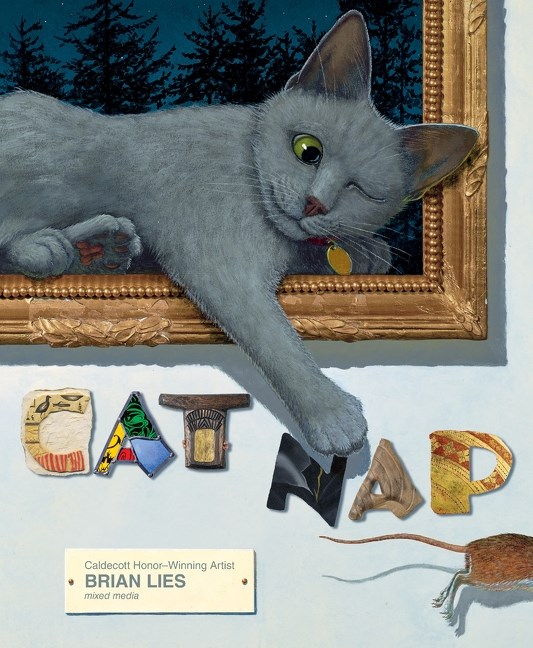
Chasing after the mouse who interrupted his nap, a beautiful cat follows his murine quarry into a poster on the wall and finds himself careening through the artwork of many different cultures and eras in this delightful picture book from author/illustrator Brian Lies. From an ancient Egyptian tomb panel to a medieval French illuminated prayer book, an early 19th-century oil portrait to a Georgia O'Keefe painting, the cat tears through ten magnificent works of art, before finding himself at home again. The book closes with a two-page description of the way the mixed media illustrations were created, and a description of each piece of art profiled in the story...
Published last year (2025), Cat Nap is the fourth picture book I have read from Brian Lies, and is an absolute masterpiece—a joy to read and peruse, from start to finish! I loved pretty much everything about it, from the overarching story idea to the charming feline hero, the world of artwork highlighted to the original illustrations used to depict it. Apparently the story was inspired by Lies' own cat Dylan, a Russian Blue-Siamese mix whose picture appears on the rear dust-jacket flap and in the section on the creation of the illustrations. All of the artwork depicted in the story is in the collection of the Metropolitan Museum of Art, and many of the individual pieces were familiar to me, especially William, the little blue faience hippo statue from ancient Egypt, who is now the Met's mascot. As it happens, I have a plush version of William on one of my shelves right now, within eyesight as I pen this review. I also greatly appreciated the section on how the illustrations were created, and admired Lies' position that while it would have been easier to create the visuals digitally, by inserting the cat into images of each artwork, it was more fun (and much more creative) to reproduce his own versions of the artwork by hand, and then add his feline figure in his own way. This required him to create his own paintings, illuminated manuscripts, sculptures and stained glass—sometimes learning the best method as he went along! If I had any critique at all to make, it would have been that I somehow expected and hoped that the saint the cat met would have been St. Francis, given his status as the patron saint of animals, but leaving that aside (and it is a small matter, a quibble really), I don't have a single fault to find with this book—a truly rare occurrence! Highly recommended to young art lovers, cat devotees, and to anyone who enjoys truly creative and beautiful picture books.
man seemed to have gotten bored w regular illustration and was like, I need a challenge. this book has the kitten character jump between different pieces of art that exist at the met museum and he not only imitates the styles but actually made and then photographed every art piece featured. he made (multiple) sculptures, he constructed masks, he carved animals, he painted, he made god damn stained glass even, what the hell. it was all beautiful and impressive and the story is also very, very cute. this is very clever and masterfully skilled. loved it!
⭐️⭐️⭐️⭐️⭐️ / 5 stars : Review from Myself and My 10 Year Old Daughter
If there’s a cat on the cover or the story centers a cat, we are picking it up for bedtime, immediately. 🐱✨
Things I loved: - The artwork is beautiful
- This is the first children’s book I’ve read where physical art was incorporated directly into the pages. It is very unique and cool. Including: sculptures and real pieces woven into the storytelling.
- There’s historical art featured throughout as the cat basically time travels through portraits trying to catch a mouse. Watching the cat move through different eras and artistic styles made it feel layered and educational.
- It turns a simple cat-and-mouse chase into something artistic and immersive.
Absolutely gorgeous! And then you get to the end of the book and read about how the art work for the book was created! Wow! It’s also a fun story about a cat who disappears somewhere inside the house for hours, only to reappear in time for dinner. Every cat lover has been there.
This was a marvelous book! From the book jacket “ when the quick footed mouse seems to slip into a picture on the wall, the captivated kitten has to follow, through time and history and nine masterpieces of art from around the world in this astonishing celebration of creativity and curiosity.” The author and illustrator Brian Lies actually created the masterpieces that he replicated from the Metropolitan Museum of aArt, and all of the illustrations of the cat chasing the mouse through the artworks are made by him. Some are sculptures. Some are stained glass, paintings, ink drawings. They are fabulous.
Phenomenal children’s book!!! It walks through some fun art movements and introduces some fun philosophical content. I cried reading it to Lochlan when St Anthony (most notably the patron saint of the lost) helps the lost and scared kitten.
This captivating picture book is about a cat that gets lost while chasing a mouse (or mice). The story takes the reader through history and into 10 art masterpieces. The highlight for me, the adult reader, is at the back of the book, "Making the Art of Cat Nap," where the author explains his process in creating each page and recreating the famous art pieces for the book. I appreciated the story's journey far greater after understanding the meticulous details that went into its creation.
Wow! Such an amazingly illustrated book. I hope this wins many awards. Brian Lies is extremely talented, so much hard work went into making Cat Nap. My adult son read this too and said it was very cool how Kitten jumped into different artworks.
5 for story and illustrations. A cat wakes up from a nap and sees a mouse. The cat chases after the mouse and jumps into multiple paintings/pieces of art along the way. The cat gets a little lost but finally makes it back home and out of the art/into its original world. Introduces children to mixed media art and different art styles/time periods worldwide through a simple story about a cat chasing a mouse.
1-3 sentences per page. Could be used for storytime for mixed family, preschoolers, or older kids (I think it’s cool to introduce children to mixed media and telling them that some dude created ALL THAT ART BY HAND)!
This book’s art is AMAZING. IT’S WILD. SOMEONE GIVE THIS GUY AN AWARD. The back matter states “The illustrations in this book were all created by the artist in his home studio in Massachusetts, and the skills he used included carving hieroglyphics in plaster, gilding a fourteenth-century icon, illuminating a manuscript on goatskin parchment, carving wood, and more.” There are pictures of the artist making the art scene in the book (gold leaf painting, clay sculptures, hot iron/solder for stained glass, carving plaster) and he also provides a list of information about the real pieces of art he made copies of in the book and their corresponding images. I adore his message to children encouraging them to practice if they like making things, and that they should do things they enjoy because they’re fun/satisfying. He encourages children with the idea of “If people before us could do it, why not me? Why not you?” Fostering kids’ creativity and willingness to try new things and to create in this age of AI is important!
I appreciate that the artist used works from different time periods, different cultures, and different media styles. It’s quite diverse – Egypt (limestone, paint, carvings), French (ink, paint, parchment), Mexico (ceramic vessel), Maryland (by an African American folk art painter, oil painting), Ivory Coast (mask, carved wood with paint), Germany (glass, lead, silver stain, stained glass panel), Japan (ink on paper), New Mexico (oil on canvas), Italy (tempera paint on wood panel, gold leaf), and another from Egypt (ceramic).
Only looking at the illustrations, you can understand the entire story.
The cover and back cover show an image of the cat in an art frame trying to catch a mouse. The title is written in a creative way, with the different art styles shown in the style of each letter. Under the dust jacket of the book, the illustration is a packed crate, similar to one you would see when transporting art goods. The end papers are a solid color. Paper quality is glossy and good quality. Illustrations merge with the gutter smoothly.
Color: The illustrator’s use of color fits the words and the time period/culture readers are transported into per page. There are cultural associations with the colors used – the color palette fits the specific art style (for example, for the Japanese painting, the illustration only uses black ink on Japanese paper (washi). The colors used throughout the book are predominantly warm or neutral (black, brown, gray, white, tan). The color reproduction is high.
Line: There are both straight lines and curved lines, with a mix of line thickness based on the art style he is recreating.
Shape: Shapes are used according to the art style he’s recreating and further bolster his art and the readers’ connection to the time period and the underlying story.
Texture: Texture really comes out in this work. The illustrator uses shadows/color/lines to create the perception that the art is coming to life. The linework also indicates motion/direction. The detail used for the different art pieces shine – I feel like I can touch them, and part of that comes from the shadow/lighting, the realistic background, the use of space, the placement of illustrations, and what is positioned at the forefront/center of the spreads.
Dominance: The cat and the mouse dominate the illustrations, but the different pieces of art also dominate the scene depending on the page. When considering size, the biggest things in the frame tend to be the art piece and the cat, and the focal point of illustrations is the interaction of the cat with the art piece.
Text: The text is integrated into and around the illustrations – appearing within the hieroglyph art piece, outside, and between the images. The typeface is san seriff and is modern but simple.
Composition: White space is used cleverly – there is white space in between the cat jumping art pieces/frames. The illustrations work seamlessly with the page turns of the book – oftentimes the cat is about to jump out of the frame/page and into the next frame/page.
Overall: A masterpiece that blows my mind.
This entire review has been hidden because of spoilers.
Kitten takes readers on a fun adventure with easy prose and jaw-dropping artwork. If you have ever doubted the work and love that goes into creating a picture book, wait until you see the images in Cat Nap! Author and artist Brian Lies painstakingly recreated ancient artifacts to have real pieces to create the path for Kitten and mouse. So, start your read of Cat Nap by skipping to the article at the end, Making the Art for Cat Nap. Readers get a fantastic explanation of the creation of the incredible artwork that Kitten jumps through on his journey while chasing the mouse—and an adamant statement about the fun and satisfaction of creating the art yourself rather than letting AI do the work.
Kitten is happily napping when a mouse runs across the sofa and into a framed poster from the metropolitan museum of art; the chase is on! They travel into various pieces until they are eventually separated and the kitten returns home. So cool that the artist recreated the art selections (annotated in the back matter) placing Kitten and the mouse within. Love how Lies explained the different mediums he used, saying it would be too easy to use AI, but the bit would be a computer creating the image, not himself.
This picture book is delightful. The cat travels through the museum morphing into the scene of every famous painting and historical art piece that he encounters. Then he safely returns home - always the best end to any story. Highly recommended to anyone who has time to linger over the pages and notice the styles and details.
A VERY cool book with a cat that travels through several different art styles. I was super impressed that the illustrator took photos of different art techniques. Highly recommend as a read aloud for art teachers.
Follow curious kitten as he slips into a picture on the wall. Chasing a mouse. kitten travels through time and 9 masterpieces found at the MET. The author's note about making the art is fascinating and inspiring. Absolutely spectacular! Deserves a Caldecott.
One of the coolest picture books ever! This mixed-media masterpiece is a celebration of art through the ages and a testament of human ingenuity. It's a simple story about a cat chasing a mouse, but the twist is that this chase occurs while they're hopping between artworks in the Metropolitan Museum of Art. And the coolest part of it all is that Brian Lies recreated all of the artworks featured in this book himself, by hand. Give this man a Caldecott award!
A kitten, called Kitten, realizes there's a mouse and chases it through a variety of time periods and paint styles until it realizes it's lost! It starts trying to get back, stopping at Ancient Egypt where the men thank him for getting rid of the rats that had been in the painting before(!) and then is able to get back home in time for supper and a nap! Fun, lots of humorous touches but not something I think many kids will pick up.
A fun story with a sprinkle of art history mixed in...I appreciated the story even more after reading the author's note about all the work he put into creating this tale. A must read for sure!
This book should win a Caldecott. Cat and mouse play a game of chase throughout famous paintings at a Met exhibit. Art is exquisite and none is done digitally. It’s all created by the illustrator using different art media such as oil, paints, glass, colored pencil, wood, and clay. Would be great to use with an art history class.