

What do you think?

Beyond the Veil: The Victorian Obsession With Death and Mourning
Beyond the Veil is a visual tour through the curious history of how we deal with death—the grief and mourning, the funerals, symbols, and ceremonies.
From Victorian England across to the US, learn about the often peculiar and at times macabre ways of how the living memorialize the dead.
Humans have always had ways of marking death, but in Victorian England death became a morbid obsession that went global—death was as much ‘celebrated’ as it was a source of fear and sadness. Queen Victoria herself became a figurehead of grief after the death of her beloved Prince Albert in 1861. Her ensuing fascination with death took many visual forms—from her ritualized embrace of black clothing to the building of ostentatious monuments—and massively influenced cultural norms in both the UK and further afield.
The Victorians built complex cemeteries, collected precious memento mori, commissioned bizarre death portraits, and obsessed over the correct mourning attire and funerary protocol, while turn-of-the century America saw reflections of many of these cultural phenomena. The bestsellers of the period were often about life and death (think Frankenstein and Dracula), while the art, architecture, and style—with its often dark and heavy gothic overtones—revelled in the glamorization of death. Beyond the Veil brings this extraordinarily elaborate and stylised visual culture together while expertly explaining and elaborating on its most peculiar and fascinating aspects.
For example, it The influence of Queen Victoria’s personal mourning on fashion and social custom.The rise of Victorian cemeteries and funerary architecture. The art of memento mori and post-mortem photography. The emergence of spiritualism, seances and afterlife communication. The fascination with gothic literature, symbolism and the romanticization of death.
Beautifully illustrated throughout with archival photography, artworks and design,Beyond the Veil is a must-have for lovers of history, art, and the macabre. It invites readers to step into the shadows of the past and discover how Victorian mourning shaped our modern relationship with grief and remembrance.
From Victorian England across to the US, learn about the often peculiar and at times macabre ways of how the living memorialize the dead.
Humans have always had ways of marking death, but in Victorian England death became a morbid obsession that went global—death was as much ‘celebrated’ as it was a source of fear and sadness. Queen Victoria herself became a figurehead of grief after the death of her beloved Prince Albert in 1861. Her ensuing fascination with death took many visual forms—from her ritualized embrace of black clothing to the building of ostentatious monuments—and massively influenced cultural norms in both the UK and further afield.
The Victorians built complex cemeteries, collected precious memento mori, commissioned bizarre death portraits, and obsessed over the correct mourning attire and funerary protocol, while turn-of-the century America saw reflections of many of these cultural phenomena. The bestsellers of the period were often about life and death (think Frankenstein and Dracula), while the art, architecture, and style—with its often dark and heavy gothic overtones—revelled in the glamorization of death. Beyond the Veil brings this extraordinarily elaborate and stylised visual culture together while expertly explaining and elaborating on its most peculiar and fascinating aspects.
For example, it The influence of Queen Victoria’s personal mourning on fashion and social custom.The rise of Victorian cemeteries and funerary architecture. The art of memento mori and post-mortem photography. The emergence of spiritualism, seances and afterlife communication. The fascination with gothic literature, symbolism and the romanticization of death.
Beautifully illustrated throughout with archival photography, artworks and design,Beyond the Veil is a must-have for lovers of history, art, and the macabre. It invites readers to step into the shadows of the past and discover how Victorian mourning shaped our modern relationship with grief and remembrance.
- GenresNonfictionHistoryDeath
208 pages, Hardcover
Published September 16, 2025
About the author
Paul Gambino
23 books31 followersPaul’s first book, SCRAP CITY: SCRAPBOOKING FOR SUBURBAN DIVAS AND SMALL TOWN REBELS (SOHO Publishing, 2006), was a semi-finalist for the Independent Publisher Book award in the Hobby/Crafts category and was touted as giving the craft of scrapbooking a youthful, cutting-edge makeover.
Paul has been an avid collector of the bizarre for over 20-years with an extensive collection of Victorian memorial photographs, antique funeria, mug shots and vintage religious items (including a life sized St. Sebastian and Virgin Mary salvaged from a 19th century church in Pennsylvania). The past two decades of serious collecting has allowed Paul to gain the trust of some of the world’s largest macabre collectors. These relationships have allowed Paul to have his second book published, MORBID CURIOSITIES: COLLECTIONS OF THE UNCOMMON AND THE BIZARRE. Amazon sums the book up like this; Morbid Curiosities is an insight into the strange world of collectors of the macabre. Centered on 18 collections, with extensive interviews with each collector and specially shot imagery detailing their objects, this is a fascinating showcase of bizarre and intriguing objects.
Included are collections of skulls, mummified body parts, occult objects, and various carnival, sideshow and criminal ephemera. Detailed captions tell the curious stories behind each object, many of which are being shown outside the private world of their collections for the first time.
Included are collections of skulls, mummified body parts, occult objects, and various carnival, side-show and criminal ephemera. Detailed captions tell the curious stories behind each object, many of which are being shown outside the private world of their collections for the first time.
Paul has been an avid collector of the bizarre for over 20-years with an extensive collection of Victorian memorial photographs, antique funeria, mug shots and vintage religious items (including a life sized St. Sebastian and Virgin Mary salvaged from a 19th century church in Pennsylvania). The past two decades of serious collecting has allowed Paul to gain the trust of some of the world’s largest macabre collectors. These relationships have allowed Paul to have his second book published, MORBID CURIOSITIES: COLLECTIONS OF THE UNCOMMON AND THE BIZARRE. Amazon sums the book up like this; Morbid Curiosities is an insight into the strange world of collectors of the macabre. Centered on 18 collections, with extensive interviews with each collector and specially shot imagery detailing their objects, this is a fascinating showcase of bizarre and intriguing objects.
Included are collections of skulls, mummified body parts, occult objects, and various carnival, sideshow and criminal ephemera. Detailed captions tell the curious stories behind each object, many of which are being shown outside the private world of their collections for the first time.
Included are collections of skulls, mummified body parts, occult objects, and various carnival, side-show and criminal ephemera. Detailed captions tell the curious stories behind each object, many of which are being shown outside the private world of their collections for the first time.
Ratings & Reviews
Friends & Following
Create a free account to discover what your friends think of this book!
Community Reviews
Displaying 1 - 14 of 14 reviews

March 3, 2026
Sloppy little thing. A lot of surface-based knowledge, especially if you're like, 1/10th of a goth person. More irksome, there are a lot of errors in this. There's at one point a picture of a skull with a clock in it, but the caption beneath says it's a photo of Victorian hair art. There are huge sections dedicated to something the author later reveals to be just a rumor or myth (like death clocks, yet they have a photo of one?), and other sections where the author hints at something interesting but never follows through (like mentioning the Salvation Army's history with matchsticks and never detailing what that is). I read sections of this to my coworker, and he said it sounds like a Buzzfeed article, which I thought was apt:
"Based on the voluminous amount of gloomy work he produced, Edgar Allan Poe could have grown up in Disneyland and he would still have found it virtually impossible to pen anything but morbid tales and frighteningly depressing poetry." How can you prove that? It's one of those sentences where I re-read it twice and still don't understand what the author is trying to convey.
Overall, ya know, I like funeral history, so I was entertained by the photos and some stray facts I didn't know, but this is definitely one of those books you see at the front of Barnes and Noble that looks pretty but is pretty slapdash inside.
"Based on the voluminous amount of gloomy work he produced, Edgar Allan Poe could have grown up in Disneyland and he would still have found it virtually impossible to pen anything but morbid tales and frighteningly depressing poetry." How can you prove that? It's one of those sentences where I re-read it twice and still don't understand what the author is trying to convey.
Overall, ya know, I like funeral history, so I was entertained by the photos and some stray facts I didn't know, but this is definitely one of those books you see at the front of Barnes and Noble that looks pretty but is pretty slapdash inside.

November 15, 2025
As a Victorian Era afficionado, I was drawn to the title and the cover, but reading this book I am astouned by the lack of depth and mostly lack of sources. I guess I expected a deep dive rather than a listing of generalities and confirmation of what is already known? The beautiful pictures make up for some of this though.

November 25, 2025
332
Rating: 4* of five
The Publisher Says: Beyond the Veil is a visual exploration of Victorian mourning, charting the often peculiar and at times macabre ways of how the living memorialize the dead.
Beyond the Veil is a visual tour through the curious history of how we deal with death—the grief and mourning, the funerals, symbols, and ceremonies.
From Victorian England across to the US, learn about the often peculiar and at times macabre ways of how the living memorialize the dead.
Humans have always had ways of marking death, but in Victorian England death became a morbid obsession that went global—death was as much ‘celebrated’ as it was a source of fear and sadness. Queen Victoria herself became a figurehead of grief after the death of her beloved Prince Albert in 1861. Her ensuing fascination with death took many visual forms—from her ritualized embrace of black clothing to the building of ostentatious monuments—and massively influenced cultural norms in both the UK and further afield.
The Victorians built complex cemeteries, collected precious memento mori, commissioned bizarre death portraits, and obsessed over the correct mourning attire and funerary protocol, while turn-of-the century America saw reflections of many of these cultural phenomena. The bestsellers of the period were often about life and death (think Frankenstein and Dracula), while the art, architecture, and style—with its often dark and heavy gothic overtones—revelled in the glamorization of death. Beyond the Veil brings this extraordinarily elaborate and stylised visual culture together while expertly explaining and elaborating on its most peculiar and fascinating aspects.
For example, it explores:
The influence of Queen Victoria’s personal mourning on fashion and social custom.
The rise of Victorian cemeteries and funerary architecture.
The art of memento mori and post-mortem photography.
The emergence of spiritualism, seances and afterlife communication.
The fascination with gothic literature, symbolism and the romanticization of death.
Beautifully illustrated throughout with archival photography, artworks and design,Beyond the Veil is a must-have for lovers of history, art, and the macabre. It invites readers to step into the shadows of the past and discover how Victorian mourning shaped our modern relationship with grief and remembrance.
I RECEIVED A DRC FROM THE PUBLISHER VIA EDELWEISS+. THANK YOU.
My Review: Lovely, design-heavy gift book, perfect for your history-minded or Victorian-obsessed giftee's coffee table. It's nicely written, easy to read, but...crucially for a book on this subject that depends on the quality of its sources...has no notes or bibliography worth spending time on. I certainly don't expect academic-standard citations, but more than the absolute minimum should've been attainable.
My longstanding dislike of Queen Victoria...won't someone, anyone, write an alternate history where Princess Charlotte lives through bearing Leopold's son?...hit glowing hot hatred as I read about how her abused-child narcissism totally screwed the entire world while she pouted and shouted about her playtoy...sorry, husband...being taken from her before she was tired of him.
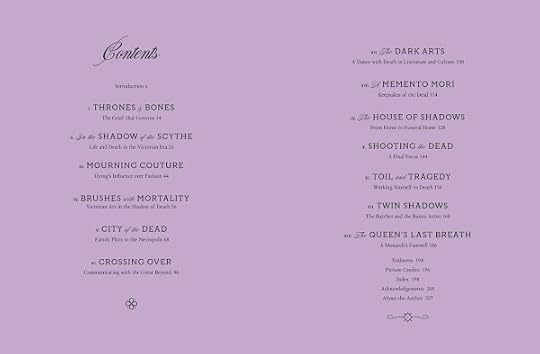
contents page spread
English society, and the broader colonial sphere in Scotland and Ireland, out into the wider Anglophone world, began to follow some truly weird death and mourning customs:
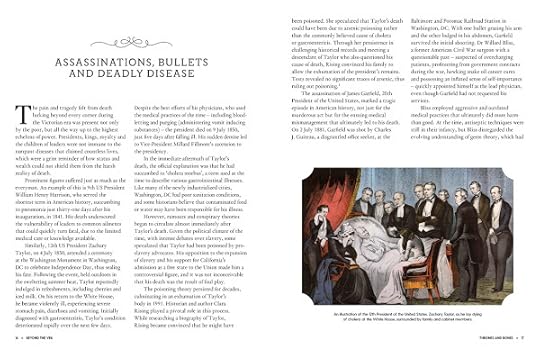
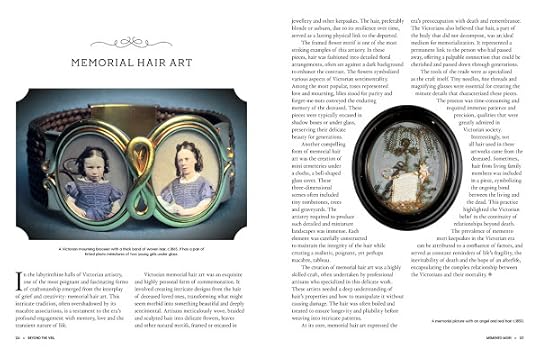
sample of essay; interior spread about hair art
...because in the time before effective antibiotics, sanitation, and city planning, there was wide scope for mourning the loss of literally anyone close to you from some unexpected cause.
This chapter spread says it all:
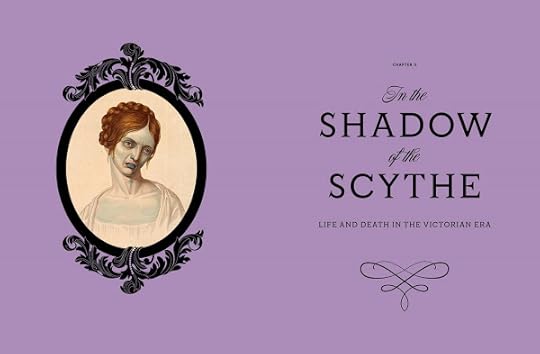
Shadow of the Scythe indeed!
As an illustrated overview of a subject that can easily consume academic careers, this is a successful book. As a beautiful gift object, it also succeeds. As a jumping-off point for looking into the truly obsessive, dysfunctional Victorian worldview, it does a fine job.
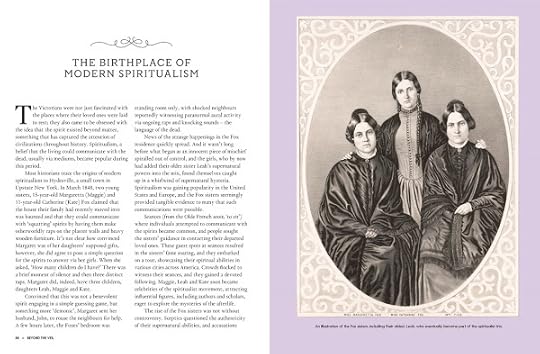
spiritualism rose to prominence in this atmosphere
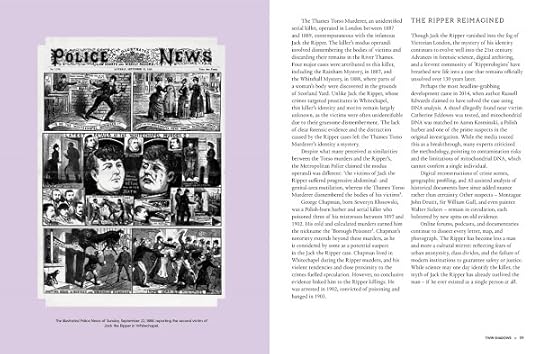
sensationalism about murder did, too
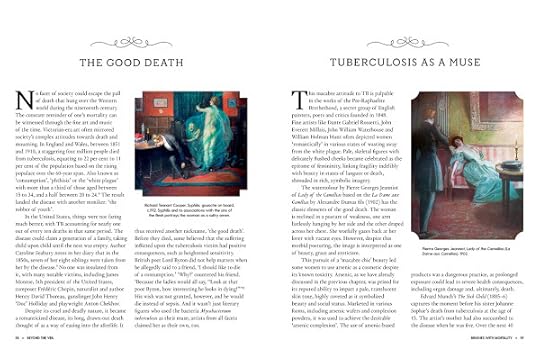
some trivia fragments
Altogether a book I'd think your serious-minded luxury-item-worthy giftee will like.
Rating: 4* of five
The Publisher Says: Beyond the Veil is a visual exploration of Victorian mourning, charting the often peculiar and at times macabre ways of how the living memorialize the dead.
Beyond the Veil is a visual tour through the curious history of how we deal with death—the grief and mourning, the funerals, symbols, and ceremonies.
From Victorian England across to the US, learn about the often peculiar and at times macabre ways of how the living memorialize the dead.
Humans have always had ways of marking death, but in Victorian England death became a morbid obsession that went global—death was as much ‘celebrated’ as it was a source of fear and sadness. Queen Victoria herself became a figurehead of grief after the death of her beloved Prince Albert in 1861. Her ensuing fascination with death took many visual forms—from her ritualized embrace of black clothing to the building of ostentatious monuments—and massively influenced cultural norms in both the UK and further afield.
The Victorians built complex cemeteries, collected precious memento mori, commissioned bizarre death portraits, and obsessed over the correct mourning attire and funerary protocol, while turn-of-the century America saw reflections of many of these cultural phenomena. The bestsellers of the period were often about life and death (think Frankenstein and Dracula), while the art, architecture, and style—with its often dark and heavy gothic overtones—revelled in the glamorization of death. Beyond the Veil brings this extraordinarily elaborate and stylised visual culture together while expertly explaining and elaborating on its most peculiar and fascinating aspects.
For example, it explores:
The influence of Queen Victoria’s personal mourning on fashion and social custom.
The rise of Victorian cemeteries and funerary architecture.
The art of memento mori and post-mortem photography.
The emergence of spiritualism, seances and afterlife communication.
The fascination with gothic literature, symbolism and the romanticization of death.
Beautifully illustrated throughout with archival photography, artworks and design,Beyond the Veil is a must-have for lovers of history, art, and the macabre. It invites readers to step into the shadows of the past and discover how Victorian mourning shaped our modern relationship with grief and remembrance.
I RECEIVED A DRC FROM THE PUBLISHER VIA EDELWEISS+. THANK YOU.
My Review: Lovely, design-heavy gift book, perfect for your history-minded or Victorian-obsessed giftee's coffee table. It's nicely written, easy to read, but...crucially for a book on this subject that depends on the quality of its sources...has no notes or bibliography worth spending time on. I certainly don't expect academic-standard citations, but more than the absolute minimum should've been attainable.
My longstanding dislike of Queen Victoria...won't someone, anyone, write an alternate history where Princess Charlotte lives through bearing Leopold's son?...hit glowing hot hatred as I read about how her abused-child narcissism totally screwed the entire world while she pouted and shouted about her playtoy...sorry, husband...being taken from her before she was tired of him.
contents page spread
English society, and the broader colonial sphere in Scotland and Ireland, out into the wider Anglophone world, began to follow some truly weird death and mourning customs:
sample of essay; interior spread about hair art
...because in the time before effective antibiotics, sanitation, and city planning, there was wide scope for mourning the loss of literally anyone close to you from some unexpected cause.
This chapter spread says it all:
Shadow of the Scythe indeed!
As an illustrated overview of a subject that can easily consume academic careers, this is a successful book. As a beautiful gift object, it also succeeds. As a jumping-off point for looking into the truly obsessive, dysfunctional Victorian worldview, it does a fine job.
spiritualism rose to prominence in this atmosphere
sensationalism about murder did, too
some trivia fragments
Altogether a book I'd think your serious-minded luxury-item-worthy giftee will like.

February 9, 2026
So as come who works in a Victorian era museum, a lot of this information was not new but it was presented so well. The book is beautiful and it has fantastic visuals. And with all books I was still able to learn something new like the etymology of "living room." I will say the end of the book is about famous serial killers of the era, so if you are triggered by gorey photos maybe skip that part as they show the crime scene photos of Jack the Ripper.

May 13, 2026
Thank you to Frances Lincoln and Edelweiss for the advance review copy. As always all opinions shared here are 100% my own.
As everyone knows by now, I am obsessed with the Victorian era. It's a fascinating period of history that combined traditionalism with scientific exploration and presented us with a unique aesthetic that we crave to this day. One of the first things that introduced me to the era was their seeming obsession with death and the strange traditions, and even industries, that spun up out of that.
"Beyond the Veil" by Paul Gambino takes a magnifying glass that introduces the reader to everything related to death and mourning in the Victorian era. Everything from causes of death (such as the various illnesses) and how they influenced people death, to mourning and memento mori and finally ends (fittingly) with the death of Queen Victoria.
While a lot of the information I had already known due to my own research, the book presented it an excellent format and shared many photos and specific cases I hadn't heard of before. The writing itself is very approachable and accessible, so if you're brand new to the subject, you won't have any problems keeping up. I think it's a great introduction to the subject before the reader digs into more in-depth sources.
All in all, I enjoyed it. But I must also warn that it's not for the faint of hearts as it does feature (obviously) morbid subjects and photos.
You can also find me on: Instagram (MoonlightCocoa) and Instagram (MoonlightCupOfStories)
As everyone knows by now, I am obsessed with the Victorian era. It's a fascinating period of history that combined traditionalism with scientific exploration and presented us with a unique aesthetic that we crave to this day. One of the first things that introduced me to the era was their seeming obsession with death and the strange traditions, and even industries, that spun up out of that.
"Beyond the Veil" by Paul Gambino takes a magnifying glass that introduces the reader to everything related to death and mourning in the Victorian era. Everything from causes of death (such as the various illnesses) and how they influenced people death, to mourning and memento mori and finally ends (fittingly) with the death of Queen Victoria.
While a lot of the information I had already known due to my own research, the book presented it an excellent format and shared many photos and specific cases I hadn't heard of before. The writing itself is very approachable and accessible, so if you're brand new to the subject, you won't have any problems keeping up. I think it's a great introduction to the subject before the reader digs into more in-depth sources.
All in all, I enjoyed it. But I must also warn that it's not for the faint of hearts as it does feature (obviously) morbid subjects and photos.
You can also find me on: Instagram (MoonlightCocoa) and Instagram (MoonlightCupOfStories)

October 3, 2026
Some interesting stuff in here, but distinctly lacking sources or any in-depth explanations. Many of the chapters repeat information previously given as if it's the first time - it almost feels like each chapter were written separately and shoved sloppily together into a book. There are also errors in abundance, with photos that have the wrong captions, incomplete sentences and paragraphs that seem to have editing notes remaining in them? Take this one about post-mortem photography: "A standard method involved using special stands or braces concealed behind furniture or drapery, which held the body upright and in a pose that conveyed a sense of normalcy. Not true, the previous scenarios are inaccurate." It then goes on to repeat the same information it supposedly just noted was inaccurate, but in slightly more detail. Very confusing.

March 2, 2026
Thanks, Goodreads,for the DNF shelf. Now I need to be able to award 0 stars.
Garbled syntax, sentence fragments, inaccurate information, unfathomable structuring, incorrect grammar, redundancies, and content that you could find in an average high school kid's research paper and with much better notes on sources. Reuse of phrases -- the boundaries of human experience, for one. And I didn't learn anything here I didn't already know. I didn't expect an academic treatise, but I did hope for maybe some insights on what is a fascinating topic.
Author, fire your editor. Find someone who knows how to build a book, write a paragraph, and proofread.
I swear I thought this was AI. It isn't.
Garbled syntax, sentence fragments, inaccurate information, unfathomable structuring, incorrect grammar, redundancies, and content that you could find in an average high school kid's research paper and with much better notes on sources. Reuse of phrases -- the boundaries of human experience, for one. And I didn't learn anything here I didn't already know. I didn't expect an academic treatise, but I did hope for maybe some insights on what is a fascinating topic.
Author, fire your editor. Find someone who knows how to build a book, write a paragraph, and proofread.
I swear I thought this was AI. It isn't.
September 20, 2026
I beautifully illustrated and interstingoverview of how, in Victorian Englsnd, death was very mcuh a part of life, with mourning rituals becoming increasingly codified. As well as looking at things such as mourning jewellery, fashion, cemeteries and ritual, Gambino also looks at death as reflected in art and literature and the romanticisation of death. A must read for anyoe interest in Victrian society and culture or mourning rituals.
June 2, 2026
an excellent, informational, fascinating read
Like reading a wonderful documentary, this held my interest and was delightfully informational. Despite the macabre themes, the authors tone keeps things fresh and the story has excellent flow. A walk through another time!
Like reading a wonderful documentary, this held my interest and was delightfully informational. Despite the macabre themes, the authors tone keeps things fresh and the story has excellent flow. A walk through another time!

September 20, 2026
A cutely packaged little book that contains the most genuinely horrific editing I have ever encountered. Hugely distracting from the content, which did contain interesting tidbits among the rambling run-on sentences and repetition

February 12, 2026
Any book on the Victorian era dealing with death is automatically a read for me. Especially if it includes postmortem photography.
May 20, 2026
While I find this subject interesting I think think Paul Gambino could have gone more in depth with this subject.

July 12, 2026
Very interesting really enjoyed it !
Needed a stronger editor - lots of grammatical mistakes
Needed a stronger editor - lots of grammatical mistakes

September 23, 2026
This was the most interesting book I’ve read in YEARS and it sent me down different rabbit holes over and over, from reading poetry to looking at postmortem photos for sale on eBay. I’m buying it.
Displaying 1 - 14 of 14 reviews