Jump to ratings and reviews
Rate this book

Детство: биография места

Rate this book
Мир американского Юга, который описывает в своей автобиографии Крюз, суров и брутален: обыденный расизм, бессмысленное насилие, гротескные и лишённые какой-либо логики поступки и планы на жизнь. Однако сладкая, несентиментальная грусть смягчает повествование — великодушное и всепрощающее сознание автора отказывается обрушиваться сурово на изменчивые фигуры, составлявшие его прошлое. Каждый персонаж Крюза тянет свою горестную ношу, и главный герой стоически принимает ту, что досталась ему. Критики относят эту книгу к канону южной готики, ставя в один ряд с Уильямом Фолкнером и Фланнери О'Коннор, а журнал The New Yorker назвал мемуары Крюза одной из лучших автобиографий, когда-либо написанных американцем.

232 pages, Hardcover

First published January 1, 1978

181 people are currently reading
6243 people want to read

About the author

Harry Crews

68 books644 followers
Harry Eugene Crews was born during the Great Depression to sharecroppers in Bacon County, Georgia. His father died when he was an infant and his mother quickly remarried. His mother later moved her sons to Jacksonville, Florida. Crews is twice divorced and is the father of two sons. His eldest son drowned in 1964.

Crews served in the Korean War and, following the war, enrolled at the University of Florida under the G.I. Bill. After two years of school, Crews set out on an extended road trip. He returned to the University of Florida in 1958. Later, after graduating from the master's program, Crews was denied entrance to the graduate program for Creative Writing. He moved to Ft. Lauderdale, Florida, where he taught English at Broward Community College. In 1968, Crews' first novel, The Gospel Singer, was published. Crews returned to the University of Florida as an English faculty member.

In spring of 1997, Crews retired from UF to devote himself fully to writing. Crews published continuously since his first novel, on average of one novel per year. He died in 2012, at the age of 78.

Ratings & Reviews

What do you think?
Rate this book

Friends & Following

Create a free account to discover what your friends think of this book!

Community Reviews

5 stars
1,518 (51%)
4 stars
1,022 (34%)
3 stars
343 (11%)
2 stars
62 (2%)
1 star
17 (<1%)
Displaying 1 - 30 of 350 reviews
Profile Image for Guille.
1,004 reviews3,272 followers
December 5, 2021

Harry Crews representa aquí los papelEs de Twain y Huckleberry Finn al tiempo, de una forma más cruda, sí, pero con el mismo amor por personajes casi siempre olvidados y que raramente son llevados al territorio de la novela.
“El mundo en que se movía la gente de la que procedo tenía tan poco margen de error, tan poco margen para la mala suerte, que cuando algo iba mal casi siempre acababa ocurriendo algo que lo empeoraba aún más. Se trataba de un mundo en el que la supervivencia dependía del valor, de un coraje crudo nacido de la desesperación y mantenido por la ausencia de alternativas”.
Es un un mundo germen de mil historias contadas en corrillos de hombres o mujeres al caer la tarde; donde una mujer embarazada a la que le acaban de matar al marido se niega a delatar al culpable porque sabe que “cuando llegue el momento arreglará las cosas”. Un mundo donde la familia es el centro de la existencia y en esa familia entran mulas, cabras, perros, animales que ni por lo más remoto entrarán en casa pero que, al igual que a la mujer o a los hijos, si se les pega será por amor y no solo por necesidad. Un mundo mojado en whisky y en sudor, tan desesperado en ocasiones que solo permanece la esperanza de la brujería, las supersticiones y el fanatismo religioso; un mundo donde nunca se habla del señor Jones, sino del negro Jones; el mundo de la gran depresión en el que tu mejor amigo puede robarte la poca carne que te queda para pasar el invierno porque no puede soportar ver llorar de hambre a sus propios hijos; un mundo no exento de humor, a pesar de todo.
Crews nos teje aquí una mezcla, nunca del todo fiable, de historias que le relataron, de leyendas que oyó, de recuerdos que guarda de aquel niño de entre cinco y seis años que fue, para relatarnos un trocito de su vida en el que sufrió una atrofia muscular, soportó terribles quemaduras al caer en un barreño de agua hirviendo, conoció el sexo, fue ladrón y busca vidas, creó cientos de historias sobre los modelos retratados en un catálogo Sears, mantuvo largas conversaciones con su inseparable perro, encontró a su padre muerto en la cama y, a pesar de todo, no perdió en ningún momento la inocencia de un niño de esa edad, que quizás no es la misma en todas las partes del mundo ni en todas las situaciones.

Este es el tercer libro que leo del autor, y los personajes e historias que encontré en los anteriores tienen sus raíces aquí, en esa infancia de la que Rilke afirmó que es nuestra verdadera patria.
Profile Image for Howard.
440 reviews381 followers
December 21, 2022
UPDATE: December 21, 2022
Here is a link to a wonderful retrospective look at Crews' book by Dwight Garner in his "American Beauties" column in the New York Times:

https://www.nytimes.com/2017/06/29/bo...

I especially agree with his conclusion:

His novels, which are mostly out of print, aren’t for everyone, despite my abiding fondness for several of them.

This memoir is for everyone. It’s agile, honest and built as if to last. Like its author, it’s a resilient American original.


-------------------------------------------

When Harry Crews died in 2012, Elaine Woo in the Los Angeles Times wrote, “[t]he word ‘original’ only begins to describe Crews, whose 17 novels place him squarely in the Southern gothic tradition, also known as Grit Lit. He emerged from a grisly childhood in Georgia with a darkly comic vision that made him literary kin to William Faulkner, Flannery O’Connor and Hunter S. Thompson, although he never achieved their broad recognition.”

In 1968, he began a long tenure on the University of Florida faculty. Woo writes, “[d]uring his three decades there, he swore, drank and generally fractured the academic mold. With piercing blue eyes set deep in his craggy face, a limp caused by one or another violent encounter, a wardrobe that ran to sleeveless T-shirts and denims, and an assortment of tattoos (including one of a skull with a line from ee cummings, ‘how do you like your blue-eyed boy/Mister Death’), he looked like the type of person one would cross the street to avoid meeting.”

I have read most of his novels and though I have to admit that they are not among my favorites, I will always have vivid memories of each of them, for they are impossible to forget. How could I forget a story about a man who sets out to eat an entire car, a Ford Maverick, piece-by-piece (Car, 1972), or a man who makes a living by knocking himself out (The Knockout Artist, 1988)?

His books never made the best-seller lists and that was because, as one critic wrote, “in part because they bewildered some readers and repelled others.” But he did develop a cult following, a huge one.

His novels are a bit too bizarre for my reading tastes, but I am a huge fan of his memoir. A Childhood: The Biography of a Place, primarily a straight forward account of the first six years of his life, is just as memorable as his novels, and will always be one of my favorites. I say primarily for there is one event in his life that he describes that is characterized by supernatural elements.

The son of agricultural sharecroppers, Crews grew up in extreme poverty in south Georgia during the '30s and '40s. In 1937, when he was a small boy, his father died as the result of a heart attack. Crews description of what happened the night after his father was buried is one of the most devastating descriptions of grinding poverty that I have ever read:

The night after the day daddy was buried, somebody went in the smokehouse and stole all the meat that had been cured and hung there before he died....

Mama knows who got the meat, not because she has any hard proof, but because in her heart she knows, and I know too, but the one who got it is himself lying in the same graveyard daddy's in and I see no reason to name him.

He was one of my daddy's friends. I do not say he was supposedly or apparently a friend. He was a friend, and a close one, but he stole the meat anyway. Not many people may be able to understand that or sympathize with it, but I think I do. It was a hard time in that land, and a lot of men did things for which they were ashamed and suffered for the rest of their lives. But they did them because of hunger and sickness and because they could not bear the sorry spectacle of their children dying from lack of a doctor and their wives growing old before they were thirty."


Harry Crews life proved at least one thing: It is possible to overcome what appear to be the insurmountable odds of one’s childhood. However, it should be added, that only a few people – a mighty few – could have surmounted the odds he faced. But not only did he have to survive a harrowing childhood, he also had to survive an adulthood that would have finished off anyone who was not blessed with his iron will and intestinal fortitude.
Profile Image for Zoeytron.
1,036 reviews897 followers
November 24, 2019
Bacon County, Georgia.  The Great Depression is in full swing.  Weekly baths are taken in a large galvanized tub with homemade lye soap, with the whole family using the same water.  Slop jars, outhouses, and clothes made from feed sacks.  Where everyone knows a farting mule is a good mule, though prone to bite.  You have to wonder if the term "dirt poor" was coined there.  At any rate, you made do with what you had and nothing went to waste.  The Sears-Roebuck catalog was a wonderment, a wish book with perfect models.  Memoir of author Harry Crews.  It ain't pretty, but it is a mighty fine read.
Profile Image for Diane Barnes.
1,613 reviews446 followers
October 31, 2019
"A man does not back away from doing whatever is necessary, no matter how unpleasant."

That pretty much describes the men AND women in this memoir. Harry Crews was born in 1935 into grinding poverty in southern Georgia. Just having a roof over your head and anything at all to put in your belly was something to be proud of. Crews blessing was that he had family who loved him. And that may be the only reason he survived a crippling disease and a horrible accident back to back, because it certainly wasn't due to what little, uninformed medical care he received. He relates the particulars of these events without any whining or "why me" attitudes, but the horror of what he endured comes through loud and clear.

There is also much understated humor in these pages as well as instructions for things I dearly hope I never need to know, such as how to skin and cook a possum, and how to tell the age of a mule from it's teeth.

"The only thing worse than my nerves was my curiosity, which had always been untempered by pity or compassion, a serious character failing in most societies but a sanity - saving virtue in Georgia when I was a child." This quote precedes a scene where he watches a hired man tortured by a bad tooth pull it out with a pair of pliers, with nothing but freezing water from the well to deaden the pain.

I rate memoirs by two criteria: The quality of the writing, and how effectively it pulls me into the life of the person who lived it. Harry Crews wowed me on both fronts. My library edition also had some wonderful pen and ink drawings by Michael McCurdy, which managed to evoke the emotion of the scene in simple lines.
Profile Image for Ken.
Author 3 books1,238 followers
April 6, 2022
At first I struggled to get into this book, and when that happens you twitch and look up and daydream. Sometimes you close the book on your finger and read the back cover to while away time, like you did cereal boxes when slurping up Trix-are-for-kids as a 10-year-old. When I did that, the back of the book shouted, "The highly acclaimed memoir of one of the most original American storytellers of the rural South."

Well shoot, you think. That explains all. Though you *love* Twain, you tend to break out in hives trying to read Faulkner or Thomas Wolfe or, God help us, Eudora Welty. Your comfort zone is north of the Mason-Dixon, for sure.

But persistence, it can sometimes coax a cat to bathwater, and I was a persistent sort. Though everything was slow and episodic, it was all well-written. At times damn well-written, the kind of description you hit reverse on so as to reread a sentence.

And all these goings-on for a boy whose daddy was a Georgia sharecropper in the Great Depression seemed other-worldly. Tobias Wolff, who wrote the introduction, had it right when he opened with the words "To enter this book is to enter another world."

An educational world, too, where you might learn the ins and outs of slaughtering a pig, and how the names of pig parts change once it goes from living to dead, and no, I don't mean bacon, either.

Patiently, I chugged along, gathering momentum like you always do with a book, even when it's a string of small narrative pearls in the dust like this. For instance, this paragraph describing the taciturn Mr. Willis removing his own painful tooth:

"He had a piece of croker sack about the size of a half dollar in his left hand and a pair of wire pliers in his right. He spat the water out and reached way back in his rotten mouth and put the piece of sack over a tooth. He braced his feet against the well and stuck the pliers in over the sackcloth. He took the pliers in both hands, and immediately a forked vein leaped in his forehead. The vein in his neck popped big as a pencil. He pulled and twisted and pulled and never made a sound."

I won't likely forget those veins for awhile. A rank amateur would have shown pain by having the character scream of clench his eyes or dance about as he fought his own mouth, but not Mr. Crews.

Meaning: Hey Mikey, I liked it. And stopped reading backs of cereal boxes with all their predictable bromides called blurbs, too.
Profile Image for Paul Bryant.
2,409 reviews12.6k followers
January 31, 2023
PARENTAL DISCIPLINE

His parents periodically beat him savagely, whether he had done anything or not, because all our parents said, a beating will loosen a child’s hide and let him grow.

THE SEARS ROEBUCK CATALOG

We are in Georgia and the year is 1941. Harry lives on a poor farm in the middle of nowhere. Harry and his friends love to look at the Sears Roebuck catalogue. They are fascinated by the perfect people in the photos. They have never seen anybody like that in their lives. Everyone they know has teeth missing, a finger missing, an ear that a mule chewed, scars. Harry’s world is sealed off. They never go into the nearest town. They mostly don’t leave their own farm. They can’t imagine what life might be like in the city where you open your front door and see six other front doors opposite you. In Bacon County you can’t see any other houses from your house, and that goes for all the other farmers too.

This memoir is about Harry’s childhood but focuses on when he was five to six years old. He does seem to remember a lot of what happened when he was five, but we’ll let that pass.

INTIMACIES

Two things jumped out at me. One was the casually intimate was these poor white farming families lived with their black neighbours/tenants. And another intimacy was the always jarring – for a citydweller like me – relationship with farm animals. On a farm animals work or they get eaten. The farmers try not to be cruel when they’re slaughtering a shoat hog but if a thing has to be done they are going to get it done. So this short hypnotising memoir is not for vegans – there are pages of exactly what happens to every part of a pig after it’s killed. This is all tastefully mechanised in our world so we never have to think about it. In Harry’s world everyone ended up covered in blood, kids, grandmas, everybody.

Mules were very important.

There were mules in Bacon County that a blind man could have laid off straight rows behind. Such mules knew only one way to work : the right way. To whatever work they were asked to do, they brought a lovely exactitude, whether it was walking off rows, snaking logs, sledding tobacco without a driver, or any of the other unaccountable jobs that came their way during a crop year.

Recommended, but not for the fainthearted. It was a tough life.

Profile Image for Cody.
988 reviews300 followers
August 5, 2017
Were anyone to doubt that Crews’ minimal style was an affectation, I would kindly turn their head to Childhood for proof that HC could’ve written up a storm had he chose to. Easily his most verbose work, this autobiography could pass as some obscure Faulkner book to the unsuspecting. The result is one of his best, evoking the environs of a Depression-soaked American people living so far below the poverty line that they’re practically interred.

This is largely a meditation on dignity and community, two prehistoric commodities that existed in this country sometime between the Iguanodon and The Beatles landing at JFK. What racial divisions linger in Bacon County, GA are largely bridged by necessity. Of course, were Crews black his point of view would likely be different. As we have to take him at his word—which we should, as there is no evidence to the contrary—one must cede that subsistence outpaced the luxury of discrimination. Almost all of his first flush of books would feature characters named after the real life black families and friends who so nurtured and helped raise him as one of their own, and I take this honoring as a testament to the man's constitution.

Check that sub-title: this isn’t a salacious retelling of Crews burning dope and fucking in the streets, rather, it is dreamy and panoramic portraiture of landscape and its inhabitants (in that order). It is also a painfully detailed rendering of his earliest years as an incipient dirt farmer and the horrific occurrences that frequent his family with the regularity of moon cycles. I’ll give none away, but let it be said that tragedy looms grossly large—a demon amok in the tobacco fields, ever-ready to snatch away innocence and sacrifice hope upon the loam.
Profile Image for Josh.
379 reviews260 followers
June 17, 2020


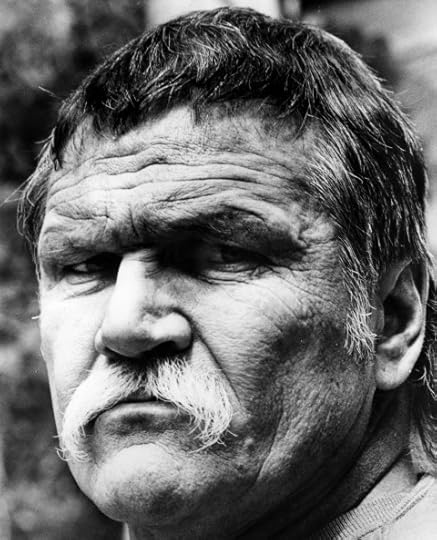
Harry Crews. You think you had it rough growing up? Just look at him. Take a close look.

What you see is a man that's been through some things in his childhood and that's in relation to the time period and place he grew up.
What you see is that scowl, that continuous look of 'leave me the hell alone'.
What you see is a stereotypical country boy that you may point and laugh at, but with a quick look in your direction, the intimidation makes you run for your life.

What you don't see is the pain of childhood - whether it be from a random disease that keeps you immobile for months, being submerged in a boiling pot of lye up to your neck, or the emotional anguish of losing a parent too soon while gaining one that beats the pain out of you, that pain no longer felt on the skin or muscles, pain that's crept into the mind and created the distance between child and man.

This is not just a childhood, but a life. Life can be horrendous, yet comical, depressing, yet enlightening. Crews makes an otherwise overlooked, invisible place fascinating, no matter how crude and horrible it may be.

One of the best biographies you'll read of a childhood and place that shaped that person through his writing and the rest of his life. Recommended.
Profile Image for Laura.
882 reviews320 followers
December 5, 2021
Not your typical beach read, but hey, it worked for me. I'm a fiction junkie and snub my nose at memoirs or nonfiction. I'll let my hubby do the heavy lifting, share the highlights, and move on. However, I loved this memoir of Harry Crews. For a reader that likes fiction, this reads a lot like fiction. It's not fact after fact after fact. It was so interesting and shocking what this author endured as a kid. I highly recommend even as a "beach read", wink. This is a good one!

Update: this review proves I’ve matured as a reader in last 6 years. I read more nonfiction, and if done well, I really enjoy and seek to read more. Still highly recommend this author and his fiction.
Profile Image for Lawyer.
384 reviews968 followers
November 7, 2019
Perhaps the best memoir/autobiography I have read. Crews must not only deal with the past, but the future. Only four months old when his father died, Crews knew nothing about his father. After three years in the Marines, Crews returns home and asks his Uncle to tell him about his father. Uncle Alton spent the day driving Crews to talk to Men who had known his father. A vivid portrait of a man dead for a quarter century.

Crews then sets out telling of his own life. Infantile paralysis. Being scalded over 2/3 of his body on a hog killing day. His best friend he learns is a "nigger." Something he had to be taught. To Crews' credit they remain friends.

It would be stretching it to say it is a pleasure to read this book. The life Crews describes is told dispassionately. There is no sentimentality here. Not does Crews resort to humor to lighten the load on the reader. As Crews wrote in his epigraph, "Survival is triumph enough."

Profile Image for Jayakrishnan.
544 reviews228 followers
December 5, 2021
A Childhood is about life on a farm during the great depression in Bacon County, Georgia.

The action packed start involves Crews' father working in a swamp, piling dirt for a highway in what was to become Tamiami Trail. A short account of his father's picaresque adventures with women and alcohol and other badass characters in Bacon County follows. This is to establish the naked tribalism that prevailed during those times when it came to the tough men guarding their territory.

The book is filled with colorful characters who tell tall stories and superstitious allegorical tales. The one about Flo who saw a baby's hand drop out of a bleeding woman was a bit eerie. Crews' love for freaks and handicapped people, like in The Gypsy's Curse is understandable, after reading this book. He himself contracted polio as a kid and had lots of people drop in to watch him. He also fell into scalding hot water in his childhood while playing with his friends.

There are detailed accounts of farming, the landscapes, the food and the animals.

Towards the end of the book, Crews and family move into the city of Jacksonville after his mother separates from his violent alcoholic father. The rural family experiences the dreariness of mass production (Crews mother works in a factory folding tobacco leaves and has many stressful days) while enjoying the certainties of modern amenities. But the city is too much for them and they go back to where they came from.

I did not like it much the first time I read it, when I was going through a reading funk. But I appreciated it a lot more this time. Along with Charles Willeford's I Was Looking for a Street, this might be one of the lesser known books set during the depression.
Profile Image for Jamie.
1,361 reviews537 followers
October 16, 2022
“I had already learned—without knowing I’d learned it—that every single thing in the world was full of mystery and awesome power. And it was only by the right way of doing things—ritual ways—that kept any of us safe. Making stories about them was not so that we could understand them but so that we could live with them. It all made perfect sense to me. Fantasy might not be truth as the world counts it, but what was truth when fantasy meant survival?”
Profile Image for Josh.
134 reviews24 followers
October 29, 2013
3 Points:

1) At a recent lecture by Clyde Edgerton, he explained to the audience how Southern writers have the advantage of a slew of outlandish stories from their immediate and peripheral lives from which to draw. It helps them in crafting work and words in a way that adds interest. Well, I got it when Edgerton said it, but there is no question this book illustrates the root of what he was explaining. By the time Crews was 10 years old, he had had enough "coming of age" to overshadow anything I could imagine as possible in today's culture. In some places rough as a cob, in other places smooth as silk. Not going to give it away by describing any of them, but suffice it to say you will not believe more than 10 events described in this book..........and I believe they were true.

2) Memoirs........some people hate them. I get that. This, is not that memoir. This reads like fiction. Good fiction. Except it isn't fiction. It's a memoir. But if all memoirs were like this one, you would like memoirs.

3) The most eye opening part of this story was his take on story telling and how "place" was (and is) so key to the stories we get to hear. In today's Facebook, goodreads, Twitter world we think we get to experience everyone's story with them.......except we don't because we only get the perspectives of those we already know or want to know. In Crews' mind, part of the fullness of story telling is hearing the story for the first time from a perspective you haven't heard or known, and the only way that can be accomplished effectively is through association that only happens in a physical proximity. Like it used to happen when you were killing hogs, or pumping gas, or sitting in church. With the same small population that has been around you all your life. My daughter while she may one day hear new stories about me from different friends of mine, but she will never get to experience the same story being told by all those people at the same time because we are virtual in connection now not physical.

Great read- highly recommended- highly southern- puts me in a place to know how he gained his unique slant on life which would have been required to write the way he did.
Profile Image for Connie  G.
2,143 reviews709 followers
July 10, 2015
Harry Crews was practicing the art of storytelling as a five-year-old in a poor sharecropper's shack in Georgia. He and his friends made up stories about the models in the Sears Roebuck catalogue. "I first became fascinated with the Sears catalogue because all the people in its pages were perfect. Nearly everybody I knew had something missing, a finger cut off, a toe split, an ear half-chewed away, an eye clouded with blindness from a glancing fence staple. And if they didn't have something missing, they were carrying sores from barbed wire, or knives, or fishhooks." The youngsters created stories where the perfect models had hard feelings and violent trouble between them, problems that were not visible to the eye. "I knew that under those fancy clothes there had to be scars, there had to be swellings and boils of one kind or another because there was no other way to live in the world."

Crews' family was terribly poor, working extremely hard farming in Bacon County, Georgia during the Great Depression. His father died when he was two-years-old, and his mother married his alcoholic uncle. Crews survived two heartbreaking challenges when he was a young child--polio and terrible burns. But there was always a sense of love and home from his large extended family.

This memoir gave me the feeling that Crews was sitting on a porch, having a drink and sharing his stories with friends on a hot Georgia night. Although there are tales of hardship, there are also many moments of humor--eccentric characters, animal stories, and superstitions. There is a real sense of place in this book, as the subtitle "The Biography of a Place" attests. So pull up a chair and spend a few evenings with Harry Crews' storytelling. I hope you'll be as impressed with his fine writing as I was.
Profile Image for Rae Meadows.
Author 10 books446 followers
January 12, 2018
Crews's memoir of his early years is quite an extraordinary capturing of a specific place and time we don't often get to see in this detailed way. As a young boy Crews lives in extreme poverty in a corner of rural south Georgia during the Depression, life that seems more 19th century than 20th, and he brings it to life with his signature color and empathy. The story of the tragic moment when he begins to see race I found particularly heartbreaking. Crews is a storyteller, and at points I wondered about hyperbole or at least exaggeration, but that's maybe just part of growing up hearing stories from those around him. He elicits beauty from Bacon County, from its hardscrabble residents to the landscape. A Childhood is interspersed with illustrations that resemble wood-block carvings--I'm not sure how I feel about them. They give the book a fabulist feel that I don't think is necessary given the richness of Crews's memories. Although I loved the content of this book, as a memoir it was a little roughly shaped, hence the four stars. Recommended for any fan of Harry Crews, but also more widely worth a read.
Profile Image for Nancy Oakes.
2,018 reviews918 followers
Read
December 22, 2014
A Childhood: The Biography of a Place is one of those books I can honestly say is nearly perfect, at least to me. I know there are people who didn't care for it, and that's cool, but I loved it. I have written something about it at my online book journal, so I'll just offer a brief look here.

In the book's opening pages, author Harry Crews says that he has "never been certain of who I am," and that he's "slipped into and out of identities as easily as other people slip into and out of their clothes." But he knows for an absolute certainty that whoever he "has its source" in Bacon County, Georgia, and that

"... what has been most significant in my life had all taken place by the time I was six years old."

What he's put together here, he says, is "the biography of a childhood which necessarily is the biography of a place, a way of life gone forever out of this world." With an old shoebox full of photos by his side, Crews goes on to tell of a hardscrabble first six years of life first on a farm in Bacon County, his "home place," then in a brief move to Florida, and finally back again to Georgia.

I haven't had the pleasure of reading any of Crews' novels yet, but my guess would be that themes that will be found in any of his writing are probably found in here as well. Here are a few I've discovered: the power and art of storytelling, poverty, family, "courage born out of desperation and sustained by a lack of alternatives," fantasy/myth as an integral part of survival, alcoholism, women, and fathers. And then, of course, looming over all of those likely candidates, there's the American South, which is why, whether or not all of the events depicted here in Harry Crews' young life are true isn't really an issue here. It is, after all, a "biography of a place," and somehow, he manages to pull it off without roaming into the usual poor-Southern farmer stereotypes, and does it in such a way that humor manages to come through the worst of harsh and tragic.

The only thing left to say, since this is a book best experienced on one's own, is that the quality of the writing drew me in pretty much immediately. I know it's cliché and even trite to say this, but frankly, I was just spellbound all the way through it. Reading this book was an experience on its own -- it was so very easy, even without the help of McCurdy's drawings, to imagine it all in my head, as if Crews was writing and illustrating all at the same time. It was also very easy, once I got the reading rhythm going, to see just how his small world made sense to him in the context of his young life.

Highly recommended. One of my favorite books of the year.
Profile Image for Andy Weston.
3,193 reviews225 followers
November 17, 2023
Second time of reading this..

Ranked by many of the media as Crews’s masterpiece, I appreciated this greatly, but prefer his novels. Some say to read this first, as an introduction to Crews’s books, but I’m going to disagree with that also.. better to read it last, and it gives some of perspective on Crews’s early life, experiences that led to his later writing.
That so much could occur to one small boy is amazing in itself, but that these sort of experiences were shared by his kin and community is almost incredible. That aspect of community is so well summarised in the subtitle, The Biography of a Place.

Crews is often described as the successor to the early greats of Southern Lit, William Faulkner, Flannery O’Connor, Eudora Welty.. but he takes the genre on a step, to a new level of violence and surrealism. Many are put off his novels. Some are unsure, wary of the blunt approach to taboo subjects. Others, like me, can’t get enough of him. Those uncertain readers should certainly read this, it’s about as close as you can get to explaining why Crews writes like he does.

The biography is told from the viewpoint of him as a child, the large part before he was ten years old. It offers a harrowing view of the trials and tribulations of sharecropping in the South during the Great Depression. The struggles are considerable and unending, many of them described in graphic detail. Literature such as this, stands as history to a time long gone; its importance should not be undervalued.
Profile Image for Mmars.
525 reviews119 followers
July 18, 2015
Really 1 star bumped up to 2.

I wish I had never read this book. It's like "The Devil All the Time" only it takes place in childhood.

I grew up on a farm and I've seen pigs castrated and vets stick their arms all the way into a cow to pull a calf. I ran a chicken over with a lawn mower (acidentally and ot was heartwrenching) and saw one run away with its head cut off when my Mom was butchering. I've seen dogs get run over by cars and I've killed mice with baseball bats. I'm not proud of it.

This was just accepted as part of my growing up. Just as such experiences were part of Crews childhood. However my childhood didn't contain violent and drunken parents or the expectation that boys would "do it" to girls while still children. Much less when inspired by fire and brimstone preaching.

My jaw just drops at the number of readers who love these stories. I've even seen it on top ten southern literature lists. Really? It's just a bunch of stomach churning stories from a boy's early childhood - including theft, sex and watching a man stab himself to death.

What really brings the book down for me was that it just sort of ended with about one page of adulthood. No summation or reflection. Only statements at the beginning saying he didn't remember many many of these things happening but heard them from others. But some are obviously his own memories and they are creepy and without conscience. it's like lying or creating an excuse to cover a crime rather than face the truth and grow up. Maybe he never did.

Absolutely cannot recommend this book. I bump it up to two stars because he wasn't stupid and CAN tell a story.Just not in a way that I wish to promote.
Profile Image for Camie.
958 reviews243 followers
July 10, 2015
This is a good biography ( although one to be taken perhaps with a grain of salt) which is the story of Harry Crews, who while living with his family in a farming community in Georgia experiences the poverty of the Great Depression ,and has a pretty tough time of it , including two very close calls almost leading to his own demise. Part of the first chapters are written from stories he garnered about his true father, Having never known him. The rest of the book focuses on his very early years from ages 5-10 . It's a short book, and it left me wanting to know more about what became of Harry. I'm new to this author . Is there a sequel ? 4 stars
Profile Image for Jim.
234 reviews53 followers
June 9, 2022
Really well-written memoir. I loved the stories of the "feud" in the wish book and the "mule men." Great storytelling.

I'm glad that Penguin has reissued this, but I would warn you if you read/listen to this new edition that I would skip the forward. There are spoilers in there.
Profile Image for Kirk Smith.
234 reviews89 followers
April 6, 2014
When I was a child, my Grandfather often drove me by some tenants on one of his rural properties that he said made the Best Possum and Sweet Potatoes. Well some how we never quite visited at the right time and never got around to having dinner with them. I was pretty happy about it then and that will never change. But the Recipe for Possum is here in this book! There is also a lot of other farming knowledge about rendering hogs, or breeding mules.
It is rural wisdom passed along collectively by way of storytelling. I would call this book one part memoir and one part fiction, but still chock full of real recipes for just surviving. The time and place would have been nearer my fathers generation than mine, but I appreciate how much just sensible knowledge is being passed along here. Harry Crews suffered two back to back tragedies in this memoir, and I appreciated how gracefully he covered the material, knowing that it must have been difficult to re-live. A wonderful book to own. May deserve to be read again someday.
Profile Image for Laura.
44 reviews
November 18, 2009
The New York Times said this was the best memoir ever written, and I wanted to love it but I just couldn't. It was engrossing and vividly written, but there was so much gruesomely-detailed violence against children and animals that it was painful to read. It transformed all of my romantic ideas about idyllic life on a farm. The farm of Crews' childhood was a bloody, abusive place.
Profile Image for Vicente Ribes.
903 reviews169 followers
September 3, 2024
Un libro muy bonito sobre la infancia y la vida en el campo. Harry Crews es conocido por ser uno de esos escritores que actualizaron el gótico sureño y lo pasaron por un tamiz más atrevido o radical.
Habiendo leído sus libros " El cantante de gospel" y " La maldición gitana", tenía curiosidad poor leerme esta bibliografía donde nos cuenta su niñez.
Es un libro tierno y duro a la vez, ya que Crews nos cuenta como creció en una familia disfuncional, con un padre borracho y unas condiciones de pobreza atenuantes. Pero también tiene momentos preciosos como aquello en los que nos cuenta sus juegos infantiles, el trabajo en el campo, la relación con los animales o con su abuela.
Una biografía que nos hace conocer de forma más profunda a un autor muy aconsejable.
Profile Image for Christie Bane.
1,467 reviews24 followers
July 11, 2022
Gosh, this has to be at the top of the list of anyone who likes memoir. This is memoir at its best. Harry Crews grew up poor in rural Georgia. This is a world I don’t know anything about but recognize as truthful immediately. It’s hard to master the art of telling about your childhood through the eyes of a child while still having a coherent narrative, but he does it. What a dreadful, wonderful, genuine experience it was to read this book.
Profile Image for Laurin-Whitney.
4 reviews
August 10, 2025
One of the rawest, most beautifully written memoirs I've ever read. It easily takes the spot of my favorite memoir I've picked up, and is now among my top five books of any genre. I will certainly read it again and again.
Profile Image for Ryan.
86 reviews15 followers
February 5, 2024
I would summarize this book as:
Death, misery, suffering, and yet persistence.

Alternatively, to quote the authors mother:
"Wish in one hand and shit in the other. See which fills up first."

No matter how bad shit gets man, and it can get bad, just keep going. What else is there to do?
Profile Image for Duarte Cabral.
191 reviews22 followers
May 10, 2024
Leitura duríssima e simultaneamente melancólica, desabrochando auras de nostalgia de poros cuja existência desconhecíamos por completo. Infância como futuro abecedário de vida, criança como o verdadeiro pai do homem.

Sempre uma merda escorregar para uma reading slump quando estamos a ler aquele que possivelmente é uma obra-prima. É o que é, I guess.
Profile Image for El Viejo Mochales.
209 reviews14 followers
March 20, 2024
Qué libro más maravilloso, joder. Prosa seca y directa al alma. Harry Crews parece que exorcizó sus demonios de infancia con un ejercicio de literatura tan sublime que, si lo lees, posiblemente te ponga la tuya patas arriba.
Extremedamente recomendable.
Displaying 1 - 30 of 350 reviews

Can't find what you're looking for?

Get help and learn more about the design.