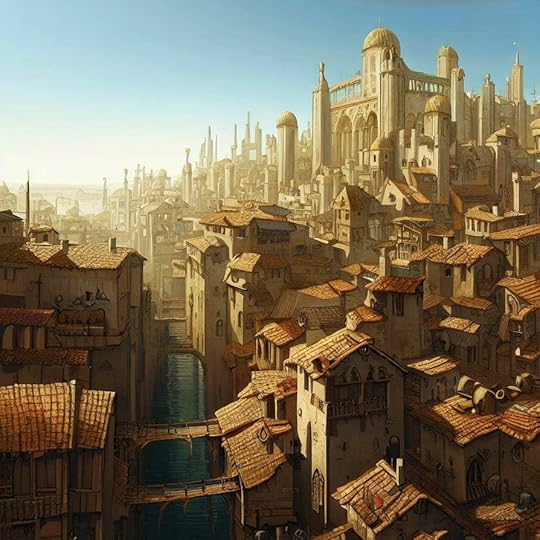
Der Stadtstaat Navola ist auf Handel gebaut. Die Paläste und Türme sind dem Reichtum ihrer Kaufleute entsprungen. Gehandelt wird mit Gerste und Reis, Flachs und Wolle, Eisen und Silber, Waffen, Armeen und Menschenleben.
Und über allem thront die Bank der di Regulai. Mit List, Gewalt und ihrem unerschöpflichen Vermögen verkörpern sie eine Kaufleute bitten um ihre Unterstützung, Künstler um ihre Gunst, Fürsten um eine Einladung zu ihrer Tafel. Die di Regulai behaupten zwar, sie seien unpolitisch, aber mit ihrem Reichtum kaufen sie Städte und stürzen Königreiche.
Schon bald soll Davico di Regulai die Macht von seinem Vater übernehmen. Sein Schicksal hängt von zwei Dingen ab. Zum einen von seiner Fähigkeit, das komplizierte Spiel der navolanischen Diplomatie zu spielen. Zum anderen von einem versteinerten Drachenauge, das sich im Besitz der Familie befindet und das weit mehr als nur ein mächtiges Symbol ihrer Macht und ein Talisman ist.
Für Leser*innen von Patrick Rothfuss, Andrzej Sapkowski und George R.R. Martin
Ein epischer Fantasyroman über Macht, Verrat und Magie in einer alternativen Rennaissance. "Voller Gift, Verrat und Ausschweifung. Die Lektüre von Navola ist wie in ein luxuriöses Bad aus Blut zu gleiten." Holly Black
Paolo Bacigalupi is an award-winning author of novels for adults and young people.
His debut novel THE WINDUP GIRL was named by TIME Magazine as one of the ten best novels of 2009, and also won the Hugo, Nebula, Locus, Compton Crook, and John W. Campbell Memorial Awards. Internationally, it has won the Seiun Award (Japan), The Ignotus Award (Spain), The Kurd-Laßwitz-Preis (Germany), and the Grand Prix de l’Imaginaire (France).
His debut young adult novel, SHIP BREAKER, was a Micheal L. Printz Award Winner, and a National Book Award Finalist, and its sequel, THE DROWNED CITIES, was a 2012 Kirkus Reviews Best of YA Book, A 2012 VOYA Perfect Ten Book, and 2012 Los Angeles Times Book Prize Finalist. The final book in the series, TOOL OF WAR, will release in October of 2017.
His latest novel for adults is The New York Times Bestseller THE WATER KNIFE, a near-future thriller about climate change and drought in the southwestern United States.
(This is a review of an ARC from Netgalley and the publisher Head of Zeus.)
A weird one this. I suppose you’d file it under F-for-fantasy: there is a dragon’s eye on the cover, after all. But in this world, which is something like Renaissance Italian City States through a glass darkly, the dragons seem long gone, and the eye is a relic, a fossil—or is it? The publishers call it “literary fantasy”, so this is like lit-fantasy or fantasy-lit(e). It’s surprising, anyway, how many literary classics contain genre elements. Ghosts at windows, uncanny omniscience, time loops… For me, Navola resembles historical fiction. It’s like one of those recipes where you add a mere grating of truffle: historical fiction with a hint of dragon. Our viewpoint character is Davico di Regulai, only son of a powerful family of bankers. (Think the Medicis, and Florence and plotting and poison and stilettos.) Navola is a city state republic, ruled by 100 prominent people, but the most prominent of them all is Davico’s father Devonaci, who plays 4-dimensional chess: not only does he manipulate you now, but he knows what you will do when you decide to defy him further down the line. The great banker has trusted friends: an assassin as well as an administrator on his staff, and soldiers, as well as a slave-consort who runs his household. On the other hand, he is surrounded by enemies, and you never know who is going to turn on you with poison, dagger, or poisoned dagger. Davico is a reluctant heir; he’d rather be out in the woods gathering herbs and fungi and learning to be a physician. He reminds me of Prince Herbert in Monty Python and the Holy Grail (“I just want to… sing!”). But a bodyguard follows wherever he goes, and learn the family business he must. Most importantly, he needs to learn how to read the people who will always be asking for money and looking for ways not to repay it. One worry he obviously has is who to trust. His father’s men protect him, but they serve his father—and who of his own generation will be as loyal and trustworthy? He is alone, frequently unhappy, and (as you might expect if you read a lot of fantasy) slow on the uptake. Like Fitz in Robin Hobb’s Farseer series, or Simon in Tad Williams’ Memory, Sorrow, and Thorn. But at least those two have the excuse of being of “low” birth. Davico is one of those characters who stretches your credulity because you think, oh, come on, surely you’ve learned by now? One noble who tries it on with Devonaci ends up losing almost everything, including his older daughter Celia, who is taken as a hostage and adopted as Davico’s sister. She is a pawn in the great game, of course, and about halfway through I started worrying for her future. I was thinking of Lucrezia de’ Medici, married at 14 to the Duke of Ferrara and dead shortly after her 16th birthday. Dead, according to Robert Browning, because she smiled too easily. A feature of Navola is the frequent use of words and phrases which (forgive my ignorance) seem to be in a kind of mediaeval Italian dialect or kind-of Latin. You can usually tell what they mean from the context, or from repetition, or simply because they’re repeated in English, but I wonder if the final published version of this will have a glossary, or some kind of Author’s Note explaining the dialect. You get words like exomentissimo, which if you put in a space between exo and the rest means (in Latin) something like “I went out of my mind” or (from the context), “I was out of my mind”. I didn’t find it annoying, but curiosity did drive me to the Latin translator in the app on my phone rather than the built-in Kindle translator, which can’t manage Latin. The (576 print pages) book feels like a labour of love, but here’s what I wonder. There’s been a lot of discourse lately about worldbuilding on the socials, with lots of back and forth about following rules, and so on. Someone mentioned M John Harrison’s (since deleted but much quoted) critique of world building, which seemed to be along the lines of: too much worldbuilding gets in the way of writing. The choice line is that worldbuilding is, “the great clomping foot of nerdism.” I do see the argument. I teach my students about how readers are the ones who create meanings, a theory that has had various names: reception theory, text world theory, and so on. The point is, that a writer can provide a mere sketch of a world and the reader can fill it in. The flipside of that is that the author can’t control reception, so what the reader fills in might be… different. But epic fantasy tends to go in for hundreds of pages of expository world-building, giving us the history, the religion, the culture, and more. It’s what fantasy fans expect. There’s a scene early in Navola, when Davico’s tutor in all things banking, Merio, takes him outside for a look at a mural and an information dump of family history. It’s a hard balance to strike. Here am I asking for a glossary of not-quite-Italian dialect (and I’d love a map, too), while at the same time wishing we could just be thrown into the deep end of the world and work it out as we go. When I read Lord of the Rings, as I have done on several occasions, I know by now that I can skim/skip through loads of pages that deliver lore and history that I just don’t need. On the other hand, there’s power in letting the reader become familiar with the lead character and his world, and allowing the stakes and the tension to build up in what feels like a naturalistic way. We’re here to be in this fully-realised world and not charging full pelt for the ending. So: I’d recommend this if you find many fantasy tropes overwhelming—or overused. As I said above, this feels like a historical novel that dips its toes in fantasy. Don’t come here anticipating magicians and portals; expect something more like Renaissance intrigue. For sure, there is that dragon’s eye (and on the very first page), but what it is and why it is there is something you will have to wait for.
Just because you are a weak card in someone else’s hand, does not mean that they will not play you.
Davico di Regulai has never seen himself as a true Navolese. He is intelligent but not cunning. He wears his feelings on his sleeve, like a lamb among the wolves that inhabit the city of Navola, and he prefers the weave of nature to the trickery that keeps his family’s banking empire alive. It’s a precarious business, but Davico’s father is a master of reading the unwritten and hearing the unspoken, and he hopes to train Davico to one day ascend to the Regulai mantle. But even though Davico cannot don a mask as well as everyone around him does, he has no freedom to leave the dreaded path of politics—and in Navola, innocence and belovedness are not enough to save those inept at navigating its deep waters.
What makes this novel so horrifying and riveting is that it treats the reader like Navola treats Davico. More than half of the book follows Davico as a child and into his teenage years, and while the twisted nature of Navolese politics and the enormity of his father’s scheming is alluded to, Davico is shielded from the worst of it. Bacigalupi writes literary coming-of-age like a master. At first, I doubted that Navola would become as twisted as the characters said it was, because I saw through Davico’s eyes—Davico, who treats politics like homework to be completed and then set aside, who doesn’t realize how his refusal to harden his heart could cost him. But we were both caught off guard.
I’m more jaded than most when it comes to characters’ fates in fiction, but what happens to Davico in Navola truly shocked me, both for the tragedy of its themes and for its violence. It’s a brutality that preys upon everything I had known but not really recognized about Davico for the 400 pages I had accompanied him—a failure that is exactly the reason why Davico himself goes through what he does. It’s done with such subtlety and Navolese deception that it’s like a fourth wall break without a real fourth wall break. It violates the unspoken rule in fantasy that gives the main character space to make mistakes and still succeed. I’m telling you, it’s chilling. And it’s tragic.
Bacigalupi’s prose is beautifully vivid and immersive. It takes its time to build a rich world that feels both wonderfully and frighteningly real. It’s also clever enough to sell the twistedness of Navola and its characters. Bacigalupi is great at writing side characters I distrust but also love and understand (for example, Celia, Davico’s adopted sister). The moments of tenderness and irreverence balance the darkness and anxiety remarkably well—it’s truly an emotional journey, and not all those emotions are painful. It just feels human.
Be warned that Navola is both very gory and excessively sexually explicit (its greatest flaw, in my opinion). It shies away from nothing—or, more accurately, leans into everything—in a way that is sometimes disgustingly effective (as in the last quarter of the book) and other times uncomfortably uncensored or complete overkill (as in the descriptions of female characters). I’m inclined to believe Davico when he says he withholds nothing about himself in this narrative, for better or for worse.
Navola is an extremely gutsy novel and an exceptional show of skill from Paolo Bacigalupi. I’ll be thinking about this one for a long time.
So, I’ve found my new favorite book of 2024. I’ve always enjoyed political intrigue, deeply personal stakes, and secondary Machiavellian characters. In Navola, Paolo Bacigalupi brings goods to the table!
The story follows Davico di Regulai, the reluctant heir to a powerful banking family in the city of Navola. Unlike his ruthless father, Devonaci, who controls the city from the shadows, Davico dreams of a simpler life, one filled with honesty, connection to nature, and kindness. Power and manipulation don’t appeal to him, but alas, he has little choice since his life is just a piece of the giant, ambitious puzzle played by his father.
Some reviewers complain about following the story through the POV of the least interesting character, but I disagree. I think Davico’s goodness and naivete make characters like Devonaci, Lady Furia, and Stilettotore even more fascinating and mysterious. I mean, think of Lord Vetinari in Discworld novels - he’s so fascinating because we witness his machinations mostly through the eyes of lesser minds and this trick emphasises his cunning and ingenuity.
Davico feels inadequate and trapped in a world that perceives kindness as a weakness to exploit and use against you. But I love coming-of-age arcs, and Bacigalupi is shockingly good at writing them. A word of caution, though—he’s also extremely good and ruthless at destroying kind characters. Davico’s foster sister, Celia, plays a crucial role in his life as his closest friend and potential love interest. The dark machinations of his father and his enemies make everything much harder for them and lay the groundwork for shocking twists and turns that left me staring blankly at the pages, muttering WTF.
There’s a fantasy element too—the dragon’s eye kept by Devonaci plays a pivotal role in Davico’s fate. But why on earth would I spoil it for you? Anyway, the relic, a remnant of a long-lost age, suggests the lingering presence of magic in a world increasingly dominated by human ambition and greed. And it’s not looking kindly at the world or its inhabitants.
Navola is a brilliant book. It takes the classic coming-of-age story, sets it in a fascinating Renaissance Italy inspired world and makes it a part of a brutal power play and political intrigue. It plays with coming-of-age storyline beats but twists them significantly. Things you’re sure will happen, won’t happen. Things you’re sure won’t happen, will happen.
Bacigalupi’s world-building is excellent—Navola comes alive through its detailed landscapes, complex societal structures and interactions, and the language filled with faux-Italian / italiante words. The di Regulai family’s influence over the city is immense, and Bacigalupi captures the tension between power-hungry factions and players. He also shows that sometimes calculated violence and unrelenting political maneuvering is the only way to maintain power.
I loved the prose and found it elegant and immersive. The novel’s pacing, while slower in its beginning, builds to a shocking twist that will change everything about the story. Anyway, the opening chapters consist of vignettes that shaped key moments in Davico’s coming-of-age arc. I found them incredibly effective at setting the tone and making readers lower their guard.
In short, Navola is brilliant and juggles heartfelt moments with outbursts of calculated violence and extreme bleakness. I loved every second of it. Some reviews mention it’s a standalone story and while it can be read as such despite an open ending, I choose to think it’s just the beginning of a brilliant epic series.
I found this to be a slow and frustrating read. A kind of Game of thrones style fantasy set in a sort of city state Italian world except it’s far from GoT as there’s only one point of view and that narrator is probably the most boring character in the book and his knowledge of the motivations of all the other characters is completely lacking. The fantasy bit is a dragon eye and it’s barely used here (I assume with the open ending further books in a series will expand on this part). When it’s good it was great but nothing really happens till about halfway through, and the last quarter or so is definitely worth the read but it took so long to get there! So most of the book is world building and frustratingly slow but I kept reading because there was the promise of something good. Disappointing.
This was not at all what I expected from the new Bacigalupi, but I really, really enjoyed it! It's far more like Guy Gavriel Kay that many of his earlier books (I believe I have read all of both of those authors' books to date). It's a Renaissance-Italy-inspired tale with a good amount of complexity and intrigue, excellent characterization, and only a very small amount of the fantastic to add a bit of spice and mystery.
Will definitely read any sequels, as I love Bacigalupi's writing and this is one of my favorite fiction genres.
Naprawdę świetna książka na poziomie. Stylistycznie majstersztyk, emocjonalnie poniewierająca.
---------------------------------
[ współpraca reklamowa @wydawnictwo_vesper ]
“Navola” to historia młodego chłopaka, wychowującego się w bogatej rodzinie kupców di Regulai. Davico od małego przygotowywany jest do objęcia władzy po swoim ojcu. Wychowywany wśród przywilejów, lecz również brutalnej polityki, będzie zmuszony podejmować bardzo trudne decyzje. Jedna z nich dotyczyć będzie tajemniczego artefaktu, w którego posiadaniu znajduje się jego ojciec.
“Navola” to książka skupiająca się przede wszystkim na losach naszego głównego bohatera. Bacigalupi wprost fenomenalnie kreuje postaci. Są one do tego stopnia wiarygodne, że momentami czyta się to niczym powieść historyczną. Natomiast relacje, jakie między nimi powstają, były dla mnie czymś niesamowicie emocjonującym.
Autor zaprasza nas do świata inspirowanego renesansowymi Włochami. Znajdziecie tutaj dosyć dużo słowotwórstwa pochodzące z języka włoskiego. Styl Bacigalupiego bardzo odpowiada moim gustom, a plastyczność z jaką operuje językiem sprawiała, że przez tekst w zasadzie się płynie.
Jest to również książka pełna intryg i polityki. Nie bez powodu porównywana jest do Gry o Tron czy Ojca Chrzestnego. Od tej pierwszej ma jednak zdecydowanie wolniejsze tempo, a sama narracja i pióro autora przypominają mi bardzo twórczość Robin Hobb czy Tada Williamsa.
Jedyne czego mogłoby w moim odczuciu być nieco więcej to magii. Jest to powieść z pogranicza fikcji historycznej i fantastyki i dużo bliżej jej do tego pierwszego gatunku. Natomiast ilość emocji jakie towarzyszyły mi, szczególnie pod koniec powieści, zdecydowanie nadrobiła te braki.
Jeśli lubicie włoskie klimaty i macie ochotę na polityczną opowieść o kupieckiej rodzinie walczącej o władzę, koniecznie sięgnijcie po “Navolę”!
Loved pretty much everything about this book. I really hope the author writes more in this world. This is how you write historical fantasy well.
All that being said, I don’t think this will be for most people. There is pretty much no plot. It’s quite dense in its historical context and it’s very character-driven. It’s very similar to The Folding Knife in some ways, which is great for me because that’s one of my favourite books of all time.
A perfectly fine old man fantasy but it sets itself up for failure with the number of similarities to Robin Hobb’s Farseer trilogy. I only have room for one naive boy and his dog in my heart.
I read this for my Hugos project, and I’m sorry, if Robin Hobb never won a Hugo award then this shouldn’t either.
Navola is a purported “literary” fantasy set in a city-state dominated by powerful merchant families. The story follows Davico di Regulai, a young member of one such powerful family, as he navigates the political struggles of Navola, and as he prepares to take over his family's [accounting] empire. Davico faces rebellion and intrigue, with his fate apparently intertwined with both a dragon relic and his adopted sister, Celia.
The opening is weighed down by all the world-specific terms and names, based heavily on an Italian-Latin root system. It’s a lot to take in at once and hard to keep track of them all. It doesn’t NOT feel like when someone in a comedy is speaking nonsense pseudo-Spanish by amending each and every English word with -o. It’s unfortunate that it’s so liberally applied, because it gives an easy springboard into the desire to skim-read.
The narrative style is also somewhat unusual, though I feel like we’re seeing this more and more often, as of late, as the author directly addresses the reader with “you.” This choice might work in certain contexts, but here it adds to the overall confusion without providing much clarity or immersion.
Despite being set in a fantasy world with an Italian city-state foundation, Navola doesn't deliver a compelling plot or strong character development. Davico is the typical empty vessel that many main characters of this kind of fantasy novel with a historical bent seem to favor. But I think Bacigalupi takes it too far and Davico really needed some proper fleshing out and purpose. Without an anchor of some kind of conflict — at least for the first half of this nearly 600 pager, the story seems aimless, neither driven by events nor by deep character arcs, as if uncertain of its own direction and intention.
That dragon's eye, prominently featured on the cover and in the book's opening, turns out to be a minor element in the narrative. It is briefly mentioned as a relic or a fossil, and some bits of lore are bandied about here and there, but it’s basically a glorified paperweight for the majority of the book. Such a missed opportunity to develop a more intriguing fantasy element, instead clearly setting up the rest of the books more than allowing this book to stand on its own. Overall, a challenging, cumbersome read that doesn’t quite achieve its potential.
I received this book for free from the publisher via NetGalley in exchange for an honest review. This affected neither my opinion of the book nor the content of my review.
В Навола конците дърпа могъща фамилия - стопроцентово копие на флорентинските Медичи (с отсянка на дон Корлеоне). Самата Навола комбинира чертите на доста средновековни италиански градове - държави. Излишно е да се споменава, че под всяка повърхност се крият безброй скрити значения, наточени кинжали и кипящи интриги.
Историята се разказва от гледната точка на Давико - наследника на този могъщ клан. Той е добро, мило и крайно несхватливо момче, което няма нито едно качество, което да го прави достоен за коварните му прадеди и не по-малко манипулативния му и властолюбив баща. По търговски и политически критерии момчето си остава тотална издънка до 90% от книгата. По човешки критерии не му е позволено да се мери, защото не му е позволено да избира сам пътя си…
Фентъзи елементът е миниатюрен и се представлява от едно хищно драконово око. Действието се задвижва истински чак на 90%, дотогава единствено се наслагва напрежение, което - въпреки живописното поднасяне, което е много приятно за четене! - просто ми досадѝ ужасно. Очевидно това е поредното начало на поредица, с леки нотки на Гавриел Кай и Робин Хоб. Но просто книгата ми дойде мудна, и реално героите не ме заплениха чак толкова. А разказвачът беше досаден, макар обстановката да е любопитна. За любители на мрачно и кърваво ренесансово фентъзи би бил удачен избор.
———- ▶️ Цитати: “He was mild, for he had power.”
“All children have secrets. We keep them from our parents, our friends, the maestri of our lessons . . . Sometimes, we hide them even from ourselves.”
“Believe not that innocence is an advantage in the face of the cutting sword of wisdom.”
“We embroider our stories to explain, to excuse, to justify.”
“Not everything is war and ambush.” “But when it is, it’s better to be the ambusher. ”
“I think the wisdom of one moment is the foolishness of the next.”
“Men make poems about our pretty lips, and then rage when we move our lips to speak.”
“When parents coddle children, it is to make them feel safe, but the coddling does not make them truly safe, it makes them ignorant, and it puts them in danger”
To be honest, this book has its ups and downs with some beautiful writing, some horrifying violence, and some deadly dull spots. The first half of the book is all about building this fantasy world that seems drawn from the days of the Italian Renaissance. Navola is a city state ruled by money, greed and political maneuvering. To succeed, one needs to be skilled at the art of 'faccioscuro'--to see behind a pleasant face to see hidden thoughts and intentions.
The story is told through the eyes of the Davico, the only child of Devonaci di Regula da Navola, a wealthy merchant banker who currently controls the city. The action finally begins at about the 50% mark at Davico's Name Day celebration, sort of his 'coming out' party. Now Davico is considered to be a man with responsibilities but even though he's been well-trained in all the arts, he remains naive, inexperienced and rather clueless, without the innate skills needed to be a powerful man's heir. Perhaps this is the excuse needed for schemers to make their move...
You may be wondering if this is actually historical fiction, loosely based on medieval times. But the touch of fantasy comes through with Davico's unique connection to the dragon's eye that his father keeps on his desk. It plays an important role at certain key moments. Very interesting conclusion which leaves the door open to further adventures.
Warnings for the story: Violence and some explicit sex.
Many thanks to the author and publisher for providing me with an arc via NetGalley. My review is voluntary and the opinions expressed are my own.
Dune by way of the Medicis and Game of Thrones — it's compelling, but also a fairly brutal loss-of-innocence story that rehashes some well-worn plot beats. Navola's too well-written for me not to rate it well, but a lot rests on where Bacigalupi goes with a (putative) sequel; the story's complete enough not to require a follow-up, but it’s not yet clear what the point of all that intricate awfulness was.
————
Davico, our narrator, is both Navola’s saving grace and one of the main reasons I found it hard to read, even allowing for the book’s already copious violence — he’s tremendously relatable and even more obviously doomed. Born near the top of a Navolese elite absolutely obsessed with deceit and manipulation, Davico’s emotionally open, basically honest, and much more interested in nature than power. He’s clever enough to see he’s fundamentally unsuited to life as heir to the di Regulai bank and observant enough to see where some of the real threats lie, but too weak to escape his patrimony or his own personality before they wreck him. It’s so very, very hard to watch, basically most of the worst parts of being an introvert in middle school but with unimaginably higher stakes. And like Paul Atreides, whose arc he roughly follows, Davico survives only at the cost of becoming a monster.
Although I’d normally ding a book like this for having such an obvious link to Herbert and its other influences, I get the feeling Bacigalupi isn’t trying particularly hard to be original here. After all, Navola's setting is a barely-reskinned version of early Renaissance Italy, with merchant banks vying for monopolies on silks from Xim, spices from Zurom, and furs from Wustholt, absolutely no prizes for guessing what real-world countries those are meant to be. There’s a big dragon’s eye on the cover so we know it’s fantasy, but all the historical analogies and elegantly-phrased vulgarities in I Can’t Believe It’s Not Italian seem designed to assure the reader we’re sticking close to reality, that there’s a lesson in here worth taking into the real world.
Which all leads to the question facing grimdark (or grimdark-adjacent) books like this: what exactly are we supposed to learn here? It doesn’t seem Bacigalupi is actually trying to convince us that might makes right or that there’s much point in his noble families’ endlessly bloody pursuit of power, but there’s just no escape from all the murder, rape and revenge. Indeed, after starting out as an interesting, if queasy, exercise in how to keep one’s soul in a world that sees authenticity as a liability, Navola ends up looking like just another revenge story with good writing. I have hope Bacigalupi can backfill some thematic depth and purpose here if he produces a sequel, but for the time being we’re left with a lot of sound and fury maybe signifying…something?
Грунтовно, інколи занадто (майже половина книги) прописаний лор альтернативного середньовічного міста (умовно Флоренції), політичні інтриги, перше кохання, свій пантеон богів і дуже маленька крапля магії - що ще треба сумуючим по ніколи не написаному роману про Квоута?
Фінал достатньо відкритий, щоб чекати на продовження. І буде іронічно, якщо його пообіцяють.
Navola is clearly going for a very particular vibe. If you’re here for it, it’s going to be a great read. If not, don’t bother.
So what’s the vibe? It’s a dark historical/political fantasy, with all the slow-pacing, careful worldbuilding (including faux-Italian sprinkled liberally through the text), and violence (including both torture and sexual violence) that entails.
This takes place in Not Renaissance Not Italy, following the reluctant heir of a powerful banking family as he grows up trying to fill his father’s immense shoes. It’s a slow-paced tale that lingers a while in childhood, but the writing quality is high enough that it never feels like a chore, even when not much is happening from a plot perspective.
And when things do happen? It gets explosive and impossible to put down. Mostly historical fantasy, with a hint of the magical. Definitely a series starter—there’s no neat conclusion here—but with enough plot progression to justify its existence as its own novel.
Only giving a glimpse of a complete arc and taking a long time to spin up are only minor dings in my eyes, though they may be deal-breakers for others. But if that’s the kind of story you want, this one is really excellent.
First impression: 17/20. Full review to come at www.tarvolon.com
Extremely slow burn second world fantasy. The first two thirds of the book are almost like a dreamy vision of Medici-era Florence. And then . . . SHIZ GETS REAL REAL. After spending weeks casually reading a chapter here and there, I read the last 150 pages in one day with my jaw hanging open. I now have an enemies list of fictional people as long as my arm.
*I am not rating books read for the World Fantasy Award.*
Mon premier 5 🌟 de l'année ! 🎉💕 Un coup de foudre, et clairement si je l'avais lu en 2024 il aurait été dans mon top 5 🫡
Un récit d'apprentissage écrit sous forme de chronique (ce que j'adore) un mix entre un Gavriel Kay, un Rothfuss ou Ruocchio, un G.R.R Martin côté intrigues et complots, avec une touche de Sofia Samatar et Claire Duvivier pour toute la partie réflexion sur l'éducation.
Un récit intelligent centré sur la famille et l'héritage, les responsabilités, le fardeau transgénérationnel, l'éducation et le passage à l'âge adulte et le destin d'un enfant partagé entre faire ce qu'on attend de lui ou bien s'ouvrir à la liberté. La relation père-fils à cœur ouvert est une des plus belles que j'ai pu lire. Très loin du cliché du père bougon et sans amour, c'est un lien sincère, pur et bienveillant que nous offre l'auteur ici, bien que les aléas de la vie et la place de la famille Di Regulai à Navola ne permette pas forcément au jeune Davico de pouvoir se créer son propre chemin. Le devoir tient également une place central ici.
L'écriture est magnifique, le rythme lent et l'auteur nous plonge dans cette fantasy semi historique inspirée de l'Italie. L'utilisation de mots, de phrases même totalement en italien et en latin, participent à l'immersion dans le récit. On comprend le sens des mots très facilement sans être bilingue c'est hyper ingénieux !
En bref vous l'aurez compris je suis en amour TOTAL pour ce récit 💖
C'est mon premier roman de l'auteur et certainement pas le dernier. Je me suis déjà procuré une de ses SF 😍
Menudo aburrimiento soberano ha resultado «Navola», la nueva novela de Paolo Bacigalupi. Poquita fantasía y un personaje principal con 0 carisma. Lo que prometía intrigas palaciegas y politiqueos termina en una historia sin ninguna trascendencia. Y, encima, con final abierto.
Aunque hay un par de momentos que la novela quiere remontar, enseguida vuelve a caer en la rutina del protagonista lamentándose por no valer para nada. Y así seiscientas páginas. Por no hablar de todos los elementos desaprovechados, como el ojo de dragón de la portada. Decepción.
I was eager to read this until I read that it's The Godfather meets Game of Thrones. Nope. The WaPo offers a different view: "The promotional copy for 'Navola' unsurprisingly proclaims its similarity to “Game of Thrones,” but those comparisons may do it a disservice." So, maybe I'm back on. I began reading science fiction in college for a fictional reality in which gender is not destiny. This book, a riff on the de Medici family (?), won't be that.
The newest novel by the author of The Wind-Up Girl and The Water Knife promises an immersion into a faux Italian Renaissance, full of warring city-states, a growing power of banks and merchants, and a little bit of fantasy. Actually, the cover promises a lot more than just a little, that baleful red eye gloriously resplendent on the creamy, delicately sculptured background. What it delivers, however, is a more of a mixed message. The alternate Italian Renaissance is indeed delivered as promised, obsessively detailed, fully realised, rich and evocative in every aspect, from the almost tactile depictions of cloths and nature to sharp observations of social mores and behaviour – Bacigalupi even goes as far as inventing his own version of Italian language and embellishes the culture with a pantheon of ancient agrarian gods, not too far from the actual Roman deities. But the author of The Wind-Up Girl would not have been himself if he hadn’t added a smear of blood and shit on that canvas – and, dear reader, better prepare yourself for the typical Bacigalupi penchant for lovingly detailed and vivid descriptions of torture, debasement, misery and suffering.
I could end my review here, but where would be fun in that :). Let me say, then, that the novel is long, and it feels even longer. That the main protagonist is a teenager, and Bacigalupi even for a moment doesn’t let us forget about that painful fact – Davico is a teenager engulfed in a hormonal storm, stupid, impulsive, focused entirely on himself, and, later, also on the object of his affection. The depiction of his emotional and physiological states is very realistic indeed, but that’s a small solace for the suffering reader, who must endure pages upon pages of the teenage angst, shortsightedness, and wildly seesawing feelings. I was close to DNFing this book two times, the first out of boredom, the second out of exasperation with Davico’s mulish stupidity.
So why didn’t I? Simple. Bacigalupi is a good writer. Oh, he has issues, his obsessive love for describing human suffering and cruelty is definitely way beyond any norm, but his style is easy and engaging, the words on the page seem to flow effortlessly, and his attention to detail, which he uses skillfully to create immersive, lush and believable worlds, is truly impressive. I enjoyed reading about his alternate Renaissance Italy, the rise and fall of the merchant clans, the bitter biting reaction from the nobles, the politics of Navola which so closely mirrored the history. I also appreciated the tiny drop of fantasy making ever bigger circles on the surface of Navola’s reality – and this slowly growing presence, Davico’s believable if painful development, and his quest for revenge, are what will make me come back for more – for while Navola’s sequel has not been announced yet, the ending ensures the story has only begun.
[...]
So, in short, Navola is largely a promise of things to come. A letter of credit, written on a thick, richly embossed and gilded paper, signed by the head of the family – an assurance of value, but not entirely value itself. I am an incurable optimist, however, and generally trust people – and thus, if not for the disturbingly intimate descriptions of violence and torture, the newest Bacigalupi’s novel would have gotten a solid 8/10 from me. But because my violence-porn-meter is very sensitive, Navola’s rating gets bumped down to 7/10 stars.
I received a copy of this book from the publisher through NetGalley in exchange for an honest review. My thanks.
This is a very hard book to rate. The prose is excellent, and the world incredibly fascinating. I loved the mythology and the politics, but I found the protagonist terribly frustrating. He's extremely passive, to the point where this didn't even feel like his story. I would have liked this much more if we'd followed Celia instead, of even his father.
I recommend checking this book out if you're a fan of political fantasy, and have a strong stomach, as it's very violent in places.
I received an advance copy of this book from the publisher through NetGalley in exchange for an honest review
I was told this book was like game of thrones and it’s far from that. It’s far from calling it a fantasy apart from the Dragon eye that’s used as a paperweight and set in a secondary world.
The characters lack any depth and thus I wasn’t compelled to follow. The is one female character that appears(that I loved) and I thought for a moment is when the story is going to pick up
I was wrong
There isn’t any plot and from looking at other reviews they say it doesn’t pick up until the 70% mark. I am not suffering through this to that point for it to ‘get good’
I believe this book will suit people who prefer literary and historical fiction to fantasy.
What a disappointment and the marketing team needs to re-evaluate their decisions.
I’m not sure I’d call this book historical fantasy so much as maybe political fantasy?
I got excited about the dragons, I mean there’s an eye on the cover. But this book is 90% politics. Not in a bad way, just not quite what I expected. The plot moved a little slow, but was still enough to keep my attention. And it picked up a good bit at the end. I’m curious enough to read the next one, but I can’t say I recommend this one to everyone. Maybe only read it if you like *dense* books. The writing is excellent though, which makes up for a bit of the dense.
I received an advance copy from the publisher, all opinions are my own and a review was not required.
Co za średnia ocen z d.py. Aż mam ochotę pocisnąć złośliwie. 😈
Powieść znakomita. Znając twórczość Bacigalupiego spodziewałem się czegoś co najmniej przyzwoitego. Ale przerosła moje oczekiwania. Kraina fantasy stylizowana na renesansową Italię - bogata i interesująca. Fabuła - o, tu był sztos. Początkowo jej nieśpieszne tempo i skupianie się na dojrzewaniu głównego bohatera do roli dziedzica swojego ojca wystarczało mi. Wszystkie intrygi były przemyślane, bez szablonów fantasy. Polityka pełna zaułków, zmyłek, planów w planach. I tak powoli meandrując dotarłem do sedna (tak to ujmując) a wtedy… A wtedy zorientowałem się, że do końca jeszcze niespełna dwieście stron i nie miałem w ogóle pojęcia, jak autor chce tę powieść zakończyć. I nagle z relaksującej, bogatej, ale stosunkowo bezpiecznej fabuły zrobił się klasyczny page turner, do samego końca.
I teraz nie wiem, czy autor ma w głowie i planach jakiś ciąg dalszy. Bo to historia na dylogię lub trylogię. Jednak to jak Bacigalupi prowadził tę fabułę wcale nie daje gwarancji kontynuacji. Takie otwarte zakończenie też jest do przyjęcia. Choć z niedosytem.
Wow, what a ride! I went in thinking Game of Thrones but this is so much more than that. Bacigalupi has given us a world of violence, family, war, betrayal, dragons, love, and treachery. This is a coming-of-age story that absolutely delivers.
Davico is a young boy growing up in a wealthy banking family, lending money and writing contracts - and basically owning people. His father is a no-nonsense and fearful man who is trying his best to raise his son to take over the business. But Davico, although very knowledgeable in contracts and deals, does not know all of the secrecy that surrounds him. And he does not want to take over as heir. He would love nothing more than to be in the gardens or riding his horse in the fields. But his name day is coming fast and this brings to light all of the traitorous people and dealings that are hiding in the shadows. And did I mention the dragon eye? The one on the cover? This eye becomes a tether that connects Davico to a side of him nobody else can see. A magic that only Davico can sense, but one that leads him to all he is to become.
His father's guards are sent to "take care" of a family one night and they bring back one of the daughters as hostage. Celia becomes like a sister to Davico and they grow up together - eventually becoming something Davico cannot seem to live without. With Celia he believes he can handle anything thrown at him, but the reality of the situation his family is in becomes too much, and life explodes around them. This story has so many layers and I am not lying when I say I literally gasped out loud and covered my mouth in shock at one point. I may even have teared up and the ending just floored me. I could read this over and over.
This story is beautifully written and gives us so much detail. I admit there are parts that are a little too much detail and were on the slow side, but I loved it so much. This has a lot of violence and a little sex, but it only added to the story for me. Fantastic story!
Normally, I love historical fantasy. Normally, I absolutely love historical fantasy set in Italy (whether it’s supposed to be our Italy or if it’s just inspired by our Italy). Normally, I love coming of age fantasy. Despite all this book should’ve had going for it, this book just wasn’t my cup of tea.
If you don’t mind books that don’t even seem to commit to a solid plot until halfway through the book, then you’ll like this book. If you don’t mind a lack of worldbuilding and atmosphere, then you’ll like this book. If you like a protagonist who’s a bit of a supercilious dullard, then you’ll like this book.
I, however, didn’t like this book. Which is sad, because I went into it thinking I would. Paolo Bacigalupi isn’t a bad writer, I just don’t think he’s the writer for me.
I was provided a copy of this title by Netgalley and the author. All thoughts, opinions, views, and ideas expressed herein are mine and mine alone. This review is rated three stars or under and will not be appearing on my social media. Thank you.
File Under: Coming of Age/Fantasy/Historical Fantasy
4.5 Wow! Such a carefully crafted book : like a piece of Renaissance art ! The writing was phenomenal . I loved every second of it, even if the begginning was reeeeeealy slow. The last 25% left me speechless.
Italy city-state foundation setting and political complexity somewhat REMINISCENT of GoT but NOWHERE NEAR THE GENIUS, INTRIGUE, OR COMPLEXITY OF GoT!!! The plot and character development couldn’t be less compelling and if they refer to a guy’s penis as “root” one more time, I will kms
Edit (4/4/25) it’s been a month since I read this and I still catch myself randomly thinking about this almost every day. I need more information about the next book plz.
“Just because you are a weak card in someone’s else’s hand, does not mean that they will not play you, and that you are not in jeopardy.”
I would start by saying that this book is not for everyone. I completed it before 3 days but haven't been able to stop thinking about it. It was quite a unique read. Not quite historical fic, not quite proper fantasy but combining the best elements of both with components from the Italian Renaissance period. Even still, at it's heart it's a character study.
The narrator Davico is the heir to generations of smart, cunning and rich men. But just as he mentions it himself, he doesn't quite fit in, a lamb among leopards. It was refreshing to read a book where the main character isn't your know it all from the start. The best part of his narration was that even the reader starts seeing the world with his eyes, the eyes of someone naive enough to see the good in everyone and ignore the serpents surrounding him such that when the threads unravel we are as surprised and hurt as he is. And then when he starts to see the real world, the readers do too. He makes mistakes, faces the consequences, has his innocence taken away, learns, grows and we readers grow with him.
The first 50% was really dragging because literally nothing was happening. We were just seeing Davico grow. The language is flowey and can get boring to read through the elaborate descriptions. But once the plot thickens, it was hard to put down and I understood the significance of the initial character development. The characters are well crafted, I loved the relationship between Davico and his father. Cazetta was probably my favorite character. The politics felt very modern, something you can see being played around even to this day. The only problem I had was with Celia and Davico's relationship but I think I got over it.
The last 25% is quite dark and I had to stop reading for a while. So if you ever pick it up I hope you check the TWs. Overall a fantastic and unique read, one whose sequel I most anticipate.
If you wish to escape your tower of despair, then you must climb down.
___________.__________
No one told me there would be a sequel?! RTC probably
I give up after 51%. The pacing is atrocious, the characters are all either naively stupid (and not in a charming way) or just plain annoying (looking at you Celia). I get that sometimes a slow start can lead to a more fulfilling conclusion sometimes but you gotta give the reader something along the way. I am so fucking bored by this book, nothing of interest happens, the damn dragon eye on the cover has like two lines in the whole plot so far and honestly, Davico's coming-of-age is the lamest story ever told. It's basically privileged whiney boy who doesn't want to do what is expected of him but gives in and does it anyway. And on top of it all, nothing truly eventful happens and at this point i don't even care what else is going to happen because i couldn't care less about any of these characters.