In the vein of Rachel Cusk, Han Kang, and Clarice Lispector, Hothouse Bloom follows a young woman who renounces her painting career and all her human relationships to become one with her late grandfather’s apple orchard.
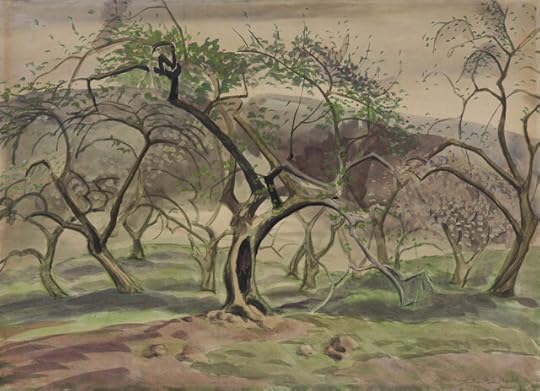
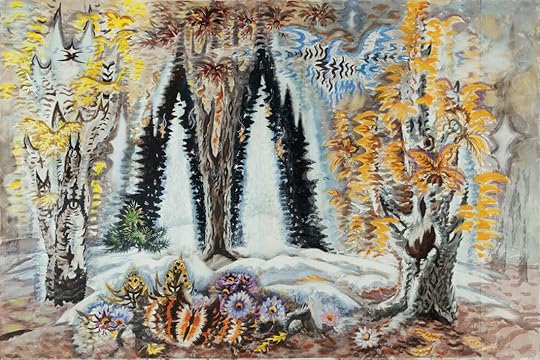
Anna arrives at the orchard with the intention to abjure social life, deverbalize her experience, and adjust her consciousness to the rhythms of the trees. She succeeds, for a time, until the arrival of her old friend Jan, nomadic and lively and at work on a book about the painter Charles Burchfield. Alarmed by her isolation and declining health, he tries to get her painting again, while Anna is determined to show him the orchard as she sees it.
As the harvest approaches, the outside world descends in the form of pickers, contractors, neighbors, and pomologists. Anna realizes that the only way back to her idyllic life is to turn a profit. It becomes an obsession, much like her former in the way it consumes her, the way an apple oxidizes, might rot.
Hothouse Bloom is a millennial pastoral, both painterly and critical in its ideas about art, permaculture, subjectivity, and the natural world.
This isn’t a fast paced read. There is a constant air of malaise throughout the novel that could be difficult for some readers but, to me, added to the allure. Austyn Wohlers has perfectly captured the yearning desire to detach from reality and become consumed by an idillic landscape… Her protagonist, Anna, willingly loses herself to an inherited apple orchard only to find out it may not be the garden of Eden she was hoping for. This book reads like a surrealist painting: somewhere between dreaming and wakefulness.
Kind of the ultimate “whenever you go, there you are” novel. Tore through this book in two days because it’s a real confluence of my interests: painting, agriculture, and dramatically disappearing to be alone even at great personal cost.
I don’t think this book is for everyone, but if it’s for you I think it’s really worth a weekend. Going to the store now to buy a bunch of apples.
Also, just a note, but Hub City Press continues to deliver excellent and interesting books. Everything I’ve picked up from them over the past couple of years has been well worth my time.
DNF. Unfortunately not for me. Blurbs promised Lispector vibes, but stopping somewhere in the middle, I have to 'say' I fully disagree with that. To me, it didn't have any Han Kang or Lispector vibes at all.
giving this a 5 because i want more people to read it. it’s surreal & also (deliberately?) noncathartic … very rich with symbolism and metaphor and archetype. my favorite kind of book, one that begs to be discussed
a delirious exploration of a failed ascetic attempting to wash away her failures by living in a constant present ignorant of past, future, and the contemporaneous world
You have such a unique voice, and I really admire the way you were able to make every page so engaging. Honestly, it’s one of those books that stays with you long after reading.
Hothouse Bloom started off slow, I was able to get into it, and by the end I was just confused. Im not someone that requires my book to be action packed or anything, but I felt like I was waiting for something to happen that never did. I didn’t get a chance to really connect to any of the characters, especially Anna because the information was so limited, and there were a few holes that were never plugged up.
Some things made sense and I was fine with some of the showing instead of telling. Through Jan, I was able to put together that she was depressed and thats why she was trying to escape her past life. But I wish we knew a little more about why? What happened with her ex? What were her family dynamics like? What was she like prior to this? I don’t feel like i learned much beyond a couple of sentences.
I liked the underlying message. In trying to escape everyday life, thoughts, responsibilities, she put herself in a situation that was killing her and much more difficult to navigate. Giving up her life and painting hurt her more than facing whatever problems she was running from. I also liked the parallels between her and her grandfather. They both were trying to escape and he must have sensed that in her in the short time they spent together.
The ending fell so flat for me, it felt rushed and left me with more questions than answers.
This entire review has been hidden because of spoilers.
"She was born for (and always seeking) a world of immense gentleness."
"She was always trying to prolong the hours into all sixty of their gradient minutes, and to stretch the minutes into the full halo of their sixty seconds."
Beautiful, dark, deep. We meet Anna, painter, lost creature, figuring out her life. She inherits an apple orchard, and we follow her journey as she wonders about her life, the meaning, and how she navigates the darkness within. So complex and relatable for those who seek solace in nature and being alone. Austyn Wohlers, an artist indeed. Life is more than living in the most grandeur moments. But also sitting in the mundane, picking the rotten apples, wandering the paths that surround us without thought. Definitely thought-provoking.
was really intrigued by the story idea, and the writing and space was so immersive (and a beautiful book cover as well). But the story and writing lost me a bit in the last 50 pages with the shifts to the new perspectives and so many loose threads left unvisited and unresolved. The book was short, so it would have been interesting to have another 50 pages maybe with a few of those things tied up
“What happened? Perhaps it is I who have impressed myself on them, not the other way around—I who have imbued myself, my coldness, my failure, my rot. There was a pleasure in that. I've deformed things. By being here I've ruined them”
I found Hothouse Bloom utterly captivating. I simply couldn’t put it down. Wohlers’s writing made Anna’s orchard so vivid that I can see it clearly whenever I close my eyes. The inclusion of the bear was a particularly clever touch, adding a sense of unpredictability that kept me on edge and eager to read more. For most of the novel, we experience the world through Anna’s perspective, but in the final quarter, Wohlers shifts to Jan’s point of view. His raw, unfiltered thoughts about Anna hit like a punch to the gut, powerfully reminding the reader that this is a novel about perception as much as isolation or ambition. I also loved the decision to end the novel at a McDonald’s; a stark, almost jarring contrast to the pastoral solitude of the orchard. It brilliantly symbolizes Anna’s reentry into the everyday, commercial world she had tried so hard to escape. Overall, Wohlers masterfully explores the boundaries between self and society, art and survival, and perception and reality.
In Wohler's captivating debut novel, Anna—a lapsed artist tackling millennial malaise inherits her grandfather's permaculture apple orchard—is transformed by a renewed connection to nature. She aims toward a nonverbal experience where she blends in with the very landscape she never expected to land in. But soon all that matters is turning a profit with the harvest; the idyllic farm falls short of her personal Eden.
Crammed to the gills with similes. If everything is like something else, what is the something else like? For a character trying so desperately to erase her human context by living in an orchard, she sure spent a lot of time tying every single thing to some other signifier.
so close to being a fave but the literal last word was such a letdown. & in general the perspective shifts in the last ~1/3 interrupted my suspension of disbelief… there could have been a way to concretize things without being so obvious about it
maybe more like 4.25 - i was expecting it to be lower during the first half but the way the characterization twisted as the story went on was so interesting. this book contains a lot in terms of reflections on the way we engage with nature, as an escape, as a refuge, a release from the world, but a lot of times we ignore that it is a part of this world, it’s inescapable to live among people and among everything humans have created up to this point. we can’t shrink away from the world like anna wants to, even if we try so desperately. this makes me think a lot about classes i took in college where we discuss this perfect, untouched idea of “nature,” when in reality that has never really existed - even preserved land is maintained and manicured to human liking and needs. i almost hated anna by the end but also understood her desires while understanding that they would never be attainable, that she was killing herself by trying to become nature in spite of her humanity. i also think this is an allegory for people in many other ways trying to find an escape from the modern world only to realize you can’t remove yourself from it.
after reading some other reviews i think people had a lot of issues with the loose ends, but i kind of feel like that wasn’t really the point - jan was always intended to be a foil to anna and we saw a lot of their relationship reflected in gil and tamara as well. i’m not sure we are meant to understand their entire story, although it could’ve been helpful to learn a bit more. i feel like jan’s chapter from his perspective was well placed because it provided a lot of important context only after seeing the unraveling from her perspective, which i think is important to understanding how that can happen to a person without realizing.
This entire review has been hidden because of spoilers.
A young woman abandons her painting career to take over an orchard she inherits from her grandfather. As I’ve noted before, I’ve had amazingly good luck with novels with orchard settings, including novels by Ann Patchett, Eliza Minot, Kristina Gorcheva-Newberry, Tracy Chevalier, Jane Hamilton, Amanda Coplin, Shelley Read, and Larry Watson. This one is good, but not in the same class as those, and it will have limited appeal because there's almost no action aside from changes in the type of work as the seasons change, and there's no ending; it just stops. Instead, it's highly introspective and mostly pretty melancholy; the novel takes place almost entirely inside Anna's mind as she struggles to understand her place in the world and to figure out whether human connections are necessary or even desirable. Oddly, for a book so tied to the land, the location is ambiguous; all we know is that it's near a university town in a place with hills. (We also learn in passing at one point that it's about an hour's drive from "the sea,") Alas, there are also far too many typos.
Hothouse Bloom is a contemplative and beautifully unsettling work of literary fiction that examines solitude, creation, and the porous boundary between self and environment. Austyn Wohlers writes with a painter’s sensitivity, rendering Anna’s retreat into her grandfather’s orchard with language that feels deliberate, tactile, and alive. The novel’s stillness is not empty but charged, inviting readers to slow down and inhabit Anna’s evolving consciousness.
What makes this book particularly striking is its intellectual and emotional ambition. The tension between art and withdrawal, productivity and purity, human connection and ecological immersion is handled with nuance rather than resolution. As the outside world presses in, Hothouse Bloom becomes a quiet but incisive meditation on obsession, labor, and the cost of idealism. It is a novel that rewards attentive readers and stands out for its originality and depth within contemporary literary fiction.
There’s something boneless and untethered about this novel that follows a season in the life of 20-something, would-be painter Anna, who unexpectedly inherits an apple orchard from a grandfather she barely knew and decides to leave painting and New York City behind and remake herself as an orchardist. She wants to cut herself off from everyone and, even though she doesn’t know what she’s doing, eschews help and advice from the well-meaning sheep-farming couple next door. She can’t even connect with the pair of young dogs they give her to help keep the bears away from the orchard. Gawd, who can’t love a young dog? Perhaps the (I assume) millennial author of this novel felt that her millennial character’s existential crisis was compelling. Just, nope. Try massively irritating.
Written with the intensity of Clarice Lispector and the early work of Elena Ferrante, Austyn Wohlers's Hothouse Bloom is a courageous satire of an idealistic artist turned ruthless capitalist. A thrilling and fevered examination of friendship, ambition, and obsession, Hothouse Bloom announces the arrival of a singular and important new voice in literature.
The writing kept me captivated, and the story and characters in the first 100 pages got me excited but at the halfway point everything seemed to take a turn, one I did not like. The ending was absurd to me
loved the lushness loved the "solitude", started getting a little cloying for me. I guess the apple's rotten right to the core, from all the things passed down from all the other apples before.