

What do you think?
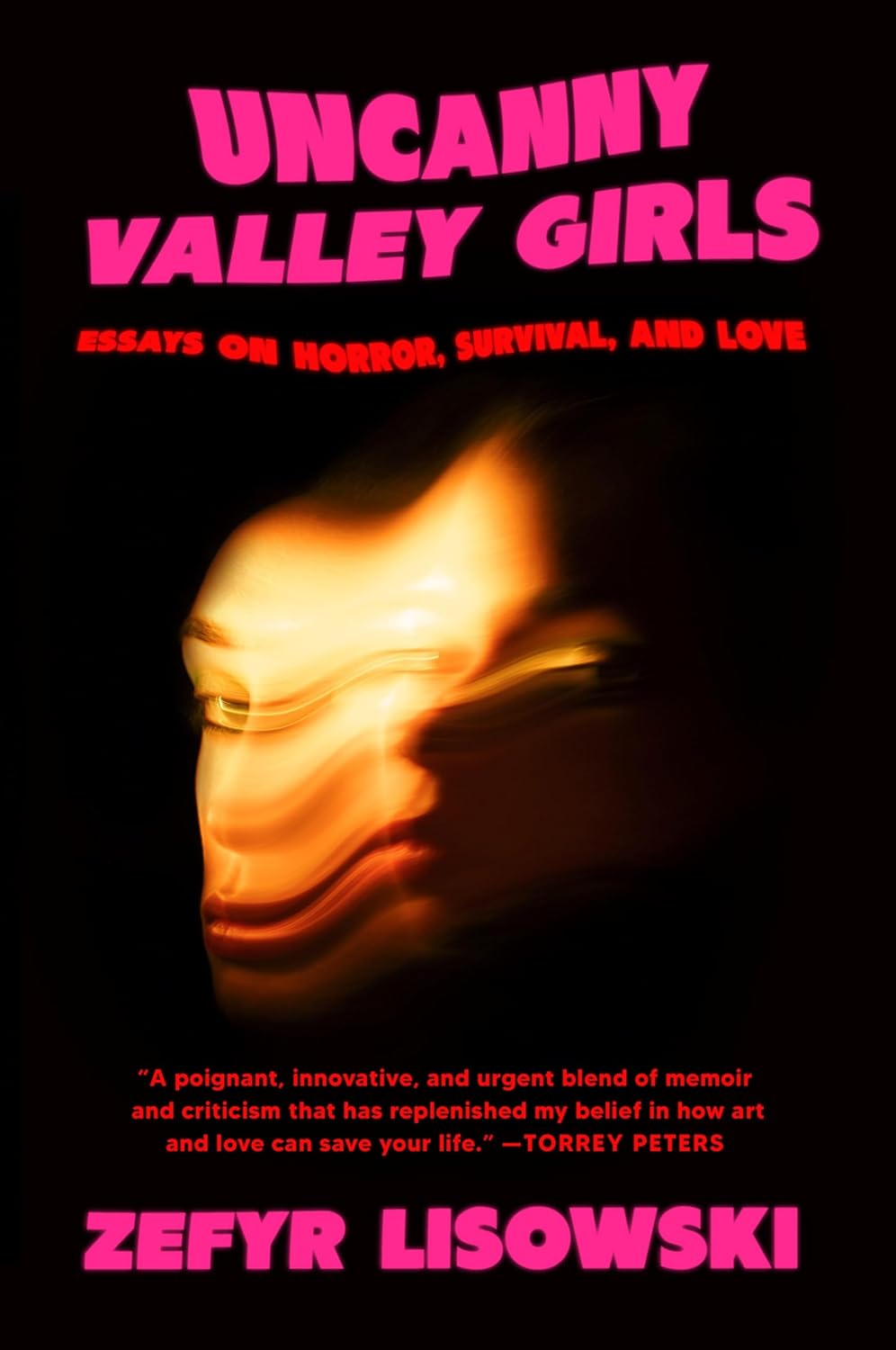
Uncanny Valley Girls: Essays on Horror, Survival, and Love
A sharply personal and expansive essay collection dedicated to the strange and absurd beauty of horror films, exploring the complications of gender, the insidiousness of class ascension, and the latent violence hidden in our own uncanny reflections.
This is how it first I loved them, and then I loved myself.
At twenty-seven, poet Zefyr Lisowski found herself in the place she feared a locked psych ward. While inside, she turned to horror movies—her deepest, most constant comfort.
Rather than disturb, scary movies have always provided solace and connection for Lisowski, as they do many others—offering a vision of a world filled equally with beauty and pain, and a reason to reach out to others and hold them tight. After all, as Lisowski argues, what terrifies us most about these movies is our own uncanny reflection—and at the root of that fear, a desperate desire to love and be loved.
In these wide-ranging essays, Lisowski weaves theory and memoir into nuanced critiques of films such as The Texas Chain Saw Massacre and Saint Maud. From fears about sickness and disability, to trans narratives and the predator/victim complex, to the struggle to live in a world that wants you dead, she explores horror’s reciprocal impact on our culture and—by extension—our lives. Through it all, Lisowski lays bare her own complex biography—spanning from a trans childhood in the South to the sweaty dancefloors of Brooklyn—and the family, friends, and lovers that have bloomed with her into the present.
Deeply felt, blood-spattered, and brimming with care and wonder, Uncanny Valley Girls thrusts this seasoned poet to centerstage.
This is how it first I loved them, and then I loved myself.
At twenty-seven, poet Zefyr Lisowski found herself in the place she feared a locked psych ward. While inside, she turned to horror movies—her deepest, most constant comfort.
Rather than disturb, scary movies have always provided solace and connection for Lisowski, as they do many others—offering a vision of a world filled equally with beauty and pain, and a reason to reach out to others and hold them tight. After all, as Lisowski argues, what terrifies us most about these movies is our own uncanny reflection—and at the root of that fear, a desperate desire to love and be loved.
In these wide-ranging essays, Lisowski weaves theory and memoir into nuanced critiques of films such as The Texas Chain Saw Massacre and Saint Maud. From fears about sickness and disability, to trans narratives and the predator/victim complex, to the struggle to live in a world that wants you dead, she explores horror’s reciprocal impact on our culture and—by extension—our lives. Through it all, Lisowski lays bare her own complex biography—spanning from a trans childhood in the South to the sweaty dancefloors of Brooklyn—and the family, friends, and lovers that have bloomed with her into the present.
Deeply felt, blood-spattered, and brimming with care and wonder, Uncanny Valley Girls thrusts this seasoned poet to centerstage.
223 pages, Paperback
First published October 7, 2025
About the author
Zefyr Lisowski
5 books64 followersZefyr Lisowski is the author of Uncanny Valley Girls, an essay collection about horror movies, exes, and intimacy (Harper Perennial 2025). A 2023 NYFA/NYSCA Fellow in Nonfiction and 2023 Queer|Art Fellow, she’s also the author of two poetry collections, Girl Work (Noemi Press 2024) and Blood Box (Black Lawrence 2019). Raised in the Great Dismal Swamp, North Carolina, Zefyr lives in Brooklyn and has seen grave robbers twice.
Ratings & Reviews
Friends & Following
Create a free account to discover what your friends think of this book!
Community Reviews
Displaying 1 - 30 of 159 reviews
February 21, 2025
”This is a story of loss, and this is also a story of love. In both, the horrors are ceaseless. In fact, it’s all the same story. The horrors are how I found myself.”
In Uncanny Valley Girls, Lisowski examines her own complex life story through the lens of horror film; critiquing cult favorites and exploring themes of illness and disability, otherness, gender and trans narratives, violence, class, and more. She journeys through her Southern trans childhood to her inpatient psychiatric stay as an adult, detailing all of the beauty and love and loss and cruelty in-between, arguing that horror—real or filmic—is about survival in the face of pain, about learning to live and love despite the wounds. What I particularly loved about this collection of essays was Lisowski’s clearly depicted complicated relationship with being raised in the South. As a born and raised Southerner myself, I could relate on a very personal level and often times found myself nodding along while reading. It’s a true love-hate relationship. ”The South, for better or for worse, was my home.”
This book gives readers a wide-ranging memoir-in-essays written with intent, grace, and a keen eye for detail; Lisowski never misses a beat. Loved this so much and will undoubtedly buy the finished copy on pub day.
🎬 Watchlist for Uncanny Valley Girls:
The Ring
Pet Sematary
Black Swan
Dark Water
Ringu
Scream
Final Destination 3
Saw
Sleepaway Camp
The Texas Chainsaw Massacre (original)
Lizzie
The Wolf Man
Ginger Snaps
Saint Maud
Antichrist
🎞️ Honorable Mentions:
Jaws
The Sixth Sense
I Know What You Did Last Summer
Dawn of the Dead
Creepshow
Maniac
Friday the 13th
Longlegs
Immense gratitude to Harper Perennial for the early copy in exchange for an honest review. Available Oct 07 2025. *Quotes are pulled from an advanced reader copy and are subject to change prior to publication* ❤️🔥
In Uncanny Valley Girls, Lisowski examines her own complex life story through the lens of horror film; critiquing cult favorites and exploring themes of illness and disability, otherness, gender and trans narratives, violence, class, and more. She journeys through her Southern trans childhood to her inpatient psychiatric stay as an adult, detailing all of the beauty and love and loss and cruelty in-between, arguing that horror—real or filmic—is about survival in the face of pain, about learning to live and love despite the wounds. What I particularly loved about this collection of essays was Lisowski’s clearly depicted complicated relationship with being raised in the South. As a born and raised Southerner myself, I could relate on a very personal level and often times found myself nodding along while reading. It’s a true love-hate relationship. ”The South, for better or for worse, was my home.”
This book gives readers a wide-ranging memoir-in-essays written with intent, grace, and a keen eye for detail; Lisowski never misses a beat. Loved this so much and will undoubtedly buy the finished copy on pub day.
🎬 Watchlist for Uncanny Valley Girls:
The Ring
Pet Sematary
Black Swan
Dark Water
Ringu
Scream
Final Destination 3
Saw
Sleepaway Camp
The Texas Chainsaw Massacre (original)
Lizzie
The Wolf Man
Ginger Snaps
Saint Maud
Antichrist
🎞️ Honorable Mentions:
Jaws
The Sixth Sense
I Know What You Did Last Summer
Dawn of the Dead
Creepshow
Maniac
Friday the 13th
Longlegs
Immense gratitude to Harper Perennial for the early copy in exchange for an honest review. Available Oct 07 2025. *Quotes are pulled from an advanced reader copy and are subject to change prior to publication* ❤️🔥
September 12, 2025
⭐⭐⭐.5
Pre-Read Notes:
I loved the title of this book and I was very curious to see the author's take on the uncanny valley.
Final Review
Great mashup of love letter to horror movies and a memoir about changing identity. These two topics played well together in this book.
This reminds me of some other books I love about horror and being human, like NIGHT MOTHER and DANSE MACABRE
Favorite Essays:
1. "Your Swan, My Swan"
2. "Ghost Face"
3. "Cutting in Miniature"
A word about the essays:
1. "Prelude" - An interesting reflection on how girls in horror movies reflect the real world.
2. "The Girl, the Well, the Ring" - "Girls were punished. The disabled were to be feared. Anything gender nonconforming was even scarier. What does it mean as a sick girl to learn again and again that sick girls deserve to be punished?" p21 "If you first identify yourself in a host of ghosts, what does it mean to live despite that? If you grow up disabled and only have hatred surrounding you in every bit of media you consume, what does it take to turn that hatred into an act of care for others who are hated, too?" p21 I feel so seen by this book.
"I realized I had always been different. Nothing had been taken from me. It’s not that I was uncurable, but rather the idea of a “cure” was proposed by someone who hated my existence in the first place." Dang this woman just...nails disability and ableism right on the head. Magnificent!
3. "Your Swan, My Swan" - A short essay on how art tends to depict disability as counter to life or counter to joy. I like this author's nonfiction work!
4. "Our Oceans, Ourselves" - A piece about taking risks, and recognizing risks best avoided.
5. "Ghost Face" - An excellent analysis of "Scream" a horror movie sensation from the '90's.
6. "War on Terror" - An essay about how US culture changed after 9/11. "There are two violences here, that of the empire and that of its denizens, and they are asymmetric violences, and different ones. But they are linked. One reflects another: The lessons of a militarized society become internal for everyone in that society. That’s why it’s broken." p81
7. "Southern Fried " - "The interpretations of the film we shared were a way of sharing each other, letting one another in. Beauty can stun, too, and sometimes the only thing to do with that is to hold that complexity with others." p98 An excellent essay on "Texas Chainsaw Massacre" and learning to love your gory bits.
8. "Cutting in Miniature" - A fascinating analysis of Lizzie Borden's infamous case. Wow, I'm reading this author's other book, DOLL HOUSE.
9. "Preliminary Materials for a Theory of the Werewolf Girl" - This one is a little cliched, with the whole pubescent girl being a werewolf or monster concept.
10. "Devotion" - An absolutely moving essay about the author's deceased sister.
11. "Crazy in Love" - This is the kind of internalized-ableist mess that really annoys me. It's subject is a little murky but I'm pretty sure it's an essay about why relationships with "crazy women" (sic) are...I dunno, doomed maybe? Whatever, I'm just going to say it doesn't take mental illness to ruin a relationship, so I don't see how it could be said that it does.
12. "Uncanny Valley of the Dolls" - An excellent essay about a friend of the authors, a maker of dolls who break typical beauty standards.This title is almost the source of the books title. The author applies the uncanny valley concept here to describe how transitioning is a re-emerging into a new concept of the self.
13. "Postlude" - "That, maybe, is what makes [horror movies] scary. Not a man with a chainsaw or a dripping girl in a well, but the fact that we can hurt others without even meaning to. The pain we can cause, and the legacies left behind by that pain anyway." p198
Notes:
1. content notes:
horror movies, gore, ableism, internalized ableism, mental illness stigma, residential treatment, institutionalization,
Thank you to Zefyr Lisowski, Harper Collins Publishers, and NetGalley for an accessible digital arc of UNCANNY VALLEY GIRLS. All views are mine.
Pre-Read Notes:
I loved the title of this book and I was very curious to see the author's take on the uncanny valley.
Final Review
Great mashup of love letter to horror movies and a memoir about changing identity. These two topics played well together in this book.
This reminds me of some other books I love about horror and being human, like NIGHT MOTHER and DANSE MACABRE
Favorite Essays:
1. "Your Swan, My Swan"
2. "Ghost Face"
3. "Cutting in Miniature"
A word about the essays:
1. "Prelude" - An interesting reflection on how girls in horror movies reflect the real world.
2. "The Girl, the Well, the Ring" - "Girls were punished. The disabled were to be feared. Anything gender nonconforming was even scarier. What does it mean as a sick girl to learn again and again that sick girls deserve to be punished?" p21 "If you first identify yourself in a host of ghosts, what does it mean to live despite that? If you grow up disabled and only have hatred surrounding you in every bit of media you consume, what does it take to turn that hatred into an act of care for others who are hated, too?" p21 I feel so seen by this book.
"I realized I had always been different. Nothing had been taken from me. It’s not that I was uncurable, but rather the idea of a “cure” was proposed by someone who hated my existence in the first place." Dang this woman just...nails disability and ableism right on the head. Magnificent!
3. "Your Swan, My Swan" - A short essay on how art tends to depict disability as counter to life or counter to joy. I like this author's nonfiction work!
4. "Our Oceans, Ourselves" - A piece about taking risks, and recognizing risks best avoided.
5. "Ghost Face" - An excellent analysis of "Scream" a horror movie sensation from the '90's.
6. "War on Terror" - An essay about how US culture changed after 9/11. "There are two violences here, that of the empire and that of its denizens, and they are asymmetric violences, and different ones. But they are linked. One reflects another: The lessons of a militarized society become internal for everyone in that society. That’s why it’s broken." p81
7. "Southern Fried " - "The interpretations of the film we shared were a way of sharing each other, letting one another in. Beauty can stun, too, and sometimes the only thing to do with that is to hold that complexity with others." p98 An excellent essay on "Texas Chainsaw Massacre" and learning to love your gory bits.
8. "Cutting in Miniature" - A fascinating analysis of Lizzie Borden's infamous case. Wow, I'm reading this author's other book, DOLL HOUSE.
9. "Preliminary Materials for a Theory of the Werewolf Girl" - This one is a little cliched, with the whole pubescent girl being a werewolf or monster concept.
10. "Devotion" - An absolutely moving essay about the author's deceased sister.
11. "Crazy in Love" - This is the kind of internalized-ableist mess that really annoys me. It's subject is a little murky but I'm pretty sure it's an essay about why relationships with "crazy women" (sic) are...I dunno, doomed maybe? Whatever, I'm just going to say it doesn't take mental illness to ruin a relationship, so I don't see how it could be said that it does.
12. "Uncanny Valley of the Dolls" - An excellent essay about a friend of the authors, a maker of dolls who break typical beauty standards.This title is almost the source of the books title. The author applies the uncanny valley concept here to describe how transitioning is a re-emerging into a new concept of the self.
13. "Postlude" - "That, maybe, is what makes [horror movies] scary. Not a man with a chainsaw or a dripping girl in a well, but the fact that we can hurt others without even meaning to. The pain we can cause, and the legacies left behind by that pain anyway." p198
Notes:
1. content notes:
horror movies, gore, ableism, internalized ableism, mental illness stigma, residential treatment, institutionalization,
Thank you to Zefyr Lisowski, Harper Collins Publishers, and NetGalley for an accessible digital arc of UNCANNY VALLEY GIRLS. All views are mine.

April 1, 2025
ARC for review. To be published October 7, 2025.
2.5 stars
Lisowski is trans and has gone through debilitating physical, mental and family issues, (seriously, she has been through the wringer) including a stay in a psych ward. Throughout she says she has looked to horror films to keep her grounded and to help her maintain her sense of self.
In each chapter/essay the author discusses or at least mentions specific movies that connect her to various points in her life, but this is all very personal to her, versus any sort of overall examination of these movies and what she believes they mean in any sort of larger context. At the beginning of the book she notes, “for those of us who live in power’s periphery - trans disabled, non-white, poor - love happens under violence’s shadow,” so perhaps she is directing the observations in the book at these audiences and I don’t fall into any of those categories.
This is SUCH a great title, and the synopsis sounded great, but I found reading the book a bit of a slog. Often the movies are mentioned only briefly, or in passing, which left me wondering why the author used the trope at all, and didn’t just go with straight up memoir; I wanted more of a connection with the movies and it really wasn’t to be found here. I did like this: “The thing about growing up in the rural South is that’s it’s so easy to fantasize about living anywhere else.” I just moved to the CITY South, but, preach, sister!
2.5 stars
Lisowski is trans and has gone through debilitating physical, mental and family issues, (seriously, she has been through the wringer) including a stay in a psych ward. Throughout she says she has looked to horror films to keep her grounded and to help her maintain her sense of self.
In each chapter/essay the author discusses or at least mentions specific movies that connect her to various points in her life, but this is all very personal to her, versus any sort of overall examination of these movies and what she believes they mean in any sort of larger context. At the beginning of the book she notes, “for those of us who live in power’s periphery - trans disabled, non-white, poor - love happens under violence’s shadow,” so perhaps she is directing the observations in the book at these audiences and I don’t fall into any of those categories.
This is SUCH a great title, and the synopsis sounded great, but I found reading the book a bit of a slog. Often the movies are mentioned only briefly, or in passing, which left me wondering why the author used the trope at all, and didn’t just go with straight up memoir; I wanted more of a connection with the movies and it really wasn’t to be found here. I did like this: “The thing about growing up in the rural South is that’s it’s so easy to fantasize about living anywhere else.” I just moved to the CITY South, but, preach, sister!

November 4, 2025
‘Horror movies are about staying alive, and that focus has taught me more about care than anything else. Through horror, you can see everything in life: atmosphere and pain and death and above all the desire to keep living. And in who you watch horror with—because few people I know watch scary movies alone—you can see the rest of it, too: the sex and guilt and grief and everything else that goes into loving yourself and others. I thought of each of my past relationships and of the movies we watched and the ways we reached for each other in the things that wounded us—’
‘The miracle is our capacity to live and love despite this wounding—To be afraid is to care, deeply, about whatever you’re afraid of; or, to be more succinct, to be afraid is to care. Scary movies, I believe, can teach you how to live. They can show you the lives you’ve already led. They can promise what a new horizon looks like. They’re how I survived.’
‘A point The Ring makes inadvertently is how interconnected all monstrosities are. The young dead girl who’s the villain is different and sick, so she becomes a recipient of violence—locked up in a barn, surveilled and neglected in the medical facilities that became her other home. And because she’s a recipient of violence, she becomes an enactor of violence. It’s important to note that the vehicle for her curse, the videotape, is a depiction of her own pain. Only after she’s murdered does she start to kill.’
‘What does it mean to “share a cold” instead of shutting it away? I’m inspired by all the small dominions we, the disabled, have, how much has been shared already. Money. GoFundMes. Personal care assistants. Lists of accessible events spaces. Mutual care and love and support. Knowledge is shared openly online and in group texts and over encrypted chats and through webs of in-person and digitized gossip. Disabled people have created a whole wellspring of culture and activism and vitality—and that buried truth is part of what makes us scary to the abled mainstream. Both Samara and Zelda have full interiorities that the movies cannot see—but that shadow of something beyond the protagonists’ comprehension is part of what makes them scary. They endure despite those in power wanting them dead. My partner had chronic pain, as well, and as we fucked during Pet Semetary that Halloween in 2015, it, too, felt like a kind of love that rejected charity. Sick bodies doing what they do, refusing to be stifled—together—is a radical act.’
‘I’m grateful for the anger that propelled this making in the first place. But even still, I have to wonder what my life would be like had I never been exposed to these supremacist messages in the first place. Here’s one last little story. In The Ring, when the girl climbs up the well, her bones cracking out of place, bending behind herself, this is supposed to be a sign she’s to be feared and pitied and isn’t even human. When I discovered, suddenly as a child, that I could do the same thing, oh, it felt like freedom.’
‘Horror movies live in the interregnum of the uncanny, a world ripe with anticipation. This is why they are so frightening. They are close enough to unnerve, and like a mirror they reflect us back—distorted into something strange and new. But isn’t that love, too? Doesn’t everything worth doing change you?’
‘In Black Swan, the protagonist dies at the end. Nina dies, the movie suggests, because she can’t change while the world around her does. In this way she differs from most horror protagonists, who bend but rarely break to survive a violent world. Personal shibboleths against killing get discarded, shrinking violets turn into hardened women, but they survive despite, or because of, these changes. There’s a whole term for it, which the scholar Carol J. Clover coined in a 1987 essay: the final girl, the one who lives because of how she transforms.’
‘—I’d break into the big botanic garden at the outskirts of my neighborhood, scrambling over the fence and walking among hydrangeas bright and pale as the moon.’
‘And who hasn’t felt nostalgia for a place because it was where they first realized who they truly were? Who hasn’t found themselves in something they didn’t even realize they were looking for?’
‘For the longest time, I’d tell people I loved art-house films as a way of making my own desires seem more palatable: the movies of Apichatpong Weerasethakul or Ingmar Bergman or Terrence Malick or any other director who specialized in long, winding, thoughtful shots and barely restrained emotions. I’d tell them they helped me see the splendor of the world around me, how their restraint helped me see myself. I do love them, and it’s true that a part of me was found there. But of all the movies I’ve seen, I’ve found the most splendor in The Texas Chain Saw Massacre, discovered myself the most in it—a revving engine of a film, sick and quick and all deep reds. In fact, this is how it worked: First I loved it, and then I loved myself.’
‘There are the marks that are left on us, and then there are the marks we leave on ourselves, and I’m still not sure if there’s a difference between the two. The South shaped me, and the South hurt me, but that doesn’t change the fact that I’m Southern and thus implicated in its own violence—raced and classed and sure as my own violence toward myself. Maybe there’s no difference at all between the social ostracization I received in the South and my rage at the other Southerners stuck in my small town and finally the punches I started to dole out to myself—all were motivated, after all, by a refusal to see the beauty in a harsh and beautiful environment.’
‘—it’s bright and yellow outside and the air smells like pine, and I’m starting to realize that everything about my life will have to change. The bruise throbs, and I wince, air sharp and cool as I inhale. Eventually I will learn to share that beauty, too, even though it’ll be years still before I stop harming myself. Soon, the sun will set. But for now the light comes into me like birdsong. Someday, I will be free.’
‘Who, in our country, could see that synchronicity in death and not think the only way out was through work? Cutting anything down can be a way to stay alive, but it can also distract from the other work of living as well—A life slivering bits away isn’t a life at all: In the aftermath—I’d feel alive and ashamed and above all still in pain, hiding in long-sleeve shirts and oversize pants splattered with the paint I covered the dollhouse in. It wasn’t purifying; it wasn’t redeeming; it just continued.’
‘But maybe I’m looking at this wrong. Things that aren’t a choice aren’t always a burden. Who hasn’t wanted to be stripped of agency but in, like, a hot way? Who hasn’t wanted to slide sure as a moon ascends in the skies towards something not you, something beautiful instead? Who hasn’t dreamed of a life beyond the moment of change, too?’
‘—in that moment—just for that moment—I felt safe and held and fully present in their arms. I turned to hold them back as I started to blur out once more. I could love this person, I thought. And then, everything started happening again, and I was gone.’
‘Faith, like desire, is rarely on your own terms: If you can only sometimes choose what you have faith in, you can never select what has faith in you—there briefly and then disappear—I gave it up, lasting six weeks before I stopped entirely. As much as I wanted to, I simply didn’t believe in the practice enough to stay. It shadowed me while I was lucky enough to hold it, and then, as quick as Maud’s own consumption in flames at the end of the film, it was gone.’
‘What stuck with me the most about Agatha’s life was the way she wasn’t restored to former glory the same way other saints were. In most icons of her, she floats holding her severed breasts on a plate. Peace, God, whatever: I knew she was propaganda to prevent women from reacting more strongly to men’s shit, but even still. The fact that something could be taken from her and she responded by putting her losses on display spoke to me before I even could register why.’
‘To be crazy is to know your life has been marked as less than by those in positions of power; to date other crazy people is to assert your life’s worth nonetheless. Antichrist is a comically misogynistic movie if you watch it from the man’s perspective; it’s a harrowing film if you watch it from the woman’s.’
‘Our beauty, constructed against a society that fetishizes and hates us in simultaneity, is abject, and Greer’s dolls are, too.’
‘Sometimes I wonder if we just reenact the same life patterns of those who haunt us—a two-way street: If grief is an act of love, then leaving a ghost of yourself behind is as well. Sharing an experience with someone who isn’t there anymore, I have to believe, is a way of communicating with them—’
‘For me, horror is a love language, but maybe that’s because for me everything is a love language. Horror at its most intimate is a way to share the secret parts of yourself with others: what frightens you, what comforts you, what you’re nonplussed by.
When I was a child, my greatest fear was losing who I was through what happened to me. And yes, I’ve lost myself again and again. But in the wake of the violence that shapes us, I’ve also found myself more fully than I ever could have without the wound.
Being in the present—which is to say, presence—implies a future, too; caring in that moment shapes that future. Presence makes a path to find future presence, too. It shows us a life, struggles linked in love and fear alike. Like a final girl, a sick girl, a girl in the well, I know I won’t heal from what I’ve done or what was done to me. But I’m not interested in being healed nor in my wounds being reopened: What I want now is to love the scars that make us us—’
‘A flash of blood transforming into hope. A girl turning into a wolf. A host of faceless women all marching up a hill. As I enter the clubhouse for dinner, I’ll only hear the unsteady metronome of the present—unknown, unwinding, scary, and free. Fear has a thumping rhythm to it, but so does being present with people you care about, and that’s what I choose to listen to now. I’ll walk to the dining table—sound of love rumbling underneath everything like a heater slowly clanking up to speed. Even if the French psychoanalysts are right and horror is about the rotten, the dead, the makeup-less, the sick; even if we’re confined to the abject, the unwell, the uncanny—that’s beautiful, too. Yes, I’ve lost myself through the things that have happened to me, but so have you. So I’ll sit down at the table with my new friends, far away from you, and you, and the you I haven’t met yet, and fix my plate and fill my belly, eating to satiation at last. Soon it will be completely dark outside and the coresidents will start trickling to bed. I’ll wash my plate, and while the other writers and artists start their nighttime routines, I’ll start my own: I’ll walk down by the lake again, dip my feet into the water, and think of the present to come. My legs, still healing, will throb from the exertion of walking down the hill, but that’s part of what being present means: accepting pain as a prerequisite for being alive.’
June 7, 2026
UNCANNY VALLEY GIRLS is Zefyr Lisowski's fraught memoir detailing her coming of age as a young transwoman and how closely she associates horror movies with both the innate violence of girlhood and the "othering" of people society deems too many standard deviations away from the norm.
I enjoyed the parallels Lisowski made between white female victimhood and drowning, the blind support of foreign war in small town America whilst ignoring numerous domestic acts of violence and Saw, and how Scream is both an archetype and a subversion of California Americana. Woven into these essays are details from Lisowski's own life, primarily focusing on their various relationships and their understanding of gender framed within the context of their coming of age.
These essays actually reminded me a lot of Rax King's TACKY, in the sense that they are less about what the things actually are and more about what they represent for the person writing about them. I was expecting more horror commentary and that wasn't quite what I got here, but it ended up being a happy accident because I quite enjoyed Lisowski's writing.
3 stars
I enjoyed the parallels Lisowski made between white female victimhood and drowning, the blind support of foreign war in small town America whilst ignoring numerous domestic acts of violence and Saw, and how Scream is both an archetype and a subversion of California Americana. Woven into these essays are details from Lisowski's own life, primarily focusing on their various relationships and their understanding of gender framed within the context of their coming of age.
These essays actually reminded me a lot of Rax King's TACKY, in the sense that they are less about what the things actually are and more about what they represent for the person writing about them. I was expecting more horror commentary and that wasn't quite what I got here, but it ended up being a happy accident because I quite enjoyed Lisowski's writing.
3 stars
January 19, 2026
“Samara Morgan, in The Ring, is just a body filtered through the horror or grief on others' faces, self-mediated by others' disgust, barely a girl at all. A cypher, a ghost, primarily—no, only—hated. She is never allowed to be a girl.”
Uncanny Valley Girls is a book I closed with my chest tight and my mind buzzing, the way good horror leaves you when it has done its work. From its opening pages, where Zefyr Lisowski recounts her admission to a psychiatric hospital after a bad breakup, the collection makes a clear promise: this will be a book that refuses easy separations between fear and care, beauty and harm, love and survival. Horror films become a language for living, a way of rerouting fear into something survivable, something that can be looked at directly.
The strongest essays ground themselves in close readings of horror movies, especially The Ring, Black Swan, Dark Water, Scream, and The Texas Chain Saw Massacre. Lisowski’s essay on The Ring and disability is particularly devastating, tracing how contamination and bodily difference are coded as monstrous and how Samara is never allowed the fullness of girlhood or care. Again and again, Lisowski shows how horror mirrors the lessons marginalized people are taught about themselves: that harm is inevitable, that love must be earned through endurance, that beauty is conditional. Her analysis of final girls, werewolves, and drowning women becomes inseparable from her own reckoning with transness, illness, class, and the quiet violences of intimacy.
Place matters deeply here. Lisowski writes with painful clarity about growing up in the rural South, longing for cinematic California, and realizing later that white supremacy travels easily. Essays on torture, war, and gendered violence trace how comfort with harm seeps into personal relationships, teaching her that being loved often meant being hurt. What gives the book its force is not just critique, but refusal. Lisowski insists that disabled and trans people do not need to be palatable to deserve care, and that pain can be named without being romanticized.
I loved this book most when it stayed close to horror films I recognize and love, letting them act as mirrors rather than metaphors stretched too thin. Some later essays drift away from horror, which occasionally left me wishing for that cinematic anchor. Still, Uncanny Valley Girls is a tender, unsettling, and deeply affirming meditation on becoming. It is a book about horror, yes, but also about choosing to live, to love, and to keep looking even when the reflection hurts.
📖 Read this if you love: intimate cultural criticism rooted in lived experience; horror as a lens for survival rather than spectacle; trans, disabled, and mentally ill narratives that refuse sanitization; essays that braid memoir with film analysis; or lyric nonfiction that sits with contradiction.
🔑 Key Themes: Horror as Care and Survival; Transness, Disability, and Unpalatability; Violence, Intimacy, and Learned Harm; Place, Class, and White Supremacy; Mental Illness, Self-Harm, and Chosen Survival.
Content / Trigger Warnings: Death of a Parent (moderate), Cancer (minor), Alcoholism (minor), Medical Content (minor), Sexual Content (minor), Murder (minor), Child Death (minor), Police Violence (minor), Fatphobia (minor), Physical Violence (moderate), Blood (minor), Homophobia (moderate), Sexual Assault (moderate), Self Harm (severe), Alcohol (minor), Child Abuse (minor), Transphobia (moderate), Pandemic (minor), Eating Disorder (minor), Misogyny (minor), Mental Illness (moderate), Forced Institutionalization (moderate), Drug Use (minor), Suicide (minor), Drug Abuse (minor).
Uncanny Valley Girls is a book I closed with my chest tight and my mind buzzing, the way good horror leaves you when it has done its work. From its opening pages, where Zefyr Lisowski recounts her admission to a psychiatric hospital after a bad breakup, the collection makes a clear promise: this will be a book that refuses easy separations between fear and care, beauty and harm, love and survival. Horror films become a language for living, a way of rerouting fear into something survivable, something that can be looked at directly.
The strongest essays ground themselves in close readings of horror movies, especially The Ring, Black Swan, Dark Water, Scream, and The Texas Chain Saw Massacre. Lisowski’s essay on The Ring and disability is particularly devastating, tracing how contamination and bodily difference are coded as monstrous and how Samara is never allowed the fullness of girlhood or care. Again and again, Lisowski shows how horror mirrors the lessons marginalized people are taught about themselves: that harm is inevitable, that love must be earned through endurance, that beauty is conditional. Her analysis of final girls, werewolves, and drowning women becomes inseparable from her own reckoning with transness, illness, class, and the quiet violences of intimacy.
Place matters deeply here. Lisowski writes with painful clarity about growing up in the rural South, longing for cinematic California, and realizing later that white supremacy travels easily. Essays on torture, war, and gendered violence trace how comfort with harm seeps into personal relationships, teaching her that being loved often meant being hurt. What gives the book its force is not just critique, but refusal. Lisowski insists that disabled and trans people do not need to be palatable to deserve care, and that pain can be named without being romanticized.
I loved this book most when it stayed close to horror films I recognize and love, letting them act as mirrors rather than metaphors stretched too thin. Some later essays drift away from horror, which occasionally left me wishing for that cinematic anchor. Still, Uncanny Valley Girls is a tender, unsettling, and deeply affirming meditation on becoming. It is a book about horror, yes, but also about choosing to live, to love, and to keep looking even when the reflection hurts.
📖 Read this if you love: intimate cultural criticism rooted in lived experience; horror as a lens for survival rather than spectacle; trans, disabled, and mentally ill narratives that refuse sanitization; essays that braid memoir with film analysis; or lyric nonfiction that sits with contradiction.
🔑 Key Themes: Horror as Care and Survival; Transness, Disability, and Unpalatability; Violence, Intimacy, and Learned Harm; Place, Class, and White Supremacy; Mental Illness, Self-Harm, and Chosen Survival.
Content / Trigger Warnings: Death of a Parent (moderate), Cancer (minor), Alcoholism (minor), Medical Content (minor), Sexual Content (minor), Murder (minor), Child Death (minor), Police Violence (minor), Fatphobia (minor), Physical Violence (moderate), Blood (minor), Homophobia (moderate), Sexual Assault (moderate), Self Harm (severe), Alcohol (minor), Child Abuse (minor), Transphobia (moderate), Pandemic (minor), Eating Disorder (minor), Misogyny (minor), Mental Illness (moderate), Forced Institutionalization (moderate), Drug Use (minor), Suicide (minor), Drug Abuse (minor).
November 6, 2025
Thank you Zefyr Lisowski, Harper Publishing, and NetGalley for the ARC!
I always hesitate to even rate memoirs. Who am I to assign a star rating to someone's life, someone's story? I didn't think about this when I requested this essay collection, which was more memoir than I had initially anticipated. It's not even that I don't enjoy memoirs- one of my favorites is a memoir. However, I really struggled through this one at times.
As someone who also wrote about women in horror media for an undergrad thesis, I was so excited to read this essay collection. I was also excited to analyze horror media from a the perspective of a trans woman. Admittedly, I had not explored trans women very much in my thesis (it wasn't very good in general- I broke my leg and was on a bunch of painkillers while I was writing it). However, identifying as queer myself now has opened up a whole new world of interpretations. Horror has not always been kind to trans women, despite how steeped in queerness these movies usually are. I really enjoyed when Lisowski explored this and found myself looking at movies I've seen a million times in a new light.
However, the inclusion of memoir passages took away from that sometimes. It certainly wasn't every single time- I really thought the passages describing her sexuality, family, grief, and mental health were good. I could very clearly see the connection in these instances to the movies that she'd be describing. At the same time, there were some chapters about relationships that I just couldn't get behind as much. I just don't see how some of these numerous, messy relationships connected to horror, other than being a clearly horrible experience for her. Additionally, the essay format of this collection could be repetitive at times. I read most of it in one or two big sittings and I found myself thinking "you've told this story before" on multiple occasions.
I also think, while interesting, the last chapter about trans artist Greer Lankton felt a little out of place. On one hand, it solidified the author's comparison of being a trans woman with being "uncanny" like the dolls made by Lankton. However, while it still qualified as horror art, I think it would've been more well-rounded and less all over the place had the author continued to just analyze horror movies and novels. It felt strange also to end on that chapter and only just then define uncanny when I think it could've been explored more throughout. I think generally many of these essays could have benefitted from some shared themes to tie everything together more cohesively.
I always hesitate to even rate memoirs. Who am I to assign a star rating to someone's life, someone's story? I didn't think about this when I requested this essay collection, which was more memoir than I had initially anticipated. It's not even that I don't enjoy memoirs- one of my favorites is a memoir. However, I really struggled through this one at times.
As someone who also wrote about women in horror media for an undergrad thesis, I was so excited to read this essay collection. I was also excited to analyze horror media from a the perspective of a trans woman. Admittedly, I had not explored trans women very much in my thesis (it wasn't very good in general- I broke my leg and was on a bunch of painkillers while I was writing it). However, identifying as queer myself now has opened up a whole new world of interpretations. Horror has not always been kind to trans women, despite how steeped in queerness these movies usually are. I really enjoyed when Lisowski explored this and found myself looking at movies I've seen a million times in a new light.
However, the inclusion of memoir passages took away from that sometimes. It certainly wasn't every single time- I really thought the passages describing her sexuality, family, grief, and mental health were good. I could very clearly see the connection in these instances to the movies that she'd be describing. At the same time, there were some chapters about relationships that I just couldn't get behind as much. I just don't see how some of these numerous, messy relationships connected to horror, other than being a clearly horrible experience for her. Additionally, the essay format of this collection could be repetitive at times. I read most of it in one or two big sittings and I found myself thinking "you've told this story before" on multiple occasions.
I also think, while interesting, the last chapter about trans artist Greer Lankton felt a little out of place. On one hand, it solidified the author's comparison of being a trans woman with being "uncanny" like the dolls made by Lankton. However, while it still qualified as horror art, I think it would've been more well-rounded and less all over the place had the author continued to just analyze horror movies and novels. It felt strange also to end on that chapter and only just then define uncanny when I think it could've been explored more throughout. I think generally many of these essays could have benefitted from some shared themes to tie everything together more cohesively.
October 2, 2025
Very personal and moving, but at times I lost the thread. This one was just more abstract than I prefer my essay collections to be. The horror is definitely more of a background framework but I still found the author’s interpretations and connection to the stories interesting.
May 1, 2026
Navadno nisem občinstvo za tovrstne knjige, ker tole je bolj spominska literatura kot avtofikcija, bolj izpovedna kot esejistična, bolj osebna kot teoretska. Ampak po drugi strani ta boleča neposrednost in hkratna nesentimentalizacija (zato pa močna lirizacija) gradita na trenutke res iskreno in mučno branje. Čeprav nisem hipohonder, je bilo to na trenutke tudi zelo telesno branje, kar pa je preprosto velika pohvala avtorici. Pripoved o travmi, nasilju, osamljenosti, samopoškodovanju, želji, toksičnih razmerjih ..., ki jo pogosto sopostavlja s pronicljivim branjem grozljivk (nikoli, recimo, nisem pomislil na volkodlake kot metaforo za trans osebe, o bolečini in vznemirljivosti postajanja) oziroma umetnosti. Knjiga te prisili k zelo pomenonosnemu razmišljanju o tem, kako se prepletata osebna izkušnja teksta in tekst, recepcija in umetnina. Noro osvežujoče in lepo, a tudi, kot že nekajkrat zapisano, boleče. Podčrtal sem si kar nekaj kompleksnih razmišljanj o tem, kako žrtve nasilja perpetuirajo (samo)nasilje, in tudi sam ugotovil, da je to ena izmed stvari, ki me pri grozljivkah najbolj pritegnejo; ta dinamika, recipročnost in cikličnost nasilja in groze, rablja in žrtve. (Avtorici je, spet tako kot meni, eden najbolj grozljivih in najlepših prizorov v zgodovini groze zaključek Teksaškega pokola z motorko.) Poleg tega eseji res prikažejo izkušnjo trans osebe v vsej njeni plastičnosti in (žal pogosto zanikani) človeškosti, v vsej bolečini (ki je družbena bolečina) in veselju (ki ni samo osebno, ampak tudi skupnostno), zato je to pomembno branje tudi zunaj tega, ali marate grozljivke ali ne.

October 7, 2025
Major thanks to NetGalley and Harper Perennial for sending me an ARC of this in exchange for my honest thoughts:
"𝘍𝘰𝘳 𝘮𝘦, 𝘩𝘰𝘳𝘳𝘰𝘳 𝘪𝘴 𝘢 𝘭𝘰𝘷𝘦 𝘭𝘢𝘯𝘨𝘶𝘢𝘨𝘦, 𝘣𝘶𝘵 𝘮𝘢𝘺𝘣𝘦 𝘵𝘩𝘢𝘵’𝘴 𝘣𝘦𝘤𝘢𝘶𝘴𝘦 𝘧𝘰𝘳 𝘮𝘦 𝘦𝘷𝘦𝘳𝘺𝘵𝘩𝘪𝘯𝘨 𝘪𝘴 𝘢 𝘭𝘰𝘷𝘦 𝘭𝘢𝘯𝘨𝘶𝘢𝘨𝘦. 𝘏𝘰𝘳𝘳𝘰𝘳 𝘢𝘵 𝘪𝘵𝘴 𝘮𝘰𝘴𝘵 𝘪𝘯𝘵𝘪𝘮𝘢𝘵𝘦 𝘪𝘴 𝘢 𝘸𝘢𝘺 𝘵𝘰 𝘴𝘩𝘢𝘳𝘦 𝘵𝘩𝘦 𝘴𝘦𝘤𝘳𝘦𝘵 𝘱𝘢𝘳𝘵𝘴 𝘰𝘧 𝘺𝘰𝘶𝘳𝘴𝘦𝘭𝘧 𝘸𝘪𝘵𝘩 𝘰𝘵𝘩𝘦𝘳𝘴: 𝘸𝘩𝘢𝘵 𝘧𝘳𝘪𝘨𝘩𝘵𝘦𝘯𝘴 𝘺𝘰𝘶, 𝘸𝘩𝘢𝘵 𝘤𝘰𝘮𝘧𝘰𝘳𝘵𝘴 𝘺𝘰𝘶, 𝘸𝘩𝘢𝘵 𝘺𝘰𝘶’𝘳𝘦 𝘯𝘰𝘯𝘱𝘭𝘶𝘴𝘴𝘦𝘥 𝘣𝘺."
A compelling memoir told through the appreciation of horror films. Lisowski’s history of grief and the trans experience mixed with the reckonings of different kinds of horror films sheds light on why queer folks, like myself, have such a curiosity around slashers, schlock, ghosts, and gore. Because of this, Lisowski finally brought me to my first-time viewing of Scream, an inherently queer film about running away from your own queerism, hiding it, shoving it down layers of Craven’s meta-masterpiece.
The perfect companion for all your Spooktober watches. What will you be watching for Spooktober?
Also, if you haven’t yet, follow me on Letterboxd! 👻🎃
"𝘍𝘰𝘳 𝘮𝘦, 𝘩𝘰𝘳𝘳𝘰𝘳 𝘪𝘴 𝘢 𝘭𝘰𝘷𝘦 𝘭𝘢𝘯𝘨𝘶𝘢𝘨𝘦, 𝘣𝘶𝘵 𝘮𝘢𝘺𝘣𝘦 𝘵𝘩𝘢𝘵’𝘴 𝘣𝘦𝘤𝘢𝘶𝘴𝘦 𝘧𝘰𝘳 𝘮𝘦 𝘦𝘷𝘦𝘳𝘺𝘵𝘩𝘪𝘯𝘨 𝘪𝘴 𝘢 𝘭𝘰𝘷𝘦 𝘭𝘢𝘯𝘨𝘶𝘢𝘨𝘦. 𝘏𝘰𝘳𝘳𝘰𝘳 𝘢𝘵 𝘪𝘵𝘴 𝘮𝘰𝘴𝘵 𝘪𝘯𝘵𝘪𝘮𝘢𝘵𝘦 𝘪𝘴 𝘢 𝘸𝘢𝘺 𝘵𝘰 𝘴𝘩𝘢𝘳𝘦 𝘵𝘩𝘦 𝘴𝘦𝘤𝘳𝘦𝘵 𝘱𝘢𝘳𝘵𝘴 𝘰𝘧 𝘺𝘰𝘶𝘳𝘴𝘦𝘭𝘧 𝘸𝘪𝘵𝘩 𝘰𝘵𝘩𝘦𝘳𝘴: 𝘸𝘩𝘢𝘵 𝘧𝘳𝘪𝘨𝘩𝘵𝘦𝘯𝘴 𝘺𝘰𝘶, 𝘸𝘩𝘢𝘵 𝘤𝘰𝘮𝘧𝘰𝘳𝘵𝘴 𝘺𝘰𝘶, 𝘸𝘩𝘢𝘵 𝘺𝘰𝘶’𝘳𝘦 𝘯𝘰𝘯𝘱𝘭𝘶𝘴𝘴𝘦𝘥 𝘣𝘺."
A compelling memoir told through the appreciation of horror films. Lisowski’s history of grief and the trans experience mixed with the reckonings of different kinds of horror films sheds light on why queer folks, like myself, have such a curiosity around slashers, schlock, ghosts, and gore. Because of this, Lisowski finally brought me to my first-time viewing of Scream, an inherently queer film about running away from your own queerism, hiding it, shoving it down layers of Craven’s meta-masterpiece.
The perfect companion for all your Spooktober watches. What will you be watching for Spooktober?
Also, if you haven’t yet, follow me on Letterboxd! 👻🎃
October 5, 2025
Explores horror films and how they reflect-and at times perpetuate-social/cultural beliefs (ie disabled and sick people are usual the villains like in the ring and pet semetary. Anyone seen as "other" is someone to be feared). Very theory focused that mixes the personal stories of Lisowski’s life with feeling seen through horror films, and how current events like the war in Iraq affected the horror industry.
More memoir than I was expecting especially further into the book. She ties her experiences to horror movies and how they made her feel seen but as we get further in the book, we get less of the horror movie stuff and it just becomes a memoir with very loose links to horror movies or "here’s some stuff about my life and a relationship and we just so happened to watch this movie together and both appreciated it." Sometimes the horror movie aspects would feel more like brief mentions or something to mark a huge emotional moment for the author rather than being fully immersed and working together with the more memoir heavy elements.
Non linear timeline and meandering storytelling really bogged down the flow of the book and made it feel too abstract for my taste. It made it hard to feel engaged and became confusing especially when it could feel repetitive at times, plus the long chapters made a fairly short book feel unending.
There were moments where I struggled to finish and continuously thought about DNFing and I probably should have because after the 70% mark I would literally skim at times.
I think it would’ve worked better if it was just a straight up memoir and she lost the attempt at tieing in the horror movie metaphors/connections because ultimately it fell flat; especially when by the second half it’s almost completely forgotten and the last chapter doesn’t even mention horror movies but instead explores Greer Lankton’s life.
She also explores artists and writers that she relates to so it very much is a memoir that tried to be unique in making those horror connections but didn’t work the way it could’ve because she was too broad in scope.
I think the personal stories can be really helpful for a lot of people, and I appreciated the author’s vulnerability, but for me it was the writing style that didn’t work. I think a lot of my lack of enjoyment in the second half especially is because it completely turned away from the horror/cultural critique aspect which I was really enjoying in the first half! There are other books that do this memoir in essay format with a connection to horror films MUCH better (ie Dinner on Monster Island by Tatiana de Rozario) so I was hoping that’s what this would be as well.
I have no doubt the book will find its audience, I’m just not it. Thank you Harper Perennial and NetGalley for the earc.
More memoir than I was expecting especially further into the book. She ties her experiences to horror movies and how they made her feel seen but as we get further in the book, we get less of the horror movie stuff and it just becomes a memoir with very loose links to horror movies or "here’s some stuff about my life and a relationship and we just so happened to watch this movie together and both appreciated it." Sometimes the horror movie aspects would feel more like brief mentions or something to mark a huge emotional moment for the author rather than being fully immersed and working together with the more memoir heavy elements.
Non linear timeline and meandering storytelling really bogged down the flow of the book and made it feel too abstract for my taste. It made it hard to feel engaged and became confusing especially when it could feel repetitive at times, plus the long chapters made a fairly short book feel unending.
There were moments where I struggled to finish and continuously thought about DNFing and I probably should have because after the 70% mark I would literally skim at times.
I think it would’ve worked better if it was just a straight up memoir and she lost the attempt at tieing in the horror movie metaphors/connections because ultimately it fell flat; especially when by the second half it’s almost completely forgotten and the last chapter doesn’t even mention horror movies but instead explores Greer Lankton’s life.
She also explores artists and writers that she relates to so it very much is a memoir that tried to be unique in making those horror connections but didn’t work the way it could’ve because she was too broad in scope.
I think the personal stories can be really helpful for a lot of people, and I appreciated the author’s vulnerability, but for me it was the writing style that didn’t work. I think a lot of my lack of enjoyment in the second half especially is because it completely turned away from the horror/cultural critique aspect which I was really enjoying in the first half! There are other books that do this memoir in essay format with a connection to horror films MUCH better (ie Dinner on Monster Island by Tatiana de Rozario) so I was hoping that’s what this would be as well.
I have no doubt the book will find its audience, I’m just not it. Thank you Harper Perennial and NetGalley for the earc.
June 16, 2026
Some of these essays I absolutely loved, while others just fell really flat for me. I found the theme of horror to be a bit lacking when compared to the summary given - it was present in some essays, while in others it seemed to be simply included to create a theme.
Outside of the themes regarding scary movies, I have a lot of respect of Lisowski's vulnerability, as she showed us the parts of herself that may be deemed ungly or bad - those are the things that often make a more interesting memoir for me. The biggest probably for me was that there lacked a certain cohesion. But when a theme really lands (ex. her essays on Texas Chain Saw Massacre and werewolves), it lands with beautiful analysis, understanding, and relatability.
R.E.A.D.S. SCORE
R: 7/10
E: 6/10
A: 7/10
D: 6/10
S: 7/10
Total: 6.60/10.00
Outside of the themes regarding scary movies, I have a lot of respect of Lisowski's vulnerability, as she showed us the parts of herself that may be deemed ungly or bad - those are the things that often make a more interesting memoir for me. The biggest probably for me was that there lacked a certain cohesion. But when a theme really lands (ex. her essays on Texas Chain Saw Massacre and werewolves), it lands with beautiful analysis, understanding, and relatability.
R.E.A.D.S. SCORE
R: 7/10
E: 6/10
A: 7/10
D: 6/10
S: 7/10
Total: 6.60/10.00
February 11, 2026
3.5 rounded down. The intersection of memoir, horror movie readings, and queer theory is exactly my cup of tea. Unfortunately, I felt like the book as a whole and even different parts of specific essays needed a stronger through line
March 8, 2026
Really, really great essay collection. I've always been fascinated by horror movies and what drives us to make and watch them (in spite of being too scared to actually watch them) and I loved Zefyr Lisowski's intersectional approach to them. The audio book was also just fantastic, Jackie Meloche is a gem.
November 17, 2025
Each essay in this collection connects an aspect of the writer’s life to a theme seen in horror films. She writes from the standpoint of a trans woman affected by disabilities. The thing with essay collections, for me, is that they’re often a mixed bag of essays that immediately draw me in and others that don’t grip me the way I want them to. While I did enjoy all of these, some were much stronger than others. I think my personal enjoyment was highest for the essays that really leaned into examining horror films as a rich text rather than those that were more focused on the author’s life story. Still, I think this book is well worth a read, especially for those with a strong interest in the memoir genre.
June 1, 2026
A Map Home Through the Haunted House
Zefyr Lisowski’s “Uncanny Valley Girls” finds, inside horror’s old violences, a difficult grammar of survival and care.
By Demetris Papadimitropoulos | June 1st, 2026
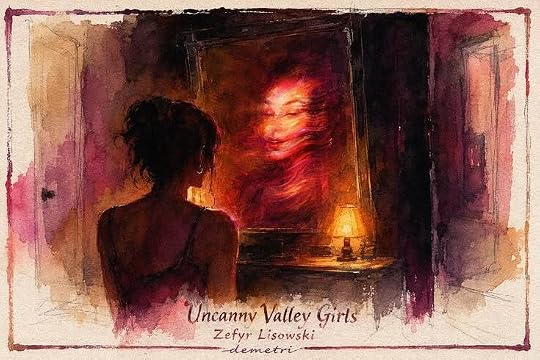
“Bad Mirror with Lamp” – A solitary figure faces a warped reflection in a dark room, where horror becomes not escape or cure but the difficult mirror through which “Uncanny Valley Girls” asks what it means to be misrecognized, wounded, and still held by one small light.
Do not mistake Zefyr Lisowski’s “Uncanny Valley Girls” for a book about learning to love horror movies. That would make the collection more domesticated, safer, and much less interesting than it is. This memoir-in-essays is about the unnerving education of being recognized by bad mirrors: the sick girl in the well, the swan woman dying for perfection, the werewolf girl mid-change, the doll too beautiful and too wounded to be merely an object. Lisowski writes from the possibility that the first image to make sense of you may also be an image trying to diagnose you into monstrosity, eroticize you, kill you, or file you under “problem” for ease of cultural shelving.
Even before the book begins its passage through horror cinema, disability, transness, grief, love, art, and psychiatric crisis, it places a blade on the table and declines to pretend it is only a prop. In the Prelude, Lisowski is preparing to enter a psych ward while watching “Scream” in the emergency room. The scene could become a too-neat emblem – scary movie as comfort object, genre as triage – but Lisowski is after something less ornamental. Horror, she argues, is not escape from real life. It is one of the forms in which real life returns wearing a mask it has chosen with care.
Much of “Uncanny Valley Girls” proceeds from that reversal. The collection is organized into a Prelude, three numbered parts, eleven essays, and a Postlude, with acknowledgments, references, and a sensitive-subject appendix following after. Its outer frame is simple enough: each essay orbits a film, artwork, cultural figure, or monstrous archetype. Its deeper motion is spiraling. A film enters Lisowski’s body, wounds her, fascinates her, embarrasses her, houses her, and then returns years later with another face. The screen does not stay on the wall. It follows her home.
Early essays establish the book’s first syntax of fear. “The Ring” becomes a way to reread sickness and disability; Samara is not absolved, but she is restored to girlhood after a culture and a film have reduced her to a curse in a wet dress. “Pet Sematary” opens onto the cruelty of making sick women into household terrors. “Black Swan” becomes, in one of the collection’s most devastating turns, a love story by misdirection: Lisowski watches it with a lover on New Year’s Eve, knows she is trans, does not know how to become herself without losing the person beside her, and later reveals that the sleeping body photographed as “my swan” was awake and posing all along.
The middle third widens from private fear to public weather. “Scream” is read through whiteness, Southern memory, Elizabeth City, class longing, and the police killing of Andrew Brown Jr. “Saw” and “Final Destination” appear in the atmosphere of the Iraq War, where torture cinema and imperial violence are not treated as identical but are allowed to share the same national air. “The Texas Chain Saw Massacre” becomes not just a grimy object of endurance but a strangely beautiful Southern text, full of heat, grass, animal death, feminized labor, and the possibility that ugliness may still know something about staying alive. Lisowski is very good at refusing the museum label that would make any of these films mean only one thing.
Rather than proceeding by revelation, the book proceeds by thickening. The later essays move through “Ginger Snaps,” werewolf girlhood, sexual violation, Simone Weil, “Saint Maud,” dead sisters, Catholic devotion, “Antichrist,” psychiatric confinement, Greer Lankton’s dolls, facial feminization surgery, addiction, suicide, and trans art-making. This is a crowded room, and some of its figures have to speak from the doorway. Yet the crowding is part of the point. Lisowski’s life, like her criticism, is full of bodies that are too visible and not seen clearly enough. The question is not how to climb out of the uncanny valley, but how to live there without letting its warped gaze write the captions.
Its nearby books are not ordinary film studies. Lisowski shares some haunted domestic architecture with Carmen Maria Machado’s “In the Dream House,” some pop-cultural spellwork with Elissa Washuta’s “White Magic,” and some cult-horror self-inquiry with Kier-La Janisse’s “House of Psychotic Women.” But “Uncanny Valley Girls” is less interested in making horror respectable than in making respectability explain itself. The problem is not only that horror contains cruel images of trans, disabled, sick, feminine, or otherwise othered bodies. The problem is that, for many viewers, those cruel images arrived first. They were already there, already internalized, already glowing in the dark before anyone thought to offer a kinder mirror.
Part of the book’s force comes from how seriously Lisowski takes that contradiction. She does not perform the familiar rescue operation by which the monster is revealed to have been heroic all along, then escorted into the soft lighting of approval. That would be too tidy, and this book has an earned suspicion of tidiness. Lisowski is drawn instead to impure recognition: the cruel film that still made a second home, the beloved object that must be criticized without being discarded, the lover whose taste cannot be separated from the years of touch surrounding it, the wound that did not heal but did teach the body a new arrangement of attention.
A great deal of contemporary cultural writing claims ambivalence; much of it merely alternates between praise and rebuke with the decisiveness of a windshield wiper. Lisowski’s double sight is more serious. She can write against “Black Swan” as a film intoxicated by annihilation while still honoring the intimacy of having watched it with someone she loved. She can find “The Texas Chain Saw Massacre” beautiful without sanding off its terror. She can identify with Samara without pretending Samara’s violence is incidental. The book is most intelligent when it can hold refusal without turning refusal into posture: refusal to purify horror into healing, trauma into lesson, art into cure, or the self into a perfectly innocent witness.
Prose remains Lisowski’s sharpest instrument and, on occasion, the knife she forgets she is still holding. She writes in long, pressure-gathering sentences that move by association – film to body, body to lover, lover to theory, theory back to the hospital room – before landing on a short declarative strike. The diction is lush but not plush; it has blood under its fingernails. Water, scars, knives, fur, dolls, masks, breasts, wrists, mirrors, screens, and hospital light recur until they stop functioning as symbols and begin behaving like tools. They do not decorate the argument. They do the cutting.
At its best, this style makes criticism feel embodied rather than merely applied. Lisowski does not stand at a clean distance from “The Ring” and announce that disabled girls have been mishandled by horror. She remembers childhood hospitals, seizures, joint pain, diagnostic dismissal, the loneliness of appearing “well,” and the fear of being seen too clearly by institutions that cannot be trusted with what they see. That is the book’s method in miniature: the film is not an example pasted into memoir; it is a room the memoir has been trapped inside for years.
Doctrinaire neatness would betray the material, and Lisowski usually lets the mess keep its weather. Still, the collection has a pattern the reader begins to hear: a horror object wounds or frightens; the narrator recognizes herself in what culture asks her to reject; the essay critiques the object’s cruelty; the movement bends toward care, community, or staying alive. The pattern is powerful. It is also, by the final third, familiar enough to leave tracks in the floorboards. The book is not patchy – its floor is high – but it can be rhythmically over-insistent, as if every haunted room must be searched with the same flashlight.
Its structure does more than stack the essays; it changes the pressure inside them. The Prelude and Postlude matter because they prevent the collection from becoming a cabinet of bright horrors. We begin in psychiatric crisis, with “Scream” playing in the emergency room; we end not with cure but with presence, appetite, lake water, friends, aching legs, and the stubborn fact of a future that has not become harmless. The three-part progression also matters: private recognition first, wider cultural violence next, and finally a more theoretical and archival reckoning with transformation, devotion, and art.
More than anything, the book understands care as something more rigorous than consolation. Care is not the tidy aftercare horror receives once it has made its mess. Care is what happens when the horror is still in the room and someone stays anyway. It appears in disabled mutual aid, in lovers watching films together, in friends who call after surgery, in a mother’s text saying she is glad her child is alive, in the refusal to make dead trans women useful only as martyrs. The miracle, Lisowski suggests, is not always healing. Many wounds do no such courteous thing. The miracle is that life continues around them and sometimes through them.
If the book belongs to the present, it does so without dressing itself in the day’s loudest topical costume. Trans and disabled bodies are still treated as public problems to diagnose, legislate, correct, pity, or fear. Horror’s old habits – the sick girl as curse, the trans-coded figure as threat, the feminine body as punishment site – have not exactly retired to a villa. But “Uncanny Valley Girls” does not stop at requesting better images. It asks what one does with the old, harmful ones that were already there, already loved for reasons no clean politics can quite explain.
That is why, beneath the filmography, the book is studying attachment: the humiliating, sustaining fact that we do not love only what is good for us. Attachment to films, to lovers, to sisters dead before one’s birth, to fathers who harmed and were harmed, to former selves, to saints, to dolls, to bad mirrors, to the frightening beauty of having survived without becoming simple. Lisowski is not trying to prove that horror is secretly good for you. She is asking how to keep living after the culture’s nightmare has already entered the bloodstream. There is wit in this, too, though it is not jokey. The wit lies in the precision of reversals, in the sideways glint of a sentence that knows the monster may have better manners than the doctor.
Really, the book’s main limitation is the cost of its chosen abundance. Lisowski wants to include every pressure point: film, theory, memory, illness, lover, war, whiteness, art, self-harm, surgery, archive, faith. Some essays are overfull because the book does not trust spareness to carry the bodies it has gathered. At times, a film or filmmaker is treated too totally, as if rage has supplied the master key a little too quickly. For a writer so suspicious of purification, Lisowski occasionally polishes a judgment until it gleams with the certainty the book elsewhere distrusts.
On my scale, “Uncanny Valley Girls” earns an 88/100, which corresponds to a Goodreads-compatible 4/5 stars. That number has to hold both the brilliance and the strain. This is a high four-star book – not a near miss, but a brilliant overlit room. It is artistically brave, emotionally forceful, intellectually alive, and sometimes more saturated than shaped. Its excesses come from abundance rather than emptiness, which is a better problem than most books manage to have. Even when its seams show, they are holding together something worth watching.
Perhaps the most moving late turn comes through Greer Lankton, whose dolls allow Lisowski to think about trans beauty, fragility, artifice, hunger, archive, and survival without reducing the artist to her death. The dolls are uncanny not because they fail to look human, but because they look too much like the contradictory fact of having a body: made, damaged, posed, desired, seen badly, seen intensely, still somehow present. Lisowski’s own surgery and recovery echo against Lankton’s art without becoming a simple parallel. The essay knows that resemblance is not sameness. It also knows resemblance can still save a place at the table.
One of the pleasures of the collection is that it refuses to make tenderness behave decorously. Its generosity is not soft. It has teeth. The book saves room for the girl in the well, the swan on the couch, the werewolf under the moon, the saint on fire, the doll with too much beauty in her seams, the patient in hospital socks, the lover who leaves, the lover who arrives later, the reader who has also mistaken fear for recognition or recognition for doom. To make room, here, is not to excuse. It is to look without flinching and without turning the looking into a little throne.
Underneath the films, the book keeps asking one question in different costumes: what if the thing that harmed you was also the thing that first made you legible to yourself? That question is not comforting, but it is fertile. It explains why Lisowski’s criticism feels less like verdict than séance, less like interpretation than contact. “Uncanny Valley Girls” does not ask horror to apologize prettily and behave. It asks horror to sit still long enough for the living to examine what it has done to them.
Look closely and the collection’s title stops sounding like a clever genre wink and starts sounding like an address. These are the uncanny valley girls: Samara, Nina, Ginger, Greer’s dolls, Lisowski herself, and all the bodies asked to live in the narrow dip between fascination and disgust. Which mirrors do you smash? Which do you turn to the wall? Which, despite everything, showed you the outline of a self before anyone else knew how to look? Lisowski’s answer is never simple, and thank goodness. A simple answer would be another locked room.
One final turn keeps the book from becoming an exorcism story: Lisowski does not end by escaping horror at all. She ends by changing her relation to it. The Postlude gives us no clean bill of health, no triumphant staircase into daylight. Instead there is food, a lake, pain in the legs, the cry of animals, the knowledge that fear remains, and the quieter knowledge that fear no longer gets to narrate everything. The final movement is not away from the haunted house. It is toward learning which rooms can hold a lamp.
Still, what remains on the page is not a monster unmasked but a person becoming visible in flickers: screen-glow, lake-mist, hospital fluorescence, the shine on a doll’s cheek, the old white mask of “Scream,” the wet hair of the girl climbing out of the well. The horror does not vanish. It changes jobs. It stops being only the thing in pursuit and becomes, by the end, part of the map home.
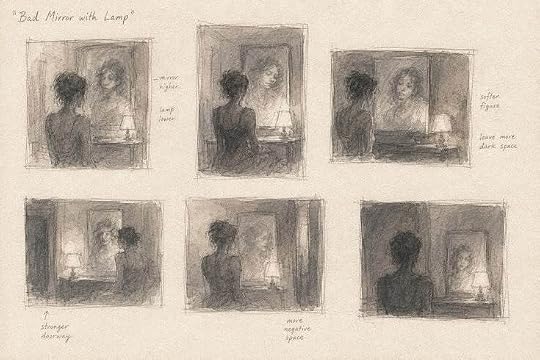
“Compositional Thumbnail Sheet” – Early thumbnail studies test the triangle of figure, mirror, and lamp, searching for the room’s emotional geometry before the watercolor’s darkness and glow begin to settle.
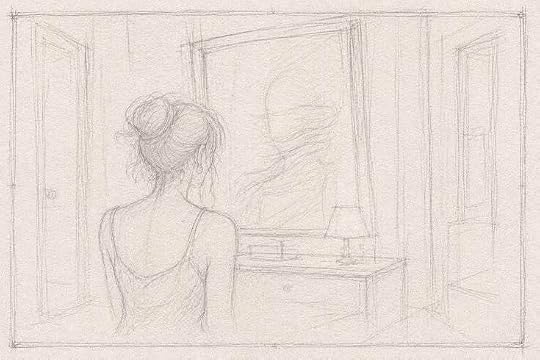
“Faint Pencil Underdrawing” – The bare graphite structure reveals the painting before atmosphere takes over: mirror frame, figure, lamp, doorway, and border held in fragile proportion.
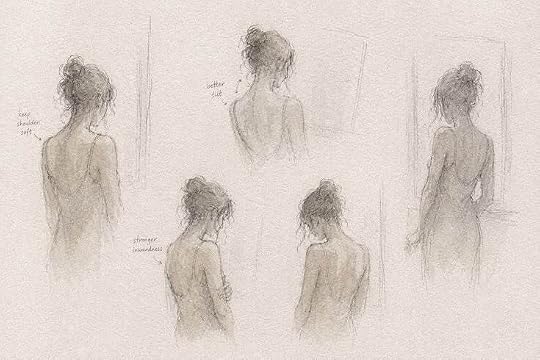
“Character Silhouette / Anatomical Posture Study” – A quiet study of the figure’s back, shoulder line, and bowed stillness, clarifying how the body would carry vulnerability without becoming portraiture.
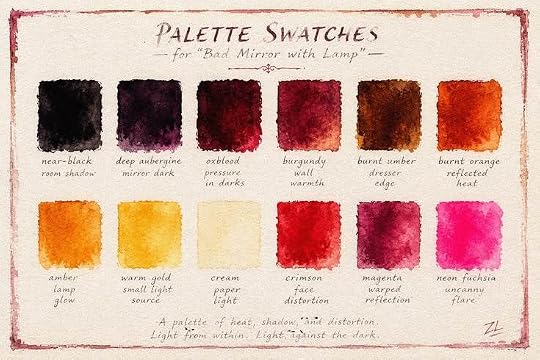
“Cover-Palette Color Swatch Sheet” – The restricted palette turns the book’s cover colors into a working vocabulary of black space, blood red, hot pink, amber, orange, cream, and bruised shadow.
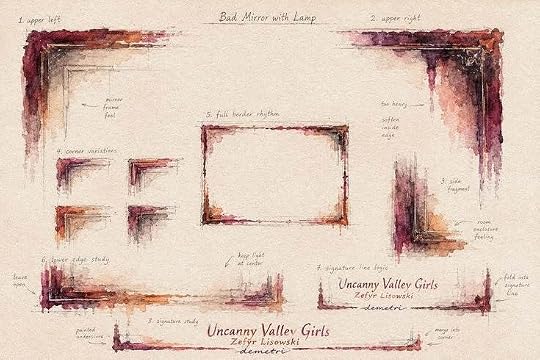
“Watercolor Border Study” – A study for the broken mirror-frame, film-frame, and plate-edge border, showing how the image would be contained without being sealed shut.
[image error]
“Pencil-Plus-First-Wash Stage” – The first washes let the mirror, lamp, and room begin to glow from the graphite bones, with the painting still visibly balanced between plan and apparition.
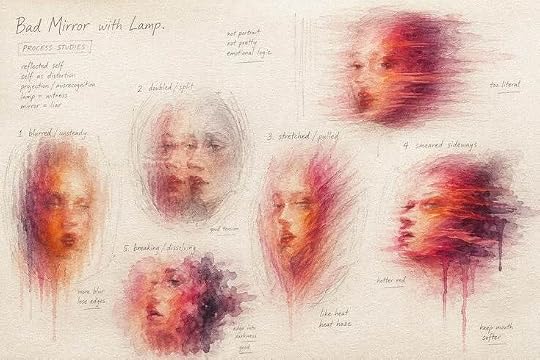
“Reflected Face Study” – A process study of the warped mirror-face, exploring how self, projection, horror image, and misrecognition might share one unstable expression.
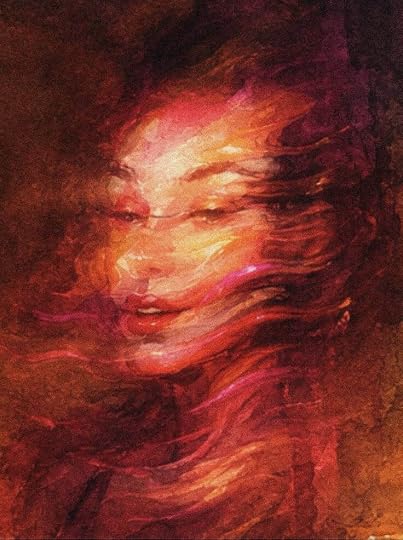
“Distorted Mirror Face Detail” – This close-up isolates the warped reflected face at the center of the larger emblematic painting, turning heat, smear, glow, and distortion into an intimate image of recognition slipping into misrecognition.
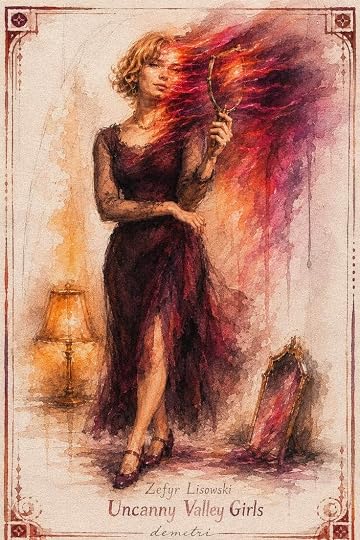
“Zefyr Lisowski – ‘Uncanny Valley Girls’” – A literary watercolor portrait of Zefyr Lisowski holding a broken mirror, where the warped red-orange reflection crosses the author’s face and turns the book’s questions of horror, authorship, trans embodiment, and misrecognition into one theatrical, handmade figure.
All watercolor illustrations by Demetris Papadimitropoulos.
Watercolors are done on 140lb vellum and then scanned into the computer using an Epson scanner. From there, they are finalized in Procreate. All art and opinions are my own.
Zefyr Lisowski’s “Uncanny Valley Girls” finds, inside horror’s old violences, a difficult grammar of survival and care.
By Demetris Papadimitropoulos | June 1st, 2026
“Bad Mirror with Lamp” – A solitary figure faces a warped reflection in a dark room, where horror becomes not escape or cure but the difficult mirror through which “Uncanny Valley Girls” asks what it means to be misrecognized, wounded, and still held by one small light.
Do not mistake Zefyr Lisowski’s “Uncanny Valley Girls” for a book about learning to love horror movies. That would make the collection more domesticated, safer, and much less interesting than it is. This memoir-in-essays is about the unnerving education of being recognized by bad mirrors: the sick girl in the well, the swan woman dying for perfection, the werewolf girl mid-change, the doll too beautiful and too wounded to be merely an object. Lisowski writes from the possibility that the first image to make sense of you may also be an image trying to diagnose you into monstrosity, eroticize you, kill you, or file you under “problem” for ease of cultural shelving.
Even before the book begins its passage through horror cinema, disability, transness, grief, love, art, and psychiatric crisis, it places a blade on the table and declines to pretend it is only a prop. In the Prelude, Lisowski is preparing to enter a psych ward while watching “Scream” in the emergency room. The scene could become a too-neat emblem – scary movie as comfort object, genre as triage – but Lisowski is after something less ornamental. Horror, she argues, is not escape from real life. It is one of the forms in which real life returns wearing a mask it has chosen with care.
Much of “Uncanny Valley Girls” proceeds from that reversal. The collection is organized into a Prelude, three numbered parts, eleven essays, and a Postlude, with acknowledgments, references, and a sensitive-subject appendix following after. Its outer frame is simple enough: each essay orbits a film, artwork, cultural figure, or monstrous archetype. Its deeper motion is spiraling. A film enters Lisowski’s body, wounds her, fascinates her, embarrasses her, houses her, and then returns years later with another face. The screen does not stay on the wall. It follows her home.
Early essays establish the book’s first syntax of fear. “The Ring” becomes a way to reread sickness and disability; Samara is not absolved, but she is restored to girlhood after a culture and a film have reduced her to a curse in a wet dress. “Pet Sematary” opens onto the cruelty of making sick women into household terrors. “Black Swan” becomes, in one of the collection’s most devastating turns, a love story by misdirection: Lisowski watches it with a lover on New Year’s Eve, knows she is trans, does not know how to become herself without losing the person beside her, and later reveals that the sleeping body photographed as “my swan” was awake and posing all along.
The middle third widens from private fear to public weather. “Scream” is read through whiteness, Southern memory, Elizabeth City, class longing, and the police killing of Andrew Brown Jr. “Saw” and “Final Destination” appear in the atmosphere of the Iraq War, where torture cinema and imperial violence are not treated as identical but are allowed to share the same national air. “The Texas Chain Saw Massacre” becomes not just a grimy object of endurance but a strangely beautiful Southern text, full of heat, grass, animal death, feminized labor, and the possibility that ugliness may still know something about staying alive. Lisowski is very good at refusing the museum label that would make any of these films mean only one thing.
Rather than proceeding by revelation, the book proceeds by thickening. The later essays move through “Ginger Snaps,” werewolf girlhood, sexual violation, Simone Weil, “Saint Maud,” dead sisters, Catholic devotion, “Antichrist,” psychiatric confinement, Greer Lankton’s dolls, facial feminization surgery, addiction, suicide, and trans art-making. This is a crowded room, and some of its figures have to speak from the doorway. Yet the crowding is part of the point. Lisowski’s life, like her criticism, is full of bodies that are too visible and not seen clearly enough. The question is not how to climb out of the uncanny valley, but how to live there without letting its warped gaze write the captions.
Its nearby books are not ordinary film studies. Lisowski shares some haunted domestic architecture with Carmen Maria Machado’s “In the Dream House,” some pop-cultural spellwork with Elissa Washuta’s “White Magic,” and some cult-horror self-inquiry with Kier-La Janisse’s “House of Psychotic Women.” But “Uncanny Valley Girls” is less interested in making horror respectable than in making respectability explain itself. The problem is not only that horror contains cruel images of trans, disabled, sick, feminine, or otherwise othered bodies. The problem is that, for many viewers, those cruel images arrived first. They were already there, already internalized, already glowing in the dark before anyone thought to offer a kinder mirror.
Part of the book’s force comes from how seriously Lisowski takes that contradiction. She does not perform the familiar rescue operation by which the monster is revealed to have been heroic all along, then escorted into the soft lighting of approval. That would be too tidy, and this book has an earned suspicion of tidiness. Lisowski is drawn instead to impure recognition: the cruel film that still made a second home, the beloved object that must be criticized without being discarded, the lover whose taste cannot be separated from the years of touch surrounding it, the wound that did not heal but did teach the body a new arrangement of attention.
A great deal of contemporary cultural writing claims ambivalence; much of it merely alternates between praise and rebuke with the decisiveness of a windshield wiper. Lisowski’s double sight is more serious. She can write against “Black Swan” as a film intoxicated by annihilation while still honoring the intimacy of having watched it with someone she loved. She can find “The Texas Chain Saw Massacre” beautiful without sanding off its terror. She can identify with Samara without pretending Samara’s violence is incidental. The book is most intelligent when it can hold refusal without turning refusal into posture: refusal to purify horror into healing, trauma into lesson, art into cure, or the self into a perfectly innocent witness.
Prose remains Lisowski’s sharpest instrument and, on occasion, the knife she forgets she is still holding. She writes in long, pressure-gathering sentences that move by association – film to body, body to lover, lover to theory, theory back to the hospital room – before landing on a short declarative strike. The diction is lush but not plush; it has blood under its fingernails. Water, scars, knives, fur, dolls, masks, breasts, wrists, mirrors, screens, and hospital light recur until they stop functioning as symbols and begin behaving like tools. They do not decorate the argument. They do the cutting.
At its best, this style makes criticism feel embodied rather than merely applied. Lisowski does not stand at a clean distance from “The Ring” and announce that disabled girls have been mishandled by horror. She remembers childhood hospitals, seizures, joint pain, diagnostic dismissal, the loneliness of appearing “well,” and the fear of being seen too clearly by institutions that cannot be trusted with what they see. That is the book’s method in miniature: the film is not an example pasted into memoir; it is a room the memoir has been trapped inside for years.
Doctrinaire neatness would betray the material, and Lisowski usually lets the mess keep its weather. Still, the collection has a pattern the reader begins to hear: a horror object wounds or frightens; the narrator recognizes herself in what culture asks her to reject; the essay critiques the object’s cruelty; the movement bends toward care, community, or staying alive. The pattern is powerful. It is also, by the final third, familiar enough to leave tracks in the floorboards. The book is not patchy – its floor is high – but it can be rhythmically over-insistent, as if every haunted room must be searched with the same flashlight.
Its structure does more than stack the essays; it changes the pressure inside them. The Prelude and Postlude matter because they prevent the collection from becoming a cabinet of bright horrors. We begin in psychiatric crisis, with “Scream” playing in the emergency room; we end not with cure but with presence, appetite, lake water, friends, aching legs, and the stubborn fact of a future that has not become harmless. The three-part progression also matters: private recognition first, wider cultural violence next, and finally a more theoretical and archival reckoning with transformation, devotion, and art.
More than anything, the book understands care as something more rigorous than consolation. Care is not the tidy aftercare horror receives once it has made its mess. Care is what happens when the horror is still in the room and someone stays anyway. It appears in disabled mutual aid, in lovers watching films together, in friends who call after surgery, in a mother’s text saying she is glad her child is alive, in the refusal to make dead trans women useful only as martyrs. The miracle, Lisowski suggests, is not always healing. Many wounds do no such courteous thing. The miracle is that life continues around them and sometimes through them.
If the book belongs to the present, it does so without dressing itself in the day’s loudest topical costume. Trans and disabled bodies are still treated as public problems to diagnose, legislate, correct, pity, or fear. Horror’s old habits – the sick girl as curse, the trans-coded figure as threat, the feminine body as punishment site – have not exactly retired to a villa. But “Uncanny Valley Girls” does not stop at requesting better images. It asks what one does with the old, harmful ones that were already there, already loved for reasons no clean politics can quite explain.
That is why, beneath the filmography, the book is studying attachment: the humiliating, sustaining fact that we do not love only what is good for us. Attachment to films, to lovers, to sisters dead before one’s birth, to fathers who harmed and were harmed, to former selves, to saints, to dolls, to bad mirrors, to the frightening beauty of having survived without becoming simple. Lisowski is not trying to prove that horror is secretly good for you. She is asking how to keep living after the culture’s nightmare has already entered the bloodstream. There is wit in this, too, though it is not jokey. The wit lies in the precision of reversals, in the sideways glint of a sentence that knows the monster may have better manners than the doctor.
Really, the book’s main limitation is the cost of its chosen abundance. Lisowski wants to include every pressure point: film, theory, memory, illness, lover, war, whiteness, art, self-harm, surgery, archive, faith. Some essays are overfull because the book does not trust spareness to carry the bodies it has gathered. At times, a film or filmmaker is treated too totally, as if rage has supplied the master key a little too quickly. For a writer so suspicious of purification, Lisowski occasionally polishes a judgment until it gleams with the certainty the book elsewhere distrusts.
On my scale, “Uncanny Valley Girls” earns an 88/100, which corresponds to a Goodreads-compatible 4/5 stars. That number has to hold both the brilliance and the strain. This is a high four-star book – not a near miss, but a brilliant overlit room. It is artistically brave, emotionally forceful, intellectually alive, and sometimes more saturated than shaped. Its excesses come from abundance rather than emptiness, which is a better problem than most books manage to have. Even when its seams show, they are holding together something worth watching.
Perhaps the most moving late turn comes through Greer Lankton, whose dolls allow Lisowski to think about trans beauty, fragility, artifice, hunger, archive, and survival without reducing the artist to her death. The dolls are uncanny not because they fail to look human, but because they look too much like the contradictory fact of having a body: made, damaged, posed, desired, seen badly, seen intensely, still somehow present. Lisowski’s own surgery and recovery echo against Lankton’s art without becoming a simple parallel. The essay knows that resemblance is not sameness. It also knows resemblance can still save a place at the table.
One of the pleasures of the collection is that it refuses to make tenderness behave decorously. Its generosity is not soft. It has teeth. The book saves room for the girl in the well, the swan on the couch, the werewolf under the moon, the saint on fire, the doll with too much beauty in her seams, the patient in hospital socks, the lover who leaves, the lover who arrives later, the reader who has also mistaken fear for recognition or recognition for doom. To make room, here, is not to excuse. It is to look without flinching and without turning the looking into a little throne.
Underneath the films, the book keeps asking one question in different costumes: what if the thing that harmed you was also the thing that first made you legible to yourself? That question is not comforting, but it is fertile. It explains why Lisowski’s criticism feels less like verdict than séance, less like interpretation than contact. “Uncanny Valley Girls” does not ask horror to apologize prettily and behave. It asks horror to sit still long enough for the living to examine what it has done to them.
Look closely and the collection’s title stops sounding like a clever genre wink and starts sounding like an address. These are the uncanny valley girls: Samara, Nina, Ginger, Greer’s dolls, Lisowski herself, and all the bodies asked to live in the narrow dip between fascination and disgust. Which mirrors do you smash? Which do you turn to the wall? Which, despite everything, showed you the outline of a self before anyone else knew how to look? Lisowski’s answer is never simple, and thank goodness. A simple answer would be another locked room.
One final turn keeps the book from becoming an exorcism story: Lisowski does not end by escaping horror at all. She ends by changing her relation to it. The Postlude gives us no clean bill of health, no triumphant staircase into daylight. Instead there is food, a lake, pain in the legs, the cry of animals, the knowledge that fear remains, and the quieter knowledge that fear no longer gets to narrate everything. The final movement is not away from the haunted house. It is toward learning which rooms can hold a lamp.
Still, what remains on the page is not a monster unmasked but a person becoming visible in flickers: screen-glow, lake-mist, hospital fluorescence, the shine on a doll’s cheek, the old white mask of “Scream,” the wet hair of the girl climbing out of the well. The horror does not vanish. It changes jobs. It stops being only the thing in pursuit and becomes, by the end, part of the map home.
“Compositional Thumbnail Sheet” – Early thumbnail studies test the triangle of figure, mirror, and lamp, searching for the room’s emotional geometry before the watercolor’s darkness and glow begin to settle.
“Faint Pencil Underdrawing” – The bare graphite structure reveals the painting before atmosphere takes over: mirror frame, figure, lamp, doorway, and border held in fragile proportion.
“Character Silhouette / Anatomical Posture Study” – A quiet study of the figure’s back, shoulder line, and bowed stillness, clarifying how the body would carry vulnerability without becoming portraiture.
“Cover-Palette Color Swatch Sheet” – The restricted palette turns the book’s cover colors into a working vocabulary of black space, blood red, hot pink, amber, orange, cream, and bruised shadow.
“Watercolor Border Study” – A study for the broken mirror-frame, film-frame, and plate-edge border, showing how the image would be contained without being sealed shut.
[image error]
“Pencil-Plus-First-Wash Stage” – The first washes let the mirror, lamp, and room begin to glow from the graphite bones, with the painting still visibly balanced between plan and apparition.
“Reflected Face Study” – A process study of the warped mirror-face, exploring how self, projection, horror image, and misrecognition might share one unstable expression.
“Distorted Mirror Face Detail” – This close-up isolates the warped reflected face at the center of the larger emblematic painting, turning heat, smear, glow, and distortion into an intimate image of recognition slipping into misrecognition.
“Zefyr Lisowski – ‘Uncanny Valley Girls’” – A literary watercolor portrait of Zefyr Lisowski holding a broken mirror, where the warped red-orange reflection crosses the author’s face and turns the book’s questions of horror, authorship, trans embodiment, and misrecognition into one theatrical, handmade figure.
All watercolor illustrations by Demetris Papadimitropoulos.
Watercolors are done on 140lb vellum and then scanned into the computer using an Epson scanner. From there, they are finalized in Procreate. All art and opinions are my own.

February 6, 2026
"Horror at its most intimate is a way to share the secret parts of yourself with others: what frightens you, what comforts you, wht you're nonplussed by."
A fantastic series of memoir essays about horror films as a lived experience rather than something tyo be flatly taken in. Maybe it's the spaces I'm in, but horror is one of the most discourse heavy genres on the internet and reading analysis from someone with true lived expereince as a trans woman, as a disabled person, as someone dealing with deep mental health issues was refreshing and illuminating. I hope there are more voices like this getting platforms to disect the genre and ways to read stories or filmmaker choices because some of the richest readings of films have come from those who are not cisgender, not white, not straight, or not neurotypical.
A fantastic series of memoir essays about horror films as a lived experience rather than something tyo be flatly taken in. Maybe it's the spaces I'm in, but horror is one of the most discourse heavy genres on the internet and reading analysis from someone with true lived expereince as a trans woman, as a disabled person, as someone dealing with deep mental health issues was refreshing and illuminating. I hope there are more voices like this getting platforms to disect the genre and ways to read stories or filmmaker choices because some of the richest readings of films have come from those who are not cisgender, not white, not straight, or not neurotypical.
October 30, 2025
Brilliantly done collection of essays. You don't necessarily need to be trans or a horror lover to appreciate this book. The author intimately wove personal anecdotes with necessary thoughts on important topics—such as mental health and art—in addition to horror and surviving the here and now as a trans woman. I was very moved by many passages and the insightful wisdom that so young a person has achieved. Bravo!
Many thanks to NetGalley and publisher for ebook ARC in exchange for my honest review.
Many thanks to NetGalley and publisher for ebook ARC in exchange for my honest review.
November 8, 2025
This book gave me a new perspective on horror classics I’d never considered, the constant alienation of underrepresented groups and the biases they face. I love how the author explored the coping mechanisms that some of these monsters and villains use to survive
June 12, 2026
This was a pretty eye-opening read for me. The author shares experiences and perspectives that are very different from my own, and I appreciated the chance to see the world through someone else’s lens. A lot of what was discussed are things I haven’t personally experienced or witnessed, at least not knowingly, so I found value in simply listening and learning.
I’m not sure I’m the exact audience this book was written for, but I still think spending time with the author’s story was worthwhile. While there were moments that really connected with me, there were also times when the essays felt a little unfocused and lost some momentum. Still, I’m glad I picked it up. Any book that helps broaden my understanding of other people’s lives and experiences is time well spent.
I’m not sure I’m the exact audience this book was written for, but I still think spending time with the author’s story was worthwhile. While there were moments that really connected with me, there were also times when the essays felt a little unfocused and lost some momentum. Still, I’m glad I picked it up. Any book that helps broaden my understanding of other people’s lives and experiences is time well spent.
July 23, 2025
I love it when people write memoirs or collections of personal essays that discuss pieces of media that were really important to them or that relate to their own experiences. Zefyr Lisowski writes about her experiences growing up in the south, chronic illness, being trans, mental health struggles, making art, sexual violence, and so much more while weaving in analysis of different horror movies. This isn’t a book solely focused on film analysis, the movies are brought in to show her mindset at different points in her life or to thematically relate to the topics she’s discussing.
Something I really appreciate about this book was how open and raw it felt. Like in the essay about werewolves when she’s talking about how she thinks of werewolf stories as trans stories, but also not wanting to depict trans people as violent predators. There’s so much nuance in her writing, and the way she discusses how she chose to represent the people who had sexually assaulted her.
This is a really heavy book full of a lot of dark topics. But I think that if you’re a fan of horror films and enjoy brutally honest personal essays, then you should add it to your TBR.
Thank you to the publisher for providing an advance copy via NetGalley. All opinions are my own.
Something I really appreciate about this book was how open and raw it felt. Like in the essay about werewolves when she’s talking about how she thinks of werewolf stories as trans stories, but also not wanting to depict trans people as violent predators. There’s so much nuance in her writing, and the way she discusses how she chose to represent the people who had sexually assaulted her.
This is a really heavy book full of a lot of dark topics. But I think that if you’re a fan of horror films and enjoy brutally honest personal essays, then you should add it to your TBR.
Thank you to the publisher for providing an advance copy via NetGalley. All opinions are my own.
April 3, 2026
Using horror movies as a lens for a memoir is an interesting premise. Horror in particular as a genre tends to reflect quite a bit about where we are culturally, and I think people who love horror know that when a horror movie resonates, it’s usually because it’s getting at something much deeper than just spooks and jump scares.
Zefyr Lisowski uses her experiences watching horror as a way to talk about and process her chronic illness, her transness, her time in a psychiatric ward, her grief, and perhaps most importantly, her love for people who have mattered to her. It’s often affecting - The Girl, The Well, The Ring, in which she discusses her experiences of being physically and mentally ill in conjunction with Samara’s experience in The Ring, in particular really resonated with me. There are a number of essays where I felt like the reflections on horror were a bit of an afterthought, woven in just to be on theme with the rest of the collection when the essay might have worked better solely as memoir, but Lisowski is a strong enough writer that this was a minor complaint.
4 stars.
Zefyr Lisowski uses her experiences watching horror as a way to talk about and process her chronic illness, her transness, her time in a psychiatric ward, her grief, and perhaps most importantly, her love for people who have mattered to her. It’s often affecting - The Girl, The Well, The Ring, in which she discusses her experiences of being physically and mentally ill in conjunction with Samara’s experience in The Ring, in particular really resonated with me. There are a number of essays where I felt like the reflections on horror were a bit of an afterthought, woven in just to be on theme with the rest of the collection when the essay might have worked better solely as memoir, but Lisowski is a strong enough writer that this was a minor complaint.
4 stars.
Did Not Finish
November 27, 2025DNF: I like the idea of this essay collection but I couldn’t get past the second essay. Art is subjective and open to interpretation, but I feel like Lisowski is almost intentionally misrepresenting “The Ring” and “Black Swan” to try and get her point across. I’m a big fan of the Ringu series and Koji Suzuki even though it clearly has its flaws. But to say people hated Sadako because she was sick or disabled is completely wrong, even if you’re just going off of the US film. To claim that Nina had absolutely zero agency and no sane moment where she’s not hallucinating is also incorrect.
I just really was disappointed by this collection. I would hope that if I kept reading Lisowski could explain her point better and I might like it, but I think most likely she’ll just describe other horror movies incorrectly and that will piss me off too much.
Date Stopped: 11/26/25
I just really was disappointed by this collection. I would hope that if I kept reading Lisowski could explain her point better and I might like it, but I think most likely she’ll just describe other horror movies incorrectly and that will piss me off too much.
Date Stopped: 11/26/25
December 10, 2025
Less about horror and more of a memoir. I think this reads as something that Lisowski needed to write for herself rather than a media studies work. Not what I was expecting from the blurb so that colors my view of it.
Read
October 27, 2025I really love the concept of personal essays meets movie critic, and horror movies no less! charisma uniqueness nerve and talent

October 8, 2025
I had very mixed feelings about this, but the highs outweighed the lows.
Uncanny Valley Girls is a group of essays that connect the author's life to analyses of popular horror movies. The horror analysis was great, and I wanted more more more. I am pretty early in my horror-movie journey, but the movies discussed were all popular enough that you didn't need to have seen them to know most of the references. I think horror is overall an extremely underrated genre, particularly for the commentary it can have on society. Lisowski does not miss how much these movies say about us - whether their meanings were intentional or a reflection of society at the time. I would read an entire book of Lisowski's analysis, and I would absolutely eat it up.
The memoir aspects to the book were more of the miss for me. First, the book is more of a collection of essays than a cohesive memoir, and so there were times when the "story" was missing pieces or were not in chronological order, which confused me. Authors are more than welcome to their own privacy, but there were times when the author would give broad hints to their lives without giving details that would have clarified things for me. The more I think about the "issues" I had with this, however, the more I realize that they were my brain trying to put the author into an unnecessary box.
I forget which chapter it was, but I particularly liked the author's analysis of their hometown in relation to police violence. The author (who I believe is white) compared their desire to "escape" their hometown with people of color's willingness to stay and make things better, and this really stood out to me as a white woman who lived very close to a well-known police killing of a Black man.
Honestly, the more I think about this book, the stronger I feel about it. Would recommend.
Thank you to HarperAudio Adult and NetGalley for an audio ARC in exchange for an honest review.
Uncanny Valley Girls is a group of essays that connect the author's life to analyses of popular horror movies. The horror analysis was great, and I wanted more more more. I am pretty early in my horror-movie journey, but the movies discussed were all popular enough that you didn't need to have seen them to know most of the references. I think horror is overall an extremely underrated genre, particularly for the commentary it can have on society. Lisowski does not miss how much these movies say about us - whether their meanings were intentional or a reflection of society at the time. I would read an entire book of Lisowski's analysis, and I would absolutely eat it up.
The memoir aspects to the book were more of the miss for me. First, the book is more of a collection of essays than a cohesive memoir, and so there were times when the "story" was missing pieces or were not in chronological order, which confused me. Authors are more than welcome to their own privacy, but there were times when the author would give broad hints to their lives without giving details that would have clarified things for me. The more I think about the "issues" I had with this, however, the more I realize that they were my brain trying to put the author into an unnecessary box.
I forget which chapter it was, but I particularly liked the author's analysis of their hometown in relation to police violence. The author (who I believe is white) compared their desire to "escape" their hometown with people of color's willingness to stay and make things better, and this really stood out to me as a white woman who lived very close to a well-known police killing of a Black man.
Honestly, the more I think about this book, the stronger I feel about it. Would recommend.
Thank you to HarperAudio Adult and NetGalley for an audio ARC in exchange for an honest review.

December 29, 2025
a touching and extremely vulnerable but hard read that follows the author through her life via a framework built out by her relationship to horror. sometimes so relatable it hurt. a must read for horror loving trans ex Catholics.
June 11, 2025
3.5 stars. I really enjoyed everything about this. A blend of a memoir and essays with themes about change, trauma, and love. Talks about how you can see yourself in horror movies and talks about all of the cult classics that I love, which I really related to. This is not what I was expecting at all but I still very much enjoyed it. Lisowski is trans, and has went through so much change in her life, which she writes about in this SO WELL. Also her taste in horror movies and art made me blush. As always, thank you Harper Perennial and Paperbacks for the earc.

October 8, 2025
Overall, this had some great topics, I loved when the horror films were referenced, there were some beautiful and haunting metaphors in this, and I appreciated the author allowing us insight into their mind.
For myself, I felt like this was a slower-paced read and I enjoyed some of the stories, but others I felt went in too many directions before circling back to what I believe the author was trying to make a point about.
Thank you Harper Perennial for my gifted copy in return for my honest review!
For myself, I felt like this was a slower-paced read and I enjoyed some of the stories, but others I felt went in too many directions before circling back to what I believe the author was trying to make a point about.
Thank you Harper Perennial for my gifted copy in return for my honest review!
Displaying 1 - 30 of 159 reviews