From the acclaimed author of Daniel O'Thunder comes a rollicking, bawdy, and haunting novel about love and redemption, death and resurrection.
The great metropolis of London swaggers with Regency abandon as nineteen-year-old Will Starling returns from the Napoleonic Wars having spent five years assisting a military surgeon. Charming, brash, and damaged, Will is helping his mentor build a medical practice — and a life — in the rough Cripplegate area. To do so requires an alliance with the Doomsday Men: body snatchers that supply surgeons and anatomists with human cadavers.
After a grave robbing goes terribly awry and a prostitute is accused of murder, Will becomes convinced of an unholy conspiracy that traces its way back to Dionysus Atherton, the brightest of London's rising surgical stars. Wild rumours begin to spread of experiments upon the living and of uncanny sightings in London's dark streets.
Will's obsessive search for the truth twists through alleyways, brothels, and charnel houses, towards a shattering discovery — about Dionysus Atherton and about Will, himself.
Steeped in scientific lore, laced with dark humour, Will Starling is historical fiction like none other.
Ian Weir is an award-winning playwright, screenwriter, and novelist. His first novel, Daniel O’Thunder, was named one of the top historical novels of 2011 by Library Journal, which described it as “a debut novel both outrageously funny and bizarrely creepy.” It was a finalist for four awards: the Commonwealth Writers’ Prize for First Book, the Amazon.ca First Novel Award, the Ethel Wilson Fiction Prize, and the Canadian Authors Association Award for Fiction.
Among his extensive television credits, he was writer and executive producer of the critically acclaimed CBC gangland miniseries Dragon Boys. He was also creator and executive producer of CBC’s adventure/drama series Arctic Air, and the long-running teen series Edgemont. Along the way, he has written more than 150 episodes for nearly two dozen series, ranging from ReBoot to Flashpoint. His stage plays, which include The Idler, Bloody Business, and The Man Who Shot Chance Delaney, have been produced across Canada, and in the U.S. and England. Other credits include ten radio plays (three for the BBC and seven for the CBC) and three young adult novels. He has won two Gemini Awards, four Leos, a Writers Guild of Canada Screenwriting Award, and a Jessie.
Ian lives near Vancouver, BC, with his wife Jude and their daughter Amy. His work takes him frequently to London, which has remained his favourite city on the planet ever since he fell in love with it as a graduate student at King’s College. For his sins he has been a lifelong fan of the Toronto Maple Leafs.
One of the best damned books I've read in years. This one has it all: the lyrical voice of a fallen angel, murder and resurrection, more historical detail than you can shake a surgeon's bloody razor at! It pulls the spirit of Frankenstein from the grave and then dances madly around in your imagination with it. If you don't like this, you must be dead inside. Which means the grave robbers will be visiting you shortly.
Look book I tried. You sounded amazing and I so wanted to like you but whenever I was reading you I got confused by your random capitalization of words like Science, Hospital, Subject or even One. I kept asking myself why these words were capitalized because they weren't part of proper names and it wasn't done just to draw attention to it once. Every time these words appeared they were capitalized. Because of Reasons apparently. Then I got annoyed by your constant phonetically spelled dialects that genuinely included 'Your Wery Umble Narrator' (capitalized of course) and that made it really hard for me to understand what was going on. It also made me wonder if the editor was sleeping when he came across the phrase 'when an irrevocable step was took' or if he had been so worn down from all the Random capitalization and Fonetik Aksents that he was already no use after just a few pages (where this phrase appeared).
Besides this book is a case of 'And wasn't the past a horrible place?' I mean I get it. For most parts of the past and in most times being poor/a minority sucked. But some books have the tendency to really rub this in. They basically stand there shouting 'Look at these horrible people! Look how horrible they are to others! Look at this poor person's horrible life! Look at how horrible this poor person is treated! Look at the shining beacon of morality that is our main character! He comes from a family of horrible people but for no discernible reason he has the sun shining out of his arse and treats everybody like a true gentleman! Look at how horrible everybody else is! Look somebody fucked a prostitute and then had horrible thoughts because he is horrible and the past was horrible!' And this book does most of this and I am getting Wery Tired of Zis.
Here’s a terrific read. To call it Charles Dickens meets “Frankenstein” may be partly accurate but hardly does justice to this dark-humoured romp. Engaging characters—foundlings, grave-robbers, resurrectionists, actors both great and dubious, brilliant surgeons and dunderheads—populate the streets, pubs, graveyards, hovels, and other outlandish locations of early nineteenth century London. A witty and well-crafted page turner with more than a few thought-provoking notions.
Let me bite the bullet and say it; I don’t think that Frankenstein is a great book. However there is no doubting its importance or its cultural relevance. At the heart of the book lies an endlessly fascinating question; was Frankenstein’s error in creating life, or in failing to take responsibility for the life he created? A similar dilemma can be found in Will Starling, a terrific new novel by Ian Weir.
Some novels take some time to find their rhythm, but I knew that this book was good from the first page. Mr. Wier grabs you by the lapels, with great style and a distinct and original prose. The first-person narration, by one Will Starling, is full of charm and unflagging energy, and I could have read this novel for that alone and been satisfied. There is however, a whole lot more to this novel than that.
WIll has just come back from the Napoleonic wars to England, having become an assistant to the brilliant but poor Surgeon Alec Comrie. They are starting a practice in the slums of Cripplegate, and have some familiarity with the Doomsday Men; the body-snatchers who provide corpses for surgeons. They are also known the rich and equally brilliant Surgeon Dionysus Atherton.
The plot of this tale is rollicking yet layered, so I am loathe to tell you much more, but after a botched grave-robbery, and some mob justice, a grieving prostitute is accused of murder, and Will Starling, with one foot in the street and one foot in the world of science and medicine, begins to see a conspiracy of diabolical cleverness that may involve Atherton, and may also just ensnare anyone who gets caught up in it.
Like the medical science of the time, the world portrayed by Mr. Weir is bloody and short. This is an historical novel that is full of sharp detail, but it’s not about hoop skirts and fox hunts. There is a loaf of anger in this story and most of it is righteous and well-deserved. Most of the characters in Will Starling have the deck stacked against them, but they push on, with a perseverance and an elan that makes a grim book a pleasure to read. Not to say that things are all sunshine and roses; there is plenty of misery to go around. Unrequited love, injustice, poverty, betrayal, arrogance, hubris, it’s all here in spades.
The bravery of common people, and the dignity of the downtrodden, and Mr. Weir’s care for these characters makes it all work. Will, the narrator is the star, but all of the rest of the characters, not matter how small, are brought to life. Meg Nancarrow will haunt me for years. She’s the kind of character that could carry her own book with ease.
When the story starts to race towards the end I got the feeling that I often get with the best of books; that the outcome is both surprising and inevitable, and that as much as I wanted to find out what happened, I dreaded the book coming to end. The question Ms. Shelley asked so many years ago is still relevant, and in Will Starling Mr. Weir shows that the answer may never be known; but posing that question, and doing it with daring and originality, is important enough.
In its way this really is a lovely book although there is nothing "lovely" about the subject matter. This is London in the 1800s with all the dirt showing in the tales here. There is an overarching story - of Will Starling, our Wery Umble Narrator and the trials of his life - however within that are some very good stories of individuals and times. Indeed the cast of this book contains some very rich characters indeed. Over all it concerns surgeons and Resurrection Men and seems well researched.
I found it highly entertaining with a dry and cutting wit; that amusement is rather basic in content at times but very funny. The language feels appropriate to the time containing archaic words at times and some it seems that were home made but quite easily understood. I found myself well involved in Will's world however, if I do have any reservations, it would be that I was maybe not gripped by the story even though I liked it a lot. The ending of this really did feel "right" for me. Those who like their history a little dirty and funny really should take the time to read and enjoy this, at times Gothic and ghostly, at times earthy and sharply funny. I'd certainly like to read another tale by Ian Weir.
Disclosure - I received an advance copy of this book from the publisher.
If Oliver Twist, The Island of Doctor Moreau, and Frankenstein had a baby, it would be Ian Weir’s brilliant Victorian-esque novel, Will Starling. Recounting the title character’s tale of being a surgeon’s assistant in the gritty heart of early 1800s London, the novel bears a striking resemblance to the classic Victorian novel style in every way that a reader could possibly want. Filled with colourful, quirky characters; depictions of the Victorian underworld; and a very distinct tone similar to that of the earliest science fiction novels, Weir’s story is one that Jane Austen would have fainted to behold, and that Charles Dickens, H.G. Wells, and Mary Shelley would have revered.
In Will Starling, Will is a foundling who finds a rather unconventional home in the company of Mr. Comrie, a war surgeon who can saw off and sew up a limb in two minutes flat. It is while in the company of Comrie that Will meets Weir’s eclectic cast of characters: Jemmy Cheese, a wounded doomsday man who digs up the graves of London’s recently deceased to provide surgeons and medical students with bodies to examine; Meg Nancarrow, a high-spirited prostitute and Cheese’s lover; Annie Smollet, an actress with a flare for the dramatic and demons that follow her around; Flitty Deakins, a household maid with a nervous tick befitting her name and a subsequent love of laudanum; and the formidable Dionysus Atherton, a handsome, up-and-coming surgeon in London who charms all that he meets and may (or may not) be performing experiments in resurrection – a rather frowned upon pastime in any time period.
It is when Meg is accused of murdering Jemmy’s brother that Will finds himself at the center of a conspiracy involving all of these characters and more – one that he is certain Dionysus Atherton is behind.
While the names themselves are Dickensian in nature, Weir does the great authors of the past proud by not shying away from the dark side of Victorian England. He chooses instead to wade in it throughout the novel, reminding audiences that the Victorian era was not all puffy dresses, fancy parties, and the charming antics of Elizabeth Bennet and Mr. Darcy. It was largely sustained upon prostitution, murder, and copious amounts of cheap gin. Filled with just as much mystery and death as romance and wit, Will Starling is a truly dark (and accurate) portrayal of London in 1816.
The accuracy of Weir’s novel persists with the scientific tensions present within, perfectly reminiscent of the atmosphere that surrounded the practice of surgery and vivisection in the 1800s. Taking a page out of H.G. Wells’ book (quite literally), the novel finds Dionysus Atherton with a stable full of “outlandish beasts” (pp. 94-95) on which he performs experiments – and, while it’s no secret island, the results appear to be just as gruesome and grossly deformed. Is the Boggle-Eyed Man that Londoners report seeing wandering the streets really Atherton’s very own version of Dr. Frankenstein’s abandoned monster? Flitty Deakins, who is Atherton’s maid and reports having seen the corpse brought back to life during a flash of lightning, certainly thinks so, but the truth is for readers to discover for themselves; this reviewer won’t be giving any further spoilers.
Of course, the truth of the story, in general, is up in the air. With Will being an unreliable narrator, due to his personal feelings about Atherton, it’s hard to say whether or not the seductive surgeon is really the cruel maniac that readers see depicted. Just the same, Deakins’ laudanum addled brain, prone to hallucinations, may not be the most reliable source for information on the goings-on of Atherton’s household. Any public opinion of a surgeon during the 1800s is questionable, given the mass hatred for the profession. They weren’t seen as doctors; surgeons were butchers who carved up bodies and damaged one’s immortal soul post-mortem as a result. Thus, readers should approach the narrative with caution; everything may not be as it seems.
At its core, Will Starling is truly a love letter to the Victorian novel and the authors who penned them. It is exquisite in how well it mimics the great stories of the era, and Weir provides readers with a hefty tale that they can really sink their teeth into as a result. While he writes that “nothing stirred the blood quite like a hanging” (p. 16), I can firmly state that nothing will stir a reader’s blood quite like this book. It is neo-Victorian literature at its finest, and this reader is eagerly awaiting The Death and Life of Strother Purcell – set for publication on September 4th, 2018 – to see what Weir does with the Victorian era next.
I was provided with an ARC by the publisher, and have been captivated ever since.
Will Starling is set in London in 1816, a city supercharged on the one hand by scientific advances yet hammered by the recently ended Napoleonic War. Will, an ex-soldier, moves in the seedy neighborhoods trying to make a living working for a surgeon and educating himself through his experiences and any book he can lay his hands on.
The story is one of a love that was lost because it was never truly given, the Doomsday Men who rob graves to feed the rapacious needs of the surgical colleges for cadavers, and a woman sacrificed to one surgeon’s desire for fame.
You won’t find much of the pretty parlors and ladies that populate so many other books. This takes readers into the filthy streets and derelict houses for an unflinching study of the realities most people lived at that time. The language is accurate to the times without becoming overwhelming for modern readers, and everything about the settings enhances the dark intentions of so many people…not the least of which reside in the heart of a surgeon who reaps other people’s pain for his own gain.
Once you read Will Starling, you’ll look for other books by Ian Weir. I certainly will.
This guy, Ian Weir, is outstanding. I swear: he and Michael Crummey are the future of literature in Canada. It's hard to believe this is only Weir's second effort in the genre of novels.
Will Starling is set in the very Dickensian London of 1816. Whitechapel, Newgate Prison, Charing Cross, St. Paul's, dark taverns and misty graveyards...it is amidst this setting that orphan, Will Starling, is compelled to undo a wrongful hanging and to discover the truth behind some grisly doings. Even the character names smack of Dickens: Little Hollis, Jemmy Cheese, the Badger, Master Buttons. At the same time, Ian Weir's post-Napoleonic Wars London has its own style and mood. It is a fantastic achievement. Very entertaining. Do yourself a favour and read Will Starling.
Mr. Dickens would be proud, Ian. (Mrs. Shelley, as well.)
- Death's mechanism remained a mystery, despite all the advancements of Science.
Will Starling tells an interesting tale, it begins as Dick Whycher stands "straddle-legged, one-eyed lad in hand braced on the lip of the merd-urinous Fleet Ditch" as he sighs with an audible aaaahhhh his pal Toby Fegen advises against pissing in the gutter on account of the tiny eel like creature with teeth a sailor told him about, "which would swim up a stream of them as pissed in the water and straight through the solitary eye of the breeches-adder, with consequences too shocking for any man to contemplate." Nearly a minute later Toby makes out a man on his back "half sunk in ooze. A little man in a weskit that had once been red, with spindly legs akimbo, eyes wide and staring blindly up at whoever was pissing down."
Dick convinces Toby to pull the victim from the slime and carry it to a door 'round the back of Guy's Hospital, where the porter will pay them four pounds for it. Inside the Death House surgeons dissect the cadavers, one surgeon "a man named Mr. Dionysus Atherton, whose deeds - both prodigious and unutterable- are at the heart of all that follows." And so Will Starling tells us how his life and Atherton's become entwined and how he comes to blame him for all the sick and twisted things that happen between that day and his last.
I loved the bawdy and gruesome descriptions of the corpses, the grave robbers and the tooth thieves. I appreciate the humor Weir threads into what is essentially a sad tale, there's quite a bit of the scatological with illustrations that amuse including those of a giant titty, Edmund Keen's pizzle as well as his puke.
As much as I loved Will Starling and enjoyed his slang and bawdy descriptions I was disappointed that his story's pacing lagged in the middle and again at the end. It's a good story but I think it'll be easy for readers to lose interest because the tension slacks and the focus seems to shift to the minutia rather than the inner conflicts that propel Will forward. There are a lot of characters and a lot of details that aren't vital to the story, both serve to bog it down. I also found one particular heartbreak and devastation Will suffers at the end of the book a bit melodramatic and somewhat out of character as it causes him to forget what a clever fugitive he is. I did, however, appreciate reading about the two deeper heartbreaks in his life.
I enjoyed this novel but would have been more satisfied if it had been pared down to a more suspenseful story-line. I'm glad I read it but I'm not sure if others will appreciate its wending wordiness. I have to add this is the second book in a row I've read that has included some "un-dead" characters and while I enjoyed this one far more than the last I would have appreciated a heads-up before I started reading. Perhaps a new system could be created where books with werewolves, vampires and zombies inside bear a symbol on the spine indicating which of each makes an appearance.
Thank you to the publisher SteerForth Press and the Amazon Vine program for making the advance reader copy available to me in exchange for an honest review.
Will Starling is the titular narrator of this story of grave robbing, surgical experimentation and murder most foul set in London in the early 1800s. As the surgeon’s assistant to Dr. Comrie, which isn’t as lofty a title as it sounds, Starling makes it his business to be aware of the ongoing experimentation into the human body. After an unfortunate death, he becomes aware that one of the locals may be trying to resurrect the recently – and not so recently – deceased. Obsessed with finding the truth, young Starling follows the trail throughout grimy Regency London, into shabby theatres, grimy pubs, reeking alleyways, gaming halls and Newgate itself. Witnesses appear then die – or do they? The question becomes who is a reliable narrator.
I love how authentic the author’s vision of the dirty end of Regency London was and the way he wove the depth of Will’s trauma from his war service was masterful. There’s often a dark humor to the tone of the story and language, made sly by the Random Capitalization and misspellings of words that occurs even more often after Will makes the romantic acquaintance of a dramatick young actress. I never knew “tossing the cat” meant throwing up! I have the beginnings of a new vocabulary after reading this.
Fans of nonfiction books about Human Curiosities and Surgical Explorations (capitalizations intended) of the era, Jack the Ripper-style thrillers and Frankenstein mythology would enjoy Will Starling. It’s worth holding on past the slow start. For those who cry easily when reading, grab the tissues – for all its thrilling moments, there are plenty of tear-jerking ones too.
Will Starling is a surgeon’s assistant in London, England during the Regency era. As an orphan he found his way into the Napoleonic Wars assisting Dr. Cromie on sidelines in his amputations and other surgeries. Now that the war is over he is back in London, helping the surgeon and wandering the streets. He suspects that other local surgeons are ressurectionists (taking dead bodies and trying to bring them back to life) while others are working with Doomsday Men (body snatchers) in order to dissection human cadavers for research. He becomes obsessed with the concept that certain surgeons are trying to reanimate bodies and is determined to find them out and expose them.
Mr. Weir does an incredible job of portraying the Regency era from the language used to the details of daily life and the city itself. His main character is interesting and entertaining – narrating the story as though it is his personal journal. This is an interesting story that takes its readers into the dark underworld of medical history and explores the human condition. Well-written it is an incredible journey into the past. Unfortunately for me, I found myself lost in the all the details of characters, the city, and the “news” articles and lost interest in the plot about ¾ into the story. It was a winding tale that zigs zags through the alleys and gutters of gloomy, dangerous London.
I received an ARC of this book from Edelweiss in exchange for an honest review.
I have mixed feelings about this book. While I was reading, I was really interested to know what would happen next. But as soon as I would put it down, it was a struggle for me to pick it up again and keep reading. It was really slow at the beginning, and I was afraid I would have to mark it as "did not finish", which I always hate to do. Fortunately, it picked up a bit once I got into the story.
I did enjoy the author's writing style, however. It was very descriptive without being too flowery, and it flowed really well. He did an excellent job of describing London in the 1800's, and it was really easy to "see" the city and characters.
Will Starling is an orphan who, quite by accident, becomes an assistant to a surgeon. He suspects a rival surgeon of going a bit too far with his experimentation and is determined to prove it. Along the way he meets an assorted cast of characters, some of whom try to help him, while others do everything they can to thwart his attempts to learn the truth Will Starling explores the dark underworld of medical study in the 1800's, and doesn't shy away from the dark and macabre details.
I think readers interested in resurrectionists, body snatchers, Doomsday Men, and anatomists will enjoy this novel.
There are moments in life when you blunder in front of a window, or a glass. And you stop to see the most risible creature peering back at you, in some hideous weskit that he has mistaken for the very pineapple of fashion, a kingsman slung round his neck like a banner of his pretentions, with an expression of adolescent constipation that is clearly intended as Deep Sagacity. You blink--you may even for an instant begin to laugh--until the realization dawns: this is a reflection, and it is mine. You've draped yourself in Rainbow togs and swaddled yourself in fervent convictions, but in that reflection there you stand: exposed in the knobbly white nakedness of your own absurdity.
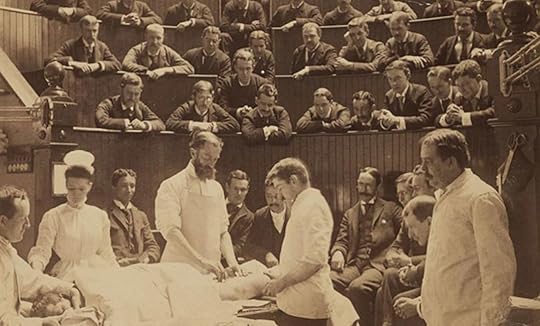
~~Depiction of an operating theater in London during the early 19th century. Dionysus Atherton would have operated/taught in a theater much like this one.
Meet Will Starling, our very own "Umble Narrator". Born to a "fallen" woman, he was handed over to a foundling hospital as an infant. There he stayed until his teen years, when he was apprenticed out to a chimney sweep. "The following morning he turned his back for a moment, and looked round again to see a scarecrow receding at speed: small, and growing smaller by the second." Will joined the Army, and traveled to the continent--one small boy in the Napoleonic War. Fortunately, (or unfortunately--you decide after reading Will's narrative), Will was handy when the army surgeon, Alec Comrie, needed an assistant. He proved himself, and became the surgeon's assistant full time. When the war ended, Will stayed on helping the brawny, opinionated Scotsman create a private surgical practice in London.
Medicine in general, and surgery in particular, was a VERY far cry from modern...or even early 20th century...practice. Hygiene was virtually nonexistent, malnutrition was rampart, poverty was pervasive, and "medications" consisted mostly of herbal concoctions, laudanum of various strengths, and strong whiskey. There was no such thing as anesthesia. Surgeons hacked away as quickly as humanly possible so as to finish before their patient died of shock. Pain was viewed as a personal cross that the patient must bear. If the patient survived the ordeal of surgery, they had a chance of surviving the *huge* risk of post-op infection. If they were lucky, they were the first surgery of the day. If not, the implements used on them had been used on every other patient that day with only a cursory wiping between procedures.
Obviously, surgeons needed to practice their skills. And just as obviously, they couldn't spend time examining the anatomy of their conscious patients. What to do then? Dissect cadavers! The government of England, in all its benevolence, authorized the release of four executed criminals' bodies to the surgical society each year. This was barely a drop in the bucket of anatomical ignorance. To fill the void, surgeons hired Doomsday Men, AKA grave robbers. Fresh "things" were valued highly. The freshest "things" were sometimes found dead in the slums, and bypassed burial entirely. The market was hot, as was the outrage from concerned citizens who wanted their family members to attend the rapture free from dissection.
Will Starling takes us into the heart of this drama. We see him navigate the streets of 1816 London. He falls in love with an aspiring "actress" who most likely has a slightly different occupation. When she is involved in a bar scene that leaves one man a choking victim, Will becomes intensely curious. The prominent surgeon Atherton arrives at the scene, attempts to revive the choking man, and then takes possession of the unconscious body. Rumors quickly begin to circulate. He dissected the dead man. He revived the man after he had died, using electrical current...essentially bringing him back to life. This "resurrected"man was now haunting the nights of London, and tormenting Will's lady friend. Will begins an investigation that darkens by the chapter. I recommend that you read to find out what he discovers!!
My two cents: Ian Weir takes us to a fascinating time and place. Will Starling has a strong, compelling voice, and I loved following his story arc. However, Weir doesn't just stop there. The supporting characters are also given full personalities, and unique voices. I loved Janet Friendly, Miss Teakins, Mr. Comrie, and Meg...among others. Great dialogue + compelling setting + intriguing mystery = a winner. The novel weighs in at just over 450 pages, but honestly, I was so pulled into Will's world that I didn't even notice. I'll be remembering this highly enjoyable read. Given 5 stars or a rating of "perfect". Highly recommended!!!
Favorite quotes: "She hovered in the doorway, clutching her shawl. Her voice was low and husky, when she wasn't using it to hit you with."
"I stayed in my attic closet for three whole days, that time, just Wm Starling and his companion the Black Dog. When I emerged I discovered that life was going on, as life does. So I rejoined it."
Further Reading Here is a very good article from the Journal of Anatomy discussing the history of body snatching during the 1700's - early 1900's, and its role in medical enlightenment. https://www.ncbi.nlm.nih.gov/pmc/arti... ~~A comprehensive review of the history of surgery from Wikipedia: https://en.wikipedia.org/wiki/History... ~~For the strong stomached, a look into the gruesome world of pre-anesthetic surgery from the Washington Post: https://www.washingtonpost.com/news/t...
Will Starling by Ian Weir is not the type of novel I generally read, but I purchased on vacation and then took it on an airplane and another vacation. I was intrigued by the setting in early 19th century London, a city I sort of know from study abroad programs. The book was filled with surprises, even identifying the narrator—that does switch during the text. The old English was somewhat of a challenge. However, it was a dark and instructive tale.
Will was a founding and you learn that people of various means give up their infants born out of wedlock and then after time with a wet nurse, the children are put in a founding home. They are raised and when of a certain age, Will was to leave for a job. He runs away and eventually is connected with the military—in a moment he is connected to a surgeon, Alec Comrie. The surgeon semi adopts him and they work together in civilian life. Comrie is not an easy man, but a decent surgeon. The book explores sentiment and the workings of early surgery, including questionable practices like grave robbing for cadavers.
Yet, this is a coming of age story, as Will grows into manhood, learning about his own past, and sorting out the events surrounding him. The writing, which is excellent, pulls us into taverns, morgues, graveyards, humble housing, the activities of prostitutes, as well as wealthy people. A key figure, Dionysus Atherton is part of Will’s past and present. Will is eager to identify Atherton’s crimes, but in this time period there is much crime and people are quick to hang people. The questionable practices are on all sides.
I don't think i have read anything by this author before and am not sure if his writing style is enough to tempt me into trying more of his repertoire. This is essentially an historicl fiction based on the development of surgery and the methods used to create practice. From grave robbing through resuscitation or recovery from near death to spooks and spectres. This book is difficult to follow it jumps backwards and forwards in time sometimes by just hours or days . I hated the nomenclature of the narrator - a literary foible and and am not sure I believe that the operations he describes were truly possible at that time - has he just used poetic licence?
His story begins in war where he meets a surgeon who took him on as an apprentice. He has some adventures as he seeks the truth about corpses and murder. Not all of them were good natures. I found the medical part of this book interesting. If you feel like a read about hangings, death and resurrection, then I recommend this one.
I actually had the privilege of hearing Mr. Weir read from Will Starling last August, and I couldn't wait to get my hands on this book! If you love language, and appreciate a rich narrative, I highly recommend Will Starling. I soaked in every word, not to mention the city of London which was a character all on its own. No review I could give would do this book justice. I loved it. Plain and simple. A creepy story that kept me shuddering all throughout. And one that I finished (taking a page from the Wery Umble Narrator of course) with a "smile on my face."
Found this a slow read and easy to lose my place if I put it down for more than a day. Excellent description of London in the 18th century however. Well researched - just a slow read.
“Once a man is truly dead and carried pale and cold across the Styx – once Old Bones has put an arm about his shoulders and walked him through the Gate into Darkness – might Science yet summon him back?” Will Starling became my new Gothic guilty pleasure this month. I found the dark tale of Resurrection Men and mad doctors particularly tantalizing, while historically fascinating. If you are seeking a horrifically fun book filled to the brim with grave robbers and reanimated corpses, look no further. However, if this topic doesn’t totally captivate your interest, I doubt you’ll survive nearly 500 pages of it.
Żeby móc dostrzec gwiazdy w całej swej krasie, noc musi być naprawdę ciemna - z księżycem w nowiu, bez poświaty miejskiej; bez szumu i gwaru - tak, by zupełnie zatrzymać się w akcie obserwacji. Zobaczyć "Trupiarza".
Oto wyszedłem ze swej codzienności w poszukiwaniu takiej nocy i jej nie znalazłem. Nie oznacza to, że gwiazd, co bohaterów mają imiona nie ma - one być może są. Nie byłem jednak w stanie dostrzec ich pełnego blasku, który powiększyłby moją radość. Radość, która zazwyczaj towarzyszy poniesionemu wysiłkowi w zrozumienie tego, co nie jest oczywiste, zbyt proste czy banalne.
Brilliant and funny, the book is for me in some ways epitome of Englishness. The final chapters (after 17) not so good. It might serve as a good script for horror or suspension movie. Surprisingly I have not found anything scary in the story, but plenty of really hilarious concepts and conversations.
The characters are endearing and the plot is delicious, but what really strikes you is the dedication of the main character, and his growth throughout the book, even though it only takes place for a few months (weeks? Not sure). He goes from seeking vengeance to seeking justice and that subtle change is what makes the book. - Ainslie
"Nie ruszyłem się z mojego kąta na strychu przez trzy dni: tylko William Starling i jego wierny, czarny pies. Kiedy wyszedłem, odkryłem, że życie toczy się dalej, jak to życie. Więc się dołączyłem."
Pulls the reader straight into the dark heart of London in the early 19th century...
For those readers who may have morbid curiosity about certain topics and love a clever mix of genres, here is a treat just for you. Mr. Weir has created a tale that plays with the unknown and the macabre details straight from the dark side of human nature and history that pulls the unwary into a tale of combating and debatable topics and messages. Is Will Starling a story of miracles or simple coincidences? A tale that pulls details from Mythology and Theology and invites further questions concerning the delicate balance between life and death after the reader has finished? Or is this a collaborative narration with events that are shrouded in superstition or can be simply explained by advancements in medicine? Fellow readers Will Starling is all the above.
Will Starling is the reader’s “wery umble narrator” as he weaves a twisted recollection of events by a guttering candle and leads his audience into an underworld of life and death that played out in early 19th century London and on the battlefields beyond. Our narrator is a surgeon’s apprentice who has a remarkable mind and keen interest in his benefactor’s profession who loves nothing more than a large word he can mimic and a fledgling actress named Annie Smollet who only seems to see his diminutive status and his other unfortunate physical flaws. Despite imperfections and personal history our narrator welcomes his readers and takes us into a gritty realistic world that concerns advancements of the medical community and the old wives tales that pose unrelenting negative views and fear of the unknown concerning physicians, surgeons and primarily what goes on behind closed doors at the anatomical colleges. Events are further built upon and threads of a dark mystery are sewn into a shroud of speculation that enfold a fascinating cast of characters that takes us into the vary twisted bowels of Will Starling's adoptive world and opens our minds and eyes to the horrors and sometimes benefits of science.
In the end, Will Starling is a book that is a little difficult for me to fully describe but was a haunting entertaining look at medical history and held so many different facets that appealed to this reader and became a title I would gladly recommend. I must confess, I initially sought this title for the entertainment of the season but now I see this is so much more than a grisly story about resurrectionists or doomsday men and the consequences of playing God with the unknown or a sinister literary mix of Dickens and Shelley. Mr. Weir has created a tale that brilliantly pays homage to the advancements of medicine and science during the 19th century and even a few cameo appearances are made by those who pioneered the way for future professions that have become respected in our current era. As a Nurse I am always fascinated by these stories and am in awe at the advancements we have made, but Will Starling is still much more than a story about progress and sharing of macabre historical details. This story has so many different facets and the narrator is ideal for this tale and the dialogue is delivered in a perfect believable tone and pulled this reader straight into the dark heart of London in the early 19th century. Although this is certainly a paced read and the sometimes haphazard events strung together by the narrator caused me distraction to reread a few passages to only realize these were cleverly hidden threads to the mystery this novel was still a treat that I savored and I couldn’t ask for more. Bravo!
*I would like to thank Steerforth and Edelweiss for the opportunity to read and enjoy Will Starling: A Novel