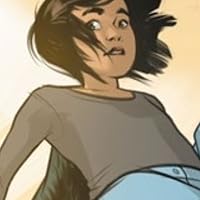
Acclaimed creators Kim Hyun Sook and Ryan Estrada are back with a lightly creepy yet hilarious young adult graphic novel about first love and friendship—sure to offer both tricks and treats.
It's almost Daeboreum in 1980s South Korea—a holiday that celebrates the first full moon of the year. Taehee couldn't care less. All she wants is to spend time with her boyfriend Kiwoo, avoid her controlling father, and play music for her mask dance club. But Taehee's weird granny and her even weirder friends have other plans for they drag her, Kiwoo, and the rest of the dance club to their remote farm to celebrate Daeboreum...the old-fashioned way.
As the group arrives at the farm, Taehee overhears her granny talking about ceremonies, ghosts, and possibly (probably) sacrificing her friends to evil spirits. And if that's not bad enough, Taehee just said those Three Little Words to Kiwoo that he can't seem to say back. Meanwhile, her friends are running wild with secrets—ones they definitely don't want the grannies to overhear. It seems like everyone is up to no good.
The first full moon of the year is about to arrive, and with it confessions that threaten to change everything. That is, of course, if they all make it out alive.
Featuring beloved characters from Banned Book Club and No Rules Tonight, Good Old-Fashioned Korean Spirit is a standalone story that melds tradition with the unexpected, and the spooky with the sweet.
Kim Hyun Sook was born in Changwon, South Korea. She became a member of a banned book club in the 1980s while studying English Language and Literature. She has co-written comics for websites including The Nib and Oh Joy Sex Toy and she translated Lady Rainicorn's dialogue for Adventure Time comics. She now runs a new banned book club in Busan, where she lives with her husband and her cat, Dog Baby.
Taehee and her fellow Korean folk dance club members each have their dilemmas. If being a college student in 1980s South Korea during the military regime wasn’t hard enough, many of Taehee’s cohorts struggle with their respective families. Some are overbearing and judgmental while another is cold and distant. Their personal lives and truths are exposed during a weekend trip to Taehee’s grandmother’s isolated persimmon orchard for Daeboreum, a Korean holiday. The story is nicely paced beginning with individual accounts of each of the characters’ storylines and then their slow intertwining into a powerful tale of found family and the different generational approaches to protest and fighting for what is right. While all characters identify as Korean, representation is diverse in terms of gender and sexual identity as well as generational and adds to the authenticity of the story. A wonderful addition to any library’s graphic novel collection. While the primary characters are college-age students, the storyline still connects with an older teen audience. Good for grades 9 and above.
Daeboreum is a holiday that takes place on the first full moon of the lunar calendar, in Korean,so it is usually in February, on the Gregorian calendar. Taehee, the main character, wants to spend time with her boyfriend, and doesn’t want to go celebrate it at her Grandmother’s, but her parents tell her that if she doesn’t, that he will cut off her tuition, so she relents.
Then she gathers everyone in her musical group, most of who are in her banned book club, and they all go up to hang out with their grand mother, despite thinking that she plans to sacrifice to them to ghosts. Oh, and there is also a young American, who keeps hearing the group whispering about American, and thinking they are talking about her, as one would.
Great illustrations. Don’t know why cartoonists keep sticking chickens wandering outside at night though. They can’t see at night, and go to sleep when the sun goes down. But, they are not the first to make this mistake, and won’t be the last. Just a little nitpick for an otherwise fun story.
This book is out as of today, and a quick read and lots of fun, despite it being the time,1980s, that South Korea was under a military dictatorship, which doesn’t appear quite so prominently in this story, as their earlier books.
Mini Book Review: I picked this book up my chance while browsing my local library. This book was such a blend of teenage antics while also learning about Korean culture. The drawings in this were really great and I thought the author did a great job explaining the ceremony that the family was going to do. I love that there was a focus on the different sets of kids and teenage issues (which even though it took place in the 80s, it felt relatable in any decade). I also love how they all remained friends in the future and that they all come back together every year to do the traditions. I recommend if you are looking for a graphic novel that has a mix of Korean culture/tradition, teenage angst and the political climate in the 80s in Korea - give this one a read!
This is such a great book. I love the story, love the message. It is not at all the type of story I thought it would be based off the title and I picked it up without even reading the blurb. But yeah really enjoyed it.
A corean book to start of 2026 except my new year starts in Feb! Anyways, happy new (solar transit) year and congratulations on making it alive from 2025<3
I really like how each of these books center on a different member of the troupe. Here, the group goes to the countryside to celebrate a holiday with one member's grandmother. And her three friends. Who are all the people left in their village. Young adult shenanigans, honoring those who have gone before, a trans journey, all rendered in Estrada's cartoony full color drawings. I think this team is getting better and better. It's not necessary to have read the other two before reading this, but it definitely enriches the experience.
A new YA graphic novel by the duo that brought us Banned Book Club and No Rules Tonight. 🌕 We are back in the 1980s in South Korea and it’s almost Daeboreum—a holiday that celebrated the first full moon of the year. Taehee only cares about her new boyfriend and playing music for her mask dance club, not some outdated event. Unfortunately for her, Taehee’s strict father makes her go to a remote farm to celebrate with Taehee’s grandmother and her weird friends. Taehee overhears her grandmother talking with her friends about rituals, sacrifices, evil spirits and ghosts. What will happen on this night of the first full moon? 🌕 I think Kim Hyun Sook and @ryanestradadotcom are quickly becoming one of my favorite graphic novel teams. I loved the nod to the Banned Book Club in this one, as well as the funny, yet spooky storyline. This title releases October 7!
Sook & Estrada dive into discussions about tradition, intergenerational relationships, and resistance in this impactful young adult graphic novel. Set in South Korea in 1985, Taehee, our college-aged Korean main character, visits her halmoni (Korean for grandmother) for a commemoration of her departed haraboji’s (Korean for grandfather) life. Her halmoni invites her to a Daeboreum celebration of the first full moon of the year, telling her to bring her friends because they play traditional folk instruments. Taehee must trick her city-dwelling friends into coming to her halmoni’s countryside persimmon farm - which may or may not be haunted - for this event. Along the way, Taehee learns a lot about tradition, her halmoni and other Korean elders, friendship, and the longstanding history of resistance amongst everyday people in Korea, whether in the face of Japanese occupation or in the face of an oppressive dictatorship.
I enjoyed so many aspects of this book, including the diversity of Taehee’s friend group. One friend, Manhee, is a transgender man struggling to come out but fearing rejection. Ashley was born in South Korea before being sent to the United States to be adopted, so she navigates feelings of otherness as the “American” in the group. These difficulties are exacerbated by other teen characters fearing that she will betray them, given the United States’ backing of the oppressive government in Korea. Suji is also queer and navigates rejection and homophobia from her mother while also trying to live in her truth with Manhee. While some of the teen characters have absorbed homophobic or misogynistic ideals from their parents, they quickly embrace acceptance when these beliefs are challenged, accepting and celebrating their friends’ identities and casting off gender norms. Their growth over the course of the story is profoundly heartwarming. This graphic novel combines a sweet story with information about Korea’s history of oppression and resistance, and it does so incredibly well. The illustrations are beautiful and bring the characters to life in a fun, cartoonish style. Panel arrangements are easy to follow and dynamic. The ARC is fully in black-and-white, but on the front cover there is a sample of the full-color final version and Lafrenais’ coloring looks wonderful, with a lot of depth. Link to complete review: https://ysbookreviews.wordpress.com/2...
Thank you to Penguin Random House for the advanced copy!
If you're unaware of what happened during the Japanese occupation of South Korea, the Korean War, and the struggle for democracy in the country, then this is a very, very good starter for that research. It's a snapshot of South Korea in the 1980s, when there is authoritarian rule and censorship gripping its people.
Some of the characters in this story have a Banned Book Club to read the books that the government has deemed illegal. There are also queer people in this story, who were oppressed both by government and by culture. There's hesitancy about including an American immigrant because the US backed this government. There is a ton of social commentary in this book, but the most prominent is how South Korean traditions going back generations have been suppressed and forgotten through all this upheaval.
The most important thing? It's intergenerational and there is something all generations are learning from each other in this story. Nothing is as it seems with everyone and tensions are high. It's a lesson in sitting with each other and speaking openly and honestly, because chances are you've got an ally right there that you never knew existed.
If you've got teens who are interested in history and are interested in learning from history, hand them this one, because there are things about South Korea that people don't know about (and Japan for that matter) and it'll help them explore what it really means to have a free and democratic society.
Returning to the characters introduced in their previous two graphic novels, set in South Korea, this creative team follows them to Taehee's remote persimmon farm. It's 1985, and she's involved with a Banned Book Club and a hidden romance. When her father insists that she spend Daeboreum with her grandmother and her city friends, Taehee does so reluctantly even though she fears what will happen when they're in such a rural area. Readers eager for insight into Korean culture will find it in these pages, filled with love, laughter, identity, gender issues, and a dash or two of spookiness. Readers won't need to have read the two previous books to appreciate this one, but doing so affords a deeper understanding of the characters, their personalities, and their motivation. I loved how the relationship between one queer couple is depicted as well as how there are various animals who move across the pages, almost as though they're part of the plot and interested in the goings on and the misunderstandings.
This fun reminder of the importance of friendship and family presents a group of young Korean college students who embark on a trip to a remote village to celebrate a spirit festival at the urging of Taehee’s Granny. The friends, united through their membership in a dance club, are tricked into the trip to celebrate Daeboreum with a collection of Grannies, but Taehee isn’t so sure that the Grannies aren’t up to no good and might even plan to feed the young people to the spirits as part of a ridiculous old fashioned ritual. Instead of finding evil spirits, the college students get to know and accept each other, forming lifelong friendships and recognizing that the traditions that the Grannies hold on to may be more valuable than they expected. The conclusion connects the Korea of the 1980s to the previous generations, particularly during the Japanese occupation that the Grannies remember from their youth.
I've now read all three graphic novels in the Banned Book Club series. This last one was delightful! The kids (well, college students) from the previous two books meet up at an old farm to celebrate Daeboreum with four grandmothers. I enjoyed this one more than the second one, not as much as the first, glad I read all three. The halmonis had me smiling a lot, and I enjoyed the continuing story arcs for all the characters, many of whom are queer. If you're unfamiliar with this series, it's based on the author's experiences growing up in South Korea during the 1980s, and being in a banned book club. While the banned book club is central in the first book and less so in the others, it's still present. I wonder if there will be any more following these characters? It ended in a good spot. But I do enjoy reading about their lives!
Kim and Estrada are easily at the top of my list of authors whose works I simply must read any time they publish something new. I have enjoyed and so deeply appreciated their other graphic novels, and I found this one to be in-line with those as well: accessible and easy-to-follow action and plot, engaging characters each with their own stories and side-plots, beautiful visuals and enticing colors, and easy-to-understand inclusion of Korean history that encourages the reader to conduct additional research without that research being strictly necessary for the enjoyment and understanding of the story within the graphic novel.
The graphic novel has many interwoven elements, from the family aspect of the grannies getting ready to show the youngins how to celebrate Daeboreum in the 1980s in South Korea—a holiday that celebrates the first full moon of the year to first loves to continuing the banned book club.
Lovingly reflective about Korean history, book censorship, and coming-of-age, Hyun Sook is definitely here to stay alongside the collaboration for this one with Estrada.
I'm still a big fan of the trend over the last few years of intergenerational connections.
Taehee just wants to spend time with her secret boyfriend Kiwoo, but instead she is forced to spend Daeboreum with her grandmother. If she doesn't, her parents will stop paying her tuition. Furthermore, she is coerced into bringing all the members of her Dance club as well. She is convinced the old ceremony will involve blood sacrifice, but she and her friends are very surprised by the acceptance and understanding they find among the elderly residents of the small village. A sweet and endearing story.
While drawing on the author's own experience in Korea in the 1980s, the story actively shows how each generation must deal with its own trauma. The grannies all endured Japanese occupation and oppression of Korea, the parents were all affected by that trauma, and the kids were enduring their own authoritarian government troubles.
It's a bit message-heavy, but the messages are good ones, giving the reader a very speedy and simplified look at Korean history and a small glimpse of the U.S. role in it.
Could have used a more robust backmatter section, but there was a brief author's note.
Oh no, Taehee has been pressured by her parents to invite her dance/music group to her grandmother's persimmon farm for some sort of ghostly ritual/sacrifice. Everyone is hiding something, but with echoes of the 1st book, the various couples go off and have adventures, and the grandmothers occasionally pop up to scare them. Issues of acceptance, trust, fighting tyranny and oppression effectively, and even what it means to be a "real man" come up among the spooky hi-jinks.
Based on the cover and title, I didn’t realize what exactly this book was going to be about. It’s really a sequel to the author’s other book, No rules tonight. I think also this book is for the sort of era we’re in where there’s talk of ICE taking people and standing up against the government. I like how this book touched on a bunch of different topics, lgbtq+, romance, family problems, and rebelling against the government. This is a very timely book and would recommend anyone to read it.
Secrets and misunderstandings abound in this charming graphic novel about a group of college friends who journey to a Korean persimmon farm to celebrate the first full moon of the year on Daeboreum. Sook & Estrada present weighty family and social issues with a light touch and appealing illustrations that connect young audiences the world over to Korean culture, history, and traditions. This book is as tender and sweet as a ripe persimmon!
Proves once again how old people always surprise the youth. People tend to think the old are set in their ways, aren’t fun, out of touch with current situations, conservative, etc., and to whatever extent that may be true, also remember old people have a lot of life experience, so they can always teach a thing or two.
I really enjoy everything I’ve read from this author. This one was a fun time and had a very interesting way of explaining how lived experiences can lead older generations to be or seem less progressive. It was my least favorite so far but I still took a lot from it so still a very worthwhile read!
An outstanding graphic novel set in the 1980s South Korea that highlights the importance of community, tradition, and bringing community back together for justice, peace, and maintaining prosperity. Love comes in accepting that just because it’s old fashioned doesn’t make it wrong, and just because it’s new doesn’t mean it’s right. Balance and found family.
This was a fantastic book. I loved that all of the characters had their own worries and things that they thought they couldn't tell the group, but by the end of the story, they had all come together. It really highlighted how, even if your own family falls short, you can make your own.
I really enjoyed this! A great mix of humor, information, and story telling, this Korean tale builds characters you’ll love and gorgeous settings. I wish there were more in some spots that could have been fleshed out more, but this was well done.
A really great story with meaningful lessons throughout. It shares a bit of Korean history while also touching on ideas that still apply to everyday life today. I loved the messages in the story, and the artwork is fun, engaging, and easy to follow without being overwhelming.
This was a fun read! I got stalled a bit in the middle, thinking it was some silly story with no real plot or connection but I was shortly proven wrong! The insight into how things used to be in Korea, the representation, the fighter spirit was all great. Loved this!
I just really like Hyun Sook's mixture of important (and occasionally alarming) history of Korea's 1980s dictatorship, mixed with young people full of hormones, mixed with a goofy comic style that makes it all seem like it'll work out.