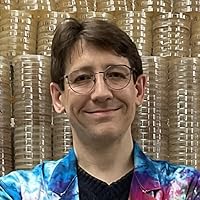
All in a day’s work for Dr Seager at Napa State Hospital in California:
I’d just made it back to my office door when an alarm rang. I joined Cohen and a crowd that surged toward Unit C, where another battle had begun. “Stupid bitch!” Mathews yelled as three staff members hustled him toward the restraint room. Luella sat on the floor, forehead resting on bent knees, blood dripping. p47
And a week after that
I pushed my alarm. Sirens erupted. A brief melee ensued. The staff broke it up and , surprisingly, tempers quickly cooled. Carver limped to the seclusion room; Xiang followed, a syringe ready. p76
And a week or so after that
I leaned back in my office chair. Then an alarm went off. I ran ahead of Cohen, unlocked the door to Unit C, and followed a crowd to the nurses’ station. “I warned you,” yelled Xiang, and kicked at Gomez, who lay on the ground covered by staff. Cohen restrained Xiang but only just. p171
Dr Stephen Seager replaced Dr Tom at Unit C. Dr Tom was involuntarily retired by a patient, Mr Mathews, who beat him and kicked him into a coma. After a few months Dr Tom died. But his murderer faced no consequences. Mr Mathews was in Unit C having committed various homicides and having been found to be chronically insane. There was no other place for Mr Mathews to be. Unit C was the end point. This meant that the staff had to deal every day with a person who murdered their colleague and who could, if he got lucky again, murder them, and who would never suffer any consequences. Would Mathews be prosecuted for the murder of Dr Tom? No. What would be the point? Just money wasted on a meaningless court proceeding.
THANKSGIVING
The staff organise a Thanksgiving dinner for the patients, whose families are invited. Some families don’t attend, because the patient has no family, because the patient killed all their family. The ones who do come bring their children.
”Let me get this straight,” I said. “The hospital is going to invite a bunch of children to have lunch in a room into which they’ve also invited the state’s most notorious child molesters?”
“Not to worry,” Cohen said. “They’re going to keep an eye on them.”
THE GOOD, THE BAD AND THE PSYCHOTIC
The majority of this book deals with the day to day barely-controlled-violence and the regular shakedowns to find shanks and stills. It’s never less than compelling, although the author will be winning no prizes for his prose style, which has a tendency to spray clichés around in a curt style of journalese which can grate (“Facing shared adversity, we’d bonded.” “Lost in thought, I felt a tug on my sleeve.”) But heck, what a story.
And also, on occasion Dr Seager bursts into a different mode, where he lets rip with some strong personal views about the whole psychiatric/legal morass, and these parts were great and all too few. In one section he outlines how America has got to its present unhappy situation (and truly America is not alone in this).
SHORT HISTORY OF THE CHRONICALLY MENTALLY UNWELL IN AMERICA
For the best part of a century, the criminally insane were warehoused in distant state hospitals. In 1963, the Community Mental Health Act, promoted by John Kennedy, established community mental health centres. These would be much more humane. The state hospitals were emptied.
Local communities, however, had not been consulted and they showed no interest whatever in a massive influx of psychotic individuals.
Also, Congress never funded most community mental health centres, so they weren’t built.
The newly-released state hospital patients, with nowhere to live and nowhere to receive treatment, took up residence on city streets and became the homeless mentally ill.
70% of those guys eventually end up in jail. So jails started to fill up with mentally ill people. The really violent perpetrators, the ones unfit to plead or not guilty by reason of insanity, were sent back to re-tooled state hospitals like Napa.
SANDY HOOK, VIRGINIA TECH, RED LAKE
Towards the end of the book, one subject begins to take over : gun rampages. It’s not clear if any of Dr Seager’s Unit C patients ever committed any of these offences, he never says so. His guys are in there for normal family massacres, serial rapes and murders, and child murders. But he quotes an outburst from his wife who sees a newspaper account about the Adam Lanza’s school shooting in which 21 children and 6 adults died.
Christ, there’s a new one every week. And the same crap happens each time. A morbid picture of the shooter appears on the news – never the victims, always the shooter – followed by an emotional call for gun control, then a plea for better mental health treatment, and finally an article explaining the insanity defense. Then nothing. Nothing ever happens.
At the end of his book, Dr Seager offers a wants list which he believes would begin to tackle these random massacre guys. He says that none of these shootings come out of a clear blue sky – when it turns out that the shooter was Adam Lanza or Elliot Rodger or Seung-Hui Cho no one who knew them is surprised. These people all have shown signs of particular types of behaviour. What Dr Seager says is that they all are suffering from one specific form of mental illness, paranoid schizophrenia, which means they can function at a high level (fill out forms, pass tests, etc) and yet have a grotesquely distorted view of reality in which usually there’s a giant conspiracy and they are its principal victim. (He points out that the homeless schizophrenic on the street will never commit a rampage, they’re never organised enough.) Another crucial fact about paranoid schizophrenia is that the sufferers do not have any insight, i.e. they never realise they are ill or even that they are wrong and the children or their family or that audience of moviegoers did not actually deserve to be killed. Which means that they will always refuse any offered treatment.
Dr Seager is therefore suggesting that the state should intervene before the rampage occurs. But I do not see how any kind of intervention into their lives before they erupt can be done unless we grant the state powers over the individual which we used to denounce in the USSR.
In Britain we don’t have school shootings. We have very strong gun control laws, so we’ve only had three crazed gun rampages. But only yesterday a 16 year old kid was sent to the British equivalent of Napa for stabbing a 62 year old teacher to death and returning to his chair where he announced “Good times!” and waited for the cops. He never apologised, he told police he was proud of what he’d done. You can organise your society any old how, but these things are going to happen now and then.
This book does what it says on the tin. If you want a fast account of what it’s like working with the most deranged, violent, psychotic people in America, and be made to think about what we’re supposed to do with them, here it is.