The shape-shifting Clayface—formerly the disgraced actor Basil Karlo—is on a rampage, and Batman must battle his way through a network of his deadliest enemies to uncover the truth. But how do you stop a killer who can be anywhere—and anyone? And soaring above Gotham is another threat in the form of the Man-Bat, whose unstable serum has made his predatory plans much more deadly!
In BATMAN - THE DARK KNIGHT: CLAY, writer Gregg Hurwitz (DETECTIVE COMICS, Wolverine) teams with superstar artists Alex Maleev (BATMAN, Daredevil), Ethan Van Sciver (GREEN LANTERN, THE FLASH), and Alberto Ponticelli (DIAL H) for tales of Gotham City's greatest villains!
Gregg Hurwitz is the critically acclaimed, New York Times and internationally bestselling author of 20 novels, including OUT OF THE DARK (2019). His novels have been shortlisted for numerous literary awards, graced top ten lists, and have been published in 30 languages.
He is also a New York Times Bestselling comic book writer, having penned stories for Marvel (Wolverine, Punisher) and DC (Batman, Penguin). Additionally, he’s written screenplays for or sold spec scripts to many of the major studios, and written, developed, and produced television for various networks. Gregg resides in Los Angeles.
Hulk-boy has bumped his head on this one. He told me to read it so that I would show some Batman loving.
In the first part of this volume we learn the dark history of Clayface. Poor Clayface. He just got tired of everyone ignoring him. He wanted to be an actor but was that guy this wasn't handsome. Was not quirky. Just kinda bland. So when old Penguin face offers him a chance to change that fact about himself he jumps on it. Penguin gives him some weirdo clay that gets absorbed into his system and changes him. Now he is the man! While it lasts. Should have known better than to trust Penguin. Does he not READ Batman? Duh. So he ends up morphing into the evil guy Clayface and we have another baddie for Bats to chase. Woot!
There are a couple of other parts to this volume but I kinda failed at them. Borrringgg.. Give me some killing and sex. Not Man-Bat. Did not like this part.
My good old Pappy Jeff is always going on and on about respecting the opinions of my elders. Or maybe he's saying he's hungry, and wants some Spam? I'm not really sure. He's old, so I sort of tune him out a lot... Anyway, he was rambling on (as the elderly do) about how this was pretty good. And wouldn't you know it? The old fart was right!
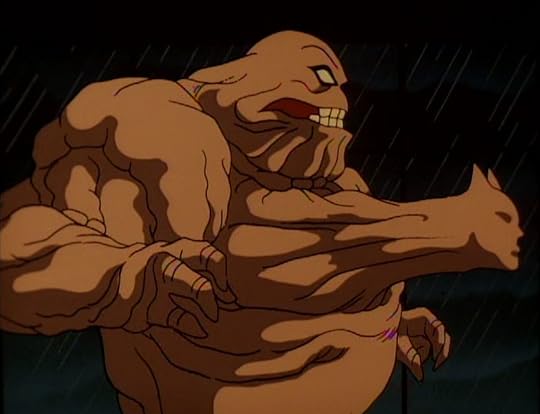
So, Clay is a pretty obvious reference Clayface. The Batman villain with the malleable skin and lumpy appearance? You know, sort of looked like a dog turd with a mouth? Yep. That's him! Ok, in the past, his powers haven't exactly given Batman a run for his money.
Clayface would rob a bank, take some lovely damsel hostage, or break into a museum to steal...something old like Jeff or priceless like me!, and Batman would show up with a (Bat-themed) garden hose and wash him down into the sewer system. At that point, he'd just hole up with Killer Croc till the heat died down. This time around, Clayface is a bit more of a challenge. And I've got to admit, I liked it! How do you stop an enemy who can become anyone?
No! Whacking him in the head DID NOT work. Try again, loser! I'll give you a hint: It involves a giant bug jar made of rainbows and pseudo-science. Regardless, it was a decent re-imagining of this character's origin.
There's also an issue without dialogue about human trafficking, that has a powerful message. Don't try to skimp on legality when immigrating to another country. Unless you sneak into Gotham. Then it'll be ok, because Batman will kick the shit out of the dickhole abusing you (and hundreds of others), and you'll be reunited with your sick child. And given a job at Wayne Enterprises.
Alrighty. Man-Bat gets a makeover in this one!
He's still a Langstrom, just not the one we're used to. He's evil. Like corporate pharmaceuticals evil. *shudder* Again, it's a decent story.
So, other than the usual 'didn't like the scratchy art' complaint, I liked this volume. It didn't change my world, but I have no problem with anything. Recommended!
Picking out and reading any New 52 volume is now like walking in a cow pasture in the dark. It’s become all too common and unavoidable to step in a pile of cow plop/read a crappy volume. So it’s refreshing to find another writer aside from Scott Snyder who has a decent handle on Batman. Greg Hurwitz has Alex Maleev doing the artsy chores on the first story and Maleev, who teams with Brian Michael Bendis on his gritty stuff, won’t be drawing Archie comics any time soon. So far, so good.
Hurwitz tackles two of Batman’s villains, sadly, they’re the cow plop of the Bat’s rogues. First, Clayface (and if I get the details wrong on his origin story, well, bite me!):
Poor Basil Karlo was the type of kid that nobody noticed. He didn’t stand out. He had no special skills. He was just ordinary. His mommy bought him a leather coat and a pair of sunglasses, in the hopes that he would now look cool. He ended up looking like a douche in school; an unnoticed douche. One day, he saw a flyer for the drama club and a light bulb went off in his ordinary head. Plus, he heard that the theatre girls were easy. So it should have been a win-win. Right? Nope. Second spear carrier and no lines (or theatre girls) for poor Basil. So grown up ordinary, unnoticed Basil goes from audition to audition. “Sorry, Bub, you just don’t stand out,” is what he hears. Wah, wah, wah!! Cue the Penguin – patron of the arts. He just happens to have a lump of some magical(?) mystical(?) alien(?) clay. (here’s where my memory kind of gets gray. The aging process. It’s a bitch! Just ask Anne.) The clay can transform poor unnoticeable and ordinary Basil into anything: cowboy, monster, detective etc. Everything about the clay is true and it’s “hi diddly dee an actor's life for him”.
Not end of story. The clay has now bonded with his DNA, so whenever poor Basil isn’t transforming himself into anyone, he’s a big lump of ugly Playdoh. Poor, poor Basil. “Hey, Batman, did you notice that big lump of clay robbing First Gotham Federal Bank?” “I sure did Commissioner Gordon. I’m on it.” Finding Clayface is the tricky part, because he can transform into anyone. Anyone!
I’m sure there’s some sort of life lesson you can glean from poor Clayface's story, kids.
There are two other stories – a two issue dialogue-less story involving Batman righting an injustice done to immigrant slave factory workers. Reading this one brought to mind the excellent, Batman: The Animated Series. Same tone, same vibe.
The other story involves Man-Bat. Scientist takes a bat-gland serum designed to help cure deaf people only he’s transformed into a man who’s now a big bat, hence Man-Bat. Only it’s not the former culprit, Kirk Langstrom, developer of the formula, it somebody else and Bats has to put all his detective skillz to work to figure out who.
If you want a trio of nice uncomplicated, linear Batman stories you can’t do much better than this. Hurwitz tosses in some black humor and Alfred and Commissioner Gordon both have some cutting, witty lines.
The Dark Knight series has been Gregg Hurwitz’s vehicle for showcasing Batman’s rogues gallery from Scarecrow to The Mad Hatter with varying results - the Scarecrow book, Cycle of Violence, was silly but The Mad Hatter book was unexpectedly brilliant. This fourth volume focuses on Clayface aka Basil Karlo, though unfortunately it’s not very good.
If you’ve read one Clayface story, you’ve read them all. He used to be an actor, now he’s a poo monster cosplayer who shape-shifts and robs jewellery stores. Usually in these stories there’s a familiar character like Gordon or Alfred acting strangely before it’s revealed – shock poo! – it’s actually Clayface! Same story structure here.
He’s just not that great a character and his origin is even less interesting. LIke every other kid, he wanted to be thought of as cool, he wanted the ladies, and he thought acting was a shortcut to fame and fortune. None of that happens until he snorts magic clay that the Penguin got from Contrived Plot Device Land, and suddenly he’s able to look uncannily like the character he’s portraying.
Because that’s what real acting is right? Not bringing the lines to life with your delivery or presence or talent - no, real acting is wearing convincing makeup! Basil goes from being a mediocre actor to a great one just because he is able to look the part. So why do crap actors remain crap with the aid of makeup, costumes, prosthetics and even CGI? Take note, wannabe actors: get really good makeup and you will somehow become the next Daniel Day-Lewis! Clayface’s origin suuuuuucks!
And one weird detail stuck out about the end of the Clayface story:
The two-part silent story, Voiceless, about an immigrant mother and daughter who come to Gotham hoping for a better life and encounter hardship and abuse, was the best of the three stories. Alberto Ponticelli’s art brilliantly carries the tale so that the reader knows exactly what’s happening at all times even without dialogue or narration.
The book closes with the worst of the three, a Manbat story. Like Clayface stories, all Manbat stories are the same: turn the manbat back into human form and then lock whoever, usually Kirk, up until it happens again, exactly the same way, next time, again and again and again. This time it stars Kirk Langstrom’s corporate raider father, Abraham, who decides to transform into a manbat for shits and giggles.
Hurwitz not at all subtly tells a rich preying on the poor story as this Ayn Randian character literally sucks the blood of the homeless. The 1% are bad, see, they’re preying on the poor of society! Yeesh. But Batman saves the day and Bruce Wayne is definitely in the top 1% himself so, mixed messages Hurwitz!
I sort of liked Voiceless even though I’ve read Batman stories like it before but mostly I felt Hurwitz’s scripts to be very sub-par in this volume. The artists carry the book. Alex Maleev’s work is wonderful, I love his inky clear Gotham, Ponticelli’s art is great too, and Ethan van Sciver does what he always does, which is to say fine but nothing special art.
The Dark Knight, Volume 4: Clay is a very unimpressive and boring Batman book about two of his worst villains.
This book is choc-full of evil villains. (It's BATMAN! Duh...)
So anyhow, The Dark Knight has been one of the 4 main Batman titles, (Batman, Detective Comics, Batman and Robin) yet it's probably the least known one. It made the mistake of having Gregg Hurwitz not write the first volume, he just drew it. Once he took over, things got better. Most of the Dark Knight seems to focus on villains and their origins (Scarecrow, Mad Hatter, and this one...Clayface) and that's a cool thing to do when Joker and Riddler (and Penguin to a lesser extent) dominate the rest of the Bat world.
I'm happy to see they've decided to go with the "original" Clayface, Basil Karlo, a very plain man who wanted to be an actor, but just didn't have "it" to get noticed. Eventually he goes to Penguin to get help, and Penguin gives him some native thingy that turns his face to clay like malleability, so he can be a great facial actor. He in turn ends up doing things for Penguin, but things go wrong and he soon becomes all clay, but can become anyone he touches.
We see here that he's taken as a very dangerous, almost invulnerable force. Arkham needs a special containment unit for him. We also see that he needs people to like him, as he stays calm in Arkham because his neighbour in the cells is a fan and they talk...only when he dies does Clayface go nuts. He takes it to another level, going after Penguin and taking him out, then seeks out the Joker to give him some Joker Gas/Serum. He then rampages thru town and takes people hostage to get an audience who he pumps full of Joker toxin so they laugh at his work non-stop.
What's different here, is that Batman is written with just the slightest sense of humour...he and Alfred trade wits and barbs, and he even jokes around with Gordon (announces his arrival before he scares the shit out of Gordon in the dark.) The best part is when Clayface impersonates Gordon at the start of the book and kills a bunch of people...then later on, Gordon uses the Bat Signal, Batman appears and bitchslaps him...(sorry Jim, just had to make sure it was you)....HAHAHA effective but funny.
In addition, Batman actually listens to Alfred who tells him to get some help, and we get brief appearances of Black Canary and Condor (who? ya, no, this guy looks like a twat). Eventually Clayface is secured, and the sad chapter closes.
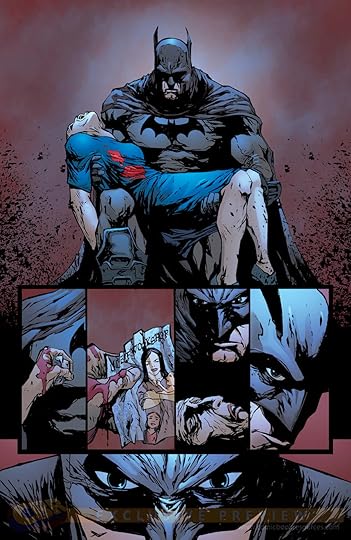
The next 2 books arc is called Voiceless, and is done entirely without dialogue. Alberto Ponticelli takes over the art here from Alex Maleev (who did a very good job with the Clayface arc, very dark muted tones and great use of browns). Alberto does different work, with good facial and body language artwork, but his is even more important in a wordless story. The story is about a family of Mexicans, the mother works in a sweatshop, and when she accidentally breaks one of the angel figures she's making, she is fired on the spot. She goes home and her young son is quite ill, she runs to the drugstore, which is closed, offers all her money to the pharmacist, who just drives off...you can figure out what happens next, since this is Batman... They see advertisments for Gotham, and get into trucks to go there, but are separated. (Granny and young daughter in one, mom in the other) The Daughter and Granny are working in a Gotham sweatshop making Christmas ornaments, when Granny sees that granddaughter is alive, she decides to break out...but one of the captors sees her sneaking out a window, and well...that's that. Batman comes upon Granny's body, and the art on this page is superb.
It gets down to the very essence of what Batman is all about, and even now, looking at it for like the 10th time in the last 18hrs, the raw emotions just hit me very hard.
Well, long story short, Batman kicks the everloving shit out of the sweatshop folks, who of course, report to the Penguin...he rescues mom, has her reunite with the daughter in the hospital (cue more tears, Anne, you better take a box of hankies) and then throws down furious vengeance. Because this is still Batman, we see the Penguin get out of jail due to his many lawyers. Wayne Enterprises attempts to employ many of the workers, and we see the mother has a job there, as Bruce Wayne walks by and smiles at her in one panel.
The last page has Batman checking in on the family, and he smiles and waves to the little girl who waves back to him, then we see the final image...the broken angel on top of the Christmas tree, made up to look like Batman.
The final story is about the evilest villain of all: Abraham Langstrom, father of Kirk Langstrom, and new Man-Bat. Langstrom Senior is a corporate raider, who buys up companies and strips them for parts in a very ruthless manner, we also see that he owns pharmaceuticals and has no problem sending defective medicine to Africa to be used there because "It's Africa.". Yup, easy to dislike him. We also see he's bullied his son, and is obsessed with being the Man-Bat and feasting on Flesh...well there's a showdown with Batman of course, and the manner in which Batman takes him out eventually is draining... (And thankfully, even in the midst of this, there's a couple of jokes! Alfred makes fun of Bruce for saying Ouch while getting stitched up, and Gordon tells Batman people need to stop "Vigilante-ING" to which Bats replies "I don't think that's a verb").
So all in all, a strong collection of 3 different stories, all relating to Batman, and giving us a nice connection to him and deeper understanding, all without extremely long and drawn out storylines. The Dark Knight is a great title to read if you like Batman but only want to dabble, or you want to jump in somewhere.
Sadly, this last volume marks the end of the series...I suppose it wasn't feasible to carry this many Bat-titles, so we should be glad that this was around while it was. It's also easy enough to read through separate from the major storylines, and good for filling your Bat-diction.
I like Clayface a lot but I'm so sick of Man-Bat (or ... Men-Bats?) This series got cancelled and I can see why. I suppose it's at least good that they finished this storyline so you're not left hanging though.
This whole series had some good moments. Not consistent enough to be a top series but mostly well done. This final volume was one of the good ones. Interesting throughout.
So we have Clayface for this volume. Don't get me wrong, I always found him kind of a scary villain. I mean his powerset is pretty insane. But on top of that I just came from detective comics run in rebirth, which made Clayface good, so was a bit jarring the character change but Gregg does a great job of making him a villain with a sound pity story. The 2nd half of this book, or later half, is mostly just one shot adventures for the Batman.
Good: I really enjoyed Clayface story and take. Showed how scary he could be and how pitiful is reasoning is for becoming a villain. I thought that showing him being semi-smart was a nice change, and I liked the first few pages SO much I thought it might be the best story ever for Clayface. Oh, and I liked the art throughout.
Bad: The clayface story came to a end a little to quick for my liking. Also, the side stories or one/two shots at the end were just okay. I don't think they were even written by Gregg.
Overall, a decent conclusion to a otherwise great run (still gotta read volume 1) But Gregg really gave some love to Batman's villains and they are indeed scary. A 3 out of 5.
Nice to see Clayface again. Also nice to know how he got his gift. Not sure how to explain it. Abraham Langstrom didn't seem like a very nice man. Poor Kirk. Hope the elder Langstrom will not become a Man-Bat again. Always nice to see the dynamic between Bruce and Alfred.
Can't wait to read more Batman and Bat family comics!!!
Batman and the Bat family are my favorite DC superheroes.
Pretty okay I would say. Wasn't bad and wasn't amazing either just okay. Though I did think the silent story was pretty good and the man bat was just there as well
A pretty well told origin story for a beloved Batman villain. In this volume of the Batman: The Dark Knight comic series we get the origin story for Basil Karlo AKA Clayface. This dark morality tale is about the human drive for attention. The artwork here is dark and has a sinister atmospheric quality. I think the writer, Mr. Hurwitz, does a good job of getting into Basil's mind as well as his perspective on the many flaws in his personality. Those who want to know more about Batman's rogues gallery will really appreciate what DC is doing with this series. I really enjoyed the last volume about the Mad Hatter as well. There is also a fast and satisfying tale featuring the villain Man-Bat in this book as well.
Once again, Hurwitz takes one of the lesser villains and flashes back to their past to show exactly what was driving them to make the choices leading to crime. This origin is coupled with a new plan by Clayface. This time the art chores are handled by Maleev who’s art style really fits the story.
Next there is a two party story dealing with human trafficking and sweatshops. The interesting thing is there are no captions or dialogue throughout.
Lastly, a story that attempts to create a “new” Man-Bat. It’s not as inventive as the other redos but it is drawn by Van Sciver.
Hurwitz has a fantastic run in this series and he was lucky enough to be coupled with outstanding artists.
J'ai beaucoup aimé les deux dernières parties avec man-bat. La partie avec clayface est sympa également, deux méchants qui méritaient d'apparaître dans la new 52 !
This is one of the better New 52 arcs 😏👍🌟!! Batman never fails to disappoint 🦇!!
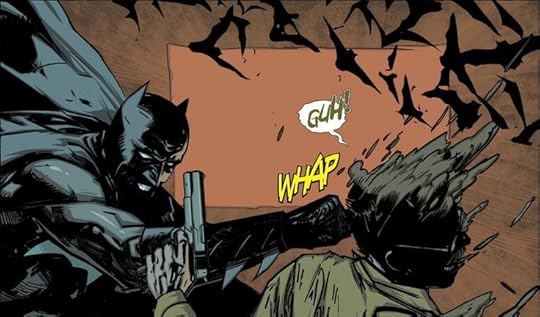
Our plot begins with Commissioner Gordon in the middle of hostage negotiations with Clayface's goons. Gordon gives himself over to the henchmen in exchange for freeing the security guard, then proceeds to murder the slue of henchmen when Batman appears, and the realization that Gordon is Clayface reveals himself. Batman and Clayface engage in a swift battle when Clayface shapes shift into Natalie, throwing Batman off of his game and escaping into the crowd.
The questions that remain on Batman's mind in the cave are: what is Clayface's objective, and where is Commissioner Gordon being held hostage? Alfred briefly confronts Batman asking him why he hesitated when Clayface shited into Natalie to try and bring some closure to Bruce, but our Dark Knight swiftly disguises it and returns to his objective to locate Commissioner Gordon. Meanwhile, we pivot to Gordon, who has been tied to a chair in one of Clayface's safe houses and left to await his fate. However, Gordon doesn't go down without a fight, and the Commissioner manages to free himself and use a spot lot as a bat signal as day turns to dusk. Batman notices the signal and tracks Gordon down, rescuing him from his captor. A crowd is formed when Batman arrives at the scene as our panel turns to Clayface, revealed to be carrying around a bag of jewels.
In our next scene, we see Clayface manage to break into the stock market with the plan to crash the Gotham economy. Batman manages to save a clerk before leaping into action to stop Clayface using a new laser design to encapsulate Clayface. However, Batman misses multiple times to fully trap his foe, allowing Clayface to escape once again.
Batman then regroups and attempts to answer his question as to how Clayface knew that Batman and Natalie were in contact, leading him back to the Mad Hatter, who is currently locked up in Arkham However, when the Madman is incapable of answering Batman's questions, the Dark Knight pivots to the Penguin who visited within the last month. Late at night, Batman arrives at Penguin's home awakening the disoriented man to an interrogation and theory as to why Clayface has done his bidding. Penguin denies it, and Batman takes off to reconvene with Gordon.
Commissioner Gordon and Batman discuss how to draw Clayface into the open to trap him when the brilliant idea to set up Commissioner Gordon's men dressed as Batman in strategic locations comes to mind. At Clayface's next heist in the mines to locate special cat-eye diamonds. The plan works perfectly, and Batman manages to capture Clayface with his laser gun and then carries his foe to Arkham.
In Arkham, we see Clayface make friends with his next-door neighbor, who adores all of his acting in past movies as Basil Karlos. Clayface begins to enthusiastically put on shows and read scenes from his past staring roles for the man's benefit, which grants him much fulfillment. In the next scene, as the inmate Scarecrow moves out of his cell down the hall, Clayface captures a glimpse of his reflection as a young boy. We then go on to learn that Basil was a very average kid who was often overlooked by all who knew him. In desperation to want to be cool or noticed, he asks his parents to buy him a leather jacket off to work in return. His father refuses, but his understanding mother sets aside some grocery money to allow her son to buy the jacket. We then pan over to the thrift store, where we see Basil buy a jacket and steal a pair of sunglasses. The next day, he appears at school, and still nobody notices him, so he tries out for the school play, where the adults find his performance and appearance to be too plain (ouch, what a bunch of jerky adults 🙄😒). Years go by, and Basil tries out for role after role and is continuously denied until he makes a deal with Penguin, who offers him an artifact of clay from the Navajo Native Americans said to have the power to shapeshift people into animals. Basil is enthralled with the hopes of becoming an Allstars movie star but can't pay back Penguin, to which the man responds with "We'll work something out," aka now and then, Penguin asks Basil to commit crimes for him by robing valuable goods. Basil quickly rises to the top and is beloved by all as he uses his shapeshifting skills to match intense facial expressions, which turn to change into various people he encounters. Although nothing lasts forever and soon Clayface loses his ability to correct his shapeshifting, turning into clay.
The plot then redirects our attention to focus on the present, where Clayface expresses much gratitude for having a friend until he realizes that his friend died in the cell next to him. This throws Basil into the woes of mourning with the need to quell his thirst for attention. In a desperate attempt, Clayface fakes choking and receives medical help, allowing him the smallest crack to escape. Once freed, Clayface manages to track down Joker, who gives him a non-lethal laughing toxin. Clayface then takes to the sky as he kidnaps multiple civilians, then traps them in a hooking their veins up to the toxin as he recreates his famous scenes until Batman steps in and saves the day. Clayface is trapped once more, and our story comes to a close.
Our second arc takes place throughout two issues as it focuses on the loss of one family as a young mom, grandma, and little girl lose their baby boy and are forced into human trafficking by local Gangs who promise the hopes of immigrating to Gotham. What follows is the separation of the grandma and granddaughter, who are forced to work in a Christmas factory until the grandmother is beaten and believed to be dead but isn't, and in her attempt to rescue her granddaughter, she is thrown off the second-story building. In a last attempt, the old woman crawls to Batman, who witnessed the atrocities with the pledges for him to save her daughter and granddaughter. What follows is a swift climax with Batman rescuing the granddaughter and all of the children trapped in the factory, then searching for the mother and doing the same, but offers her a job at WE, and he takes the daughter to Gotham General, where the two are reunited. A year passes by, and the girl and her mother are now in a safe home. As they fall asleep, the little girl looks up to see Batman waving by her window, and she is filled with joy and gratitude.
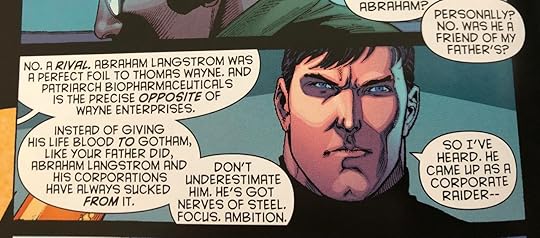
In our third and final arc, we are taken to an alley where Commissioner Gordon investigates a crime scene where a homeless man has been killed with his veins all appearing dried and dilated. Batman sneakly takes a sample and returns to the cave where the vial shows traces of Man-Bat serum. Batman then bursts through Dr. Langstrom's lab, but upon confronting Kirk, he pleads, telling Batman he hasn't used the serum and that this is not his doing. Batman believes him, and the results return with family DNA to his father, Abraham Langstrom, who is a ruthless CEO who seeks to use the Man-bat serum to make a fortune in the pharmaceutical industry to regain hearing in the deaf community. However, he's dipped into his supply at night and transforms into Man-bat with the desire to kill the "stain on Gotham" by killing the homeless population (because the formula makes him into a vampire bat needing blood to quell his thirst for power...um 🤨). Abraham then appears at Kirk's lab and shows him what an alpha man he is, and raves about how much he admired Bruce as a boy because of his discipline and focus. That night, Bruce asks Alfred about what he knows about Abraham Langstrom, which was that he was a rival to Thomas, seeking to drain Gotham of its resources, whereas Thomas enriched them. Alfred reverse engineers the Man-bat formula thanks to Lucius and takes to the skies. Manbat, and he engages in a close pursuit above the clouds. Batman attempts to inject Man-Bat to reveal that he is Abraham Langstrom but fails as the needle breaks off. Man-Bat throws him to his death as Batman falls far above Gotham's Skyscrapers towards the pavement. With quick thinking, Batman deploys his grappling guns and is suspended in the sky until his plane daringly receives him.
The next night, Batman confronted Abraham. The two had some back and forth, but without visible proof, Batman had nothing until he traced the whereabouts of Abraham's car, revealing that he plans on visiting the Hill homeless shelter. Batman then returns to Krik and asks for his help on how to defeat the Man-bat serum, to which he responds that the hide of his father is impenetrable. Kirk had an idea, and Batman took off to the shelter disguised as a homeless man.
When chaos ensues, Batman leads the innocent people towards the exit, and when Man-bat lays his claws on Batman, drinking his blood, he is then transformed back into a man, where he is swiftly apprehended. In the next scene, we see Abraham being absolved in court using Insanity, and all appears to be fine as he is released. Outside of the courtroom, a young girl and her mother confront the Rick CEO, with the girl claiming the man killed her dad. Abraham then leaves feeling somewhat remorseful to hear that news but returns to his life as it's always been with the knowledge that Batman is always watching.
Overall, this was a fantastic three-part arc filled with daring action, beautiful full-page illustrations, and compelling storytelling for both Kirk Langstrom and Basil Karlos. I loved the more psychological elements explored throughout the Dark Knight series, as well as the in-depth plot points. This comprehensive arc deserves 9.0/10 🌟.
However, this is an excellent series that is deserving of 10/10 🌟🌟🌟🌟🌟🌟🌟🌟🌟🌟 from this Batgirl 😁👍🦇💯!!
Well, Hurwitz returns to the same extremely dry well once again, this time telling a flat, rote story about Clayface's past and how it turned him into a monster. This has been the case with Hurwitz's previous three stories, all shining a light on a Batman villain's supposed trauma that made them who they are, and the more he does it the more it becomes clear that he only really has one idea. It also feels thoroughly unbelievable. To boil characters down into one or two defining moments in their lives is a very TV/movie thing to do, and doesn't actually humanize them the way he seems to be trying to.
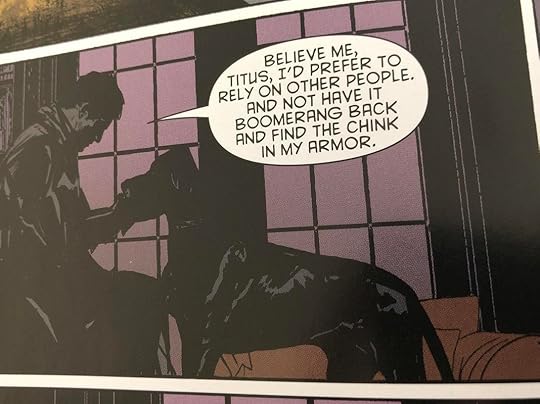
Even the repetitiveness aside, I also just can't handle how on the nose everything is here. Everyone says exactly how they're feeling, tells the reader exactly what they should be taking away from a given scene. I mean, look at what Bruce Wayne says to his dog:
What kind of character is so aware of their own foibles that they express them in secret to an animal? It's just nuts.
Once we get past the Clayface nonsense, Hurwitz finally moves into some slightly different territory, starting with a two-issue story that is completely without dialogue. I thought this might be one to turn me around (I love creative approaches to comic storytelling). However, there's just no reason for the story to be silent. There are myriad instances of someone pointing or "mouthing" something that they should really just be saying out loud, and the only reason they aren't speaking is because the writer has decided they aren't going to. It doesn't work.
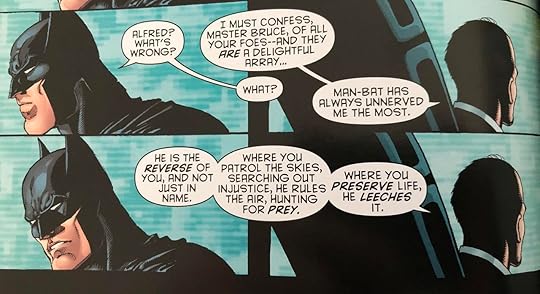
And lastly, we return to the weak characterizations and on-the-nose storytelling of the previous arcs. This time it's a story about Man-Bat, and in case you were wondering if the story was about the dueling natures of Man-Bat and Batman, here are two separate instances within as many pages where a character just flatout explains it:
With dialogue like this, I just can't keep reading this series. It's unfortunate, because Hurwitz has been paired with some truly great artists. Alex Maleev does great work in this volume, as does Ethan Van Sciver. Previously even David Finch worked on this title. Sadly, there just aren't stories that can match the art. Oh well.
This final volume in The Dark Knight series is a bit of a mixed bag. The main storyline features Clayface. I think Clayface is a cool character, but to me, he never quite fit into Batman's rogue gallery. He's more of a superpowered villain than most Batman faces such as Joker, Penguin, Riddler etc. I think Clayface would work better against more cosmic type heroes than Batman, although there have been good Batman Vs. Clayface tales over the years.
In addition to the main Clayface storyline you get a two issue "silent" storyline, which was OK but a bit confusing in parts due to the lack of words. The volume wraps up with the best storyline of the volume in my opinion, which is a Manbat 2 parter.
Overall good, but not great. If you have read the other Dark Knight volumes then I'd recommend this one, but if you haven't read any, the other volumes are better.
2.5 rounded up. This one covers the origin of Clayface but only briefly and the entire Clayface story could have used more details and more development. The Man-Bat story was decent, but keeping consistent with the previous two volumes, it would have been nice to see a thorough origin story rather than assuming readers know the history of the character. I'm sure many will disagree, but the wordless section was a nice departure. The story was ordinary at best but the plot was suitable for a novice attempt at a picture only segment. The art varied from great to middling.
Eh. Nowhere near as good as Vol. 3, which told the best Mad Hatter story I've ever read. This volume contains three stories and all three are less than original and have been done better elsewhere. There's nothing necessarily bad about this volume, it just doesn't do much well either. It's a good library grab or bargain bin steal.
Focusing mostly on Clayface, this volume gives us an updated origin story for the mucky monster. Also more of the Man-Bat saga that has been playing out across several Batman family titles. Not a bad collection, but certainly nothing above average.
As far as Clayface stories go, this is surprisingly good. I usually do not care for anything involving that particular villain or those who take after him. The Man-Bat story was pretty lacking, though.
Čitateľa čaká naozaj, že naozaj temný rytier - Kresba je celá lietrally dark, že mi to miestami až trošku vadilo. Ale zas na atmošku je to veľmi dobré ;) :).
Prvý príbeh sa sústredí hlavne na postavu Clayfacesa. Čo si budeme hovoriť, Clayface je veľmi zaujímavý egocentrický charakter, ktorý je schopný ukecať Jokera, aby mu predal nariedenú dávku svojho toxinu, aby mal večne usmievavé publiku.
„...že na můj vkus je to trochu zvrácené.”
Zdá sa však, že Clayface tentokrát pracuje inak. Akoby zmenil taktiku. Akoby poznal a vedel o Batmanovi viac vecí, než Bruce tuší ... Lenže odkiaľ? Ako? A tu už na scénu nastupuje samotný malý-veľký Penguin, ktorý si necháva takto Clayfaceom platiť starý dlh. Lenže aj tomuto nemilému kschtíku z hlíny raz rupnú nervy a rozohrá svoje vlastné predstavenie.
Niekto písal, že mu je aj ľúto osudu Clayfacesa ... Ale mne teda určiet nie. Vždy chcel iba pozornosť a zaujať a bolo mu v podsatate jedno ako. A zaujal ani nie vlastným pričinením, skôr vďaka "inteligentnej plastelíne" ale to je asi tak celé.
Potom nasleduje véééľmi páčivá vsuvka, ktorá nám rozpráva príbeh bez slov. Tu môže čitateľ oceniť krásu a prepracovanosť kresby. Veľmi silný príbeh, ktorý sa dotýka aj stále aktuálnych problémov ako je chudoba, obchodovanie s ľuďmi, detská práca atď ... Škoda len, že nemáme takého Batmana, ktorý by zachránil všetky tie nevinné obete ... (Ale tomu tímu právnikov a hnusnému vtáčiemu krpcovi by som hneď najradšej skočila do úsmevu -_-)
Do tretice všetko dobré - Nekoná sa síce Twilight, ale Langstrom starší si chce dokazovať svoju úžasnosť a genialitu, tak sa zmení na obrosvkého vyciciavača krvi.
Lenže tento komiks mal svoj vrchol v druhom príbehu a od tohto tretieho až nebezečne rýchlo strácal na kvalite a zaujímaosti. Bolo to také - ok, rýchlo záporak, letom-svetom vyriešené, spacifikovanie a koniec. Možno je ten tretí až zbytočný, ja by som osobne to kľudne ukončila po druhom príbehu.
Tak či tak tolo to supeeer počteníčko a ja sa teším na ďalšie Bat-stories ;) :)
Batman: The Dark Knight: Clay picks up where the previous volume left off, collecting the last eight issues (Batman: The Dark Knight #22–29) of the 2011 on-going series.
This trade paperback has Bruce Wayne as Batman taking on various of villains Basil Karlo as Clayface is reintroduced with a new origin story for the New 52 (Batman: The Dark Knight #22–25), Oswald Cobblepot as the Penguin (Batman: The Dark Knight #26–27), and Abraham Langstrom and a modified Man-Bat serum (Batman: The Dark Knight #28–29).
Gregg Hurwitz penned the entire trade paperback. For the most part, it was written moderately well. Unlike the previous trade paperbacks, where Hurwitz intimately explores and recreates classical villains from the Batman’s Rouges Gallery and give them new life and origin stories for the New 52, it seems that he crammed a tad too much for the last eight issues. He covers Basil Karlo as Clyaface, somewhat with Oswald Cobblepot as the Penguin and the state of the Man-Bat serum. In short, it just felt too hectic and divided – a hodgepodge of stories collected together.
Alex Maleev (Batman: The Dark Knight #22–25), Alberto Ponticelli (Batman: The Dark Knight #26–27), Ethan Van Sciver (Batman: The Dark Knight #28–29) and Jorge Lucas (Batman: The Dark Knight #29) penciled the trade paperback. For the most part, their penciling styles complemented somewhat well with each other, as their penciling styles are slightly different and noticeable, this makes the artistic flow rather rough.
Overall, this series of Batman: The Dark Knight is a rather mix bag. It started out and ended rather mediocre with a safe and predictable breakout at Arkham Asylum and ending with a multiple of short comics of various Batman villains. The core of the series is best where Hurwitz explores the origin stories of Jonathan Crane as the Scarecrow and Jervis Tetch as the Mad Hatter.
All in all, Batman: The Dark Knight: Clay is a mediocre conclusion to an uneven series.
Me gustó la historia de Basil. Estamos acostumbrados a ver a Clayface como un monstruo, como un ser que solo quiere matar y personificar, pero aquí tenemos a un humano que ha medio sufrido (o sufrido a su manera), que quería o que necesita atención y que al final casi es víctima de las circunstancias. Es triste ver la muerte de ese otro personaje y como esto afectó a Karlo. También me gustó mucho cómo lo dibujan, entre amenazante y entre un personaje temeroso y miedoso, que se la pasa corriendo.
La historia de man bat es aburridísima a más no poder. Creo que hasta ahora el detective comics se lleva las palmas con man bat y ya no necesitamos más arcos con texto y texto de "pobres víctimas que necesitan salir a matar por el llamado de la naturaleza" y blabla.
Después tenemos una especie de historia de navidad. Muy buena, muy cruel y triste y desgarradora. Que a la vez te hace querer aventar el cómic y a la vez te recuerda la capacidad que tiene la imagen para contar algo, un verdadero arte el hacerte sentir.
Al final está la Gatophia o algo así, interesante y muy padre ver a Ivy, sin embargo la historia es apresurada y se resuelve de forma muy equis. Como algunos dijeron en el arco anterior, se agradece la falta de la conejita casi en tanga en una historia estúpida para justificar el querer vender sexo; pero sí tenemos a Scarecrow (que no se explica cómo escapó del anterior arco.
(Read as Single Issues) This is a very different Clayface (made all the more obvious if you've read the Monsters Unleashed Clayface issue that happened in the midst of the story and presents a much less intelligent version of the character). Clayface here is an unstoppable force and utter escape artist. Batman is somehow thrown off by this, which is a little weird. The art is dark and grim (the coloring especially), and the back story is a little weak. Not much action takes place. The collection also includes Voiceless, a 'timely' issue about slave labor in Christmas toy factories that is notable only by its lack of text (and minimal presence of Batman). It's decent, but its attempt at topicality ends up overwhelming its story. The final two issues offer up a variation of ManBat that was pretty stupid. The new ManBat is a corporate raider and relative of Langstrom who murders homeless because 'nobody will miss them.' It's another political story that doesn't meet the mark of quality. So all told, you've got three different stories here, none of which are wonderful, and one of which is actually pretty bad. The art is consistently good throughout, but unless you're trying to keep up with every Batman story, it's not something worth picking up.
While not as inspired as Hurwitz’s other volumes, this was still a worthwhile read with more villain-focused tales. This go ‘round, Clayface takes center stage, and we learn about how his desperate need for attention ended up transforming him to a monster of both mind and body. This was interesting, but not as deep or captivating as the other 3 he’s focused on.
There is also a story consisting of 2 silent issues that I rather enjoyed, quick as it was. It’s another testament to how dark of a writer Hurwitz is, even when he cuts some of the edge with humor occasionally. The last issues were focused on a new Man-Bat terror, and is still fine despite its brevity.
Overall, not the best of the bunch, but not bad by any means. I enjoyed this (not-often-mentioned) run more than I expected once it really hit its stride. It’s a dark, messed up approach to Batman capers, and I liked it quite a bit. Throw in his Penguin book, and this is a fine stretch of Batman mythos.
Good book, but the weakest in this series. The first story of Clayface does not have a great start but does improve over time. Similarly to the prior 3 volumes, the book provides some backstory to the villain and while it was cool learning more about Clayface’s past, it wasn’t as strong as the previous ones (Scarecrow and Mad Hatter). The artwork for the Clayface story is not my cup of tea, but isn’t too bad. It’s also fairly well-written like the volumes before. The book finishes off with 2 two-part stories. The first was an almost textless tale about an unfortunate family that find themselves in Gotham city, which was decent. The second was the return of Man-Bat, which goes back and forth with different artists. Some of these pages had the best art in the book. Overall a good final volume, that I’d recommend to any Batman fan. I’m glad I read this Dark Knight series.
The 4-star rating is for Voiceless, a 2 part story in the middle. That story is excellent. The rest of the book gets 3 stars like much of the rest of the New 52 Dark Knight series. These books do an excellent job creating a back story for the villains that Batman is facing and weaving those backstories into the main story. The problem I have is them main stories these backstories are attached to are just not great. They are ok, over the top, not very well thought out and require Batman to do stupid things in order to move the story along. If your story needs the world's greatest detective to do stupid things to make it work, it isn't a very good story.