PSYCHOLOGY, RELIGION AND HEALING. A critical study of all the non-physical methods of healing, with an examination of the principles under lying them and the techniques employed to express them, together with some conclusions regarding further investigation and action in this field LESLIE D. WEATHERHEAD M. PREFACE: IN THE FIRST WORLD WAR a young doctor, working in the desert amongst troops stationed north of Baghdad, talked about his dreams to two young chaplains far into the night. I was one of the chaplains. That doctor was a remarkable man. He practised psychological treat ment of an impressive kind when what was then called The New Psy chology was very new indeed. He practised hypnotism, both as a means of investigating the deep mind of the patient and also of giving him suggestions of courage, confidence and recovery. Further, he had as great a spiritual faith and power as I have ever seen. He would go out into the desert, and for hours he would concentrate his mind on one patient
Leslie Dixon Weatherhead was an English Christian theologian in the liberal Protestant tradition. Renowned as one of Britain's finest preachers in his day, Weatherhead achieved notoriety for his preaching ministry at City Temple in London and for his books, including The Will of God, The Christian Agnostic and Psychology, Religion, and Healing.
Having borne myself through this entire work, I will attempt to summarize my take-aways, which may edify the inquisitive reader, while simultaneously allowing them to devote their time to more entertaining reading elsewhere.
The Importance of Emotions, Internalizing God, & Human Cooperation in Healing
Weatherhead begins by reminding us that Jesus directed us to “heal the sick”, remarking that believers would do “even greater things” than He, even “move mountains”. For Weatherhead, this means that our efforts to heal must extend beyond the physical sciences and into the realm of spirituality. But Weatherhead is careful not to jettison physical remedies altogether, as he makes a case for the combination of physicality and spirituality in healing efforts. This means that cures lie not only in the administration of drugs or surgery, but also in the relief of worry, strife, embarrassment, deprivation of love, guilt, envy, arrogance, and other deficit emotional states.
Weatherhead cites examples and case studies in demonstrating how emotional afflictions actually result in physical ailments and how relieving emotional symptoms can alleviate physical problems. Throughout this book, Weatherhead preaches the importance of mind, body, and spirit in sustaining health. Certain chapters seem to imply this trilogy may also be translated as God (Mind), Christ (Body), and Holy Spirit (Spirit), respectively, with the emphasis being that God resides in the mind as opposed to externally.
Realization of an internal God has been a historical difficulty in human religions. The ultimate realization that God is not without, not within temples, not within other men, not far away in the sky, but inside ourselves, is the key to finding healing and happiness. When we project God somewhere else, we distance ourselves and consequently become unable to release the kind of energies that Christ manifested. We must engage moral effort and spiritual insight, in order to tap the energies of faith and love.
Unfortunately, most people are restrained by unbelief, sneering attitudes, and subconscious contempt. To succeed in healing, we have to be encouraged by an atmosphere of trustful expectancy in which the mental cooperation of others is gained. Weatherhead points out that, if it is true, as the Bible says, that Jesus was unable to do mighty works in one place because of people’s unbelief then, by extension, it stands to reason that mighty works are much more probable amidst a crowd of true believers.
Hypnosis
Weatherhead uses the phenomenon of hypnosis to underscore how important the mind is in the healing process. At the risk of forsaking brevity, I’ve compiled the following list of some of the remarkable things that Weatherhead cites from hypnosis sessions. This list is necessary for the reader to understand how the phenomenon of hypnosis lays foundation for Weatherhead’s subsequent positions.
• The ability of the operator to raise or lower the temperature of a hypnotized person. • How an uneducated coal-miner suddenly began using the perfect diction of a deceased Oxford scholar, even employing words far beyond his normal vocabulary and maintaining an Oxford accent that he never had before. • How suggestions made to one under hypnosis are readily carried out even after the patient awakens. • How a hypnotized woman was able to lie with her heels on one chair and her neck on another without intermediate support and, upon being told her body was firm and unyielding, could support an adult sitting on her abdomen. • How needles could be driven into a hypnotized person with no reaction when they were told their body was made completely anesthetic. • How hypnotized people told that their raised arms are completely stuck cannot be made to drop them, even when others attempt to push them down. • How hypnotized people break out visibly on their skin when told they have a rash. • How blisters erupt on the skin of hypnotized persons when told they are being burned. • How hypnotized persons remember with ease events that occurred so early in their life that their parents are necessary to confirm them. • How textbooks on hypnotism record permanent cures of almost every type of illness. • How hypnotized people can be induced into hallucinations, such as being told a lovely black cat is asleep on the couch near them such that they begin stroking it and holding it. • How hypnotized people see pictures on blank paper when told they are holding a photograph, even going into details in explaining what they are seeing. • How hypnotized persons can be made to dream and actually react to the actions within the dream, such as getting wet, falling, or being punched. • How a hypnotized person told they are deaf can’t detect a loud noise right beside them. • How a hypnotized person told that something sweet is bitter, will spit it out. • How the phenomenon of Dermographia was discovered when the skin of a hypnotized patient was made to display an outline of a design which the hypnotist was describing.
The point of this list is not to suggest hypnosis as the means of healing, but to convince the reader of the power that the mind actually has upon the body. Because our mental state affects our ability to heal, we must consider whether or not we sometimes hypnotize ourselves, thereby establishing certain sicknesses, remedies, or recoveries.
Certainly, there are those of us who can induce trance by meditation. These are states of altered consciousness that we achieve alone. Much has been written about the power of positive thinking and undoubtedly, people convince themselves of all sorts of things that may or may not be true. All this encourages devotion to the art of self-healing and to the healing of others.
Beyond Hypnotism
Weatherhead introduces us to Emile Coue (1857-1926), a French psychologist who introduced a method of psychotherapy known as autosuggestion. Coue asserted that a complex arrangement of ideas exists in the unconscious mind that continuously and spontaneously suggest things to us which influence our health and wellbeing. Coue prescribed the following mantra as a method of healing: “Day by day, in every way, I’m getting better and better.” People came to Coue with all sorts of ailments: kidney, diabetes, memory loss, stammering, weakness, atrophy, etc. and Coue experienced a 93% success rate in his healing practice.
Coue’s work reveals that a patient doesn’t necessarily need a trance state to access the healing powers of the unconscious mind. Repeating the mantra again and again allows the idea to seep deeply into the unconscious parts of the mind, much like a catchy song sometimes gets stuck in our head. Repetitively speaking these positive words of healing succeeded in working miracles in the lives of many people. Coue’s work exemplifies that the unconscious mind has enormous power over the body.
Emotional Deficiencies That Promote Physical Illness
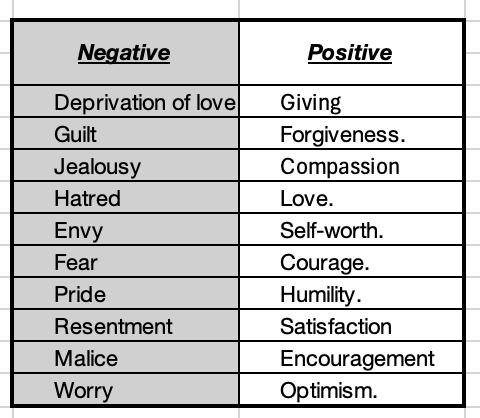
Weatherhead mentions the following states of mental anguish that may create physical illnesses of various sorts. I’ve taken the liberty to supplement the list with the alternative positive states of mind that likely serve as antidote for the negatives.
Reading through these lists allows us to immediately understand the sort of positive or negative energies that arise through our emotions. Without doubt, these energies affect us physically. We must endeavor to set our intentions towards the positive energies.
Emotion is an outlet of release that is necessary to prevent an overwhelming of the nervous system and emotions affect the discharge, extent, and chemical composition of bodily secretions. We express emotions physically, such as when we cry, orgasm, or salivate. Emotions can release adrenalin, endorphins, testosterone and other substances that can affect our strength, virility, or state of wellbeing. The extent and composition of snot, excrement, sweat, and urine reflect the condition of our health.
Emotions are particularly reflected upon the skin because the skin is that organ of the body which, more than any other, has literally to face the outer world. The skin is our intermediary between the inner and outer worlds. We commonly get goose bumps, itching, blushing, chills, shivers, rash, sweats, and other skin reactions.
There is not much of our body that can be said to be unmoved by our emotions. Our hates, fears, angers, and worries can poison our own systems via enzymic and hormonal actions, causing ulcers, eczema, hypertension, anorexia, arthritis, warts, psoriasis, tumors, asthma, and bodily ailments. Even the common cold is thought to be influenced by emotional states.
There is no tissue of the human body wholly removed from the influence of our spirit. More people are sick because they are unhappy than unhappy because they are sick and much unhappiness results from a deprivation of love. We cannot overemphasize how important it is to distribute love. Love has the power to sweep out unhealthy emotions like fear, jealousy, pride, resentment, anger, worry, and others that precipitate illness.
When we pour out our love to others we tend to forget ourselves and the unhealthy emotions that go along with us. We must build into our minds what we desire to express in our lives, particularly thoughts of love, health, happiness, success, and power.
How to Cultivate Positive Energy
Emotions arise out of our innate desire to control everything. Relinquishment of control promotes the ability to see matter as an expression of the creative activity of God, instead of as things to covet, hoard pathologically, or become intoxicated over. Matter is infinitely diverse. It is a vast kaleidoscope of God’s ideas, translated into manifestations of energy, sometimes solidified as in a rock, other times alive and moving. This energy of God is also within us, and Weatherhead asserts that it can be a healing force if we but learn to utilize it properly.
Pessimism leads to weakness. Optimism leads to power. If the mind deeply receives an idea, it tends to actualize it. Immense energies are unleashed by us through our personality. There is a spiritual element in personality that can address healing because significant energies are emitted through the personality.
Weatherhead reports that nearly all human pain, suffering, and disease comes from human folly, ignorance, and sin; but the will of God is that man should replace folly with wisdom, ignorance with knowledge, and sin with holiness. In other other words, replace the negative emotions with positive ones. We must resist allowing unhealthy emotions to seep into our minds. Loving others unleashes our therapeutic energies. Often, you can actually love a patient back to health.
Weatherhead remarks that if the hypnotized mind can randomly produce a blister then harboring the idea that a cancerous growth is being healed is not without merit. The mind can involve itself in cutting off supplies of blood and nourishment to a carcinoma such that is sloughs away and perishes.
Our Multiple Personalities, Positive & Negative
We’ve all heard of multiple personality disorder and how people often hear voices. A voice distinct from the personality of the one hearing it is a baffling thing. Split personalities are much more prevalent than anyone is willing to recognize. Certainly, many admit to hearing voices, and we all exhibit varying emotional moods that affect our personality.
Weatherhead speaks of cases wherein the multiple personalities of a person exhibit varying degrees of health. One personality of his patient exhibited very poor heath while the alternative personality showed exuberant vitality and radiant health. For some people, the different personalities become so highly developed that psychologists must recognize them as distinct psychic beings. Are these alternative personalities demons, ancestral spirits, memories from past lives, other versions of ourselves, or something else? Whatever they are, it is obvious that in some cases human beings can be controlled by alternative intelligences.
Weatherhead believes that humans sometimes yield to evil powers that are hostile to God’s will and who utilize sin to accelerate death, thereby lessening the time allotted for a man to grasp spiritual ascendance. Just as an envious or jealous person might wish to drag a better man down into their own oblivion, so spiritual beings seek to thwart the collective goodwill of men by destroying relationships, shortening lives, and inciting violence. Ultimately, Weatherhead endeavors to connect this idea into the psychology of Carl Jung.
Weatherhead suggests these mysterious personalities hail from the subconscious realm, or from what Jung referred to as the collective unconscious. Jung actually identified personalities (archetypes) that hailed from this unconscious realm. Jung’s perception of the collective unconscious was as a vast spectrum of instinct and animality from which the conscious mind first evolved. Weatherhead suggests that the collective unconscious is forever attempting to overthrow the conscious mind by overwhelming it back into its more primitive state of animality and instinct. This battle between the unconscious and conscious is associated with the battle between sin and morality, freewill and instinct, volition and the passions, and ultimately, good and evil.
The personality that dominates in all of us is in control of our conscious existence and hopefully it is the one we are strengthening with positive energies. To the extent that we allow the conscious personality to be weakened with negative energies, we become susceptible to emotional conflicts and personality disorders that can result in sickness.
The Uniqueness of Christianity In Healing
Primitive religions favored the healthy and strong under the idea that they were favored by god or by “the gods”. Christianity is remarkable in the sense that it involves a loving God caring for the sick and the impoverished. Jesus Christ was a historical person who was in a unique relationship with God, who healed people, who changed lives, and who continues, even after His death, to change lives and heal people through His spirit, wherever He is seriously and adventurously followed.
Brotherly love was fundamental to Christ’s early church. However, the church became very different after it was hijacked by the Romans, who ultimately turned it into an institution of inquisitors, burnings at the stake, crusaders, and exploiters of the masses.
True Christianity is about helping others, loving others, communal organization, and caring for one another, particularly the sick and destitute. This is the true function of the church, as opposed to the hierarchies of ostentatious figureheads and elaborate temples that we see today. The function of the church is not to conduct war, tax the impoverished, promote elaborate superstitions, conduct magical rites, build giant temples, or impose conditions of judgement. On the contrary, the church is intended to be a vehicle for the dissemination of love and therefore of healing.
Much emotional sickness abounds because modern churches are tainted with superstitious rituals, elaborate theologies, or they exist only as an obligatory social vehicle. The modern church is insidiously different than the early church in which healings were more common. We’ve allowed superstitious rituals and the quest for social standing to replace sacrificing ourselves through love.
Human history is replete with the idea of sacrifice. Primitive men sought to give up something of value in order to alleviate the guilt of sin. Modern Christianity proclaims that Christ sacrificed Himself to remove human sin. However, it is undeniable that sin remains among us. We must ask: was there an alternative reason for Christ’s sacrifice? Could it be that Christ’s sacrifice was a call for our own self-sacrifice?
Truly, we can help heal another person through a process of sacrificing our own vitality or health. We can expend our energies cooking for them, cleaning, massaging, loving, touching, bathing and nurturing others. We know factually that love can manifest in sufficient magnitude to motivate such sacrifices and that such love aids in the healing process.
The predominant tendency is for older people to sacrifice themselves for younger people, wearing themselves out, and this contributes to their aging decline. Most parents sacrifice themselves for their children. We observe, therefore, the necessary and predominant tendency in life of self-sacrifice, as necessary to sustain subsequent generations and to advance mankind. Our failures in this arena result in the dissolution of families, distraught lives, addictions, crime, social deterioration, and many other forms of illness.
Clearly, the Message of Jesus Christ is to sacrifice ourselves for others, to aid in their healing, to promote their goodwill, to advance their education, and to see after their health. Why can’t we better see that self-sacrifice is the catalyst for the kingdom of God on earth that Jesus proclaimed? Instead, so many of us have turned this simple message into a license to sin under the guise of cheap grace amidst our sustained un-repentance. We must begin to see that the method of altering the world is the giving of ourselves unto others, promoting peace, uplifting others out of poverty, aiding, caring, and loving those around us. This is the way we will succeed in healing, not only many prevalent illnesses, but also in the healing of our societies.
Weatherhead see Jung’s collective unconscious as like unto the continents of the world which, though they are divided by the seas, actually join up beneath the sea and constitute one great mass. In this way, Weatherhead sees all of humanity joined beneath their individual consciousnesses by the great realm of the collective unconsciousness that Jung identified. In this sense, all of us have subconscious wells that sink deep into the collective unconsciousness and if we drop poison into our well it works to disrupt all of society. Conversely, if we infuse our wells with love, then society as a whole benefits. To sin is to poison the public reservoir. To love is to strengthen the whole community.
I find Leslie D Weatherhead fascinating. For a Rev and Dr to write like he does i can relate so much to his books and the reason being is i was brought up Roman Catholic but left church at 18 but promised to see if i could find a religion for myself. I tried Hindu and Jehovah witness but got nothing from them. I love old books and buy from second hand shops i found It happened In Palestine and that was it i was hooked. I bought loads of his books. His sexual book i wish i had read at school would have saved me years of suffering. This book is perfect because for years ive suffered with epilepsy slight psychosis. I can relate to all three subjects Psychology Religion and Health. Its a long read but worth it i wish i had met him in London all those years ago. XXX
Incredibly thorough, thoughtful and deep coverage of almost precisely the topic of the title. This is albeit an old investigation, of the interrelationship between psychology (both natural psychology and the theories of professional psychologists up until that time) to physical illness and recovery; alongside of how just 'Christian religion' can intersect this mix. This is undoubtedly a strong faithful Christian position - again albeit of its day prior to the Charismatic Renewal, with attendant suspicion of Pentecostalism. Really apart from discussion of secular psychologist's positions on God, the only area where Weatherhead departs from Christian belief was when he briefly speculates on the perhaps greater efficacy of eastern mediation against historical Christian meditation practices. Generally Weatherhead is very strong on the gospel truth and I particularly like his section on 'The Nature and Place of Faith in Healing' where he is incredibly relevant for late modern and post modern human condition.
Elsewhere in the book Weatherhead looks at Jesus' healings for hints of hidden psychological means and techniques. This might be a cynical approach but it legitimately raises the question of how what happens in the spirit - that is psychologically - also effects the body both for sickness and conversely how the 'whole spirit' aids healing. Then the book looks at other psychological practices - many of which are later adopted as so-called New Age therapies. He moves through other Christian healing practices and exponents, before then dealing with the theories of the psychologists like Freud, Jung etc. He is unsparing in his criticism as well as admiring of their "science".
Finally section five and six come back to address whether this scientific physical and mental healing, also needs Christianity; and whether Christianity needs to pull in scientific expertise.
In all of this Weatherhead is far ahead of his time. The book is dense, but remains readable because it is very strong in anecdotal and in metaphorical examples throughout. At times there can be repetition - probably little wonder and a necessary reminder in 500+ wordy pages, and there can be sections of comparative little interest (like the extensive review of half a dozen historical psychological theorists) and a more up to date edition would be an unattainable boon; yet this truly is a magnum opus of the first degree.
Van tevoren verwachtte ik dat dit boek heel zweverig zou zijn, maar dat was niet zo. Het was juist realistisch, over het algemeen down-to-earth en in wetenschappelijke stijl geschreven. Soms even doorzetten, maar algemene conclusie: veel geleerd van dit boek.