

What do you think?

Fantastic Four: 1234 #1-4
Fantastic Four: 1234
Reed Richards. Sue Richards. Benjamin Grimm. Johnny Storm. They rocketed into outer space aboard an experimental starship, the first humans to attempt interstellar travel. But a freak encounter with cosmic radiation altered their lives forever, granting each amazing abilities.
Forty years later, the greatest team of adventurers ever assebled continues to push the bounds of human exploration—discovering parallel dimensions, lost civilizations and hidden nations; initiating contact with alien races; and repelling all manner of threats to mankind, both terrestrial and cosmic.
Now, Marvel's first family finds its members divided—their unique powers stretched to the absolute limit, their time-tested resolve pushed to the point of breaking. Each chapter of this quintessential collection focuses on one member of the cosmic quartet, as the team's greatest foes band together in an all-out assault on the FF.
Collecting: Fantastic Four: 1234 1-4
Forty years later, the greatest team of adventurers ever assebled continues to push the bounds of human exploration—discovering parallel dimensions, lost civilizations and hidden nations; initiating contact with alien races; and repelling all manner of threats to mankind, both terrestrial and cosmic.
Now, Marvel's first family finds its members divided—their unique powers stretched to the absolute limit, their time-tested resolve pushed to the point of breaking. Each chapter of this quintessential collection focuses on one member of the cosmic quartet, as the team's greatest foes band together in an all-out assault on the FF.
Collecting: Fantastic Four: 1234 1-4
96 pages, Paperback
First published September 23, 2002
About the author
Grant Morrison
1,812 books4,676 followersGrant Morrison has been working with DC Comics for twenty five years, after beginning his American comics career with acclaimed runs on ANIMAL MAN and DOOM PATROL. Since then he has written such best-selling series as JLA, BATMAN and New X-Men, as well as such creator-owned works as THE INVISIBLES, SEAGUY, THE FILTH, WE3 and JOE THE BARBARIAN. In addition to expanding the DC Universe through titles ranging from the Eisner Award-winning SEVEN SOLDIERS and ALL-STAR SUPERMAN to the reality-shattering epic of FINAL CRISIS, he has also reinvented the worlds of the Dark Knight Detective in BATMAN AND ROBIN and BATMAN, INCORPORATED and the Man of Steel in The New 52 ACTION COMICS.
In his secret identity, Morrison is a "counterculture" spokesperson, a musician, an award-winning playwright and a chaos magician. He is also the author of the New York Times bestseller Supergods, a groundbreaking psycho-historic mapping of the superhero as a cultural organism. He divides his time between their homes in Los Angeles and Scotland.
In his secret identity, Morrison is a "counterculture" spokesperson, a musician, an award-winning playwright and a chaos magician. He is also the author of the New York Times bestseller Supergods, a groundbreaking psycho-historic mapping of the superhero as a cultural organism. He divides his time between their homes in Los Angeles and Scotland.
Ratings & Reviews
Friends & Following
Create a free account to discover what your friends think of this book!
Community Reviews
Displaying 1 - 30 of 167 reviews

February 11, 2015
2.5 stars
Beware: LOADS OF SPOILERS IN THIS ONE!
In fact, I'm probably going to end up spoiling the entire story. So.
Our FOURTH week of Shallow Buddy reads is a nod to Marvel's oldest family, The Fantastic Four!

OH! So close!
This one almost made me get excited for this team. Almost.
At first it seemed like this was a grand What If story, told in Morrison's schizophrenic style and brought to life by Jae Lee's art.
Very cool, no?

No.
Midway through, I was convinced that this was going to be THE ULTIMATE Fantastic Four story for me.
Ben goes to see Doom, because he promised to tell him The Truth about something. Whatever he says rocks Grimm's world, and in exchange for listening...Victor cures Ben.
Meanwhile, Reed has hooked himself up to some machine and become totally unresponsive to the outside world.

Sue goes to Alicia's house to escape her brother's childish behavior, and get some advice on what do do about Reed.
He ignores her for his work, she can't take it anymore, blah, blah, blah.
Ding Dong!
Guess who shows up at the door?

Also, it looks like Doom is actually Reed!
OMG! Mr. Fantastic, what have you done?!

I'm literally bouncing around by the time I read that part!
*insert squealing*
Shit is getting REAL!
Oh. Wait. No, it isn't.
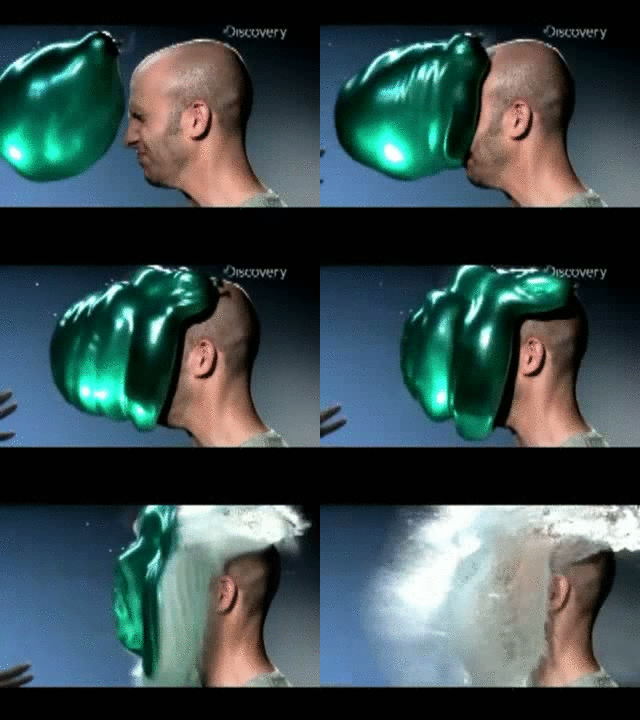
I was drooling all over the place, thinking YES! I've found MY Fantastic Four Book!, and that's when the cop-out happens.
Wah, wah, wah...
Nothing is really real. Reed is still a good guy. Sue still loves him, Ben was tricked (but it can be fixed!), and Johnny...well,the rain shorts out his power, but it's cool.
Turns out Doom has a giant reality bending Game of Life machine.
Not kidding. I wish I was, but I'm not...

So. Reed somehow figured out that Victor was going to use his Game machine on them, went onto his lab, built a replica of the machine, hooked himself up to it, grew more brains, and outplayed Dr. Doom.
But somehow...there was no time to explain to the rest of the team.

I loved the idea of mixing it all up, going crazy with the personalities, and turning these guys loose. It could have been interesting, but it ended up turning into a boring scoop of vanilla. And since it was Morrison, I not only felt unsatisfied by the conclusion...I was also slightly disoriented and confused.
Thanks, Grant.
First part of the story is great, so I'm grudgingly giving it 2.5 stars.

Beware: LOADS OF SPOILERS IN THIS ONE!
In fact, I'm probably going to end up spoiling the entire story. So.
Our FOURTH week of Shallow Buddy reads is a nod to Marvel's oldest family, The Fantastic Four!
OH! So close!
This one almost made me get excited for this team. Almost.
At first it seemed like this was a grand What If story, told in Morrison's schizophrenic style and brought to life by Jae Lee's art.
Very cool, no?
No.
Midway through, I was convinced that this was going to be THE ULTIMATE Fantastic Four story for me.
Ben goes to see Doom, because he promised to tell him The Truth about something. Whatever he says rocks Grimm's world, and in exchange for listening...Victor cures Ben.
Meanwhile, Reed has hooked himself up to some machine and become totally unresponsive to the outside world.
Sue goes to Alicia's house to escape her brother's childish behavior, and get some advice on what do do about Reed.
He ignores her for his work, she can't take it anymore, blah, blah, blah.
Ding Dong!
Guess who shows up at the door?
Also, it looks like Doom is actually Reed!
OMG! Mr. Fantastic, what have you done?!
I'm literally bouncing around by the time I read that part!
*insert squealing*
Shit is getting REAL!
Oh. Wait. No, it isn't.
I was drooling all over the place, thinking YES! I've found MY Fantastic Four Book!, and that's when the cop-out happens.
Wah, wah, wah...
Nothing is really real. Reed is still a good guy. Sue still loves him, Ben was tricked (but it can be fixed!), and Johnny...well,the rain shorts out his power, but it's cool.
Turns out Doom has a giant reality bending Game of Life machine.
Not kidding. I wish I was, but I'm not...
So. Reed somehow figured out that Victor was going to use his Game machine on them, went onto his lab, built a replica of the machine, hooked himself up to it, grew more brains, and outplayed Dr. Doom.
But somehow...there was no time to explain to the rest of the team.
I loved the idea of mixing it all up, going crazy with the personalities, and turning these guys loose. It could have been interesting, but it ended up turning into a boring scoop of vanilla. And since it was Morrison, I not only felt unsatisfied by the conclusion...I was also slightly disoriented and confused.
Thanks, Grant.
First part of the story is great, so I'm grudgingly giving it 2.5 stars.

April 8, 2018
While Reed Richards is Deep In Thought, Victor Von Doom tries to dismantle the rest of the Fantastic Four - but is Reed as oblivious to Doom’s machinations as he appears?
I’m definitely not a Fantastic Four fan but Grant Morrison is my favourite comics writer so curiosity drove me to check out this relatively obscure book from way back when he worked at Marvel before he began his DC tenure. So is 1234 any good? Eh… s‘ok.
I get the impression that Morrison feels the same way about the FF that I do. Namely, that Reed is the only interesting member of the team and only then when he’s in direct conflict with his inverted nemesis, Doom. Because he so pointedly takes Reed out of the picture from the start, I knew there was more to his story than that he was busy locked in some random experiment and the anticipation of that reveal was what kept me reading.
As for the others? Without Reed around they don’t know what to do with themselves - Morrison again underlining that Reed is the crux of this team - and what they did get up to was barely engaging. Ben Grimm lives up to his surname by having a very torturous storyline after Doom turns him human again and he suffers a series of physical and mental maladies he wouldn’t have if he’d remained The Thing. Ironyyy…
Sue Storm’s storyline is almost comical in how romantically cliched it is. She’s not getting her itch scratched because her hubby’s always stuck in the lab and hot pants Namor is hanging around ready and waiting for her to Imperius his Rex. I actually laughed at the panel where he stands practically naked in her doorway and, while staring at his abs, she stutters “Oh god. I… I’m married…”! Johnny Storm doesn’t really have anything to do, he just sputters out when it starts raining and crash-lands at Mole Man’s feet.
The fourth issue made the book for me (see what Morrison did - four issues for a Fantastic Four book?) not least because Reed and Doom are playing literal 4D chess against each other (another 4 reference)! Doom’s alternate origin was so eye-openingly imaginative that I wish it were his real origin. And Morrison writes Doom really well - not cartoonishly villainous but sinister in an effective, understated way. Doom remains the best character in the Fantastic Four and he’s not even a part of the team! And Jae Lee’s gothic art style perfectly suited the story’s tone of unreal claustrophobia and destruction, helping create an intense atmosphere for the increasingly nightmarish tale.
Fantastic Four: 1234 isn’t anywhere close to either creator’s best work nor is it a great FF book. Morrison clearly doesn’t have much to say about these characters beyond what’s here or seem to have any deep affection for them but he at least tries to do some compelling stuff with some of this outdated bunch. The book has enough interesting moments here and there so as not to be terrible. That said, unless you’re a huge Grant Morrison fan like me, it’s not really worth bothering with.
I’m definitely not a Fantastic Four fan but Grant Morrison is my favourite comics writer so curiosity drove me to check out this relatively obscure book from way back when he worked at Marvel before he began his DC tenure. So is 1234 any good? Eh… s‘ok.
I get the impression that Morrison feels the same way about the FF that I do. Namely, that Reed is the only interesting member of the team and only then when he’s in direct conflict with his inverted nemesis, Doom. Because he so pointedly takes Reed out of the picture from the start, I knew there was more to his story than that he was busy locked in some random experiment and the anticipation of that reveal was what kept me reading.
As for the others? Without Reed around they don’t know what to do with themselves - Morrison again underlining that Reed is the crux of this team - and what they did get up to was barely engaging. Ben Grimm lives up to his surname by having a very torturous storyline after Doom turns him human again and he suffers a series of physical and mental maladies he wouldn’t have if he’d remained The Thing. Ironyyy…
Sue Storm’s storyline is almost comical in how romantically cliched it is. She’s not getting her itch scratched because her hubby’s always stuck in the lab and hot pants Namor is hanging around ready and waiting for her to Imperius his Rex. I actually laughed at the panel where he stands practically naked in her doorway and, while staring at his abs, she stutters “Oh god. I… I’m married…”! Johnny Storm doesn’t really have anything to do, he just sputters out when it starts raining and crash-lands at Mole Man’s feet.
The fourth issue made the book for me (see what Morrison did - four issues for a Fantastic Four book?) not least because Reed and Doom are playing literal 4D chess against each other (another 4 reference)! Doom’s alternate origin was so eye-openingly imaginative that I wish it were his real origin. And Morrison writes Doom really well - not cartoonishly villainous but sinister in an effective, understated way. Doom remains the best character in the Fantastic Four and he’s not even a part of the team! And Jae Lee’s gothic art style perfectly suited the story’s tone of unreal claustrophobia and destruction, helping create an intense atmosphere for the increasingly nightmarish tale.
Fantastic Four: 1234 isn’t anywhere close to either creator’s best work nor is it a great FF book. Morrison clearly doesn’t have much to say about these characters beyond what’s here or seem to have any deep affection for them but he at least tries to do some compelling stuff with some of this outdated bunch. The book has enough interesting moments here and there so as not to be terrible. That said, unless you’re a huge Grant Morrison fan like me, it’s not really worth bothering with.

July 11, 2011
As Dr. Doom picks off the members of the Fantastic Four one at a time with help from Namor and the Mole Man, Reed Richards is cooped up in his lab. Can he find a way to stop Doom? And will he stop him if he can?
For a Grant Morrison story, 1234 is pretty straight forward. Dr. Doom is manipulating reality and trying to destroy the Fantastic Four.
Despite being pretty well written, I didn't find the story to have much substance. Grant Morrison's known for throwing a lot of big ideas around and that's what I expected from this one. Besides hints that Dr. Doom is part of Reed Richards' subconscious, there was very little of that here. Reed's role in the story reminded me of a condensed version of what Blackbolt did in the Inhumans miniseries by Jae Lee and Paul Jenkins.
The artwork was pretty good but I've seen better from Jae Lee both before and since. I guess my main gripe with 1234 is that neither creator really lived up to my expectations. It was still enjoyable but really nothing special.
For a Grant Morrison story, 1234 is pretty straight forward. Dr. Doom is manipulating reality and trying to destroy the Fantastic Four.
Despite being pretty well written, I didn't find the story to have much substance. Grant Morrison's known for throwing a lot of big ideas around and that's what I expected from this one. Besides hints that Dr. Doom is part of Reed Richards' subconscious, there was very little of that here. Reed's role in the story reminded me of a condensed version of what Blackbolt did in the Inhumans miniseries by Jae Lee and Paul Jenkins.
The artwork was pretty good but I've seen better from Jae Lee both before and since. I guess my main gripe with 1234 is that neither creator really lived up to my expectations. It was still enjoyable but really nothing special.

March 8, 2022
Dr. Doom starts picking off the Fantastic Four one by one. There's some cool ideas here like how Dr. Doom could really be the dark side of Mr. Fantastic placed into a tulpa. But then Morrison instantly walks away from it. A big wishing machine is behind everything. Ugh. So bad. Jae Lee's art is phenomenal though.

January 10, 2008
I love Grant Morrison and read this eagerly when it first came out, but now it seems a bit too dark.
Edgy deconstruction doesn't work with the Fantastic Four, which is a shame because Grant does fun outlandish sci-fi better than anyone.
If only there were more chances to explore this era of Marvel, but alas other than New X-Men it wasn't meant to be...
Edgy deconstruction doesn't work with the Fantastic Four, which is a shame because Grant does fun outlandish sci-fi better than anyone.
If only there were more chances to explore this era of Marvel, but alas other than New X-Men it wasn't meant to be...

January 14, 2017
Although I’ve always been fond of superheroes at an early age through the animated adventures of Batman and Spider-Man, the Fantastic Four was something I was never fond of, largely due to the cheesy bright blue outfits and were more like kiddie celebrities with a lack of edge. Certainly the movies have done them no justice from the goofiness of the Tim Story-directed double bill to the dour seriousness of the 2015 reboot, but having delved into the pages of Marvel comics in ironically, my adult years (you’re never too old to read funny books, right?), I can at least appreciate the idea of Stan Lee and Jack Kirby’s creation, which at its heart, is a family.
With so many comics about Marvel’s First Family since their debut in 1961, where does one begin to read their sci-fi adventures? I picked an unconventional choice in the form of Grant Morrison and Jae Lee’s Fantastic Four: 1234, published under the Marvel Knights Imprint. Opening with the team divided, each of the four issues focuses one member of the cosmic quartet going through a personal crisis, whilst their arch nemesis Doctor Doom prepares his most dastardly plan yet against the Fantastic Four.
During his brief stint at Marvel where his major contribution was in the revamping of a major superhero team with New X-Men, Grant Morrison presented a dark and somewhat dystopian approach to the Fantastic Four, which was a complete contrast to their more colourful outings. Using what was there in the legendary Lee/Kirby run, Morrison deconstructs these characters into simple human functions, from Reed Richards becoming so consumed by work that he is neglecting his wife Susan, who is trying to look for comfort from someplace if not someone else. Although you could say Morrison is doing a sub-Alan Moore impression in depicting the Fantastic Four’s world and certainly Doctor Doom’s master plan creates a sense of dread, it is ultimately a Morrison comic with metaphysics playing a key role and instead of a climatic superheroic smackdown, it is a battle of “mind over muscle” and the resolution is sadly anti-climactic.
Known for his gritty surroundings and silhouetted figures, artist Jae Lee is an ideal for Morrison’s dark script as he presents a New York that is decrepit and ugly with its concrete places looking crumbled whilst the iconic Baxter Building which despite its futuristic exterior, it looks old. Despite the bright blue suits from our heroes, José Villarrubia uses a lot of muted colours which seem appropriate the book’s content, whilst Lee’s dynamic panel layouts do allows stunning double page spreads.
As always when it comes to Grant Morrison’s typical metaphysical writing, 1234 is an interesting if flawed attempt at deconstructing Marvel’s First Family, something which Warren Ellis did brilliantly with Planetary.
With so many comics about Marvel’s First Family since their debut in 1961, where does one begin to read their sci-fi adventures? I picked an unconventional choice in the form of Grant Morrison and Jae Lee’s Fantastic Four: 1234, published under the Marvel Knights Imprint. Opening with the team divided, each of the four issues focuses one member of the cosmic quartet going through a personal crisis, whilst their arch nemesis Doctor Doom prepares his most dastardly plan yet against the Fantastic Four.
During his brief stint at Marvel where his major contribution was in the revamping of a major superhero team with New X-Men, Grant Morrison presented a dark and somewhat dystopian approach to the Fantastic Four, which was a complete contrast to their more colourful outings. Using what was there in the legendary Lee/Kirby run, Morrison deconstructs these characters into simple human functions, from Reed Richards becoming so consumed by work that he is neglecting his wife Susan, who is trying to look for comfort from someplace if not someone else. Although you could say Morrison is doing a sub-Alan Moore impression in depicting the Fantastic Four’s world and certainly Doctor Doom’s master plan creates a sense of dread, it is ultimately a Morrison comic with metaphysics playing a key role and instead of a climatic superheroic smackdown, it is a battle of “mind over muscle” and the resolution is sadly anti-climactic.
Known for his gritty surroundings and silhouetted figures, artist Jae Lee is an ideal for Morrison’s dark script as he presents a New York that is decrepit and ugly with its concrete places looking crumbled whilst the iconic Baxter Building which despite its futuristic exterior, it looks old. Despite the bright blue suits from our heroes, José Villarrubia uses a lot of muted colours which seem appropriate the book’s content, whilst Lee’s dynamic panel layouts do allows stunning double page spreads.
As always when it comes to Grant Morrison’s typical metaphysical writing, 1234 is an interesting if flawed attempt at deconstructing Marvel’s First Family, something which Warren Ellis did brilliantly with Planetary.

June 12, 2014
I keep looking for a FF book to enjoy. This isn't it.

September 27, 2025
Read Sept. 26. 2025
Wow. I was excited to read this even tho I knew right off the bat that I didn’t love the artwork, but several people had hyped this up and I was fresh from having seen FF & a Marvel Knights story seemed perfect bc it would be a one & done!
Talk about anticlimactic! Sue just like, scolds Doom?! Pff. The scandalous bits with Namor were somewhat juicy but I needed more. Two stars is fair for this unfortunately.
Wow. I was excited to read this even tho I knew right off the bat that I didn’t love the artwork, but several people had hyped this up and I was fresh from having seen FF & a Marvel Knights story seemed perfect bc it would be a one & done!
Talk about anticlimactic! Sue just like, scolds Doom?! Pff. The scandalous bits with Namor were somewhat juicy but I needed more. Two stars is fair for this unfortunately.

June 30, 2011
A pretty solid outing from Morrison, using solid character dynamics to slowly pick the Fantastic Four apart, with Dr. Doom aiming to divide and conquer. The story builds incredibly well, which is obviously due to Morrison's vast amount of experience. I loved the way he played on each member's realistic fears and hangups in order, bringing the FF down to earth in order to take them out, which is a nice contrast to how much time they spend in the stars or hopping around alternate realities.
Jae Lee's art is great as usual, adding a dark, semi-twisted landscape for this mostly-mental battle, taking a few liberties of his own with the visual storytelling that really add to the whole thing.
The only problem is, the story didn't really stick with me once it was over. It's definitely interesting and never slows down, but once it was over I just kind of felt a little ambivalent towards it. It's still loads better than a ton of stuff out there, but I guess it was just missing that extra bit of Morrison oomph I like to see in his work.
In any case, this is one of the more original and grounded Fantastic Four stories out there, and definitely worth a read. Just don't expect to have your mind blown.
Jae Lee's art is great as usual, adding a dark, semi-twisted landscape for this mostly-mental battle, taking a few liberties of his own with the visual storytelling that really add to the whole thing.
The only problem is, the story didn't really stick with me once it was over. It's definitely interesting and never slows down, but once it was over I just kind of felt a little ambivalent towards it. It's still loads better than a ton of stuff out there, but I guess it was just missing that extra bit of Morrison oomph I like to see in his work.
In any case, this is one of the more original and grounded Fantastic Four stories out there, and definitely worth a read. Just don't expect to have your mind blown.

August 10, 2024
This was a strange comic. Not suprising since it was written by Grant Morrison. The story is rather trippy and Jae Lee's trippy artwork seems to suit the story, though it is not to my particular liking.
Dr. Doom has a plan to destroy the Fantastic Four. He tries to isolate and attack each of the members by focusing on their internal issues. As this is happening, Reed is stuck in a machine "thinking". The dark and grim nature of the story does not portray the FF in a good light. Personal problems, mental hangups, possible infidelity, etc. It's a terrible look for them all.
But through it all, Reed's master plan comes to fruition as he and Dr. Doom play a high stakes "game" to control the FF's view of reality.
This volume also had a Marvel Knights Double Shot short story regarding Nick Fury. Not sure WTF that had to do with anything. There were some cool alternate covers though it was of Ben Grimm fighting the Hulk, which as odd since the Hulk has nothing to do with any of the story.
Dr. Doom has a plan to destroy the Fantastic Four. He tries to isolate and attack each of the members by focusing on their internal issues. As this is happening, Reed is stuck in a machine "thinking". The dark and grim nature of the story does not portray the FF in a good light. Personal problems, mental hangups, possible infidelity, etc. It's a terrible look for them all.
But through it all, Reed's master plan comes to fruition as he and Dr. Doom play a high stakes "game" to control the FF's view of reality.
This volume also had a Marvel Knights Double Shot short story regarding Nick Fury. Not sure WTF that had to do with anything. There were some cool alternate covers though it was of Ben Grimm fighting the Hulk, which as odd since the Hulk has nothing to do with any of the story.
July 10, 2008
This book is the epitome of why I love Grant Morrison, Jae Lee and the Fantastic Four. In one panel Morrison and Lee show the deepest understanding of these characters I've seen in far too long:
Reed Richards tells Doom:
My family are an equation:Alter one part of the equation and it no longer tells the truth. You failed at the start: you can't change our essential nature anymore than you can change e=mc squared. Are you my opposite, Victor? Are we reverse conceptual mirrors doomed to reflect? Alicia's part of the equation, too! Daughter of the Puppet Master , my secret weapon. Oh Sue, Johnny, Ben, my dearest friends, all of us so beautiful like a perfect emotional molecule turning in mathematical space.
Perfect. That is a perfect description and assessment of the Fantastic Four.
Reed Richards tells Doom:
My family are an equation:Alter one part of the equation and it no longer tells the truth. You failed at the start: you can't change our essential nature anymore than you can change e=mc squared. Are you my opposite, Victor? Are we reverse conceptual mirrors doomed to reflect? Alicia's part of the equation, too! Daughter of the Puppet Master , my secret weapon. Oh Sue, Johnny, Ben, my dearest friends, all of us so beautiful like a perfect emotional molecule turning in mathematical space.
Perfect. That is a perfect description and assessment of the Fantastic Four.

March 29, 2026
“RICHARDS.
In One Short Night, I’ve Taken Everything.
The Boy is Blinded, Crippled and Enslaved. The Monster is Shattered, Lost, His Lover Now the Mole Man’s Bride in His Kingdom of Filth.
Your Wife is Drowning in the Deep Fathoms of Her Adulterous Frenzy. And All That Remains…
…is Doom.
While You’ve Been Locked Away, I’ve Been Busy Destroying Your Life and the Lives of Your Family Forever, Richards…
Tell Me…What Have You Been Doing?”
“Well, Victor…I’ve been thinking.”
Yeah, shocking absolutely nobody, Grant writes one helluva FF. It’s weird I’ve never read this until now! I barely even knew it existed aside from The Page™️, but even seeing that in context, this is a pretty nifty little mini! And it even comes with apparently the only other Marvel Knights thing Morrison wrote; a nasty little FutureShock about Nick Fury that actually made me laugh a bunch.
But yeah! This was very cool and ends up subverting its own slightly dour and overwrought opening issue with 3 constantly building and shockingly upbeat finale issues that reveal the larger game Morrison and their Mighty Marvel Marching Society toys are playing.
I think their characterizations of everybody are a little strident and maybe a little too flip for my tastes but again, the ending beats really show a level of understanding and maybe a bit more optimistic sheen than you would expect from something from the godless era of 2001 comics would be.
And it also looks the good kind of weird. I think Lee’s expressions are a little wonky here, especially when it comes to Reed in his dumb thinking room (which I didn’t realize was a Morrison idea! That’s Supes fun) but everything else is laid out and blocked so awesomely across the page that you kind of roll with it when you can.
Also love love love the choice to frontline Alicia so much in this. Doubly so the choice to make her and Sue’s dinner largely just her talking to floating wine glasses and ghost napkins. I love how gross the Mole Man looked. I really ended up vibing with this a lot, beyond just my extraordinary love of Morrison and the FF overall.
I might actually want to own this so I could go over it more. It feels like something I could read a bunch.
In One Short Night, I’ve Taken Everything.
The Boy is Blinded, Crippled and Enslaved. The Monster is Shattered, Lost, His Lover Now the Mole Man’s Bride in His Kingdom of Filth.
Your Wife is Drowning in the Deep Fathoms of Her Adulterous Frenzy. And All That Remains…
…is Doom.
While You’ve Been Locked Away, I’ve Been Busy Destroying Your Life and the Lives of Your Family Forever, Richards…
Tell Me…What Have You Been Doing?”
“Well, Victor…I’ve been thinking.”
Yeah, shocking absolutely nobody, Grant writes one helluva FF. It’s weird I’ve never read this until now! I barely even knew it existed aside from The Page™️, but even seeing that in context, this is a pretty nifty little mini! And it even comes with apparently the only other Marvel Knights thing Morrison wrote; a nasty little FutureShock about Nick Fury that actually made me laugh a bunch.
But yeah! This was very cool and ends up subverting its own slightly dour and overwrought opening issue with 3 constantly building and shockingly upbeat finale issues that reveal the larger game Morrison and their Mighty Marvel Marching Society toys are playing.
I think their characterizations of everybody are a little strident and maybe a little too flip for my tastes but again, the ending beats really show a level of understanding and maybe a bit more optimistic sheen than you would expect from something from the godless era of 2001 comics would be.
And it also looks the good kind of weird. I think Lee’s expressions are a little wonky here, especially when it comes to Reed in his dumb thinking room (which I didn’t realize was a Morrison idea! That’s Supes fun) but everything else is laid out and blocked so awesomely across the page that you kind of roll with it when you can.
Also love love love the choice to frontline Alicia so much in this. Doubly so the choice to make her and Sue’s dinner largely just her talking to floating wine glasses and ghost napkins. I love how gross the Mole Man looked. I really ended up vibing with this a lot, beyond just my extraordinary love of Morrison and the FF overall.
I might actually want to own this so I could go over it more. It feels like something I could read a bunch.

July 28, 2025
До слова, у цьому випадку фільм — кращий

August 7, 2022
Proof that Morrison can sometimes miss the mark.
While I admire what he was trying to do in Fantastic Four: 1234, the moody tone didn't quite fit the First Family of Marvel. It makes perfect sense for Doctor Doom to tire of his game of one-upmanship with Mr Fantastic and apply his considerable resources to destroying the superhero team once and for all. However, the way he goes about this in the plot seemed a little meandering, and it accentuates turmoil that isn't really seen elsewhere in the Fantastic Four canon, at least by me.
Morrison is the kind of writer who likes to derive poetic meaning from the colourful history of popular superheroes. It worked for Superman in All-Star Superman. It worked for the X-Men in New X-Men. However the Fantastic Four canon is an outlier: more sci-fi adventure than herculean heroics.
Jae Lee's artwork is beautifully melancholy and put me in mind of Frank Miller, but again it wasn't a good fit for the Fantastic Four. As far as experiments go, Fantastic Four: 1234 succeeds in being a dark imagining of the First Family's mythos, but I would argue that it lacked the spirit to be a seminal miniseries about the Fantastic Four.
As for Nick's World, a short 12-page comic about Nick Fury, it's much more fun, though again I think it didn't quite capture the character's personality, or rather who Nick Fury has become in recent years. That being said, Gutierrez's artwork is dynamic.
In summary, I found Fantastic Four: 1234 a bit too gloomy. I recommend it to completionists of Morrison's writing.
While I admire what he was trying to do in Fantastic Four: 1234, the moody tone didn't quite fit the First Family of Marvel. It makes perfect sense for Doctor Doom to tire of his game of one-upmanship with Mr Fantastic and apply his considerable resources to destroying the superhero team once and for all. However, the way he goes about this in the plot seemed a little meandering, and it accentuates turmoil that isn't really seen elsewhere in the Fantastic Four canon, at least by me.
Morrison is the kind of writer who likes to derive poetic meaning from the colourful history of popular superheroes. It worked for Superman in All-Star Superman. It worked for the X-Men in New X-Men. However the Fantastic Four canon is an outlier: more sci-fi adventure than herculean heroics.
Jae Lee's artwork is beautifully melancholy and put me in mind of Frank Miller, but again it wasn't a good fit for the Fantastic Four. As far as experiments go, Fantastic Four: 1234 succeeds in being a dark imagining of the First Family's mythos, but I would argue that it lacked the spirit to be a seminal miniseries about the Fantastic Four.
As for Nick's World, a short 12-page comic about Nick Fury, it's much more fun, though again I think it didn't quite capture the character's personality, or rather who Nick Fury has become in recent years. That being said, Gutierrez's artwork is dynamic.
In summary, I found Fantastic Four: 1234 a bit too gloomy. I recommend it to completionists of Morrison's writing.

August 4, 2012
This was a dark read, both art-wise and tonally. A stand-alone story that deals with our favorite family being (overtly) torn apart emotionally by a plotting Dr. Doom. There's more to it than that, of course, particularly on the "Morrison grand sci-fi concept" end of things. But the gist of this one is that the characters aren't acting terribly heroic, and some of their more selfish, less-than-stellar traits are instead the focus. It's a family that is pissed off at each other and bickers, fights, etc. - this alone makes things significantly different from any other Fantastic Four story out there, to my knowledge. And it's well done, really taking advantage of what we know about these characters that have been around as icons since the 60's.
The art, to be honest, was a perfect fit. The action scenes aren't going to be anybody's favorite splash page, but that's OK, because this story doesn't call for that kind of a pairing. I wouldn't call this a favorite Fantastic Four story of mine, but is very unique and worth reading if you'd like something that's different and stands alone on it's own merits.
The art, to be honest, was a perfect fit. The action scenes aren't going to be anybody's favorite splash page, but that's OK, because this story doesn't call for that kind of a pairing. I wouldn't call this a favorite Fantastic Four story of mine, but is very unique and worth reading if you'd like something that's different and stands alone on it's own merits.
August 19, 2025
Morrison is the best at what he does, so even a weaker showing has its positives.
I feel like this is Morrison trying to give the FF their own “Arkham Asylum: A Serious House on Serious Ground” but it doesn’t really translate as well.
Before Morrison worked with these characters they had undergone a transformation, shedding their old 90s and early 2000s selves who were overly edgy and abusive, to become the fun and campy versions we all fell in love with, with a modern twist of course. Morrison writes a story to display this change in demeanour.
The story takes place over a storm which rages across the lives of each FF member. They start at their worst but hit ROCK BOTTOM. Like things get bad here.
My main issue is that as things get so bad I’m just wondering how the FF will get out of it! And then they just do… and then all is well. Just a bit of an anti-climax.
I do LOVE most everything else in this. Especially Ben’s arc, but it’s hard to write The Thing in a bad way. I did not enjoy Sue’s arc. Her problem is that her husband ignores her and she solves it by rejecting the advances of a guy who actually wants her? I just think she gets horrible objectified in this. And it’s SUSAN GODDAMN STORM. She deserved better.
But yeah it’s Morrison so it’s mainly really good. I love love love how freaky Reed gets in this and how great Johnny is.
Also the art is gorgeous. Some of the best in comics.
I feel like this is Morrison trying to give the FF their own “Arkham Asylum: A Serious House on Serious Ground” but it doesn’t really translate as well.
Before Morrison worked with these characters they had undergone a transformation, shedding their old 90s and early 2000s selves who were overly edgy and abusive, to become the fun and campy versions we all fell in love with, with a modern twist of course. Morrison writes a story to display this change in demeanour.
The story takes place over a storm which rages across the lives of each FF member. They start at their worst but hit ROCK BOTTOM. Like things get bad here.
My main issue is that as things get so bad I’m just wondering how the FF will get out of it! And then they just do… and then all is well. Just a bit of an anti-climax.
I do LOVE most everything else in this. Especially Ben’s arc, but it’s hard to write The Thing in a bad way. I did not enjoy Sue’s arc. Her problem is that her husband ignores her and she solves it by rejecting the advances of a guy who actually wants her? I just think she gets horrible objectified in this. And it’s SUSAN GODDAMN STORM. She deserved better.
But yeah it’s Morrison so it’s mainly really good. I love love love how freaky Reed gets in this and how great Johnny is.
Also the art is gorgeous. Some of the best in comics.
August 19, 2026
Щіра й трохи з перебором Моррісовщіна
July 27, 2012
Still following Mr Patrick Meaney's writings of "Grant Morrison: The Day-Glo Years" at sequart.org, I decided to pick this one up and read it, since he'd just posted about it.
So often with Morrison's work, even with my favorite of his "The Invisibles", I sit down, read through them, scratch my head, and go on a quest to extract every modicum of information out of the internet that I can on them. I often have to return to them, having had my brain helped along by some fantastic web article or book, and wait for the lightbulb to come on after a second reading.
That wasn't the case here, and this, though I haven't read many, is quite possibly the greatest Fantastic Four story I've ever seen.
It starts out sort of dark. The Fantastic Four are bored, they're brooding, they're semingly sick of life. Sue Storm (The Invisible Woman) is moping about because Reed (Mr. Fantastic) has been in a room with a bright sign that says "DEEP IN THOUGHT: KEEP OUT" for 32 hours, shunning all contact with everything. The Thing threatens the Human Torch with physical violence and says that he just wants to be treated normal, sniveling like a boy. The aforementioned Human Torch couldn't care less about any of this and is just worried about making his latest date.
It's a dark world and a dark version of our heroes.
At the start, this book kind of reminded me of dystopian comics like "Watchmen", but as I read further through, Morrison's ever present messages of "life as a game" and "reality as a fluid" began to crest.
This is a Fantastic Four tale like none other you'll ever read.
Jae Lee's artwork is perfect for the mood of this book, with the characters not looking like chiseled works of mainstream comics, but slightly more abstract works of darkly beautiful art. Not much can be said about Jose Villarrubia's painted color work, except that it was amazing, flawless, and again: perfect for this tale.
This one's an interesting book that I might just recommend to anyone...
So often with Morrison's work, even with my favorite of his "The Invisibles", I sit down, read through them, scratch my head, and go on a quest to extract every modicum of information out of the internet that I can on them. I often have to return to them, having had my brain helped along by some fantastic web article or book, and wait for the lightbulb to come on after a second reading.
That wasn't the case here, and this, though I haven't read many, is quite possibly the greatest Fantastic Four story I've ever seen.
It starts out sort of dark. The Fantastic Four are bored, they're brooding, they're semingly sick of life. Sue Storm (The Invisible Woman) is moping about because Reed (Mr. Fantastic) has been in a room with a bright sign that says "DEEP IN THOUGHT: KEEP OUT" for 32 hours, shunning all contact with everything. The Thing threatens the Human Torch with physical violence and says that he just wants to be treated normal, sniveling like a boy. The aforementioned Human Torch couldn't care less about any of this and is just worried about making his latest date.
It's a dark world and a dark version of our heroes.
At the start, this book kind of reminded me of dystopian comics like "Watchmen", but as I read further through, Morrison's ever present messages of "life as a game" and "reality as a fluid" began to crest.
This is a Fantastic Four tale like none other you'll ever read.
Jae Lee's artwork is perfect for the mood of this book, with the characters not looking like chiseled works of mainstream comics, but slightly more abstract works of darkly beautiful art. Not much can be said about Jose Villarrubia's painted color work, except that it was amazing, flawless, and again: perfect for this tale.
This one's an interesting book that I might just recommend to anyone...
March 28, 2008
The Fantastic Four was my favorite comic book series as a child (Would that I had been born early enough for John Byrne's run!) and reading alternate takes on Marvel's First Family is one of my guilty comic pleasures. If you set out to write a dystopian and dysfunctional interpretation of Reed Richards and Co., then FANTASTIC FOUR: 1 2 3 4 is exactly what you'd come up with.
The ties that bind the FF are growing weak: Reed spends all his days in the lab, neglecting his wife Sue who contemplates an affair with the Atlantean god Namor. Ben is dejected about his monsterous appearance and tired of taking crap from cops, kids, and super-villians for just doing his job. And Johnny is a shallow, selfish, thrill-seeking douchebag (nothing new here).
Sensing this weakness, Doctor Doom hatches a complex scheme to take down the Fantastic Four once and for all. He recruits a few other classic FF villains to his cause, and the destruction of the FF begins.
The plot is a little absurd (a cosmic chessboard? please...), a bit too convoluted (even for a maniacal league of super-villains), and I can't help feeling that I've read similar stories in the pages of Fantastic Four many years ago. But all that can be excused because the story really shines as a character study of our four heroes. Fantastic Four: 1 2 3 4 shows us that being a superhero team isn't all fun and games, merchandising deals and photo-ops. This team has its own share of troubles, and underneath the costumes and superpowers they deal with hardship just like any family would.
To seal the deal, I was able to buy all four issues (Near-Mint!) of this series for a total of $1.48 at Half Price Books. Definitely a purchase that I couldn't pass up.
The ties that bind the FF are growing weak: Reed spends all his days in the lab, neglecting his wife Sue who contemplates an affair with the Atlantean god Namor. Ben is dejected about his monsterous appearance and tired of taking crap from cops, kids, and super-villians for just doing his job. And Johnny is a shallow, selfish, thrill-seeking douchebag (nothing new here).
Sensing this weakness, Doctor Doom hatches a complex scheme to take down the Fantastic Four once and for all. He recruits a few other classic FF villains to his cause, and the destruction of the FF begins.
The plot is a little absurd (a cosmic chessboard? please...), a bit too convoluted (even for a maniacal league of super-villains), and I can't help feeling that I've read similar stories in the pages of Fantastic Four many years ago. But all that can be excused because the story really shines as a character study of our four heroes. Fantastic Four: 1 2 3 4 shows us that being a superhero team isn't all fun and games, merchandising deals and photo-ops. This team has its own share of troubles, and underneath the costumes and superpowers they deal with hardship just like any family would.
To seal the deal, I was able to buy all four issues (Near-Mint!) of this series for a total of $1.48 at Half Price Books. Definitely a purchase that I couldn't pass up.

September 17, 2012
Only Grant Morrison, the perfect comic writing storm of geek meets psychedelic shaman, could write lines like "That was the night I smashed my way into the dark universe of necro-technology where spirit meets anti-spirit in mutual annihilation" and "...I hope you'll all let me take you with me on an exploratory mission to the Quintasphere: an entirely new type of reality made of superconducting living material. I noticed it out of the corner of my elasti-consciousness while I was interfacing with the Prime Mover circuits..." into a Fantastic Four comic and not only get away with it, but pull it off with style. My generation's Kirby? Perhaps. Perhaps a good deal more.

May 10, 2014
Grant Morrison - writer
Jae Lee - illustrator
Doctor Doom tries to use a reality-altering alien machine to turn the fantastic four against each other by granting them their darkest desire. Spoiler alert: it doesn't work.
Thick, languid writing by Morrison - not quite the acid-trip I usually expect from him. Lee's art is dark, jagged and dense - a very nice compliment to the writing.
All in all, unless you are a big fan of the FF, this one is
3/5
Not Recommended.
Jae Lee - illustrator
Doctor Doom tries to use a reality-altering alien machine to turn the fantastic four against each other by granting them their darkest desire. Spoiler alert: it doesn't work.
Thick, languid writing by Morrison - not quite the acid-trip I usually expect from him. Lee's art is dark, jagged and dense - a very nice compliment to the writing.
All in all, unless you are a big fan of the FF, this one is
3/5
Not Recommended.
September 30, 2019
Overall good to great art, decent concepts but a sloppy execution. Strange take on the Fantastic Four, surprised Morrison went dark instead of campy like he does with Superman. Morrison doesn’t really have a solid grasp on any of the characters voices except Namor surprisingly.
4/10 would not recommend
4/10 would not recommend

September 13, 2019
This was really weird, I don’t really understand what happened I’ll probably have to read it again to grasp it but I doubt it will change my opinion on it. The art however was breathtaking, everything looked absolutely stunning and fit the tone of the story extremely well.

July 21, 2016
Grant Morrison always brings something new and different to the table. Jae Lee's art is great. He gives the environment a dark and gloomy look, perfectly in line with the story.
December 26, 2019
Reed and Dr. Doom play chess with the lives of the fantastic Four. It's ok at best but doesn't evoke any big emotion
July 23, 2026
I’m really torn about this, at first I didn’t like it at all, because everything felt wrong and you could say doom tricked me too, but when everything was revealed in the end it was pretty cool! The kiss with namor was so unnecessary though. Overall I’d say this is a 2/5 story for the FF at the start and a 3/5 story for them in the end, but for doom as character this was amazing, the manipulation and pettiness was great! I’d maybe go as far as to say 5/5 for doom.
This whole comic felt pretty weird, lowkey disgusting at times and unsettling though, I think it’s one that stays a while in your head, but more because of the off putting elements.
Without all of this weird stuff and the „bad“ start the twist wouldn’t have worked as good as it did, but still it lowkey just hurts to read through the first 2.5 out of 4 issues and no matter how good the twist and ending is, that 2.5 issues sit with you.
These were my notes while reading:
- Im not really a fan of the idea that the whole team breaks if mister fantastic as the center piece is away for 24 hours. Their supposed to be a family who got eachothers backs and not rely solely on one person.
- The art is beautiful
- I feel like this run tries to be like main universe too hard, if it would’ve been more different and that would’ve been explored more, then it would’ve been better in my opinion
- I really like what Alicia said about reeds love for sue being the thing he pours in everything he does which makes it all so individual and special. As a way for him to show his love through his passion
- I feel so disgusted reading this sometimes, especially the stuff about mole-man
- Dooms pettiness is insane xD
This whole comic felt pretty weird, lowkey disgusting at times and unsettling though, I think it’s one that stays a while in your head, but more because of the off putting elements.
Without all of this weird stuff and the „bad“ start the twist wouldn’t have worked as good as it did, but still it lowkey just hurts to read through the first 2.5 out of 4 issues and no matter how good the twist and ending is, that 2.5 issues sit with you.
These were my notes while reading:
- Im not really a fan of the idea that the whole team breaks if mister fantastic as the center piece is away for 24 hours. Their supposed to be a family who got eachothers backs and not rely solely on one person.
- The art is beautiful
- I feel like this run tries to be like main universe too hard, if it would’ve been more different and that would’ve been explored more, then it would’ve been better in my opinion
- I really like what Alicia said about reeds love for sue being the thing he pours in everything he does which makes it all so individual and special. As a way for him to show his love through his passion
- I feel so disgusted reading this sometimes, especially the stuff about mole-man
- Dooms pettiness is insane xD
This entire review has been hidden because of spoilers.
September 10, 2026
Une lecture correcte mais inégale. L'approche psychologique et plus sombre de Grant Morrison sur la première famille de Marvel est intrigante, mettant en avant les failles, les insécurités et les tensions du groupe (notamment entre Reed, Sue et Namor). Le dessin si particulier et stylisé de Jae Lee crée une ambiance lourde et gothique intéressante, mais qui ne plaira pas forcément à tous les fans des Quatre Fantastiques.
Au final, l'histoire manque un peu de rythme sur ces 112 pages et la résolution semble un peu précipitée. Ça reste une curiosité sympathique pour les amateurs du scénariste ou pour ceux qui cherchent un récit hors norme sur l'équipe, mais ce n'est pas un indispensable absolu malgré l'appellation Must-Have.
Au final, l'histoire manque un peu de rythme sur ces 112 pages et la résolution semble un peu précipitée. Ça reste une curiosité sympathique pour les amateurs du scénariste ou pour ceux qui cherchent un récit hors norme sur l'équipe, mais ce n'est pas un indispensable absolu malgré l'appellation Must-Have.

December 11, 2024
I’ve always wondered what Morrison would’ve been able to create with a Fantastic Four run. This is the closest thing we have and this is pretty much a celebration of Lee and Kirby’s original run instead of Morrison creating his own epic.
It’s still good but you can’t help but imagine what could’ve been.
It’s still good but you can’t help but imagine what could’ve been.

June 16, 2022
Grant Morrison never fails to make a story interesting whether good or bad. In this case since I’ve never read a Fantastic Four comic this was a fun start. It was probably better that I hadn’t read another one.
All in all it was weird and fun.
All in all it was weird and fun.

March 2, 2018
Jae Lee's art is great, and the Grant Morrison's is great–I just wasn't sold on the twist. It felt a little cheap.
Displaying 1 - 30 of 167 reviews