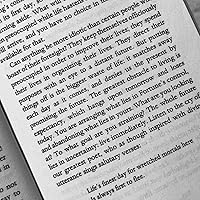
“I would fear the mob less if my neighbour would not stay silent were I to be pilloried.”
“Racism may indeed carry out the doom of the Western world and for that matter of the whole of human civilization. For no matter what learned scientists may say, race is, politically speaking, not the beginning of humanity, but its end, not the origin of peoples, but their decay, not the natural birth of man but his unnatural death.”
“Now pay attention and get on with the work of resisting the sorry reality that you find yourselves in. And for goodness’ sake - a puff of a smoke, raising a glass of Campari - have some fun!”
Les og bli mer inspirert enn du noen gang har vært. Gi litt motstand og ikke aksepter verden for det verden er. La oss skape nye begynnelser sammen, mer demokratisk og mindre kapitalistisk, med mer håp og kjærlighet, vennskap og glede, og mindre vold, hat og kynisme. Politikk er mer enn hva det i dag er. Politikk er handling i et uenighetsfellesskap der det eneste vi har felles er at vi skal opprettholde hverandres frihet. Politikk er våre handlinger, og skal bestemmes mer av oss individer i den felles offentligheten, ikke noen få i sine private stuer og møterom. Vær mer som Arendt: vær glad i livet, i mangfoldet av mennesker, som hver og en rommer nye begynnelser.
I had seen the name Arendt cropping up in various social media memes as we lurch through the tumult of unfettered end-stage capitalism, so this book reviewing the political scientist/philosopher’s life and works caught my eye on the shelves of a Belfast Waterstones.
While I like to support physical bookshops by buying physical books, paper copies cannot match the convenience of note taking that my kindle offers with E-books. Instead of the convenient sortable and searchable list of highlighted texts with my own asides I have to resort to iphone photographs of pages and subsequent trimming of images to make some record of pithy quotes and observations. It is a testament to the insights of both Arendt and Stonebridge that my phone has as many text pictures as scenery pictures from the Corfu holiday where I consumed this enlightening book. There are times perhaps, where the more esoteric ideas strayed beyond the grasp of my imagination, but there was much to enjoy and appreciate in a book that is as sadly relevant today as when it was first published.
The cycle to human affairs (and human depravity) is shown in the way Arendt’s observations inspired by Nazi Germany resonated with Stonebridge’s experience of Trump and indeed my own holiday haunted by a surge in racist violence in Belfast. This makes Arendt’s words and Stonebridge’s examination of them both timely and a little harrowing.
While Arendt liked to structure her books in great tryptics (The Origins of Totalitarianism was divided into anti-semitism, imperialism and racism) Stonebridge braids elements of Arendt’s life around a critical examination of her academic works.
“Arendt is best known for her analysis of politically dark times, but her abiding question is one that is again being asked in a series of defiant, creative and extraordinarily courageous response to contemporary terror, occupation and ideology: What is freedom? For Hannah Arendt that question is neither abstract nor simply theoretical. She loved the human condition for what it was; terrible, beautiful, perplexing, amazing and above all, exquisitely precious. And she never stopped believing in a politics that might be true to that condition.”
This then is the essence of Arendt’s belief in a commonality and plurality of humanity in all its rich variety and foibles that is the antithesis of the ‘othering’ where racism and totalitarianism have their roots. As Terry Pratchett observed, people are just people and we need to see another group not as ‘other’ people but as ‘more’ people.
Arendt lived through a post-truth era and, no matter how people may invoke Goodwin’s law about the invocation of Nazi-ism marking the end of rational debate, the parallels with the 1930s and the 2020s are striking and alarming.
When I was at school in Dulwich College (in the same school year as Farage) I studied Hitler History as an A’level specialist topic (as apparently Farage did – albeit in a different class, there were a lot of kids in the Dulwich sixth form!). One lesson I took from that (different perhaps to Farage) was the stupidity that underlay not just Nazi ideology but Nazis themselves. A political approach that rewarded loyalty and cruelty would lead to the elevation to power of people who – as Gene Wilder would put in blazing saddles – were frankly morons. Given power to meddle on raw instincts with science and economics they didn’t understand the origins of eventual failure were built into the very foundations, but sadly not before huge harm was done to the world. (One observation from my History essays I still remember was how – even as the Eastern front was collapsing – rail transport priorities were organized around moving Jews to the extermination camps rather than meeting military needs). We can see the same in Trump’s second term where the lunatics (RFK! Hegseth etc) have been put in charge of the asylum.
However, Arendt noted the onion nature of totalitarianism, it was not just the tyrants at the top but the layers beneath them each serving and inculcating the system’s inhumanity – with people like Adolf Eichmann and those above and below him who faced trial at Nuremberg and in Israel. Arendt caught that essence of Totalitarianism in the phrase ‘the banality of evil’ – the image of a moustache twirling Sauronesque ‘Dark Lord’ is both misguided and misleading. If we believe in an ‘uber-Evil’ we dignify it with an academic rigour it never earned and a separation from normal humanity that countless hate-filled social media posts show is simply not true.
The risk Arendt identified and feared is that “we would not only fail to understand the nature of modern evil, but also how to defy it.” “There is nothing like a political and existential void for making an atrocious idea welcome…As populists and propagandists know, whipping up fake storms in the wastelands gives the appearance of action, meaning, purpose, salvation.”
Arendt’s experience of mainstream media at best trivializing, dismissing and downplaying the antisemitism of her youth (at worst echoing it) feels horribly resonant today when the media seems bent on being the wind that steers people, rather than the weather vane that shows where the danger is coming from. She was also alarmed at “how many supposedly clever people made bad moral and political decisions in the 1930s and then pretended they hadn’t” including an early lover and former tutor.
Stonebridge also highlights Arendt’s belief in communication and how the interconnectedness and networking of human beings is the essence of humanity. No man is an island and all that – we live through our experiences of and with others which is why solitary confinement has always been a profoundly cruel punishment.
As Stonebridge notes, “The ‘Jewish question’ has now been replaced by the ‘migrant question’” While asserting that Arendt would argue it is how we do politics rather than any group of people where we should be asking the questions that would secure our future as a civilized human and humane society.
Stonebridge also notes the fidelity, and intensity with which Arendt maintained friendships and intimate relationships. “Hannah Arendt worked at love because she understood that it is only through relationships with other people that we are able to exist at all.”
It is telling to a contemporary eye that an early title of the magnum opus ‘The origins of Totalitarianism’ was ‘The elements of shame: anti-semitism-imperialism-racism.’ Looking at social media these days one sees an emboldening and amplification of the crudest expressions of racism – thoughts given voice in a public forum that would, in the past have been kept hidden in shame. Racists have been gifted word-salads of ‘legitimate concerns’ or ‘protect our culture’ or ‘deal with our own pedophiles rather than importing any others’ all used to excise the shame that should accompany their racism. A huge welter of deliberate social media engineering and foreign interference is going into telling people ‘it’s OK to be racist now’ where once shame would have made them think twice before spewing their vile prejudices.
As Stonebridge points out Arendt was clear that racism was not only an accessory to the catastrophe that befell the West in the twentieth century; it was the catastrophe. “Racism may indeed carry the doom of the western world and, for that matter, of the whole of human civilization … For no matter what the learned scientists may say, race is, politically speaking, not the beginning of humanity but its end, not the origin of people but their decay, not the natural birth of man but his unnatural death.” The entire idea of race was a myth. Race-thinking turned that myth into the ideological wing of a politics of unprecedented administrative cruelty.
Paradoxically, as Stonebridge admits, Arendt’s writing on the racist politics of the American South in the Jim Crow era proved sadly misguided, mainly because she wrote at a distance and without understanding of the lived experience of the people enduring a world of lynchings and the cruelest of discriminations. Hence she upbraided black parents for sending a daughter in as the vanguard of the intense and heated desegregated schools battle. But even in her error Arendt offers us a lesson, that clever people either misguided by hubris or simply misinformed can misstep quite badly when they are not driven by evidence and information.
It is ironic though given her own statement in The Origins of Totalitarianism that
The ideal subject of totalitarian rule is not the convinced Nazi or the convinced communist, but people for whom the distinction between fact and fiction (i.e. the reality of experience) and the distinction between true and false (i.e. the standards of thought) no longer exist.
A fair few MAGAts and Reform supporters should recognize themselves in that (but probably won’t!).
Arendt’s other great work is The Human Condition, on what it is and what it means to be human. And here I find a resonance with thoughts that illuminated my early fantasy trilogy which – essentially – is about two character’s different sacrifices in pursuit of immortality.
Back then I had a character say that there are four kinds of immortality, the memories we sow in those who knew us, the artefacts we create that endure after us, the behaviours and habits we help instill in others by our example, and the children we leave behind.
Arendt put it more eloquently
Works and deeds and words are the only things that give us frail humans a home in a cosmos where everything is immortal except ourselves.
As an Arendt fanboy, I really enjoyed it. The context about her life, especially after studying her work on 'freedom' at university, was fascinating.
If you haven’t read Origins of Totalitarianism, On Revolution, or The Human Condition, I wouldn’t recommend it as you might feel a bit lost.
One part I particularly loved was the anecdotes about her and her mother around Rosa Luxemburg. Had I known that story and Rosa’s influence on her earlier, it would definitely have changed how I engaged with her work. 🌹
Enjoyable book with just a bit of pathos addressed at the present times. Serves as a 3D map of Arendt´s life&work, intertwined, meandering.
I like the personal voice of the author - admitting where her interpretation of Arendt digresses from others, or when she admits that it would be much easier if there was no letter exchange with Heidegger after war.