Seishi Yokomizo (横溝 正史) was a novelist in Shōwa period Japan. Yokomizo was born in the city of Kobe, Hyōgo (兵庫県 神戸市). He read detective stories as a boy and in 1921, while employed by the Daiichi Bank, published his first story in the popular magazine "Shin Seinen" (新青年[New Youth]). He graduated from Osaka Pharmaceutical College (currently part of Osaka University) with a degree in pharmacy, and initially intended to take over his family's drug store even though sceptical of the contemporary ahistorical attitude towards drugs. However, drawn by his interest in literature, and the encouragement of Edogawa Rampo (江戸川 乱歩), he went to Tokyo instead, where he was hired by the Hakubunkan publishing company in 1926. After serving as editor in chief of several magazines, he resigned in 1932 to devote himself full-time to writing. Yokomizo was attracted to the literary genre of historical fiction, especially that of the historical detective novel. In July 1934, while resting in the mountains of Nagano to recuperate from tuberculosis, he completed his first novel "Onibi" (『鬼火』), which was published in 1935, although parts were immediately censored by the authorities. Undeterred, Yokomizo followed on his early success with a second novel Ningyo Sashichi torimonocho (1938–1939). However, during World War II, he faced difficulties in getting his works published due to the wartime conditions, and was in severe economic difficulties. The lack of Streptomycin and other antibiotics also meant that his tuberculosis could not be properly treated, and he joked with friends that it was a race to see whether he would die of disease or of starvation. However, soon after the end of World War II, his works received wide recognition and he developed an enormous fan following. He published many works via Kodansha's Weekly Shōnen Magazine in serialized form, concentrating only on popular mystery novels, based on the orthodox western detective story format, starting with "Honjin Satsujin Jiken" (『本陣殺人事件』) and "Chōchō Satsujin Jinken" (『蝶々殺人事件』) (both in 1946). His works became the model for postwar Japanese mystery writing. He was also often called the "Japanese John Dickson Carr" after the writer whom he admired. Yokomizo is most well known for creating the private detective character Kosuke Kindaichi (金田一 耕助). Many of his works have been made into movies. Yokomizo died of colon cancer in 1981. His grave is at the Seishun-en cemetery in Kawasaki, Kanagawa (神奈川県 川崎市).
Detective Kindaichi goes to a remote and peaceful mountain village to relax and not worry about murders for a while. Unfortunately for him, murder tends to follow him wherever he goes as an old friend asks him to investigate a twenty year old murder while he’s there.
The village was dominated by two powerful families: the Nire and the Yura family. One day however, the Nire family decided to grow grapes and they became the wealthiest family of the village. The Yura family quickly wanted to close the gap between them, but the person they trusted to help them was a con man and one person ended up dead.
One woman, Harue, was pregnant with the con man’s child when he fled the village. She became a pariah and eventually left the village. Twenty years later, Harue’s daughter Chieko has become a successful actress. And Chieko is about to go back to the village where she was raised. But she’s not the only one who’s coming back home.
The pace of the story is quite relaxed at first and it takes quite a while for the mystery plot to get going. Once it starts though, it does everything in its power to grab you. It’s full of suspense and twists and turns. The way the temari song is used in the mystery plot is reminiscent of certain Agatha Christie books that incorporate nursery rhymes into the story, though with a traditional Japanese touch to it.
The remote Japanese setting is once again a highlight, as is the norm for this series. And the remoteness of it gives it that little extra special something. The two wealthy families that dominate the village are quite fascinating, as is the village chieftain.
The mystery plot is excellently crafted and keeps you guessing, even if it feels a bit too complicated for its own good. There are also quite a lot of characters to keep track of. Still, this is another solid installment in a strong murder mystery series.
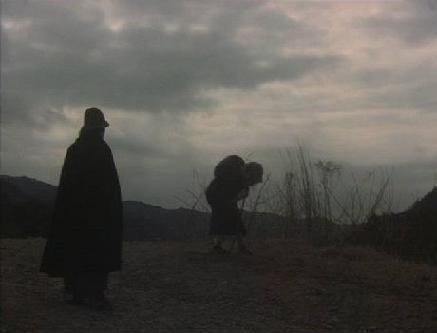
One of the famous scenes from the movie, Kindaichi met the weird old woman outside of the village.
The story follows Detective Kindaichi, visiting a remote village in order to have his relaxing hot spring vacation. While making some friends among villagers, he soon found out the widow who owned the hot spring resort had a tragic past: 20 years ago her husband was murdered by a villain who tricked the villagers out of their money; and the body of the victim was damaged beyond recognition. The murderer then escaped the village and was never found. At the great shock of finding her husband's corpse, the widow later gave birth to a girl infant who had red birthmarks covering half her face and body.
Now 20 years later, the daughter of the at-large murder suspect, had returned to the village as a famous pop star; Kindaichi sensed danger approaching for both the returned girl and the entire village, and he didn't guess wrongly.
First the aged village chief went missing on the night of his supposed reunion of his estranged ex-wife, then the daughters of the two most powerful families in the village were also found murdered under ominous consequences; it seems that the murderer was killing villagers off with the pattern of a long forgotten local nursery, could Kindaichi stop the murderer before it is too late?
Demon's Nursery has an utterly complicated story: young women were being murdered one by one, the old village chief went missing under suspicious condition with his ex-wife might or might not be the killer;. At the heart of the mysteries, there is the unsolved murder case from 20 years ago.
It's a finely done murder mystery filled with thrilling murder of young girls, creative methods of killing and creating alibi. At the same time it's also an epic tragedy of karma and mistaken identities. The art of trickery and suspense is being masterfully played to the extreme by the author, and I also love the last scene of the story *major spoiler ahead*.
It's one of the best works of Detective Kindaichi series, strongly recommend to anyone who has a taste for classy, finely crafted old schooled detective novel.
I can put bits and pieces together but still have not seen a single conclusion coming in this series.
I LOVE IT.
Kindaichi is back, but he's headed to Turtle Spring for a well-earned break. His good friend Isakawa recommends the place as his friend owns the Spring, but coincidentally there was an unsolved murder in the town 30-odd years ago that Isakawa hasn't been able to leave behind.
But of course Kindaichi is just here for a holiday.
Until someone goes missing, and suddenly this lil mystery has all of us curious.
Just another run of bizarre deaths, strange occurrences, family politics and curious mysteries. It delivers one after the other, keeping the action smooth and leaving no time for putting the pieces together yourself. An almost impossible task, anyway, as it's always unexpected connections that make these books really stand out.
I raced through it again, and really enjoyed the scenario here. Kindaichi is a fantastic character and I'll be eagerly awaiting the next translation!
Travelling back to the 50s in another crime adventure with Kosuke Kindaichi in this latest translated instalment from the series. Set in the isolated Onikobe Village in Okayama Perfecture, I followed Kindaichi during his vacation stay at the Aoike’s spa inn when the village was shuddered by a series of murder happening in a row that was said to be plotted like the lyric to a traditional temari song. As he knew about the unsolved murder incident that happened in the village 20 years ago before the visit, Kindaichi thought that these two cases might be related so with the help of Inspector Isokawa, he started to investigate the case and try to link and uncover the two incidents to find the murderer.
I love the village backdrop with its traditional hue a lot; so aesthetic and raw despite that sense of bleak and mysterious aura it grasped me everytime. Kind of spooky too as the plotline was set around the o-bon festival and due to the serial murder, most scenes were told and crafted at a wake ceremony— thrilling but can be confusing too with its massive characters (a list of characters included, fortunately) yet the progress and their suspicious characterization hooked me with curiosity on the puzzling and devious howdunnit.
Love the interactions, all the investigation musings and how Yolomizo interlaced his storytelling with a gripping societal conflict and cultural perspective. From a crime of vengence and passion to familial secrets and scandals, a resentment was served through a serial tragedy and one’s fiendish motive— not much of red herring but I could catched up on the hints from Kindaichi’s POV just it upsets me a bit on the last victim’s tale after the truth was revealed.
An enjoyable crime read, overall. Almost a page-turner too for its appealing and knotty plotting, also as usual I love how Kindaichi could helped to solve it; the last chapter, epilogue and Kindaichi’s last words to Inspector Isokawa— so wicked of him to make that guess!
Another fav from the series added to my list 🙌🏻
(Thank you Pansing Distribution for the gifted copy!)
i wait for these new yokomizo translations to come out every year, and this is probably my favorite since the village of eight graves, which was also translated by bryan karetnyk. huge congratulations for his effort! as these crimes are always so ridiculously ornate w enormous casts, i think a deft translator is very necessary and can completely change how the novel is received. this latest entry is a long-winded tragedy, starting in 1932 and ending some twenty or so years later (dated further by yokomizo’s movie refs—morocco by josef von sternberg and a minor character being a machiko kyō (rashōmon, ugetsu) lookalike). the crimes are confined to a secluded village, so everything about it is backwards, just like the people involved…and inevitably, much of the writing is devoted to lineage, the sins of one’s father, class, &c. like yokomizo’s other fare, it has a gloomy atmosphere, along w his trademark insane/unbelievable crimes, esoteric folklore, and unnerving jokes. loved :)
Đây là cuốn tiểu thuyết trinh thám thứ hai trong series về thám tử Kosuke Kindaichi của tác giả Yokomizo Seishi mà mình đọc, sau cuốn “Đảo Ngục Môn”. Phải nói là tác giả một lần nữa không làm mình thất vọng với câu chuyện trong “Khúc Ca Tú Cầu của Ác Quỷ”.
Cuốn sách này hội tụ đủ những gì mình muốn đọc trong một cuốn tiểu thuyết trinh thám cổ điển Nhật Bản. Chúng ta có một ngôi làng heo hút mang tên Làng Đầu Quỷ; mạng lưới các nhân vật với những mối liên hệ, dây mơ rễ má phức tạp, đặc trưng của một xã hội “sau lũy tre làng”; một vụ án bí ẩn hai mươi ba năm về trước chưa có lời giải rõ ràng; và một chuỗi án mạng là cái chết của các cô gái trẻ trong làng, với việc các thi thể được sắp đặt theo tư thế kỳ lạ được mô tả trong bài đồng dao chơi tú cầu cổ xưa.
Nói đến mạng lưới nhân vật, quả thực nếu không có bản liệt kê tên các nhân vật ở phần đầu cuốn sách trước khi vào câu chuyện, thì chắc mình đã không biết ai là ai rồi :D Mặc dù thế, mình cũng vẫn gặp một số khó khăn nhất định trong quá trình đọc truyện, vì tên người Nhật thì các bạn đã biết rồi đó, không dễ phân biệt và dễ nhớ chút nào :)))) Nhưng mà càng đọc, càng tiếp xúc với các nhân vật thì mình lại càng nhớ và biết ai là ai hơn ^^
Cuốn này ban đầu đọc thấy hơi lôi cuốn thôi, nhưng càng đọc về sau, nhất là cỡ 100 trang cuối, khi vụ án được phá nhờ vào tài suy luận tài tình của Kindaichi, thì phải nói là mình chỉ biết ngấu nghiến từng trang sách thôi ^^ Cảm giác hồi hộp theo dõi xem chân tướng hung thủ là ai, cách thức gây án, nguyên nhân gây án, và nhất là mối liên hệ với vụ án bí ẩn hai mươi ba năm về trước nữa. Trời ơi twist nối twist, thật không thể ngờ một ngôi làng heo hút biệt lập như thế lại có thể ẩn chứa những bí mật động trời đến như vậy. Và danh tính hung thủ thì mình cũng không thể ngờ được nốt :))) Yokomizo Seishi quả không hổ danh là một trong những tác giả trinh thám cổ điển nổi tiếng của Nhật Bản ^^ Mình sẽ đọc tiếp một số tác phẩm của bác này. Cơ mà không biết cuốn “Thôn Tám Mộ” đã được IPM xuất bản chưa nhỉ?...
When it comes to murder mystery, I have always enjoyed stories with dysfunctional family drama thriller the most especially one with a very tragic background. The whole premise of this latest translation in Detective Kosuke Kindaichi series is exactly that although by Book 6, we kinda already know this formula is well incorporated in the series. This time around, Kindaichi went to Onikobe Village with the purpose of relaxation but was recommended by Inspector Isokawa to go to Turtle Spring Spa for a rest. The place had a pretty grisly unsolved murder case of 20 years ago where the master of the house was cruelly murdered. Then, there are 2 powerful family that had relation to case, Yuras and Nire. Soon, one murder after another happened eerily similar to a Temari song that tells on death of each woman and the way they died.
What I like about this story is the atmospheric writing of the whole village and the folklore or cultural aspect of the village. The incorporation of these elements make the story more compelling to read. By tying the unsolved murder case to the current cases kept the whole story intriguing as I kept reading to know what happened. The murders are horrible & I do hate how by the end, when we get the reveal, it just feels too cruel that these young women's lives were ripped apart so unjustly. There are so many characters in this story that it gets muddled up at times when you have to keep track of who is who which does take away some of the enjoyment in reading. The plot twist was heartbreaking as it delves into how actually effed up the whole thing is. I like we get more of Kindaichi in here from start to beginning but we actually get less of his quirks and I sort of miss the way he stammers when he is nervous which made him such an endearing character to me. This story felt like his charm is lesser than before? I think this was a good one but I certainly love The Devil Flutes Murder significantly more and Village of Eight Graves is my personal favourite.
Thank you Definitely Books for review copy in exchange for an honest review
Poor Kosuke Kindaichi! The scruffy but brilliant private investigator may go on holiday, but murder never does!
Kosuke heads to isolated, peaceful Onikobe — but not so peaceful that Kindaichi’s widowed hostess is unacquainted with murder. Her husband was murdered 20 years ago — and it’s 1955, and the murderer has not been caught. That old, unsolved murder sparks a new spate of mayhem while Kindaichi is there. To say more would ruin this twisty novel. I never suspected who the murderer was, even though author Seishi Yokomizo provides the clues. Yokomizo’s novels can be hit or miss, but this one is definitely a hit.
I enjoyed all of the previous Kindaichi books that have been translated but found this one to be quite weak.
The story itself is quite mundane and I found Kindaichi’s behaviour quite odd. Despite apparently knowing who the culprit was he said nothing and just allowed another couple of murders to take place. In the end the murderer reveals themself, at which point everyone tells Kindaichi how great he was for knowing all along. Even though he never said so and didn’t stop the murderer.
Bizarre ending where the detectives all have a good laugh about how much they enjoyed the whole thing.
This entire review has been hidden because of spoilers.
Der Privatdetektiv Kosuke Kindaichi möchte im Sommer 1955 Urlaub machen und sein Freund Kommissar Isokawa empfiehlt ihm ein Badehaus in dem Bergdorf Onikobe. Vielleicht hatte der Kommissar einen kleinen Hintergedanken, denn in Onikobe gab es vor etwas über zwanzig Jahren einen Mord, an dessen Ermittlungen der Kommissar beteiligt war. Mit dem Ergebnis der Ermittlungen hatte er sich nie wohl gefühlt. Er hofft deshalb, dass Kosuke, der als gewiefter Ermittler bekannt ist, nochmal einen neuen Blick auf die Sache wirft. Kurz nach Kosukes Ankunft verschwindet der alte Dorfvorsteher und damit werden die Ereignisse in Gang gesetzt.
Dies ist der fünfte Band der Reihe um den Privatdetektiv Kosuke Kindaichi, der auf Deutsch veröffentlicht wird. Im japanischen Original ist die Reihe umfangreicher, da die Fälle in sich abgeschlossen sind, ist das eher unerheblich. Kosuke Kindaichi fühlt sich gleich angekommen in Onikobe, deshalb hilft der dem alten Dorfvorsteher auch beim Verfassen eines Briefes. Als der ältere Herr, der sich nach dem Versenden des Briefes auf Besuch freute, verschwindet, ist Kosukes Neugier geweckt. Er ist allerdings auch besorgt. Kosuke beginnt, sich über die Vergangenheit und die Beziehungen zwischen den unterschiedlichen Familien in Onikobe Gedanken zu machen.
Mit Kosuke Kindaichi haben wir einen klassischen Ermittler, dessen Erfinder Seishi Yokomizo leider bereits verstorben ist. Die Romane sind daher eher ruhig und der Ermittler muss sich auf seine Beobachtungsgabe, seine Kombinationsgabe und seine geschickte Fragestellung verlassen. Das macht Kindaichi ganz hervorragend. Und das wiederum macht die Lektüre sehr spannend. Gleichzeitig verschlägt es Kosuke Kindaichi häufig in unterschiedliche Gegenden Japans, so dass man beim Lesen auch etwas über die unterschiedlichen Landschaften, aber auch über Sitten, Gebräuche und Legenden erfährt. Auch hier geht es um Beziehungen zwischen den unterschiedlichen Familien, die teils als höhergestellt gelten, teils auch nicht. Wie die Menschen selbst ihre Stellung empfinden führt manchmal zu Handlungen, die dann ungeahnte Konsequenzen haben. Den Verwicklungen zu folgen, macht sich Kosuke Kindaichi zur Aufgabe und damit sind die Berichte des Kommissars sehr unterhaltsam, informativ und fesselnd.
It is no secret how much I have come to love these books. I'd had this one preordered for months once I learned it was going to be published; I already have the next Pushkin Vertigo translation, Murder at the Black Cat Cafe, due out in the fall of this year, on my radar and in my sights. The Little Sparrow Murders is number 49 of 77 in Yokomizo's Kosuke Kindaichi detective series and is the sixth of this author's books to have been published in translation by Pushkin Vertigo. I was also lucky enough to have latched on to a dvd of the film made in 1977, which was not quite as good as the novel, but then again, I expected that.
It's July, 1955 and Kindaichi Kosuke is taking a much-needed rest, and decides that he should go Okayama Prefecture where he'd "developed a fondness for the local people and their ways" after spending time there during a few of his crime-solving adventures. First he stops in to visit with an old friend, Inspector Isokawa in Okayama, who gives him the address of an inn in Onikobe Village, owned by a woman who Isokawa once knew. Evidently, she's had "her fair share of sorrow," since her husband had been murdered some twenty years earlier, and the crime had never been solved. While Kindaichi insists he only wants to rest for a while, he agrees to listen to the inspector about this case, which seems to mean so very much to him. Once in the village, Kindaichi holes up at the Turtle Spring Inn, where he "could quite happily give himself over to idleness without being disturbed by anybody." As he notes, he didn't "feel any particular sense of obligation" to the inspector, but at the same time, he kept his eyes and ears open while "lazing around idly like a cat." Kindaichi's plans for R&R are interrupted, however, with the disappearance (and perhaps murder?) of the elderly Hoan Tatara, a self-described "recluse" and local historian. Any further plans for quiet time will just have to wait -- not too long after Tatara disappears, a young woman is killed in a most horrific way, the first of many to come.
While my favorite of the Kindaichi mysteries so far continues to be The Inugami Clan (it's bizarre beyond belief and firmly in my strange-reading wheelhouse), The Little Sparrow Murders follows closely in second place. The novel is also much more reader friendly than the previous ones, and Bryan Karetnyk's translation made the story flow. I will say that I flipped back and forth between the text and the map that is provided at the beginning of the book any number of times before I finally took a photo and kept it up on my iPad screen to refer to. The provided list of characters soon becames vital as well, because the family relationships are beyond critical to the story.
The Little Sparrow Murders delivers a super murder mystery, while also examining how the past has a powerful impact on the present and delving into social divisions, ritual, customs and the importance of history in this village. It is also a solid puzzle that armchair detectives will appreciate, making for a particularly good whodunit, and I am most happy to admit that I did not guess or even come close to guessing the who here. High marks to this one, and definitely recommended to readers of Japanese crime fiction or to fans of Yokomizo's detective Kindaichi Kosuke. Now I'm not so patiently waiting for the next book.
The movie (in Japanese -- my copy had no subtitles) was also good; the murder scenes would be horror-movie watcher approved, but still not as good as the book.
I received an ARC from Edelweiss. The version I downloaded has lot of missing letters and badly formatted. Reading this on kindle was a chore. can you figure what these words mean? - eort, gure, dierent, oer, ower, dicult(that's how words with ff, if, ef, fe appeared in the Kindle text) I hope this will be taken care and fixed in the final publication. Even ignoring these formatting issues, the plot didn't hold my attention. I didn't care who killed whom. There were too many characters. The author helpfully listed them in the beginning of the book, but it didn't help as the text formatting in the ARC was jumbled up. One thing I noticed in Japanese detective novels is that there are too many policemen. Added to number of victims, suspects all with confusing names (the author messes it further by using first name and last names arbitrarily), it was difficult to track who's who. I was also disturbed by the way certain characters reacted. I don't know if it is a cultural thing. In the end, when the case is solved, everyone , including the victims' family members start laughing at some joke. I don't know how Kindiachi solved the murders, but everyone was so full of praise for him. I found the first book interesting, but I think this will the 2nd and last book I would be reading.
This is my first time ever being dissappointed with this series. I have read all five titles preceded this and they were all splendid with the most recent one, The Devil Flute Murders being my favourite. But this one *sigh It just feels draggy and the pace is frustratingly slow. The story only started to pick up around after the second murder happened (around 60% in, roughly).
Yokomizo's writing was usually very descriptively beautiful. The way he conjured images so vivdly to your head or the way he invoked feelings with his words were noticeably absent in this book.
It also felt hurriedly written. The investigation process also seems lackluster. It lacks that certain Kosuke Kindaichi 'kick' to it that makes me feel like it isn't part of the series. If someone change the name of the detectives and pass it off as someone else's work that isn't Yokomizo, I'd believe them in a heartbeat.
I hope this was just a one time thing and the next one will gives us classic Detective Kosuke Kindaichi again because gosh, do I miss him.
I found the number of names hard to follow, and the ending pretty unsatisfying. The famous detective just relayed the whole murder after it was over, and I didn’t find any surprises during the unfolding of the book.
This entire review has been hidden because of spoilers.
I’m starting to think Seishi has an issue with his mother because how many times can the mother be the murderer in a row lol
This one makes sense, even though much to my chagrin, the murderer is the mother again.
Rikas husband went off to another village and got three women pregnant, then Rikas daughter was raised with these three other daughters. Super awkward, and yes, I can see why Rika killed her husband and the daughters (with her own daughter sacrificing herself to take the place of one of the bastard daughters, which is why Rika killed herself at the end.
Honestly, I think the mystery would’ve been better if Rikas daughter was the killer. She had a horrific birthmark and was the ugliest of all four girls. At school, she must’ve been bullied for it, and if these 3 half sisters of her were the bullies, now that would’ve been a better motive.
Instead Rika killed the girls out of jealousy for her daughter (weka motive) and to stop her son from marrying his half sister (slightly better motive).
This entire review has been hidden because of spoilers.
The aftertaste of reading this book is me feeling dumbfounded. I think among all of his works that have been translated so far, this was the one that got me on the level of frustration. Yokomizo once again managed to keep the tension in the air right from the start, scattering some provocal sentences in order to teased his readers and to urged them to keep on guessing what would happen next.
This book worked rather slowly than the previous ones. It feels like the author wanted to built the vibe step by step, in a slow but sure way to the point that I couldn't think of how this and that are connected. I started to think that not every chapter is important, only to be proved wrong, of course. Until a certain point, I still can't figure everything out nor find any important clues or even a faint string that connects everything. I couldn't point out who's the culprit although I had my suspicion. It's not something boring, though. To me, it made me wanted to read more and more, to know what exactly happened. In the end, the revelation shooked me.
Yokomizo always combined the Japanese folklores alongside his mysteries and this book is no exception. A temari song, murders, and mystery, all mixed together spreading fear and hidden malice from the past to both the characters and the readers. No one could escape nor see the terror that lurking in the dark, waiting its time to strike every target. As the 'Agatha Christie' of Japan, Seishi Yokomizo successfully bringing twist and pitiful tragedy once again.
Thank you Edelweiss and Pushkin Press for the DRC.
Welcome to 300 pages of Japanese people drinking Sake like water. Kosuke Kindaichi might be chillest detective I've ever read, and given his job profile, it isn't much of a compliment. Sure, it's pretty laidback and breezy, but what happens when the breeze starts to blow all the tension and suspense away? So much so, that you find yourself wondering, Am I really supposed to care about all this?
A late-Golden Age mystery based on a nursery rhyme? Yes, please! It's actually a temari rhyme (roughly the equivalent of a jump rope song), but Yokomizo's Christie influences are clear here, right down to Kindaichi mentioning his "little grey cells." It's the right amount of twisty while still being fair play, and definitely recommended for mystery fans.
বিখ্যাত গোয়েন্দা কোসুকে কিনদাইচির একটু ছুটি দরকার। সমস্ত যান্ত্রিকতা আর ব্যস্ততা থেকে কয়েকটা সপ্তাহ একটু দূরে থেকে শুধু বিশ্রাম নিতে চায় সে। আর সেই কারণে কিনদাইচি খুঁজছে একটা গ্রাম্য এলাকা। পুরোনো বন্ধু পুলিশ ইন্সপেক্টর ইসোকাওয়া তাকে দিলেন ওনিকোবে গ্রামের সন্ধান। পাহাড়ে ঘেরা গ্রামটা আসলেই শান্ত ও নিস্তরঙ্গ। এখানকার অধিবাসীরাও বেশ অতিথিবৎসল ও আন্তরিক স্বভাবের। তবে ইন্সপেক্টর ইসোকাওয়া গোয়েন্দা কিনদাইচিকে এই গ্রামের সন্ধান দেয়ার সাথে সাথে তাকে শোনালেন এমন এক রহস্য মাখানো হৃদয়বিদারক গল্প, যার জন্ম ২০ বছর আগে।
২০ বছর আগে ওনিকোবে গ্রামে একটা খুনের ঘটনা ঘটেছিলো। খু'ন হয়েছিলো ওই গ্রামেরই অধিবাসী গেনজিরো আওইকে নামের এক লোক। গেনজিরোকে খু'নের অভিযোগ উঠেছিলো যে ইকুজো ওনদার বিরুদ্ধে, সে ছিলো বহিরাগত। খু'নি লোকটা খু'ন করার পর পালিয়ে গিয়েছিলো। তাকে আজও ধরা সম্ভব হয়নি। ওই সময় কেসটার দায়িত্ব ছিলো ইন্সপেক্টর ইসোকাওয়ার ওপর। কেসটা নিয়ে আজও তাঁর মনে অনেক খটকা, অনেক প্রশ্ন। হয়তো এই কারণেই কৌশলে তিনি কোসুকে কিনদাইচিকে ওনিকোবে গ্রামে ছুটি কাটানোর পরামর্শ দিলেন।
ইন্সপেক্টর ইসোকাওয়ার পরামর্শে গোয়েন্দা কিনদাইচি যখন ওনিকোবে গ্রামে ছুটি কাটাচ্ছে ঠিক তখনই সেখানে ঘটতে শুরু করলো অস্বাভাবিক কিছু ঘটনা। গ্রামের প্রভাবশালী পরিবারগুলোর মধ্যে খু'নের মতো ভয়ঙ্কর ঘটনা ঘটতে শুরু করলো৷ অতি চতুর এই খু'নি কোন ক্লু-ই যেন রাখছে না। এদিকে খোদ গোয়েন্দা কোসুকে কিনদাইচির নাকের ডগা দিয়ে খু'নগুলো ঘটে যাওয়ায় সে নিজেও অস্থির হয়ে উঠলো রহস্যগুলোর সমাধান বের করার জন্য। কিনদাইচি জোরেশোরে তদন্ত শুরু করলো। তার সাথে যোগ দিলেন ইন্সপেক্টর ইসোকাওয়া আর ডেপুটি ইন্সপেক্টর তাচিবানা। জানা গেলো, খু'নি খু'নগুলো করছে ঐতিহ্যবাহী তেমারি গানের স্তবক অনুসারে।
তদন্ত যতোই এগোতে লাগলো সবকিছু আরো জট পাকিয়ে যেতে লাগলো কোসুকে কিনদাইচির সামনে। গ্রামের প্রভাবশালী পরিবারগুলোর ভেতরে চলা ঠান্ডা স্না'য়ু'যু'দ্ধ, গ্রামের বাতাসে ভেসে বেড়ানো নানা গুজব আর ২০ বছর আগে ঘটে যাওয়া গেনজিরোর খুনের ব্যাপারটা যেন পরিস্থিতি আরো জটিল করে তুললো। গোয়েন্দা কিনদাইচি আর ইন্সপেক্টর ইসোকাওয়া পক্ষে কি শেষমেশ এই সমস্ত রহস্যের জট খোলা সম্ভব হবে?
জাপানের আগাথা ক্রিস্টি হিসেবে পরিচিত লেখক সেইশি ইয়োকোমিজো'র 'দ্য লিটল স্প্যারো মা'র্ডা'র্স' একটা আদর্শ মিস্ট্রি থ্রিলার উপন্যাস। কয়েক বছর আগে আমি তাঁর গোয়েন্দা কোসুকে কিনদাইচি বিষয়ক মিস্ট্রি থ্রিলার 'দ্য হোনজিন মা'র্ডা'র্স' পড়েছিলাম। দীর্ঘ একটা সময় পার করে আবারও তাঁর লেখা পড়ার সুযোগ হলো। ক্লাসিক গোয়েন্দা কাহিনির ধাঁচে লেখা 'দ্য লিটল স্প্যারো মা'র্ডা'র্স'-এর মধ্যে পাঠককে ধরে রাখার মতো সমস্ত প্রয়োজনীয় উপাদানই ছিলো৷
লেখক সেইশি ইয়োকোমিজো তাঁর এই উপন্যাসের ঘটনাগুলোকে দেখিয়েছেন দুটো টাইমলাইনে। একটা হলো ১৯৩২ সাল৷ আরেকটা ৫০-এর দশক। দুটো টাইমলাইনেই তিনি চমৎকারভাবে তুলে ধরেছেন জাপানের গ্রামাঞ্চলগুলোর কৃষ্টি-কালচার আর সমাজব্যবস্থা। শুধু একটা রহস্য উপন্যাস হিসেবে না, বরং আদি জাপানিজ কালচারের একটা গুরুত্বপূর্ণ দলিল হিসেবেও 'দ্য লিটল স্প্যারো মা'র্ডা'র্স' বইটাকে আমি সফল বলবো। বিশেষ করে তৎকালীন জাপানিজ গ্রাম্য সমাজব্যবস্থা আর সংস্কৃতির বেশ কিছু অজানা বিষয় সম্পর্কে জানতে এই বইটা আমাকে বেশ সাহায্য করেছে।
এই উপন্যাসের মূল চালিকাশক্তি ছিলো রহস্য। থিমটা এমনিতেই বেশ ইন্টারেস্টিং। তার ওপর সেইশি ইয়োকোমিজো যেভাবে এটাকে এক্সিকিউট করেছেন তা ছিলো উপভোগ্য। ক্লাসিক রহস্য কাহিনিগুলোর বিল্ড-আপ যেমন হয়, 'দ্য লিটল স্প্যারো মা'র্ডা'র্স'-এর বিল্ড-আপও ছিলো তেমন। খুব ধীরেসুস্থে রহস্যের জট ছাড়াতে দেখা গেছে গোয়েন্দা কোসুকে কিনদাইচিকে। যদিও 'Whodunit'-এর উত্তরটা আমি আগেই কিছুটা আন্দাজ করতে পেরেছিলাম, তারপরও পুরো রহস্যটার আবেদন আমার কাছে আগের মতোই ছিলো। আর এই উপন্যাসের শেষটাও আমার বেশ ভালো লেগেছে।
'দ্য লিটল স্প্যারো মা'র্ডা'র্স'-এর একটা ব্যাপার আমার কাছে আলাদাভাবে ভালো লেগেছে। সেটা হলো, অন্যান্য অনেক রহস্য উপন্যাসের মতো এখানে শুধু মূল গোয়েন্দা চরিত্রের ওপরেই সমস্ত ফোকাসটা রাখা হয়নি। বরং অন্যান্য চরিত্রদেরও উল্লেখযোগ্য কন্ট্রিবিউশন দেখিয়েছেন লেখক সেইশি ইয়োকোমিজো মূল রহস্যটা ক্র্যাক করতে। এই ব্যাপারটা কাহিনিটাকে আরো কিছুটা বাস্তবসম্মত করেছে আমার মতে।
বিমুগ্ধ সরকার রক্তিমের অনুবাদ বরাবরের মতোই চমৎকার লেগেছে আমার। অনেকদিন বাদে উনার অনুবাদ পড়লাম। সবসময় যেমনটা লাগে, তেমনই সুখপাঠ্য ও সাবলীল অনুবাদ। বইয়ের শুরুতে চরিত্রগুলোর নাম, ওনিকোবে গ্রামের ম্যাপ আর গুরুত্বপূর্ণ কিছু টার্মের নির্ঘন্ট যুক্ত করার ব্যাপারটা বেশ সহায়ক ছিলো বইটা পড়ার ক্ষেত্রে। জাওয়াদ উল আলমের করা 'দ্য লিটল স্প্যারো মা'র্ডা'র্স'-এর ভিন্টেজ টাইপ প্রচ্ছদটা ভালো লেগেছে। চিরকুটের প্রোডাকশনও ছিলো বরাবরের মতোই চমৎকার। আগ্রহীরা চাইলে পড়ে ফেলতে পারেন।
Einfach ein netter und wirklich leicht zu lesender Krimi. Das ist jetzt das zweite Buch in der Reihe, das ich gelesen habe, und wiederum ist es trotz Kriminalfall einfach irgendwie wholesome - weil die Handlung so klar in ihrer Struktur ist, der Fall spannend und der Hauptcharakter irgendwie ein wenig schrullig und dadurch sympathisch.
Auch gut fand ich, dass ich wieder etwas über japanische Geschichte und Kultur im 20. Jahrhundert gelernt habe. Einerseits die Bedeutung von "Temari"-Liedern und andererseits die Hintergründe der Berufssparte "Benshi" - das waren am Anfang des 20. Jahrhunderts offenbar Menschen, die in den Kinos live die Stummfilme vertont haben. Also Dialoge eingefügt und kommentiert, was passiert. Der Beruf verschwand dann mit dem aufkommenden Tonfilm.
An und für sich ist der Anspruch dieser Bücher ja, dass man den Leser:inenn genügend Hinweise im Verlauf der Story gibt, dass sie den Fall selbst lösen könnten - davon war ich wieder meilenweite entfernt. Aber muss ja auch nicht sein. Ich lass mich gern überraschen. Und was für eine Überraschung es dann war ;).
Hat mir wirklich gut gefallen! Freu mich auf den nächsten Teil.
Even with a map, a list of the characters, and my infinite patience, I struggled to keep up with the story here…too many people to keep track of, a convoluted series of events, and two timelines to follow. I find it a bit head scratching that almost all of the murders happen after “the most famous detective in Japan” arrives on the scene—maybe it has something to do with how much sake gets consumed during the course of the novel! I think I’m done with these translations of Japanese classic mysteries—while the historical-cultural features of post-war Japan are interesting, the mysteries themselves seem awfully contrived.
Pretty good but I feel like tweaking the structure and focusing on other aspects of the mystery would have made it far more impressive than what it is currently. It is still a really good murder mystery though! Full review to come