Jump to ratings and reviews
Rate this book

LO QUE LA TORTUGA LE DIJO A AQUILES

Rate this book
Nuestra editorial se especializa en publicar libros en español. Para encontrar otros títulos busque “Editorial Medí”.
Contamos con mas volúmenes en español que cualquier otra editorial para el kindle y continuamos creciendo.

5 pages, Kindle Edition

First published January 1, 1895

6 people are currently reading
185 people want to read

About the author

Lewis Carroll

6,156 books8,416 followers
The Reverend Charles Lutwidge Dodgson, better known by the pen name Lewis Carroll, was an English author, mathematician, logician, Anglican clergyman and photographer.

His most famous writings are Alice's Adventures in Wonderland and its sequel Through the Looking-Glass as well as the poems "The Hunting of the Snark" and "Jabberwocky", all considered to be within the genre of literary nonsense.

Oxford scholar, Church of England Deacon, University Lecturer in Mathematics and Logic, academic author of learned theses, gifted pioneer of portrait photography, colourful writer of imaginative genius and yet a shy and pedantic man, Lewis Carroll stands pre-eminent in the pantheon of inventive literary geniuses.

He also has works published under his real name.

Ratings & Reviews

What do you think?
Rate this book

Friends & Following

Create a free account to discover what your friends think of this book!

Community Reviews

5 stars
33 (27%)
4 stars
44 (36%)
3 stars
32 (26%)
2 stars
10 (8%)
1 star
3 (2%)
Displaying 1 - 16 of 16 reviews
Profile Image for Forked Radish.
3,855 reviews82 followers
March 18, 2021
Carroll's sophistry falls as flat as a tortoise dropped on stone by a soaring eagle. Zeno was right, motion is impossible, but there is still speed. How can motion be impossible but things appear to move? Is there any motion across a video screen, are the pixels moving? Of course not, but they do have a refresh rate i.e. speed. Q.E.D.
Profile Image for Avery.
169 reviews1 follower
April 18, 2023
This made my head hurt and gave me flashbacks to high school geometry class. I wanna come back and reread more carefully at some point so I can figure out exactly wtf these logical musings are getting at.
Profile Image for Heather.
105 reviews3 followers
February 23, 2020
I'm not one to have much fun with hypotheticals or pointless problems so this one was really not for me.
Profile Image for Scott Bordelon.
94 reviews35 followers
July 16, 2024
What the tortoise taught us

Zeno of Elea was a Greek philosopher famous for his thought experiments written in the form of several paradoxes around 490-430 BC, a few generations before Plato and Aristotle were en vogue. One of his best known paradoxes was the Achilles Paradox of motion where Zeno proposed a footrace between Achilles (the greatest hero of Greek mythology) and a tortoise (the most painfully slow creature on the planet). In the story of "Achilles and the Tortoise”, Achilles gives the tortoise a head start of, say 100m. Eventually, Achilles will have run 100m, but the tortoise will have moved forward to, say 102m. When Achilles gets to the 102m mark, again the tortoise will have moved forward by some amount, and this pattern continues forever. Therefore, Zeno concludes that in a race, the fastest runner can never pass the slowest runner, because the pursuer must first reach the point where the pursued started, so the slower runner will always hold the lead when given a head start. It could also be interpreted as Zeno’s cry for help, to rescue him from his ridiculous living as an ancient Greek philosopher.

In “What the Tortoise Said to Achilles”, Carroll imagines a dialog between Achilles and the Tortoise at the end of the race, where the Tortoise challenges Achilles to logically prove that (Z) is true, given that (A) and (B) are true, where:
(A) Things that are equal to the same are equal to each other.
(B) The two sides of this Triangle are things that are equal to the same.
(Z) The two sides of this Triangle [the same triangle from (B)] are equal to each other.
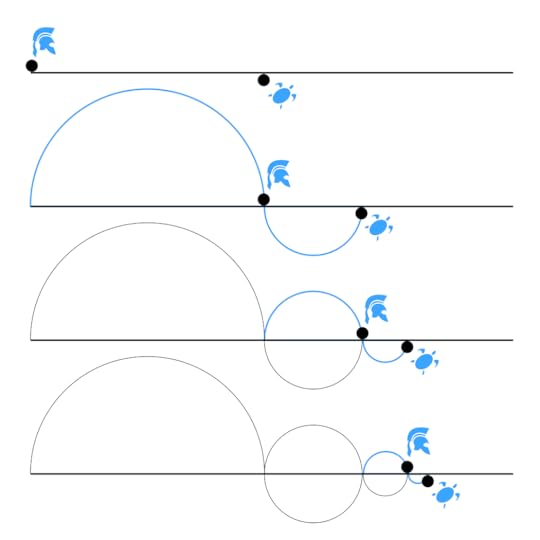
In the vein of Zeno, Carroll asserts the Tortoise defeats Achilles once again.

Douglas Hofstadter chose to include this story in his Pulitzer Prize winning book, Godel, Escher, Bach: An Eternal Golden Braid, to help illustrate his concept of strange loops, while also asking the question, “Do words and thoughts follow formal rules, or do they not?”

Back to Carroll, it’s a mildly amusing read, part thought-provoking and part aggravating. The end.
Zeno-Achilles-Paradox
Profile Image for Rory Fox.
Author 9 books47 followers
June 13, 2025
At just less than 1300 words this is a hyper-short story. It takes its point of departure from Zeno’s classic paradox about how a runner can converge on a tortoise if there is always a divisible gap between them. Even if the gap is closing, logically speaking, it will still exist, ad infinitum. That paradox has occasioned gallons of ink over the centuries.

The focus of this story is a rather different issue of infinite regress in argumentation, and how the ‘force’ of logic arises and applies. The tortoise effectively gets Achilles to reflect on the fact that premises imply a conclusion, but the force of the implication is not visibly present in the argument itself. For example, if someone said If p then q, that would mean that having a p entails a q. But where does the ‘entails’ come from? There is no ‘entails’ in the original argument, there is just a ‘then’. Reading the ‘then’ as an entailment is a (kind of) logical jump which we all make quite naturally and uncontroversially. It is not a fallacy or error. But, strictly speaking, it isn’t actually there in the argument which the tortoise insists that Achilles keep writing out.

It is that (apparently) missing element of the argument which the tortoise presses Achilles to consider, and that consideration continues on and on and on, as it is a regress.

Overall, its an interesting little piece, and its short length makes it very suitable for use with students, as a prompt or discussion starter.
Profile Image for Ben DeCuyper.
32 reviews1 follower
Read
May 25, 2024
A play on Zeno’s Paradox where instead of Achille’s never reaching the tortoise due to infinitely divisible distances, the Tortoise challenges Achilles to convince him of an ever expanding proof.

“But what if they [the distances] were constantly increasing?”

Logic is an elusive thing. I think in addition to critiquing the effectiveness of proofs, the story is also demonstrating how linguistics and communications unravel… herein lie the faults of proofs. A-kill-ease
22 reviews
January 19, 2018
Spoilers**
Ever the punster.
Tortoise becomes a "Taught Us"
Achilles becomes "A Kill Ease"
This entire review has been hidden because of spoilers.
201 reviews1 follower
March 15, 2024
My formal study of the liberal arts is a bit lacking(read: absent), but I thought the dialogue was funny and it laid out a logic problem in a digestible way.
Profile Image for Cecilia Rea.
256 reviews2 followers
August 23, 2025
Un libro bonito e interesante. Me lo recomendaron en la universidad, y me agradó.
Profile Image for Jag.
32 reviews
January 28, 2025
https://www.reddit.com/r/philosophy/s...
He's saying that the laws of deduction is not necessarily true. The use of Achilles and the tortoise comes from Xeno, who posed the paradox that if Achilles were to chase after the tortoise he should never catch him, when the tortoise had been given a head start. This is because if Achilles is at point A and the tortoise at point B, Achilles would first have to pass through the halfway point between points A and B (call it C), then the halfway point between C and B (D), then the halfway point between B and D - hence he should never actually reach B (as this sequence can go on ad infinitum).

What Carroll does, is use this idea of an infinite regress and apply it to deductive logic itself. Consider:

Premise A) All triangles have 3 sides

Premise B) Shape X is a triangle
_______________________

Conclusion Z) Shape X has 3 sides

To draw the conclusion we rely on an unspoken rule which says the validity of the conclusion is entailed by the premises: 'If A and B are true, Z must be true.' However this isn't included in our formal argument above. So we must then add it:

Premise A) All triangles have 3 sides

Premise B) Shape Z is a triangle

Premise C) If A and B are true, Z must be true
_______________________

Conclusion C) Shape X has 3 sides

But what is our justification for premise C? Carroll claims we must add another premise instructing us that if premises A B and C are true, the conclusion must be true. So like Xeno's Achilles and the tortoise, we can draw out an infinite regress in the fabric of syllogistic reasoning.

This is the case regardless of whether the distances are infinity becoming larger or smaller
Author 5 books18 followers
July 24, 2014
A very clever little dialogue that has some fun with one of Zeno's paradoxes, and illustrates how we often forget how much we take for granted even in the most certain of ideas.
Displaying 1 - 16 of 16 reviews

Can't find what you're looking for?

Get help and learn more about the design.