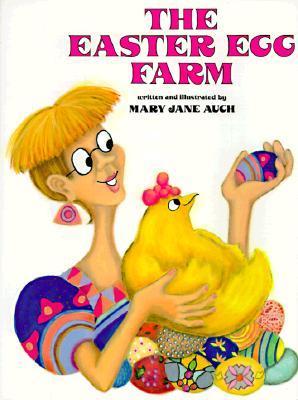
Mrs. Pennywort's hen, Pauline, can't seem to lay eggs like the others. . . . Until she finds some inspiration, and a strange talent.
When she nests outside to get away from the noise and teasing of the others, Pauline manages to lay a beautiful sky-blue egg. Watching a ladybug in the grass, she lays a bright red spotted egg. The hen is confused, but Mrs. Pennywort is thrilled—and she takes Pauline on an adventure!
Soon Pauline is laying eggs of all colors and patterns, to the delight of everyone who sees them. It seems like the perfect way to celebrate Easter. . . . even when the eggs start hatching into brightly colored chicks.
Mary Jane Auch's funny text and vibrant illustrations will make this an Easter favorite. . . . and a year-round reminder of the importance of being true to yourself.
The thought of becoming a writer never occurred to MJ Auch as a child. Her only literary efforts in those days were the plays which she and her girlfriend, Noreen, wrote for their marionettes. They produced these extravaganzas in Noreen’s garage and organized the neighborhood boys into a sales force to sell tickets and refreshments.
Summer visits to both of MJ’s grandmothers led to her fascination with chickens. One grandmother had a small backyard flock and the other grandmother and two bachelor uncles had a large farm that supplied eggs to half of Long Island. MJ learned that a flock of chickens had almost the same range of personalities that could be found in a classroom, from the quiet, shy chicken to the big bully.
MJ loved books and read constantly. She wrote stories, drawn in comic book style with speech balloons for the dialog. Her interest in drawing continued through high school, and she went on to become an art major at Skidmore College. After graduation, MJ headed for New York City to seek fame and fortune, but after a year of designing prints for men's pajamas, she decided she wanted to do something more meaningful with her life. She enrolled in the Occupational Therapy program at Columbia University, which led to some wonderful years of working in a children's hospital near Hartford, Connecticut.
On a brief stop home to visit her parents before transferring to a new job in Denver, she met Herm Auch, a graphic artist and editorial cartoonist for the Rochester newspaper. It was love at first sight, and MJ never made it to Denver. They were married in 1967 and within a few years had produced a daughter, Katrin and a son, Ian. They moved from the city to a small farm, complete with chickens, ducks, and geese. Armed with a huge collection of Mother Earth News and absolutely no practical experience, they tackled farm life with gusto, gaining much comedy material for books MJ’s future books.
As the children grew older, MJ began to look for work in her original field of art. Like Jenna's mother in Mom Is Dating Weird Wayne, she had a brief stint as a “zit zapper” at a school picture factory. Then she started illustrating for Pennywhistle Press, a national children's newspaper, and this sparked her interest in illustrating children’s books.
In the summer of 1984, MJ took a week-long children's writing conference on Cape Cod. She tried to write a picture book manuscript to take to the conference, but instead found herself writing a middle-grade novel. When her instructor, Natalie Babbitt, told of starting out as an artist and finding she could paint better pictures with words, something clicked. MJ finally knew that she wanted to a writer.
She started sending manuscripts to publishers, writing four full-length novels before she sold the first one. Then she sold a second book to another publisher that same week. It had taken two years and thirteen rejections, but MJ had finally reached her goal!mShe continued writing books for older kids and abandoned her dream of illustrating for a while. Then, after nine books, she wrote and illustrated The Easter Egg Farm. This set in motion a series of picture books featuring poultry involved in the arts.
The Auchs have now become a family of artists. Their children are grown and pursuing art careers of their own. Kat, a graphic artist, is now working as Associate Art Director for Scrapbook Answers Magazine in San Francisco. Ian has been a graphic artist and 3-D animator and is now Assistant New Media Editor for the Rochester Democrat and Chronicle newspaper. Ian is also a metal artist and created the chicken-sized beauty parlor chair for [b:Beauty and the Beaks|1918127|Beaut
Update. I read this many years ago with my children. This is a perfect book to read aloud with little ones at Easter! Wonderful story about a chicken who is ostracized by her farm mates, but ends up being a star after she begins to lay eggs with pictures on them.
My youngest loved this book so much that we had to keep getting it out of the library, long past Easter time! A cute message, of valuing everyone, regardless of differences. Loved her chicks, my daughter had fun finding where each egg pattern came from (dress, lamp, window shades, etc.) Highly recommend. Read in 2013
I met Mary Jane Auch at our local annual Writer's Jubilee, and she told us that she loves chickens. It's only natural, then, that she should come up with this story. I think she may even have drawn herself in the book...
A little chicken lays colorful, patterned eggs she's feels embarrassed by these eggs, but her owner loves them. Soon everyone wants these unique eggs, they eventually hatch into colorful little baby chicks.
Each Easter I like to pull this one back out. What a clever tale about a hen who lays eggs that match what she sees. This book is a celebration of creativity!
Pauline is a hen who lives in Mrs. Pennywort's henhouse, but she doesn't seem to be laying any eggs! One day she does, and it turns out patterned! She's very embarrassed and tries to hide it. Once she accidentally lays a colored egg in front of Mrs. Pennywort! Pauline thinks that she's going to be furious, but instead, she's delighted! Pauline starts laying all colors of eggs, and pretty soon a lady notices all the pretty eggs in Mrs. Pennywort's window, and she wants to buy some for the annual Easter egg hunt. But then suddenly, the eggs hatch into chicks! What will happen then?! This is such a fun book with cute illustrations and a perfect one for Easter! Follow @bronteandwilder on Instagram for more fun book recommendations!
Greedy, mean adult wants to take advantage of the fact that one of her hens lays already colored eggs. She treats the hen nicely enough, but then gets angry when the eggs hatch and she can't sell them. So then she wants to sell the chicks. Then hen is sad and luckily the woman realizes this and doesn't sell her chicks. (But does sell the unhatched eggs.) So then, after being happy with being different from the other hens, the hen decides to lay a plain, white egg "to be different."
Pauline was a hen at the Easter Egg Farm, but she couldn't lay any eggs because the other four chickens were too noisy. So Pauline left the chicken coop and made a nest outside. She started making strange eggs. Mrs Pennywort saw new eggs, they were beautiful. A sweet lady saw the unusual eggs and wanted them for her Easter Egg Hunt. Pauline hatched a bunch of colored egg. Read the book to find out what happens to the eggs.
I would include this to my library to show that it is okay to be different. There is one chicken who lays eggs that look like the things she is looking at and at first everyone thought it was weird but ending up liking her unique eggs in the end. I could also use this around Easter and do an activity after reading this where the children design their own egg.
Love this book!! This is a story about a chicken who lays eggs different from her friends. Mrs. Pennyworth decides to sell the eggs, but they start hatching into colorful chicks! The illustrations are beautiful and it shows kids that it's OK to be different!
It was getting close to Easter and I knew I was having a sub. I chose this book for my library lesson because I found lesson plans ready made online. I kept teaching it because the students really love this silly fun book.
A story about an interesting chicken who makes eggs that are different than the other chickens. My daughter enjoyed this story and I did too. The illustrations were good as well. Would recommend.
The Easter Egg Farm is imaginative, bright and colorful. If we can imagine that Santa's elves make toys (and we do!) we can imagine a hen that lays colorful Easter eggs
I like this book because she lays some Easter eggs and some regular chicken eggs with patterns on them. So that's why it's called The Easter Egg, but it's not Easter-y.
Julia and I both liked this one for the most part. We both felt the lady was portrayed kind of weird with that long neck and it was funny to hear Julia comment on something I was thinking about at that exact moment but the story isn't bad at all. The story is very simple with Mrs. Pennywort (how do these authors think of these names? How about Mrs. Henley? Mrs. Miller? No? No.) finding out she has a very special chicken. The story starts with the chicken, Pauline, being made fun of because of her lack of egg making. (The other chickens don't go too far with this, they call her lazy and that's about it.) Mrs. Pennywort seems sort of ogre-like with her demand of five eggs instead of four but whatever. One day Pauline finally laid an egg but it wasn't what she - or anyone else - expected. Pauline lays eggs that look like whatever she looks at whether it's the feed bag, her nest, a picture, anything. The other chickens predictably begin to make fun of Pauline and Pauline's reply is always the same - she, or the egg, is *different*. Not lazy, not ugly, different. The story continues with Mrs. Pennywort finding the beautiful, unique eggs and of course praising Pauline, so much so that Pauline is allowed to go in the house now. This is sort of out of the blue because I was expecting the story to fold into a lesson on how different isn't necessarily bad, everyone is different, etc. but instead an old woman shows up at Mrs. Pennywort's and asks to buy the lovely Easter eggs that Mrs. Pennywort has taken to displaying in the windows and around her house. The Mrs. agrees and tells the woman to come back before Easter. Right before the woman is due to come back to collect the eggs the eggs hatch. (Kids will even see this one coming but no big deal...) The old lady is upset of course, until Mrs. Pennywort asks her if she wouldn't rather have the chicks anyway. Now, this didn't sit well with me at all. I don't think many people are aware just how high chick and bunny sales go on Easter. Research it. Then think about how many of them are actually kept after the cuteness and fuzziness wears off. I have a tractor supply store near me who gets in baby ducks and chicks each year - at Easter time. Last year I commented to the girl about how I didn't think it was good practice to entice people into buying these animals as Easter surprises and she looked shocked and told me, "No! We wouldn't do that! These go to farmers!" So I asked her why they only came at Easter time and why the cartons to package them are right next to the animals. (The packages look like Happy Meal boxes by the way.) She had no answer of course. Because the store she works for doesn't give a hoot about those animals or what happens to them a week after Easter. They care about the money they bring in before Easter. So, I didn't like that this book borderline portrayed it being okay to use chicks as Easter props but I have to admit the story didn't say kids were going to get them, no use was given, etc. I can't complain too much because what the chicks are used for is left up to the reader - which I greatly appreciated but I'd still have liked that part to be left out. I'd have liked the kids to read about the chicks going to a farm and then the kids in the story that are going to the Easter Egg hunt able to have an Easter visit to see them. Much better all around. Something else I wish would have been different was the chickens from the beginning. I'm the last person in the world who needs her kids books to all have lessons. My daughter and I are great at having worthwhile conversations on our own or with help so it's certainly not needed and sometimes it's downright off-putting to be honest. But to have these chickens making fun of Pauline, not once but twice, and then nothing further seems odd. Why not make this a central part to the story instead of the chicks being given away? I don't know but I'd love to know the answer. I can't say I recommend this - I don't. If you read it please keep in mind what I said about the baby animals. Do your own research if you don't want to take my word for it. It's a sad, sad thing that we're okay with giving our little children live baby animals like they're nothing more than a stuffed animal to be thrown out of the house when they've outgrown their use. :(
"The Easter Egg Farm" by Mary Jane Auch is part of the picture book collection. Mary Jane Auch won the Flicker Tale Children's Book Award in 1995. This book is recommended for young children ages 4-8 years old (P) Primary.
This book is about Mrs. Pennywort's and her beautiful hen's attempt to lay beautiful eggs. One hen named Pauline in particular is having a problem with laying a regular white normal egg and is only laying ugly eggs at first. The other hens teases Pauline about her crazy looking, awful colored eggs, but eventually she lays pretty eggs and is happy and content with her little chicks.
I rated this book with 4 stars. This book has nice bright spring colors throughout the entire book. The eggs that Pauline has laid are pretty colors and designs which gives kids great ideas when dying their eggs for the Easter holiday. The illustrations throughout the book is amazing and looks realistic. Pauline's character is quiet, loving and appreciative. Mrs. Pennywort is nice, outspoken and caring. The language throughout is appropriate for a third grader, but maybe a little difficult for a first or second grader. There are big words throughout the book and may be hard to pronounciate. A theme for this book could be "Beautiful Eggs".
I would recommend this book to third graders to read, but I would read to this book aloud to first and second graders because the would enjoy listening.
I'm not crazy about this book. In the beginning it seems promising, with the idea that being different isn't bad. However, the end of the story is problematic. I know a lot of people think talking to kids about how babies are made is weird and awkward, but can we at least stop flat-out misleading them? Eggs do not hatch into chicks if they are left in the sun. That's not how reproduction works. Also, the whole Easter chick thing is troubling. There is a market for Easter chicks, and it's not pretty. The chemicals they use to make the chicks come out different colors is not good for them, and most of them die very soon after hatching. And those that make it into adulthood are often discarded by families who just wanted a cute little chick for one holiday, and didn't think about the animal's welfare after the novelty wears off.
Bottom line, there are enough Easter picture books out there that this one can be skipped.
This is a very cute book about a hen who lays eggs, but not just any type of eggs. The eggs she lays have the patterns/designs of things she sees on them! Illustrations are very nice and it's a book I plan to read to my elementary classes once Easter rolls around.
I love reading this book for story time. It is about a hen who is different, and teased by the other hens for it. The owner, however, appreciates her uniqueness, and the hen thrives in the positive feedback she is given.
This is a cute story about a hen that lays odd looking eggs. The eggs look like colored easter eggs and the hen is at first embarrassed about her eggs. It is a good story about holding on to individuality and expression. Being proud of who you are.
This is a book even adults can enjoy. the beautiful illustrations are amazing and colorful along with creative. Also underneath the storylines is a beautiful message about being true to yourself and not hiding what you think is an oddness. It has been approved by my toddler.