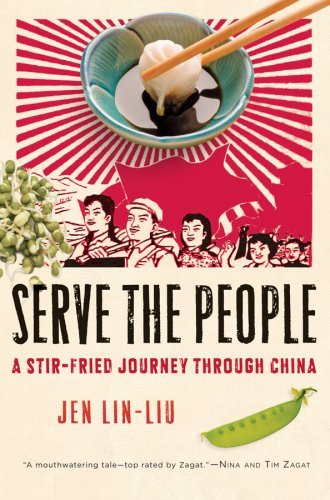
A memorable and mouthwatering cook’s tour of today’s China
As a freelance journalist and food writer living in Beijing, Jen Lin-Liu already had a ringside seat for China’s exploding food scene. When she decided to enroll in a local cooking school—held in an unheated classroom with nary a measuring cup in sight—she jumped into the ring herself. Progressing from cooking student to noodle-stall and dumpling-house apprentice to intern at a chic Shanghai restaurant, she finds poor young men and women streaming in from the provinces in search of a “rice bowl” (living wage); a burgeoning urban middle class hungry for luxury after decades of turmoil and privation; and the mentors who take her in hand in the kitchen and beyond. Together they present an unforgettable slice of contemporary China in the full swing of social and economic transformation.
Jen Lin-Liu is the author of Serve the People: A Stir-Fried Journey Through China and the founder of the cooking school Black Sesame Kitchen in Beijing. She was raised in southern California, graduated from Columbia University, and went to China in 2000 on a Fulbright fellowship. A food critic for Time Out Beijing and the coauthor of Frommer’s Beijing, she has also written for Newsweek, the New York Times, the Wall Street Journal, Saveur, and Food & Wine.
In 2005, the author decided to take her interest in cooking a bit further, and went to cookery school in Beijing. After passing the tests, she then became a noodle intern at a noodle stall serving mainly migrants, the later got more experience in Shanghai in the fine dining restaurants. She is a food critic and article writer, founded a cooking school in Beijing after the events mentioned in this book, and currently lives wherever her diplomat husband is (he appears in this book, where she dates and gets engaged to him).
Although her time in this cooking world is not as tightly tied to it as those who really do it (she has more money, and can detach herself from each place when she's ready), through her we learn what the life on each level is like, get to see how the political system influences it and people's attitudes, and see also how pollution, and drab buildings/neighborhoods/cities feel like, plus what the life is like for migrants, waitresses, cooks and restaurant owners (whatever level of a restaurant they are). And we also get in touch with food ingredients one might not like but don't mind reading about (civets, dogs, fish eyes, genital meat etc.).
Here and there in the text we gets recipes related to what we have read, and the recipes are also listed at the start for easy access. Sometimes the author is in a hunt for a perfect version of a certain dish (like certain dumpligs). She also struggles with understanding and speaking Mandarin at first on a good level, but I think that might improve over time. Some of her views also show her life in America before moving to China (not approved by her parents at first). It's good that she had enough confidence to stick to it when she couldn't quite do some dishes at first, and forgive herself some of her clumsiness.
And it's good that she met people that could help her through things and who would teach her to make certain dishes well. I learned a lot about what food culture in China can be like, and more about MSG than I already knew. It didn't really make me want to visit, but I appreaciate that she had done the visiting, working, and tasting work for me. (Same thing can be said about some other things I'm quite unlikely to do, like mountain climbing, or traveling to certain places.)
I almost never read books of this sort, but this one was a charmer. A lot of this has to do with Lin-Liu's self-effacing style: She's not trying to earn a Michelin star, open a hot new restaurant or reinvent cooking. Instead, this American author, on a journalistic assignment in Beijing, decides to humble herself by learning the basics of Northern Chinese cooking, which means learning a whole lot about noodles.
(I love noodles. The second-best meal I ever ate in China, after a Szechuanese hotpot, was a humble bowl of green-pepper noodles in a little Mom-and-Pop place in the mountains of Anhui province. I still dream about those noodles, sometimes.)
Lin-Liu does not set out to impress us with her brilliance -- a refreshing break from the typical foodie memoir -- but instead humbly accepts her role at the very bottom tier of a tradition stretching back over 5000 years, in which innovation is a much less laudable trait than fidelity. She spends several weeks in an outdoor sidewalk restaurant, learning to properly make 'knife noodles' (shaved off a loaf of dough with an extremely sharp knife right into furiously boiling water.) One imagines not an arrogant craftsman in clogs and chef's jacket, but rather a sweating, bug-eyed young woman ready to collapse from exhaustion.
In Chinese cooking, perhaps more than any other style, the quality of the meal is really decided during the ingredient-procurement stage, which can involve herbs grown in the windowsill, trips to several different markets, and bartering with neighboring restauranteurs.
In the end, she takes clear pride in the accomplishments of Chinese cuisine, and her small role in it. I found the whole thing cheering.
You can definitely tell this book is over a decade old but it is still a good starter on learning about food, cooking, and restaurants in certain parts of China
I enjoyed this look at the food and people of China in the early 2000s. Jen goes to China as a free-lance journalist from America. She's American-Chinese. This gives her a unique perspective: American born/raised and looks Chinese. She's accepted in ways that other Americans wouldn't perhaps be, yet she struggles with the language & customs, putting her outside the "norm" of the people she meets and keeping her slightly apart. She's also privileged in the sense that her journalist job pays her more than the average Chinese person makes for much longer hours and harder work. In all, a very unique perspective. Jen becomes interested in the cuisine of China. It permeates through all levels of social interaction and the deliciousness of it intrigue her. She enrolls in a cooking school, then works in a noodle house, a dumpling shop, works her way up to high-class restaurants. Along the way, she learns the techniques, meets the people, hears their stories and falls evermore in love with the country, its people and the food. This is a close look at what it's like to work in the noodle houses and dumpling shops in China and, again, it's a privileged position to write from: Jen volunteers her time to learn but she also works fewer hours and knows that this isn't her life-long career; she goes home to a large apartment. The people she meets do not have these privileges. All in all, I liked the perspective within this book and the witty, warm way that Jen told her story and discoveries. Popped into the pages are recipes she's encountered along the way. I'm going to try the crispy sweet & sour pork. What can go wrong? :D
My mother came back from her first trip to China with tales of duck tongue and fried chicken feet being offered up as authentic dishes for diners. Personally, I found this both fascinating and a little disgusting - it was this mix of wonder and dread that led me to pick up this book penned by Jen Lin-Liu, a Chinese-American journalist trying to find her culinary way in the cities and towns of China. Beginning in a Beijing cooking school where she struggles to be taken seriously, to a tiny noodle shop, to the kitchen of a famous fine dining establishment in Shanghai, Jen Lin-Liu provides a well-written account of her search to understand multifaceted, often obfuscated China. Our stomachs become the vehicle to uncover how China has changed politically, socially, economically, and gastronomically since its "liberation." The people introduced in this book have remarkable stories and the short esposés scattered throughout the text (on MSG among other things)demonstrate Lin-Liu's strength as a journalist. Her aptitude as a chef is evident through the inclusion of numerous recipes discussed in the body of her writing.
There are a number of things to admire in this text as well and as a few things that might turn the average American reader's stomach; Lin-Liu is induced to try a number if unappetizing things including dog meat and animal genitalia. If you can get beyond the "ick" factor of these brief encounters, this book has a great deal to offer in terms of its unique insight. The only time if fell short for me was near the very end when Lin-Liu falls in love and her writing moves from descriptive to mushy (a different type of "ick" factor). In my mind it took away from an otherwise polished story of self discovery set against the backdrop of cultural exploration. Still, her appreciation and reverence for the land, people, and food that appear on the pages of her book make this an enjoyable read. Her writing is honest and though I might not like or agree with the totality of what I found, this book opened my eyes and for that I am always grateful.
What initially attracted me to this book was the title: the writer claimed to be taking a journey throughout China for the food culture. But, I was disappointed to find out that Jen Lin-Liu seemed to mainly focus on the cuisine in the northern part of the country, Beijing and Shanghai.
Call me a little biased, but I would have liked to learn more about food from the Guangdong region, where my family originates from. Maybe I'm just not aware that there are already plenty of books out there about Cantonese cooking, but really, for this book to have such a title, I think it would have been better to include ALL of China's cuisines. Perhaps the title wasn't Jen Lin-Liu's fault; maybe her agents or publishers decided the title would fit better, would sell better.
Anyway, I digress. Despite the lack of talking of Cantonese cooking, I liked the recipes and the semi-memoir that Jen Lin-Liu included. It was interesting to read her experiences going through cooking school/cooking internships in China. I would have liked to see certain things written out in Chinese characters (such as Chinese phrases), but then again, that might just be my own preference. I'd like to talk to my parents about some of the recipes, but it might be a little hard to do that with the pinyin written out instead.
Also, the last section of the book, Hutong Cooking, could have been expanded more. I would have liked to learn about how Lin-Liu was able to establish her Black Sesame Cooking School and how that's been going on; also, her relationship with her now-husband Craig seemed to be mentioned too quickly in that last section. It seemed out-of-place for the whole of the book.
So, to finalize, I enjoyed most of the book and the recipes; but, the book could have been executed a lot better, whether by Lin-Liu herself or by her agents/publishers. However, I will commend her on the efforts and on her journeys. It felt nice to vicariously live her cooking school days. I'd like to do that one day as well.
I've read many different memoirs about life in China during the Cultural Revolution and enjoyed all of them. This book, however, is my first foray into Chinese life in the modern day - a current and compelling look at life and, especially, eating and cooking in 21st century China.
Jen, the author, is a Chinese-American journalist and food critic by trade. For a chance to explore, not only her roots, but the esoteric underworld of the Chinese food and restaurant industry, she decides to enroll in a cooking school in Beijing. In a male-dominated classroom she learns the art of chopping and stir-frying, and with the help of a teacher outside the classroom works on making the perfect dumpling.
Cooking school is only the beginning for Jen, who then heads out into China, talking her way into various cooking internships in restaurants as varied as a tiny noodle shop in a canteen to a high end restaurant in Shanghai, she even heads to the mountains to help with the rice harvest. Her cooking experiences and the people she meets are fascinating and all the while she is teaching us Chinese history, culture and legend, usually through the personal experiences of the chefs and waitresses with whom she crosses paths. Explanations about the variations in Chinese cuisine and food preparation based on geography were particularly compelling, probably because the cuisine of the culture I've grown up in feels infantile compared to the dishes I read about.
Many other reviews of the book described is as humorous. I can't say that I found things particularly funny, sometimes more, a-hem, unappetizing to my taste - but her writing style was very pleasant and readable. I was always happy to pick the book up and despite its choppy style (many in-depth recipes are sprinkled throughout and things aren't always completely chronological) I found it a very satisfying read.
This is the world's longest Vogue or Vanity Fair article. You know the kind -- the author talks about how she is Totally Fascinated By Something, The Something's Personal Meaning to Her, and goes off on a Quest to Discover the Something. In this case, the Something is Chinese food, and I give Lin-Liu credit for learning a king hell of a lot. The recipes in this sound delicious. But while this is more aware of its author's privilege than most Vogue/Vanity Fair articles ("yes, $gazillion is a lot to pay for something that only I would ever see. But the peace of mind I have from knowing that I $insert-spurious-reasoning-here makes it worth it."), that does not mean it is not ultimately superficial and disappointing. It's not bad enough that I decided not to finish it, but it's in no way good enough to recommend as a reading experience.
Enjoyed this more than I expected; Lin-Liu's writing whisks you along from one mouth-watering dish description to the next and features a charming cast of people. I think it's slightly misnamed; the scope of the novel is pretty limited to just Shanghai and Beijing (with some, but not much, Sichuan cooking), but there's a lot of cultural unpacking here as well that's really interesting. I'm not sure I'll make any of the recipes here (well, maybe the Sichuan green beans), but as a dive into the Chinese culinary scene, you'd be hard pressed to find a better read.
The precursor to On the Noodle Road which was also good. A young Chinese American woman goes to China to live and learn about food. Gained some early cred through blogs and writing for the slicks before she turned to long-form. Lovely sense of place, loving details of people in the neighborhood and delicious food stories. Recipes included.
This book is a nice light read. (I actually started reading it on an airplane, the perfect setting.) After reading the last half of it, I'd really like to visit Shanghai. No, I have no desire to start cooking...
idk why i loved this book so much; maybe because it has all of the best things: food, culture, and an honest narrator. jen lin-liu writes exactly how i want to read. i did try making dumplings using a recipe in this book and failed horribly, but i blame that on reader-error and my pasty whiteness. i’ve discovered a new favorite genre and am on my way to buy her next book :)
Great book about a lovely journey around china - although any book both Chinese cooking will give 5 stars from me. Kudos to Queen Rosie for the best birthday present
The second most disturbing part of this book was learning that the secret ingredient to the highly addictive xiao long bao I obsess over is probably jellied pork skin.
The most disturbing part was that I then immediately googled ways to make jellied pork skin.
If you are the type of person that systematically rates buffets on their dumpling choices, seeks out Chinese restaurants which offer more than the generic and ubiquitous one page paper menu, or has contemplated naming your firstborn Dim Sum; then this book is for you. Jen Lin-Liu puts a playful spin on the I-went-to-another-country-and-saw-weird-stuff genre of travel writing. Starting in Beijing, she fumbles through a Chinese cooking school and moves on to internships and volunteer work at noodleshops, a fine dining restaurant and rice picking.
Peppered with borrowed recipes and asides on the history and use of MSG and noodle making techniques, Lin-Liu’s mixture of personal anecdote and research results in a light literary dish. It gets a little sappy toward the end when she starts bringing her personal love story into the book. Overall, her wok-side view of contemporary China is a funny and honest take on the lives of those feeding a nation of some billion-plus bellies.
Plus, you’ll need its recipes to figure out what to do with your vat of jellied pork skin.
This took the longest time for me to read, mostly because I kept thinking to myself it was worth finishing. DO NOT MAKE THIS MISTAKE.
It's not as if Serve the People is a badly written book. It's just way too long and it's like listening to someone repeat the same story over and over but changed it up every few times in case someone wanted to bow out and check out of that convo quick.
I'm trying to think of what could have made this better. And honestly it really just comes to length. Also she's not really talking much about HERSELF as she is everyone else. How many "feel sorry for me" stories do I really need to read about? I get it, being born and raised in China is shit. But here I was thinking you'd be talking about food and how you got along being a resident in another country. I would have much rather heard her childhood stories of being raised in America and the food she grew up with in comparison to China's, instead of repeating the same day over and over. Or even speak of more of the guy she was dating at the time? How was dating another American in another country like? Guess we'll never know. Again with just focusing on others instead of her own experiences.
As a Chinese American journalist living in China, she attends the local cooking school, interns at establishments, and writes for Time Out Beijing.
Questions came up but where eventually answered as I progressed through the story (ie., why she started a cooking school in Beijing instead of Shanghai; what her parents in San Francisco thought of her move to China instead of staying in The States).
I'm not sure why I didn't like it, it was ok. Perhaps I would've liked for her to delve more into what "Serve the People" meant to her - or was the historical and biographical stories to suffice the Country's motto? Perhaps too I would've liked for her to delve more here as to what triggered her into opening her own cooking school (even though you could infer) and more on her take of what others would see as "regressing" in more of a paragraph.
I really enjoyed this book - it's an interesting and entertaining account from a Chinese American woman who moves to China and wants to learn about cooking Chinese food. Along the way, she works in fancy restaurants and roadside noodle stands, getting to know all sorts of interesting people from different parts of China and different social classes — who are all passionate about food. In that way it reminded me a bit of Bill Buford's book "Heat." This was a great window into Chinese food and culture for me as well as a snapshot of how quickly China is changing.
I found out about this book through the Seattle Public Library's "Your Next 5" program, where you tell them what you want to read, and a librarian will recommend 5 books to you. I asked for entertaining armchair travel memoirs and this definitely fit the bill!
This book started slowly, but it was excellent once it got going. It reminded me that we really are our food, and our food is us. (This probably sounds incredibly pretentious. But what can I say. Too much time spent around historical food geeks, and reading Anthony Bourdain.)
I felt like I got a better grasp on China by reading this than I did by reading things like China Shakes the World and The China Price.
I knew so little about Chinese cuisine and history going into this book; coming out of it, I know a bit more -- though many things were still somewhat unclear, either because of my lack of knowledge or Lin-Liu's sometimes meandering writing or a combination of the two -- and was entertained along the way. I actually found the palate cleanser "side dish" chapters in between the main sections of Lin-Liu's journey to be some of the most interesting parts.
This is a light and enjoyable read, yet she manages to pack in a lot of fascinating Chinese cultural and historical details. She's a very straightforward writer--I'd say she has a better eye for detail than an ear for clever or charming prose, but I'll take simple over garish anyday (we can't all be Calvin Trillin).
Some of the foodie stuff overwhelmed me by the end, but I was rushing through it for a library deadline. There are other books on China and/or food but this one did a terrific job interpreting those for an American audience - definitely worth the read.
I found this foodie memoir in a neighborhood Little Free Library. It is filled with stories of the author’s experiences, as a Chinese-American who grew up in America, having moved to China and becoming immersed in the food culture there. She enrolls in culinary school and interns in a variety of restaurants, learning different philosophies, approaches and cuisines, as well as a lot about Chinese food and cultural history. Fascinating take - also including the racism and gender bias she faced, and cultural challenges. It has inspired me to want to purchase a wok and try many of the included recipes.
This reminded me a lot of Fuscia Dunlop's memoir about Chinese food, but it fortunately finished with much less moralizing. It also stays interesting until the end, though I did enjoy her time in fancy restaurants less than her portraits of Chinese culinary school.
I’ve been called a banana, which is slang for “yellow” on the outside and “white” on the inside, but recently, I’ve become more interested in exploring my roots. Plus I love to eat Chinese food, as well as every other kind of food.
So I picked up this book, written by Jen Lin-Liu, a Fullbright scholar who was born in the U.S., but who moved to Beijing to explore the cuisine. She made me nostalgic for a China that probably no longer exists, razed by capitalism. For example, she bought a cleaver that was dull. Her teacher explained that traditionally, a knife-sharpener would bicycle around the neighbourhood with knives clinking on his belt. If you heard the noise, you were supposed to run out with your knife for him to sharpen. It took a few weeks before she heard the clinking. By then, she had already bought a pre-sharpened cleaver, and he pedaled away without anyone stopping him for his services. I also found myself worrying about Chef Zhang, who taught Jen how to make the best noodles, but kept his prices so low to compete that two of his noodle stalls folded. And what about the fresh markets, which were being squeezed out by Wal-Mart and Starbucks? Fortunately, a quick Google reveals that after publishing Serve the People, Jen opened Black Sesame Kitchen, a cooking school that employs Chef Zhang and has earned rave reviews. So this book earns a happy ending both on the page and in real life.
Update: I've tried at least two of the recipes now, with my friends Becky and Genevieve. Two delicious thumbs up for noodles and smashed cucumbers!
It took me several weeks longer than I would have expected to finish this book. Partly because life got in the way and partly because it definitely lost momentum. The best part is the beginning when the author attends a vocational cooking school, where she must prove herself as a woman and foreigner. At the school, she also befriends Chairman Wang and through her, hears a firsthand account of life during the Cultural Revolution. The story of Chairman Wang's life brings the historical context to a deeply personal level. From this, the author goes on to work at a noodle stall (also fairly interesting as an example of entrepreneurship and the art of noodle-making) and a fancy restaurant (probably the least critical part of the book). In the last few chapters, the author moves back to the neighborhood where the cooking school was located and starts to feel like she's found a home. She also starts her own cooking school with Chairman Wang, though it feels like she spends much less time talking about that than about falling in love unfortunately. The author obviously wrote the last few chapters while recently engaged and it shows. Yuck. Anyway, the beginning and middle of the book were strong enough that I'm still giving this four stars.
Between the recipes and the author's detailed account of Chinese kitchens, I salivated my way through the book. Her take on "nouveau" cuisine in general is astute - there's something very universal about the Chinese experience as it relates to food and something sad and ironic as well. In some ways, this can be seen as a book about the corrupting influence of "status" on any society, while also showing what decades of privation do to a proud people. But in the end, this is a book about a woman's journey of some kind of discovery and the unfortunate thing is that the author isn't all that interesting. Her obvious love of food doesn't overcome the strange banality of her life. Strange because she is doing something quite incredible - her quest is a noble and brave one. But that she settles with a bland seeming western guy with no great love of food is more poetic than it's worth. It points to something about the author that might be rude to admit but is true: take away her food curiosity and she's pretty boring herself. But it's a tasty trip along the way nonetheless and is as good an introduction to Chinese society and the incredible changes taking place there.
For me, history and current events are much easier to understand at a personal level. This book does this for modern China from an unique perspective. The author, as a Chinese-American, has some cultural background from her parents, who arrived in the US via Taiwan. Also I think the Chinese respond to her differently because she does not "look American". The people that she meets during her quest to understand Chinese cuisine range from those who were nearly adults at the time the Cultural Revolution started to those who were born after China started adopting a market economy. Talk about a "generation gap"! She describes how the middle class and the poor working class live in Beijing and Shanghai as well as visits to other cities and to, at least, one rural area. Along the way she describes the working conditions in restaurant kitchens from struggling noodle shops to state-owned to world-class. She explains how various dishes are made and includes recipes. She does all this with compassion and wit.
Jen is a Chinese-American journalist who decides to move to Beijing, having never been there, as a writer and food critic. After being there a few years she decides to enroll in a local cooking school. It is a fascinating look at modern China with the interesting twist of how a non-native Chinese speaker (struggling at first) who looks Chinese finds her place in China and the stories of the people she meets--Wang, who grew up in the cultural revolution; Zhang, who was given away by his parents along with his sister because they couldn't feed all their children and he was child 4--an unlucky number... Sprinkled with recipes, it was a fun glimpse into the culture, history, food, and modern life of China. I would have given the first half of the book where she is in the cooking school and working at the noodle stall 4+ stars, but the last third or so she divided into different sections of her travels and it started to drag for me. It is a worth checking out just for the fascinating first section though! I definitely would reccomend it.
Super fun and fascinating cultural-history/foodie-memoir. Come for the food, stay for the intimate tour of modern China and the human drama. Lin-Liu, in addition to eating (well, usually while eating), does a lot of thinking about her insider-outsider identity and befriends seasoned cooks, wise teachers, bright-eyed waitresses, and a cast of extras from every walk of life. Juggling all these elements and indulging in researchy asides (MSG, regional cuisines) makes for a slightly uneven read, but that only makes me more tempted to call this book the Chinese "Heat."
(Bonus: When you finish the book you can aww over the happy ending, complete with pictures of Chairman Wang and Chef Zhang!)
I thought this book was a compelling look at different types of regional Chinese cuisines, especially Northern styles I'm unfamiliar with as a Cantonese-American. The first half of the book, where Jen is learning at the cooking school and interning at the noodle shop, was much more interesting than the world of five-star hotels she explores in the second half. I enjoyed meeting characters like Chairman Wang and Chef Zhang who are passionate about cooking but began their culinary careers out of economic necessity.
At many points, in the book, I found Jen a little condescending and clearly writing for an audience she expects to have prejudices about Chinese food. She makes frequent mention of "exotic" ingredients she herself is not able to stomach. Her privilege comes through in passages like, "Once I had mastered the noodle shop's entire menu, it was time to move on." She peers into people's lives, learns their history and how to make their recipes, and flits on.