

What do you think?

Powerless
In a society where lies are law, a simple act of honesty can become the ultimate rebellion.
When does silent compliance with an oppressive regime become unbearable? For Charlie Simpkins, the manager of a small vegetable shop in Los Angeles' San Fernando Valley, part of the West Coast People’s Democratic Republic, the breaking point comes when he is asked to display a meaningless propaganda poster in his shop window.
It is a seemingly insignificant act in a lifetime of obedience. But Charlie just can’t bring himself to doing it. This minor act of defiance, however, show too much independent thinking on Charlie’s part, setting off a chain of escalating consequences for Charlie and his wife and two children.
Powerless is a haunting dystopian tale of how even the smallest act of defiance can spiral into disaster in a society that demands total conformity. It serves as a chilling reminder of how easily standing up for one’s principles can lead to crushing consequences, erringly echoing the challenges we face today for speaking our truth, even in societies that claim to uphold freedom.
While the novel draws original inspiration from Alexander Dubček's 1968 vision of "socialism with a human face" in Czechoslovakia (the reformist movement sought to humanize authoritarian rule), it will resonate with many who fear that individual freedoms are under attack in many parts of the world. In Powerless, Charlie Simpkins' growing disillusionment mirrors the psychological toll experienced by many today as political stress and uncertainty become ever more pervasive.
As Charlie seeks out others who share his dissatisfaction, his increasingly deliberate and risky actions symbolize the quiet acts of defiance that offer hope and resistance in a society where the powerful suppress dissent. Powerless serves as a poignant reminder of the consequences that can arise when standing up for one's principles in an environment that demands conformity.
When does silent compliance with an oppressive regime become unbearable? For Charlie Simpkins, the manager of a small vegetable shop in Los Angeles' San Fernando Valley, part of the West Coast People’s Democratic Republic, the breaking point comes when he is asked to display a meaningless propaganda poster in his shop window.
It is a seemingly insignificant act in a lifetime of obedience. But Charlie just can’t bring himself to doing it. This minor act of defiance, however, show too much independent thinking on Charlie’s part, setting off a chain of escalating consequences for Charlie and his wife and two children.
Powerless is a haunting dystopian tale of how even the smallest act of defiance can spiral into disaster in a society that demands total conformity. It serves as a chilling reminder of how easily standing up for one’s principles can lead to crushing consequences, erringly echoing the challenges we face today for speaking our truth, even in societies that claim to uphold freedom.
While the novel draws original inspiration from Alexander Dubček's 1968 vision of "socialism with a human face" in Czechoslovakia (the reformist movement sought to humanize authoritarian rule), it will resonate with many who fear that individual freedoms are under attack in many parts of the world. In Powerless, Charlie Simpkins' growing disillusionment mirrors the psychological toll experienced by many today as political stress and uncertainty become ever more pervasive.
As Charlie seeks out others who share his dissatisfaction, his increasingly deliberate and risky actions symbolize the quiet acts of defiance that offer hope and resistance in a society where the powerful suppress dissent. Powerless serves as a poignant reminder of the consequences that can arise when standing up for one's principles in an environment that demands conformity.
363 pages, Kindle Edition
First published July 15, 2025
About the author
Harry Turtledove
572 books2,045 followersDr Harry Norman Turtledove is an American novelist, who has produced a sizeable number of works in several genres including alternate history, historical fiction, fantasy and science fiction.
Harry Turtledove attended UCLA, where he received a Ph.D. in Byzantine history in 1977.
Turtledove has been dubbed "The Master of Alternate History". Within this genre he is known both for creating original scenarios: such as survival of the Byzantine Empire; an alien invasion in the middle of the World War II; and for giving a fresh and original treatment to themes previously dealt with by other authors, such as the victory of the South in the American Civil War; and of Nazi Germany in the Second World War.
His novels have been credited with bringing alternate history into the mainstream. His style of alternate history has a strong military theme.
Harry Turtledove attended UCLA, where he received a Ph.D. in Byzantine history in 1977.
Turtledove has been dubbed "The Master of Alternate History". Within this genre he is known both for creating original scenarios: such as survival of the Byzantine Empire; an alien invasion in the middle of the World War II; and for giving a fresh and original treatment to themes previously dealt with by other authors, such as the victory of the South in the American Civil War; and of Nazi Germany in the Second World War.
His novels have been credited with bringing alternate history into the mainstream. His style of alternate history has a strong military theme.
Ratings & Reviews
Friends & Following
Create a free account to discover what your friends think of this book!
Community Reviews
Displaying 1 - 30 of 30 reviews

April 26, 2025
That was horrifying. Really well written, and a terrifying book to read in April of 2025. Turtledove does an excellent job blending the every day mundanities of life with the horror of living under a dictatorship. And yet I walk away with hope, which hits just right.

May 15, 2025
An ordinary guy in a communist-dominated world
Charlie Simpkins is an ordinary guy, manager of a fruit and vegetable shop in the San Fernando Valley in the West Coast People’s Democratic Republic. Charlie, like his neighbors, ordinarily bows down to whatever the Party deals out, but one day, when a political poster arrives for him to put in the shop window, he rebels and throws it into the trash. There are consequences!
Powerless displays the engaging narrative style that makes Turtledove’s books so enjoyable. Even in the depressing atmosphere of a communist-dominated world, there is humor as well as the suspense and tension that readers would expect in such a society. Page 1 has a marginal note from me that “It sure is dystopia”, but I also inserted a number of “ha ha”s throughout.
The book contains some challenging big events in the world of the WCPDR, but it is about how such events affect average citizens like Charlie rather than the competition within the elites. The people are believable folks dealing with a tough society, and Turtledove describes them well. They all seem to smoke and drink to excess, which was sad. Even sadder were the lessons Charlie’s 11-year-old daughter and 13-year-old son already had learned about how to behave or not behave.
I was drawn in by the struggles of the masses, but as an alternate history, I wanted a bit more background. It is clear that North America and some other countries are communist and they are dominated by the USSR, but is the whole world communist or do they have opponents? How did the takeover come about and when? I got no feel for the date either of the events in the book or the communist takeover.
I also was anticipating a stronger denouement, either positive or negative. This disappointed me, but perhaps Turtledove intended exactly the message I got!
I received an advance review copy of Powerless from Edelweiss and Arc Manor LLC.
Charlie Simpkins is an ordinary guy, manager of a fruit and vegetable shop in the San Fernando Valley in the West Coast People’s Democratic Republic. Charlie, like his neighbors, ordinarily bows down to whatever the Party deals out, but one day, when a political poster arrives for him to put in the shop window, he rebels and throws it into the trash. There are consequences!
Powerless displays the engaging narrative style that makes Turtledove’s books so enjoyable. Even in the depressing atmosphere of a communist-dominated world, there is humor as well as the suspense and tension that readers would expect in such a society. Page 1 has a marginal note from me that “It sure is dystopia”, but I also inserted a number of “ha ha”s throughout.
The book contains some challenging big events in the world of the WCPDR, but it is about how such events affect average citizens like Charlie rather than the competition within the elites. The people are believable folks dealing with a tough society, and Turtledove describes them well. They all seem to smoke and drink to excess, which was sad. Even sadder were the lessons Charlie’s 11-year-old daughter and 13-year-old son already had learned about how to behave or not behave.
I was drawn in by the struggles of the masses, but as an alternate history, I wanted a bit more background. It is clear that North America and some other countries are communist and they are dominated by the USSR, but is the whole world communist or do they have opponents? How did the takeover come about and when? I got no feel for the date either of the events in the book or the communist takeover.
I also was anticipating a stronger denouement, either positive or negative. This disappointed me, but perhaps Turtledove intended exactly the message I got!
I received an advance review copy of Powerless from Edelweiss and Arc Manor LLC.
July 18, 2025
Just as good
This story was different in the context of the tale. The writing was excellent and the characters well thought out. I recommend this book.
This story was different in the context of the tale. The writing was excellent and the characters well thought out. I recommend this book.
May 7, 2026
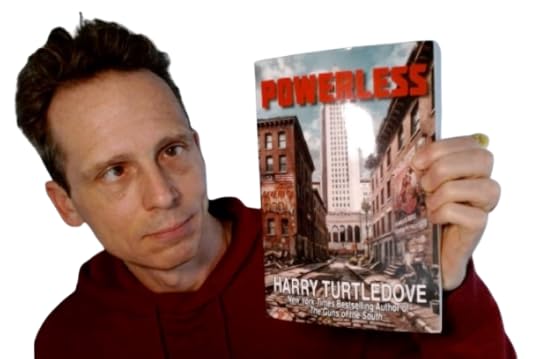
Charlie Simpkins is no philosopher. He's just another "comrade" in the West Coast People’s Democratic Republic, operating a vegetable shop in Los Angeles. He smokes the government-issued Progress cigarettes, he drinks the rationed rotgut at the local class-four tavern and, generally, lives a life of silent compliance.
Until, one day, the government asks him to put up a communist propaganda poster, with the words "WORKERS OF THE WORLD UNITE!" Instead of taping it to the window of his shop, he tosses it in the garbage.
That's how Harry Turtledove's Powerless opens: With one man finally saying no, even though the consequences could easily involve time breaking rocks in a concentration camp.
Charlie understood all that. He didn’t feel particularly heroic about chucking WORKERS OF THE WORLD, UNITE! into the trash can. He was just sick and tired of giving lies a helping hand. The lies, no doubt, would go on all the same, but they could go on without him.
This alternative historical fiction is set in a parallel universe where Soviet ideology has spread around the world — forming individual "democratic republics" on "the path to true communism."
Powerless caught my attention because of the many parallels to my own novel, Much Ado About Corona. In its opening pages, the owner of a bakery (rather than a vegetable shop) has put up a sign (rather than taken one down) that opposes the COVID mask mandates ("No face, no service"). In both novels, refusal to parrot the state's ideology escalates to life-threatening consequences.
As the publisher's synopsis of Powerless puts it:
Powerless is a haunting dystopian tale of how even the smallest act of defiance can spiral into disaster in a society that demands total conformity. It serves as a chilling reminder of how easily standing up for one's principles can lead to crushing consequences... even in societies that claim to uphold freedom.
The novel isn't so much about rebellion as it is about irritation. It's not about overthrowing the machine of government, merely gumming up the gears.
For example, Charlie starts by refusing to hang a poster in his shop window. This leads to him losing not only his store but also the right to be employed. Forced into the black market, he soon finds himself being mentored by a senior member of the underground, a balding chainsmoker named Ervin.
Here is some of Ervin's dissident advice for toppling a totalitarian regime:
“So be as difficult as you can. Ask questions in public, where they’ve got to give you some kind of answer. If you get a chance, check the laws. A lot of time, they sound good — it’s just how the bastards use ’em that screws ordinary people. If you quote what they really say, you scare the crap out of the apparatchiks.”
“Isn’t that stuff, like, secret?”
“Nah.” Ervin waved his hand. “Any library has the MCPDR law codes. They’re in with the collected works of the past Party chairmen and General Secretaries, so they’ll have half an inch of dust on ’em, but they’re there. It’s boring shit, but it helps you play the game.”
Hence, most of Charlie's acts of defiance are subtle enough to avoid a one-way ticket to the Long Island labour camp, while disruptive enough to put a speedbump on "the road to true communism." It's this middle ground approach that I really appreciated about the novel: No one man has to martyr themselves for freedom. Instead, if enough people consistently push back against tyranny in small ways, then...
Well, I'll let Ervin explain:
Before Charlie left, he asked, "Think there’s any chance?"
“For my druthers? Maybe one day, but I don’t think soon,” Ervin answered. “For some wiggle room? Mostly you lose. Once in a while, though, you don’t. Trying’s better than not trying, or that’s how I see it.”
Powerless was a compelling read, as each time Charlie tries to disrupt the West Coast People's Democratic Republic, I kept turning the pages to find out what the consequences would be. Most of the consequences were negative. Yet, concomitant with the punishment, Charlie finds himself meeting and building friendships with wise old freedom fighters like Ervin.
But, make no mistake, Powerless is deliberately unsensational. The wins are small and the pushback harsh. As Ervin wisely warns:
"It’s hard. It’s the hardest thing in the whole damn world. You want to know what’s easy, Louie? I’ll tell you what’s easy. Going along is easy. Doing what they want you to do, doing what they tell you to do, that’s easy. The hard part comes when you say no and try and make it stick. Then you find out what trying to hold back the tide is all about."
Despite the hard subject matter, I found Powerless easy to read — a genuine page turner. As the excerpts above demonstrate, Harry Turtledove's narrative style is as natural as talking to Charlie Simpkins over a mug of rotgut at the novel's class-four tavern, the Valley Relic.
Likewise, the gritty realism of the story is quite pronounced, and the storyline, while never sensational, makes it hard to resist knowing what will happen next to Charlie Simpkins' family as he, per Ervin's counsel, tries to be as difficult as possible.
Harry Turtledove's writing is a clear example of why tyrants hate books. Or, as he says in his novel, why they hate typewriters:
You had to be in good order with the authorities to have a phone, the same way you did to own a typewriter. Governments naturally distrusted gadgets that made it easier for ordinary people to exchange ideas with one another. In the Mexican Soviet Socialist Republic, a typewriter license was much harder to get than one for driving a car, and the authorities took type samples from every machine before releasing it to the licensee.
No doubt, Turtledove never would have been issued a license.
So far, I've had nothing but praise and admiration for his dystopian tale set in an alternative reality where the Soviets rule the world.
Now, I'd like to talk about what I didn't like about the novel...
To start, I had issues with the main character, Charlie Simpkins. Despite his many acts of civil disobedience — ranging from failing to hang a communist propaganda poster, disrupting government meetings, working too efficiently and purchasing produce on the black market — I couldn't help but wish the character would try a little bit harder and drink a little less. His default to most problems was the Daily Relic (a class-four tavern), where he eventually got himself so drunk it's a miracle he found his way home to his wife and kids.
But Charlie's sense of "powerlessness" is further enhanced by the character of Alex Eichenlode.
Alex Eichenlode is a sort of Ron Paul character in the story. He's a libertarian-leaning politician who manages to become the leader of the West Coast Democratic Republic — somehow convincing the Russians that loosening the leash a little would help productivity and quell opposition.
Despite Charlie's own small acts of defiance, I couldn't help but feel that too much of the novel was Charlie with his ear to the radio or reading every line of the state-controlled newspaper, waiting to see what Eichenlode's next move to save the people would be.
I actually spent most of the novel wondering if Eichenlode would turn out to be just another leader promising freedom who slowly turns on the people. As Charlie's wife says: "The Russians'll tell him what he has to do, and they'll stick a gun to his head to make sure he does it."
I won't spoil whether Eichenlode lives up to his Ron Paul vibe or not, but I will say that I might have enjoyed the novel more if he'd been absent (no matter how much I admired his character). Most of the progress towards freedom comes as a result of this saviour politician, leaving Charlie as a passive bystander. The story leans too much towards political hopium rather than grassroots resistance.
All that said, the final chapter, in which Charlie Simpkins and Alex Eichenlode finally meet, offers an emotionally moving and satisfying end to the novel.
Another issue I had with Powerless — given that it is set within an "alternative history" — was that it contained very little history of its alternative reality. Not much is said to explain how the nations of the world have adopted the Soviet-enforced communism. When exactly the transition in America took place, and how it unfolded, is also unclear. Even the year of the story itself is never stated. It appears to be set in the 60s or 70s based on the level of technology (but it could have easily been 2040, considering how inefficient "the path to true communism" was proving to be).
Lastly, my one issue with Turtledove's writing style was the belated attribution tags. I was often unclear which character was talking, or assumed it was another character, only to find at the end of the paragraph that it wasn't Charlie but his wife Lucille who had made the comment (as in the above excerpt).
Despite these issues, Powerless was a four-star read for sure. Possibly four-and-a-half (I rarely give five-star ratings).
The novel demonstrates the power of the typewriter (or word processor) so well that it is a finalist for this year's Prometheus Award for Best Novel. James Corbett and I will also be discussing it in this month's episode of Film, Literature and the New World Order (FLNWO) podcast.
It's the pro-freedom SF read of the month. I highly recommend purchasing a copy. Support the authors you want to see in the world, before the government requires they get a word processing license.

December 29, 2025
When I was in junior high school many years ago, we had a required class called Americanism vs. Communism. In actuality, it was more about Communism and less about Americanism since we learned about our American form of government in civics classes. The class gave us some history of the Soviet Union and a heavy dose of what modern-day life was like under a Communist regime (hint: it wasn’t enjoyable). I hadn’t thought about that class in decades until I read Harry Turtledove’s novel “Powerless.” Turtledove’s book reads much like my old class text. Unfortunately, what seemed topical when I was in junior high school is hopelessly musty today, with no overarching fictional story to make the material more interesting.
“Powerless” is set in the 1950s or early 60s. (The author provides no dates, but the technology fits that era.) Most of the world is under Soviet domination. That includes the United States, which has been divided into several smaller “people’s republics.” The West Coast People’s Democratic Republic (or WCPDC, as its residents call it) comprises California, Oregon, and Washington. Many people consider Harry Turtledove the current master of alternate history sagas, and he usually approaches his fictional worlds from a microscopic perspective. Rather than focus on world leaders and governments, the author adopts the point of view of a few “ordinary” citizens, trying to show what their lives are like in this particular fictional reality.
The author adopts his customary storytelling convention in “Powerless.” The book’s protagonist is Charlie Simpkins, the manager of a fruit-and-vegetable market selling fresh produce in Los Angeles. Charlie had been apolitical his entire life until he received the latest propaganda poster (“Workers of the World United!”) from the unspecified powers that be. Rather than hang the poster in his window, as the government requires, Charlie decides he’s had enough of the status quo. He tears the poster up and throws it in the trash. Word of Charlie’s action gets around, and he is soon reassigned to a new job as a warehouse worker at a location several miles farther from his home.
Fortunately, Charlie has a guardian angel of sorts in Alex Eichenlode, a progressive politician in the governing Politburo. He sends Alex a letter of support, and when Eichenlode eventually gains power, Charlie gets his old job back and enjoys a somewhat improved lifestyle. Eichenlode’s government also introduces various reforms, including a freer press, all in the name of making “true Communism” easier to achieve. Those familiar with European history of the 1960s can probably guess what will eventually happen to Eichenlode’s government and its quest for true Communism.
Those expecting life in the WCPDC to be a uniquely Americanized version of European Communism circa 1960 will be disappointed by “Powerless.” Other than a few quirks (such as many families, including Charlie’s, naming their children “Nikita” or “Svetlana” to curry favor with the authorities), life in Los Angeles is pretty much like life in Moscow of that era. However, I realize that many of those younger than me are unfamiliar with life under the version of Communism that existed back then. This book may prove educational in that regard. Like most people in Los Angeles, Charlie and his wife Lucille are on the waiting list to get a car, a telephone and a television. Charlie takes the notoriously unreliable bus to work. Typewriters have an even longer waiting list; Charlie figures it’s because the government doesn’t want people printing anti-Communist propaganda.
Those interested in learning more about life in the Soviet Union will be much better off reading a history book than “Powerless.” Turtledove’s book is a novel set in an alternate universe, not a factual history, so the events he portrays aren’t always accurate depictions of the era. The author also makes the same points over and over, to increasingly less effect. For example, Charlie and Lucille caution each other at least a dozen times their house may have been bugged by the NBI (National Bureau of Investigation). Readers may be shocked to hear that the first time, but by the tenth repetition, the warning becomes monotonous.
This extreme repetition results from the author’s narrative choice in “Powerless.” He tells the story almost exclusively from Charlie’s point of view. However, other than his initial act of defiance in tearing up the poster, Charlie is a relatively passive individual with no real authority. The author tries to compensate for this narrative decision by making Charlie an avid reader. He reads the “Los Angeles Times” and “Daily Worker” on the bus each morning and is clever enough to read between the lines to guess what’s actually going on in Sacramento and Moscow. He also has frequent discussions with customers, his former co-workers in the warehouse, and even a local Communist Party official who drops by the store occasionally to relay the party line. Charlie isn’t always very forthcoming because of his fear that anyone he’s talking to may be an informer, but readers are privy to his thoughts, even when he doesn’t verbalize them.
I kept waiting for something dramatic or exciting to happen to Charlie, but nothing ever did. His career has its trials, but nothing extraordinary. Mostly, he does his job, which the author describes in vague, general terms, and he reads, listens, and sometimes talks. Many dramatic things occur at a safe distance around Charlie, but he and the readers remain insulated for nearly the entire book. Charlie is a dull protagonist, and “Powerless” is often a dull book.
The only reason to read “Powerless” is to get a better idea of what life under Communism was like in its heyday. However, Communism in the 21st century is far different from what it was 60 years ago. China and some other countries remain autocracies, but their economies are quite Westernized. I realize many readers in the social media era will never pick up a history text but will read genre fiction like “Powerless.” The book is meticulously researched and will be educational for many. For that reason, I can give “Powerless” a two-star rating, but I can’t recommend it.
NOTE: The publisher graciously provided me with a copy of this book through NetGalley. However, the decision to review the book and the contents of this review are entirely my own.
“Powerless” is set in the 1950s or early 60s. (The author provides no dates, but the technology fits that era.) Most of the world is under Soviet domination. That includes the United States, which has been divided into several smaller “people’s republics.” The West Coast People’s Democratic Republic (or WCPDC, as its residents call it) comprises California, Oregon, and Washington. Many people consider Harry Turtledove the current master of alternate history sagas, and he usually approaches his fictional worlds from a microscopic perspective. Rather than focus on world leaders and governments, the author adopts the point of view of a few “ordinary” citizens, trying to show what their lives are like in this particular fictional reality.
The author adopts his customary storytelling convention in “Powerless.” The book’s protagonist is Charlie Simpkins, the manager of a fruit-and-vegetable market selling fresh produce in Los Angeles. Charlie had been apolitical his entire life until he received the latest propaganda poster (“Workers of the World United!”) from the unspecified powers that be. Rather than hang the poster in his window, as the government requires, Charlie decides he’s had enough of the status quo. He tears the poster up and throws it in the trash. Word of Charlie’s action gets around, and he is soon reassigned to a new job as a warehouse worker at a location several miles farther from his home.
Fortunately, Charlie has a guardian angel of sorts in Alex Eichenlode, a progressive politician in the governing Politburo. He sends Alex a letter of support, and when Eichenlode eventually gains power, Charlie gets his old job back and enjoys a somewhat improved lifestyle. Eichenlode’s government also introduces various reforms, including a freer press, all in the name of making “true Communism” easier to achieve. Those familiar with European history of the 1960s can probably guess what will eventually happen to Eichenlode’s government and its quest for true Communism.
Those expecting life in the WCPDC to be a uniquely Americanized version of European Communism circa 1960 will be disappointed by “Powerless.” Other than a few quirks (such as many families, including Charlie’s, naming their children “Nikita” or “Svetlana” to curry favor with the authorities), life in Los Angeles is pretty much like life in Moscow of that era. However, I realize that many of those younger than me are unfamiliar with life under the version of Communism that existed back then. This book may prove educational in that regard. Like most people in Los Angeles, Charlie and his wife Lucille are on the waiting list to get a car, a telephone and a television. Charlie takes the notoriously unreliable bus to work. Typewriters have an even longer waiting list; Charlie figures it’s because the government doesn’t want people printing anti-Communist propaganda.
Those interested in learning more about life in the Soviet Union will be much better off reading a history book than “Powerless.” Turtledove’s book is a novel set in an alternate universe, not a factual history, so the events he portrays aren’t always accurate depictions of the era. The author also makes the same points over and over, to increasingly less effect. For example, Charlie and Lucille caution each other at least a dozen times their house may have been bugged by the NBI (National Bureau of Investigation). Readers may be shocked to hear that the first time, but by the tenth repetition, the warning becomes monotonous.
This extreme repetition results from the author’s narrative choice in “Powerless.” He tells the story almost exclusively from Charlie’s point of view. However, other than his initial act of defiance in tearing up the poster, Charlie is a relatively passive individual with no real authority. The author tries to compensate for this narrative decision by making Charlie an avid reader. He reads the “Los Angeles Times” and “Daily Worker” on the bus each morning and is clever enough to read between the lines to guess what’s actually going on in Sacramento and Moscow. He also has frequent discussions with customers, his former co-workers in the warehouse, and even a local Communist Party official who drops by the store occasionally to relay the party line. Charlie isn’t always very forthcoming because of his fear that anyone he’s talking to may be an informer, but readers are privy to his thoughts, even when he doesn’t verbalize them.
I kept waiting for something dramatic or exciting to happen to Charlie, but nothing ever did. His career has its trials, but nothing extraordinary. Mostly, he does his job, which the author describes in vague, general terms, and he reads, listens, and sometimes talks. Many dramatic things occur at a safe distance around Charlie, but he and the readers remain insulated for nearly the entire book. Charlie is a dull protagonist, and “Powerless” is often a dull book.
The only reason to read “Powerless” is to get a better idea of what life under Communism was like in its heyday. However, Communism in the 21st century is far different from what it was 60 years ago. China and some other countries remain autocracies, but their economies are quite Westernized. I realize many readers in the social media era will never pick up a history text but will read genre fiction like “Powerless.” The book is meticulously researched and will be educational for many. For that reason, I can give “Powerless” a two-star rating, but I can’t recommend it.
NOTE: The publisher graciously provided me with a copy of this book through NetGalley. However, the decision to review the book and the contents of this review are entirely my own.

May 6, 2026
Powerless by Harry Turtledove (2025, Kindle, $9.99) is an alternate-history book where Russian communist party has won the cold-war and has their thumb & control over the U.S. It follows the exploits of Charley, Mr. Difficult, and his family as they try to get though daily life in L.A. The book reminded me a touch of The Man in the High Castle by Phillip K. Dick. It is well written, easy to read, and is basically in three Acts. It's thought provoking and shows how life here in the states could be a whole lot worse. I liked the read and recommend...except...no biggie but I thought the title "Powerless" was a poor choice and I would have named it something else....-4.0 outta 5.0... -I read Powerless as a group-read with the Corbett Report's FLNWO (Film, Literature, and the New World Order).
September 9, 2025
Powerless is the first novel I have ready by Harry Turtledove. I chose it because of its anti-authoritarian message. The structure and function of this alternate reality in which communism has taken over the United States (and apparently much or all of the world) seemed familiar and frighteningly plausible to me based on my study of the years under Lenin and Stalin.
Our protagonist is Charlie Simpkins, more of a regular guy than any kind of superhero. But he is a regular guy with more spine than most around him who buckle under every order and demand of the West Coast People’s Democratic Republic. Charlie manages a small (state-owned) vegetable shop in Los Angeles' San Fernando Valley. Under threat of the hammer coming down on him, he has so far obeyed orders and been a “good” (obedient) citizen. But one day he is told to put up a ludicrous propaganda poster in his shop window. Charlie has had enough and tosses it in the trash, thereby setting off a chain of unpleasant events.
This is a static society and economy where communist party members are in control and want to continue enjoying their benefits at the expense of everyone else and at the cost of halting progress. One of the local party members, Mary Ann Hannegan, drops in every so often to lecture, berate, and threaten him. As she says, “Any change threatens the system. Any unauthorized change, all the more.” “Deviationism will not be tolerated, will not be permitted.”
Like the communists of our world, “The leaders might talk about the arrival of true Communism and the withering away of the state, but they ruled as if they and their successors, like the dead leaders who appeared only on coins and postage stamps and monuments these days, were in for the long haul.”
Charlie persists in being a thorn in the side of the system, encouraged and infused with a flicker of hope by a rising party member who seeks to loosen things up a bit. The situation seems to be improving a little for a while but this is a dystopian tale in which the authoritarians reassert their dominance. Charlie’s initial act of defiance is small but leads toward major trouble in a world where conformity and obedience are required to be absolute.
Although the story is set in a communist world, the events painfully reminded me of the less extreme pressures to not speak out against a proclaimed orthodoxy or consensus, whether relating to woke obsessions or climate apocalypticism. It also reminded me of some other recent novels, such as the excellent Cancelled: The Shape of Things to Come by Danny King and Mania by Lionel Shriver, as well as the older classic that I only recently read, This Perfect Day, by Ira Levin.
My one criticism is that Turtledove gets a little repetitive in hammering home some obvious points. An example: ‘Then Eichenlode said, “Maybe you’d like to talk outside, where we have more space?” Charlie heard Maybe you’d like to talk outside, where the Nibbies can’t listen?’ Similar unnecessary passages appear throughout, which feels a bit like being spoon-fed.
While not an uplifting read, Powerless is focused on a man who stands up against the powers that be, a man willing to pay the price. I was expecting to feel depressed when I finished it but the ending could have been worse for Charlie and others and does leave us with some hope, however faint.
Our protagonist is Charlie Simpkins, more of a regular guy than any kind of superhero. But he is a regular guy with more spine than most around him who buckle under every order and demand of the West Coast People’s Democratic Republic. Charlie manages a small (state-owned) vegetable shop in Los Angeles' San Fernando Valley. Under threat of the hammer coming down on him, he has so far obeyed orders and been a “good” (obedient) citizen. But one day he is told to put up a ludicrous propaganda poster in his shop window. Charlie has had enough and tosses it in the trash, thereby setting off a chain of unpleasant events.
This is a static society and economy where communist party members are in control and want to continue enjoying their benefits at the expense of everyone else and at the cost of halting progress. One of the local party members, Mary Ann Hannegan, drops in every so often to lecture, berate, and threaten him. As she says, “Any change threatens the system. Any unauthorized change, all the more.” “Deviationism will not be tolerated, will not be permitted.”
Like the communists of our world, “The leaders might talk about the arrival of true Communism and the withering away of the state, but they ruled as if they and their successors, like the dead leaders who appeared only on coins and postage stamps and monuments these days, were in for the long haul.”
Charlie persists in being a thorn in the side of the system, encouraged and infused with a flicker of hope by a rising party member who seeks to loosen things up a bit. The situation seems to be improving a little for a while but this is a dystopian tale in which the authoritarians reassert their dominance. Charlie’s initial act of defiance is small but leads toward major trouble in a world where conformity and obedience are required to be absolute.
Although the story is set in a communist world, the events painfully reminded me of the less extreme pressures to not speak out against a proclaimed orthodoxy or consensus, whether relating to woke obsessions or climate apocalypticism. It also reminded me of some other recent novels, such as the excellent Cancelled: The Shape of Things to Come by Danny King and Mania by Lionel Shriver, as well as the older classic that I only recently read, This Perfect Day, by Ira Levin.
My one criticism is that Turtledove gets a little repetitive in hammering home some obvious points. An example: ‘Then Eichenlode said, “Maybe you’d like to talk outside, where we have more space?” Charlie heard Maybe you’d like to talk outside, where the Nibbies can’t listen?’ Similar unnecessary passages appear throughout, which feels a bit like being spoon-fed.
While not an uplifting read, Powerless is focused on a man who stands up against the powers that be, a man willing to pay the price. I was expecting to feel depressed when I finished it but the ending could have been worse for Charlie and others and does leave us with some hope, however faint.

February 27, 2026
I’ve been reading Harry Turtledove books for close to thirty years now. If you’ve read any of his, you’ll know what to expect when you pick one up. Powerless is a very different story from many of his other alternate history books, but it still has many Turtledove trademarks in it.
Alternate history is a sub-genre of science fiction where the author takes a point in history and extrapolates what life would look like if something else had happened. In the case of Powerless, Turtledove imagines a world where the Soviet Union managed to take over the world. After reading it, my guess is that this happened sometime between the First and Second World Wars. It’s not important to the main thrust of the story, and Turtledove doesn’t give readers any insight into how it happened. The United States was split up into several different countries, each with its own Premier. Events in Powerless take place in the West Coast People’s Democratic Republic, which makes up the states of California, Oregon, and Washington.
Charlie Simpkins manages a produce store for the West Coast People’s Democratic Republic. One day, he is sent a propaganda poster to display in the window of the store. Fed up with just going along, even though everyone knows it’s propaganda, he tosses the poster in the trash. This gets the attention of local members of the Communist Party. Even a small act like not displaying a poster ends up with him demoted to a warehouse job and a black mark on his record.
Charlie is married to Lucille, and they have two children. They watch what they say at all times, even in their apartment, afraid that the authorities are listening to them for any signs of subversion. Of course, he has given them a good reason at this point to think he could be subversive. His attitude soon gets him fired from the warehouse as well. With that on his record, it will be nearly impossible to find work. Unemployment means being sent to a labor camp.
There is a brighter spot on the horizon, though. Alex Eichenlode is a progressive politician in the governing Politburo. Charlie sends him a letter asking for help since he doesn’t think what happened to him was fair. In response, Charlie gets his old job back. Eichenlode soon ousts the current Premier and takes his place, experimenting with reforms for the population. Charlie and others enjoy their newfound freedoms, only wondering when it might end.
To read my complete review, please go to Powerless by Harry Turtledove – Understanding Life Under Tyranny
Alternate history is a sub-genre of science fiction where the author takes a point in history and extrapolates what life would look like if something else had happened. In the case of Powerless, Turtledove imagines a world where the Soviet Union managed to take over the world. After reading it, my guess is that this happened sometime between the First and Second World Wars. It’s not important to the main thrust of the story, and Turtledove doesn’t give readers any insight into how it happened. The United States was split up into several different countries, each with its own Premier. Events in Powerless take place in the West Coast People’s Democratic Republic, which makes up the states of California, Oregon, and Washington.
Charlie Simpkins manages a produce store for the West Coast People’s Democratic Republic. One day, he is sent a propaganda poster to display in the window of the store. Fed up with just going along, even though everyone knows it’s propaganda, he tosses the poster in the trash. This gets the attention of local members of the Communist Party. Even a small act like not displaying a poster ends up with him demoted to a warehouse job and a black mark on his record.
Charlie is married to Lucille, and they have two children. They watch what they say at all times, even in their apartment, afraid that the authorities are listening to them for any signs of subversion. Of course, he has given them a good reason at this point to think he could be subversive. His attitude soon gets him fired from the warehouse as well. With that on his record, it will be nearly impossible to find work. Unemployment means being sent to a labor camp.
There is a brighter spot on the horizon, though. Alex Eichenlode is a progressive politician in the governing Politburo. Charlie sends him a letter asking for help since he doesn’t think what happened to him was fair. In response, Charlie gets his old job back. Eichenlode soon ousts the current Premier and takes his place, experimenting with reforms for the population. Charlie and others enjoy their newfound freedoms, only wondering when it might end.
To read my complete review, please go to Powerless by Harry Turtledove – Understanding Life Under Tyranny

November 22, 2025
Thanks to Arc Manor and Netgalley for this eARC.
Harry Turtledove’s Powerless is a stark, unsettling alternate history novel that asks what happens when truth itself becomes rebellion. It’s a story that thrives on quiet defiance, showing how even the smallest refusal can ripple through lives under authoritarian rule.
Set in a dystopian Los Angeles that has fallen under the control of the West Coast People’s Democratic Republic, Powerless follows Charlie Simpkins, a greengrocer who lives a cautious, compliant life with his wife and children. His existence is defined by obedience—until one moment of conscience changes everything. When ordered to display a Party propaganda banner in his shop window, Charlie refuses. That single act of resistance, seemingly trivial, becomes the catalyst for escalating consequences that threaten his family and community.
Turtledove captures the suffocating dread of a society where ideology dictates every gesture. The novel’s power lies in its depiction of how fear infiltrates ordinary routines, making even silence dangerous.
Charlie is not a grand revolutionary but an ordinary man whose conscience collides with authoritarian demands. His vulnerability makes him relatable, and his quiet courage underscores the precariousness of living under totalitarianism.
Inspired by Václav Havel’s essay The Power of the Powerless, the book explores the fragility of truth, the moral cost of obedience, and the ripple effects of honesty in a world built on lies.
Originally a novelette, the full-length novel broadens the scope, tracing Charlie’s radicalization and the long-term impact of his defiance on family and society.
Turtledove’s prose is direct and unadorned, allowing the weight of the situation to speak for itself. The pacing is deliberate, building tension gradually as Charlie’s refusal reverberates outward.
Powerless is dystopian fiction and moral meditation. It asks readers to consider how much truth they are willing to sacrifice for safety, and whether silence in the face of oppression is itself complicity.
For readers who value alternate history with ethical depth, this novel stands alongside classics like 1984 and The Handmaid’s Tale, offering a fresh yet haunting perspective on conscience under authoritarianism.
Harry Turtledove’s Powerless is a stark, unsettling alternate history novel that asks what happens when truth itself becomes rebellion. It’s a story that thrives on quiet defiance, showing how even the smallest refusal can ripple through lives under authoritarian rule.
Set in a dystopian Los Angeles that has fallen under the control of the West Coast People’s Democratic Republic, Powerless follows Charlie Simpkins, a greengrocer who lives a cautious, compliant life with his wife and children. His existence is defined by obedience—until one moment of conscience changes everything. When ordered to display a Party propaganda banner in his shop window, Charlie refuses. That single act of resistance, seemingly trivial, becomes the catalyst for escalating consequences that threaten his family and community.
Turtledove captures the suffocating dread of a society where ideology dictates every gesture. The novel’s power lies in its depiction of how fear infiltrates ordinary routines, making even silence dangerous.
Charlie is not a grand revolutionary but an ordinary man whose conscience collides with authoritarian demands. His vulnerability makes him relatable, and his quiet courage underscores the precariousness of living under totalitarianism.
Inspired by Václav Havel’s essay The Power of the Powerless, the book explores the fragility of truth, the moral cost of obedience, and the ripple effects of honesty in a world built on lies.
Originally a novelette, the full-length novel broadens the scope, tracing Charlie’s radicalization and the long-term impact of his defiance on family and society.
Turtledove’s prose is direct and unadorned, allowing the weight of the situation to speak for itself. The pacing is deliberate, building tension gradually as Charlie’s refusal reverberates outward.
Powerless is dystopian fiction and moral meditation. It asks readers to consider how much truth they are willing to sacrifice for safety, and whether silence in the face of oppression is itself complicity.
For readers who value alternate history with ethical depth, this novel stands alongside classics like 1984 and The Handmaid’s Tale, offering a fresh yet haunting perspective on conscience under authoritarianism.

September 1, 2025
This is a review of an ARC from publisher Caezik SF and Fantasy and Netgalley.
I found this a strange experience. Published in 2025, this nevertheless read like it was written 60 years ago. It has a real “New Wave” 1960s vibe, and might have been spawned at the height of the Cold War, when American paranoia about the Soviet threat was at its height.
But why now? Set in an alternate California, we find the landmass we know as the USA split into smaller communist states, all in thrall to the Russian powerhouse, which dictates policy and threatens Hungary-1956 or Czechoslovakia-1968 style reprisals. It’s a curiously timeless place. There are neighbourhood stores: produce, hardware, etc. but no supermarkets. Queues and waiting lists for everything, just like Moscow in the Soviet era. But to what end?
It seems so odd, to write about an oppressive totalitarian communist state at this moment, when there is an actual fascist dictator in the White House who is occupying cities with his National Guard, bullying the media, installing giant portraits of himself on public buildings, covering everything in gold paint and ruling by decree. Perhaps the author thinks Powerless is an allegory? But why pick on the communists? Communism isn’t and hasn’t been a problem in America, but capitalism certainly has.
Although I enjoyed the 60s-“new wave” vibe, I found the rest of this a bit of a drag. I feel it’s overwritten, repetitive, lacking in pace, and short on plot. It’s more of a Menippean satire than a novel, but like the proverbial meeting that could have been an email, this is a novel that could have been a short story. It would have worked much better at shorter length, with a lot less repetition. For example, several times during the novel, the protagonist arrives home from work to be greeted by his wife with an official envelope. He opens it, reads the message inside, reacts, and then tells her/us what it says. The first time this happens, it’s a bit of a drag. But then it happens four, five, six more times, which is… something else.
I found this a strange experience. Published in 2025, this nevertheless read like it was written 60 years ago. It has a real “New Wave” 1960s vibe, and might have been spawned at the height of the Cold War, when American paranoia about the Soviet threat was at its height.
But why now? Set in an alternate California, we find the landmass we know as the USA split into smaller communist states, all in thrall to the Russian powerhouse, which dictates policy and threatens Hungary-1956 or Czechoslovakia-1968 style reprisals. It’s a curiously timeless place. There are neighbourhood stores: produce, hardware, etc. but no supermarkets. Queues and waiting lists for everything, just like Moscow in the Soviet era. But to what end?
It seems so odd, to write about an oppressive totalitarian communist state at this moment, when there is an actual fascist dictator in the White House who is occupying cities with his National Guard, bullying the media, installing giant portraits of himself on public buildings, covering everything in gold paint and ruling by decree. Perhaps the author thinks Powerless is an allegory? But why pick on the communists? Communism isn’t and hasn’t been a problem in America, but capitalism certainly has.
Although I enjoyed the 60s-“new wave” vibe, I found the rest of this a bit of a drag. I feel it’s overwritten, repetitive, lacking in pace, and short on plot. It’s more of a Menippean satire than a novel, but like the proverbial meeting that could have been an email, this is a novel that could have been a short story. It would have worked much better at shorter length, with a lot less repetition. For example, several times during the novel, the protagonist arrives home from work to be greeted by his wife with an official envelope. He opens it, reads the message inside, reacts, and then tells her/us what it says. The first time this happens, it’s a bit of a drag. But then it happens four, five, six more times, which is… something else.
July 3, 2026
This is a relatively short but deeply thought provoking novel from Harry Turtledove. It’s not quite the alternate history he’s known for, but it’s adjacent to that genre. Many of the themes he returns to over and over again show up here, too. I’m not sure I’d entirely call it an enjoyable read, as some aspects are pretty bleak, but I found it very worthwhile.
The novel has echoes of classics like “1984” and “Animal Farm”, which explore some similar themes with similarly cynical eyes. Like them, Turtledove tells an involving story while also begging you to think about the bigger questions behind them.
Many of Turtledove’s novels explore issues of equality, discrimination, misused power, repression, and difference. All of that is in here to varying degrees, along with a subtle but telling exploration of the communist political system and repressive regimes. These are woven through the novel rather more overtly than in some of his work, but in ways that make total sense for this story. I never felt preached at.
Turtledove knows how to tell a good story, and he never loses sight of that, even though there are some pretty strong political messages here. The novel is well written, tight, and moves at a decent pace even though there are few truly dramatic events. Many readers will be surprised at how fast this goes.
I’m not sure I was completely on board with the ending. There’s a mild sense of incompleteness that not all readers will be comfortable with. However, it’s consistent with the novel overall and underlines some of the things Turtledove wants you to think about. I found myself thinking about what I’d want or expect as an ending and why – in other words, I was doing exactly what he hoped I would.
This is an absorbing read which engages you in one man’s story, but also prompts you to consider broad social issues. I found it topical and thought provoking, and hard to let go of.
You may be interested in my review of other books by Harry Turtledove:
https://otherdreamsotherlives.home.bl...
The novel has echoes of classics like “1984” and “Animal Farm”, which explore some similar themes with similarly cynical eyes. Like them, Turtledove tells an involving story while also begging you to think about the bigger questions behind them.
Many of Turtledove’s novels explore issues of equality, discrimination, misused power, repression, and difference. All of that is in here to varying degrees, along with a subtle but telling exploration of the communist political system and repressive regimes. These are woven through the novel rather more overtly than in some of his work, but in ways that make total sense for this story. I never felt preached at.
Turtledove knows how to tell a good story, and he never loses sight of that, even though there are some pretty strong political messages here. The novel is well written, tight, and moves at a decent pace even though there are few truly dramatic events. Many readers will be surprised at how fast this goes.
I’m not sure I was completely on board with the ending. There’s a mild sense of incompleteness that not all readers will be comfortable with. However, it’s consistent with the novel overall and underlines some of the things Turtledove wants you to think about. I found myself thinking about what I’d want or expect as an ending and why – in other words, I was doing exactly what he hoped I would.
This is an absorbing read which engages you in one man’s story, but also prompts you to consider broad social issues. I found it topical and thought provoking, and hard to let go of.
You may be interested in my review of other books by Harry Turtledove:
https://otherdreamsotherlives.home.bl...

November 17, 2025
It has been a while since I have read one of the author's books. I think that I read every book he wrote in the 1990's and through the early 2000's. Then I seemed to burn out on his writing, finding much of it so similar to his last book that I wandered away.
I decided to give the author another chance, and requested an ARC of his latest book from NetGalley.
Powerless is the story of a Joe Everyman, who is trying to cope with the reality that life in the US has completely changed, and your every move is controlled by the powers representing Russia. Turtledove does a good job of demonstrating daily life, and the frustrations of the average person. The main character, one day, decides he is fed up with the system, and does a little act of rebellion by not hanging up the latest propaganda poster in his store. That act takes on a life of it's own, as the main character finds his (and his family's) situation completely changed for the worse. This leads the main character to slide deeper into the oppositions side, until you don't know what will happen to him next.
The plot was good. Where the book fails is in not explaining what exactly happened to the US, and is it a world wide problem. Plus, the author is still writing in the style of the 1990's, where there are LOTS of little dialogues that would seem to have been more appropriate to a book set in the 1930's or 1940's. Plus, everyone is very cynical, and almost always drinking or drunk. It just makes for a rather depressing book.
I am glad that I gave the author another chance, and feel like I can now shut the door on his writing for good.
I decided to give the author another chance, and requested an ARC of his latest book from NetGalley.
Powerless is the story of a Joe Everyman, who is trying to cope with the reality that life in the US has completely changed, and your every move is controlled by the powers representing Russia. Turtledove does a good job of demonstrating daily life, and the frustrations of the average person. The main character, one day, decides he is fed up with the system, and does a little act of rebellion by not hanging up the latest propaganda poster in his store. That act takes on a life of it's own, as the main character finds his (and his family's) situation completely changed for the worse. This leads the main character to slide deeper into the oppositions side, until you don't know what will happen to him next.
The plot was good. Where the book fails is in not explaining what exactly happened to the US, and is it a world wide problem. Plus, the author is still writing in the style of the 1990's, where there are LOTS of little dialogues that would seem to have been more appropriate to a book set in the 1930's or 1940's. Plus, everyone is very cynical, and almost always drinking or drunk. It just makes for a rather depressing book.
I am glad that I gave the author another chance, and feel like I can now shut the door on his writing for good.
September 20, 2025
Extremely mediocre
First, this has got to be his most anticlimactic book Turtledove ever wrote. Just when you think something is going to happen, it doesn't. Then it's a bunch of nothingness all the way to its fitting conclusion. He had an opportunity to create another alternate universe series, but thankfully chose to put it out of its misery.
Also, in what universe on what political spectrum is Communism to the right of Socialism? I guess the same one where Jim Beam is a premium Bourbon. I'm all for "the best whiskey is the whiskey you like to drink," but even Beam lovers agree it ain't premium. Guess the craft Bourbon industry never took off in this timeline, in which case, I guess Jim is the best-ish.
Anyway, back to the book... "freedom" of communism? Yeah, where the state owns everything, you own nothing and be happy? WTF Turtledove? In no alternate universe would this be an acceptable form of freedom.
Lastly, if this book is a commentary on how we need to live our lives, it's even more depressing. Is Turtledove suggesting if we conservatives want freedom to do what we want, WE need to move in the middle of nowhere? Silencing the opposition is what has gotten us to where we are right now as a country. Only through true discourse and sharing of opinions can we move forward as a country, but when one side wants to silence the other, that's when we get your leftist utopia and that's not any place I'll ever live in.
First, this has got to be his most anticlimactic book Turtledove ever wrote. Just when you think something is going to happen, it doesn't. Then it's a bunch of nothingness all the way to its fitting conclusion. He had an opportunity to create another alternate universe series, but thankfully chose to put it out of its misery.
Also, in what universe on what political spectrum is Communism to the right of Socialism? I guess the same one where Jim Beam is a premium Bourbon. I'm all for "the best whiskey is the whiskey you like to drink," but even Beam lovers agree it ain't premium. Guess the craft Bourbon industry never took off in this timeline, in which case, I guess Jim is the best-ish.
Anyway, back to the book... "freedom" of communism? Yeah, where the state owns everything, you own nothing and be happy? WTF Turtledove? In no alternate universe would this be an acceptable form of freedom.
Lastly, if this book is a commentary on how we need to live our lives, it's even more depressing. Is Turtledove suggesting if we conservatives want freedom to do what we want, WE need to move in the middle of nowhere? Silencing the opposition is what has gotten us to where we are right now as a country. Only through true discourse and sharing of opinions can we move forward as a country, but when one side wants to silence the other, that's when we get your leftist utopia and that's not any place I'll ever live in.

June 10, 2026
This book surprised me, as I'd heard of Turtledove but not read any of his work.
It's a dead-on bit of alternate history, in which a grocer in the Soviet State of California learns the price of a small act of defiance, and the often tantalizing hope of reform in authoritarian states. Turtledove's prose is tight and effective, and effectively emulates the tone of dissent works I read back in college from those living in the old Soviet bloc.
What's most striking is how effectively Powerless expresses the mix of despair, cynicism, wariness, and defiance that develops in more independently minded souls living in the crushing corruption of an ersatz socialist state. If you're looking for hoo-rah rip-roarin' Red Dawn action, look elsewhere. If you're able to appreciate something far more tonally accurate and historically informed...particularly by the Prague Spring...this is a gripping and engaging read.
A four point five, which rounds up.
It's a dead-on bit of alternate history, in which a grocer in the Soviet State of California learns the price of a small act of defiance, and the often tantalizing hope of reform in authoritarian states. Turtledove's prose is tight and effective, and effectively emulates the tone of dissent works I read back in college from those living in the old Soviet bloc.
What's most striking is how effectively Powerless expresses the mix of despair, cynicism, wariness, and defiance that develops in more independently minded souls living in the crushing corruption of an ersatz socialist state. If you're looking for hoo-rah rip-roarin' Red Dawn action, look elsewhere. If you're able to appreciate something far more tonally accurate and historically informed...particularly by the Prague Spring...this is a gripping and engaging read.
A four point five, which rounds up.

September 14, 2026
I thoroughly enjoyed Powerless by Harry Turtledove. Turtledove does an excellent job creating a compelling story and characters while exploring the larger issues of power, responsibility, and the consequences of the choices people make. The story kept me engaged throughout, and I found myself invested in the protagonist and wanting to see how everything would ultimately play out.
My biggest criticism is the ending. While I appreciated what Turtledove was trying to accomplish, I found it somewhat unsatisfying because many of the protagonist’s central issues were left largely unresolved. After investing so much time in the character and the story, I was hoping for a little more resolution.
That said, the ending didn't diminish how much I enjoyed the book as a whole. Turtledove is a talented storyteller, and Powerless kept me interested from beginning to end. Definitely a book I'd recommend, even if I wanted a bit more closure when the story was over.
My biggest criticism is the ending. While I appreciated what Turtledove was trying to accomplish, I found it somewhat unsatisfying because many of the protagonist’s central issues were left largely unresolved. After investing so much time in the character and the story, I was hoping for a little more resolution.
That said, the ending didn't diminish how much I enjoyed the book as a whole. Turtledove is a talented storyteller, and Powerless kept me interested from beginning to end. Definitely a book I'd recommend, even if I wanted a bit more closure when the story was over.

July 19, 2025
3/5. A very stereotypical novel about a United States that was somehow taken-over by Russia and broken-up into multiple “People’s Republics.” These Soviet satellites are bleak, downtrodden, and repressive. Everything is being watched and the slightest deviation from good, communist living is reported and punished. A new, progressive leader is installed in the Western Republic (the former states of WA, OR, and CA). At the local level, the book’s protagonist feels similarly. [Spoiler alert!] Surprisingly, some liberal changes are introduced, life improves slightly, the people are happier, and the future holds promise. Unfortunately, other American governments fear radical changes and a Russian invasion restores the status quo. This novel seems ripe for a sequel.

July 20, 2025
Another solid story from Turtledove. Imagine a world where the Soviet Union ruled. What would the US be like then? What would daily life be like?
Interesting characters, living prosaic lives. One, Charlie, gets counterrevolutionary by not putting up a poster. His life changes, a bit.
Too short- as with many Turtledove books, though they can have many pages. I wished it weren't over so soon. The ending was all too predictable (if you know history.) I'll have to reread some favorites of his while I wait for his next novel (he does seem to have several coming out and in the works.)
Interesting characters, living prosaic lives. One, Charlie, gets counterrevolutionary by not putting up a poster. His life changes, a bit.
Too short- as with many Turtledove books, though they can have many pages. I wished it weren't over so soon. The ending was all too predictable (if you know history.) I'll have to reread some favorites of his while I wait for his next novel (he does seem to have several coming out and in the works.)

May 2, 2025
It started out feeling like dogmatic alt history - the Communists win the Cold War and Americans get a taste of totalitarian life. But by bringing it down to the street level, Turtledove offers a nuanced view that explores what it requires to resist an authoritarian regime without becoming the thing you are fighting against. Draw real-life political parallels as you wish. Read an advance copy, forthcoming July '25

October 13, 2025
In an alternative America there is an attempt by the West Coast People’s Democratic Republic government to reduce corruption, increase transparency and improve social systems for people. This is too much for the USSR overlords who invade along with forces from the former CSA and Canadians.
A better than average revolution novel, the people feel real and while its a harsh reality, there is some hope at the end. An interesting read.
A better than average revolution novel, the people feel real and while its a harsh reality, there is some hope at the end. An interesting read.

March 8, 2026
Turledove's latest volume blends 1984 with The Man in the High Castle and he does it well.
He does not give a reason for the USSR becoming the most powerful country and the United States being broken up into socialist republics. However, the political relations among and within the various socialist republics match history (I am not going into details to avoid spoilers). One of the entertaining aspects was to find the parallels.
He does not give a reason for the USSR becoming the most powerful country and the United States being broken up into socialist republics. However, the political relations among and within the various socialist republics match history (I am not going into details to avoid spoilers). One of the entertaining aspects was to find the parallels.

July 17, 2025
An interesting tale of a world where communism has succeeded in taking over the world, a world that has a different history than ours. Throw in a combination Prague spring and a Gorbachev type figure set in the western United States. There is a lot going on here but it is an interesting and compelling story. Well worth your time.
August 6, 2025
What does the world look like if the Communists had won the Cold War? The author did a very good job of portraying that world from the point of view of an ordinary workman, including all the contradictions and paradoxes of Marxist Communism. What would it take to overthrow such a society? I wonder if the author will write something about that.
October 2, 2025
Sad
I used to love Turtledove. Read all of his books. For some reason I thought he had died. I started the book and thought this was an old book finally seeing light of day. Asked AI when written and tools current.
I was terribly disappointed in book. I suspect first of all series which I will absolutely NOT read.
I used to love Turtledove. Read all of his books. For some reason I thought he had died. I started the book and thought this was an old book finally seeing light of day. Asked AI when written and tools current.
I was terribly disappointed in book. I suspect first of all series which I will absolutely NOT read.

October 23, 2025
Love love love this book. What used to be the United States became a series of “People’s Republics” under Soviet domination where even small acts of defiance are met with an iron fist. When a new premier loosens the reins a bit the reactions from both Moscow and ordinary people are about what you expect. Great characters in a realistically constructed world.

January 4, 2026
Different from his usual work. I kept expecting the other shoe to drop and when it felt like it did not, I was slightly let down. The story itself was enjoyable to read. Plus if you have any understanding of what the western ideal of what living in a socialist country was like, this is it. How true that is, is not my say.

July 26, 2026
Power flows like Water;
Stay hydrated.
These red-hats backed a golden shower goon and cosplay as Kevin Costner in Waterworld while the weak-stream warlords sell us trickle down economics. You can’t spell urination w/o AI. True, pure power springs eternal and they wouldn’t know it until it hits them over the head like a tsunami! 🌊
Stay hydrated.
These red-hats backed a golden shower goon and cosplay as Kevin Costner in Waterworld while the weak-stream warlords sell us trickle down economics. You can’t spell urination w/o AI. True, pure power springs eternal and they wouldn’t know it until it hits them over the head like a tsunami! 🌊
June 11, 2025
An intense story of an ordinary man in a totalitarian Russian controlled America that never was from the master of alternate history. I hope there will be more of Charlie’s story, I want to know what happens next.
August 28, 2025
I enjoy nearly all of Turtledove's books but could not get into this one. The characters seemed very bland and the plot was lacking.

March 17, 2026
Pure Turtledove
Read
November 21, 2025This book is a timely read relating to what is happening in the USA with socialist/communist politcians becoming more popular. People in this book put up with the socialist government out of fear and intimidation, not because they like it. Freedom is a precious thing and can easily be taken away. I liked the character of Charlie, finally trying to resist by a simple act of not posting a propaganda sign in his store window. Not really his store, it belongs to the government. I was left with a slight feeling of hope, but the ending was a little depressing. Worth the read and thought provoking!
Displaying 1 - 30 of 30 reviews