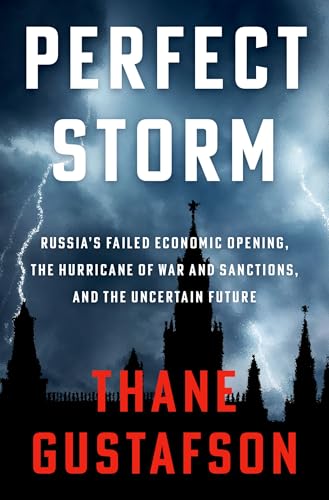
The story of Russia's historic opening to the West (1992-2022), where it succeeded and why it has failed, the impact of war and sanctions, and the prospects for Russia's future.
Russia's invasion of Ukraine in 2022 brought a tragic close to a thirty-year period of history that began with the collapse of the Soviet Union and the reopening of Russia to the West after six decades of Soviet isolation. The opening lasted for three tumultuous decades and ended with a new closing, driven by the Ukrainian war, the imposition of Western sanctions, and the Russian responses to them.
In Perfect Storm, Russia analyst Thane Gustafson reinterprets the story of Russia's failed opening to the West, focusing on its economic, technological, and social aspects, and the role they played in its ultimate failure. These parallel events are essential for understanding what happened and what went wrong. Yet they have received much less attention than the military and geopolitical aspects of the current conflict. Gustafson tells the story of the West's entry into Russia, the arrival of Russians into the West, and the conflicting emotions and responses these aroused on both sides, contributing to the ultimate breakdown of relations and the unprecedented hurricane of Western sanctions. The book concludes with an examination of possible futures under a new generation of leaders.
A measured and nuanced account of the evolution of Russia's economic relations with the world, Perfect Storm illuminates the longer history of Russia's opening to the West, from its achievements and disappointments to the complexity of the post-invasion sanctions regime and Russia's responses to them.
Thane Gustafson is Professor of Government at Georgetown University and Executive Director of IHS Markit. His books include Crisis amid Plenty: The Politics of Soviet Energy under Brezhnev and Gorbachev, Capitalism Russian-Style, and Wheel of Fortune: The Battle for Oil and Power in Russia.
(The English review is placed beneath the Russian one)
Я уже встречал подобные книги, только они были посвящены немного другой теме – российско-украинскому кризису. Впрочем, суть (или структура) подобных книг одна и та же – короткий и достаточно поверхностный обзор одной какой-то темы за последние 30 лет. В этой книге такой темой является развитие бизнеса (или экономики) в России через призму российской политики.
Всё начинается с 90-ых и того как российский бизнес формировался в те годы. Тут и привычные бандитские разборки за самые прибыльные куски собственности и появление иностранных компаний в России и первые российские предприниматели и появление олигархов и так далее. Лично я ничего нового и интересного для себя в этом разделе не нашёл. По мне, автор коротко пересказывает всё то, что писали авторы других книг об экономике ельцинского периода, только делает это в более сокращённом виде. Впрочем, про российский бандитский капитализм, его зарождение и развитие, как мне кажется, уже знают все.
Следующая часть книги посвящена расцвету российской экономики в начале 2000-ых, а так же политическому событию которое надолго определило будущее направление движения российской политики – дело ЮКОСа.
But Putin’s next move, when he seized Khodorkovsky’s company Yukos and folded it into Rosneft, showed Putin’s broader aim, to control the “commanding heights” of the economy, by placing them under state-owned entities. Several other privately owned oil companies, such as Bashneft, were also absorbed into Rosneft, even though their owners were loyal to Putin.
Опять же, ничего нового я тут не обнаружил, ибо вся информация уже давно циркулирует в различных информационных источниках (традиционные СМИ, Интернет), так же как об этом конкретном периоде российской истории было написано и издано множество книг. Возможно, кого-то заинтересует глава, в которой автор рассказывает о продвижении российского государственного бизнеса связанного с газом на рынок Германии и появление проекта «Северный поток», однако и тут информация выглядит как типичная новостная лента (или колонка в газете). Впрочем, пару раз тут проскальзывает интересная информация:
Gazprom under Chernomyrdin had reasons of its own to be dissatisfied with Ruhrgas. Under the traditional arrangement, it had no access to the German domestic market. In the Russians’ view, this meant they were sacrificing most of their gas’s value to the middleman, namely Ruhrgas. In 1990, Gazprom and BASF’s gas subsidiary, Wintershall, agreed to create a JV, to be called Wingas, to deliver and market gas inside Germany.
This was a potential game-changer, but there was only one problem. BASF did not own a pipeline, it had no gas customers, and there had never been gas-on-gas competition in the German industry. The two conspirators agreed to do something that had never been done before in Europe: to build an entire new pipeline from scratch. Since they had no customers, they built the new line on speculation, effectively on a wish and a prayer, while touring local gas distributors in Germany to sign them up as buyers. It took five years of fierce battles, but by the mid-1990s they had breached Ruhrgas’s monopoly, and Gazprom had won a place as a major player inside Germany.
Что касается главной темы книги – санкции, что были наложены на Россию после её вторжения в Украину в 2022 году, то тут просто пересказывается всё то, что произошло в России и в мире в контексте этих самых санкций, включая и то, как олигархи пытались их избежать и так далее. Как я понимаю, уже для многих стало очевидно, что хотя санкции и нанесли сильный удар по российской экономике, они не нанесли того удара, который мог бы подтолкнуть Путина к прекращению боевых действий и тем более это не привело к его свержению.
As a result, the sanctions’ record to date is not encouraging. They have not isolated Russia from the non-Western world; they have not crippled its economy; and above all, they have not impeded Russia’s will or ability to prosecute the war in Ukraine. Russia is simply too large, its economy is too highly developed in many of the key sectors, and it is too well connected to global trade flows. This is precisely what experienced practitioners might have predicted. Moreover, the sanctions are all too easy to beat. They create irresistible opportunities for arbitrage by intermediaries, who take advantage of the convoluted supply chains that lead from producers to Russian buyers, passing through networks of middlemen in countries that either reject the sanctions or apply them, as the Russian expression goes, “by looking through their fingers.” The result is higher costs and uncertainties for the Russians, but no significant loss of capacity, at least for current goods and technologies. The sanctions are high-cost instruments in other ways.
Заканчивается книга авторским прогнозом о том, как может выглядеть послевоенный мир между Россией и Украиной. Как мне показалось, тут автор предложил нечто свежее. Да, не только этот автор предполагает, что именно так может закончиться эта война (если не случится никаких сюрпризов), но всё же весь предыдущий текст походит на краткое изложение новостных ссылок на те или иные события что происходили в России или в Европе (но которые были связаны с Россией), а тут автор предложил собственный взгляд.
The first is that Russia publicly reaffirms the legitimacy of Ukraine as an independent state. It removes all of its armed forces from the eastern provinces of Ukraine, as well as outside Russian administrators. A permanent cease-fire goes into effect, guaranteed by an international peacekeeping force. Donetsk and Luhansk are governed as semi-autonomous provinces. Open access to the Black Sea for both Russian and Ukrainian exports is restored. Inasmuch as these steps amount to reversing Putin’s failed policies, they should not be beyond reach for his successors. However, the West must be prepared to make one fundamental concession in reply: Crimea remains part of Russia.
Second, Ukraine continues down the path to joining the EU. EU membership will not be achieved overnight, or even, realistically speaking, in less than a decade. But each step forward will consolidate Ukraine’s identity as a European power, and Russia must accept this. The likely quid pro quo, however, is that Russia will expect Ukraine to join the Russia-led Eurasian Economic Union (EAEU). But one result of the war is that its non-Russian members have grown more independent-minded and assertive than they were under Putin, when the EAEU was essentially a Russian club. A dual membership in both organizations might actually provide some advantages for Ukraine. <…> Given the new security map of Europe, Ukrainian membership in NATO is neither necessary nor beneficial. Moreover, even a post-Putin government can be expected to strenuously oppose NATO membership for Ukraine. Instead, Russia and the West might agree on a neutral status for Ukraine, similar to that of Finland and Sweden before the invasion. <…> The third issue is reparations and reconstruction. This will be particularly difficult, since no Russian government is likely to accept the obligation of rebuilding Ukraine, or the use of the RCB’s frozen funds for that purpose. Under a measure recently adopted by the EU, the profits from the RCB’s frozen funds will be used to provide weapons to Ukraine, together with smaller amounts for Ukrainian recovery. This in itself will be a lasting source of recriminations. An even tougher question will be the final disposition of the frozen principal. <…> There is no lack of documentary evidence of Russian guilt from the battlefield, but it only implicates lower-ranking personnel, despite the tacit complicity of their superiors. It is difficult to imagine that any Russian government will agree to accept guilt at any level. It is perhaps not impossible that some former members of Putin’s inner circle could be sent to the International Criminal Court in The Hague to face charges (leaving aside the awkward fact that the United States is not a member of this court). But it is more likely that war crimes will remain an unresolved bone of contention.
Насколько такой сценарий выгоден как для Украины, так и для Запада, сказать со 100% уверенностью трудно, т.к. пока даже ничто и не указывает на то, что мир скоро будет заключён, но как мне кажется, Россия не сможет или не захочет контролировать все те восточные территории Украины, которая она аннексировала за последние три года. Так что в целом, такой сценарий выглядит вполне реалистичным. Далее в книге автор делает предположения о том, как с России будут постепенно сниматься санкции, и как она будет возвращаться в те международные организации, из которых вышла или из которых её исключили.
I've seen similar books before, only they were on a slightly different topic - the Russian-Ukrainian crisis. However, the essence (or structure) of such books is the same - a short and (rather) superficial overview of one topic over the last 30 years. In this book, that topic is the development of business (or economy) in Russia through the prism of Russian politics.
It all begins with the 90s and how Russian business was shaped in those years. There are the typical gangster squabbles for the most profitable pieces of property, the emergence of foreign companies in Russia, the first Russian entrepreneurs, the emergence of oligarchs, and so on. I found nothing new and interesting for me in this section. In my opinion, the author briefly retells everything that was written by the authors of other books about the economy of the Yeltsin period, only Thane Gustafson does it in a more abbreviated form. However, it seems to me that everyone already knows about Russian bandit capitalism, its birth, and its development.
The next part of the book is devoted to the blossoming of the Russian economy in the early 2000s, as well as to a political event that permanently determined the future direction of Russian politics - the Yukos case.
But Putin’s next move, when he seized Khodorkovsky’s company Yukos and folded it into Rosneft, showed Putin’s broader aim, to control the “commanding heights” of the economy, by placing them under state-owned entities. Several other privately owned oil companies, such as Bashneft, were also absorbed into Rosneft, even though their owners were loyal to Putin.
Again, I found nothing new here because all the information has long been circulating in various information sources (traditional media, Internet), as well as many books have been written and published about this particular period of Russian history. Perhaps someone will be interested in the chapter in which the author talks about the promotion of Russian state business related to gas on the German market and the emergence of the Nord Stream project. Still, even here, the information looks like a typical news story (or newspaper column). However, a couple of times some interesting information slips through here:
Gazprom under Chernomyrdin had reasons of its own to be dissatisfied with Ruhrgas. Under the traditional arrangement, it had no access to the German domestic market. In the Russians’ view, this meant they were sacrificing most of their gas’s value to the middleman, namely Ruhrgas. In 1990, Gazprom and BASF’s gas subsidiary, Wintershall, agreed to create a JV, to be called Wingas, to deliver and market gas inside Germany.
This was a potential game-changer, but there was only one problem. BASF did not own a pipeline, it had no gas customers, and there had never been gas-on-gas competition in the German industry. The two conspirators agreed to do something that had never been done before in Europe: to build an entire new pipeline from scratch. Since they had no customers, they built the new line on speculation, effectively on a wish and a prayer, while touring local gas distributors in Germany to sign them up as buyers. It took five years of fierce battles, but by the mid-1990s they had breached Ruhrgas’s monopoly, and Gazprom had won a place as a major player inside Germany.
As for the main theme of the book - the sanctions that were imposed on Russia after it invaded Ukraine in 2022 - it simply recounts everything that happened in Russia and the world in the context of those very sanctions, including how the oligarchs tried to avoid them and so on. As I understand it, it has already become obvious to many that while the sanctions have hit the Russian economy hard, they have not struck the kind of blow that might have prompted Putin to stop fighting, much less led to his overthrow.
.As a result, the sanctions’ record to date is not encouraging. They have not isolated Russia from the non-Western world; they have not crippled its economy; and above all, they have not impeded Russia’s will or ability to prosecute the war in Ukraine. Russia is simply too large, its economy is too highly developed in many of the key sectors, and it is too well connected to global trade flows. This is precisely what experienced practitioners might have predicted. Moreover, the sanctions are all too easy to beat. They create irresistible opportunities for arbitrage by intermediaries, who take advantage of the convoluted supply chains that lead from producers to Russian buyers, passing through networks of middlemen in countries that either reject the sanctions or apply them, as the Russian expression goes, “by looking through their fingers.” The result is higher costs and uncertainties for the Russians, but no significant loss of capacity, at least for current goods and technologies. The sanctions are high-cost instruments in other ways.
The book ends with the author's forecast of what a post-war peace between Russia and Ukraine might look like. It seemed to me that the author offered something fresh. Yes, not only does this author suggest that this is how this war might end (if no surprise happens), but the previous text is like a summary of news references to certain events that took place in Russia or in Europe (but which were related to Russia), and here the author offered his own view.
The first is that Russia publicly reaffirms the legitimacy of Ukraine as an independent state. It removes all of its armed forces from the eastern provinces of Ukraine, as well as outside Russian administrators. A permanent cease-fire goes into effect, guaranteed by an international peacekeeping force. Donetsk and Luhansk are governed as semi-autonomous provinces. Open access to the Black Sea for both Russian and Ukrainian exports is restored. Inasmuch as these steps amount to reversing Putin’s failed policies, they should not be beyond reach for his successors. However, the West must be prepared to make one fundamental concession in reply: Crimea remains part of Russia.
Second, Ukraine continues down the path to joining the EU. EU membership will not be achieved overnight, or even, realistically speaking, in less than a decade. But each step forward will consolidate Ukraine’s identity as a European power, and Russia must accept this. The likely quid pro quo, however, is that Russia will expect Ukraine to join the Russia-led Eurasian Economic Union (EAEU). But one result of the war is that its non-Russian members have grown more independent-minded and assertive than they were under Putin, when the EAEU was essentially a Russian club. A dual membership in both organizations might actually provide some advantages for Ukraine. <…> Given the new security map of Europe, Ukrainian membership in NATO is neither necessary nor beneficial. Moreover, even a post-Putin government can be expected to strenuously oppose NATO membership for Ukraine. Instead, Russia and the West might agree on a neutral status for Ukraine, similar to that of Finland and Sweden before the invasion. <…> The third issue is reparations and reconstruction. This will be particularly difficult, since no Russian government is likely to accept the obligation of rebuilding Ukraine, or the use of the RCB’s frozen funds for that purpose. Under a measure recently adopted by the EU, the profits from the RCB’s frozen funds will be used to provide weapons to Ukraine, together with smaller amounts for Ukrainian recovery. This in itself will be a lasting source of recriminations. An even tougher question will be the final disposition of the frozen principal. <…> There is no lack of documentary evidence of Russian guilt from the battlefield, but it only implicates lower-ranking personnel, despite the tacit complicity of their superiors. It is difficult to imagine that any Russian government will agree to accept guilt at any level. It is perhaps not impossible that some former members of Putin’s inner circle could be sent to the International Criminal Court in The Hague to face charges (leaving aside the awkward fact that the United States is not a member of this court). But it is more likely that war crimes will remain an unresolved bone of contention.
It is difficult to say with 100% certainty how beneficial this scenario is for both Ukraine and the West, as nothing even indicates that peace is imminent, but it seems to me that Russia will not be able or willing to control all those eastern territories of Ukraine that it has annexed over the past three years. So, on the whole, this scenario looks quite realistic. Further in the book, the author speculates on how the sanctions will be gradually lifted from Russia and how it will return to those international organizations from which it has withdrawn or been excluded.