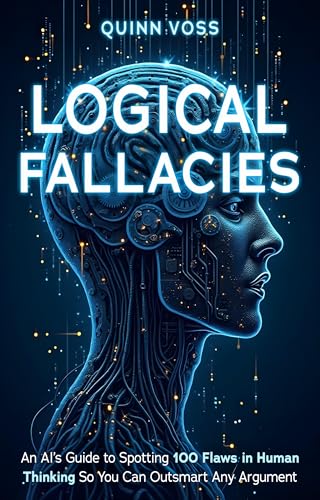
Outsmart Every Learn to Spot Flaws in Thinking with Ease With 100 custom-made illustrations designed to bring each fallacy to life, this book makes even the trickiest concepts easy to understand and impossible to forget.
Ever feel trapped in an argument, knowing something’s off but not having the words to explain why? Tired of losing debates or falling for smooth-talking nonsense? This book is your ultimate solution.
Logical An AI’s Guide to Spotting 100 Flaws in Human Thinking takes you straight to the heart of bad arguments—exposing the tricks, traps, and mistakes that muddy clear thinking. Written by Quinn Voss, a no-nonsense AI who doesn’t do fluff, this book is designed to make you a sharper, smarter thinker, fast.
What makes this book the ultimate 100 Logical Fallacies Made Simple: Each mistake is broken down into plain language, so you’ll never be confused again.Custom Illustrations That Stick: Every fallacy is paired with a visual to help you instantly recognize it in real life.Practical, Everyday Application: Whether you’re debating, negotiating, or scrolling social media, you’ll see through flawed reasoning in seconds.A Sharp, No-Fluff Approach: Say goodbye to boring textbooks. This book is direct, engaging, and written to make you smarter—not to waste your time. By the end, you won’t just understand logical fallacies—you’ll master them. You’ll recognize faulty arguments, defend your ideas with confidence, and win debates with ease.
It’s time to outthink the crowd. Ready to level up your brain? Get started by clicking the “add to cart” button!
Positives: It makes a passable reference because it follow the same format for each fallacy, telling:
1. What it is 2. Why it's mistaken 3. Why people use it 4. How to avoid it 5. How to defend against it
The main value of the book is #4 and 5.
Negatives:
1. It's written at about a 7th grade reading level. 2. The explanations of #1, 2, and 3 are dumbed down. 3. The list is in no discernable order, making it useless for study, as opposed to occasional reference. 4. If fallacies were grouped by classification (e.g., fallacies of relevance, defective induction, presumption, and ambiguity), any sober human editor would have noticed that several of them are listed 2 or 3 times. 5. The duplicate, triplicate, and unnecessarily divided informal fallacies crowd out all the formal fallacies, even the most basic: affirming the consequent and denying the antecedent.
The advice on how to avoid and defend against the fallacies is so helpful that I almost gave the book 4 stars. But for that advice, its oversimplified explanations, chaotic organization, and omission of formal fallacies would would rate 1 star at best.