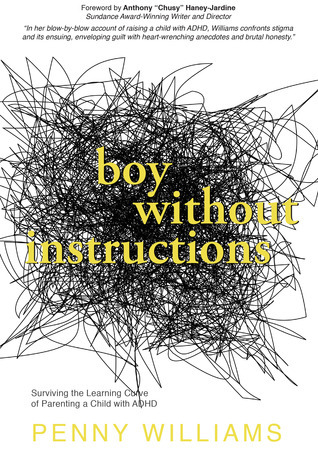
Bookstores are filled with titles on ADHD from professionals and experts, but books from a momma’s perspective are few and far between. Yet, hearing other parents’ experiences raising a child with similar challenges is often therapeutic, reassuring, and even liberating. When her son was diagnosed with ADHD at the age of six, Williams found that some of the most helpful information came not from books on ADHD, the disorder, but actually from parents with similar experiences. And so this book was crafted to offer these special parents more of what they need — validation and understanding from someone who has been where they are.
Williams shares her unfiltered emotions during the progression of learning to parent a child with ADHD in the roller coaster ride that is Boy Without Instructions. This unapologetic, initially grief-stricken momma transforms from obsessed-with-ADHD control-freak and helicopter mom to optimistic and (mostly) confident parent of a child who happens to have ADHD. This candid compilation of been-there-done-that wisdom will validate your feelings and prove that you, Warrior Parent, are not alone.
2015 International Book Awards Winner: Psychology & Mental Health 2014 USA Best Book Awards: Parenting & Family, Finalist Award
A self-proclaimed "veteran" parent of a son with ADHD, Penny Williams is the creator of the award-winning website, {a mom's view of ADHD}, and a frequent contributor on parenting a child with ADHD for ADDitude Magazine, Healthline, and other parenting and special needs publications.
"I endured a long learning curve when my son was diagnosed with ADHD," says Williams. "I share my experiences parenting my son, Ricochet, in the hopes of shortening that painful time of trial by fire for others." Williams says she gains strength in parenting Ricochet through a quote from Albert Einstein, "Everybody is a genius. But if you judge a fish by its ability to climb a tree, it will live its whole life believing that it is stupid."
Williams' first book, Boy Without Instructions: Surviving the Learning Curve of Parenting a Child with ADHD, is an Amazon best-seller and a USA Best Book Awards winner. (#BoyWithoutInstructions). Her second book, What to Expect When You're Not Expecting ADHD (#WhatToExpectADHD), won the Psychology & Mental Health category of the 2015 International Book Awards.
There are lots of books about ADHD by people with letters behind their names. They can tell you a lot about clinical trials and symptoms and methods. Sometimes they also tell you about all the negative things that you really didn't want to know.
This is an entirely different book. This is from a mom's point of view about what it's like to mother and parent a child with ADHD. If you are just starting down this path, it might be a good heads up about what to prepare for and watch out for. If you have been dealing with ADHD for a while you are knod your head in agreement and understanding as you read about Penny's experience.
In telling her tale, Penny provides comfort in sharing that none of us really knows what we are doing in facing ADHD. There are no 100% right answers for all kids. And it doesn't just affect the child; it affects the whole family. It's a process with a steep learning curve and some bumps along the way. But armed with a lot of love, you make the best decisions you can and reevaluate along the way.
The only criticism I have about Boy Without Instructions is that names have been edited to protect the innocent (and occasionally the guilty). I don't mind that in theory, but every time she calls her husband Mr. T, I get the image of a guy with a Mohawk and heavy gold chains! But she is right to protect their privacy in telling the story that is as much theirs as hers.
Reading Boy Without Instructions is like sitting down to coffee with a friend after you just found out her family has lived through what you are now experiencing. Sit back and listen, and know that you will find your way through. ADHD comes with a lot of challenges, but many gifts, too.
Sooo...1st off...this book made me cry. A lot. Very A lot.
This is not a "how to" book on parenting a child with ADHD; if that's what you're looking for, circle back to this after you've figured some things out.
This book...is the author sharing her story, her journey, her challenges...and is relatable. Heartbreakingly relatable. She shares thoughts I've thought, feelings I've had, scenarios I can relate to and I'm happy she has.
This book served as a much needed reminder that I'm not alone. That others are trying to figure some similar things out, that the challenges they face are just a new version of normal.
I recommend but, be prepared to have heart strings pulled.
This was a fantastic book that showed the ups and downs that come with parenting a child with ADHD. It was funny and heartbreaking all at the same time. It showed me that there are other people and parents struggling with similar issues that I am now struggling with.
There is much to agree with in this book, and much to disagree with. Ultimately, I would say this is a story of a mother learning that her son has ADHD, and learning that she cannot “fix him”. But instead she learns that ADHD isn’t something to be fixed. I disagree with her ideas about education. She often blames the school and states that there are skills that can’t be taught. They try a private charter school, and learn that isn’t the fix they were hoping it would be. As an educator those things were hard to read and sympathize with. However, as a mom, I really did resonate with her struggle to accept ADHD, search for treatments that work, and accepting her child just the way he is.
I related to this book on so many levels. It was honest, gut-wrenching, and left me feeling hopeful as I think about my own child’s journey into the school years.
While I didn’t always agree with how the author navigated her child’s use of medication, screens, and diet, I deeply connected with her lowest moments. The constant worry that your child won’t be accepted by their peers. The relentless self-blame, convincing yourself that it’s somehow all your fault.
I also appreciated how the author reflected on her relationships with each of her children. She described having a trauma bond with her son, while believing her daughter didn’t need her as much because she seemed to have it all together. As a mother of a daughter myself, that was a powerful reminder that even the children who appear strong and independent are still children, and they need us just as much.
This was an emotional read, but a comforting one. It felt good to relate to someone who has walked a similar path and put those feelings into words.
This review is critical both because the author literally asked for it at the end of her book and because books covering such intimate topics as developmental disorders in our children should be closely scrutinized. So, I will start and end on a positive note.
The courage required to voluntarily bare all for the world to judge our personal life is almost superhuman. While memoirs are a specific genre of literature they are generally withheld till the end of one’s life for a reason. William’s blow-by-blow account of daily activities is so honest that if you are like me you may find yourself audibly gasping, or averting your eyes at the thought that a person would actually write about events which most of us rush to get through when they occur in daily life and then spend as little time as possible reflecting on later. However, ‘raw’ is not a term I would use to describe it. As I reached the final third of the book I began to realize that most of the verbal interactions with her son, affectionately given the name Ricochet since it described his energy level so well, were too polished, almost scripted. The book began to take on a sense of no longer two humans bumping through the world lovingly holding hands trying to find their way and turned into a realization that William’s actions & words, while human, were always perfectly suited given the circumstances. I was disappointed to see it take this turn because of the value she obviously assigned to the accuracy of happenings. Her Christmas nearly being ruined is a perfect example of willingness to share her life with the reader even when it doesn’t reflect favorably on her. I couldn’t understand why I was now getting the impression that her parenting skills suddenly reached final form and were above reproach. The last third of the book also took on a less structured nature which didn’t fit well. At times it felt like a blog with informalities such as apologizing to her husband, or shortcutting the writing process with profanity instead of searching for a better suited literary device. Sorry, but this is a published book, not 0’s and 1’s stored and easily erased in digital format for consumption by those looking for a distraction. Books are mulled over, highlighted, dog-eared, analyzed, cited, annotated, inscribed - they intrinsically hold more value and shouldn’t be rushed. If I had gotten the sense that these situations and a few others were intentional instead of convenient I probably wouldn’t mind.
This book took a turn for me when William's discussed a hypothetical holiday letter that she imagined writing to her family which consisted of many tribulations throughout the year. I had a visceral reaction to her writing that her son quit baseball because he wasn't getting enough playing time. I was livid. She planted the seed in her son's mind - he had no issue riding the pine and being a member of the team. William's herself had an issue with sitting in the rain at night to watch him (not) play and suggested that he quit. The selection of words is so important. Teaching a child to 'quit' is wrong on so many levels with regards to sports. Teaching a child to 'move on' to a more enjoyable preferred activity at the end of the season is quite different. This led me to see the entire book from a different perspective - newly framed to include a child not benefitting from the life skills learned through persisting in activities but being driven by conveniences of the adults in his life.
Next major objection is the brevity of time with which Williams considered medication as appropriate for her child. She concedes that she thought nothing was wrong with Ricochet until he entered Kindergarten (by the way, pre-school is fairly common, why no mention of it?) and even then only in the classroom after he began to get complaints from his teacher. His behavior at home was typical of any rambunctious boy, it is a little weird for an educated individual not to question best health practices. Looking back, I would have expected her - maybe not someone else - but her, to share more about her research into treating ADHD and discuss what she thought of them. Apparently she is well-read on the subject. Even something as general as “given acceptable medication options historically provided for ‘fixing’ homosexuality less than 50 years ago by the same clinical psychology DSM manual that provided an ADHD diagnosis for my son I critically evaluated whether this was right for Ricochet”. However, she just accepted medication as the logical next step without discussing with the reader why which seems like it was worth including. It led me later in the book to thinking about the physiological toll these were taking on poor Ricochet as he tried to cope with regulating his emotions and maintaining focus while the chemical reactions occurring in his body were inconsistent and out of his control. I couldn’t help but think a skills based approach would have been more beneficial. Which leads me to the positive ending: William’s discussion of services such as IEP, 504, Occupational Therapy, psychiatry, and others are experientially discussed and are a real strength to the book. She advocates for a broad range of support services and lets the reader know what is available. The book is easy to read and organized chronologically which is also nice.
I would recommend this to any parent as summer reading material as I think it is a useful discussion to have - however, I might not recommend it for a specific parent of a child with ADHD because every diagnosis is different and Ricochet’s case could raise your hopes or lead to foreboding anticipation.
This book!!! This is exactly what I needed. My 8 year old daughter was diagnosed with ADHD combined type in November 2019. In a way, I saw it coming. I’m a special Ed teacher, so I’m familiar with ADHD. It still knocked me off kilter though. Teaching ADHD and parenting ADHD are totally different!!! This book provided so much hope. I know there will be ups and downs as I learn more about how to help my daughter manage the symptoms of her ADHD, but I know we will figure it out... to some extent. Thank you for sharing your personal experiences through this book. It was truly inspiring!!
This book is truly an accurate account of what it is like to raise an ADHD child in a world that doesn’t understand them. The public stares, the battles with educators, the meltdowns…it’s all there. This book was a great reminder that, as a parent of an ADHD boy, I am not alone.
Wow. If you are looking for a frankly honest account of one momma's struggle of raising a child with AD/HD, this is the book for you. In fact, I highly recommed it for just about anyone who deals with AD/HD from pediatricians to therapists--you'll get a first-hand account of what us parents--mothers especially--go through on a day to day basis. Night, too. Because you know, there are times we just can't sleep for thinking about our precious punkins with a special need. And yes, AD/HD definitely qualifies.
BOY WITHPOUT INSTRUCTIONS is well-written, in fact at times I wasn't sure if I was reading a novel, memoir, self-help, or parenting book--it certainly encompasses all genres--and for that, it's compulsively readable.
You'll hear all about Penny's struggles with getting a diagnosis, navigating an IEP, school woes, living on a moutain surrounded by bears (no kidding), boiling snow for water when power is lost, and struggles with helicopter parenting. This is momma uncensored. You'll laugh, you're not in recognition, you might even shed a tear or two.
Stay tuned to www.speakingofapraxia for an author interview of Penny in early October.
I have a child who has been struggling in school and was diagnosed with ADHD/ADD. I'm currently reading several clinical books on ADHD/ADD and how it affects the brain, as well as absorbing as many parenting strategies as I can via podcasts, YouTube (Russell Barkley), and websites (CHADD). While I certainly didn't agree with everything this book had to offer (Penny Williams and I are different sorts of parents), it felt good to recognize some parallels and find some camaraderie. I'm coming to terms with this new definition of myself as a parent of a little human with ADHD--so while I found myself mentally arguing with Penny Williams a fair amount throughout this book, I appreciated the perspective and the human approach nonetheless. It was an easy read (Williams is clearly a blogger--this book reads like a collection of blog entries which jump from topic to topic without the "flow" of a "regular" book), and a nice addition to the heavier and more intense books I am reading about ADHD.
Another must-read for any person who knows someone with ADHD, personally and/or professionally. A first person account, it is easy to read and gives excellent insight into the parental and family struggle.
I honestly couldn't get through this book. I so wanted to, as an Autistic and ADHD mom to an almost certainly ADHD child. I got about 3 pages into chapter 4 and just couldn't do it anymore. Listen, I understand that ADHD can be burdensome on a parent who hasn't had any experience raising a child with it. But her constant use of "Grieving" and "Sad" and other disparaging language made me somewhat angry. Her immediate jump to medicating him without trying ANYTHING else first irked me. It reminded me of one of my teachers who told every kid's parents that we all just needed to be medicated because we all had ADHD and she just couldn't deal with us.... we were in 2nd grade. Her getting higher and higher doses of different medications (that they didnt even 100% know were able to properly treat ADHD) made me feel like she was using her child as a guinea pig. To me, it didn't seem to be "curing" the symptoms of his ADHD, but making him lethargic (but I dont medicate my ADHD so I honestly dont have the right speak on it I suppose). Im aware that neurodivergent child will ALWAYS get more attention than a neurotypical child, but it felt like she was almost brushing her oldest to the side sometimes. Her use of "differently abled" is kinda annoying too. I guess i can understand it, because yes, ADHD people do have to do things differently, but like, the story about her son being unable to clean his room because it was too much? ADHD can literally make our brains so overwhelming that we CAN NOT properly process the outside world. It's disabling, which is why it's called a disability.
Another thing I noticed (and it could be mentioned further on in the book, I don't know) is that it seems as if ADHD isnt his only struggle. I'm not sure if he's also Autistic, or if he has other struggles, but him just being diagnosed with ADHD didn't make much sense to me. I'm not a medical professional, not am I trying to diagnose him with something, but that was just my thoughts on that.
I just finished reading this book and the emotions are real. I literally cried throughout this book as it related so closely to my life parenting a little 8 year old boy with ADHD. I too am that helicopter mom, I have gone as far as pulling him out of public school and homeschooling at home (which did not work out for us in the end). Parenting a child with ADHD definitely comes with never ending trials and tribulations along with feelings of loneliness as no one else seems to understand what we as parents are going through. I also wanted to "fix" all of my child's struggles and the mommy guilt of wondering what we did or went wrong is real. The truth is we may never know, but looking "beyond the windshield" and being accepting that some things are way beyond our control ultimately gave me peace. I no longer feel embarrassed about the unique or silly things he does in public, i.e, humming out loud while walking through the grocery store, saying random things to strangers.. etc, I LOVE my little boy too much to even care. I agree that as parents of a child with special needs it is very important to take things one day at a time and not look to far out in the future, because today we are doing our very best. After reading your book I also have more compassion for not just my child in understanding that he is not alone, as there are other children that are also facing his challenges, but also to myself. The guilt, the criticism of myself and that little voice in my head that I should be trying harder. We already have a lot on our plates and the going is simply rough. I have also found that sometimes we helicopter moms need to ease off because we wont always be there for them when its time for our neuro-divergent kid to fly solo. Thank you for sharing your story.
Absolutely loved this story! Thank you, Penny Williams, for sharing your life with us. Sharing your struggles and feelings of failure as well as your successes, has inspired me to continue. As a parent with ADHD of a child with ADHD some days can feel very defeating and lonely. Thank you for giving me the courage to continue to fighting for my child and their rights to the best future that they can. I am inspired to pick up the baton as well, and continue to fight for the rights of every child that struggles with a non-visible disability to be heard to be seen, to be heard, to be treated as a child. Children need to be advocated for despite being in a system that is extremely flawed. Telling a parent that you are only going to give their child the barest minimum help needed when you know that if they got more help, they would do so much better seems very wrong to me. Why is it that you have to fight so hard for your child to have as much of a leg up to a better life as possible? It shouldn’t be so hard.
Like the author, I've read a number of books about ADHD, but none from the point of view of a parent's experience. I felt a strong sense of solidarity as I read this book. At times I thought, "Is she in our house?" because the experiences were so similar.
That said, the book could have used an editor. There's a good bit of repetition. I realize that reflects the repetitive experiences of trying different medications and the general ups and downs of the condition, but sometimes it got in the way of what I took to be the overall message of the book: that parents of kids with ADHD can and do mature in their understanding, even as the kids are learning how to cope.
I noticed that the author never refers to any medication by name. There are probably legal reasons for that choice. And yet, at times I was very keen to know what they were.
My only complaint is her initial reaction to learning of her son’s ADHD diagnosis. It’s not a death sentence. Maybe it’s different when one of the parent had ADHD and expects that their future children may have it too - which is the case for us. My husband is ADHD. I’m not. But our son is. We weren’t surprised at all, but it still makes parenting difficult. Thankfully things have changed a lot since this book was written with the medical and school system, but not enough. This book only affirmed my commitment to continually advocating for my son, and to be the first to set expectations in the classroom before the teachers start with their complaining.
I really enjoyed listening to this and felt a connection with the mama in this book. I could relate to almost every single impulsive action her son exhibited and I felt less alone reading this. Parents with NT kids just cannot relate to the struggles parents face with ND kids. My mind is in a constant state of thought wondering how to help my kids and I too spend countless hours researching meds, parenting techniques, doctors, medical studies, and whatever else I can find that may “help”. It was nice, if just for a day, to feel a connection to someone who might possibly understand what parenting is like for me.
I had a hard time with the book because I felt it was all about medication for 2/3 of the book rather than looking at the root cause of ADHD. I understand that’s the writer story and path. But if you don’t plan to medicate your child, I personally would have never picked up the book. I felt that the child was babied, yes he has limitations but you also as a parent have to work with the limitations and not expect everyone to adjust to your child. I personally think that there was much more than ADHD and I wonder how much the medications affected that. As a parent no one likes to see their child struggle but it is a critical part of life and learning too.
I really, really enjoyed this book. Penny Williams chronicles her life with a child with ADHD but I truly felt like she could have been writing my story. As a mother of a child diagnosed with ADHD just two short years ago, I could totally relate to Penny’s stories. Lately, more than anything, I just want to talk to people who are going through the same things because it helps to not feel so alone. This book definitely made me feel not alone. I would highly recommend it to ANYONE who knows someone with ADHD.
Hmm I have mixed feelings about this book. I despise the term special needs for a start. But it was a good insight into the life of another family with a child with adhd and I recognised some of their challenges and got some ideas of strategies to support my kiddo. Many of the hurdles faced by the writer’s family arose due to her son’s other diagnoses aside from ADHD so that obviously added a level of complexity. my advice would be to read this book knowing that not everything in it will be for you but you might be able to take some useful bits from it.
Being a school counselor, i didn't really need to understand all the school jargon since i already have that in my wheelhouse, but it was eye opening to see someone from the outside trying to understand our school world. As a parent with a child who has ADHD, i don't think i really gained a ton from reading her experience, but as a member of a school community, i think i now have even more compassion for parents who have littles like Ricochet. also teachers like ms. Gulch should be sued and fired.
This book is amazing because it tells me I am not alone. My struggles with my ADHD child are almost exactly the same. What she learned and how she coped made me cry at times. Anyone dealing with the struggles and isolation of parenting a child like this needs to read this book. Our children are amazing but parenting them is not for the weak.
This book was engaging and within its pages I found another mom of an ADHD kiddo just trying to figure out life with her son. I found the end to be rather disappointing. I had hoped that somewhere along the way she might try homeschooling or that she might see his ADHD as a gift. I guess it was nice knowing that I’m not alone in my anxieties and seeing how other parents deal with ADHD. I had hoped to find some ideas or strategies, but it turned out more like a memoir.
This entire review has been hidden because of spoilers.
An accurate portrayal of life with a child with ADHD
Great read. Not really a "self help" book, more like a collection of stories of what it's like to live day in and day out with a child with ADHD. The stories seemed so familiar, b/c they parallel my life. It made me feel not so alone.
Bless Mrs. Williams for tirelessly advocating for her son and trying to understand ADHD and learning disabilities. I sincerely hope her son was able to blossom in the midst of some trying circumstances. I have a child with ADHD and could identify with some of the experiences the author wrote about. Thank you for sharing your story.
I truly appreciated Penny’s candidness throughout this part of her family’s journey. I enjoyed how she did not insert her hindsight into every example along the way, but rather told the story as she felt and perceived it in real time. It was validating and encouraging to parents of children who are not neurotypical/“mainstream” in some way or another.
I was hoping this could be helpful, as a parent to an ADHD child (still seeking diagnosis). However, I found it discouraging. Most of us don’t have the ability, time, or flexibility to do as much as this mother did for her childx It’s the story of this mother’s experience though, and I can appreciate that.
Reading much of this was like looking directly into my own life, seeing my own child, seeing my own feelings, even some exact words about my own thoughts. It was reassuring to see that someone else gets it and I am not alone, my child is not alone. I am sure my own daughter would say she relates to Warrior Girl.