

What do you think?

The Underwater Welder
WARNING: CONTENTS UNDER PRESSURE.
As an underwater welder on an oilrig off the coast of Nova Scotia, Jack Joseph is used to the immense pressures of deep-sea work. Nothing, however, could prepare him for the pressures of impending fatherhood. As Jack dives deeper and deeper, he seems to pull further and further away from his young wife and their unborn son. Then one night, deep in the icy solitude of the ocean floor, something unexplainable happens. Jack has a mysterious and supernatural encounter that will change the course of his life forever.
Equal parts blue-collar character study and mind-bending mystery, The Underwater Welder is a graphic novel about fathers and sons, birth and death, memory and reality, and the treasures we all bury deep below the surface.
As an underwater welder on an oilrig off the coast of Nova Scotia, Jack Joseph is used to the immense pressures of deep-sea work. Nothing, however, could prepare him for the pressures of impending fatherhood. As Jack dives deeper and deeper, he seems to pull further and further away from his young wife and their unborn son. Then one night, deep in the icy solitude of the ocean floor, something unexplainable happens. Jack has a mysterious and supernatural encounter that will change the course of his life forever.
Equal parts blue-collar character study and mind-bending mystery, The Underwater Welder is a graphic novel about fathers and sons, birth and death, memory and reality, and the treasures we all bury deep below the surface.
228 pages, ebook
First published July 11, 2012
About the author
Jeff Lemire
1,497 books3,968 followersLibrarian note:
There is more than one author in the GoodReads database with this name
Jeff Lemire is a New York Times bestselling and award winning author, and creator of the acclaimed graphic novels Sweet Tooth, Essex County, The Underwater Welder, Trillium, Plutona, Black Hammer, Descender, Royal City, and Gideon Falls. His upcoming projects include a host of series and original graphic novels, including the fantasy series Ascender with Dustin Nguyen.
There is more than one author in the GoodReads database with this name
Jeff Lemire is a New York Times bestselling and award winning author, and creator of the acclaimed graphic novels Sweet Tooth, Essex County, The Underwater Welder, Trillium, Plutona, Black Hammer, Descender, Royal City, and Gideon Falls. His upcoming projects include a host of series and original graphic novels, including the fantasy series Ascender with Dustin Nguyen.
Ratings & Reviews
Friends & Following
Create a free account to discover what your friends think of this book!
Community Reviews
Displaying 1 - 30 of 1,243 reviews

November 20, 2017
This is what a graphic novel should be. A brilliant story, fleshed-out characters, deep emotions and great art that captures the mood of the story and the character's feelings.
While diving, Jack, an underwater welder on a deep sea oil rig, sees and hears strange things.
These strange occurrences seem to be related with his fear of becoming a father in a few weeks, and with his own childhood.
Jack becomes obsessed with this strange experiences and with his repressed memories of his own father.
What kind of relationship did they have? What happened? Is Jack becoming like his father? Can we learn from our parents' mistakes?
The story unfolds through dreamlike flashbacks and the atmosphere of the deep sea and the remote harbor city capture Jack's inner struggle perfectly.
A poignant graphic novel with real heart and great storytelling. The raw, yet beautifully atmospheric black, grey and white illustrations are mesmerizing.

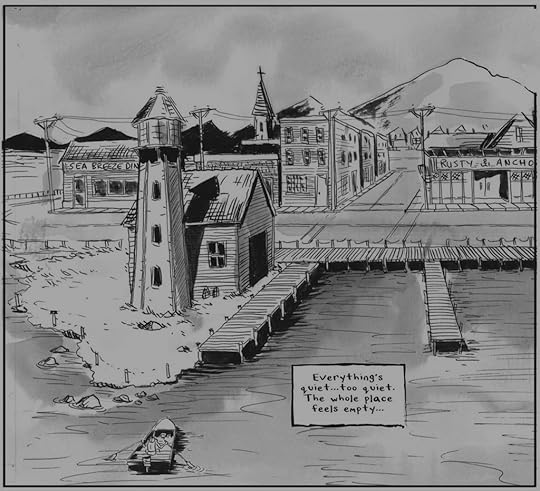
While diving, Jack, an underwater welder on a deep sea oil rig, sees and hears strange things.
These strange occurrences seem to be related with his fear of becoming a father in a few weeks, and with his own childhood.
Jack becomes obsessed with this strange experiences and with his repressed memories of his own father.
What kind of relationship did they have? What happened? Is Jack becoming like his father? Can we learn from our parents' mistakes?
The story unfolds through dreamlike flashbacks and the atmosphere of the deep sea and the remote harbor city capture Jack's inner struggle perfectly.
A poignant graphic novel with real heart and great storytelling. The raw, yet beautifully atmospheric black, grey and white illustrations are mesmerizing.


October 16, 2012
I am not sure why others are not liking this book more. I think it is amazing, with terrific drawing and storytelling and depth. Have been reading Sweet Tooth, another father-son story from Lemire that is in a more dystopian setting. I really liked The Nobody. I liked Essex County, too, maybe his best work that I have read from him. But this is also great, pretty consistent tone with Essex, an indication of his potential extending even more, maybe.
Why do I like this so much? Is it because I am a father of sons? It is haunting, but not exactly Twilight Zone scary, in my opinion (contrary to the intro). It is more about a father, abandoned by his own father, coming to terms with his long unresolved father issues as he prepares to be a father himself. That makes sense to me, and works in sync with my own experience. You sometimes get dragged into lots of issues as you prepare to parent, duh!
Jack, the main character and an underwater welder, likes to dive deep and make connections, weld them together, make sense of them, but this particular episode of his life is traumatic for him, needs to be faced for him to go on. Always for Lemire it is the human, it is empathy, we care deeply about the characters, Jack, his wife, his Dad, his wife, and all their deep sadnesses, all good people, all a little lost, and trying to get found and to find each other. No one seems to completely give up. Beautiful book. The "dream" or fantasy sequences are particularly compelling, deftly done.
Why do I like this so much? Is it because I am a father of sons? It is haunting, but not exactly Twilight Zone scary, in my opinion (contrary to the intro). It is more about a father, abandoned by his own father, coming to terms with his long unresolved father issues as he prepares to be a father himself. That makes sense to me, and works in sync with my own experience. You sometimes get dragged into lots of issues as you prepare to parent, duh!
Jack, the main character and an underwater welder, likes to dive deep and make connections, weld them together, make sense of them, but this particular episode of his life is traumatic for him, needs to be faced for him to go on. Always for Lemire it is the human, it is empathy, we care deeply about the characters, Jack, his wife, his Dad, his wife, and all their deep sadnesses, all good people, all a little lost, and trying to get found and to find each other. No one seems to completely give up. Beautiful book. The "dream" or fantasy sequences are particularly compelling, deftly done.

March 22, 2017

Jeff Lemire is awesome. This is bittersweet, ethereal, but still somehow ending on a high note. I always open an indie Lemire book and think, great, black and white. Because I'm really into a good colorist. Then a few pages in I think, I'm an ass, this is awesome, and it clearly creates an appropriate tone of minimalism which complements the writing. Just great stuff.

January 10, 2016
Jeff Lemire’s 2012 graphic novel The Underwater Welder is a somber, black and white study of loneliness, psychological fear and abandonment issues.
On the surface, Nova Scotian oilrig welder Jack Joseph is a hard working blue-collar guy whose wife is expecting their first child. Under the surface, Jack is a mess of emotions as he reconciles his own expectations of fatherhood with his own complicated and troubled childhood, torn between divorced parents.
Lemire uses Jack’s job to serve as a metaphor for the pressures and isolation he feels when confronted with deep seated issues that have yet to be resolved as he prepares to become a father himself.
The novel’s haunting artwork works well with the thoughtful, introspective subject matter. Lemire explores themes of family, loyalty, and duty with a character who is as elusive as the doubts that paralyze him and risk his relationships. Ultimately Lemire provides a meditative and pensive examination of heartfelt emotions.
On the surface, Nova Scotian oilrig welder Jack Joseph is a hard working blue-collar guy whose wife is expecting their first child. Under the surface, Jack is a mess of emotions as he reconciles his own expectations of fatherhood with his own complicated and troubled childhood, torn between divorced parents.
Lemire uses Jack’s job to serve as a metaphor for the pressures and isolation he feels when confronted with deep seated issues that have yet to be resolved as he prepares to become a father himself.
The novel’s haunting artwork works well with the thoughtful, introspective subject matter. Lemire explores themes of family, loyalty, and duty with a character who is as elusive as the doubts that paralyze him and risk his relationships. Ultimately Lemire provides a meditative and pensive examination of heartfelt emotions.

July 27, 2012
Jack Joseph has a wife with a baby on the way and a job welding pipes underwater for an oil rig off the coast of Nova Scotia in the small town he grew up in. Things should be great - good job, happy family - but Jack's haunted by the disappearance of his father 20 years ago who went diving one night during Hallowe'en and never returned. His dreams have seeped over from the night into the daytime and under the sea, welding pipes, he begins to see and hear things from those dreams. And lately his dreams have seemed so real.
Jeff Lemire's impressive comics career has really taken off in the last couple years with his brilliant creator-owned "Sweet Tooth" series for Vertigo, his one-off book "The Nobody", and signing on to DC's New 52 reboot series "Animal Man" and "Frankenstein, Agent of SHADE", and he continues this successful streak with the excellent story of "The Underwater Welder". It reads a lot like a Twilight Zone episode with supernatural elements creeping into the story early on before totally submerging it (pun intended) and taking the reader with it.
Lemire's line-work in his art is perfectly suited to the ghostly story presented here with many disturbing elements such as Joseph's father's alcoholic face staring out of an obituary page to the reader or the surreal experiences Joseph experiences under the waves. The parallels between Joseph and his father's life is also haunting as Lemire merges the two into an intertwining and complex storyline that adds to the feeling of unease this reader felt as the story unfolded.
I'm a sucker for ghost stories especially when they're told in a compelling and mysterious way like this and I've been a huge fan of Lemire's since the "Essex County Trilogy" so I'm predisposed to enjoy this book, but it has all the elements of a successful comic book: great twisty story, likeable main character, great art with imaginative layouts, and clever plotting. "The Underwater Welder" is a superb book from one of the most gifted comics artist/writers living today and is a fantastic read.
Jeff Lemire's impressive comics career has really taken off in the last couple years with his brilliant creator-owned "Sweet Tooth" series for Vertigo, his one-off book "The Nobody", and signing on to DC's New 52 reboot series "Animal Man" and "Frankenstein, Agent of SHADE", and he continues this successful streak with the excellent story of "The Underwater Welder". It reads a lot like a Twilight Zone episode with supernatural elements creeping into the story early on before totally submerging it (pun intended) and taking the reader with it.
Lemire's line-work in his art is perfectly suited to the ghostly story presented here with many disturbing elements such as Joseph's father's alcoholic face staring out of an obituary page to the reader or the surreal experiences Joseph experiences under the waves. The parallels between Joseph and his father's life is also haunting as Lemire merges the two into an intertwining and complex storyline that adds to the feeling of unease this reader felt as the story unfolded.
I'm a sucker for ghost stories especially when they're told in a compelling and mysterious way like this and I've been a huge fan of Lemire's since the "Essex County Trilogy" so I'm predisposed to enjoy this book, but it has all the elements of a successful comic book: great twisty story, likeable main character, great art with imaginative layouts, and clever plotting. "The Underwater Welder" is a superb book from one of the most gifted comics artist/writers living today and is a fantastic read.

September 9, 2016
One of the best GN I have read all year. Jack Joseph is an underwater welder who lost his treasure hunting father in a diving accident when he was a little boy. Jack starts to 'see' things about his past down below even as he prepares to become a father himself. This book will leave you with many thoughts on family and how important it is to connect.

January 13, 2019
I thought this was good. What does it take for a man to realize his wife and soon to be baby are worth his time and he can't keep running away from them. It appears he has to go through something a little similar to what his dad went through before he disappeared.
The black and white story tells a heavy story about trying to get your life in order. The man is stuck in the past waiting for his dad and he's missing his present. I thought this was a good and interesting story. I did think there would be more about welding in the story than there was and I thought I would learn something, but they do have the basics in there and they make the job sound straight forward. It's a lonely job.
This was a different kind of story - very interesting and unusual. I did appreciate sea life and living off the sea.
The black and white story tells a heavy story about trying to get your life in order. The man is stuck in the past waiting for his dad and he's missing his present. I thought this was a good and interesting story. I did think there would be more about welding in the story than there was and I thought I would learn something, but they do have the basics in there and they make the job sound straight forward. It's a lonely job.
This was a different kind of story - very interesting and unusual. I did appreciate sea life and living off the sea.

August 6, 2022
It's okay. Familiar Lemire themes. The storytelling feels a bit muddled. Probably would've been a lot better if drawn by someone else.

September 26, 2012
I enjoyed this book, but in the end I was left with an empty feeling like one induced by the many wordless panels. The artwork was good (black and white with occasional touches of gray), but not so spectacular that I was mesmerized for full minutes by it and the story lacks the depth that I was expecting.
** SPOILERS **
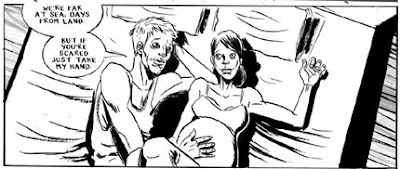
I see that people try to find some deep meaning and hidden clues of brilliance. For me, it was quite simple. Jack is unable to accept his father's death and lives his life mechanically, while still trapped in the past where he feels he belongs and where he's still looking for the answer to the mystery surrounding his father and the reassurance that he was more than a drunk. One day, he finds on the bottom of the ocean the watch his father gave him before he died, moment that triggers a surreal experience that makes him realize how out of his life he's been in the last couple of years and forces him to let go of the past and find happiness with his family.

The only genuine symbolism I see is that of the black and white panels versus the gray ones. The gray panels represent the places where Jack feels most alive, where he is truly present: when he's underwater, when he remembers or dreams about his father, and in the "ghost town" (which I think is the place he's lived in - metaphorically speaking - since his father's death; his underwater experience triggered by the finding of the watch only makes him acknowledge how much of a ghost he's been all this time and how in danger he is of turning into his father). That's why I think that the gray-inked ending is exactly what it looks like: Jack finally escaping his past, letting his father go ("It's time" his father said - time to wake up from the past, to let go) and finding happiness. He wasn't fully present in his life in the beginning (black and white panels), but by the end he is (gray panels).
As for the clock ticking in the last panel, it may simply suggest the start of his new happy life marked by the birth of his baby and the definitive death of his father.

** SPOILERS **
I see that people try to find some deep meaning and hidden clues of brilliance. For me, it was quite simple. Jack is unable to accept his father's death and lives his life mechanically, while still trapped in the past where he feels he belongs and where he's still looking for the answer to the mystery surrounding his father and the reassurance that he was more than a drunk. One day, he finds on the bottom of the ocean the watch his father gave him before he died, moment that triggers a surreal experience that makes him realize how out of his life he's been in the last couple of years and forces him to let go of the past and find happiness with his family.
The only genuine symbolism I see is that of the black and white panels versus the gray ones. The gray panels represent the places where Jack feels most alive, where he is truly present: when he's underwater, when he remembers or dreams about his father, and in the "ghost town" (which I think is the place he's lived in - metaphorically speaking - since his father's death; his underwater experience triggered by the finding of the watch only makes him acknowledge how much of a ghost he's been all this time and how in danger he is of turning into his father). That's why I think that the gray-inked ending is exactly what it looks like: Jack finally escaping his past, letting his father go ("It's time" his father said - time to wake up from the past, to let go) and finding happiness. He wasn't fully present in his life in the beginning (black and white panels), but by the end he is (gray panels).
As for the clock ticking in the last panel, it may simply suggest the start of his new happy life marked by the birth of his baby and the definitive death of his father.

June 30, 2014
I would be thankful for the gifts that were given,
I will not turn my back on the past,
You should not resent me for moving forward,
I cannot rectify all the things that went bad for you.
I cannot move where these four walls surround me,
Even though it may be right for you,
I cannot see through another man's eyes,
I will not walk in my father's shoes.
This graphic novel is a beautifully rendered maritime mystery that speaks volumes about the often fraught relationships between fathers and sons. It's a sad fact of life that sometimes understanding and forgiveness are not achieved until after death.
Lovely, intriguing and immensely touching.
Would I be selfish to alter the order?
Would I be foolish to not follow you?
But I have the strength to walk past all that you have
I will not walk in my father's shoes
No, I will not walk in my father's shoes.*
*Cliff Eberhardt, My Father's Shoes
http://www.releaselyrics.com/4403/cli...
I will not turn my back on the past,
You should not resent me for moving forward,
I cannot rectify all the things that went bad for you.
I cannot move where these four walls surround me,
Even though it may be right for you,
I cannot see through another man's eyes,
I will not walk in my father's shoes.
This graphic novel is a beautifully rendered maritime mystery that speaks volumes about the often fraught relationships between fathers and sons. It's a sad fact of life that sometimes understanding and forgiveness are not achieved until after death.
Lovely, intriguing and immensely touching.
Would I be selfish to alter the order?
Would I be foolish to not follow you?
But I have the strength to walk past all that you have
I will not walk in my father's shoes
No, I will not walk in my father's shoes.*
*Cliff Eberhardt, My Father's Shoes
http://www.releaselyrics.com/4403/cli...

March 5, 2017
Wow. This, along with Essex County, is Jeff Lemire's best work to date (maybe ever). Although I loved Essex County slightly more, this is still an absolutely brilliant, heartbreaking and heartfelt story, a deep examination of one person's relationship with himself, his dead father and his family. Incredible stuff.
June 14, 2026
Dear Jeff Lemire, i love your writing and storytelling but your drawing is the biggest dog 💩 ever
It feels like he got the idea in his head and immediately thought "omg i don't wanna split the book's earnings with a professional comic book artist so imma draw it by myself"
Or maybe he just wanted a book drawn by himself, who knows?
After all i think we really needed a good artist to draw this 10/10 story
It feels like he got the idea in his head and immediately thought "omg i don't wanna split the book's earnings with a professional comic book artist so imma draw it by myself"
Or maybe he just wanted a book drawn by himself, who knows?
After all i think we really needed a good artist to draw this 10/10 story

June 17, 2018
Another elegant Jeff Lemire story and a great read for Father's Day. This book confronts the fears and insecurities of fatherhood in the poignant tale of a man struggling to piece together the mysterious disappearance of his father years ago, an event he hasn't fully come to grips with and one that affects his feelings about being a new father himself. It's sincere and nostalgic, with the grace we've come to expect from Lemire's independent work. Happy Father's Day!

September 12, 2012
Memory is a beast, savage and merciless. It bites and tears and conquers. Its armory storehouse is not filled with inconsequentialities but with the things that stick—with barbs and teeth and talons more often than not. Certainly memory can be a rewarder, but only capriciously so.
Do I remember my first kiss? I do. But not in the fidelity of colour and texture and temperature and tone that such a moment should deserve. Do I remember where things went wrong with that girl, so long ago? I do. And often in tantalizing, horrible detail. Do I remember where things went wrong with the next girl and the next? I do and I do. Scars, as it turns out, are more indelible than comfortable massages.
Do I remember when my daughter was born? A little. More that it happened and that I was there than any sense of real presence. Do I remember my son being born? Not really. But I do remember, vividly, the first time my daughter fell down a flight of stairs, when she had a terrifying experience with croup, when she hit her head hard and stopped breathing. I do remember saving her with a split-second to spare from a rogue tide shift when she was only one. The things that break your heart are the things that build you for they are the things that remain strongest in your memory.
And if memory has one single weapon with which it eviscerates the soul more gleefully, heartlessly, and permanently, that tool of destruction is surely regret. And it is against that particular blade that Jack Joseph struggles. He may not yet have put a name to the thing that is killing him, destroying his life, and leaving his personal society and civilization a derelict wasteland—but a deep regret (and its companion sense of guilt) is Jack's enemy, whether subconscious or not.

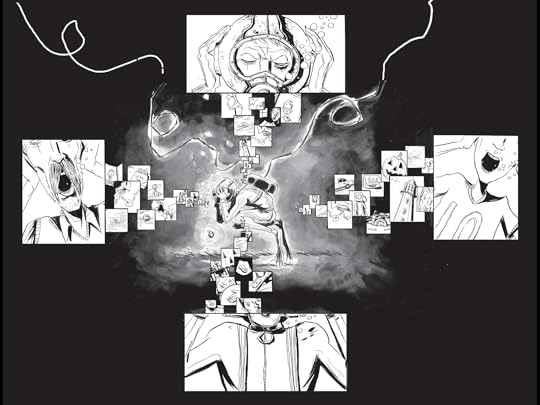
Jeff Lemire, as he has in Essex County, continues to explore the lives of broken people—people to whom life's treacherous circumstances have paid particular attention. In exploring Joseph's life, times, and other times, Lemire uses a mix of pages defined either by the strict and straightforward promise of black-and-white, cut-and-dried art or by dreamy, less-defined and less-defining water-diluted ink washes. The stark positives and negatives of the former are the ground on which The Underwater Welder's present day unfolds. This reality seems unshakeable and intentionally closed to interpretation and reinterpretation. The hazy, low-contrast mist that colludes with Lemire's usually strong-lined art is used strictly1 in narrative sections that cross the boundaries of the real, whether through memories or through imagination or through the imposition of some sort of world of magic and mystery that runs parallel our own. It's a good visual trick and works very well for a story that skips through all sorts of versions of What Is And Was.
Through his visual storytelling Lemire has crafted a pretty wonderful tale of how the mistakes of the past, even when forgotten, can rule the choices of the present. Jack, the titular welder, is governed (almost maniacally so) by the ghost of decisions made as a child. Decisions that, while certainly selfish and childish, would hold outcomes impossible to predict. These are the kinds of choices that none of us should feel guilt over, but rationality and memory have never held any tenderness toward each other. We live our lives feeling responsible for things beyond our control (and inexplicably feeling not-culpable for a host of things we ought to feel responsible for—a topic for another story perhaps). We are confused souls and far more delicate than we usually prefer to recognize—and as Lemire explores, we are not that super at dealing with the wounds that memory not only leaves to visibly scar but tends also to draw to our attentions.

And at this point, I will discuss the ending, so if you wish for a spoiler-free experience of The Underwater Welder, please skip down to the Production Notes section below.
Initially, I was disappointed in Lemire's conclusion to Jack's struggle with regret. It seemed too crisp, too easy, too pat. Unlike the rest of us, Jack was granted instant catharsis, a magical moment unearned and unendured. He gets what he wanted, an impossible forgiveness. And while it makes for exciting storytelling, it felt to me too hollow. I wanted a story that reflects my experience with the beast, with memory. I wanted to see what Lemire had to say as a reasonable, thinking artist of great works about how a man weighed down under the bondage of regret might resolve his struggle. And in the end, it seemed, his entire solution was that there is no solution save for the miraculous. I felt cheated in that Jack's story no longer bore any resemblance to our own stories—for the wronged dead do not rise to offer their unmerited forgiveness.

But then, I thought more about Lemire's ending and I thought that I perhaps got it wrong at first. That Jack's conclusion remains steadfastly a variety of grey washes prompts the reader to wonder whether Jack has had his instant catharsis after all. If he never does actually return to the real world, the reader is opened up to all kinds of interpretive joys. Did Jack die and the magic of his ending is some sort of afterlife healing? Did Jack somehow travel into a parallel existence—and remain, as that place would be his only chance for happiness and safety from his memories? This second look at The Underwater Welder's conclusion leaves a more satisfying taste. It feels less a cheat and more an acknowledgement of the brutality of regret. In that reading, Lemire doesn't answer any questions so much as he points out how unanswerable those questions would be.
And that is good enough for me.
Production Notes
While The Underwater Welder is a solid project, both beautifully drawn and written, there is some evidence of rushed production that slightly mars an otherwise wonderful work. There are, for instance, strange interruptions of obviously computer-created graphics into what are meant to look like traditional-media pages—and not just the annoyance of the book's occasional digital fonting for signs. As awkward as that always looks, I'm referring to digital artistic elements, such as the low-res leg, ear, and blanket/gown that occupy the foreground of page 218.

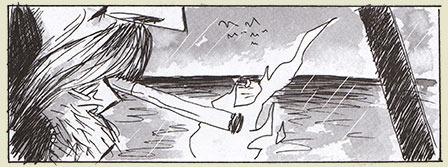
And whenever there is a smoke-like trail obscuring the background, it looks as if it were drawn with a mouse. Examples of this can be found on page 9 (as well as throughout) both in the cigarette smoke of panel 3 and in the trail of radio words snaking up the page.
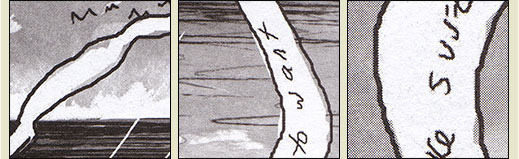
A lesser offense is that Lemire seems to have pretty small stock of word balloons (possibly even just one for dialogue and one for narration). He uses the same balloons throughout, only stretching them and rotating them as panels require it. It's not terrible and at least they seem to be vectored and well built to withstand the push-and-pull of resizing, but again, it makes it seem as if the project was rushed. Which is a pity when one considers how powerful Lemire's art can be.

[These three word balloons feature the same art. The lower two have the same orientation but one is stretched vertically. The upper one is rotated. Sometimes they'll be mirrored, rotated, and stretched. Lemire gets creative, but I kind of wish he just drew each balloon.]
Another issue is textual and should have, I think, been caught by an editor. On page 99, Jack narrates that he is the same age his dad was when Jack was born. On pages 164 and 191, Jack narrates that he is the same age as his dad was when his dad disappeared (his dad having disappeared when Jack was around ten). The conflict is obvious and could be read as a clue that Jack's grip on memory and reality are not firm, but as there don't seem to be other clues (so far as I noticed—to be fair, I'm not sometimes the most attentive reader) to direct us toward that line of thought, it seems more likely to read this as an error. In which case, more evidence of unfortunately rushed production.
Footnotes
1. There is one notable exception to this (spoiler):
_____________________
[Review courtesy of Good Ok Bad]
Do I remember my first kiss? I do. But not in the fidelity of colour and texture and temperature and tone that such a moment should deserve. Do I remember where things went wrong with that girl, so long ago? I do. And often in tantalizing, horrible detail. Do I remember where things went wrong with the next girl and the next? I do and I do. Scars, as it turns out, are more indelible than comfortable massages.
Do I remember when my daughter was born? A little. More that it happened and that I was there than any sense of real presence. Do I remember my son being born? Not really. But I do remember, vividly, the first time my daughter fell down a flight of stairs, when she had a terrifying experience with croup, when she hit her head hard and stopped breathing. I do remember saving her with a split-second to spare from a rogue tide shift when she was only one. The things that break your heart are the things that build you for they are the things that remain strongest in your memory.
And if memory has one single weapon with which it eviscerates the soul more gleefully, heartlessly, and permanently, that tool of destruction is surely regret. And it is against that particular blade that Jack Joseph struggles. He may not yet have put a name to the thing that is killing him, destroying his life, and leaving his personal society and civilization a derelict wasteland—but a deep regret (and its companion sense of guilt) is Jack's enemy, whether subconscious or not.
Jeff Lemire, as he has in Essex County, continues to explore the lives of broken people—people to whom life's treacherous circumstances have paid particular attention. In exploring Joseph's life, times, and other times, Lemire uses a mix of pages defined either by the strict and straightforward promise of black-and-white, cut-and-dried art or by dreamy, less-defined and less-defining water-diluted ink washes. The stark positives and negatives of the former are the ground on which The Underwater Welder's present day unfolds. This reality seems unshakeable and intentionally closed to interpretation and reinterpretation. The hazy, low-contrast mist that colludes with Lemire's usually strong-lined art is used strictly1 in narrative sections that cross the boundaries of the real, whether through memories or through imagination or through the imposition of some sort of world of magic and mystery that runs parallel our own. It's a good visual trick and works very well for a story that skips through all sorts of versions of What Is And Was.
Through his visual storytelling Lemire has crafted a pretty wonderful tale of how the mistakes of the past, even when forgotten, can rule the choices of the present. Jack, the titular welder, is governed (almost maniacally so) by the ghost of decisions made as a child. Decisions that, while certainly selfish and childish, would hold outcomes impossible to predict. These are the kinds of choices that none of us should feel guilt over, but rationality and memory have never held any tenderness toward each other. We live our lives feeling responsible for things beyond our control (and inexplicably feeling not-culpable for a host of things we ought to feel responsible for—a topic for another story perhaps). We are confused souls and far more delicate than we usually prefer to recognize—and as Lemire explores, we are not that super at dealing with the wounds that memory not only leaves to visibly scar but tends also to draw to our attentions.
And at this point, I will discuss the ending, so if you wish for a spoiler-free experience of The Underwater Welder, please skip down to the Production Notes section below.
Initially, I was disappointed in Lemire's conclusion to Jack's struggle with regret. It seemed too crisp, too easy, too pat. Unlike the rest of us, Jack was granted instant catharsis, a magical moment unearned and unendured. He gets what he wanted, an impossible forgiveness. And while it makes for exciting storytelling, it felt to me too hollow. I wanted a story that reflects my experience with the beast, with memory. I wanted to see what Lemire had to say as a reasonable, thinking artist of great works about how a man weighed down under the bondage of regret might resolve his struggle. And in the end, it seemed, his entire solution was that there is no solution save for the miraculous. I felt cheated in that Jack's story no longer bore any resemblance to our own stories—for the wronged dead do not rise to offer their unmerited forgiveness.
But then, I thought more about Lemire's ending and I thought that I perhaps got it wrong at first. That Jack's conclusion remains steadfastly a variety of grey washes prompts the reader to wonder whether Jack has had his instant catharsis after all. If he never does actually return to the real world, the reader is opened up to all kinds of interpretive joys. Did Jack die and the magic of his ending is some sort of afterlife healing? Did Jack somehow travel into a parallel existence—and remain, as that place would be his only chance for happiness and safety from his memories? This second look at The Underwater Welder's conclusion leaves a more satisfying taste. It feels less a cheat and more an acknowledgement of the brutality of regret. In that reading, Lemire doesn't answer any questions so much as he points out how unanswerable those questions would be.
And that is good enough for me.
Production Notes
While The Underwater Welder is a solid project, both beautifully drawn and written, there is some evidence of rushed production that slightly mars an otherwise wonderful work. There are, for instance, strange interruptions of obviously computer-created graphics into what are meant to look like traditional-media pages—and not just the annoyance of the book's occasional digital fonting for signs. As awkward as that always looks, I'm referring to digital artistic elements, such as the low-res leg, ear, and blanket/gown that occupy the foreground of page 218.
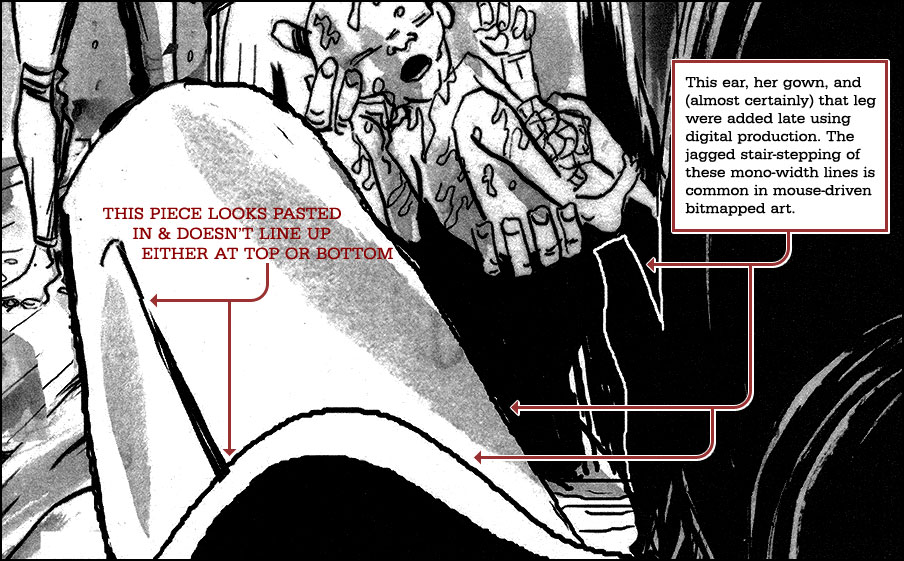
And whenever there is a smoke-like trail obscuring the background, it looks as if it were drawn with a mouse. Examples of this can be found on page 9 (as well as throughout) both in the cigarette smoke of panel 3 and in the trail of radio words snaking up the page.
A lesser offense is that Lemire seems to have pretty small stock of word balloons (possibly even just one for dialogue and one for narration). He uses the same balloons throughout, only stretching them and rotating them as panels require it. It's not terrible and at least they seem to be vectored and well built to withstand the push-and-pull of resizing, but again, it makes it seem as if the project was rushed. Which is a pity when one considers how powerful Lemire's art can be.
[These three word balloons feature the same art. The lower two have the same orientation but one is stretched vertically. The upper one is rotated. Sometimes they'll be mirrored, rotated, and stretched. Lemire gets creative, but I kind of wish he just drew each balloon.]
Another issue is textual and should have, I think, been caught by an editor. On page 99, Jack narrates that he is the same age his dad was when Jack was born. On pages 164 and 191, Jack narrates that he is the same age as his dad was when his dad disappeared (his dad having disappeared when Jack was around ten). The conflict is obvious and could be read as a clue that Jack's grip on memory and reality are not firm, but as there don't seem to be other clues (so far as I noticed—to be fair, I'm not sometimes the most attentive reader) to direct us toward that line of thought, it seems more likely to read this as an error. In which case, more evidence of unfortunately rushed production.
Footnotes
1. There is one notable exception to this (spoiler):
_____________________
[Review courtesy of Good Ok Bad]

March 5, 2022
Jack Joseph is used to the pressures of diving deep beneath the surface of land thanks to his career as an underwater welder, but the immense pressure of impending fatherhood is beginning to crush him. As he tries to swim away from his self doubts, memories of the past rise to the surface and threaten to suffocate him. He wonders if he can escape from the irresponsible path of his alcoholic father who instilled in him a love for the deep seas, or if he is doomed to fail his wife and child just as his father once did.
Deep, emotional and relatable. The Underwater Welder is a simple story of a struggling young man trying desperately not to live in the shadow of his father who failed him and his mother, even though deep down he loved him immensely and follows many of the same passions and hobbies as him. He worries that he will fail his wife and unborn son, so he returns to the place where he last saw his father to confront the darkness of his past in search of finding hope for the future.
The story has a melancholy dreamlike style that feels like an episode of the Twilight Zone, but it never goes so overboard that it becomes pretentious or uninterpretable. It has just the right amount of mysticism to feel magically surreal but not to the point it sacrifices good storytelling and character development.
A great coming of age tale that perfectly balances fear, sadness and hope.
My rating: 4.6/5
Deep, emotional and relatable. The Underwater Welder is a simple story of a struggling young man trying desperately not to live in the shadow of his father who failed him and his mother, even though deep down he loved him immensely and follows many of the same passions and hobbies as him. He worries that he will fail his wife and unborn son, so he returns to the place where he last saw his father to confront the darkness of his past in search of finding hope for the future.
The story has a melancholy dreamlike style that feels like an episode of the Twilight Zone, but it never goes so overboard that it becomes pretentious or uninterpretable. It has just the right amount of mysticism to feel magically surreal but not to the point it sacrifices good storytelling and character development.
A great coming of age tale that perfectly balances fear, sadness and hope.
My rating: 4.6/5

March 9, 2022
As a welder diving off an oil rig, Jack Joseph is well accustomed to the underwater pressure at the bottom of the ocean. He is less able to deal with the pressure of being soon to become a father. His deep dives seem to be tied to escaping his problems, but then things begin to happen. I don’t usually get on with graphic novels, but this one was quite special with the words and art work combining to great effect. Well worth the time!

September 19, 2016
This comic is being marketed as “an un-aired episode of the Twilight Zone”, yet I am not sure this is the perfect description. It is mostly a story of memories, and letting go, with very little of the surreal actually being an important part of the tale. The best word to describe it would be “Lemire-esque”. It takes on his ephemeral stories with the mundane and un-normalcy of his art, making it just a bit magical but mostly centered on reality.
In here we follow Jack Joseph, an underwater welder, who has returned to his hometown to work and wait for his wife to give birth. However, he seemed to have finally lost his marbles, as he stars hallucinating after being underwater and seeing an old watch. Soon we are driven by images of the past and present as they mix together. And it is all down to whether or not the past will repeat itself.
The main theme in the story comes from the main character’s insecurities of becoming a father, as he suffers from some repressed feelings of abandonment from his own one. He is often presented as a person who loves his wife, however, there are times in which he resembles his father, and they are usually noticed by those close around him. We don’t discover exactly what is the issue between the mother and father until a bit into the story, and the reason for his disappearance is not given until near end, making the entire story a big setup to something we might have already known but that was damaging in more ways than we expected. In that aspect it is quite similar to his Essex County. Little hints in stories we later find to be interconnected, and which use these hints to drive the emotional charge.
At the beginning of the review I mentioned that “Lemire-esque” was the best way to describe the story, as someone that already knows his writing and art will get most out of it, however, it is a fantastic window for all those that wish to enter into his world of weirdness. Please, give it a try, it might just become a favourite.
In here we follow Jack Joseph, an underwater welder, who has returned to his hometown to work and wait for his wife to give birth. However, he seemed to have finally lost his marbles, as he stars hallucinating after being underwater and seeing an old watch. Soon we are driven by images of the past and present as they mix together. And it is all down to whether or not the past will repeat itself.
The main theme in the story comes from the main character’s insecurities of becoming a father, as he suffers from some repressed feelings of abandonment from his own one. He is often presented as a person who loves his wife, however, there are times in which he resembles his father, and they are usually noticed by those close around him. We don’t discover exactly what is the issue between the mother and father until a bit into the story, and the reason for his disappearance is not given until near end, making the entire story a big setup to something we might have already known but that was damaging in more ways than we expected. In that aspect it is quite similar to his Essex County. Little hints in stories we later find to be interconnected, and which use these hints to drive the emotional charge.
At the beginning of the review I mentioned that “Lemire-esque” was the best way to describe the story, as someone that already knows his writing and art will get most out of it, however, it is a fantastic window for all those that wish to enter into his world of weirdness. Please, give it a try, it might just become a favourite.

June 5, 2020
Nasıl ki kadehinize şarap doldurdukları zaman ilk önce hafifçe çalkalamalı, koklamalı ve küçük bir yudum almalısınız, benim için de bir çizgiromanı elime aldığım zaman ilk yaptığım şey en orta sayfayı açıp koklamak. Çizgiromanın kokusu hiçbirşeye benzemiyor. Kitapları da koklarım ama hiçbir zaman bir çizgiroman gibi kokmazlar.
Portekiz'den sonra uzun zamandır küskün olduğum çizgiromana dönüş yaptım. Eskisi gibi hunharca değil, seçerek okuyorum ve bence mükafatını da görüyorum. Sualtı Kaynakçısı'nı da gayet başarılı buldum.
Öncelikle Marmara Çizgi'nin daha önce yayınladığı bir eseri okuduğumu hatırlamıyorum. Ancak harika bir iş başarmışlar. Yani 10 üzerinden 27 alabilirler! Portekiz'in harflemesi o kadar kötüydü ki (excel'deki gibi bir dikdörtgen yaratıp içine "insert text" diyecek kadar kötü) Sualtı Kaynakçısı için harcadıkları emeğe hayran oldum. Aslında uygun fontlar mı dersiniz, küçücük bir gazetenin küpürüne bile özenmek mi dersiniz, bir vitrin camının arkadan görünüşünü orijinal yazıtipi ile yazmak mı dersiniz hepsi var!
Hikaye basit ve dokunaklı olmasına rağmen işleniş biçimi ilginç ve değerli. Sonundaki taslak çizimlere ve storyboard'a bayıldım. Jeff Lemire küçücük bir kasabanın bile her binasına tek tek özenmiş. Nerede ne olacağını detaylarıyla belirlemiş. Hem de hikayede neredeyse hiç yer etmemesine rağmen! Eksiklik demeyeyim ama "olsa daha güzel olurdu" diyeceğim tek konu çizimin siyah beyaz oluşu. Kapak o kadar tatlı ve güzel ki eminim içerik de renklendirilmiş olsa insanı çok daha başka yerlere götürürdü. Mesela bir denizadamı olmamama rağmen 59. sayfanın beni alıp götürdüğü gibi.
Herkese tavsiye edebileceğim, oldukça kısa ama keyifli bir hikayeydi.
Herkese keyifli okumalar!
Portekiz'den sonra uzun zamandır küskün olduğum çizgiromana dönüş yaptım. Eskisi gibi hunharca değil, seçerek okuyorum ve bence mükafatını da görüyorum. Sualtı Kaynakçısı'nı da gayet başarılı buldum.
Öncelikle Marmara Çizgi'nin daha önce yayınladığı bir eseri okuduğumu hatırlamıyorum. Ancak harika bir iş başarmışlar. Yani 10 üzerinden 27 alabilirler! Portekiz'in harflemesi o kadar kötüydü ki (excel'deki gibi bir dikdörtgen yaratıp içine "insert text" diyecek kadar kötü) Sualtı Kaynakçısı için harcadıkları emeğe hayran oldum. Aslında uygun fontlar mı dersiniz, küçücük bir gazetenin küpürüne bile özenmek mi dersiniz, bir vitrin camının arkadan görünüşünü orijinal yazıtipi ile yazmak mı dersiniz hepsi var!
Hikaye basit ve dokunaklı olmasına rağmen işleniş biçimi ilginç ve değerli. Sonundaki taslak çizimlere ve storyboard'a bayıldım. Jeff Lemire küçücük bir kasabanın bile her binasına tek tek özenmiş. Nerede ne olacağını detaylarıyla belirlemiş. Hem de hikayede neredeyse hiç yer etmemesine rağmen! Eksiklik demeyeyim ama "olsa daha güzel olurdu" diyeceğim tek konu çizimin siyah beyaz oluşu. Kapak o kadar tatlı ve güzel ki eminim içerik de renklendirilmiş olsa insanı çok daha başka yerlere götürürdü. Mesela bir denizadamı olmamama rağmen 59. sayfanın beni alıp götürdüğü gibi.
Herkese tavsiye edebileceğim, oldukça kısa ama keyifli bir hikayeydi.
Herkese keyifli okumalar!

March 23, 2021
Přečteno potřetí a furt skvělý.

August 26, 2015
The Underwater Welder reveals itself in layers.
The introduction compares this book to an episode The Twilight Zone, and that's a fairly apt description. A deeply flawed character makes his way through a supernatural situation - it's Jeff Lemire's pacing that really sets the tone for this story. Although it doesn't experiment with narrative or paneling as much as his (in my opinion) masterpiece SWEET TOOTH, The Underwater Welder stands alone in expressing its vision.
Often haunting, sometimes heartbreaking; this is what a graphic novel should be.
The introduction compares this book to an episode The Twilight Zone, and that's a fairly apt description. A deeply flawed character makes his way through a supernatural situation - it's Jeff Lemire's pacing that really sets the tone for this story. Although it doesn't experiment with narrative or paneling as much as his (in my opinion) masterpiece SWEET TOOTH, The Underwater Welder stands alone in expressing its vision.
Often haunting, sometimes heartbreaking; this is what a graphic novel should be.

December 11, 2016
As Jack is about to become a father for the first time, his memories go back to his father. As the story progresses, Jack tries to find a way to reconcile the past so that he can live his future.
This is a wonderful story of how guilt, pain, confusion and regret from the past can threaten and possibly destroy our futures if we don't face them. How can we move forward if our past holds us back and makes us afraid?
Wonderfully told story with wonderful graphics that show the turmoil of Jack's thoughts.
This is a wonderful story of how guilt, pain, confusion and regret from the past can threaten and possibly destroy our futures if we don't face them. How can we move forward if our past holds us back and makes us afraid?
Wonderfully told story with wonderful graphics that show the turmoil of Jack's thoughts.

June 14, 2018
This is my second book by Lemire and once again have been touched deeply by his story and characters. Lemire is fantastic at setting up the mood of the story from the start. You get the sense that something big is about to happen and immediately feel for the MC, hoping he will stay safe where nothing can harm him. In this case, it's the memories that bring Jack, our MC, into a downward spiral as the relationships in his life are being weighed down by his refusal to leave the past behind. The memories with his dad are bittersweet and I wanted more. There was so much love there that doesn't need to be in your face but the reader can still pick up from Lemire's raw artwork. The artwork is not necessarily pretty and clean to look at but is always perfect for setting up the tone of the story. At this point I would recognize Lemire's artwork in a line-up and as such I appreciate it for the more personal touch it gives to his stories.
Lemire has now become one of my favorite graphic novelists.
Lemire has now become one of my favorite graphic novelists.

February 2, 2013
I don't seem to have gotten as much out of this book as so many others have. I have to wonder if the art, which I really disliked, kept me from fully engaging. That's a shame, because the writing and story are both well above average. Jack's struggle to fully accept his father's death (and his absence before his death), especially in the light of his own impending fatherhood, drives the story. And while Jack isn't always sympathetic (I found myself sympathizing with his wife instead) he's always realistically written. There are supernatural elements at the heart of the story, but it's really about Jack. And full marks to Lemire for writing such a memorably real character. And not just him, the entire cast felt like real, breathing people, and not just characters on a page. But something was missing for me, and I have to think that it was that art. So not to my taste, and unfortunately, I think that affected the read for me. One of those "it's not you, it's me" moments.

November 12, 2019
This graphic novel is written and illustrated by Lemire, and takes place in a small seaside community in Nova Scotia. Jack works as an underwater welder on an oil rig and is facing big changes in his life, and still processing unanswered questions from his past. There's a Twilight Zone feel to this one, and Damon Lindelof, writer of some of my favorite TV shows (The Leftovers, Watchmen) writes an introduction to the book.
Lemire is a prolific writer in the comic book world (the continuing comic series Gideon Falls is my most recent Lemire obsession. I reviewed a few weeks ago!)
Lemire is a prolific writer in the comic book world (the continuing comic series Gideon Falls is my most recent Lemire obsession. I reviewed a few weeks ago!)

June 24, 2013
Book blurb: The Underwater Welder is a graphic novel about fathers and sons, birth and death, memory and reality, and the treasures we all bury deep below the surface.
The black and white art is really sketchy, maybe almost too sketchy for my tastes, but surprisingly it works really well for this story. The characters are tragically fleshed out, and the exploration of how childhood trauma haunts us was wonderfully done.
The black and white art is really sketchy, maybe almost too sketchy for my tastes, but surprisingly it works really well for this story. The characters are tragically fleshed out, and the exploration of how childhood trauma haunts us was wonderfully done.

July 1, 2022
У час, коли Джефф Лемір почав працювати із видавництвом DC Comics та активно писати серії коміксів, як «Тваринна-людина» чи «Темна Ліга Справедливості», він ніколи не забував про свої авторські комікси. Однією із таких робіт є «Підводний зварювач», над якою автор почав працювати ще задовго до зустрічі із редакторами із великої двійки.
«Підводний зварювач» розповідає про Джека Джозефа, морського підводного зварювача на нафтовій вежі, якому залишилося кілька днів до народження його первістка. Джека охоплює хвиля емоцій у зв’язку із важливою подією на життєвому шляху. І він змушений зіткнутися зі скелетами у своїй шафі, а також пригадати загадкову смерть свого батька-п’яниці. Але його дім зараз розташований не там, де його серце, тому перед народженням дитини він вислизає, щоби востаннє поринути в темряву моря. У такому місці, позбавленому кисню й надії, він бачить — чи ні — найдивнішу річ: іржавий старий кишеньковий годинник, який нагадує йому про єдиний справжній подарунок, що подарував батько.
Джек намагається змиритися із загибеллю батька та образою, яку він відчуває через те, що ріс без нього. У той час, як головний герой намагається боротися зі своїм минулим, його молода сім’я починає розвалюватися на друзки, оскільки вчинки Джека постійно перебувають на перехресті між сімейним щастям і повторенням помилок власного батька. Увесь комікс він намагається знайти себе в цьому світі та розірвати вічне коло батька-сина, яке так само може вплинути на його первістка. Читаючи, відчуваєш, що автор узяв для сценарію багато із власного життєвого досвіду, адже він також є батьком, і також має сина. Тому це проймає удвічі сильніше.
Джефф Лемір — майстер передачі особистих конфліктів і емоцій, і «Підводний зварювач» — чудовий приклад його здібностей. Історія повністю орієнтована на персонажів, і малюнки Леміра добре доповнюють це за допомогою власного спрощеного стилю, який зосереджується на передачі думок і почуттів персонажа, а не на вишуканих і детальних кадрах. Використовуючи свій характерний чорно-білий стиль, Лемір будує історію з продуманим використанням форми кадрів, які справляють приголомшливе враження й зачіпають усі можливі струни серця. І, якщо б не схожі обличчя персонажів у всіх його авторських коміксах, де він був сценаристом й художником, то це було б, без перебільшення, навіть сильнішою стороною у коміксі. А так, хороший і атмосферний малюнок, який гарно підходить оповіді.
«Підводний зварювач» — це прониклива історія про втрачену та здобуту любов між батьками та синами, про цінність кохання і просто зворушлива історія життя, яка проникає в душу від самого початку. Тому не оминайте та прочитайте цей комікс від Джеффа Леміра, бо це одна з кращих робіт цього сценариста (якщо не найкраща) з тих, які мені вдалося прочитати.
«Підводний зварювач» розповідає про Джека Джозефа, морського підводного зварювача на нафтовій вежі, якому залишилося кілька днів до народження його первістка. Джека охоплює хвиля емоцій у зв’язку із важливою подією на життєвому шляху. І він змушений зіткнутися зі скелетами у своїй шафі, а також пригадати загадкову смерть свого батька-п’яниці. Але його дім зараз розташований не там, де його серце, тому перед народженням дитини він вислизає, щоби востаннє поринути в темряву моря. У такому місці, позбавленому кисню й надії, він бачить — чи ні — найдивнішу річ: іржавий старий кишеньковий годинник, який нагадує йому про єдиний справжній подарунок, що подарував батько.
Джек намагається змиритися із загибеллю батька та образою, яку він відчуває через те, що ріс без нього. У той час, як головний герой намагається боротися зі своїм минулим, його молода сім’я починає розвалюватися на друзки, оскільки вчинки Джека постійно перебувають на перехресті між сімейним щастям і повторенням помилок власного батька. Увесь комікс він намагається знайти себе в цьому світі та розірвати вічне коло батька-сина, яке так само може вплинути на його первістка. Читаючи, відчуваєш, що автор узяв для сценарію багато із власного життєвого досвіду, адже він також є батьком, і також має сина. Тому це проймає удвічі сильніше.
Джефф Лемір — майстер передачі особистих конфліктів і емоцій, і «Підводний зварювач» — чудовий приклад його здібностей. Історія повністю орієнтована на персонажів, і малюнки Леміра добре доповнюють це за допомогою власного спрощеного стилю, який зосереджується на передачі думок і почуттів персонажа, а не на вишуканих і детальних кадрах. Використовуючи свій характерний чорно-білий стиль, Лемір будує історію з продуманим використанням форми кадрів, які справляють приголомшливе враження й зачіпають усі можливі струни серця. І, якщо б не схожі обличчя персонажів у всіх його авторських коміксах, де він був сценаристом й художником, то це було б, без перебільшення, навіть сильнішою стороною у коміксі. А так, хороший і атмосферний малюнок, який гарно підходить оповіді.
«Підводний зварювач» — це прониклива історія про втрачену та здобуту любов між батьками та синами, про цінність кохання і просто зворушлива історія життя, яка проникає в душу від самого початку. Тому не оминайте та прочитайте цей комікс від Джеффа Леміра, бо це одна з кращих робіт цього сценариста (якщо не найкраща) з тих, які мені вдалося прочитати.

December 27, 2018
Bir İstanbul-Hamburg yolculuğu esnasında uçarcasına okundu. Çizimler son derece şade ama anlattıkları bir o kadar derin. Girişte de belirtildiği gibi tam bir “Alacakaranlık” hikayesi. Çizgi roman severler icin çok iyi bir iş, fazlasıyla tatmin edici bir eser.

January 12, 2020
Depresivní, ale krásná kniha o těžkém vyrovnávání se s traumatem z dětství. Jackův otec se ztratil o Halloweenu a Jack v tomto období roku upadá do depresí. Tentokrát se mu navíc má brzy narodit dítě a tak to prožívá hůře než jindy. Potom se ale stane něco, co celou situaci vyeskaluje... Miluji, jak Jeff Lemire pracuje s emocemi. Miluji jeho kresbu a práci s vodovkami. Miluji, jak pracuje s panely! Navíc je tento komiks psaný poměrně jednoduchou angličtinou, takže se ho nemusí bát ani ti, kteří si v angličtině příliš nevěří.

May 19, 2019
There are many comics that resemble past films or novels or television series' that we love. Koike's Lone Wolf and The Cub is reminiscent of Kurosawa's samurai epics, or Palmiotti and Grey's run on Jonah Hex reminding me of classic westerns in the vein of Leone or Ford, there's also the new Image series Ice Cream Man that is reminiscent of The Twilight Zone, but there is another book out there that also captures the tone and pace of Serling's masterpiece, and it's also written by one of comics' brightest stars today.
While Maxwell Prince catches the tone of The Twilight Zone well, it is Jeff Lemire who manages to master it with his hallucinogenic and dream-like exploration of fatherhood, loneliness, and grief. His writing and storytelling is tight and contained with a minimalistic elegance that makes works of his like Roughneck, Sweet Tooth, and Essex County work so well. We also see his art, which while not perfect, still illustrates his characters and the tone that he wants to go with beautifully, which makes the imperfections of his work seem perfect (as paradoxical as it seems). It is also a comic that is mature, without reducing to laughable morally ambiguous characters or uber-violence, it's mature in the way that it handles the tough subject matter that's talked about and gives his characters the dignity, humanity, and respect that they deserve.
There are many comics that often struggle with character development, in particular with independent comics. While with mainstream superhero runs you could get away with shoddy character development because we've known the characters in those universes for as long as we've existed (unless you're crazy enough to revitalize or redefine these characters), but that excuse isn't acceptable in independent comics. Far too often, I see independent comics struggle with flat characters or even shoddy storytelling, but Lemire, along with other indie giants as Kirkman or Vaughan, has managed to make character development his chief strength and has been his consistent strength since his start in the comics industry. His work with character in Underwater Welder has to be one of his best character driven works asides from Roughneck or Sweet Tooth. His characters in this book feel real and relatable and you grow to care about them, and like I mentioned earlier, doesn't sacrifice their dignity in its mature exploration of its themes.
There's also Lemire's interest in the surreal that is reminiscent of The Twilight Zone, like mentioned earlier (in fact, Damon Lindelof, in his introduction for the book, dubbed it 'The Twilight Zone episode that was never developed.') While the afore mentioned Prince captures The Twilight Zone's penchent for the darkness lurking about in the light, Lemire takes the more personal focus with this book, placing characters in odd situations but letting them come back out of the situations and being a better person for it or being given a much more bittersweet ending, but I'll keep what happens in the book tightly closed, as this book is a book to be experienced.
Jeff Lemire might possibly be one of comics' most versatile and prolific creators still working today, and if you're going to be a creator that I want to check out or even like, than those things are what I look for, as well as a capacity for good storytelling, and Lemire has proven himself to be a creator that is worth following.
While Maxwell Prince catches the tone of The Twilight Zone well, it is Jeff Lemire who manages to master it with his hallucinogenic and dream-like exploration of fatherhood, loneliness, and grief. His writing and storytelling is tight and contained with a minimalistic elegance that makes works of his like Roughneck, Sweet Tooth, and Essex County work so well. We also see his art, which while not perfect, still illustrates his characters and the tone that he wants to go with beautifully, which makes the imperfections of his work seem perfect (as paradoxical as it seems). It is also a comic that is mature, without reducing to laughable morally ambiguous characters or uber-violence, it's mature in the way that it handles the tough subject matter that's talked about and gives his characters the dignity, humanity, and respect that they deserve.
There are many comics that often struggle with character development, in particular with independent comics. While with mainstream superhero runs you could get away with shoddy character development because we've known the characters in those universes for as long as we've existed (unless you're crazy enough to revitalize or redefine these characters), but that excuse isn't acceptable in independent comics. Far too often, I see independent comics struggle with flat characters or even shoddy storytelling, but Lemire, along with other indie giants as Kirkman or Vaughan, has managed to make character development his chief strength and has been his consistent strength since his start in the comics industry. His work with character in Underwater Welder has to be one of his best character driven works asides from Roughneck or Sweet Tooth. His characters in this book feel real and relatable and you grow to care about them, and like I mentioned earlier, doesn't sacrifice their dignity in its mature exploration of its themes.
There's also Lemire's interest in the surreal that is reminiscent of The Twilight Zone, like mentioned earlier (in fact, Damon Lindelof, in his introduction for the book, dubbed it 'The Twilight Zone episode that was never developed.') While the afore mentioned Prince captures The Twilight Zone's penchent for the darkness lurking about in the light, Lemire takes the more personal focus with this book, placing characters in odd situations but letting them come back out of the situations and being a better person for it or being given a much more bittersweet ending, but I'll keep what happens in the book tightly closed, as this book is a book to be experienced.
Jeff Lemire might possibly be one of comics' most versatile and prolific creators still working today, and if you're going to be a creator that I want to check out or even like, than those things are what I look for, as well as a capacity for good storytelling, and Lemire has proven himself to be a creator that is worth following.

September 27, 2018
I tend to think of myself as someone who doesn't enjoy graphic novels, but on occasion I pick one up (generally prompted by a reading challenge) and I can't put the thing down. This is especially true of fantastic graphic novels like this one. I was a bit disappointed that there are no colour illustrations, but once I got into the story, I didn't even notice!
Displaying 1 - 30 of 1,243 reviews