

What do you think?

The Traitors Circle
"An astonishing true story of courage, love, and betrayal, told with the verve of a thriller. Freedland is a master at weaving spellbinding entertainments drawn from forgotten corners of history."—Mick Herron, bestselling author of Slow Horses
From the New York Times bestselling author of The Escape Artist, an extraordinary true story of resistance, heroism and betrayal.
When the whole world is lying, someone must tell the truth.
Berlin, 1943: A group of high society anti-Nazi dissenters meet for a tea party one late summer’s afternoon. They do not know that, sitting around the table, is someone poised to betray them all to the Gestapo.
They form a circle of unlikely rebels, drawn from the German two countesses, a diplomat, an intelligence officer, an ambassador’s widow and a pioneering head mistress. What unites every one of them is a shared loathing of the Nazis, a refusal to bow to Hitler and the courage to perform perilous acts of meeting in the shadows, rescuing Jews or plotting for a future Germany freed from the Führer's rule. Or so they believe.
How did a group of brave, principled rebels, who had successfully defied Adolf Hitler for more than a decade, come to fall into such a lethal trap?
Undone from within and pursued to near-destruction by one of the Reich’s cruelest men, they showed a heroism in the face of the most vengeful regime in history that raises the what kind of person does it take to risk everything and stand up to tyranny?
From the New York Times bestselling author of The Escape Artist, an extraordinary true story of resistance, heroism and betrayal.
When the whole world is lying, someone must tell the truth.
Berlin, 1943: A group of high society anti-Nazi dissenters meet for a tea party one late summer’s afternoon. They do not know that, sitting around the table, is someone poised to betray them all to the Gestapo.
They form a circle of unlikely rebels, drawn from the German two countesses, a diplomat, an intelligence officer, an ambassador’s widow and a pioneering head mistress. What unites every one of them is a shared loathing of the Nazis, a refusal to bow to Hitler and the courage to perform perilous acts of meeting in the shadows, rescuing Jews or plotting for a future Germany freed from the Führer's rule. Or so they believe.
How did a group of brave, principled rebels, who had successfully defied Adolf Hitler for more than a decade, come to fall into such a lethal trap?
Undone from within and pursued to near-destruction by one of the Reich’s cruelest men, they showed a heroism in the face of the most vengeful regime in history that raises the what kind of person does it take to risk everything and stand up to tyranny?
480 pages, Hardcover
First published September 11, 2025
About the author
Jonathan Freedland
21 books281 followersJonathan Freedland is a British journalist. He also writes thrillers under the pseudonym Sam Bourne.
Ratings & Reviews
Friends & Following
Create a free account to discover what your friends think of this book!
Community Reviews
Displaying 1 - 30 of 232 reviews

August 7, 2025
It is so easy to forget that during World War II, there were Germans actively working from the inside to destroy Hitler. Very often, they would pay a terrible price. This is certainly the case for the people in Jonathan Freedland's The Traitors Circle.
I hesitate to give any of the plot away, so I will keep to a very high level recap. The story is centered around a gathering of Germans who are in various stages of resistance against the Nazis. Some are just talkers while others are actively making things happen. Unfortunately, one of the attendees is an agent for the Gestapo. I'll leave it there.
Freedland does write this like a thriller. Chapters end on ominous notes which promise twists, turns, and further betrayal. I generally hate books which try to hard to make history into something that it is not. However, this is one of the few times where it absolutely works. Freedland doesn't overdo it, and his characters are not well known enough for the reader to know what ultimately happens to each. For example, Dietrich Bonhoeffer is mentioned, but he is not a direct part of this particular group. This makes sense since anyone familiar at all with World War II knows exactly how Bonhoeffer's brilliant life ends.
All of this is to say that this book works for every audience. Non-history readers will be enthralled by the propulsive and novel-like storytelling. History nerds will once again be reminded that doing the right thing can sometimes exact a terrible cost.
(This book was provided as an advance copy by NetGalley and Harper Books.)
I hesitate to give any of the plot away, so I will keep to a very high level recap. The story is centered around a gathering of Germans who are in various stages of resistance against the Nazis. Some are just talkers while others are actively making things happen. Unfortunately, one of the attendees is an agent for the Gestapo. I'll leave it there.
Freedland does write this like a thriller. Chapters end on ominous notes which promise twists, turns, and further betrayal. I generally hate books which try to hard to make history into something that it is not. However, this is one of the few times where it absolutely works. Freedland doesn't overdo it, and his characters are not well known enough for the reader to know what ultimately happens to each. For example, Dietrich Bonhoeffer is mentioned, but he is not a direct part of this particular group. This makes sense since anyone familiar at all with World War II knows exactly how Bonhoeffer's brilliant life ends.
All of this is to say that this book works for every audience. Non-history readers will be enthralled by the propulsive and novel-like storytelling. History nerds will once again be reminded that doing the right thing can sometimes exact a terrible cost.
(This book was provided as an advance copy by NetGalley and Harper Books.)

February 5, 2026
Check out all my reviews at: https://www.avonnalovesgenres.com
THE TRAITOR’S CIRCLE by Jonathan Freedland is a nonfiction novel that reads like a gripping spy thriller. This book features a group of aristocratic Germans during WWII who come together to voice their objections to Hitler and the Nazi regime, help Jewish friends, families, and even strangers escape the Holocaust and are then betrayed by a traitor within. The terrible retribution of the Gestapo on all involved during the final years of the war is stark and terrible and yet their stories need to be told and remembered for their bravery and moral resistance to the depravity of the Nazi regime.
This is a nonfiction book that I was unable to put down, even with scenes of torture and depravity. The author masterly introduces the members of the group, and you become invested in the varied individuals and the various reasons for them opposing the new regime. I have read many nonfiction history books and historical fiction books about WWII and that era, so I assumed this story would not end well, but the author does a great job of following all the characters to the end of their journeys whether they lived or died. This book gives the reader a look at German dissenters during a time that a radical regime sought to eliminate all dissent.
I highly recommend this gripping nonfiction WWII novel!
THE TRAITOR’S CIRCLE by Jonathan Freedland is a nonfiction novel that reads like a gripping spy thriller. This book features a group of aristocratic Germans during WWII who come together to voice their objections to Hitler and the Nazi regime, help Jewish friends, families, and even strangers escape the Holocaust and are then betrayed by a traitor within. The terrible retribution of the Gestapo on all involved during the final years of the war is stark and terrible and yet their stories need to be told and remembered for their bravery and moral resistance to the depravity of the Nazi regime.
This is a nonfiction book that I was unable to put down, even with scenes of torture and depravity. The author masterly introduces the members of the group, and you become invested in the varied individuals and the various reasons for them opposing the new regime. I have read many nonfiction history books and historical fiction books about WWII and that era, so I assumed this story would not end well, but the author does a great job of following all the characters to the end of their journeys whether they lived or died. This book gives the reader a look at German dissenters during a time that a radical regime sought to eliminate all dissent.
I highly recommend this gripping nonfiction WWII novel!

November 28, 2025
There is no big conspiracy or plot at the centre of The Traitors Circle. Instead the use of a social gathering - a tea party - amongst friends who disagreed with the Nazi regime is used ro highlight how brutal the punishment for the merest hint of dissent against the Reich was. This does leave the book in a slightly odd place - there is no dramatic climax to a plot, not much in terms of excitement or high drama. It is the story of normal people standing up against an intolerable evil in small ways and being severely punished for doing so - and that is still relevant in the world today, perhaps worryingly so. An interesting and well written look at a lesser known story from the time.

September 20, 2025
There are a few (and of course clandestine) groups of German anti-Nazi resisters during the Third Reich whose courageous activities (dangerous and generally also deadly for both group members and often also for their families and for their friends) have been well chronicled and are also internationally known and respected, such as the 1944 assassination plot of Adolf Hitler planned by Adam von Trott and his fellow army collaborators and the pacifist White Rose circle of Munich university students and their professor who distributed anti-Nazi leaflets (and with both groups paying for their rebellion with their lives, with their executions, something I can sort of very very grudgingly accept and understand regarding the 1944 assassination plot even if I totally do admire and strongly agree with the plotters and with their supporters, but considering that all the White Rose did was to distribute propaganda denouncing Nazism, while I am not really surprised that Hans and Sophie Scholl et al were executed for their public resistance, it still does flabbergast me a trifle but it also clearly demonstrates just how dangerous, how potentially lethal ANY kind of rebellion and negativity towards Nazism and towards Adolf Hitler was and could be, and in particular in Germany proper). But just to point out that aside from the 1944 assassination plot and the White Rose, and as author Jonathan Freedland very specifically notes in the preface for his autumn 2025 The Traitors Circle: The True Story of a Secret Resistance Network in Nazi Germany―and the Spy Who Betrayed Them (and contrary to popular belief I might add) there were actually very very many Germans who opposed Nazism in one way or another (both quietly and actively) and that between 1933 and 1945 some three million Germans were imprisoned in concentration camps for so-called crimes of dissent (and that even making jokes about Adolf Hitler could in fact lead to arrest, and worse, often even to execution).
Now while doing research for his 2022 book The Escape Artist: The Man Who Broke Out of Auschwitz to Warn the World (and which I now definitely want to read even though a number of trusted Goodreads friends have really disliked The Escape Artist: The Man Who Broke Out of Auschwitz to Warn the World) Freedland came across the heartbreaking but also encouraging story of one such German resistance group (of the so-called Solf Circle or the Solf Kreis in German) and in and with The Traitors Circle: The True Story of a Secret Resistance Network in Nazi Germany―and the Spy Who Betrayed Them Jonathan Freeedland tells the story of the Solf Circle in meticulous, horrifying and cinematically dramatic detail, textually exploring the secretive world of anti Nazi activists in the Third Reich (and yes, like with the 1944 assassination plot mentioned above, the conspirators, the resisters in The Traitors Circle: The True Story of a Secret Resistance Network in Nazi Germany―and the Spy Who Betrayed Them were mostly upper class Germans).
And Freedland's textual focus in The Traitors Circle: The True Story of a Secret Resistance Network in Nazi Germany―and the Spy Who Betrayed Them, this is a September 1943 Berlin tea party hosted by Elisabeth von Thadden, the aristocratic headmistress of a private girls’ academy (and where she neither did nor even permitted any Heil Hitler type of salutes), with guests being Otto Kiep (a Foreign Ministry official who was also part of a clandestine governmental anti-Nazi ring), the Countess Hannah von Bredow, Count Albrecht von Bernstorff, Jesuit priest Father Friedrich Erxleben, Nikolaus von Halem, Richard Kuenzer, State Secretary Arthur Zarden and his daughter Irmgard as well as Paul Reckzeh, a young "Swiss" doctor who enthusiastically applauded the other party attendees musing about overthrowing Adolf Hitler (but who also made no such comments himself) only to later (since Reckzeh was in fact a ruthless spy) make a detailed and damning report to his Gestapo handlers (and while Kiep received Reckzeh's report, as it was leaked to him by fellow anti-Nazi government official Helmuth James von Moltke, this was sadly not in time to save both himself and the other tea party conspirators, the majority of whom were arrested, brutally tortured and executed, and indeed the same fate was in store for von Moltke as well).
Furthermore in The Traitors Circle: The True Story of a Secret Resistance Network in Nazi Germany―and the Spy Who Betrayed Them Jonathan Freedland also recounts the extraordinarily cinematic exploits of Countess Maria von Maltzan, a close friend of Elizabeth von Thadden (and who luckily skipped the fateful tea party), who sheltered Jewish fugitives, viscously harangued SS officers regarding their investigations, hid in a tree to evade searchlights and guard dogs and even shot a man in a Berlin sewer (sounding almost unbelievable, but my own research indeed shows that all of the scenarios presented by Freedland about von Maltzan are or more to the point were reality, they did indeed occur). And albeit Jonathan Freedland's text for The Traitors Circle: The True Story of a Secret Resistance Network in Nazi Germany―and the Spy Who Betrayed Them with its tense cat-and-mouse espionage game, pitting vilely sadistic Nazi functionaries and their unsavoury minions against their victims, against their hapless prey whose considerable monetary resources, privilege and moxie do give them at least a fighting chance against Nazism (and even though readers well know right from page one of The Traitors Circle: The True Story of a Secret Resistance Network in Nazi Germany―and the Spy Who Betrayed Them that all is and will be for naught so to speak) is often almost a bit too verbally movie-like and as such also sometimes even feels rather artificial for me, no, what Freedland presents in The Traitors Circle: The True Story of a Secret Resistance Network in Nazi Germany―and the Spy Who Betrayed Them is contents wise absolutely and totally historically accurate (which yes, I did check online). But well, if Freedland wants to make his text (his story) a bit like a thriller, like espionage fiction so be it, and that the exciting and in one's face textuality of The Traitors Circle: The True Story of a Secret Resistance Network in Nazi Germany―and the Spy Who Betrayed Them should keep in particular young adult readers of The Traitors Circle: The True Story of a Secret Resistance Network in Nazi Germany―and the Spy Who Betrayed Them nicely engaged even if I personally would definitely prefer a bit less theatrics, less melodrama and a bit drier a text. Therefore, I do majorly understand why Jonathan Freedland uses extensive dramatics in his account, that The Traitors Circle: The True Story of a Secret Resistance Network in Nazi Germany―and the Spy Who Betrayed Them totally works as an espionage story (and that my rating for The Traitors Circle: The True Story of a Secret Resistance Network in Nazi Germany―and the Spy Who Betrayed Them is also solidly five stars and as such comes highly and warmly recommended).
Now while doing research for his 2022 book The Escape Artist: The Man Who Broke Out of Auschwitz to Warn the World (and which I now definitely want to read even though a number of trusted Goodreads friends have really disliked The Escape Artist: The Man Who Broke Out of Auschwitz to Warn the World) Freedland came across the heartbreaking but also encouraging story of one such German resistance group (of the so-called Solf Circle or the Solf Kreis in German) and in and with The Traitors Circle: The True Story of a Secret Resistance Network in Nazi Germany―and the Spy Who Betrayed Them Jonathan Freeedland tells the story of the Solf Circle in meticulous, horrifying and cinematically dramatic detail, textually exploring the secretive world of anti Nazi activists in the Third Reich (and yes, like with the 1944 assassination plot mentioned above, the conspirators, the resisters in The Traitors Circle: The True Story of a Secret Resistance Network in Nazi Germany―and the Spy Who Betrayed Them were mostly upper class Germans).
And Freedland's textual focus in The Traitors Circle: The True Story of a Secret Resistance Network in Nazi Germany―and the Spy Who Betrayed Them, this is a September 1943 Berlin tea party hosted by Elisabeth von Thadden, the aristocratic headmistress of a private girls’ academy (and where she neither did nor even permitted any Heil Hitler type of salutes), with guests being Otto Kiep (a Foreign Ministry official who was also part of a clandestine governmental anti-Nazi ring), the Countess Hannah von Bredow, Count Albrecht von Bernstorff, Jesuit priest Father Friedrich Erxleben, Nikolaus von Halem, Richard Kuenzer, State Secretary Arthur Zarden and his daughter Irmgard as well as Paul Reckzeh, a young "Swiss" doctor who enthusiastically applauded the other party attendees musing about overthrowing Adolf Hitler (but who also made no such comments himself) only to later (since Reckzeh was in fact a ruthless spy) make a detailed and damning report to his Gestapo handlers (and while Kiep received Reckzeh's report, as it was leaked to him by fellow anti-Nazi government official Helmuth James von Moltke, this was sadly not in time to save both himself and the other tea party conspirators, the majority of whom were arrested, brutally tortured and executed, and indeed the same fate was in store for von Moltke as well).
Furthermore in The Traitors Circle: The True Story of a Secret Resistance Network in Nazi Germany―and the Spy Who Betrayed Them Jonathan Freedland also recounts the extraordinarily cinematic exploits of Countess Maria von Maltzan, a close friend of Elizabeth von Thadden (and who luckily skipped the fateful tea party), who sheltered Jewish fugitives, viscously harangued SS officers regarding their investigations, hid in a tree to evade searchlights and guard dogs and even shot a man in a Berlin sewer (sounding almost unbelievable, but my own research indeed shows that all of the scenarios presented by Freedland about von Maltzan are or more to the point were reality, they did indeed occur). And albeit Jonathan Freedland's text for The Traitors Circle: The True Story of a Secret Resistance Network in Nazi Germany―and the Spy Who Betrayed Them with its tense cat-and-mouse espionage game, pitting vilely sadistic Nazi functionaries and their unsavoury minions against their victims, against their hapless prey whose considerable monetary resources, privilege and moxie do give them at least a fighting chance against Nazism (and even though readers well know right from page one of The Traitors Circle: The True Story of a Secret Resistance Network in Nazi Germany―and the Spy Who Betrayed Them that all is and will be for naught so to speak) is often almost a bit too verbally movie-like and as such also sometimes even feels rather artificial for me, no, what Freedland presents in The Traitors Circle: The True Story of a Secret Resistance Network in Nazi Germany―and the Spy Who Betrayed Them is contents wise absolutely and totally historically accurate (which yes, I did check online). But well, if Freedland wants to make his text (his story) a bit like a thriller, like espionage fiction so be it, and that the exciting and in one's face textuality of The Traitors Circle: The True Story of a Secret Resistance Network in Nazi Germany―and the Spy Who Betrayed Them should keep in particular young adult readers of The Traitors Circle: The True Story of a Secret Resistance Network in Nazi Germany―and the Spy Who Betrayed Them nicely engaged even if I personally would definitely prefer a bit less theatrics, less melodrama and a bit drier a text. Therefore, I do majorly understand why Jonathan Freedland uses extensive dramatics in his account, that The Traitors Circle: The True Story of a Secret Resistance Network in Nazi Germany―and the Spy Who Betrayed Them totally works as an espionage story (and that my rating for The Traitors Circle: The True Story of a Secret Resistance Network in Nazi Germany―and the Spy Who Betrayed Them is also solidly five stars and as such comes highly and warmly recommended).

January 1, 2026
I was eager to read this book for a number of reasons. First, I read and was deeply affected by Freedland's
The Escape Artist: The Man Who Broke Out of Auschwitz to Warn the World
. And second, I hoped I would learn more about heroes—members of Berlin's elite society, non-Jews, who were against the Nazi regime. That they merely met at a tea party to discuss strategy and were infiltrated by a covert member of the Gestapo and then were subjected to all manner of torture, terror, and interrogation provided understanding for my third reason for reading this painstakingly researched and dramatically written history: I wanted to see where the USA is in its devolvement and emulation of the Nazi regime.
For both present-day USA and Hitler's Third Reich, cruelty and terrorizing people is/was the intention. How the torture was so studied and developed makes me queasy. But it is important to know.
This is vibrant, character-driven history, not "torture porn" but Freedland does not back away from what these people endured as the Nazis interrogated them not only for their "defeatism" (the crime of believing Germany would not win the war) at the tea party but for nonexistent connections to the German generals' foiled attempt to assassinate Hitler.
In my hunger to understand the difference between then and now, I took note of details about the Gestapo's inaugural mission "to detect the first hints of a hostile opinion forming in the German population, and to prevent the holders of those opinions, dissidents actual or potential, from making contact with each other (132)." Despite the chilling similarity between Hitler's trajectory and our own, our internet allows lightning speed communication and sharing of information that Nazi Germany did not have. It has birthed a robust independent media on Substack—trained journalists who value fact-checking and sourcing—that is working at blazing speed to inform us—publicly, in real time. It has summoned nearly 8 million of us to the streets to fight for democracy; nobody is hiding. It allows me to write freely here and on Substack about my concerns and disgust with the Trump regime. So there is no need for secrecy on the democracy side and there can be none of the secrecy that allowed the Nazis to thrive as they did. That, to me, is cause for some optimism.
As with Freedland's previous book, this one sent me into my own research. He briefly mentions "Greifers"—Jews who worked for the Nazis grabbing "submarines" (Jews who were hiding) and sending them to their deaths in concentration camps. The most infamous Greifers were Stella Kȕbler and Rolf Isaaksohn. Stella was known as the "Blonde Poison" for her skillful tricking of fellow Jews. Because the mention is so brief, I instantly judged her to be a monster, and I was absolutely incredulous. How could anyone do this?
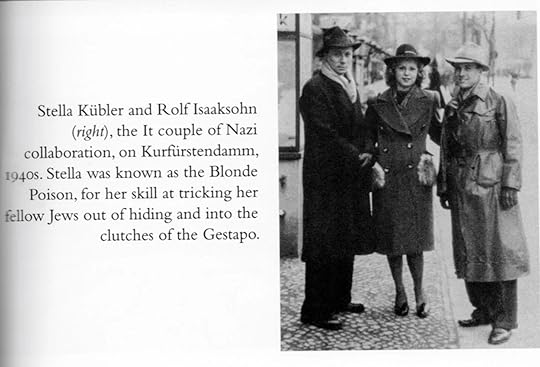
This led to me reading her Wikipedia page which tells a much bigger story, and this led to my learning about a 2023 movie, Stella, a Life, shortlisted as the German submission for the Academy Award for Best International Feature Film for the 97th Academy Awards. I am going to rent it at Fandango.
It also led me to one of several true heroes of this book, Countess Maria von Maltzan, a veterinarian who hid her Jewish lover, helped Jews escape, and even stood up to the molestations of the Russians who liberated Germany but also liberally raped women. There is a videoed oral history with her here: Oral history interview with Maria Grafin von Maltzin, 2 hrs. and bad audio.
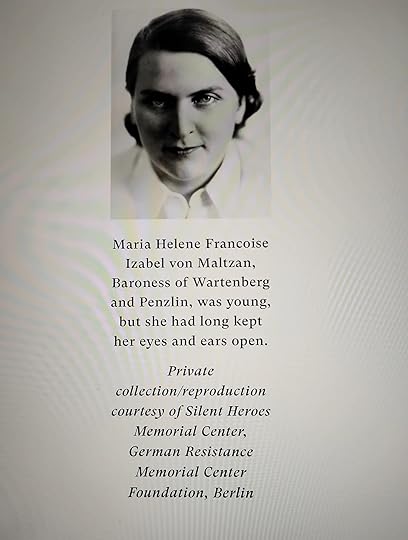
I am so eager to understand what makes one person endure torture yet never betray others and another (Greifer Stella Kȕbler) to not only betray her own people but rebuke them with contempt once she is free of personal threat.
Before Hitler took over in 1933, Berlin had more than 160,000 thriving Jews. When the war was over, there were 1,500. One of the characters who was interned in Ravensbrȕck concentration camp, a sick woman named Lagi Solf who died young after liberation, trying desperately to free her husband from a Soviet-run labor camp, once free, seemed to lose the resilience that had sustained her through the camp. She wrote:
Here are some villains; since it’s not always clear from the captions, I’m adding to them.
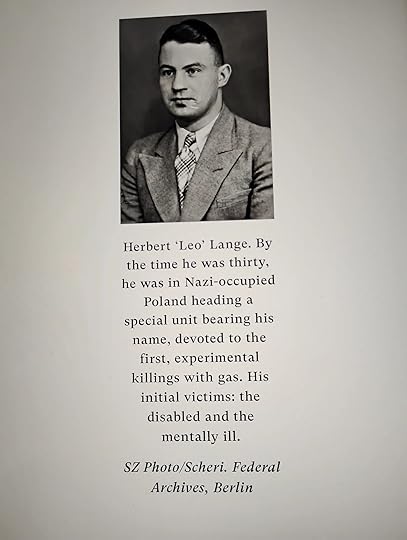
Leo Lange inaugurated gassing people to death by experimenting in ways to murder first sick and disabled people, then Jews. He was famous for his death van disguised as a coffee truck.
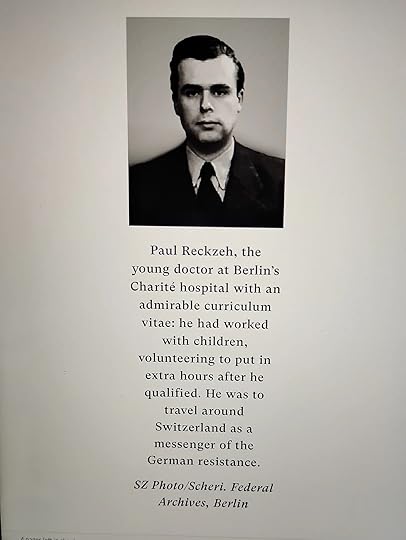
Paul Reckseh should chill all Americans’ blood. He was a doctor who worked as a spy for the Gestapo (pretending to be with the German resistance), was responsible for the arrest of all those involved in the infamous tea party, testified at their trials, and much more. And he got away scot-free. His father, also a doctor, after the war testified that his son was a congenital psychopath. No matter what he did, he always managed to slither free and not only get away with it, but by making manipulative alliances, live quite well. He believed in nothing but himself and his own wellbeing. His "colleagues regarded him as untrustworthy from the start. His wife's friends found him creepy and pompous, whether because of his tendency to pepper any conversation with Latin tags or his constant bragging. (416)" After sabotaging his own daughter for daring to try to go with her fiancé to West Germany and having her arrested by the Stasi of East Germany (where he was living well beyond his salary means), he died “a peaceful, old-man’s death on the last day of March 1996, his remains buried in the anonymous field of urns in the Ohlsdorf [West Germany after reunification] main cemetery. Like so many Nazis who had spilled the blood of innocents, he was allowed what his victims were denied: a life. (419)”
A note about the edition(s) of the book I read
I took this very long book out of the library. There was so much demand for it that I had to wait awhile and I could not renew it because others had it on hold. The minute I began to read I realized the borrow time would be a problem (this is not a book to fly through). So I bought a copy. I preferred the cheaper and easier to hold e-book, and I bought it at Bookshop.org, where profits go to indie bookstores. Their e-books are the same cost as Amazon's Kindle edition. I read mine on my iPad which is actually easier on the eyes than the small font of the hardback, and as I found places I wanted to highlight in the hardback, I made the notation on my e-book.
Also, in the e-book, the photos are in their own section at the back of the book where they are far more pristine, vivid, and therefore chilling than the reproduced images in the hardcover.
For both present-day USA and Hitler's Third Reich, cruelty and terrorizing people is/was the intention. How the torture was so studied and developed makes me queasy. But it is important to know.
This is vibrant, character-driven history, not "torture porn" but Freedland does not back away from what these people endured as the Nazis interrogated them not only for their "defeatism" (the crime of believing Germany would not win the war) at the tea party but for nonexistent connections to the German generals' foiled attempt to assassinate Hitler.
In my hunger to understand the difference between then and now, I took note of details about the Gestapo's inaugural mission "to detect the first hints of a hostile opinion forming in the German population, and to prevent the holders of those opinions, dissidents actual or potential, from making contact with each other (132)." Despite the chilling similarity between Hitler's trajectory and our own, our internet allows lightning speed communication and sharing of information that Nazi Germany did not have. It has birthed a robust independent media on Substack—trained journalists who value fact-checking and sourcing—that is working at blazing speed to inform us—publicly, in real time. It has summoned nearly 8 million of us to the streets to fight for democracy; nobody is hiding. It allows me to write freely here and on Substack about my concerns and disgust with the Trump regime. So there is no need for secrecy on the democracy side and there can be none of the secrecy that allowed the Nazis to thrive as they did. That, to me, is cause for some optimism.
As with Freedland's previous book, this one sent me into my own research. He briefly mentions "Greifers"—Jews who worked for the Nazis grabbing "submarines" (Jews who were hiding) and sending them to their deaths in concentration camps. The most infamous Greifers were Stella Kȕbler and Rolf Isaaksohn. Stella was known as the "Blonde Poison" for her skillful tricking of fellow Jews. Because the mention is so brief, I instantly judged her to be a monster, and I was absolutely incredulous. How could anyone do this?
This led to me reading her Wikipedia page which tells a much bigger story, and this led to my learning about a 2023 movie, Stella, a Life, shortlisted as the German submission for the Academy Award for Best International Feature Film for the 97th Academy Awards. I am going to rent it at Fandango.
It also led me to one of several true heroes of this book, Countess Maria von Maltzan, a veterinarian who hid her Jewish lover, helped Jews escape, and even stood up to the molestations of the Russians who liberated Germany but also liberally raped women. There is a videoed oral history with her here: Oral history interview with Maria Grafin von Maltzin, 2 hrs. and bad audio.
I am so eager to understand what makes one person endure torture yet never betray others and another (Greifer Stella Kȕbler) to not only betray her own people but rebuke them with contempt once she is free of personal threat.
Before Hitler took over in 1933, Berlin had more than 160,000 thriving Jews. When the war was over, there were 1,500. One of the characters who was interned in Ravensbrȕck concentration camp, a sick woman named Lagi Solf who died young after liberation, trying desperately to free her husband from a Soviet-run labor camp, once free, seemed to lose the resilience that had sustained her through the camp. She wrote:
I do not want to think of the past because it has lost its meaning. The world has learned nothing from it—neither slaughterers nor victims nor onlookers. Our time is like a dance of death whose uncanny rhythm is understood by few. Everyone whirls confusedly without seeing the abyss. (387)If you want to better understand the abyss we Americans are circling, take a look at this deeply researched book that reads as if it has a novel's plot.
Here are some villains; since it’s not always clear from the captions, I’m adding to them.
Leo Lange inaugurated gassing people to death by experimenting in ways to murder first sick and disabled people, then Jews. He was famous for his death van disguised as a coffee truck.
Paul Reckseh should chill all Americans’ blood. He was a doctor who worked as a spy for the Gestapo (pretending to be with the German resistance), was responsible for the arrest of all those involved in the infamous tea party, testified at their trials, and much more. And he got away scot-free. His father, also a doctor, after the war testified that his son was a congenital psychopath. No matter what he did, he always managed to slither free and not only get away with it, but by making manipulative alliances, live quite well. He believed in nothing but himself and his own wellbeing. His "colleagues regarded him as untrustworthy from the start. His wife's friends found him creepy and pompous, whether because of his tendency to pepper any conversation with Latin tags or his constant bragging. (416)" After sabotaging his own daughter for daring to try to go with her fiancé to West Germany and having her arrested by the Stasi of East Germany (where he was living well beyond his salary means), he died “a peaceful, old-man’s death on the last day of March 1996, his remains buried in the anonymous field of urns in the Ohlsdorf [West Germany after reunification] main cemetery. Like so many Nazis who had spilled the blood of innocents, he was allowed what his victims were denied: a life. (419)”
A note about the edition(s) of the book I read
I took this very long book out of the library. There was so much demand for it that I had to wait awhile and I could not renew it because others had it on hold. The minute I began to read I realized the borrow time would be a problem (this is not a book to fly through). So I bought a copy. I preferred the cheaper and easier to hold e-book, and I bought it at Bookshop.org, where profits go to indie bookstores. Their e-books are the same cost as Amazon's Kindle edition. I read mine on my iPad which is actually easier on the eyes than the small font of the hardback, and as I found places I wanted to highlight in the hardback, I made the notation on my e-book.
Also, in the e-book, the photos are in their own section at the back of the book where they are far more pristine, vivid, and therefore chilling than the reproduced images in the hardcover.

September 23, 2025
I received a free copy of this book from Net Galley. The following review is only my thoughts, and have not been influenced by the author, the publisher or by Net Galley.
This is a heart-wrenching biography on an Anti-Nazi group made up of people from all walks of life. Family members. Differences in ages. Of workers or people of pleasure. A group of intellectuals that came together to talk. These weren't people who wanted to kill Hitler or any other Nazi. These were people talking about how the world would be better if Hitler and the Nazis were over-thrown and the world returned to making sense. And yet even that, these discussions between them over how Germany could be changed, was enough to sign their death warrant.
The aftermath once caught; upon being betrayed changed their lives. Not all of them survived, and the ones that did were broken. And yet the spy in their midst... Well, you'll have to read the book to find out what happened to -that one-.
I don't want to go much further into this book, because I feel like this will detract from the beauty of the writing style, of the lives of everyone involved in this. Jonathan Freedland is a really good author, based on this book alone I will be seeking out more of his. This reads more like a thriller, and there is barely any point when the reader can breathe. I had to put this down because not only was I not going to bed at a reasonable time, or even at a unreasonable one, I was staying up until three in the morning. And not only did I need sleep; I needed to pause from the rush of feelings that never melted away. This book consumed me.
I'd highly recommend this book, and I'm buying the audiobook once it comes out.
4.5 Stars
This is a heart-wrenching biography on an Anti-Nazi group made up of people from all walks of life. Family members. Differences in ages. Of workers or people of pleasure. A group of intellectuals that came together to talk. These weren't people who wanted to kill Hitler or any other Nazi. These were people talking about how the world would be better if Hitler and the Nazis were over-thrown and the world returned to making sense. And yet even that, these discussions between them over how Germany could be changed, was enough to sign their death warrant.
The aftermath once caught; upon being betrayed changed their lives. Not all of them survived, and the ones that did were broken. And yet the spy in their midst... Well, you'll have to read the book to find out what happened to -that one-.
I don't want to go much further into this book, because I feel like this will detract from the beauty of the writing style, of the lives of everyone involved in this. Jonathan Freedland is a really good author, based on this book alone I will be seeking out more of his. This reads more like a thriller, and there is barely any point when the reader can breathe. I had to put this down because not only was I not going to bed at a reasonable time, or even at a unreasonable one, I was staying up until three in the morning. And not only did I need sleep; I needed to pause from the rush of feelings that never melted away. This book consumed me.
I'd highly recommend this book, and I'm buying the audiobook once it comes out.
4.5 Stars
October 3, 2025
This was such an interesting non-fiction book about the secret resistance network in WW2 Nazi Germany, and the spy who betrayed them. I love reading about parts of history that are not well known. In The Traitors Circle we read about a group of Germans, working to resist Hitler and the Nazis, but one of them is a spy. Freedland did such a great job with his research and the way he implemented it all in such a gripping way. This book was intense and I cannot believe the bravery of these people. The things they did, and how they risked their lives is beyond amazing! It breaks my heart to know what happened to some, and wishing others got what they deserved. Such a great read and now my 17 yr old son who LOVES history is also going to read this!
Thank you to the publisher for the gifted copy. All opinions are my own.
Thank you to the publisher for the gifted copy. All opinions are my own.

March 20, 2026
Susan Rice, perhaps opined it best on how to destroy the supposed enemies who oppose a certain doctrine: "The Democrats will get even with those who opposed us in the past." With that mindset is exactly how Adolph Hitler eliminated anyone who opposed Nazism.
Mr. Freedland outlines in his outstanding book how Adolph Hitler and his henchmen stopped at no expense to murder those who refused to submit to The Third Reich.
Mr. Freedland relied upon a plethora of documents to support his argument how the German people betrayed life long friends and even family members to betray anyone who dared speak out against Hitler and his obsession to eliminate the Jews throughout Germany and Europe.
Mr. Freedland outlines in his outstanding book how Adolph Hitler and his henchmen stopped at no expense to murder those who refused to submit to The Third Reich.
Mr. Freedland relied upon a plethora of documents to support his argument how the German people betrayed life long friends and even family members to betray anyone who dared speak out against Hitler and his obsession to eliminate the Jews throughout Germany and Europe.

August 23, 2025
4.5* The Traitor’s Circle - Jonathan Freedland. Bringing together multiple strands of the true story of those who stood up against the tyranny of the Nazis. An impeccable work of non-fiction which buries deep into the soul (this book wlll be with me for a long time), while reading like a thriller and courtroom drama. It’s an astonishing accomplishment.
The work of the resistance across Europe is well documented across every kind of media. There have been some excellent accounts of life for ordinary Germans living inside the Nazi bubble but Jonathan Freedland brings us a fascinating account of those who secretly denounced the Nazi party, hid and helped Jews, denounced the rhetoric of certain victory and actively planned for a Germany beyond the Third Reich. The group comprise nobility, high ranking officials and intellectuals and they are all aware of the peril of denouncing Hitler’s idea - potentially the death penalty. It is a powerful story of friendship, bonds and holding out against cruelty and evil.
The detail should be read and not spoilt in a review. Suffice to say there is follow up on those who make it to the end of the war. The detail is incredible (the first third is maybe a little too detailed) but the structure with short chapters and cliffhangers, means that this is not a dry work of non-fiction it is both a page turner and an eye opener. Highly highly recommended.
With huge thanks to John Murray Press and Netgalley for an ARC.
The work of the resistance across Europe is well documented across every kind of media. There have been some excellent accounts of life for ordinary Germans living inside the Nazi bubble but Jonathan Freedland brings us a fascinating account of those who secretly denounced the Nazi party, hid and helped Jews, denounced the rhetoric of certain victory and actively planned for a Germany beyond the Third Reich. The group comprise nobility, high ranking officials and intellectuals and they are all aware of the peril of denouncing Hitler’s idea - potentially the death penalty. It is a powerful story of friendship, bonds and holding out against cruelty and evil.
The detail should be read and not spoilt in a review. Suffice to say there is follow up on those who make it to the end of the war. The detail is incredible (the first third is maybe a little too detailed) but the structure with short chapters and cliffhangers, means that this is not a dry work of non-fiction it is both a page turner and an eye opener. Highly highly recommended.
With huge thanks to John Murray Press and Netgalley for an ARC.
November 1, 2025
A fascinating story of courage and defiance by extraordinary German people who refused to be engulfed in the horror and terror of the Nazi years.
Freedland tackles the disturbing subject of ‘what would I have done’ ‘what kind of person I might have been’.
The book is unfortunately peppered with spicy touches of murder mystery, little give-aways and spoiler alerts at the end of short chapters .
This style is unfortunate and inappropriate to honour the memory, bravery and resilience of those who have been betrayed, viciously tortured and brutally murdered.
Freedland tackles the disturbing subject of ‘what would I have done’ ‘what kind of person I might have been’.
The book is unfortunately peppered with spicy touches of murder mystery, little give-aways and spoiler alerts at the end of short chapters .
This style is unfortunate and inappropriate to honour the memory, bravery and resilience of those who have been betrayed, viciously tortured and brutally murdered.

October 30, 2025
Brilliantly written and researched: it must have been a mammoth task.

March 25, 2026
this book was displayed in the window of a book store in new zealand as one of the top 10 most popular books so that’s why i decided to give it a try. looking back im not sure why bc i don’t like history books? so take this review as from someone who doesn’t like this genre but forced myself to finish it😭
January 3, 2026
This was a very interesting and informative book about a group of German people during World War II who were anti-Nazi, and were exposed by a spy working for the Gestapo. The author did a wonderful job writing this story, and exposing the life of the spy himself. It's amazing how the horror that was Nazi Germany still has new stories to be told.
September 10, 2025
Jonathan Freedland’s The Traitors Circle is an extraordinary account of the little-told story of Germans who dared to resist Hitler from within Berlin’s elite circles. Drawing on meticulous research and vivid detail, he brings to life aristocrats, officials and intellectuals who risked everything, only to be betrayed and dragged before brutal Nazi courts. The book balances historical depth with the pace of a thriller, building tension around a fateful tea party while never losing sight of the moral weight of the story. Gripping, sobering and deeply human, it’s a powerful reminder of courage in the darkest of times.
Many thanks to John Murray Press, Jonathan Freedland and Netgalley for the advanced copy.
Many thanks to John Murray Press, Jonathan Freedland and Netgalley for the advanced copy.
September 9, 2025
Many thanks to NetGalley for providing an advance copy.
This review contains spoilers.
The Traitor's Circle's greatest strength is that it is absolutely gripping, in a way that had me flipping forward to the next chapter so many times when I should have been getting up to do chores or going to bed on time! I devoured this book in about three or four sittings, getting so hooked on the story that I read for several hours straight. The blurb promises tension, and the book delivers.
A real strength of this book is that it conveys so powerfully the kind of everyday stress and scrutiny that came with the Nazi regime, and how oppressive it was to live under. Readers get a clear picture of how horrendous it was - Freedland, to his credit, does not shy away from the gory details, especially when discussing Leo Lange, who essentially invented concentration camp gas chambers - and I think that emphasises just how brave the group of people the book follows really were. We follow them through true ups and downs, into the horrors of being imprisoned in a concentration camp and tortured, and it drives home the message of just how horrific Nazi Germany was.
Freedland does a great job of introducing us to the main cast of 'characters,' the people in the so-called 'Traitor's Circle.' Their stories were central to the book, and Freedland manages to condense a vast amount of research and detail into a narrative that is easy to follow and gripping to watch unfold. My only problem with this was that sometimes, the intense focus on the members of the tea party worked to the book’s detriment. There were several times when a brother, son, maid, etc., of one of the leading ‘characters’ seemed to spring out of nowhere, or were referred to as if they had already been introduced; I would have appreciated a little more introduction of these people.
Also, while I'm not entirely sure this is not my own faulty memory talking, I felt like we could’ve done with more explanation or detail of how the participants knew each other before they were all invited to the tea party. We got that for some members, but some invites seemed a little random. And because of this, it felt a little odd that the blurb and title were selling this as ‘the Traitor’s Circle’ as if they were an organised group of rebels, like the various groups who plotted to assassinate Hitler, several of whom (Black Orchestra, July 20th plot) are detailed in this book as well. As for the tea party group, it often seems more like they were rebels doing separate anti-government things who all happened to know each other and all happened to get invited to the tea party with the spy. They were treated as if they were an organised group later on by their interrogators, true, but it still felt like a disconnect between the marketing and what actually happened in the book.
As for the writing itself, I often felt The Traitor's Circle could have used more mentions of exactly where Freedland was getting his information from, for example, ‘she wrote in her diary’ or ‘we know from a letter’. The style he’s written it in increases the thriller-like nature of the text, but I would’ve really appreciated seeing a bit more of the bones, so to speak, so I would know when the author had direct evidence for someone saying or thinking something, and when he was inferring what they must have been feeling. I feel like this is so important in historical writing because it assures people you’re not just pulling this stuff from nowhere to make the story more exciting; it gives the text much more credibility.
Linked to this, I felt that the author missed a trick when I reached the acknowledgements section and saw how many relatives he had spoken to who got no mention in the text. Again, seeing more of the bones of the research would've helped hugely with making this feel more like a credible historical work than a thriller. It would’ve been great to hear that this comment came from an interview with a nephew or granddaughter, for example, and I don't think asides like that would've slowed down the pace of the book or made it feel less thrilling. The author did a tremendous amount of work and research in writing this book, and unless you flip through the notes or read the acknowledgements (which many readers don’t!), you’re not getting a good sense of exactly how much work went into this.
I also feel that there’s some information in the notes that would have been much more satisfying if it had been included in the main text. The account of what Bianca Segantini felt after Reckzeh was outed as a spy stands out most obviously in my mind; I was wondering about that throughout most of the book, and I am glad we got that answer, but it should have been in the main text!
And while we're talking about it, a note on the notes system in this book: I’m not convinced by the idea of having notes attached to phrases in the main text (i.e., “joining the Kriminalpolizei: Montague, Chełmno, p. 16.”) rather than the usual style of having a superscript number correspond with a note in the back of the book. In the former system, you still have to flip from the main text to the notes section to see exactly which part of the main text is relevant, and random phrases are, in my opinion, much harder to pick out than superscript numbers. A case of ‘don’t fix what isn’t broken'!
Throughout the book, I got a little tired of the ‘stinger’ lines at the end of every chapter. Some worked well, setting up anticipation for the next chapter that kept me reading, but when it was at the end of every chapter, it at times became forced and repetitive.
With all that said, I am still giving The Traitor's Circle four stars, as it is a very well-written book with a lot of research behind it. None of my gripes above really detracted from my reading experience all that much; I often got so caught up in the flow of the story that I didn't really notice them. What's more, I think The Traitor's Circle addresses a truly important subject matter that, with the worrying rise of fascist tendencies worldwide, we need to be discussing. Topical, intense, and thrilling, I would highly recommend The Traitor's Circle.
This review contains spoilers.
The Traitor's Circle's greatest strength is that it is absolutely gripping, in a way that had me flipping forward to the next chapter so many times when I should have been getting up to do chores or going to bed on time! I devoured this book in about three or four sittings, getting so hooked on the story that I read for several hours straight. The blurb promises tension, and the book delivers.
A real strength of this book is that it conveys so powerfully the kind of everyday stress and scrutiny that came with the Nazi regime, and how oppressive it was to live under. Readers get a clear picture of how horrendous it was - Freedland, to his credit, does not shy away from the gory details, especially when discussing Leo Lange, who essentially invented concentration camp gas chambers - and I think that emphasises just how brave the group of people the book follows really were. We follow them through true ups and downs, into the horrors of being imprisoned in a concentration camp and tortured, and it drives home the message of just how horrific Nazi Germany was.
Freedland does a great job of introducing us to the main cast of 'characters,' the people in the so-called 'Traitor's Circle.' Their stories were central to the book, and Freedland manages to condense a vast amount of research and detail into a narrative that is easy to follow and gripping to watch unfold. My only problem with this was that sometimes, the intense focus on the members of the tea party worked to the book’s detriment. There were several times when a brother, son, maid, etc., of one of the leading ‘characters’ seemed to spring out of nowhere, or were referred to as if they had already been introduced; I would have appreciated a little more introduction of these people.
Also, while I'm not entirely sure this is not my own faulty memory talking, I felt like we could’ve done with more explanation or detail of how the participants knew each other before they were all invited to the tea party. We got that for some members, but some invites seemed a little random. And because of this, it felt a little odd that the blurb and title were selling this as ‘the Traitor’s Circle’ as if they were an organised group of rebels, like the various groups who plotted to assassinate Hitler, several of whom (Black Orchestra, July 20th plot) are detailed in this book as well. As for the tea party group, it often seems more like they were rebels doing separate anti-government things who all happened to know each other and all happened to get invited to the tea party with the spy. They were treated as if they were an organised group later on by their interrogators, true, but it still felt like a disconnect between the marketing and what actually happened in the book.
As for the writing itself, I often felt The Traitor's Circle could have used more mentions of exactly where Freedland was getting his information from, for example, ‘she wrote in her diary’ or ‘we know from a letter’. The style he’s written it in increases the thriller-like nature of the text, but I would’ve really appreciated seeing a bit more of the bones, so to speak, so I would know when the author had direct evidence for someone saying or thinking something, and when he was inferring what they must have been feeling. I feel like this is so important in historical writing because it assures people you’re not just pulling this stuff from nowhere to make the story more exciting; it gives the text much more credibility.
Linked to this, I felt that the author missed a trick when I reached the acknowledgements section and saw how many relatives he had spoken to who got no mention in the text. Again, seeing more of the bones of the research would've helped hugely with making this feel more like a credible historical work than a thriller. It would’ve been great to hear that this comment came from an interview with a nephew or granddaughter, for example, and I don't think asides like that would've slowed down the pace of the book or made it feel less thrilling. The author did a tremendous amount of work and research in writing this book, and unless you flip through the notes or read the acknowledgements (which many readers don’t!), you’re not getting a good sense of exactly how much work went into this.
I also feel that there’s some information in the notes that would have been much more satisfying if it had been included in the main text. The account of what Bianca Segantini felt after Reckzeh was outed as a spy stands out most obviously in my mind; I was wondering about that throughout most of the book, and I am glad we got that answer, but it should have been in the main text!
And while we're talking about it, a note on the notes system in this book: I’m not convinced by the idea of having notes attached to phrases in the main text (i.e., “joining the Kriminalpolizei: Montague, Chełmno, p. 16.”) rather than the usual style of having a superscript number correspond with a note in the back of the book. In the former system, you still have to flip from the main text to the notes section to see exactly which part of the main text is relevant, and random phrases are, in my opinion, much harder to pick out than superscript numbers. A case of ‘don’t fix what isn’t broken'!
Throughout the book, I got a little tired of the ‘stinger’ lines at the end of every chapter. Some worked well, setting up anticipation for the next chapter that kept me reading, but when it was at the end of every chapter, it at times became forced and repetitive.
With all that said, I am still giving The Traitor's Circle four stars, as it is a very well-written book with a lot of research behind it. None of my gripes above really detracted from my reading experience all that much; I often got so caught up in the flow of the story that I didn't really notice them. What's more, I think The Traitor's Circle addresses a truly important subject matter that, with the worrying rise of fascist tendencies worldwide, we need to be discussing. Topical, intense, and thrilling, I would highly recommend The Traitor's Circle.

August 11, 2026
Um livro interessante, principalmente pelo contexto histórico e pelas histórias de resistência dentro do círculo de Hitler. Gostei do tema, mas achei que em alguns momentos a leitura se tornou um pouco pesada com alguns promenores a serem bastante gráficos e detalhado. No geral, foi uma leitura interessante.

January 26, 2026
2.5 stars. Could’ve been 150 pages shorter.

February 24, 2026
5 ⭐️ This was a very long harrowing read but so very worth it. It's hard to imagine the depravity of Nazi Germany with the Gestapo, SS and its spy's. The heroism in the face of such evil makes for a very interesting read. Recommended reading in my opinion
February 26, 2026
Interesting look at aristocratic Germans "resisting" fascism passively, all the way to risking their lives for their fellow man, all would pay a price.
March 20, 2026
This was a book detailing the true accounts of a group of people trying to defy the Nazis. (Was the group a book club? Or a tea party ? I picked it up multiple times over the month reading other books on other devices. That poor woman that hosted and invited the spy that did them in...) There were many personal accounts of these individuals in their attempts to stand up to the regime. The book was well researched and presented in an interesting format, and the audiobook was done well.
September 7, 2025
This is interesting but it took me a while to get onboard with the writing style
January 12, 2026
it took me like, 3 months, to finish this book. it’s an all in all fulfilling read even if at no point did i actually know who anyone was in the 375 pages… but that’s a personal problem. Freedland does a good job at creating suspense early on, but i found myself yawning through some of the middle part.
January 22, 2026
dnf at 18%
Disjointed writing, repetitive, boring and the historical accuracy is in question. I couldn't finish this one. I love reading history non-fiction, particularly on WWII but this was a slog.
Disjointed writing, repetitive, boring and the historical accuracy is in question. I couldn't finish this one. I love reading history non-fiction, particularly on WWII but this was a slog.

December 17, 2025
Long and obvs heavy going. Scary reminder of what happened. Really interesting and would recommend to everyone as it told historical facts in a story/fiction way.

January 2, 2026
Sensational and not at all to do with BBC’s The Traitors

June 8, 2026
What to do if you are bothered by inquisitive SS men at the post office, just as you are about to mail illicit material abroad? Without hesitation, Maria von Maltzan challenged them to a drinking game, in which she held her own for several rounds before slipping away with the contraband. Jonathan Freedland has produced a compelling account of upper-class dissidents in the Third Reich, many of them instinctively conservatives or nationalists themselves, who were affronted by what Hitler and the Nazis were doing to Germany, and determined to oppose them.
Their dissent was prompted by motives that would have been uncontroversial in most other societies: Christian charity, disapproval of the regime’s bullying and corruption, and patriotic concern for the future of Germany. More important, perhaps, they were better placed to resist than most Germans, with country estates and large townhouses providing a greater degree of privacy and independence, but above all with friends in high places, including senior Nazis. Their social standing enabled them not only to hide Jews, but also – with the help of contacts in Switzerland and the western Allies – to help them escape. Born to rule, they were sometimes recklessly outspoken in their criticism of the regime, but they were also meticulously careful to cover their tracks – for the most part.
Fascists are notoriously thin-skinned, however, and even the discreet “defeatism” of a small group of afternoon tea-party guests in Berlin discussing Germany’s increasingly bleak military prospects in the autumn of 1943 was too much for the regime. These patriotic “traitors” were denounced by a very charming young doctor who had infiltrated this group.
Arrests, imprisonment and torture inevitably followed. Elisabeth von Thadden and Otto Kiep, identified as ringleaders, were sentenced to death. Others survived, but struggled to come to terms with their experience.
Reinforces what I've always said: not all Germans were Nazis but not surprisingly, for me at least, was that most were upper-crust which made sense in Germany at that time. Some low-life like Adolf was NOT going to tell these high society Germans what to do and think. 3.5
Their dissent was prompted by motives that would have been uncontroversial in most other societies: Christian charity, disapproval of the regime’s bullying and corruption, and patriotic concern for the future of Germany. More important, perhaps, they were better placed to resist than most Germans, with country estates and large townhouses providing a greater degree of privacy and independence, but above all with friends in high places, including senior Nazis. Their social standing enabled them not only to hide Jews, but also – with the help of contacts in Switzerland and the western Allies – to help them escape. Born to rule, they were sometimes recklessly outspoken in their criticism of the regime, but they were also meticulously careful to cover their tracks – for the most part.
Fascists are notoriously thin-skinned, however, and even the discreet “defeatism” of a small group of afternoon tea-party guests in Berlin discussing Germany’s increasingly bleak military prospects in the autumn of 1943 was too much for the regime. These patriotic “traitors” were denounced by a very charming young doctor who had infiltrated this group.
Arrests, imprisonment and torture inevitably followed. Elisabeth von Thadden and Otto Kiep, identified as ringleaders, were sentenced to death. Others survived, but struggled to come to terms with their experience.
Reinforces what I've always said: not all Germans were Nazis but not surprisingly, for me at least, was that most were upper-crust which made sense in Germany at that time. Some low-life like Adolf was NOT going to tell these high society Germans what to do and think. 3.5
This entire review has been hidden because of spoilers.
July 12, 2026
I have seen some reviewers disparage this work as not being as deep a dive into the history of this story as they would have liked. And I could understand that argument - however that is precisely what this book is trying not to be.
Jonathon Freeland, instead, does a tremendous job homing in and exploring the both the lives and the dire consequences faced by those unfortunate enough to attend von Thadden’ tea party. Its structure is approachable and unbelievably easy to read. Short, snappy chapters prevent you from ever feeling stuck, or bogged down in a difficult or slightly dryer aspect of the story (not that there is much of that anyway) as 1943 ticks into ‘44 and ‘45.
With a small understanding and interest in the Second World War already, I was familiar with a handful of the key characters the story hinges upon. However Freeland expertly manages to juggle the plethora y of key players in a way which never becomes confusing or overwhelming. I felt I always knew exactly where I was in the story, and whom I was with. Not only that, but he also does a wonderful job of ensuring you get a full, in colour picture of who they are - I can almost imagine conversing with each of them. And not only that, but upon finishing this book, I feel compelled to look deeper.
No, this isn’t an academic deep dive, but rather it as perfect stepping off point for further exploration. Whether you’re enthralled by the Second World War and want a snapshot of some people’s lives within the Reich, or you’re just a fan of fascinating stories of bravery and mystery - this book will offer something to each in a way which is enjoyable, accessible and undoubtedly engaging.
Jonathon Freeland, instead, does a tremendous job homing in and exploring the both the lives and the dire consequences faced by those unfortunate enough to attend von Thadden’ tea party. Its structure is approachable and unbelievably easy to read. Short, snappy chapters prevent you from ever feeling stuck, or bogged down in a difficult or slightly dryer aspect of the story (not that there is much of that anyway) as 1943 ticks into ‘44 and ‘45.
With a small understanding and interest in the Second World War already, I was familiar with a handful of the key characters the story hinges upon. However Freeland expertly manages to juggle the plethora y of key players in a way which never becomes confusing or overwhelming. I felt I always knew exactly where I was in the story, and whom I was with. Not only that, but he also does a wonderful job of ensuring you get a full, in colour picture of who they are - I can almost imagine conversing with each of them. And not only that, but upon finishing this book, I feel compelled to look deeper.
No, this isn’t an academic deep dive, but rather it as perfect stepping off point for further exploration. Whether you’re enthralled by the Second World War and want a snapshot of some people’s lives within the Reich, or you’re just a fan of fascinating stories of bravery and mystery - this book will offer something to each in a way which is enjoyable, accessible and undoubtedly engaging.

February 4, 2026
The Traitor’s Circle reads like a heart-in-your-throat suspenseful thriller but is tragically true and lacks a happy ending. This story of deceit and betrayal is well researched and thoroughly documented with details taken from letters, diaries, testimonies and court documents as well as memoirs and interviews with relatives of the individuals remembered here. Hanna Dotti Solf, the daughter of an industrialist, banker and widow of the former governor of German Samoa and Ambassador to Japan founded a group of like-minded people which came to be known as the Solf Circle (“Solf-Kreis” in German) dedicated to help victims of Nazi persecution flee the country. These friends were influential, upper-class intellectuals and ardent anti-fascists who bravely opposed Hitler. Most of whom paid the ultimate price when a charming spy and member of the Gestapo deceptively infiltrated one of their afternoon tea parties.
This potent and relatively unexamined segment of history is well worth exploring and elicits honor for the courage of convictions displayed...
There's more we have to say! Read the full review on BookTrib.com
This potent and relatively unexamined segment of history is well worth exploring and elicits honor for the courage of convictions displayed...
There's more we have to say! Read the full review on BookTrib.com

January 5, 2026
Fascinating book, excellent narration.
At first I found this audio version a bit confusing, as more and more people and the details of their lives were introduced. Being an audiobook, one can't really flip pages to remind oneself who was who and where they fitted in.
Just persevere for a bit and it all starts clicking into place as the stars of the stories and the historical threads become fleshed out. I found myself drawn deeply into the subjects' lives and on the edge of my seat as danger crept ever closer.
I have read many books on WW2, but was not aware of these particular German resistance figures and their fates. What fascinating, diverse characters who risked their welfare and their lives to stick to their convictions, resist the Nazis and help the persecuted. At times I must admit I was moved to tears.
The author's narration is excellent with my only gripe his mispronunciation of more challenging German names and words. The bit of extra Googling I'll need to do to clarify in order to explore further, is an exceedingly small price to pay for the pleasure and enrichment gained.
At first I found this audio version a bit confusing, as more and more people and the details of their lives were introduced. Being an audiobook, one can't really flip pages to remind oneself who was who and where they fitted in.
Just persevere for a bit and it all starts clicking into place as the stars of the stories and the historical threads become fleshed out. I found myself drawn deeply into the subjects' lives and on the edge of my seat as danger crept ever closer.
I have read many books on WW2, but was not aware of these particular German resistance figures and their fates. What fascinating, diverse characters who risked their welfare and their lives to stick to their convictions, resist the Nazis and help the persecuted. At times I must admit I was moved to tears.
The author's narration is excellent with my only gripe his mispronunciation of more challenging German names and words. The bit of extra Googling I'll need to do to clarify in order to explore further, is an exceedingly small price to pay for the pleasure and enrichment gained.

January 25, 2026
I didn’t know about the story within this book - which isn’t a surprise as the characters (members of WWII-era German high society who opposed the Nazis) obviously didn’t achieve any of their goals and were some of the millions crushed by the time in which they lived.
Freedland brings their story to life really well - although lots of them lived remarkable lives, the common thread binding them together is very innocuous; really just that they met intermittently with varying degrees of conviction before being betrayed.
As a book, it really picks up momentum as it goes - I found the first 100 pages or so dragged but the build towards the conclusion (including, inevitably, the lack of consequences for the informant who died post-reunification having served a total of 2 years in prison in the 1950ss) is very painfully reconstructed and told.
Freedland brings their story to life really well - although lots of them lived remarkable lives, the common thread binding them together is very innocuous; really just that they met intermittently with varying degrees of conviction before being betrayed.
As a book, it really picks up momentum as it goes - I found the first 100 pages or so dragged but the build towards the conclusion (including, inevitably, the lack of consequences for the informant who died post-reunification having served a total of 2 years in prison in the 1950ss) is very painfully reconstructed and told.
Displaying 1 - 30 of 232 reviews