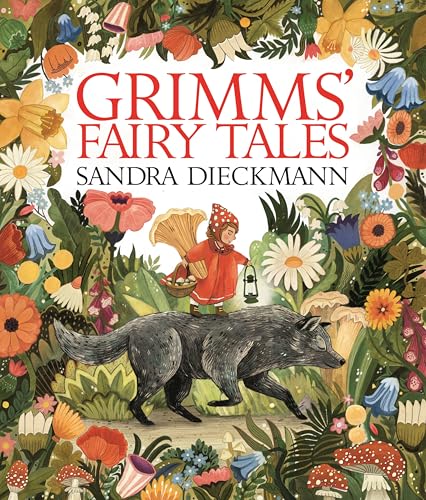
Twenty classic stories get a gently modernized twist in Sandra Dieckmann’s beautifully illustrated collection of treasured and lesser-known fairy tales.
From internationally acclaimed creator Sandra Dieckmann comes a captivating collection of Grimms’ fairy tales, accessibly written and illustrated with an eye to inclusivity. Including much-loved stories like “Rapunzel” and “Sleeping Beauty” as well as more obscure gems from the author’s childhood in northern Germany, this splendidly illustrated gift book of twenty tales is poised to charm readers of all ages. Enchanted forests, wild animals, powerful princesses, and brave heroes all reflect a lightly modern take in this Grimms’ collection to be cherished by all.
In a Nutshell: A collection of some of the best-known and not-so-known fairy tales from the Brothers Grimm works. Many tales updated, some mostly the same. Some are light, some dark. Good for fairytale-loving kids. Parental guidance advised.
~~~~~~~~~~~~~~~~~~~~~~~
This collection has twenty fairy tales from the compilations of the Brothers Grimm. Most of the tales are popular ones such as ‘Rumpelstiltskin’ and ‘Sleeping Beauty’, but there are also a couple of relatively uncommon tales such as ‘Sweet Porridge’ and ‘Jorinda and Joringel’. A few of the tales were known to me under other names. For instance, ‘The Shoes That Were Danced to Pieces’ always appeared as ‘The Twelve Dancing Princesses’ in my fairytale story books.
Now you might wonder if we really need yet another fairytale collection based on the Grimm compilations. Aren’t there too many of them in the market already? I agree. But the stories in this book come with a twist. Or rather, as the blurb calls it: “a gently modernized twist”.
While almost all the stories will be familiar to most (adult) readers, the book changes a few details. For instance, there is no “true love’s first kiss” at all in ‘Sleeping Beauty’ and ‘Little Snow White’. One key character in ‘ Little Snow White’ and Little Red Cap (or as we know it more popularly, ‘Little Red Riding Hood’) is a woman instead of the man in the originals. Even the ending of two stories (‘Little Red Cap’ and ‘The Frog Prince’) is slightly different. There are some more stories with changes, but let me not spill all the beans here.
Of course, many of the stories retain the original Grimm content, which means it is *grim* content, not the frothy Disney version. Expect darkness. (The worst in this regard was ‘The King of the Golden Mountain’. I had never read this story before, and now that I read it, I know why it isn't a common inclusion in children’s fiction. What a horrible ending!) There are also a good number of tales where daughters end up being given in marriage as a reward; this is a shortcoming of the original stories and not of this particular collection.
The illustrations, sketched by author Sandra Dieckmann herself, are wonderful. There are the usual smaller mid-page illustrations and also full-page sketches. All are in full colour and complement their story and the mood of the book perfectly. While the graphics obviously need to match the stories and hence can't experiment much, they still try to be inclusive wherever possible, especially in terms of the characters’ skin tones and ethnic appearance. I love how one of the ballroom dance scenes showed two men dancing with each other.
Overall, while classic fairy tales haven’t necessarily aged well, this book does a commendable job of updating at least some of the hackneyed details without killing the essence of the original stories. Having both known and not-so-known fairytales in a single volume is also a great idea. The diversity in the illustrations is a bonus.
Recommended to children interested in fairytales. The official target age is 4-8 years, but some of the tales would be quite horrifying for little readers. I think the book would better suit slightly older children, so perhaps 7-10 years. The book would also a great gift option during this festive season thanks to its colourful illustrations.
3.75 stars.
My thanks to Candlewick Press for providing the DRC of “Grimms' Fairy Tales” via Edelweiss+. This review is voluntary and contains my honest opinion about the book.
Adults will no doubt be familiar with most if not all of the 20 fairy tales by the Brothers Grimm chosen by this author to adapt and to illustrate. They may not, however, recollect them in the ways they are retold by Dieckmann.
Jacob (1785-1863) and Wilhelm (1786 - 1859) Grimm were German academics who shared a lifelong dedication to collecting and publishing German folktales, debuting their first collection of folklore in 1812. The brothers popularized stories still well-known and retold today, including Cinderella, The Frog Prince, Hansel and Gretel, Sleeping Beauty, Snow White, and Rapunzel. All of the aforementioned are featured in Dieckmann’s edition (although sometimes with different titles).
That first edition of folktales from the Brothers Grimm, Kinder und Hausmärchen (Children's and Household Tales) had 210 stories and went through seven editions. Along with The Arabian Nights, the two books are, according to the writer Sir Philip Pullman, the most important and influential collections of folk tales ever published. Their enduring appeal has led to countless retellings and adaptations and in various formats.
Some of the Grimms’ recurring motifs have led to a variety of academic studies. College courses may focus on Jungian archetypes, (universal and fundamental patterns of human behavior driven by our deepest motivations, fears, and desires) that are said to be embodied by the fairy tales; the inclusion of sex and violence and their Freudian implications; attitudes toward women revealed by the stories; the characterizations of valor and virtue; and the commentary on family dynamics, especially when stepparents enter into the picture. For this volume designed for young readers, most of the sex and violence has been toned down.
For example, while there is still evil and there are still bad people (usually women), there is much less in the way of intimacy - even, say, when it might be needed to wake you up from a sleeping spell. And as for those spells, they are more often punitively inflicted on women, for no more reason than being pretty, or talented, or nice. Violence has been included (you can scarcely get through a Grimms’ tale without it) but it is largely reserved for witches, meanies, traitors, and other characters clearly “deserving” of a wretched end. And some of the violence is skipped altogether: in this book, while Cinderella’s stepsisters do mutilate themselves to try to fit into the glass slipper, the story ends before they have their eyes pecked out by doves.
(And by the way, a Grimm scholar avers that the tales were never meant to be classified as children’s stories: “the Grimms’ first collection was shaped as an archaeological excavation and as a book for adults and for scholars.”)
Some other non-Grimm-like aspects have been added. The story of Little Red Riding Hood (here called “Little Red Cap”) features a gender switch with the inclusion of a brave female forest ranger saving the day. It also has the wolf feeling guilty for his deeds, as evinced afterwards, when Little Red Cap asks him:
"'Have you got someone you love?’ And even though he didn’t respond, she added, ‘Would you like them to be eaten?’”
Censorious parents and school boards may be gratified that Rapunzel’s out-of-wedlock pregnancy goes unmentioned, and that Sleeping Beauty is awakened without a kiss from a stranger. But I can’t imagine that homophobes who insist on imposing their notions of morality on book content will let pass the illustration showing same-sex couples dancing at Cinderella’s ball. Nor are they likely to appreciate the varied skin tone of some of the protagonists. It’s a pity, but that is the regrettable nature of the Zeitgeist.
Evaluation: It’s hard to resist a fairy tale, and even harder to pass up this modernized collection with its beautiful illustrations, also by the author. On pages with mostly text, she often includes a rich decorative border, full of clever details that reflect the story. The colors are vivid, and both people and animals have expressive faces that clearly indicate their feelings - I especially loved the wolf’s shifting emotional state shown in Little Red Cap. There are animals on most of the pages, and they appear in friendly and helpful guises. Unlike some volumes of fairytales, there is nothing scary in this one - the images focus on happy moments. This book would make a lovely gift.
The is much debate on the appropriateness of Grimms' Fairy Tales for the reading to or by children. Some versions are somewhat benign and others replete with overtones of unacceptable behavior. The tales are not original to Grimms but are the Grimms' 1814 retelling of existing German folk tales passed down orally through the years.
Some retelling and publishing of the Grimme's versions have been gentled-down and told in bare minimum versions for young children. These are published in cute, sweet little books or produced in video versions animated or with actors.
Basically, it is up to the parents to make a determination what their child reads and when they read it.
Grimms' Fairy Tales by Brothers Grimm (Sandra Dieckmann)...
My thoughts: This is a beautifully illustrated publication of Grimms' Fairy Tales illustrated with rich colors and visually stimulating scenes and characters. The illustrations show the good and the bad side of the characters and the intensity of the story.
The compilation of 20 stories consists of well known stories and some rarely heard. The book is large size consisting of 176 pages and weighs about two pounds.
Folk tales were often used to scare children into obedience and to make them aware of evil in the world. In ages by gone, there wasn't a lot of entertainment so oral storytelling was a form of entertainment but carried with it strong emotions.
As I read through several of the listed stories, I found the text flowed well and was easy to understand. The story of "Little Red Cap" was essentially "Little Red Riding Hood" but a bit different from what I've traditionally heard. In this story, the wolf eats the little girl's grandmother, and the ranger cuts the wolf's stomach open so Grandmother can escape. Then the wolf's stomach is sewn shut. The story ends with Little Red Cap riding a demure wolf into the village. So ends well but with a bit of gore.
"Sleeping Beauty" was told sweetly but does talk about the evil fairy casting an evil spell. Story ends well with spell being broken by a gentle touch to Sleeping Beauty's face by the sweet man who rescues her.
So parents, the choice is yours.
I received a complimentary copy to facilitate a review. Opinions are mine, alone and are freely given.
Readers will enjoy the timeless nature of Grimms’ fairy tales paired with nostalgic artwork reminiscent of Tomie dePaola. The storybook collection contains full color illustrations and artwork used as both borders and multiple page pieces. This collection includes well-known stories such as Cinderella and Hansel and Gretel; a table of contents at the beginning of the book provides a clear roadmap to help readers navigate through the tales. Additionally, Dieckmann opens the book with a very touching dedication that I think sets the tone for the rest of the book. My favorite part of this read is the effort that Dieckmann made to incorporate diversity within the artwork. For example, one of the illustrations in Cinderella depicts same sex couples dancing at the ball. There are also many different ethnicities represented within the artwork as well. Link to complete review: https://ysbookreviews.wordpress.com/2...
- klasika v novom čarovnom šate - hrubšia kniha ( aj keď sa nezdá ) - nádherné ilustrácie - 20 rozprávok - návrat do detstva
Ja proste milujem tvorbu Sandry Dieckmann ( to tam musíte povedať 😄 ). Jej ilustrácie sú ako kúzelné okná do iných svetov a príbehy vždy pohladia dušu na tom správnom mieste. Doma mám už tri jej knihy a keď vyšla novinka - Rozprávky bratov Grimmovcov - bolo mi jasné, že zbierka sa rozrastie.
Táto kniha je nádherným spojením klasických príbehov, ktoré poznáme od detstva a novej vizuálnej mágie, ktorú vie vytvoriť len Dieckmann. Každá stránka proste dýcha úplnou rozprávkovou atmosférou. Čítanie príbehov bolo pre mňa návratom do detstva, no zároveň objavovaním niečoho nového. Sandra dokázala dať známym rozprávkam čerstvý dych a premeniť ich na malé umelecké diela.
Toto je kniha, ktorú si zamilujú deti aj dospelí, ktorí ešte nestratili schopnosť veriť na kúzla. Ak hľadáte darček, ktorý poteší oko aj srdce, Rozprávky bratov Grimmovcov sú presne to, čo hľadáte.
The illustrations are beautiful throughout the book, though I was a bit confused by how the author decided to edit and change the stories. Much of the mature and adult content was left in the stories and most of the edits seemed to be more oriented towards suiting the author’s personal beliefs. I think I would more easily understand editing the original tales if the more mature content was taken out.