

What do you think?

Der Vulkan
Klaus Manns Roman entfaltet ein facettenreiches Panorama von Exil-Schicksalen: Er erzählt vom oft bitteren Alltag der aus Nazi-Deutschland Vertriebenen, von ihren politischen Kämpfen und Debatten, von ihrer Not und Verzweiflung, von ihren Hoffnungen
Der Vulkan, den Klaus Mann selbst für sein bestes Buch hielt, ist ein großes poetisches Plädoyer für Toleranz und Menschlichkeit - gerade darum hat das Buch bis heute nichts von seiner Aktualität eingebüßt.
Der Vulkan, den Klaus Mann selbst für sein bestes Buch hielt, ist ein großes poetisches Plädoyer für Toleranz und Menschlichkeit - gerade darum hat das Buch bis heute nichts von seiner Aktualität eingebüßt.
570 pages, Paperback
First published January 1, 1939
About the author
Klaus Mann
206 books169 followers Born in Munich, Klaus Mann was the son of German writer Thomas Mann and his wife, Katia Pringsheim. His father was baptized as a Lutheran, while his mother was from a family of secular Jews.
Mann's most famous novel, Mephisto, was written in 1936 and first published in Amsterdam. The novel is a thinly-disguised portrait of his former brother-in-law, the actor Gustaf Gründgens. The literary scandal surrounding it made Mann posthumously famous in West Germany, as Gründgens' adopted son brought a legal case to have the novel banned after its first publication in West Germany in the early 1960s. After seven years of legal hearings, the West German Supreme Court upheld the ban, although it continued to be available in East Germany and abroad. The ban was lifted and the novel published in West Germany in 1981.
Mann died in Cannes from an overdose of sleeping pills on 21 May 1949, following further drug treatment. He likely committed suicide because of financial problems and social isolation. He was buried in Cannes at the Cimetière du Grand Jas.
Mann's most famous novel, Mephisto, was written in 1936 and first published in Amsterdam. The novel is a thinly-disguised portrait of his former brother-in-law, the actor Gustaf Gründgens. The literary scandal surrounding it made Mann posthumously famous in West Germany, as Gründgens' adopted son brought a legal case to have the novel banned after its first publication in West Germany in the early 1960s. After seven years of legal hearings, the West German Supreme Court upheld the ban, although it continued to be available in East Germany and abroad. The ban was lifted and the novel published in West Germany in 1981.
Mann died in Cannes from an overdose of sleeping pills on 21 May 1949, following further drug treatment. He likely committed suicide because of financial problems and social isolation. He was buried in Cannes at the Cimetière du Grand Jas.
Ratings & Reviews
Friends & Following
Create a free account to discover what your friends think of this book!
Community Reviews
Displaying 1 - 30 of 36 reviews

May 13, 2022
Klaus Mann finished ‘The Vulcan’ in 1938. It was subsequently published by Querido Publisher in Amsterdam in 1939. Klaus Mann left Germany in 1933 and he lived a while in Amsterdam and subsequently moved to Paris where he remained until 1938. In Paris, he was part of a steadily increasing group of German refugees. If you have read biographies of Klaus Mann and his sister Erika before, you realize that the characters Martin and Marion in ‘The Vulcan’ are an almost literal portrayal of the actual individuals that they were in real life.
Knowing what we know nowadays, it is rather astonishing to read that the German emigrants were optimistic that Germany would return to being a healthy nation of sensible people within a rather short time frame. They were unanimously expressing a strong desire to return to Germany as soon as they could. It took years for most of them to realize that the political situation in Germany would only unfold to ever more horror, hysterial adoration of Hitler and acceptance of fascism, but also how apathy and the fear to stand out became a common feature of the general public. It is easy for us to judge them naive, but how could they have possibly imagined the unimaginable what was to materialize. Reading the novel, you have to keep being aware that there was no way to predict what was about to come to pass, even in 1938 or 1939.
The German emigrants group in Paris consisted of a wide range of people of various political and philosophical persuasion, a lot of fired Jewish university professors, writers, actors and stage performers, but also a famous Berlin pub owner and her friends. All shared the same sentiments: a fierce hatred for Hitler and his cronies and the disgust at the passivity and the gradual realization of the cruelty of the nazi scum (as they call them) of the German population.
The novel is basically recounts the life of Martin and Marion, but the life stories of other group members are extensively discussed as well. There are quite a number of members of the group to depart for Spain to join the fight against Franco and that is, of course, an ultimate anti-fascist endeavour. Many did not return. Martin (I might as well call him Klaus, but he is a fictional character here) prefers to be his old passive self and stays in Paris. He subsequently allows himself to get increasingly addicted to cocaine and later on heroin, as occured to Klaus Mann in real life. Martin has a very odd boyfriend, Kikjou. Kikjou looks like an angel and is very religious. With the introduction of Kikjou and his religious deliberations, I often started to feel strangely irritated. The introduction of guardian angels also were quite out of control for a novel that was to that point realistic and full of intelligent conversations. The book was later severely critized by the emigrants and many other readers for this religious dimension. Perhaps it was a means for Klaus Mann to ventilate his agony about his own heroin addiction and seek a solution. But there was obviously no solution, so Klaus describes Martin’s suicide by heroin in shocking detail which is all the more devastating to read when you realize that Klaus killed himself in exactly same way in 1949, thus some 10 years later.
Klaus Mann moved to the United States in 1938. Erika and Thomas Mann and his wife had moved there earlier. Erika continued to travel with her recital tour of German poetry and anti-fascist lectures, as did her fictional character Marion in The Vulcan. Thomas Mann appreciated The Vulcan which must have been the only work of fiction of Klaus that he ever complimented Klaus on. It made Klaus tremendously happy.
The Vulcan was published in 1939 and only a few hundred copies of the novel were sold. When the Germans occupied the Netherlands in May 1940, they destroyed the remaining stock at Querido Publisher in Amsterdam. It was not until 1956 that Erika Mann managed to have the novel republished.
An interesting novel, but I found it very peculiar in its unbalanced moods. Klaus Mann’s novel ‘Mephisto’ (published 1936) is and will remain one of my favorite novels ever. ‘Mephisto’ was clear and passionate, offering an often hilarious portrayal of the top nazi’s and their devotees. Consequently, I had sometimes a hard time to appreciate the often quaint content of ‘The Vulcan’. Nevertheless, this is surely an interesting novel to read for the Mann affectionado’s.
Knowing what we know nowadays, it is rather astonishing to read that the German emigrants were optimistic that Germany would return to being a healthy nation of sensible people within a rather short time frame. They were unanimously expressing a strong desire to return to Germany as soon as they could. It took years for most of them to realize that the political situation in Germany would only unfold to ever more horror, hysterial adoration of Hitler and acceptance of fascism, but also how apathy and the fear to stand out became a common feature of the general public. It is easy for us to judge them naive, but how could they have possibly imagined the unimaginable what was to materialize. Reading the novel, you have to keep being aware that there was no way to predict what was about to come to pass, even in 1938 or 1939.
The German emigrants group in Paris consisted of a wide range of people of various political and philosophical persuasion, a lot of fired Jewish university professors, writers, actors and stage performers, but also a famous Berlin pub owner and her friends. All shared the same sentiments: a fierce hatred for Hitler and his cronies and the disgust at the passivity and the gradual realization of the cruelty of the nazi scum (as they call them) of the German population.
The novel is basically recounts the life of Martin and Marion, but the life stories of other group members are extensively discussed as well. There are quite a number of members of the group to depart for Spain to join the fight against Franco and that is, of course, an ultimate anti-fascist endeavour. Many did not return. Martin (I might as well call him Klaus, but he is a fictional character here) prefers to be his old passive self and stays in Paris. He subsequently allows himself to get increasingly addicted to cocaine and later on heroin, as occured to Klaus Mann in real life. Martin has a very odd boyfriend, Kikjou. Kikjou looks like an angel and is very religious. With the introduction of Kikjou and his religious deliberations, I often started to feel strangely irritated. The introduction of guardian angels also were quite out of control for a novel that was to that point realistic and full of intelligent conversations. The book was later severely critized by the emigrants and many other readers for this religious dimension. Perhaps it was a means for Klaus Mann to ventilate his agony about his own heroin addiction and seek a solution. But there was obviously no solution, so Klaus describes Martin’s suicide by heroin in shocking detail which is all the more devastating to read when you realize that Klaus killed himself in exactly same way in 1949, thus some 10 years later.
Klaus Mann moved to the United States in 1938. Erika and Thomas Mann and his wife had moved there earlier. Erika continued to travel with her recital tour of German poetry and anti-fascist lectures, as did her fictional character Marion in The Vulcan. Thomas Mann appreciated The Vulcan which must have been the only work of fiction of Klaus that he ever complimented Klaus on. It made Klaus tremendously happy.
The Vulcan was published in 1939 and only a few hundred copies of the novel were sold. When the Germans occupied the Netherlands in May 1940, they destroyed the remaining stock at Querido Publisher in Amsterdam. It was not until 1956 that Erika Mann managed to have the novel republished.
An interesting novel, but I found it very peculiar in its unbalanced moods. Klaus Mann’s novel ‘Mephisto’ (published 1936) is and will remain one of my favorite novels ever. ‘Mephisto’ was clear and passionate, offering an often hilarious portrayal of the top nazi’s and their devotees. Consequently, I had sometimes a hard time to appreciate the often quaint content of ‘The Vulcan’. Nevertheless, this is surely an interesting novel to read for the Mann affectionado’s.

July 6, 2025
From a literary perspective, this may not be the finest work by the German writer Klaus Mann (1906-1949), son of Thomas Mann, but as a historical document, it certainly still is valuable. Klaus wrote it between 1936 and 1939, when he was in exile, first in Amsterdam, and from 1938 in the United States. He quickly recognized the true nature of the Nazis and was among the first to leave his country. Those days, both in exile and in Germany, there was intense debate about whether migration was such a good choice: wasn't it better to take responsibility in one's own country and directly confront the Hitler regime there? In his prologue to this book, Mann has the young Dieter aptly express this: okay, the Nazis aren't exactly gentle people, but perhaps their rule won't last too long, and they are actually bringing a breath of fresh air to the country, which had become politically mired in a bitter struggle between left and right; migrating is, in any case, the worst of two good choices.
Throughout his voluminous book, Mann then unleashes a procession of characters on the reader, all German migrants, in Paris, Amsterdam, New York, and a dozen other locations, a very motley crew of highly diverse characters, each with their own perspective on the Nazis, Germany, and the world. They have in common—despite their occasional boastfulness—that they struggle with their practical situation (most of them are destitute), but also with their fundamental choice: did they do the right thing by leaving their country? Aren't they evading their responsibility by doing so? Can they actually influence the situation in Germany itself from abroad? And as the years pass: what future do they actually have left? All in all, the German communities in European and American cities form a pitiful, desperate heap of misery. It's a poignant picture the author paints.
Mann follows several characters more closely. Some, after many detours, end up relatively well (usually in America), others hit a wall and see no way out but suicide (also for reasons other than the political situation), and a few explicitly choose to return to Germany and put up a fight there. There's a constant debate about the situation in Germany (one character wonders whether Jews would be so opposed to the Nazis if these weren't anti-Semitic), and about the choices that must be made. This is undoubtedly the most interesting aspect of this novel. Not just for historical reasons: this book has relevance today, and shows the wrenching ambiguity that communities fleeing tyrannical regimes still grapple with today.
"The Volcano" (a reference to the fiery abyss looming over the migrants) is a literary work of very uneven quality. After a slow and unconvincing beginning (too many palavers), the novel gains momentum in the following sections, with sometimes very intense and poignant passages, but also very weak ones. Frequently, the tone is bombastic, message-driven, and even pushy, and towards the end, Mann briefly veers into surrealism when he has a character carried away by an angel to various countries where German emigrants have ended up. The author felt the need to clarify his own position in an epilogue (he wrote this section in early 1939): no concessions can be made to the Nazis, and exile is absolutely a responsible choice. It is admirable how Klaus Mann has tried to do justice to the struggles of people in his situation, and therefore this novel deserves continued attention.
Throughout his voluminous book, Mann then unleashes a procession of characters on the reader, all German migrants, in Paris, Amsterdam, New York, and a dozen other locations, a very motley crew of highly diverse characters, each with their own perspective on the Nazis, Germany, and the world. They have in common—despite their occasional boastfulness—that they struggle with their practical situation (most of them are destitute), but also with their fundamental choice: did they do the right thing by leaving their country? Aren't they evading their responsibility by doing so? Can they actually influence the situation in Germany itself from abroad? And as the years pass: what future do they actually have left? All in all, the German communities in European and American cities form a pitiful, desperate heap of misery. It's a poignant picture the author paints.
Mann follows several characters more closely. Some, after many detours, end up relatively well (usually in America), others hit a wall and see no way out but suicide (also for reasons other than the political situation), and a few explicitly choose to return to Germany and put up a fight there. There's a constant debate about the situation in Germany (one character wonders whether Jews would be so opposed to the Nazis if these weren't anti-Semitic), and about the choices that must be made. This is undoubtedly the most interesting aspect of this novel. Not just for historical reasons: this book has relevance today, and shows the wrenching ambiguity that communities fleeing tyrannical regimes still grapple with today.
"The Volcano" (a reference to the fiery abyss looming over the migrants) is a literary work of very uneven quality. After a slow and unconvincing beginning (too many palavers), the novel gains momentum in the following sections, with sometimes very intense and poignant passages, but also very weak ones. Frequently, the tone is bombastic, message-driven, and even pushy, and towards the end, Mann briefly veers into surrealism when he has a character carried away by an angel to various countries where German emigrants have ended up. The author felt the need to clarify his own position in an epilogue (he wrote this section in early 1939): no concessions can be made to the Nazis, and exile is absolutely a responsible choice. It is admirable how Klaus Mann has tried to do justice to the struggles of people in his situation, and therefore this novel deserves continued attention.

November 12, 2020
Wat een bom van een boek is dit! Klaus Mann, de even getalenteerde als getroebleerde zoon van oerschrijver Thomas Mann, schreef deze beruchte “roman onder emigranten” als emigrant, op de vlucht voor Nazi-Duitsland.
In de openingsscène worden Duitse vluchtelingen in een Parijs restaurant beschimpt en bespuwd door Amerikaanse toeristen (die hen – o ironie – voor nazi’s aanzien) en daarna gaat het enkel maar bergaf.
De Vulkaan is een impressionante ‘Gesamtroman’. Mann registreert en regisseert de vele vluchtelingenverhalen tot een grootse roman, waarin niemand echt gelukkig is, toch niet voor lang.
Armoe en vernedering, misdaad en paranoia, sekshonger, verslaving, abortus en zelfmoord…niets wordt de lezer gespaard in dit genadeloze werkstuk. Maar het grote kwaad is de vulkaan Duitsland die op uitbarsten staat. Radeloos huilen de personages weg, hopend, biddend, vechtend dat er geen brokstukken van dat geweld op hun kop terecht komen.
Wat schrijft Klaus Mann mooi. Zeker, er is de invloed van zijn vader de Nobelprijslaureaat, bijvoorbeeld in het gebruik van dubbele adjectieven: op p.331 gaat het over “het krachtig-tere parfum van de engel” (p.331), een bladzijde eerder wordt er schande uitgeroepen over een “honds-zondig schepsel” (p.330).
Maar Mann heeft zijn eigen stem. Vergeleken met de badinerende, contemplatieve vertelstijl van zijn vader, is dit een roman in een rotvaart. Naar het einde toe moest ik op de rem gaan staan, moeizaam vertragen omdat ik vooral niet wilde dat er eind aan zou komen.
De Vulkaan werd geschreven in de jaren 30 en verscheen vlak voordat de vulkaan ontplofte. Hoe schrijnend, hoe doorleefd ook, dat was geen tijd voor boeken. De Vulkaan verkocht voor geen meter, de Nazi’s vernietigden de onverkochte exemplaren die ze in de Amsterdamse uitgeverij aantroffen en daarna werd het stil.
In een latere uitgave werden er wat scherpe kantjes vanaf gehaald, maar dit is de roman is zijn volle, stinkende glorie. Niets blijft je gespaard. Wat een heerlijk boek!
Kikjou, Martin, Marion, Abel, Charles, Ernst, Hans, Tilly, Inge, Ilse…ik mis jullie.
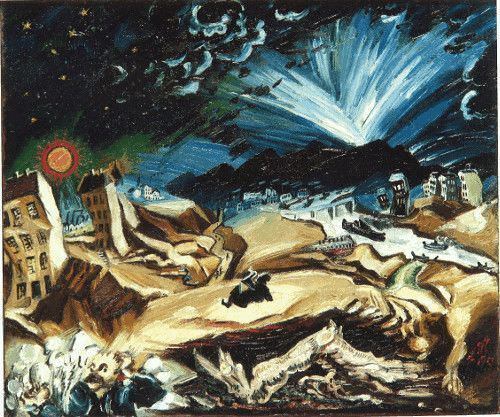
Ludwig Meidner, Apokalyptische Landschaft (1913), Jüdische Museum, Frankfurt.
In de openingsscène worden Duitse vluchtelingen in een Parijs restaurant beschimpt en bespuwd door Amerikaanse toeristen (die hen – o ironie – voor nazi’s aanzien) en daarna gaat het enkel maar bergaf.
De Vulkaan is een impressionante ‘Gesamtroman’. Mann registreert en regisseert de vele vluchtelingenverhalen tot een grootse roman, waarin niemand echt gelukkig is, toch niet voor lang.
Armoe en vernedering, misdaad en paranoia, sekshonger, verslaving, abortus en zelfmoord…niets wordt de lezer gespaard in dit genadeloze werkstuk. Maar het grote kwaad is de vulkaan Duitsland die op uitbarsten staat. Radeloos huilen de personages weg, hopend, biddend, vechtend dat er geen brokstukken van dat geweld op hun kop terecht komen.
Wat schrijft Klaus Mann mooi. Zeker, er is de invloed van zijn vader de Nobelprijslaureaat, bijvoorbeeld in het gebruik van dubbele adjectieven: op p.331 gaat het over “het krachtig-tere parfum van de engel” (p.331), een bladzijde eerder wordt er schande uitgeroepen over een “honds-zondig schepsel” (p.330).
Maar Mann heeft zijn eigen stem. Vergeleken met de badinerende, contemplatieve vertelstijl van zijn vader, is dit een roman in een rotvaart. Naar het einde toe moest ik op de rem gaan staan, moeizaam vertragen omdat ik vooral niet wilde dat er eind aan zou komen.
De Vulkaan werd geschreven in de jaren 30 en verscheen vlak voordat de vulkaan ontplofte. Hoe schrijnend, hoe doorleefd ook, dat was geen tijd voor boeken. De Vulkaan verkocht voor geen meter, de Nazi’s vernietigden de onverkochte exemplaren die ze in de Amsterdamse uitgeverij aantroffen en daarna werd het stil.
In een latere uitgave werden er wat scherpe kantjes vanaf gehaald, maar dit is de roman is zijn volle, stinkende glorie. Niets blijft je gespaard. Wat een heerlijk boek!
Kikjou, Martin, Marion, Abel, Charles, Ernst, Hans, Tilly, Inge, Ilse…ik mis jullie.
Ludwig Meidner, Apokalyptische Landschaft (1913), Jüdische Museum, Frankfurt.

September 11, 2018
Mijn recensie op THE DREAM LIFE OF BALSO SNELL staat hier: https://thedreamlifeofbalsosnell.tumb...

February 17, 2019
Klaus Mann, zoon van Thomas Mann, schreef minder breedvoerig dan zijn vader, maar zeker niet minder goed! Hij schreef met veel meer vaart.
In De vulkaan neemt Klaus Mann de lezer mee naar de jaren '30 van de 20e eeuw.
Een groep uit Duitsland gevluchte kunstenaars, geleerden en bohemiens ontmoeten elkaar geregeld in een Parijs café.
In Duitsland rukt het nazisme op.
Een ontslagen Joodse geleerde, Abel, probeert in Amsterdam een nieuw bestaan op te bouwen. Maar ook daar heerst er veel antisemitisme, en wordt Abel openlijk gewantrouwd.
Twee jonge Duitsers zonder papieren zwerven van het ene land naar het andere, maar zijn in geen enkel Europees land welkom.
Marion verzorgt literaire avonden in Parijs en reist heel Europa rond, als woordkunstenares. Zij neemt het nazisme flink op de korrel, oogst succes, maar ziet met lede ogen haar geliefde Duitsland ten onder gaan. Er is niets tegen te beginnen.
De verschillende karakters worden zeer goed uitgediept en personages ontmoeten elkaar... en verhalen komen samen.
Klaus Mann beschrijft in een prachtige stijl de levenswijze en de psychische gesteldheid van mensen die ontheemd zijn.
Een boek over vluchtende mensen, die ondanks alles, heimwee blijven hebben naar hun land.
Zij hopen allen dat het snel weer beter zal worden in Duitsland, dat de nazi's binnenkort het onderspit zullen delven.
Maar het wordt daar niet snel beter. Het wordt alleen maar slechter.
Het eerste deel van de roman gaat over 1933-1934, het tweede deel over 1936-1937 en het derde deel over 1937-1938. Met daarna nog een vreemde epiloog.
En wij, hedendaagse lezers, weten waar het uiteindelijk op uitgedraaid is: op de onvoorstelbare HEL.
Mann (en velen met hem) hadden dat wel voorvoeld.
In 1939 stond Europa als een vulkaan op uitbarsten.
In De vulkaan neemt Klaus Mann de lezer mee naar de jaren '30 van de 20e eeuw.
Een groep uit Duitsland gevluchte kunstenaars, geleerden en bohemiens ontmoeten elkaar geregeld in een Parijs café.
In Duitsland rukt het nazisme op.
Een ontslagen Joodse geleerde, Abel, probeert in Amsterdam een nieuw bestaan op te bouwen. Maar ook daar heerst er veel antisemitisme, en wordt Abel openlijk gewantrouwd.
Twee jonge Duitsers zonder papieren zwerven van het ene land naar het andere, maar zijn in geen enkel Europees land welkom.
Marion verzorgt literaire avonden in Parijs en reist heel Europa rond, als woordkunstenares. Zij neemt het nazisme flink op de korrel, oogst succes, maar ziet met lede ogen haar geliefde Duitsland ten onder gaan. Er is niets tegen te beginnen.
De verschillende karakters worden zeer goed uitgediept en personages ontmoeten elkaar... en verhalen komen samen.
Klaus Mann beschrijft in een prachtige stijl de levenswijze en de psychische gesteldheid van mensen die ontheemd zijn.
Een boek over vluchtende mensen, die ondanks alles, heimwee blijven hebben naar hun land.
Zij hopen allen dat het snel weer beter zal worden in Duitsland, dat de nazi's binnenkort het onderspit zullen delven.
Maar het wordt daar niet snel beter. Het wordt alleen maar slechter.
Het eerste deel van de roman gaat over 1933-1934, het tweede deel over 1936-1937 en het derde deel over 1937-1938. Met daarna nog een vreemde epiloog.
En wij, hedendaagse lezers, weten waar het uiteindelijk op uitgedraaid is: op de onvoorstelbare HEL.
Mann (en velen met hem) hadden dat wel voorvoeld.
In 1939 stond Europa als een vulkaan op uitbarsten.

March 31, 2022
Perché non si parla mai, se non per lievi cenni alle loro vite scandalose, ai figli di Thomas Mann? Eppure questo romanzo-fiume del figlio Klaus è semplicemente stupendo.
A differenza della raccolta, appena letta, della sorella maggiore Erika, che accendeva il faro sui rimasti, su coloro che cercano di tirare avanti sotto un regime fingendo di farselo piacere, qui Klaus focalizza l'attenzione sugli espatriati, gli esuli, gli scacciati.
Ci pensiamo mai a come ci si sente ad abbandonare tutto, a perdere tutto? E' un pensiero fugace, diciamocelo. Oggi, 2022, possiamo immedesimarci in un lavoratore che sceglie di andarsene dall'Italia per stipendi più alti, città più vivaci e condizioni di vita migliori, ma non so fino a che punto possiamo farlo, intimamente, nel profondo, verso chi scappa dalle guerre, dalle prigioni politiche, dalle carestie...
Mai così attuale, scattante e nervosa e nel contempo orchestrato come una sinfonia, la storia di Klaus Mann intreccia varie vicende accomunate da una frattura insanabile: cosa succede alle persone che per sopravvivere, per ragioni politiche e morali, preferiscono l'esilio alla dittatura nazista? Quali lo capiscono in tempo, quali troppo tardi; quali hanno le risorse fisiche, mentali e a volte finanziarie (che però non sempre le salveranno), quali sono troppo deboli per non crollare sotto il peso enorme della fatica di sopravvivere lontano da tutto quello che aveva un significato.
I dotati di umorismo e cultura potrebbero essere favoriti, ma non è detto; la cultura non ti salva dalla droga e dagli istinti autodistruttivi; la forza fisica e di carattere di un lavavetri italiano antifascista o di uno studente tedesco potrebbero alla fine farli ritrovare insieme sulle barricate, e un brasiliano decadente figlio di papà potrebbe finire per assorbire il meglio dell'energia dei suoi amici morti e raccogliere il loro testimone.
Socialdemocratici, comunisti, anarchici, indifferenti, piccola nobiltà, aristocrazia ebraica e sottoproletari, luterani, atei e mistici cattolici, si spandono per le città più glamour, discutono accaniti tra loro mentre cercano di farsi piacere Parigi o Praga senza visitarne mai i musei, vengono scacciati da uno Stato all'altro e privati della cittadinanza tedesca senza riuscire ad ottenerne una nuova, chi si sposa per il permesso di soggiorno, chi sceglie di combattere in Spagna e non si fa mai illusioni fin dal 1933 sulle reali intenzioni di Hitler, chi si salva in Svizzera o, molto più spesso, negli Stati Uniti, dove peraltro potrà capitare loro - come di certo capitò alla conferenziera Erika Mann, qui trasfigurata in Marion - di trovare perfino nel bendisposto pubblico del Midwest piccole comunità di tedeschi filonazisti.
E che stile ha Klaus Mann, favoloso; imperdibile.
A differenza della raccolta, appena letta, della sorella maggiore Erika, che accendeva il faro sui rimasti, su coloro che cercano di tirare avanti sotto un regime fingendo di farselo piacere, qui Klaus focalizza l'attenzione sugli espatriati, gli esuli, gli scacciati.
Ci pensiamo mai a come ci si sente ad abbandonare tutto, a perdere tutto? E' un pensiero fugace, diciamocelo. Oggi, 2022, possiamo immedesimarci in un lavoratore che sceglie di andarsene dall'Italia per stipendi più alti, città più vivaci e condizioni di vita migliori, ma non so fino a che punto possiamo farlo, intimamente, nel profondo, verso chi scappa dalle guerre, dalle prigioni politiche, dalle carestie...
Mai così attuale, scattante e nervosa e nel contempo orchestrato come una sinfonia, la storia di Klaus Mann intreccia varie vicende accomunate da una frattura insanabile: cosa succede alle persone che per sopravvivere, per ragioni politiche e morali, preferiscono l'esilio alla dittatura nazista? Quali lo capiscono in tempo, quali troppo tardi; quali hanno le risorse fisiche, mentali e a volte finanziarie (che però non sempre le salveranno), quali sono troppo deboli per non crollare sotto il peso enorme della fatica di sopravvivere lontano da tutto quello che aveva un significato.
I dotati di umorismo e cultura potrebbero essere favoriti, ma non è detto; la cultura non ti salva dalla droga e dagli istinti autodistruttivi; la forza fisica e di carattere di un lavavetri italiano antifascista o di uno studente tedesco potrebbero alla fine farli ritrovare insieme sulle barricate, e un brasiliano decadente figlio di papà potrebbe finire per assorbire il meglio dell'energia dei suoi amici morti e raccogliere il loro testimone.
Socialdemocratici, comunisti, anarchici, indifferenti, piccola nobiltà, aristocrazia ebraica e sottoproletari, luterani, atei e mistici cattolici, si spandono per le città più glamour, discutono accaniti tra loro mentre cercano di farsi piacere Parigi o Praga senza visitarne mai i musei, vengono scacciati da uno Stato all'altro e privati della cittadinanza tedesca senza riuscire ad ottenerne una nuova, chi si sposa per il permesso di soggiorno, chi sceglie di combattere in Spagna e non si fa mai illusioni fin dal 1933 sulle reali intenzioni di Hitler, chi si salva in Svizzera o, molto più spesso, negli Stati Uniti, dove peraltro potrà capitare loro - come di certo capitò alla conferenziera Erika Mann, qui trasfigurata in Marion - di trovare perfino nel bendisposto pubblico del Midwest piccole comunità di tedeschi filonazisti.
E che stile ha Klaus Mann, favoloso; imperdibile.

March 27, 2017
There are some books that you always want to read, and they show up in a precise time and place. This was that case of Klaus Mann's novel. A book that reminds us that history never changes, and today we can be close to see again how hatred and injustice can lead us to the destruction of humanity.

June 11, 2025
Uma obra única que nos descreve o mundo dos exilados alemães nos anos 30. Um texto poderoso e transformador. O melhor livro que li de Klaus Mann.

June 14, 2017
Klaus Manns letzter und umfangreichster Roman handelt von lauter Leuten, die nur das Beste wollen, aber auf ganzer Linie scheitern. Dasselbe lässt sich auch vom Autor sagen, der in den wenigen gelungenen Momenten sogar seinen überdimensionalen Vater alt aussehen lässt, aber wohl selbst nicht die Energie hatte, diesen Riesenhaufen Papier noch mal durchzuarbeiten und auf ein einigermaßen erträgliches Gesamtniveau zu bringen.
Dabei beginnt der Roman sogar einigermaßen verheißungsvoll, über den Besuch von drei Pariser Lokalen macht erweitert er die anfängliche Vierergruppe auf 30 Exilanten, allerdings bringt er sein Ensemble im weiteren Verlauf nie so recht in Schwung, sondern hangelt sich sich ziemlich dilettantisch klein-Doofi-mäßig an den Schicksalen der Schauspielerin Marion (=Erika Mann), Professor Abel und Martin Korella (ultra schlaffer Klaus Mann) und Kikjou (Martins Liebhaber) entlang. Martin stirbt auf halber Strecke einen Morphinistentod, Marion heiratet erst den Schriftsteller Marcel, der an seiner Kunst verzweifelt und sich im spanischen Bürgerkrieg tot schießen lässt, später lässt sie sich in New York von einem italienischen Fensterputzer schwängern und im mittleren Westen von Professor Abel zur Heirat beschwatzen, womit sich zwei Hauptpersonen gefunden haben. Der Heiratsantrag, in dem der sonst so kluge Professor vollkommen von der Rolle ist und nach einer Riesenblamage doch noch zum Erfolg bei seiner Angebeteten kommt, ist die Stelle, in der KM seinen Vater übertrifft.
Kikjou, der nicht damit zurecht kommt, dass er Martin im Stich ließ, trifft einen Engel, der ihn u.a. dabei zusehen lässt, wie sein frührer Beschützer Marcel erschossen wird. Kikjous zweites Treffen mit dem Engel, zugleich eine Hommage an André Gides Falschmünzer und eine absolute Verlegenheitsgeste.
Das Buch ist über weite Strecken misslungen bzw. der Autor hatte aufgrund der äußeren Umstände (Entzug, neue Liebe) nicht die Kraft, das für den Erfolg erforderliche Potenzial abzurufen. Eine selten deprimierende Lektüre, die einem kaum etwas für den Leseaufwand zurück gibt, außer einem Haufen Klischees und ein paar trügerische Momente, in denen der Eindruck entsteht, jetzt würde der Verfasser doch noch die Kurve kriegen. Der Vulkan ist alles andere als eine prickelnde Lektüre, sondern ein schwarzes Loch, bei dem sich gleich mehrfach die Frage nach dem Sinn des Lesens stellt. Von daher ein Stern in Sachen Lesevergnügen für einen Aufwand an Zeit und Energie, der nur für ein paar ganz wenige Seiten belohnt wird.
Zum Abschluss eine bezeichnende Anekdote, die ich schon in den Wasserstandsmeldungen gepostet habe, aber gern in die Rezi mit aufnehmen möchte, zumal ich jetzt mit gutem Gewissen nie mehr wieder schreiben kann:
Der Bürgermeister von Korbach spricht mich in der Pause der Rosenkrieg-Premiere auf meine Lektüre an und meint, er hätte auch mal den Vulkan gelesen, wäre aber inzwischen davon abgekommen, sich mit dergleichen den Urlaub kaputt zu machen. Ich antworte, im Urlaub hab ich's schon vor über 20 Jahren abgebrochen und ich werde es auch nie wieder lesen, wenn ich jetzt nicht damit fertig werde, dann nie.
Dabei beginnt der Roman sogar einigermaßen verheißungsvoll, über den Besuch von drei Pariser Lokalen macht erweitert er die anfängliche Vierergruppe auf 30 Exilanten, allerdings bringt er sein Ensemble im weiteren Verlauf nie so recht in Schwung, sondern hangelt sich sich ziemlich dilettantisch klein-Doofi-mäßig an den Schicksalen der Schauspielerin Marion (=Erika Mann), Professor Abel und Martin Korella (ultra schlaffer Klaus Mann) und Kikjou (Martins Liebhaber) entlang. Martin stirbt auf halber Strecke einen Morphinistentod, Marion heiratet erst den Schriftsteller Marcel, der an seiner Kunst verzweifelt und sich im spanischen Bürgerkrieg tot schießen lässt, später lässt sie sich in New York von einem italienischen Fensterputzer schwängern und im mittleren Westen von Professor Abel zur Heirat beschwatzen, womit sich zwei Hauptpersonen gefunden haben. Der Heiratsantrag, in dem der sonst so kluge Professor vollkommen von der Rolle ist und nach einer Riesenblamage doch noch zum Erfolg bei seiner Angebeteten kommt, ist die Stelle, in der KM seinen Vater übertrifft.
Kikjou, der nicht damit zurecht kommt, dass er Martin im Stich ließ, trifft einen Engel, der ihn u.a. dabei zusehen lässt, wie sein frührer Beschützer Marcel erschossen wird. Kikjous zweites Treffen mit dem Engel, zugleich eine Hommage an André Gides Falschmünzer und eine absolute Verlegenheitsgeste.
Das Buch ist über weite Strecken misslungen bzw. der Autor hatte aufgrund der äußeren Umstände (Entzug, neue Liebe) nicht die Kraft, das für den Erfolg erforderliche Potenzial abzurufen. Eine selten deprimierende Lektüre, die einem kaum etwas für den Leseaufwand zurück gibt, außer einem Haufen Klischees und ein paar trügerische Momente, in denen der Eindruck entsteht, jetzt würde der Verfasser doch noch die Kurve kriegen. Der Vulkan ist alles andere als eine prickelnde Lektüre, sondern ein schwarzes Loch, bei dem sich gleich mehrfach die Frage nach dem Sinn des Lesens stellt. Von daher ein Stern in Sachen Lesevergnügen für einen Aufwand an Zeit und Energie, der nur für ein paar ganz wenige Seiten belohnt wird.
Zum Abschluss eine bezeichnende Anekdote, die ich schon in den Wasserstandsmeldungen gepostet habe, aber gern in die Rezi mit aufnehmen möchte, zumal ich jetzt mit gutem Gewissen nie mehr wieder schreiben kann:
Der Bürgermeister von Korbach spricht mich in der Pause der Rosenkrieg-Premiere auf meine Lektüre an und meint, er hätte auch mal den Vulkan gelesen, wäre aber inzwischen davon abgekommen, sich mit dergleichen den Urlaub kaputt zu machen. Ich antworte, im Urlaub hab ich's schon vor über 20 Jahren abgebrochen und ich werde es auch nie wieder lesen, wenn ich jetzt nicht damit fertig werde, dann nie.

April 10, 2022
Notevolissimo romanzo fiume di Klaus Mann sulla vita degli espatriati tedeschi degli anni '30. È stato pubblicato nel 1939, poco prima della guerra, e copre appunto gli anni dal 1933 al 1939. Compare in esso una nutrita schiera di personaggi, di vario genere, classe sociale, età e aspirazioni, che alternano i propri punti di vista; i più centrali sono Martin Korella, un poeta poco affermato, dotato ma molto tormentato e fragile, modellato su Klaus stesso, e Marion von Kammer, una brillante attrice e cabarettista, modellata sulla sorella Erika Mann; sono entrambi di buona famiglia, per metà ebrei, in contrasto con la generazione dei genitori. Intorno a loro, emigrati a Parigi, si dispone un circolo di espatriati di prima data, costituito da persone che frequentavano i locali alla moda di Berlino prima dell'avvento dei Nazisti, intellettuali, ebrei e non ebrei, uomini di finanza, commercianti, attori, giornalisti, attivisti politici; man mano che l'emigrazione cresce si aggiungono operai e attivisti antifascisti di vario genere, in contatto con la resistenza interna alla Germania. Oltre a questa fetta di apolidi che conquistano una parziale stanzialità che non è affatto definitiva, compaiono vagabondi che entrano fugacemente in contatto con i personaggi più importanti, legati con debole filo alla storia e alla Storia, i quali passano le frontiere senza passaporti, senza diritti e senza una destinazione precisa, a volte si perdono e a volte si affermano. Penso che sia perfettamente riuscita la costruzione di questa "diaspora" a gradazione, dominata dal fragile equilibrio tra organizzazione e caos, tra ricomposizione di vita comunitaria e rottura dei rapporti interpersonali, tra spinta centripeta verso la lotta antifascista che accomuna diverse identità e quella centrifuga alla dispersione e all'assorbimento individuale entro realtà nazionali e sociali estranee. Spesso queste donne e uomini sono visti male a prescindere dalla loro condizione: da chi simpatizza per il Nazismo o lo giustifica perché hanno abbandonato vilmente il loro paese in quanto incapaci di adattarsi e di accettare un regime popolare, da chi si oppone al Nazismo perché sospetti e comunque appartenenti ad un popolo malvisto.Lo stato d'animo di queste persone è contraddittorio e complesso; da un lato proseguono la loro vita e continuano ad avere desideri, affetti, progetti, dall'altro restano sempre indietro, perché incompresi, isolati, declassati, dominati dal pensiero ossessivo delle sorti della Germania; essi vedono le loro capacità intellettuali e spirituali contrarsi per via della necessità costante di guardarsi le spalle e procurarsi il necessario per vivere, di capire cosa sarà di loro; da un lato sono ancorati al passato dalla nostalgia e dalla melanconia, dall'altro sono protesi verso il futuro e immaginano costruzioni politiche e sociali innovative e capaci di inaugurare una nuova era. In questo ambito l'analisi politica resta lucida, comprende riflessioni sintetiche sulla dittatura, sulla democrazia liberale, sul socialismo, sul radicalismo, ma è fortemente problematizzata e Mann evidenzia la frattura tra teoria e prassi, uno dei fattori della crisi delle sinistre, sottolinea i problemi lasciati aperti dall'astrazione ideologica e mostra come gli espatriati sono obbligati a riflettere su ciò che non conoscono più e a trascurare molti fattori fuori dal loro controllo; spesso i personaggi più intellettuali sono frustrati e devono rinunciare al loro impegno teorico in favore o dell'azione concreta o di una sorta di "ritorno alle origini", più umano ma parallelo a quello delle mitologie fasciste; il periodo storico è in effetti caratterizzato da questa polarizzazione tra abbandono dell'intelletto e della ragione ed esasperazione isterica delle tendenze spirituali e intellettuali, Mann auspica la paradossalmente difficile via di mezzo. L'analisi psicologica dei personaggi non è un obiettivo principale del testo, ma è presente in una certa misura, specialmente grazie alla grande abilità a ritrarre lo stato interiore generale dell'espatriato, creatura lacerata e disorientata, egoista e solidale al contempo, inquieta ed esaurita; prevale la tipizzazione soprattutto per i personaggi minori. La prospettiva geografica è ampia ed è arricchita dalle varie esperienze dirette dell'autore. Lo stile è perlopiù oggettivo ma ci sono degli abbandoni al puro lirismo, che nascono dall'amore di K. Mann per la poesia, spesso autenticamente belli e profondi, capaci di smorzare l'aspetto militante del testo e di dare profondità al contenuto, un inno alla libertà e alla dignità personale. La metafora del vulcano, che dà il titolo all'opera, serve a restituire un'immagine di questa condizione pericolosa: è come se gli espatriati si trovassero sul cratere di un vulcano, pronto ad esplodere in modo imprevisto causando la distruzione generale, ma loro sono nella posizione più rischiosa, possono essere investiti dai lapilli e dalla lava e precipitare prima delle persone a cui cercano di comunicare con scarso successo il pericolo. Perfettamente riusciti sono, come ho già detto, il ritratto della condizione dei senza patria e la caratterizzazione di un'epoca tragica e precaria della storia europea attraverso un punto di vista meno conosciuto e considerato rispetto ad altri; inoltre le vicende legate alle migrazioni e all'esilio politico restano sempre attuali. Ci sono delle pecche per alcune ingenuità stilistiche e per l'uso smaccato dell'esperienza personale in certi tratti; mi è sembrato di avvertire in certi punti delle cadute autocelebrative o una certa autocommiserazione poco filtrata, però sono fatti trascurabili. Finora tutto quello che ho letto di Klaus mi ha colpito molto, penso che il difficile rapporto con il padre e l'ombra di lui monopolizzino ingiustamente la sua figura, ma Thomas Mann è probabilmente il mio scrittore preferito e non posso sminuirne la grandezza; tra l'altro credo che l'influenza di un simile genio in famiglia sia un'arma a doppio taglio, fa da stimolo alla vocazione e la schiaccia allo stesso tempo, contribuisce alla notorietà e la oscura. Forse è per ironia della sorte che l'eterno figlio scapestrato e dissoluto si è trovato ad essere una figura importante della lotta antifascista e della seconda guerra mondiale, uno dei periodi più truci della storia europea, e ha dovuto stabilire un contatto traumatico e concreto con la realtà del suo tempo; ha pagato abbastanza-e ingiustamente-per le sue debolezze e ha affermato con sincerità e coraggio il suo spirito. Non ha senso paragonare i talenti, la potenza intellettuale e immaginativa, che siano o meno ereditarie, appartengono a Klaus e gli permettono di creare qualcosa di diverso e significativo, che spero venga rivalutato il più possibile.

March 9, 2013
Liked it, but, like most of his father Thomas Mann, too much + overdone especially in style. I prefer Feuchtwanger (brilliant: Exile) and some books by Remarque on the topic.

August 12, 2019
Che cosa provi una pianta che da lungo tempo ha radici in un posto, oramai divenuto la sua casa, e ne viene sradicata come fosse erbaccia infestante, non saprei dire; per comprendere però che cosa può provare un uomo a cui viene riservato lo stesso trattamento, si può leggere “Il vulcano” di Klaus Mann.
È l’esilio, infatti, il tema del romanzo; addirittura, ciò è chiarito sin dal sottotitolo – «Romanzo dell’esilio». Nelle pagine di questa straordinaria opera, che ha un’importanza, a mio avviso, tanto letteraria quanto documentaristica, viene affrontato l’esilio mostrando gli effetti che la condizione di «sans patrie» ha sulla vita di un gruppo di persone eterogenee (artisti, imprenditori, professori, studenti, lavoratori, etc…) e quanto questo effetto sia tanto più consistente quanto più quella condizione pare essere definitiva. Siamo negli anni che precedettero la seconda guerra mondiale – l’arco temporale va dal 1933 al 1939 – e col passare degli anni la condizione di «sans patrie», di esule, di emigrante pare sempre più non essere provvisoria, e con quella si accompagna una progressiva e sempre più fievole speranza di fare ritorno in patria – una vera e propria parabola, sembra, dalla speranza alla cocente disillusione –, quella patria che per motivi così stolti, da un giorno all’altro, non ti considera più suo figlio: non importa se sei stato un degno e rispettabile professore tedesco che ha portato lustro all’Accademia teutonica, non importa se sei un ricco banchiere che ha contribuito onestamente alla società oppure se sei appartenente a un’aristocratica famiglia di antico retaggio tedesco-prussiano; niente di tutto questo ha più importanza, sei escluso dal novero dei cittadini di quel paese, ingiuriato e coperto d’infamia, per giunta! Di fronte a queste vicende – mi ha fatto riflettere il libro – come avrei reagito io? Da quale turbinio di emozioni sarei stato pervaso? Quali pensieri avrebbero albergato nella mia mente?
Le pagine presenti in questo romanzo, che, come ho detto, sono da considerare anche un documento storico di enorme interesse, sono dense, e ciò potrebbe risultare noioso ad alcuni lettori. Tuttavia, mi si consenta di dire che, se bisogna avere il cuore colmo di amarezza, tristezza, senso di spaesamento, sradicamento e in parte sordo alle perfette ricette stilistiche per scrivere pagine così dense, coloro che ritengono siano troppo dense potrebbero allora essere sordi ai tormenti del cuore. Per una generazione vissuta con l’idea di essere patriottici, cioè di avere rispetto per la Patria ed esserne orgogliosi – senza scadere in forme di nazionalismo, però –, questo smacco subìto per mano di quella stessa Patria deve essere stato un colpo terribile – ciò è chiaro dalle pagine del libro quando viene affermato: «Lo stigma dei senzapatria: non l’ha acquisito in esilio, ma nella patria fattasi estranea!» –, ed è l’impatto di quel colpo ciò che ci viene raccontato in quelle piene pagine da Klaus Mann. Klaus Mann che, insieme alla sua famiglia, fu costretto ad abbandonare l’Europa per trovare infine rifugio negli Stati Uniti.
In questo pellegrinaggio a cui sono costretti i protagonisti de “Il vulcano” emergono riflessioni struggenti, profonde, toccanti sulla loro condizione; al contempo essi cercano spiegazioni razionali a un atto che di razionale ha ben poco; come mette chiaramente in luce Marion, infatti, uno dei personaggi principali approdata alla fine in America: «Questa nausea nei confronti della ragione, questi dubbi aggressivi verso la critica intellettuale sembrano essere la malattia della nostra generazione.» Non penso sarebbe stata felice Marion di sapere che quella “malattia” non sarebbe stata propria solo della sua generazione, ahimè!
E, sullo sfondo, lui: il vulcano! «Tremendo è il vulcano», dice Klaus Mann. Tremendi sono i fascisti e i nazisti. «Vincono senza combattere! Non incontrano resistenza, nemici!... Si lascia che l’orrore infurii, distrugga, si sfoghi – come se fosse una catastrofe naturale! Come se vivessimo su un vulcano in eruzione! Nessuno aiuta. Tutti aspettano per vedere se tocca a loro…»
Alle soglie del 1939, ecco che una domanda dirompente trova accoglimento in una lettera scritta a un suo amico da un esule tedesco: «Noi giovani tedeschi abbiamo mai compreso il valore della libertà, l’ideale della giustizia? Temo che fosse necessario passare prima attraverso l’inferno della totale non-libertà, della completa mancanza di diritto, per misurare ciò che abbiamo disprezzato e perduto.»
Quella domanda è senza tempo: esprime sempre il suo valore in ogni tempo, sia esso di guerra o di pace, sia esso sereno o tumultuoso.
Questo libro, scritto da Klaus Mann, pure lui esule come i suoi protagonisti, e pubblicato nel 1939 è denso, profondo, ricco. In esso trova luogo la descrizione delle condizioni di vita degli esuli nell’Europa alle soglie della seconda guerra mondiale incarnate nelle vite di diverse anime, tutte tormentate, spaesate, incerte sul loro destino a causa di atti che, parafrasando Dante, “nei modi ancor li offendono”. Questo libro, nell’intento, è stato scritto affinché non ci si dimentichi di quanto è accaduto; esso è «la cronaca precisa dei nostri turbamenti, delle sofferenze, e anche delle speranze.»
È un libro dimenticato, un autore oscurato dal suo stesso padre – Thomas Mann – col quale aveva un pessimo rapporto, non è forse giunto il momento di riscoprirli entrambi?
È l’esilio, infatti, il tema del romanzo; addirittura, ciò è chiarito sin dal sottotitolo – «Romanzo dell’esilio». Nelle pagine di questa straordinaria opera, che ha un’importanza, a mio avviso, tanto letteraria quanto documentaristica, viene affrontato l’esilio mostrando gli effetti che la condizione di «sans patrie» ha sulla vita di un gruppo di persone eterogenee (artisti, imprenditori, professori, studenti, lavoratori, etc…) e quanto questo effetto sia tanto più consistente quanto più quella condizione pare essere definitiva. Siamo negli anni che precedettero la seconda guerra mondiale – l’arco temporale va dal 1933 al 1939 – e col passare degli anni la condizione di «sans patrie», di esule, di emigrante pare sempre più non essere provvisoria, e con quella si accompagna una progressiva e sempre più fievole speranza di fare ritorno in patria – una vera e propria parabola, sembra, dalla speranza alla cocente disillusione –, quella patria che per motivi così stolti, da un giorno all’altro, non ti considera più suo figlio: non importa se sei stato un degno e rispettabile professore tedesco che ha portato lustro all’Accademia teutonica, non importa se sei un ricco banchiere che ha contribuito onestamente alla società oppure se sei appartenente a un’aristocratica famiglia di antico retaggio tedesco-prussiano; niente di tutto questo ha più importanza, sei escluso dal novero dei cittadini di quel paese, ingiuriato e coperto d’infamia, per giunta! Di fronte a queste vicende – mi ha fatto riflettere il libro – come avrei reagito io? Da quale turbinio di emozioni sarei stato pervaso? Quali pensieri avrebbero albergato nella mia mente?
Le pagine presenti in questo romanzo, che, come ho detto, sono da considerare anche un documento storico di enorme interesse, sono dense, e ciò potrebbe risultare noioso ad alcuni lettori. Tuttavia, mi si consenta di dire che, se bisogna avere il cuore colmo di amarezza, tristezza, senso di spaesamento, sradicamento e in parte sordo alle perfette ricette stilistiche per scrivere pagine così dense, coloro che ritengono siano troppo dense potrebbero allora essere sordi ai tormenti del cuore. Per una generazione vissuta con l’idea di essere patriottici, cioè di avere rispetto per la Patria ed esserne orgogliosi – senza scadere in forme di nazionalismo, però –, questo smacco subìto per mano di quella stessa Patria deve essere stato un colpo terribile – ciò è chiaro dalle pagine del libro quando viene affermato: «Lo stigma dei senzapatria: non l’ha acquisito in esilio, ma nella patria fattasi estranea!» –, ed è l’impatto di quel colpo ciò che ci viene raccontato in quelle piene pagine da Klaus Mann. Klaus Mann che, insieme alla sua famiglia, fu costretto ad abbandonare l’Europa per trovare infine rifugio negli Stati Uniti.
In questo pellegrinaggio a cui sono costretti i protagonisti de “Il vulcano” emergono riflessioni struggenti, profonde, toccanti sulla loro condizione; al contempo essi cercano spiegazioni razionali a un atto che di razionale ha ben poco; come mette chiaramente in luce Marion, infatti, uno dei personaggi principali approdata alla fine in America: «Questa nausea nei confronti della ragione, questi dubbi aggressivi verso la critica intellettuale sembrano essere la malattia della nostra generazione.» Non penso sarebbe stata felice Marion di sapere che quella “malattia” non sarebbe stata propria solo della sua generazione, ahimè!
E, sullo sfondo, lui: il vulcano! «Tremendo è il vulcano», dice Klaus Mann. Tremendi sono i fascisti e i nazisti. «Vincono senza combattere! Non incontrano resistenza, nemici!... Si lascia che l’orrore infurii, distrugga, si sfoghi – come se fosse una catastrofe naturale! Come se vivessimo su un vulcano in eruzione! Nessuno aiuta. Tutti aspettano per vedere se tocca a loro…»
Alle soglie del 1939, ecco che una domanda dirompente trova accoglimento in una lettera scritta a un suo amico da un esule tedesco: «Noi giovani tedeschi abbiamo mai compreso il valore della libertà, l’ideale della giustizia? Temo che fosse necessario passare prima attraverso l’inferno della totale non-libertà, della completa mancanza di diritto, per misurare ciò che abbiamo disprezzato e perduto.»
Quella domanda è senza tempo: esprime sempre il suo valore in ogni tempo, sia esso di guerra o di pace, sia esso sereno o tumultuoso.
Questo libro, scritto da Klaus Mann, pure lui esule come i suoi protagonisti, e pubblicato nel 1939 è denso, profondo, ricco. In esso trova luogo la descrizione delle condizioni di vita degli esuli nell’Europa alle soglie della seconda guerra mondiale incarnate nelle vite di diverse anime, tutte tormentate, spaesate, incerte sul loro destino a causa di atti che, parafrasando Dante, “nei modi ancor li offendono”. Questo libro, nell’intento, è stato scritto affinché non ci si dimentichi di quanto è accaduto; esso è «la cronaca precisa dei nostri turbamenti, delle sofferenze, e anche delle speranze.»
È un libro dimenticato, un autore oscurato dal suo stesso padre – Thomas Mann – col quale aveva un pessimo rapporto, non è forse giunto il momento di riscoprirli entrambi?

January 21, 2023
„Man kann die Gewalt durch Gewalt besiegen, aber nicht aus der Welt schaffen. Der verhängnisvolle Irrtum ist, zu meinen, daß der Zweck die Mittel heilige.“ (Zitat Pos. 4411)
Inhalt
Dieser Roman umfasst etwa 550 Seiten. Er beginnt mit einem Prolog im April 1933, gefolgt von den drei Teilen 1933-1934, 1936-1937, 1937-1938 und endet mit einem Epilog am 1. Januar 1939. In diesem Zeitrahmen werden die Schicksale von Menschen im Exil geschildert. Es waren Wissenschaftler, Geschäftsleute, politische Flüchtlinge, vor allem jedoch Künstler, darunter viele Schriftsteller. Sie alle hatten in der Zeit der Machtübernahme durch die Nationalsozialisten ihre Heimat Deutschland verlassen müssen und versuchen nun, nach dem Verlust der Heimat, Identität, ihres gesamten bisherigen Lebens, in einer ihnen oft fremden Welt klarzukommen. Sie treffen einander in Städten wie Paris, Amsterdam, in der Schweiz, in Spanien und in den USA. Es sind Einzelschicksale, die jeweils chronologisch in unterschiedlichen Handlungssträngen geschildert werden, und im Laufe der Handlung manchmal aufeinandertreffen, sich kreuzen, sich verbinden und auch wieder trennen. Doch alle Exilanten haben eines gemeinsam: gespannt verfolgen sie die Ereignisse in Deutschland, diesem Land, das einem gefährlichen Vulkan vor dem alles vernichtenden Ausbruch gleicht.
Thema und Genre
Dieser autobiografische Roman ist 1939 erschienen und wird heute als eines der wichtigsten Beispiele der deutschen Exilliteratur genannt. Es geht um die Machtübernahme der Nationalsozialisten in Deutschland, die Flucht der vorwiegend jüdischen Intellektuellen und Bildungsbürger, und die vielen damit verbundenen wirtschaftlichen, aber vor allem menschlichen, Probleme eines unsicheren Lebens im Exil, um Verlust, Entwurzelung und den Versuch, sich unter völlig veränderten Bedingungen zurechtzufinden.
Über diese Ausgabe
Wer nicht das Glück hat, Werke wie dieses in einer alten, gebundenen Ausgabe zu besitzen, dem kann ich diese Sammlung empfehlen. So gut wie kostenlos erhält man folgende Romane: DER VULKAN, MEPHISTO, SYMPHONIE PATHÉTIQUE, FLUCHT IN DEN NORDEN,TREFFPUNKT IM UNENDLICHEN, ALEXANDER, DER FROMME TANZ. Die übersichtlich gestaltete Inhaltsangabe macht es einfach, den jeweiligen Roman zu finden und zu lesen.
Fazit
Romane wie dieser sind auf Grund des realen geschichtlichen Hintergrundes zeitlos gültig und wichtige Einblicke in die politischen Veränderungen einer Zeit, die weniger als einhundert Jahre entfernt ist. Über Klaus Mann und seine Werke gibt es umfassende Fachliteratur und Interpretationen von namhaften Literaturwissenschaftlern, daher ist es nicht meine Absicht, mich hier an einer Rezension zu versuchen. Was mich neben Handlung und Themen beim Lesen dieses Romans persönlich begeistert hat, sind die unterschiedlichen Erzählperspektiven, in Verbindung mit einer eleganten Sprache, die ebenfalls zeitlos ist und genau beobachtet und schildert. Gerade in der heutigen Zeit regt die Vielfalt der brisanten Themen, die Klaus Mann in diesem Roman aufwirft, die Konflikte, Gedanken, Feststellungen und auch politisch relevanten Überlegungen zum Nachdenken an.
Inhalt
Dieser Roman umfasst etwa 550 Seiten. Er beginnt mit einem Prolog im April 1933, gefolgt von den drei Teilen 1933-1934, 1936-1937, 1937-1938 und endet mit einem Epilog am 1. Januar 1939. In diesem Zeitrahmen werden die Schicksale von Menschen im Exil geschildert. Es waren Wissenschaftler, Geschäftsleute, politische Flüchtlinge, vor allem jedoch Künstler, darunter viele Schriftsteller. Sie alle hatten in der Zeit der Machtübernahme durch die Nationalsozialisten ihre Heimat Deutschland verlassen müssen und versuchen nun, nach dem Verlust der Heimat, Identität, ihres gesamten bisherigen Lebens, in einer ihnen oft fremden Welt klarzukommen. Sie treffen einander in Städten wie Paris, Amsterdam, in der Schweiz, in Spanien und in den USA. Es sind Einzelschicksale, die jeweils chronologisch in unterschiedlichen Handlungssträngen geschildert werden, und im Laufe der Handlung manchmal aufeinandertreffen, sich kreuzen, sich verbinden und auch wieder trennen. Doch alle Exilanten haben eines gemeinsam: gespannt verfolgen sie die Ereignisse in Deutschland, diesem Land, das einem gefährlichen Vulkan vor dem alles vernichtenden Ausbruch gleicht.
Thema und Genre
Dieser autobiografische Roman ist 1939 erschienen und wird heute als eines der wichtigsten Beispiele der deutschen Exilliteratur genannt. Es geht um die Machtübernahme der Nationalsozialisten in Deutschland, die Flucht der vorwiegend jüdischen Intellektuellen und Bildungsbürger, und die vielen damit verbundenen wirtschaftlichen, aber vor allem menschlichen, Probleme eines unsicheren Lebens im Exil, um Verlust, Entwurzelung und den Versuch, sich unter völlig veränderten Bedingungen zurechtzufinden.
Über diese Ausgabe
Wer nicht das Glück hat, Werke wie dieses in einer alten, gebundenen Ausgabe zu besitzen, dem kann ich diese Sammlung empfehlen. So gut wie kostenlos erhält man folgende Romane: DER VULKAN, MEPHISTO, SYMPHONIE PATHÉTIQUE, FLUCHT IN DEN NORDEN,TREFFPUNKT IM UNENDLICHEN, ALEXANDER, DER FROMME TANZ. Die übersichtlich gestaltete Inhaltsangabe macht es einfach, den jeweiligen Roman zu finden und zu lesen.
Fazit
Romane wie dieser sind auf Grund des realen geschichtlichen Hintergrundes zeitlos gültig und wichtige Einblicke in die politischen Veränderungen einer Zeit, die weniger als einhundert Jahre entfernt ist. Über Klaus Mann und seine Werke gibt es umfassende Fachliteratur und Interpretationen von namhaften Literaturwissenschaftlern, daher ist es nicht meine Absicht, mich hier an einer Rezension zu versuchen. Was mich neben Handlung und Themen beim Lesen dieses Romans persönlich begeistert hat, sind die unterschiedlichen Erzählperspektiven, in Verbindung mit einer eleganten Sprache, die ebenfalls zeitlos ist und genau beobachtet und schildert. Gerade in der heutigen Zeit regt die Vielfalt der brisanten Themen, die Klaus Mann in diesem Roman aufwirft, die Konflikte, Gedanken, Feststellungen und auch politisch relevanten Überlegungen zum Nachdenken an.
March 10, 2026
Spannendes Zeitdokument aus dem Jahr 1939. Wir lernen ganz unterschiedliche Schicksale der Exilanten kennen. Gleichzeitig werden genau die Fragen gestellt, die uns auch heute umtreiben. Wie umgehen mit Demokratiefeinden? Und wie mit der blanken Brutalität?



August 11, 2023
ik we love to use big words like "iconic" or even "love" for everything but this one, and this is no exaggeration, is an actual masterpiece. i would like to write an actual review but i genuinely think i do not have the capacity/ability to do that. might try at some other time when I have had the time to truly think about what i want to say and how. anyways, apparently, Klaus Mann himself thought this was his best novel and honestly, I agree.
December 24, 2018
Verry high quality of writing. Had many extra levels of reading.

September 1, 2023
Klaus Mann geeft in dit boek een mooi inzicht over het migrantenleven in de dertiger jaren voor de tweede Wereldoorlog.
Een groep kunstenaars, wetenschappers, schrijvers, joden vertrekken uit Duitsland om de dreigende terreur van de nazis te ontvluchten. Het gaat om een groep van ongeveer 10 mensen die de komende jaren gevolgd worden in hun doen en laten. Hun verzamelpunt is een café in Parijs waar de nieuwkomers worden opgevangen. Ze hebben allemaal heimwee naar hun vaderland. De roman is gesitueerd in diverse plaatsen in Europa, Amsterdam Zürich, Praag, Wenen, Barcelona en later de verenigde Staten.
Mann geeft uiterst gedetaillleerde persoonsbeschrijvingen die voor mijn gevoel soms te ver gingen en wel wat korter mochten zijn.
Ik vond het een leesbaar interessant boek omdat alle personages hun verschillende levensloop doormaakten, soms spannend, soms triest. Op de laatste 50 bladzijden na waarin opeens een engel komt opdagen, de gebeurtenissen worden dan zo onwerkelijk en dan hoeft het voor mij niet meer, dat is me allemaal te wazig.
Een groep kunstenaars, wetenschappers, schrijvers, joden vertrekken uit Duitsland om de dreigende terreur van de nazis te ontvluchten. Het gaat om een groep van ongeveer 10 mensen die de komende jaren gevolgd worden in hun doen en laten. Hun verzamelpunt is een café in Parijs waar de nieuwkomers worden opgevangen. Ze hebben allemaal heimwee naar hun vaderland. De roman is gesitueerd in diverse plaatsen in Europa, Amsterdam Zürich, Praag, Wenen, Barcelona en later de verenigde Staten.
Mann geeft uiterst gedetaillleerde persoonsbeschrijvingen die voor mijn gevoel soms te ver gingen en wel wat korter mochten zijn.
Ik vond het een leesbaar interessant boek omdat alle personages hun verschillende levensloop doormaakten, soms spannend, soms triest. Op de laatste 50 bladzijden na waarin opeens een engel komt opdagen, de gebeurtenissen worden dan zo onwerkelijk en dan hoeft het voor mij niet meer, dat is me allemaal te wazig.
September 1, 2026
Sorry, diesmal wird es länger:
Klaus Manns Der Vulkan ist für mich ein außergewöhnliches Buch.
"Der Roman der Heimatlosen."
Es ist einer dieser Romane, bei denen man nicht einfach nur liest, sondern immer wieder innehält, weil ein Satz so präzise, so scharf oder so schön formuliert ist, dass man ihn erst einmal wirken lassen muss. Schon im Prolog wird eine Atmosphäre geschaffen, die den gesamten Roman prägt. Man liest ihn heute mit dem Wissen, was kurz danach tatsächlich geschehen ist und dadurch bekommen manche Passagen eine fast unheimliche Genauigkeit.
Besonders beeindruckt hat mich, wie genau Klaus Mann seine Figuren beschreibt: ihre Ängste, Hoffnungen, Zweifel, politischen Überzeugungen und ihre ganz persönlichen Erfahrungen mit dem Exil. Marcel, Marion, die Schwalbe, Tilly, Kikjou und die anderen werden noch lange in meinen Gedanken bleiben.
Das Buch erzählt von verschiedenen deutschen Emigrantinnen und Emigranten während der Zeit des Nationalsozialismus. Dabei geht es nicht nur um die äußeren Erlebnisse des Exils, sondern vor allem darum, was es mit den Menschen macht, aus der Heimat vertrieben zu sein. Deutschland ist für die Figuren gleichzeitig Erinnerung, Sehnsuchtsort, Bedrohung und Gegenstand politischer Auseinandersetzung.
"Wie wollen wir Deutschland?"
Auch wenn der Text hin und her springt und manchmal auch Längen hat, ist es unglaublich fesselnd, all diesen Personen zu folgen.
Tolle Zitate:
"Die erbitterte Opposition gegen das reaktionär-bigotte Milieu einer französischen Bourgeoisfamilie, aus der er stammte, hatte sich zunächst nur als bissig-melancholische Aufsässigkeit und als eine etwas puerile Neigung zu bohömehaften Exzentrizitäten geäußert. >Mein Vater«, pflegte Marcel zu konstatieren, >war ein degeneriertes Schwein."
"Nazis stinken."
"Alles ist schon gesagt, alles ist schon verbraucht. Das Neunzehnte Jahrhundert war enorm redselig, durchaus rhetorisch, ins Wort verliebt, ihm vertrauend wie einem Fetisch. Nun ist alles entleert. Die Krise des Zwanzigsten Jahrhunderts – die ich wie eine Krankheit in meinem Leibe spüre –, ist die Krise der großen Worte. Die Demokratie ist fertig, weil sie sich an die verbrauchten, großen Worte klammert. Der Faschismus, die neue Barbarei, hat leicht siegen: er köpft Leichen. Wir müssen eine neue Unschuld lernen. Zu der kommen wir nicht durch Worte; nur durch die Tat. Die großen Worte hängen an uns wie Schmutz, machen unsere Stirnen klebrig und unsere Hände. Nur eine Flüssigkeit wäscht dies ab: Blut. Soll es unser Blut sein? Dann müssen wir es vergießen! Besser, es strömt dahin, als daß es uns in den Adern erstarrt wie ein zäher Brei. Wir sollen töten und leiden; nicht mehr reden und schreiben. Genug geredet! Genug geschrieben! Genug gedacht! Vielleicht werden andere Generationen wieder Freude haben und Gewinn von den Worten und Gedanken. Nicht wir – nicht mehr wir! Wir sollen gegen die Raserei des Rückschrittes nicht mehr Argumente setzen, sondern ein anderes Rasen, eine neue Besessenheit. Wir müssen blind und stumm werden und bereit zum Untergang. Nur so sühnen wir die Schuld unserer Väter . . ."
Es ist unglaublich, dass Mann diese Zeilen 1939 geschrieben hat. Beim Lesen entsteht fast der Eindruck, jemand habe die Ereignisse im Rückblick beschrieben und dabei bereits genau gewusst, was passieren würde. Natürlich wusste Mann nicht alles, was tatsächlich kommen würde. Aber er beschreibt die politische und gesellschaftliche Entwicklung mit einer erschreckenden Klarheit. Gerade deshalb ist der Text heute so beklemmend. Mann beschreibt nicht nur den Faschismus als politische Bewegung, sondern eine ganze gesellschaftliche Krise: die Krise der Demokratie, der Sprache und des Vertrauens in politische Argumente. Seine Verzweiflung ist dabei so groß, dass er sogar davon spricht, nicht mehr reden, sondern handeln zu müssen.
Besonders hängen geblieben ist bei mir deshalb die Frage:
"Um der Liebe wegen und des Hasses wegen lohnt es sich zu leben. Lohnt es sich zu leben?"
Dieser Satz fasst für mich einen wichtigen Grundkonflikt des Romans zusammen. Die Figuren wollen leben, aber die politische Realität macht die Frage nach dem Sinn des Lebens immer wieder neu auf.
Noch ein Zitat:
"Das Dritte Reich hat eigentlich keine Realität. Ihm fehlen alle Elemente der Größe – selbst im Negativen. Es ist durch und durch journalistisch. Seine Basis ist das Schlagwort; die Propaganda – die für sein Entstehen die Voraussetzung war. Das Leben verödet, es verliert seine Inhalte, seine Substanz. – Es wird niemals ein großes Epos über Nazi-Deutschland geschrieben werden«, versicherte er mit überraschender Dezidiertheit. »Nicht einmal ein großes Epos der Anklage – wenn alles vorüber ist. Dieser monströse Staat ist hohl wie die Köpfe derer, die ihn dirigieren. Das Hohle haßt oder bewundert man nur, solange es Macht hat. Wenn es gestürzt ist, vergißt man es möglichst schnell, wie einen Alptraum."
Oh wie er sich irrt: Es sind unzählige große historische, literarische und filmische Werke über den Nationalsozialismus entstanden. Aber eben nicht im Sinne der Nazi-Deutschen sondern eben im Sinne der Anklage. Mann prognostiziert Vergessen, tatsächlich entstand Erinnerung. Der Nationalsozialismus wurde nach 1945 nicht schnell vergessen. Er wurde zu einem der zentralen Gegenstände der deutschen und europäischen Erinnerungskultur.
Und er irrt sich auch über die Tiefe des Systems: Das Dritte Reich war tatsächlich voller Propaganda, aber sie war an einen extrem leistungsfähigen Gewalt-, Verwaltungs- und Militärstaat gekoppelt. Und genau darin liegt rückblickend die Tragik des Zitats: Mann erkannte die Kulisse messerscharf, unterschätzte aber den Apparat hinter der Kulisse.
"Handelt. Protestiert. Schreitet ein. Er ruft die Kreatur zur Aktion, damit das kolossale Stinken nur endlich aufhöre. An Euch liegt alles; alles liegt an euch."
Klaus Manns Der Vulkan ist für mich ein außergewöhnliches Buch.
"Der Roman der Heimatlosen."
Es ist einer dieser Romane, bei denen man nicht einfach nur liest, sondern immer wieder innehält, weil ein Satz so präzise, so scharf oder so schön formuliert ist, dass man ihn erst einmal wirken lassen muss. Schon im Prolog wird eine Atmosphäre geschaffen, die den gesamten Roman prägt. Man liest ihn heute mit dem Wissen, was kurz danach tatsächlich geschehen ist und dadurch bekommen manche Passagen eine fast unheimliche Genauigkeit.
Besonders beeindruckt hat mich, wie genau Klaus Mann seine Figuren beschreibt: ihre Ängste, Hoffnungen, Zweifel, politischen Überzeugungen und ihre ganz persönlichen Erfahrungen mit dem Exil. Marcel, Marion, die Schwalbe, Tilly, Kikjou und die anderen werden noch lange in meinen Gedanken bleiben.
Das Buch erzählt von verschiedenen deutschen Emigrantinnen und Emigranten während der Zeit des Nationalsozialismus. Dabei geht es nicht nur um die äußeren Erlebnisse des Exils, sondern vor allem darum, was es mit den Menschen macht, aus der Heimat vertrieben zu sein. Deutschland ist für die Figuren gleichzeitig Erinnerung, Sehnsuchtsort, Bedrohung und Gegenstand politischer Auseinandersetzung.
"Wie wollen wir Deutschland?"
Auch wenn der Text hin und her springt und manchmal auch Längen hat, ist es unglaublich fesselnd, all diesen Personen zu folgen.
Tolle Zitate:
"Die erbitterte Opposition gegen das reaktionär-bigotte Milieu einer französischen Bourgeoisfamilie, aus der er stammte, hatte sich zunächst nur als bissig-melancholische Aufsässigkeit und als eine etwas puerile Neigung zu bohömehaften Exzentrizitäten geäußert. >Mein Vater«, pflegte Marcel zu konstatieren, >war ein degeneriertes Schwein."
"Nazis stinken."
"Alles ist schon gesagt, alles ist schon verbraucht. Das Neunzehnte Jahrhundert war enorm redselig, durchaus rhetorisch, ins Wort verliebt, ihm vertrauend wie einem Fetisch. Nun ist alles entleert. Die Krise des Zwanzigsten Jahrhunderts – die ich wie eine Krankheit in meinem Leibe spüre –, ist die Krise der großen Worte. Die Demokratie ist fertig, weil sie sich an die verbrauchten, großen Worte klammert. Der Faschismus, die neue Barbarei, hat leicht siegen: er köpft Leichen. Wir müssen eine neue Unschuld lernen. Zu der kommen wir nicht durch Worte; nur durch die Tat. Die großen Worte hängen an uns wie Schmutz, machen unsere Stirnen klebrig und unsere Hände. Nur eine Flüssigkeit wäscht dies ab: Blut. Soll es unser Blut sein? Dann müssen wir es vergießen! Besser, es strömt dahin, als daß es uns in den Adern erstarrt wie ein zäher Brei. Wir sollen töten und leiden; nicht mehr reden und schreiben. Genug geredet! Genug geschrieben! Genug gedacht! Vielleicht werden andere Generationen wieder Freude haben und Gewinn von den Worten und Gedanken. Nicht wir – nicht mehr wir! Wir sollen gegen die Raserei des Rückschrittes nicht mehr Argumente setzen, sondern ein anderes Rasen, eine neue Besessenheit. Wir müssen blind und stumm werden und bereit zum Untergang. Nur so sühnen wir die Schuld unserer Väter . . ."
Es ist unglaublich, dass Mann diese Zeilen 1939 geschrieben hat. Beim Lesen entsteht fast der Eindruck, jemand habe die Ereignisse im Rückblick beschrieben und dabei bereits genau gewusst, was passieren würde. Natürlich wusste Mann nicht alles, was tatsächlich kommen würde. Aber er beschreibt die politische und gesellschaftliche Entwicklung mit einer erschreckenden Klarheit. Gerade deshalb ist der Text heute so beklemmend. Mann beschreibt nicht nur den Faschismus als politische Bewegung, sondern eine ganze gesellschaftliche Krise: die Krise der Demokratie, der Sprache und des Vertrauens in politische Argumente. Seine Verzweiflung ist dabei so groß, dass er sogar davon spricht, nicht mehr reden, sondern handeln zu müssen.
Besonders hängen geblieben ist bei mir deshalb die Frage:
"Um der Liebe wegen und des Hasses wegen lohnt es sich zu leben. Lohnt es sich zu leben?"
Dieser Satz fasst für mich einen wichtigen Grundkonflikt des Romans zusammen. Die Figuren wollen leben, aber die politische Realität macht die Frage nach dem Sinn des Lebens immer wieder neu auf.
Noch ein Zitat:
"Das Dritte Reich hat eigentlich keine Realität. Ihm fehlen alle Elemente der Größe – selbst im Negativen. Es ist durch und durch journalistisch. Seine Basis ist das Schlagwort; die Propaganda – die für sein Entstehen die Voraussetzung war. Das Leben verödet, es verliert seine Inhalte, seine Substanz. – Es wird niemals ein großes Epos über Nazi-Deutschland geschrieben werden«, versicherte er mit überraschender Dezidiertheit. »Nicht einmal ein großes Epos der Anklage – wenn alles vorüber ist. Dieser monströse Staat ist hohl wie die Köpfe derer, die ihn dirigieren. Das Hohle haßt oder bewundert man nur, solange es Macht hat. Wenn es gestürzt ist, vergißt man es möglichst schnell, wie einen Alptraum."
Oh wie er sich irrt: Es sind unzählige große historische, literarische und filmische Werke über den Nationalsozialismus entstanden. Aber eben nicht im Sinne der Nazi-Deutschen sondern eben im Sinne der Anklage. Mann prognostiziert Vergessen, tatsächlich entstand Erinnerung. Der Nationalsozialismus wurde nach 1945 nicht schnell vergessen. Er wurde zu einem der zentralen Gegenstände der deutschen und europäischen Erinnerungskultur.
Und er irrt sich auch über die Tiefe des Systems: Das Dritte Reich war tatsächlich voller Propaganda, aber sie war an einen extrem leistungsfähigen Gewalt-, Verwaltungs- und Militärstaat gekoppelt. Und genau darin liegt rückblickend die Tragik des Zitats: Mann erkannte die Kulisse messerscharf, unterschätzte aber den Apparat hinter der Kulisse.
"Handelt. Protestiert. Schreitet ein. Er ruft die Kreatur zur Aktion, damit das kolossale Stinken nur endlich aufhöre. An Euch liegt alles; alles liegt an euch."
January 26, 2020
Zeer breedvoerige, caleidoscopische roman die meer over persoonlijke neuroses lijkt te gaan dan een realistisch portret van Duitse ballingen in de jaren 1930. Veel lijkt uit het persoonlijke leven van Klaus Mann geplukt, wat voor mij ook meteen het grootste minpunt vormt: het te sterk anekdotische. Wel voortreffelijk geschreven en met genoeg boeiende, doorleefde stukken erin.

December 17, 2021
Wollte vier Sterne vergeben, aber das Schlusskapitel mit dem Engel ist so schlimm (überflüssig, schwülstig, kitschig) dass es mir das ganze Buch verleidet hat. Fazit: Darstellung der Personen, ihrer Geschichte, des Emigrantenmilieus, auch Aufbau des Buches okay, aber einiges zu lang und, wo der Erzähler die Welt erklärt, affektiert und schwer erträglich.

December 29, 2016
Magnifique fresque qui nous plonge parmi les émigrants allemands ayant choisi l'exil plutôt que la vie sous le Troisième Reich. Le récit est parfois longuet, mais l'impression d'ensemble est forte, puissante.

April 12, 2021
Het is goed geschreven maar ik heb toch afgehaakt wegens te deprimerend. Het beschrijft het leven van een aantal vluchtelingen die hun thuisland moeten ontvluchten. Tijdens hun verblijf op een plaats in het buitenland zoeken ze elkaar op om herinneringen op te halen over betere tijden. Triestig, vooral als je bedenkt dat dit nog dagelijks gebeurt.

October 2, 2024
Alle Facetten des erzwungen Exils während der Nazizeit - Frankreich, Tschechoslowakei, Spanien, USA - die Zweifel und Debatten unter den Exilanten - die Nöte, denen sie sich stellen müssen - Kompromisse, Anpassungen und neue Hoffnung vor dem Hintergrund der politischen Debatte - Leben in der Lücke, beschrieben aus der eigenen Erfahrung heraus.

June 26, 2025
Un roman trop dense pour être jugé dans son ensemble, car c’est toute une fresque de l’exil des années 30 que dresse Klaus Mann avec Le Volcan et ses nombreux personnages. Quelques passages sublimes arrivent à sauver pour moi le style un peu lourd et la fin inutilement christique. Si on sent l’urgence de l’auteur d’écrire et d’alerter sur le régime nazi, l’œuvre est également tristement empreinte du désespoir et du nihilisme qui va le pousser au suicide une dizaine d’années plus tard.

March 5, 2020
** 1/2

October 10, 2020
L'epopea degli emigrati tedeschi durante il nazionalsocialismo.

February 1, 2021
Prophetic in the increasing barbarity of the nazies coming to power. The book describes the search for existence for the German political émigré. It reads as a semi biography of Klaus Mann.
Displaying 1 - 30 of 36 reviews