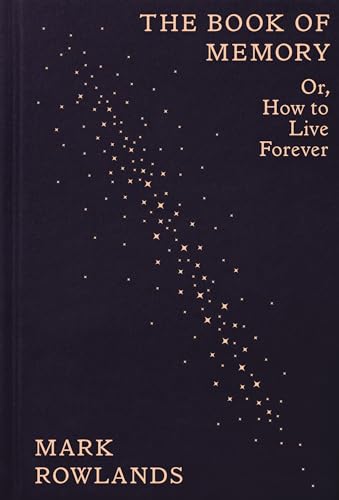
'The book of you is dominated by night-black seas, sprinkled with shining island tiny islets of remembrance, glimmering in the night.'
Memory isn't all that we think it is. Each time we revisit even our most deeply ingrained memories, they can soften and consolidate, distorted. Yet they also carry within them the blueprint of each person's unique style. From episodic memories like shining islands in dark water, and forgotten memories that underpin our personalities, to the memories authored by others that we carry within us, Rowlands explores our negotiations with the past and how memory makes us who we are.
Drawing on the latest neurological and psychological research and on a range of writers and thinkers, The Book of Memory is a mesmerising journey into how memories are made, lost and remembered, with important consequences for how we understand ourselves.
Mark Rowlands was born in Newport, Wales and began his undergraduate degree at Manchester University in engineering before changing to philosophy. He took his doctorate in philosophy from Oxford University and has held various academic positions in philosophy in universities in Britain, Ireland and the US.
His best known work is the book The Philosopher and the Wolf about a decade of his life he spent living and travelling with a wolf. As The Guardian described it in its review, "it is perhaps best described as the autobiography of an idea, or rather a set of related ideas, about the relationship between human and non-human animals." Reviews were very positive, the Financial Times said it was "a remarkable portrait of the bond that can exist between a human being and a beast,". Mark Vernon writing in The Times Literary Supplement "found the lessons on consciousness, animals and knowledge as engaging as the main current of the memoir," and added that it "could become a philosophical cult classic", while John Gray in the Literary Review thought it "a powerfully subversive critique of the unexamined assumptions that shape the way most philosophers - along with most people - think about animals and themselves." However, Alexander Fiske-Harrison for Prospect warned that "if you combine misanthropy and lycophilia, the resulting hybrid, lycanthropy, is indeed interesting, but philosophically quite sterile" and that, although Rowlands "acknowledges at the beginning of the book that he cannot think like a wolf... for such a capable philosopher and readable author not to have made the attempt is indeed an opportunity missed."
As a professional philosopher, Rowlands is known as one of the principal architects of the view known as vehicle externalism or the extended mind, and also for his work on the moral status of animals.
A good philosophical exploration into what memories are and how they hold significance. the conclusion is slightly anticlimactic, but I enjoyed the journey. Thought-provoking and an easy read for philosophical discussion.
I’m at the clinic and just finished this book this afternoon, so I might as well get my thoughts down.
Wow, where do I start?
This book (specifically, its topic) piqued my interest when I spotted it in the library. A while before that, I’d went down a midnight rabbit hole, watching 2 moving documentaries in full on severe memory ailments (specifically those of Clive Wearing and Junko Mizuta, very poignant and thought-provoking works btw). Rowland’s book ended up being the perfect supplementary resource to my elementary dive into memory and how it works.
I didn’t expect it to be as poetic as it was for sure. The prose in the book is incredible, daresay some of the best I’ve ever read. (I’m surprised how few reviews this book has here.) Several beautiful comparisons and metaphors (some he cited, some he invented) raised by Rowland really stuck with and resonated with me. In particular, the metaphor of man as a book of memories may strike one as cliché prima facie, but the nuanced way that Rowland constructs the idea of it being a book with redactions of “catastrophic” proportions, swirling like small black seas (given how little we truly remember of our entire lives), was something I have never considered before and really reinforced the idea of transience. Additionally, being a past student of Romanticism continuing my study of literature into university, the mention of the “forgetting waters of Lethe” was a nice little reference. (Keats!)
Rowland also elucidates the concept of Rilkean memories—non-tangible memories which manifest not in the mind but in one’s mannerisms and demeanour (e.g. the way the author carried one of his legs to prevent getting hurt due to ‘memories’ of a past injury) which I found fascinating as well. (They can even be retained by patients with dementia. Isn’t that wonderful?) It strengthened the message I read from Clive Wearing’s documentary from an interview with his wife (if I remember correctly). Essentially, even though Clive could recall nothing but scarce, detached semantic memories of his past, his quintessential spirit (the result of his experiences and ‘forgotten’ memories!) lingered in his disposition and body. I truly found that so beautiful.
As several other reviews have stated on here, there were indeed some portions of Rowland’s book which I felt could be condensed (though sometimes they helped jog my forgetful memory which was helpful, lol), I overall really enjoyed this short book, which was both poetically and scientifically fascinating. Underrated!!
This entire review has been hidden because of spoilers.