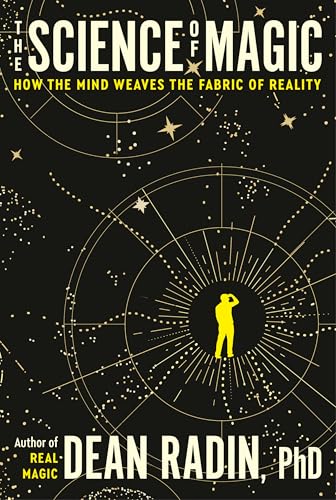
A science-backed guide to discovering the real power of magic and implementing it in your life, from the renowned author of Real Magic
There is an idea that shakes the core of our scientific That our consciousness participates in creating our physical reality. It's an idea that runs counter to the materialist worldview we're all taught in school. But the outer edges of scientific inquiry bleed into what can only be called 'magic.'
Dean Radin, Ph.D., is at the forefront of researching magic from a scientific standpoint. In The Science of Magic, he shines a light on today's scientific breakthroughs, from quantum mechanics to the mind-body connection to telepathy, that can best be explained by what we currently call magic (or psi). In short, today's magic is the science of tomorrow. He shares his own groundbreaking research on psi phenomena, and explains how you can start utilizing these findings in your own life today.
Accessible and practical, The Science of Magic offers magical methods from the perspective of a scientist, demonstrating how to effect change with exercises and hands-on techniques. In short, magic is a mental skill, like meditation or mathematics. You will find a quiz to discover your natural talents and foundational activities for strengthening your skills,
With his uniquely science-backed approach, Dean guides you through testing magic on your own, for example through dream precognition, evoking synchronicity, and more. The Science of Magic is a journey to the outer edges of our understanding of the universe, showing where science is leading namely, to magic.
This page-turner of a book is filled with comprehensive summaries of the most interesting and detailed scientific experimental research in the field of psi and magic, as well as fascinating personal insights about Dr. Dean Radin's experiences, and powerful practical information and exercises to assist readers in making the most of what cutting-edge researchers in this field have learned.
Far more than being an interesting book about magic or a good summary of scientific psi experiments, "The Science of Magic" also succeeds at meeting far loftier goals. Dr. Dean Radin opens the gates to the dawning of a new day of the beginning of the re-enchantment of our world--recovering after some 400 years of nihilism and marginalization of anyone or anything striving to scientifically explore consciousness. It's now been four centuries after consciousness was separated from scientific study, with the result that a state of nihilism became rampant. This nihilism has operated under an assumption that life is ultimately random and meaningless, since the study of science had been totally set aside from all that fell under the official dominion of the church. And somewhat surprisingly, even in recent years there still exists a stigma of anything having to do with spirituality, prayer, consciousness, or mind-matter interaction. Radin explains, "As nihilism took hold, modernity did not simply reject the importance of meaning, purpose, magic, mystery, and spirituality. It actively denigrated these factors." Skeptics succeeded in mainstreaming the dismissal of anecdotal evidence as unreliable, baseless assertions that experimental evidence supporting psi or magic must be solely due to flaws or fraud, and "writing off these phenomena as impossible because they supposedly violate physical laws." It really does appear that after Pope Gregory XV coined the word "Propaganda" in 1622, the witch-hunting Inquisition of the Middle Ages "still strikes fear in the hearts of academics."
Fortunately, those of us who are alive now are graced with amazing news that the tide is beginning to turn. This is primarily due to the fact that physics can no longer ignore the role of consciousness, While our 19th century idea of reality was based on the ideas that physical objects have definite properties that remain stable independently of observation, and that different observers observing the same object and event will see the same thing--recent scientific experiments are demonstrating "in top-tier science journals that (a) different observers measuring the same object can experience different realities; (b) in spite of Einstein's opinion that 'spooky action at a distance' doesn't exist, experimental demonstrations of nonlocality won the Nobel Prize in physics in 2022; and (c) retrocausal influences can and do occur in quantum mechanics." And while some skeptical hold-outs might declare that surely these aberrations must only occur at the "quantum scale," and not in our larger-than-quantum selves, the burgeoning field of quantum biology research papers suggests otherwise. In fact, quantum effects appear to be necessary in living systems.
How and why we can gain a deeper understanding of consciousness, and best assist humanity becomes increasingly clear while reading this outstanding book. Highly recommended!
A great overview of the past 100 years or so of the scientific study of psi / magic and what we do and don't know about "supernatural phenomena" at this point in time in the early 21st century.
I shouldn’t have taken me long to read and initially it didn’t but then life got in the way but I very much enjoyed it. A little more in-depth ‘geekery’ than the previous book Real Magic, on which this, I think, is an obvious extension of that brilliant book. I do think that this book is far less an accessible read than Real Magic, and the reader won’t be missing out that much except maybe for some shred protocols in the last few chapters of how to perform basic magic. Which, if you already practice magic to a foundational level you will be familiar. There were a few places in which I felt a little out of my depth even with my PhD in biological sciences but on the whole enjoyed this book, especially the anecdotes, of which a major one is repeated in this one with a little more to it. I recommend to read Real Magic first before this one.
The Science of Magic feels like the book Dean Radin has been building toward for decades. His earlier work helped establish the scientific case for taking psi seriously, but here he takes the next logical and much more exciting step: if consciousness really does have capacities that extend beyond our conventional understanding of mind and matter, what happens when we deliberately train and apply them?
For someone interested in both magick and parapsychology, this is incredibly satisfying territory. Radin moves through experimental research involving telepathy, precognition, mind-matter interaction, the mind-body relationship, and nonlocal consciousness, but he doesn't leave these phenomena confined to laboratories and statistical analyses. He eventually brings them into the realm of practical magick through sigils, candle spells, knot magick, affirmations, written spells, dream precognition, synchronicity, and other techniques.
I loved seeing these two worlds brought together so explicitly. Occultists have spent centuries developing methods for focusing intention and shifting consciousness, while parapsychologists have spent decades attempting to determine whether consciousness can acquire information or exert influence in ways that exceed conventional explanations. Those pursuits have always seemed much more closely related to me than either field usually acknowledges.
One of the ideas I found most compelling is Radin's treatment of magick as a skill. That sounds deceptively simple, but it changes the entire framework. A skill is something that can vary between individuals, respond to training, improve through feedback, and become more reliable through practice. Meditation works this way. Visualization works this way. Attention works this way. There is no obvious reason to assume that psi, if it represents a genuine human capacity, would operate completely differently.
This is also where psychology becomes incredibly important. Psychic perception presents a fascinating problem because consciousness constantly generates thoughts, images, memories, associations, expectations, emotions, and intuitions. If anomalous information occasionally enters that stream as well, the challenge becomes learning how to recognize it.
That is a much more interesting model of psychic development than simply trying harder to “be psychic.” Practice becomes an education in the phenomenology of your own mind. You begin learning how imagination feels, how expectation feels, how anxiety alters perception, how analytical thought interferes with spontaneous impressions, and how accurate information tends to present itself for you personally.
Feedback gradually teaches discrimination.
I was especially excited by Radin's emphasis on testing these abilities yourself. Dream precognition is a perfect example because dreams are notoriously vulnerable to retrospective interpretation. Record the dream first, establish the future target afterward, compare the two, repeat the process, and suddenly something that could easily remain an extraordinary personal story becomes an experiment.
That experimental attitude is something I wish were much more common in magick.
Magicians already keep journals. We record rituals, dreams, divinations, synchronicities, spirit encounters, and spell results. With only a little additional rigor, magical recordkeeping can become a remarkably useful form of personal experimentation. Define the intention beforehand. Decide what would constitute success. Record misses alongside hits. Blind yourself to information when possible. Repeat operations. Look for patterns.
This doesn't diminish the mystery of magick. It helps reveal where the mystery actually begins.
Psychology can already explain many things ritual does extraordinarily well. Symbols activate associations. Expectation shapes experience. visualization affects emotion and behavior. Repetition conditions responses. Ritual environments focus attention. Emotional intensity strengthens memory. Physical actions embody intention. These mechanisms make ritual psychologically sophisticated before anything paranormal enters the equation.
Then comes the fascinating question: does anything remain after those mechanisms have been accounted for?
That is where parapsychology enters.
If information can sometimes be obtained without conventional sensory access, clairvoyance and divination become very different propositions. If physiological responses can anticipate genuinely unpredictable future events, our understanding of time and causation becomes more complicated. If intention correlates with changes in physical systems under controlled conditions, then the relationship between consciousness and matter deserves reconsideration.
The effects don't have to be enormous to matter. A tiny but repeatable anomaly can have gigantic theoretical consequences.
That may be my favorite underlying idea in the entire book. We tend to imagine proof of psychic ability as something spectacular, but science often advances because of small deviations that reveal something missing from an existing model. A reliable precognitive effect would matter because any genuine transfer of information from future to present would force profound questions about time. Even weak evidence of mind-matter interaction would matter because consciousness isn't supposed to behave that way under a strictly conventional model.
This naturally brings Radin into physics and questions about the fundamental nature of reality. I appreciate these discussions most when they are treated as attempts to imagine what kind of universe could accommodate psi rather than as shortcuts claiming that quantum mechanics automatically proves magick. The existence of quantum entanglement does not itself demonstrate telepathy, but physics has certainly taught us that reality behaves in ways our everyday intuitions never anticipated.
That leaves room for much larger questions.
Is consciousness entirely produced by localized brain activity? Is it somehow more fundamental? Can information behave in ways that our ordinary experience of space and time conceals? Does observation merely register reality, or does consciousness participate in it more deeply?
These are scientific questions, philosophical questions, and metaphysical questions simultaneously.
They are also ancient magical questions.
What delighted me most about The Science of Magic is how ordinary Radin allows practical magick to be. A candle, knot, sigil, written statement, dream journal, or focused intention becomes enough to begin experimenting. Each technique organizes consciousness differently. A sigil compresses intention into symbolic form. A knot gives intention a physical action and tangible anchor. A candle provides focus and a temporal container. Words stabilize an idea through language and repetition.
The psychological mechanisms alone are fascinating, but Radin asks us to entertain the possibility that these techniques may do something more. Perhaps organizing consciousness around intention affects more than the practitioner. Perhaps some of what magicians historically described as spells overlaps with phenomena that parapsychologists describe using very different terminology.
That possibility is electrifying to me.
It also suggests that occult traditions may contain an enormous archive of hypotheses about consciousness. Divination proposes anomalous access to information. Spellcasting proposes anomalous influence. Spirit communication proposes interaction with apparently autonomous consciousness. Mysticism proposes that ordinary individual awareness can participate in a much larger field of mind. Magical traditions developed countless techniques for exploring these propositions long before anyone had laboratories designed to test them.
Science gives us tools for asking which effects survive controlled investigation. Magick gives us centuries of experimental ideas about where to look.
The Science of Magic brings those two impulses together with unusual confidence. Radin takes the magician seriously enough to ask what might actually be happening, and he takes science seriously enough to believe that extraordinary claims can be investigated rather than protected from scrutiny.
That combination is exactly what I want from books exploring consciousness.
I finished this feeling energized rather than merely informed. It made me want to design experiments, revisit old magical techniques with better controls, record results more carefully, test dream precognition, examine synchronicities prospectively instead of retrospectively, and think more seriously about what successful spellwork might imply about consciousness.
That may ultimately be the book's greatest achievement. The Science of Magic doesn't simply ask the reader to believe that magick is real. It makes magick feel like an enormous research program that has barely begun.
For anyone fascinated by the intersection of occultism, psychology, parapsychology, consciousness studies, and the deeper structure of reality, this is precisely the kind of book I have been waiting for.
Dean Radin occupies a fascinating position in the world of psychic research. He has spent decades experimentally studying psi, yet unlike many researchers who carefully keep that work separated from spirituality and occultism, he is increasingly willing to ask the question I've wanted parapsychology to ask for years: if phenomena like telepathy, precognition and mind-matter interaction are real, what happens when people deliberately cultivate and apply them? The Science of Magic takes that question seriously, surveying experimental parapsychology before moving into enchantment, divination, theurgy, gnosis and practical magical experimentation.
The scientific material was easily my favorite part. Radin discusses research involving consciousness, psi and mind-matter interaction, placing phenomena traditionally called psychic alongside practices traditionally called magical. I especially appreciate his willingness to treat these subjects as questions that can be investigated rather than beliefs that must either be accepted or ridiculed. There is something wonderfully destabilizing about considering divination alongside precognition research. If experiments suggest that human consciousness sometimes obtains information in ways our conventional models have difficulty explaining, then practices developed for obtaining information through intuition, dreams or divination suddenly become much more interesting objects of study. Radin has spent roughly forty years working in this territory, and that depth of familiarity shows.
Where I became somewhat less convinced was in the transition from evidence for psi to explanations of magic itself. Demonstrating anomalous information transfer or mind-matter correlations would be enormously important, but it doesn't automatically demonstrate every larger metaphysical interpretation we might build around those findings. Quantum mechanics enters the discussion as well, and although I find possible connections between consciousness and physics fascinating, I occasionally felt Radin was moving faster from intriguing evidence to sweeping interpretation than I was prepared to follow. A scholarly review from the Society for Psychical Research raises a related limitation: Radin gives comparatively little attention to skeptical interpretations and unresolved problems within experimental parapsychology. I would actually have enjoyed more sustained engagement with the strongest counterarguments because surviving serious criticism makes unusual evidence considerably more interesting to me.
The practical section was an unexpected pleasure. Radin includes exercises involving affirmations, sigils, knots, candles, written magic and spellcasting, along with experiments involving dream precognition and synchronicity and ways of testing one's own results. As someone interested in psychic development, the emphasis on testing appealed to me enormously. Keep records. Make predictions before outcomes are known. Look at what actually happens. Magical and psychic practice can become frustratingly slippery when every coincidence becomes confirmation and every failure receives a metaphysical explanation after the fact. Bringing even an imperfect experimental attitude into personal practice seems like a healthy corrective.
I finished The Science of Magic with more questions than answers, but they were excellent questions. I remain more persuaded by Radin's case that psi deserves serious scientific investigation than by every connection he draws between psi research and magical theory, yet I am very glad somebody with his background is attempting to connect these worlds. Other readers seem divided along similar lines, praising the breadth of studies and practical experimentation while sometimes finding the scientific sections dense or the leap from psi to magic less convincing. For me, this is exactly the sort of ambitious book worth reading critically: exciting enough to expand my sense of what consciousness might be capable of, rigorous enough to send me looking through the research, and provocative enough to make me want to design a few experiments of my own.
I found this book after reading the author’s earlier work, Real Magic. Dean Radin has been a researcher in “psi” for several decades. Psi in this context covers a range of terms, including extra-sensory perception, clairvoyance, telepathy, parapsychology. divination and magic. The book essentially has three messages. First, that psi has been scrupulously investigated by many scientists across a range of disciplines for well over a century using the most rigorous scientific standards available. Second, despite this, many scientists across the same disciplines have continued to dismiss psi as “baloney” and psi researchers as frauds and cheats at worst or delusional at best. However, the dirty secret of science is that many of those rationalist-materialist sceptics secretly admit that there must be something in psi. Third, you can try magic at home – but don’t expect miraculous results on day one. The early chapters of the book are an updated version of the history of psi research given in the author’s earlier work, Real Magic. The tone is more optimistic than in the earlier work because even the most sceptical materialists are having to admit that there are weird things going on in the universe and inside our heads. These weird things are essentially related to quantum mechanics and to what is generally called consciousness. I’ll repeat what I said in my earlier review about the surprising gaps in the author’s otherwise comprehensive account of psi research. For example, although he refers to the US government’s interest in psi during the latter stages of the Cold War, he doesn’t mention the Monroe Institute, which was used by the US Army as a training school for intelligence analysts to acquire skills in remote viewing and is still operating today. Nor does the author mention Dr Joe Dispenza. Dispenza’s mission seems to be to inject a healthy dose of scientific rigour into manifesting, meditating, breathwork etc. Maybe because the author’s specialism is parapsychology, he doesn’t refer to evidence used by Dispenza et al coming from areas like brain chemistry and the physiology of the heart and gut. I’m talking about the pineal gland, the heart’s electromagnetic field and your stomach’s “brain”, the enteric nervous system. The author includes a more comprehensive overview of magical practice than you’ll find in the earlier book. This includes chapters on enchantment, divination and gnosis (aka meditation). He also includes a chapter on testing your magical abilities. The techniques he offers are straightforward and do not involve expensive equipment or elaborate rituals. You can get by with a pen and paper, and maybe a notebook to record your results in. Even candles are optional. I would recommend this book to anyone who wants to know more about research into psi and how it relates to current thinking about quantum physics, manifesting, consciousness etc. The chapters on practical magic are a bonus and might whet your appetite for further exploration. The book ends on an optimistic note: “gaining a better understanding of consciousness, psi and magic could offer an enormous boon to humanity.” I also ended my reading of the book with a feeling of optimism.
liked this one, but i’m a little mixed on it. dean radin is at his best when he’s discussing the actual research into psi, consciousness, telepathy, precognition, and other phenomena that mainstream science tends to dismiss or overlook. there’s some genuinely fascinating material here, and i appreciate his willingness to take these subjects seriously and look at the evidence. where it lost me a little was when it moved from psi research into explaining magic itself. some of the connections between scientific findings and magical practices felt like bigger leaps than the evidence actually supports, especially when quantum mechanics enters the conversation. i also found some of the practical magic material pretty basic compared to the scientific sections. still, there’s plenty here worth thinking about and i’m glad books like this are pushing conversations about consciousness and psi into places they’re usually excluded from.
Despite the subject matter making me assume this book would be difficult for me to understand, I was pleasantly surprised. Finally a book that talks about the science behind what we know as magic. The different aspects of this science are broken down and explained so thoroughly with plenty of easy to grasp examples along the way. I love that the societal views of “magic” are addressed and this is a book I will treasure and refer to again and again. I received a review copy for free, and I am leaving this review voluntarily.
I don't know if I am smart enough to understand this. It was basically a lot of studies and different trials about how you can do magic within certain perimeters and within certain restrictions if you believe you can do it and your psy/magnectic field is strong enough (?). It was confusing as the audiobook and seemed to be redundant as what the author was talking about seemed very similar to each other.
Scientists have avoided admitting any interest at this subject (esp, etc.), as they would usually be ridiculed and black balled from ever being published or advanced in their field if they did. Scientific verification of these phenomena have been done for many years, and in fact, Dean Radin has carried out many successful experiments in this field himself! This volume is a compendium of many of these experiments and can actually be almost overwhelmimg in its breadth and scope.
A thoughtful and insightful book, similar to his other book, but better in every way. I highly recommend this to anyone wanting to learn more about Magic.
I found this book fascinating. It’s not one I’d recommend to everyone, but if you’re curious, enjoy questioning assumptions, and are willing to entertain ideas you may ultimately reject, I think it’s well worth reading. The studies shared were really interesting and piqued my curiosity. It definitely gets you thinking about the nature of reality.
Dean Radin is one of my favorite authors in the field of consciousness research, and this book is another great addition to his work. He explores the intersection of ancient esoteric practices and modern science, reframing traditional "magical" concepts like enchantment, divination, and theurgy through the lens of nonlocal consciousness, psi research, and quantum mechanics.
What makes this book such an engaging read is the sheer variety of clever, well-designed experiments he presents. From testing mind-matter interactions with optical double-slit setups and plasma balls to double-blind experiments on intention-treated tea and chocolate, the empirical approach is both fascinating and rigorous. I especially liked how he connects the observer effect and quantum entanglement to practical mechanics like intention, attention, and "effortless striving". The inclusion of practical exercises - such as breathing methods for reaching a state of gnosis, sigil crafting, and simple home experiments with plants and flame observation - adds genuine, hands-on value.
The main downside for me was the amount of time spent discussing the struggles psi researchers face against mainstream academic skepticism. While I completely understand why it is frustrating for scientists working in this field to deal with dogmatic materialists and funding hurdles, as an everyday reader, those sections felt repetitive and less relevant. I would have preferred that space to be dedicated to even more experimental data, theory, and practical takeaways.
Overall, it is an insightful, well-researched book that bridges the gap between laboratory science and spiritual reality creation. Highly recommended for anyone interested in quantum physics, consciousness, and the science behind how mind influences matter.