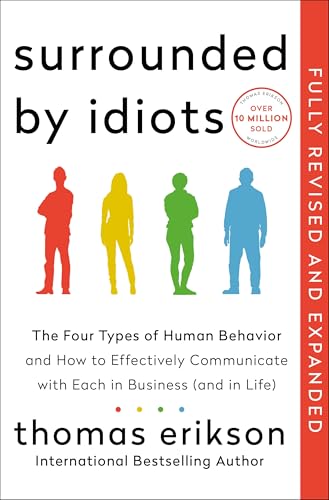
A fully revised and expanded edition of the runaway bestseller, Surrounded by Idiots—now with Text • Charts • Examples • Snark!
Master the four basic behavior types and change the way you communicate!
Do you ever think you’re the only one making any sense? Or tried to reason with your partner with disastrous results? Do long, rambling answers drive you crazy?
You are not alone. After a disastrous meeting with a highly successful entrepreneur, who was genuinely convinced he was ‘surrounded by idiots,’ communication expert and bestselling author Thomas Erikson dedicated himself to understanding how people function and why we often struggle to connect with certain personality types.
Erikson’s simple yet ground-breaking techniques will help you understand yourself better, hone communication and social skills, handle conflict with confidence, improve dynamics with your boss and team, and get the best out of the people you deal with and manage.
At a moment in time when understanding one another is more important than ever, Thomas Erikson revisits his most popular title, offering an updated and expanded edition that will make you a master of communication.
Thomas Erikson is a behaviourist and the bestselling author of the Surrounded by- series about human behaviours.
The series, has been translated to close to 60 languages and has sold over 8 million copies.
His mission is to make people’s lives easier by making them more aware of themselves and help people to a better understanding of what it takes to achieve the best possible communication.
He is a highly sought-after public speaker with 120 keynotes yearly on topics such as human behaviours, self-awareness, , narcissism, and leadership.
He lives by the simple but useful quote: You can’t change somebody else, but you can change yourself.
Thomas was writing for twenty years before finally getting published. Being an author was his dream in life, so he never gave up. Instead he tested new ideas, tweaked his writing style, learned new skills, asked professionals, worked from 03.00 in the morning for years.
No one really believed in his writing ambitions, so he had to believe in himself.
Nowadays Thomas is Sweden’s most translated author still active. Only Selma Lagerlöf and Astid Lindgren has been translated into more languages. He has until today published twelve books – half fiction and half non-fiction – and he will continue to write as long as he breathes.
He lives on the countryside in Sweden with his wife Christina, Sweden’s biggest romance author, he runs a family business that provides online courses and master classes on all the topics he writes about in his books.
Fun fact: Thomas is a true anglophile. He is a passionate gardener, loves topiary: if he could wear tweed the full year he would. And he is s collector of old Land Rovers. Some of them works, most of them don’t.
Overall a great read and interesting view on how we behave. Explaining how we match with certain types and why we don't match, is certainly funny and gives you a moment of revelation. I don't think however that we should normalize behaving "rude" just because we have a certain profile and we can't help it.
Oh dear. Where to start with this book? The front cover maybe! It is telling me that 'over 10 million copies have been sold'. Thus disproving the saying never judge a book by it's cover. It is clear that a lot of Erikson's readers did exactly that! I am one of them. Who hasn't whispered the title to themselves at work or on the roads or in the supermarket? The catchy title immediately engages and hooks the reader, but unfortunately it's downhill from there.
I found this book to be a half-baked attempt to re-hash the work of the Myers-Briggs personality indicators. But with this system we are only allowed four pigeon holes for the whole of humanity! Erikson then proceeds to squeeze an unsettling amount of self-assured examples very deftly into each box.
Page after page after page of preachy conclusions, judgements and behavioural knowledge stretch the bounds of believability to breaking point for this reader.
Erikson has more in common with a highly financed American tv evangelist than a serious psychologist. Think more Mystic Meg than professional academic.
Anyone that will pay to have their fortune told or reads Astrology will love this book. But for serious behavioural studies most of us will need to look elsewhere.
Last point. I couldn't find any references in the book. That's also a bit unsettling.
This entire review has been hidden because of spoilers.
4.75⭐️ The title is quite strange and has caught some people’s attention while I was reading in public😅 however it’s a bit misleading as it’s not as negative as it seems. I’ve learned a lot about personalities and what makes us all so different. It was so fun to identify myself and other people in my life and make sense of it. I don’t usually read non-fiction but this one was engaging and would recommend it!
I have to admit, the title grabbed me immediately and then I was pleasantly surprised to see this was a behavior type book similar to Meyers-Briggs. I had never heard of this one before or read the original, so I’m not going to be much help in distinguishing this from the original version unfortunately. I listened via audio which was easy to do, and I thought that the four types were fairly spot on and the assessments reasonable, as they are all types of people I’ve seen and worked with before. I do think folks are not that easily put in one bucket for all things, so that is where you have to be careful when reading books like this, but otherwise this was a great read with a good perspective on how to relate to different types of people.
Thank you to St. Martin’s Essentials #partner for the gifted book to review.
The theory is very interesting, and I started reading because I wanted to learn more about the DISC model. However the way the book is written is very boring. From the middle to the end I just wanted to finish it as quick as possible. The fact that is very structured and have chapters divided by each color is good for when we want to revisit or find something specific about each color. But it is a very boring approach if you want to read it as a linear thing.
I never read the original, so I'm not sure what's different about this revised version, but it's a basic overview of the DISC personality types. Most people find it fun to diagnose themselves and their friends, but the book wasn't useful on a very practical level. I was given an ARC by NetGalley to review.
Loved it! The only thing I really hated was when he would reference a color the author would say 'he' instead of not 'they'. Example: 'I red tends to get mad quick. HE needs to work on that'. Thats the only flaw though!
First, kudos to the author for choosing a title that will draw anyone in. It's the first rule when giving a speech or writing a piece, draw your audience in with a catchy opening line or anecdote, or in this case title. There probably isn't a person on the planet who has not felt like they were surrounded by idiots. All you have to do is read the daily news.
But instead of finding confirmation of this title in the book, it is of course not about that. I've been on Company training courses where inevitably a variant of the four colours or DISC model have been used but was still curious about this book.
The author does have an accessible writing style which gets you through the first 200 pages quite quickly and easily. It's fun trying to figure out what colour you see yourself in and how you would categorize your colleagues. Confusing also because I started out as thinking I am mostly one colour, then turned purple and almost ended up a rainbow.
I have to agree with some other reviews on here that after page 200 it starts to get quite repetitive and by page 300 or so I started skimming. I took the test and found out what colours I apparently am (green/blue and red) but of course it very much depends on the questions asked and whether it concerns private life or work life.
So it is rather disappointing that after all those pages and all the author's anecdotes he comes to the same conclusion, we all behave in a certain way and adapt when it's possible or even required depending on the situation. We just may have a different approach to it. The lesson he ends on is that we should all listen more to each other and basically just try to get along. Well, that's hardly news, hence the 2,5 stars.
Man discovers not all people are the same… 🙄 I was fooled by the clever, intriguing title. This started OK with some mildly interesting insight into how people’s behaviour patterns can be categorised based on a combo how introverted/ extroverted they are as well as how task/relationship driven they are, then this waa repeated over and over again, somehow becoming more reductionist every page.
The title turned out to be misleading. A lot of the ‘idiotic’ behaviour described was often actually selfish and unkind. Are people with cruel, toxic bosses like the CEO described in the early chapters supposed to read this book, think ‘Lol he’s such a RED’ and then suffer on?
The author smugly recalled people who had disagreed with him in the past, citing more than once that he’d spent two decades working on this theory of behaviour. Despite this, the only so-called evidence he could come up with to back this up were personal anecdotes, all centred in western office job meetings or middle class dinner parties. There was no exploration of why people behave the way they do, no acknowledgement of how or why people behave differently in different scenarios, and apparently neurodiversity and mental health conditions do not exist.
P.S., claiming you are not sexist in the first chapter does not mean this is true.
P.P.S. Kudos to the author for making so much money off this.
This is an insightful book about personality, behavior, and thinking patterns and how to communicate with people who differ from you in those areas. Erikson utilizes the DISC model of behavior types, which includes Red (Dominant), Yellow (Influential), Green (Stabilizing), and Blue (Conscientious). He describes the general characteristics of each type (positive and negative), how each type views itself, and how each type may be perceived by others. He then discusses how to communicate and collaborate effectively with each. Additionally, he devotes a few chapters to ideas separate from behavior, such as motivations and driving forces.
What I liked: I found the book well-organized and easy to read. The author includes plenty of examples and personal anecdotes, which helped me understand the points he was making. Overall, I believe the things I’ve learned from this book will prove useful in my interactions with people around me, especially in the workplace.
What I didn’t like: The majority of the book focuses on each behavior type as a pure color, yet Erikson states that only about 5% of the population is solely (or almost solely) one color. Most people are a combination of two colors, with one color being dominant. Therefore, the real-life people you encounter won’t fit neatly into the categories the book describes, and this somewhat lessens the book’s ease of applicability.
Conclusion: The ideas in this book are beneficial to understanding others who work and think in different ways. It helped me comprehend why some people do certain things or act in certain ways that seem illogical to me. It’s just important to remember that assigning different colors to people is so that we can better understand them and work with them, not to pigeonhole them and ignore their individual complexities.
I didn't finish this so I don't know if I should give it a full review. The funny thing is the book said most people don't finish non-fiction but that we should push through to the end. I thought this had lots of helpful information but became redundant. I think I will continue to use it as a reference guide when working with different personalities throughout my career though..
I've been exposed to the DISC model a few times over the last decade, and each time it made sense while I was in the room. I'd forgotten how to apply it within weeks. That's probably because those exposures were all training seminars. Reading a book is different - it sticks.
Thomas Erikson's Surrounded is funny, engaging, and full of examples I'll actually remember. The "keep the receipt" joke in the opening sets the tone, and Erikson has a knack for making behavioural psychology feel real rather than academic.
The idea that struck me first was his challenge to the Golden Rule. Rather than treating others as you'd like to be treated, he argues you should treat people as they'd like to be treated. It's a small shift in thinking, but the implications for communication and leadership are obvious once you see them.
Erikson presents DISC with a lot of confidence, but the evidence behind the colour descriptions isn't especially rigorous. If you want a scientifically robust model of personality, you'll be disappointed. Treat it as a framework for thinking about communication rather than a diagnostic tool, though, and it earns its keep.
I enjoyed Surrounded by Idiots. It's well written, genuinely funny in places, and full of practical suggestions that could improve conversations at work and at home. I'd recommend the book as a reminder that not everyone thinks, communicates or decides the same way, and that adapting to those differences is often the key to being understood.
This book, first published in Swedish in 2014, then in English in 2019, and revised and expanded in this 2025 edition, is a classic self-help book. It categorises people into 4 personality types (labelled as Red, Blue, Yellow and Green), which supposedly helps people to understand themselves and others. The author claims that recognising and adapting to the differing behavioural styles will improve your personal and professional interactions. I found that the book spent too long focussing on workplace examples and not enough on ‘personal’ ones, so I think that the primary audience for this book is professional leaders, though individuals may find it useful too. I’ve spent my whole life thus far not knowing about this system, and in my experience, pigeonholing people ignores the complexity of individuals. Suffice to say that I wasn’t predisposed to like this book, but I persevered, to see what the author had based his system on. Critics say there’s not much rigorous scientific research behind ‘the system’, but in chapter 18 the author provides a short description of how his system evolved. He mentions the history of Hippocrates system of ‘humours and elements’ that predates modern systems like his own. Hippocrates proposed that human health and personality relied on the balance of bodily humours associated with four temperaments, eg: sanguine (optimistic and social), choleric (ambitious and irritable), melancholic (pensive and analytical), and phlegmatic (calm and sluggish). This ancient system of ‘humorism’ was disproved by modern science, but there’s a legacy of modern personality systems, including the author’s own. It’s based on the DISC personality-type model, which categorises people as Dominant, Inspiring, Stable or Compliant. DISC was researched and devised by US psychologist Walter Marston, who in 1928 researched the behaviour patterns of healthy people. (Jung and Freud had earlier published studies involving mentally unstable people). Many other people since then have fine tuned Marston’s model. In the 1950’s, Walter Clarke developed the DISA concept, which exchanged ‘compliance’ with ‘analytic ability’. The author uses these four main traits, substituting colours associated with these traits for simplicity. The Dominance trait (RED) relates to how controlling a person is in their approach to problems and challenges. The Inspiration trait (YELLOW) refers to how much a person likes to impress and influence others. Stability (GREEN) measures how receptive a person is to change, and Analytic Ability (BLUE) shows how willing someone is to follow rules and regulations. Most people (80%) are a combination of two colours in their preferred behavioural style. REDs and YELLOWs are extroverts, and more active implementers; GREENs and BLUEs are introverts, and more passive and reserved. To use a colour pun, the system seems a bit ‘black and white’ (and ‘dated’) to me. It doesn’t take into account how many people adopt a different ‘work persona’ in order to fit in with a work or ‘corporate culture’, (although workplaces are thankfully becoming more ‘inclusive’ these days). It also doesn’t factor in the new ‘work-from-home’ reality that many workers now adopt. However, personality test systems can be ‘fun’ to explore whether they’re scientifically valid or bogus, so I decided to continue reading. The author acknowledges in chapter 3 that most readers will want to launch right into how everything works in practice, so it’s not necessary to skip to Chapter 18 for background unless you want to. As he used various people he knows to illustrate ‘the system’, I started to slot people I know (including myself) into ‘colours’, based on my own perceptions. I found myself intrigued by the author’s anecdotal evidence, and the tone of the book is anecdotal and humorous too, which makes it easy to read and digest. I wasn’t convinced though that the system was particularly ground-breaking or revelatory. The first sections of the book concentrate on the ‘positive’ and ‘negative’ perceptions of the various colours or personality types. There are no perfect human beings of course, and the best teams are composed of a mix of all traits. (The YELLOWs will come up with new ideas, the REDs will make the decisions, the GREENs will do all the work, and the BLUEs will evaluate and make sure the results are excellent)! The author spends the next part of the book showing how to use what you’ve learned about the various types, to your (or your business’s) advantage. In the Chapter on ‘Adapting to others’, the author notes that you can’t change everyone else, and it’s ‘unnatural’ and can even be ‘unhealthy’ to continually adapt to others, but we all do it all the time. He recommends using a system (his system), after appropriate training of course, to cope. As to whether to ‘not be yourself’ is deceptive or manipulative, the author says that you can choose how much or how little to adapt. The advice he gives is pretty common sense really, but it will be useful to those who struggle to adapt to others. It basically teaches how to adapt your messaging to match the communication style of your listener. There’s a chapter on ‘Group Dynamics, and who gets on with whom. Certain combinations are more suitable than others in terms of working together. Natural combinations include pairing REDS & YELLOWS who will set a fast tempo, set high goals, and motivate others to achieve great things. Pairing BLUES and GREENS will also work as they’ll feel secure with one another, and the decisions (when they eventually make them) will be well thought out. Complementary combinations will work too. BLUES and REDS are both task oriented, one interested in results, the other in process. YELLOWS and GREENS are both relationship oriented. One will talk, one will listen. Greens will ground Yellows, while Yellows will give Greens as much space as they want to work. The two most challenging combinations, that should be avoided where possible, are the pairing of colours with their exact opposite,eg: RED and GREEN, and YELLOW and BLUE. The Chapter on Written Communication may help when you can’t meet face to face. It shows how different colours have different, distinct writing styles. The trick is to reply in the same style. There are chapters on what angers and stresses each COLOUR, which can easily be deduced from their preferred behaviour, eg: do what they dislike to anger them, and their stress reaction will be to reinforce and exaggerate their preferred behaviour. After CH 18 (the chapter that reflects on the history of the system), the book finishes with a chapter of ‘testimonials’ and a short quiz to test what you’ve learned. I got 17/22! Then, there’s a final chapter, using a real life example of an experiment the author did with a group of managers at a conference. He divided them into groups with similar behavioural profiles, and set them a challenge that required cooperation. None of the groups succeeded, proving that diversity is the best way to structure groups. There’s a list of Further References, and a useful index. There’s also a series of ads for a further 5 books by the author which are variations on this theme, eg: ‘Surrounded by Psychopaths’(or how to stop being exploited by others)! This led me to believe that the author is milking his system like a ‘cash-cow’. While I found this book interesting and entertaining, it didn’t seem ground-breaking, and I won’t be reading any further titles in the series.
I grabbed - nay, lunged - for this based on the title alone. I really didn't know what to expect (it's a massive bestseller that I'd never heard of), but, seeing as how I've recently taken on some managerial responsibilities, I thought this book would be helpful in avoiding becoming one of those Idiots (and seeing if I am one already.)
This is not so much a management style book as it is a study of a certain personality type system called DISC. Instead of D and I and S and C, the author uses Red, Yellow, Green and Blue:
Reds are action- and results-oriented, very shouty; Yellows are social butterflies, not as shouty but very chatty, and everyone likes them; Greens are thoughtful and kind. They'll make sure your coffee is always topped off but probably won't get anything else done; Blues are deep thinkers who analyze all angles before acting in order to ensure everything is meaningful and perfect.
I'm a Blue/Green!
Fortunately, I am interested in personality types (how very Blue of me), so I rather enjoyed learning about this new system. What I appreciated, though, were the practical examples of how to engage with each personality type in order to maximize their best traits:
One of my work friends is Yellow - she loves to interview people and organize our team social events, and she is amazing at both. I told her about this book and she said, "let me guess - I'm Yellow, right? I'm always the bright social sunny one." Her expense reports are a disaster, however; There's me, Blue - I'm the expense coordinator. I'm not kidding. I love spreadsheets and minutia. I loathe social events and am figuring out how to worm my way out of going to the team's offsite this fall; I don't think we have any obvious Reds on our team? Upper management for sure though.
Overall, the personality types come across as pretty simplistic, but, we're all composed of different colors, just varying degrees of them. I've already found it helpful and recommend it.
written by someone with just above average social analysis for people with no social analysis.
So far the argument of the book is that we judge people too harshly because we don't know how to analyse them, and therefore call people idiots as they act in an unpredictable unfathomable way, that to someone with no analysis comes across as idiocy. He also comes from the perspective of being able to analyse people will help one not to judge others, but I think it'd be better to say you can judge people in a more correct manner.
Only got 6% in but may listen to some more. Got very aggravated listening to very basic ideas about core ideals and things.
ok fuck it, DNF @ 32%. no data, no references. just a whole lot of yapping and making oversimplified, biased, reductive, immature, generalized sweeping statements. this book made me so annoyed
The Publisher Says: A fully revised and expanded edition of the runaway bestseller, Surrounded by Idiots—now with Text • Charts • Examples • Snark!
Master the four basic behavior types and change the way you communicate!
Do you ever think you’re the only one making any sense? Or tried to reason with your partner with disastrous results? Do long, rambling answers drive you crazy?
You are not alone. After a disastrous meeting with a highly successful entrepreneur, who was genuinely convinced he was ‘surrounded by idiots,’ communication expert and bestselling author Thomas Erikson dedicated himself to understanding how people function and why we often struggle to connect with certain personality types.
Erikson’s simple yet ground-breaking techniques will help you understand yourself better, hone communication and social skills, handle conflict with confidence, improve dynamics with your boss and team, and get the best out of the people you deal with and manage.
At a moment in time when understanding one another is more important than ever, Thomas Erikson revisits his most popular title, offering an updated and expanded edition that will make you a master of communication.
I RECEIVED A DRC FROM THE PUBLISHER VIA NETGALLEY. THANK YOU.
I didn't read the original version so cannot comment on whatever might be new in the presentation of the text. I can tell you it's easy to read, easy to understand, and easy to misuse. You are not going to be a mental-health professional after reading this book. I think anyone who feels frustrated and put-upon by the goofballs and simps surrounding them should go get a therapist. To be completely honest I think that anyway...go get a therapist! It will change your life for the better.
Absent that, reading this book is best done with the realization that at least a dozen people are reading it because of you. It behooves all of us to get better at communication with people not like ourselves, but from a place of non-judgmental desire to be better about our affect in this world.
I can hear y'all snickering, it's really quite rude. I already said it's best to read this (and all other books like it) in the full realization that others are reading them to detoxify your affect on them. I really mean that. Communication problems are always mutual. When you simply dislike someone you still need to be able to communicate with them to be effective in any social situation where there are other people...in other words, all of them. Talking to MAGAts or religious nuts is hard, but we all need to do it sometimes. I myownself keep interactions with them as short as possible and avoid eye contact the way our pal Mamie does with Mondays, for the same reason.
This particular iteration of the DISC / Meyers-Briggs system, using colors in place of letters, works as well as these things ever do: Not very, but useful as a quick issue-defusing technique. It's easy to internalize, comes with built-in shorthand, and can help you walk away from difficult conversations without creating more trouble.
It's not, and does not purport or pretend to be, a substitute for the hard work of therapy. Which everyone should do. But since there's no way in hell most lazy slugs will bother, and no way most people can afford it if they were willing (which they're not), and no easy way to find or know how to judge which therapist is the right one for you, we have books like this.
Use it the way he tells you to and you will do no (further) harm.
Overview This book introduces a simplified behavioral framework (DISC) that categorizes people into four types (Red, Yellow, Green, and Blue) to explain differences in communication, decision-making, and motivation.
At its core, it’s not trying to perfectly map human psychology. It’s trying to reduce avoidable friction. Most communication breakdowns happen because people assume others think the way they do. They don’t.
The book gives you a usable lens to recognize those differences, and adjust.
Why You Should Read This Book * You manage people or operate cross-functionally * You’ve never used a trait framework before * You want a practical communication tool, not a deep psychological model
This is a fast way to build baseline awareness and avoid obvious mistakes.
Concepts That I Learned That Will Change My Behavior 1. Adaptability Is the Skill The goal isn’t labeling; it’s adjusting. → What I do differently: I treat communication as situational. Default = adapt to the audience.
2. You Are the Idiot in Someone Else’s Story Everyone thinks they’re the rational one. → What I do differently: I assume misalignment is mutual, which lowers friction and improves patience.
3. Imperfect Models Are Still Useful No system fully captures human behavior. That’s fine. → What I do differently: I use frameworks (DISC, Culture Index) as directional tools, not truth.
4. Communication = Translation * Red → What? * Yellow → Who? * Blue → Why? * Green → How?
→ What I do differently: I tailor messaging to what the other person is optimizing for.
5. Opposing Styles Create Predictable Friction Red (speed) vs Blue (precision). Both necessary, conflict inevitable. → What I do differently: I design around tension instead of trying to eliminate it.
Final Thoughts The criticism of this book is that it oversimplifies people. That’s true, and also irrelevant if you use it correctly.
This isn’t a diagnostic system. It’s a communication shortcut.
Coming from a Culture Index background, none of this was nee, but it all checked out. The mapping is directionally consistent with real trait frameworks, just packaged for accessibility.
The core takeaway holds: adaptability wins. The best leaders don’t rely on being understood, and they get good at understanding others.
Not deep. Not novel (for me). But useful, and very usable.
Easy to Read: 5/5 Deep Content: 2/5 Overall Rating: 3/5
I had not read the original, before this revised & expanded edition, but I had heard of it because my teen had to go through it in one of her courses a couple years back. So while I had previous knowledge of the existence of the book, aside from her discovering she was a "Green", I don't have a personal comparison between the initial print and this one. So my review will be based solely on the ARC of this version that I received from NetGalley and St. Martin's Press. While I thank them for the opportunity to get to read and review this piece, my opinions on it area strictly my own.
My initial impression upon reading this book was an appreciation for the authors acknowledgement that times change and that they felt they needed to upgrade their piece to reflect that, as well as to answer a lot of very popular questions that people apparently had after reading the precious editions. I find that very respectable of them. (That alone makes me want to pick up their other works.) This was a very intriguing read for me. As much as I love a lot of other genres, I do from time to time love to educate myself with thought provoking and enlightening material like this book. While I found this book to be just that, I was a little perplexed to notice that I apparently don't fit into the singular RYGB categories. I actually was divided by two, which I guess can happen from time to time. My own life experience has taught me to walk with a certain level of respect, courtesy and grace towards others that I encounter outside my home-this book is really eye opening to the amount of people that don't seem to do that as an acknowledgment of that nor that amount of different personalities that exist in this world. Thus the "idiots" aspect of the book stemming from people only existing in their own personal bubbles of thoughts, emotions and actions and judging others based solely on that. Honestly I think this is a really important read for anyone and everyone and highly suggest that you pick it up. It's always good to broaden your horizons and expand your mind. No one in this world knows everything and that's ok, but you can always continue to grow and learn. Seriously, don't bypass the opportunity to read this one it can really help you to better understand those in the world around you, as well as bring better self-awareness.
This entire review has been hidden because of spoilers.
⭐️⭐️⭐️⭐️/5 Pub date: Aug 26, 2025 "Surrounded by Idiots Revised & Expanded Edition" By @thomaseriksonwriter
iG: ArchivesOfArmina
"Surrounded by Idiots" has always been a fun, easy-to-digest introduction to the four-color personality model, and this revised and expanded edition makes it even better. Thomas Erikson refreshes the original framework with updated examples, new sections on remote and digital communication, and a deeper dive into mixed personality profiles. I especially appreciated the added “do’s and don’ts” lists for working with each personality type 'cause they make the concepts far more actionable in daily life. The tone is still light and humorous, but with a slightly more balanced approach that avoids overgeneralizing. Whether you’re new to the model or read the first edition years ago, this version offers enough fresh material to make it a worthwhile read, particularly if you work in diverse or global teams. Highly recommended for anyone curious about why people behave the way they do and how to adapt with your communication.
I’ve read both the first edition and the revised and the ARC expanded version, and the updates really stood out to me. The newer edition feels much more relevant, with examples that fit today’s world, especially situations involving remote work and online communication. I also like that it goes deeper into “mixed” personality types, since most people aren’t just one color. The added “do’s and don’ts” lists, chapter summaries, and exercises make it easier to apply in real life, whether at work or in personal relationships. The tone is still light and funny, but a bit more balanced so it doesn’t stereotype as much, and I appreciated the broader cultural and generational perspective compared to the more Europe-focused first edition. Overall, it’s a richer and more practical read without losing what made the original fun.
I highly recommend it! Thank you @netgalley and @stmartinspress @stmartinsessentials for the advanced copy!
Genre: Non-fiction • Psychology • Self-help • Communication
Why the title Surrounded by Idiots? The book isn’t calling people idiots. It humorously explains how we often label others as “difficult” simply because they think, react, or communicate differently. Once we understand personality types, those “idiots” start making sense.
This book explains human behavior through four personality types— Red, Yellow, Green, and Blue —based on the DISC model. It shows why communication fails and how adapting to others improves relationships, teamwork, and everyday interactions.
🔴 RED — Driven (Extrovert) They think they are: Strong leaders People perceive them as: Aggressive, impatient How to deal with them: Be direct and result-focused How they should react: Slow down and listen Careers: Entrepreneur, Manager, Lawyer, Sales, Leadership roles
🟡 YELLOW — Enthusiastic (Extrovert) They think they are: Fun and inspiring People perceive them as: Talkative, unfocused How to deal with them: Friendly but structured How they should react: Listen and follow through Careers: Marketing, Media, PR, Content Creator, Events, Sales
🟢 GREEN — Calm (Introvert) They think they are: Kind and supportive People perceive them as: Passive, change-resistant How to deal with them: Be patient and reassuring How they should react: Speak up and accept change Careers: Teacher, Psychologist, HR, Nurse, Social Work
🔵 BLUE — Analytical (Introvert) They think they are: Logical and accurate People perceive them as: Cold, overthinking How to deal with them: Use facts and structure How they should react: Be flexible Careers: Doctor, Engineer, Researcher, Accountant, IT
✨ What I loved: Simple, practical, and relatable. Great for understanding people without judging them. ⚠️ What I didn’t love: Repetitive and surface-level—better as a starter book than a deep dive.
📌 Final Thoughts: A great introduction to personality types, but not a complete guide.
This entire review has been hidden because of spoilers.