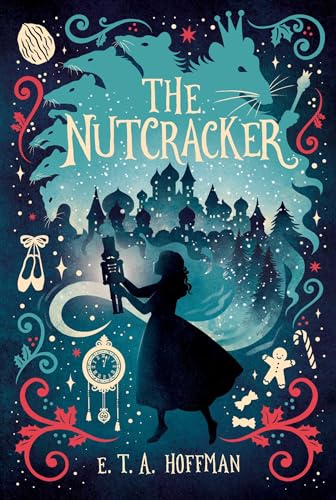
The Nutcracker Ballet Suite, composed in 1892 by Pyotr Ilyich Tchaikovsky, has become an indispensable part of Christmas celebrations all over the world. Many people who would be skeptical about attending an actual live performance by a ballet company nonetheless look forward to firing up their download or CD of Tchaikovsky’s evocative music and savoring its ties to the holiday season. And therefore it was a particular pleasure for me to turn, this Christmas season, to the story that inspired Tchaikovsky’s immortal music – E.T.A. Hoffmann’s 1816 story Nussknacker und Mausekönig (The Nutcracker and the Mouse King), here published in a book volume that is titled simply The Nutcracker.
Hoffmann, who hailed from Königsberg in the old Kingdom of Prussia, was one of the leading authors of the German Romantic movement. He, and other German Romantic authors were strongly identified with literary Gothicism. Indeed, no less a Gothicist than Edgar Allan Poe once faced critics' accusations that his stories were mere recreations of German Gothicism, and wrote in response that “Terror is not of Germany but of the Soul.” One can agree with Poe’s ideas regarding the universal and archetypal qualities of the Gothic, while at the same time acknowledging that Hoffmann had a particular talent for weaving elements of the weird and the uncanny into what might otherwise have been a story of ordinary, quotidian life.
And those aspects of Hoffmann’s work certainly make their way into The Nutcracker. The story begins on Christmas Eve, in the comfortable home of Dr. Stahlbaum, where the Stahlbaum children, Fritz and Marie, await the arrival of their godfather. Their Yuletide excitement is accentuated by their knowledge that Godpapa Drosselmeier, a talented inventor, invariably brings them hand-crafted gifts that demonstrate his creativity.
Marie’s present is “a most delicious little man” – green-eyed, with a little beard of white cotton – who strikes Marie as having “a sweet nature and disposition” along with a bold and soldierly bearing: “[T]he elegance of his costume…showed him to be a person of taste and cultivation. He had on a very pretty violet hussar’s jacket, knobs and braid all over, pantaloons of the same, and the loveliest little boots ever seen on a hussar officer – fitting his little legs just as if they had been painted on them” (p. 8).
He is the Nutcracker; and when Fritz inconsiderately breaks the Nutcracker’s jaw and teeth by having the Nutcracker crack overly large nuts, Marie becomes his protector: “Marie got Nutcracker’s lost teeth together, bound a pretty white ribbon, taken from her dress, about his poor chin, and then wrapped the poor little fellow, who was looking very pale and frightened, more tenderly and carefully than before in her handkerchief. Thus she held him, rocking him like a child in her arms, as she looked at the picture books” (p. 10). As the story goes on, the Nutcracker will protect Marie in turn.
For that night, Marie’s room is invaded by an army of mice; and their leader, the Mouse King, is a giant, seven-headed mouse, with each of his seven heads adorned with a royal crown! Here, in the midst of what is ostensibly a children’s story, the reader sees Hoffmann’s particular talent for adding a particular touch of horror. As with the Lernaean Hydra, the multi-headed serpent from Greek mythology, so the Mouse King, with his seven crowned heads, seems to represent a set of non-human intelligences joined together for one malign purpose. Fortunately, the Nutcracker at once comes to life, calling out to the rest of Marie’s toys: “Ye, my trusty vassals, brethren and friends, are ye ready to stand by me in this great battle?” (p. 17)
Battle is joined at once, but Nutcracker and his side seem in danger of being overcome; in a fun allusion to William Shakespeare’s play Richard III, the Nutcracker actually cries out at one point, “A horse! A horse! My kingdom for a horse!” Marie cries out in alarm, throws her own shoe at the Mouse King, feels “a stinging pain in her left arm” (p. 23), and…
…awakens in her little bed to find that the family doctor has been treating her for a cut that Marie received when she broke a pane of the glass cupboard with her elbow! The battle between the toys and the mice was (evidently) a dream. Godpapa Drosselmeier is among the relatives who have come to check on the progress of Marie’s recovery, and among his gifts for Marie is “Nutcracker! – whose teeth he had put in again quite firmly, and set his broken jaw completely to rights” (p. 27).
In order to amuse Marie during her recovery, Godpapa Drosselmeier tells the children “The Story of the Hard Nut,” a sort of origin story for the Nutcracker. Once again, mice are the villains in this tale of a long-ago royal family whose princess daughter, Pirlipat, was cursed by Dame Mouserink, and immediately turned from her formerly beautiful appearance into a creature with “An enormous bloated head…at the top of a diminutive, crumpled-up body, and green, wooden-looking eyes” (p. 35). It is the kind of bizarre metamorphosis that is characteristic of this thoroughly Gothic story, as the lines between the organic and the mechanical, between human and toy, are regularly crossed and recrossed.
Drosselmeier is himself a character in the story – a clockmaker of Nuremberg, who is charged by the king with restoring Princess Pirlipat’s beautiful appearance, on pain of death. He learns from the Court Astronomer that the princess can only be restored by someone who can crack the uncrackable nut Crackatook to extract the nut’s sweet meat.
After a long search, it turns out that the hero who can accomplish this quest may be Drosselmeier’s young cousin – “a nice-looking, well-grown young fellow who “stood in his father’s shop exceedingly lovely to behold, and from his native galanterie…occupied himself in cracking nuts for the young ladies, who called him ‘the handsome nutcracker’” (p. 40).
The king has promised Pirlipat’s hand to the man who can crack the nut Crackatook and restore the princess’s beauty. Young Drosselmeier, whom the princess already loves, “received the nut from the hands of the Clerk of the Closet, put it between his teeth, made a strong effort with his head, and – crack – crack – the shell was shattered into a number of pieces” (p. 42).
The princess’s beauty is at once restored, but just then Dame Mouserink reappears and invokes one final curse, this time against young Drosselmeier: “Oh, misery! – all in an instant he was transmogrified, just as the princess had been before: his body all shrivelled up, and could scarcely support the great shapeless head with enormous projecting eyes and the wide gaping mouth. In the place where his pigtail used to be, a scanty wooden cloak hung down, controlling the movements of his nether jaw.” In short, a young and human nut-cracker has become a toy Nutcracker.
With the end of Godpapa Drosselmeier’s “Story of the Hard Nut,” Marie reflects upon her new awareness “that her Nutcracker was none other than young Mr. Drosselmeier, of Nuremberg, Godpapa Drosselmeier’s delightful nephew, unfortunately under the spells of Dame Mouserink” (p. 45).
In the back-and-forth between dream-life and waking life that characterizes the remainder of the story, the mice renew their aggressions against Marie’s candy and toys, until the Nutcracker returns to life and asks Marie for a sword. Her brother Fritz sportingly offers the sword of one of his toy soldiers, and soon the Nutcracker is able to furnish Marie with good news: “The treacherous King of the Mice lies vanquished and writhing in his gore!” (p. 53)
At this point, the Nutcracker celebrates the victory over the Mice by taking Marie into the mystical realm of Toyland, where toys frolic and play in a landscape made up entirely of candy and sweets. These passages of The Nutcracker, with different groups and peoples among the the toys offering introductions and presenting themselves to Marie, no doubt inspired those “Land of Sweets” passages from Tchaikovsky’s ballet in which personified candies from Russia, Denmark, Spain, Arabia, and China appear and dance before the protagonist.
In the royal court at Marzipan Castle, Marie is introduced by the Nutcracker as “the daughter of a most worthy medical man and the preserver of my life”, and Marie is welcomed by the ladies of the court as the “noble preserver of our beloved royal brother!” (p. 65)
Another of the story’s unsettling shifts back and forth between “dream” and reality and “dream” takes place, at the end of which Marie finds the restored young Drosselmeier, a handsome prince once again, proposing to her: “Ah! Most exquisite lady! Bless me with your precious hand; share with me my crown and kingdom, and reign with me in Marzipan Castle, for there I am now king” (p. 70). And on that note The Nutcracker concludes, with an ambiguous “happy ending.”
Fans of Tchaikovsky’s Nutcracker ballet will no doubt enjoy reading the original German story that provided the genesis for this beloved musical tradition of Christmastime – and they may find themselves appreciating the manner in which the great Russian composer “cleaned up” some of the more openly bizarre and Gothic elements of Hoffmann’s original tale.



![Profile Image for [ J o ].](/_next/image?url=https%3A%2F%2Fi.gr-assets.com%2Fimages%2FS%2Fcompressed.photo.goodreads.com%2Fusers%2F1673171874i%2F4639825._UY200_CR4%2C0%2C200%2C200_.jpg&w=128&q=75)


