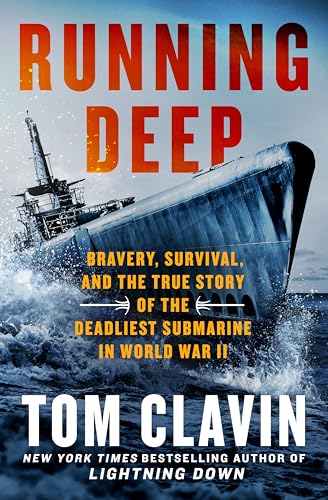
By Bill Marsano. Tom Clavin’s superb book brings vividly to life a forgotten side of World War II—the Pacific war. While Dec. 7, 1941 awakened Americans to the hitherto unsuspected existence of Pearl Harbor, it was the Atlantic theater that gripped them, and with good reason. Europe was close and familiar; our East Coast was thick with European immigrants and their descendants; and U-boats were sinking ships before the very eyes of sun-bathers on Florida’s beaches. Front-page news? It was front-porch news.
Moreover, it was powerfully dramatic and vividly photogenic—Dunkirk, the Battle of Britain and the Blitz! Goose-stepping Nazis and menacing Messerschmitts, howling Stukas and growling Panzers! Hollywood has never gotten over it.
The Pacific war? It sprawled across an ocean too vast and was fought on unheard-of islands with unpronounceable names; all of them far-flung and barren or featureless or choked with fetid jungle. It was war in the middle of nowhere and our foe was no Nordic superman but a cartoon, a runty, yellow-skinned tribe of bespectacled, buck-toothed half-savages (and as racist as we were).
Worse, that mighty ocean had no grand-opera sea battles--no Jutland-style Armageddons, with rows of battleships lined up and slugging it out broad-side to broadside. Instead it was a new, camera-starving war, UNphotogenic and fought largely by aircraft carriers that never saw each other and submarines that were at their best when neither seen nor heard.
The Navy’s carriers were stars. Such battles as the Coral Sea, Midway, and the Marianas Turkey Shoot made headlines then and have been studied ever since. Submarines were assassins. Operating alone or in U-boat-style wolfpacks, they were known, if at all, as “the Silent Service.” Their attacks were usually hit-and-run, as they had virtually no defensive armament. Their best chance was to dive fast and deep, and remain as silent as possible as bombs and depth charges rained down from above. Just one could sink a sub, usually with all hands. That’s one reason the submarine service was 100% volunteer. It’s also why submariners suffered the highest casual-ty rate of the U.S. military.
Moreover, their primary target was decidedly unglamorous: drab, workaday cargo ships. But Japan was critically dependent on imports, not only of oil, rubber and strategic metals but even rice. This was a war of logistics. Despite being hampered by unreliable torpedoes (the failure rate was 50%), American submarines steadily ground down Japan’s merchant marine, eventually sinking more that 50% of it. Tankers, loaded with the oil Japan went to war for, were favorite targets; the resulting shortage seriously hobbled the imperial navy. The army lacked transports to supply island garrisons, and some nearly starved. By war’s end, Japan herself faced famine.
And, as if for lagniappe, US submarines accounted for one-third of the Imperial Navy ships sunk, rescued downed fliers, reported fleet movements, transported commandos and ran supplies to Philippine guerrillas—all without fanfare.
In his tight, tense narrative, author Clavin focuses on the scarcely credible exploits of the Navy’s deadliest submarine, USS Tang. Skippered by Commander Richard O'Kane, Tang sank 33 enemy ships, more than 116,000 tons of critically important fuel, food and military supplies, in her tragically short combat life of a mere nine months. O’Kane was daring but not reckless, disciplined but not doctrinaire, and deeply concerned for his crew. He was awarded the Medal of Honor in large part for his heroism toward the end of the war, during a post-combat episode that is too surprising and moving to reveal here. —Bill Marsano is a long-time naval buff specializing in the Pacific war.